


Community hub
Recent from talks
Contribute something
Nothing was collected or created yet.
Linksys WRT54G series
View on Wikipedia
The Linksys WRT54G Wi-Fi series is a series of Wi-Fi–capable residential gateways marketed by Linksys, a subsidiary of Cisco, from 2003 until acquired by Belkin in 2013. A residential gateway connects a local area network (such as a home network) to a wide area network (such as the Internet).
Models in this series use one of various 32-bit MIPS processors.[1] All WRT54G models support Fast Ethernet for wired data links, and 802.11b/g for wireless data links.
Hardware and revisions
[edit]WRT54G
[edit]-
 WRT54G version 2.0 with upgraded antennas

The original WRT54G was first released in December 2002. It has a 4+1 port network switch (the Internet/WAN port is part of the same internal network switch, but on a different VLAN). The devices have two removable antennas connected through Reverse Polarity TNC connectors. The WRT54GC router is an exception and has an internal antenna with optional external antenna.
As a cost-cutting measure, as well as to satisfy FCC rules that prohibit fitting external antennas with higher gain, the design of the latest version of the WRT54G no longer has detachable antennas or TNC connectors. Instead, version 8 routers simply route thin wires into antenna 'shells' eliminating the connector. As a result, Linksys HGA7T and similar external antennas are no longer compatible with this model.
Until version 5,[2] WRT54G shipped with Linux-based firmware.
| Version | CPU | RAM | Flash memory | S/N Prefix[3] | Power | Notes |
|---|---|---|---|---|---|---|
| 1.0 | Broadcom BCM4702 @ 125 MHz | 16 MB | 4 MB | CDF0 CDF1 |
5 V 2 A positive tip |
20 front panel LEDs (including link/activity, collision detection and speed rating indicators for each Fast Ethernet port). Wireless capability was provided by a Mini PCI card attached to the router motherboard |
| 1.1 | Broadcom BCM4710 @ 125 MHz | 16 MB | 4 MB | CDF2 CDF3 |
12 V 1 A positive tip |
Front panel LEDs reduced to eight (one link/activity LED per port, plus one each for power, wireless, DMZ and WAN/Internet connectivity). Wireless chipset is integrated onto motherboard.
Note: some of the routers have BCM4702 CPU[4] |
| 2.0 | Broadcom BCM4712 @ 200 MHz | 16 MB | 4 MB | CDF5 | Same as 1.1 with a CPU upgrade and greater wireless transmitter integration (fewer transmitter parts). Some of these have 32 MB of RAM but are locked to 16 MB in the firmware (can be unlocked to use all RAM — see [5] (general info) and [6] (for an XB card) and [7] (for an XH card)). | |
| 2.1 | Broadcom BCM4712 @ 216 MHz | 16 MB | 4 MB | CDF6 | Same physical appearance as 1.1 and 2.0 models. Some of these models have 32 MB of RAM installed but have been locked to 16 MB by the manufacturer. Some models have two 16 MB MIRA P2V28S40BTP memory chips. | |
| 2.2 | Broadcom BCM4712 @ 216 MHz | 16 MB | 4 MB | CDF7 | Same physical appearance as 1.1 and 2.0 models. Switching chipsets from ADMtek 6996L to Broadcom BCM5325EKQM. Some of these models have 32 MB of RAM installed but have been locked to 16 MB by the manufacturer. Some models have 16 MB Hynix HY5DU281622ET-J memory chips. | |
| 3.0 | Broadcom BCM4712 @ 216 MHz | 16 MB | 4 MB | CDF8 | Identical to 1.1 and later models, except for the CPU speed and an undocumented switch behind left front panel intended for use with a feature called "SecureEasySetup". | |
| 3.1 | Broadcom BCM4712 @ 216 MHz | 16 MB | 4 MB | CDF9 | The Version 3.1 hardware is essentially the same as the Version 3.0 hardware. Adds "SecureEasySetup" button. | |
| 4.0 | Broadcom BCM5352 @ 200 MHz | 16 MB | 4 MB | CDFA | Switched to new SoC | |
| 5.0 | Broadcom BCM5352 @ 200 MHz | 8 MB | 2 MB | CDFB | 12 V 0.5 A positive tip |
Switched to VxWorks OS and reduced flash memory and RAM; not compatible with most third-party firmware, although the "VxWorks killer" utility allows some third-party open source firmware to be loaded. Since less physical RAM is available in this and future models, the third-party firmware (popular open source projects) were modified into special "micro" versions. |
| 5.1 | Broadcom BCM5352 @ 200 MHz | 8 MB | 2 MB | CDFC | ||
| 5.2 | Broadcom BCM5352 @ 200 MHz | 8 MB | 2 MB | CDFB | ||
| 6.0 | Broadcom BCM5352 @ 200 MHz | 8 MB | 2 MB | CDFD | Also based on VxWorks, will only run DD-WRT micro. VxWorks killer must be used prior to flashing, otherwise, it will refuse to flash. Due to low RAM, users may encounter issues when running P2P software. | |
| 7.0 | Atheros AR2317 @ 240 MHz | 8 MB | 2 MB | CDFE | Switched to Atheros SoC. This is the only version of the WRT54G that does not support third-party firmware at all. | |
| 7.2 | Broadcom BCM5354 @ 240 MHz | 8 MB | 2 MB | CDFK | Switched back to Broadcom based SoC; Samsung K4S641632K-UC75 (RAM); Samsung K801716UBC PI07 (flash). Micro versions of third-party firmware are supported again. | |
| 8.0 | Broadcom BCM5354 @ 240 MHz | 8 MB | 2 MB | CDFF CDFG |
Some units come with 16 MB of RAM. VxWorks killer works. Antennas cannot be removed. | |
| 8.1 | Broadcom BCM5354 @ 240 MHz | 8 MB | 2 MB | MDF0 | FCC ID: Q87-WRT54GV81. Operating system is Linux, no need for VxWorks killer.[8] Antennas cannot be removed. | |
| 8.2 | Broadcom BCM5354 @ 240 MHz | 8 MB | 2 MB | CDFJ | FCC ID: Q87-WRT54GV82. VxWorks killer does work, dd-wrt is supported, 2 MB of flash memory can be limiting.[9] Antennas cannot be removed. |
WRT54GS
[edit]-
 Linksys WRT54GS version 7.2
The WRT54GS is nearly identical to the WRT54G except for additional RAM, flash memory, and SpeedBooster software. Versions 1 to 3 of this router have 8 MB of flash memory. Since most third parties' firmware only use up to 4 MB flash, a JFFS2-based read/write filesystem can be created and used on the remaining 4 MB free flash. This allows for greater flexibility of configurations and scripting, enabling this small router to both load-balance multiple ADSL lines (multi-homed) or to be run as a hardware layer-2 load balancer (with appropriate third party firmware).[10]
| Version | CPU | RAM | Flash memory | S/N Prefix | Notes |
|---|---|---|---|---|---|
| 1.0 | Broadcom BCM4712 @ 200 MHz | 32 MB | 8 MB | CGN0 CGN1 |
ADMtek 6996L switch. Added SpeedBooster technology (Broadcom Afterburner technology), claims to boost the throughput of 802.11g by 30% (for maximum boost needs SpeedBooster technology on the other side, but will boost standard 802.11g as well). Has LEDs for Power, DMZ, WLAN, Internet, and 1–4 Ports. |
| 1.1 | Broadcom BCM4712 @ 200 MHz | 32 MB | 8 MB | CGN2 | Switched to Broadcom BCM4712 SoC and BCM5325E switch. |
| 2.0 | Broadcom BCM4712 @ 216 MHz | 32 MB | 8 MB | CGN3 | 10 LED Front Panel (two new ones behind Cisco logo button). Also capable of SecureEasySetup, but use of the logo button and lighting of the new LEDs behind it requires firmware upgrade. SoC chip REV1 or REV 2. The flash chip on this unit is Intel TE28F640. |
| 2.1 | Broadcom BCM4712 @ 216 MHz | 32 MB | 8 MB | CGN4 | Radio chip is changed from BCM2050 to BCM2050KML. |
| 3.0 | Broadcom BCM5352 @ 200 MHz | 32 MB | 8 MB | CGN5 | Switched to newer Broadcom SoC |
| 4.0 | Broadcom BCM5352 @ 200 MHz | 16 MB | 4 MB | CGN6 | Reduced RAM & Flash (a very rare few have 32 MB/8 MB) |
| 5.0 | Broadcom BCM5352 @ 200 MHz | 16 MB | 2 MB | CGN7 | Uses VxWorks OS and reduced Flash Memory; not compatible with most third-party firmware, although the "VxWorks killer" utility allows some third-party open source firmware to be loaded on this and future versions.[11] |
| 5.1 | Broadcom BCM5352 @ 200 MHz | 16 MB | 2 MB | CGN8 | |
| 6.0 | Broadcom BCM5352 @ 200 MHz | 16 MB | 2 MB | CGN9 | |
| 7.0 | Broadcom BCM5354 @ 240 MHz | 16 MB | 2 MB | CGNA CGNB CGNC |
Switched to newer Broadcom SoC. Newest[when?] VxWorks killer works. Antennas can be removed. CGNB and CGNC antennas can be removed. |
| 7.2 | Broadcom BCM5354 @ 240 MHz | 16 MB | 2 MB | CGNE | FCC ID: Q87-WRT54GSV72. Some antennas can be removed. Some refurbished ones have EN29LV160A 16 Mb (2 MiB)[12] Flash and IS42S16800A or K4S281632IUC75 128 Mb (16MiB) RAM |
WRT54GL
[edit]-
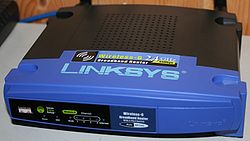 Linksys WRT54GL
Outside view, front -
 Linksys WRT54GL version 1.1
Circuit board and internals -
 Linksys WRT54GL version 1.1
Close-up of the circuit board


Linksys released the WRT54GL (the best-selling router of all time[13][14][15]) in 2005 to support third-party firmware based on Linux, after the original WRT54G line was switched from Linux to VxWorks, starting with version 5. The WRT54GL is technically a reissue of the version 4 WRT54G. Cisco was sued by the FSF for copyright infringement, but the case was settled.[16]
| Version | CPU | RAM | Flash memory | S/N Prefix | Power | Notes |
|---|---|---|---|---|---|---|
| 1.0 | Broadcom BCM5352 @ 200 MHz | 16 MB | 4 MB | CL7A | 12 V 1 A positive tip |
New model line, released after the version 5 WRT54G, which returns to a Linux-based OS as opposed to the VxWorks firmware. SpeedBooster is not enabled in stock firmware, however third-party firmware will enable the feature. The hardware is essentially the same as the WRT54G version 4.0. One alteration is that the internal numbering scheme of the 4-port switch changed in this model, from 1 2 3 4, to 3 2 1 0. |
| 1.1 | Broadcom BCM5352 @ 200 MHz | 16 MB | 4 MB | CL7B CL7C CF7C | Detachable antennas. As of August 2009, this version was shipping with firmware revision 4.30.11. This pre-loaded firmware allows the user to upload a 4 MB firmware image, whereas the pre-loaded firmware on version 1.0 limited the image to 3 MB. Firmware version 4.30.18 is now available for both hardware versions. Fully supported by Tomato, OpenWrt, and DD-WRT. |
WRTSL54GS
[edit]WRTSL54GS is similar to the WRT54GS while adding additional firmware features and a USB 2.0 port (referred to as StorageLink) which can be used for a USB hard disk or flash drive.[17]
Unlike other models, the WRTSL54GS has only a single 1.5 dBi antenna, and it is not removable.
| Version | CPU speed | RAM | Flash memory | S/N Prefix | Notes |
|---|---|---|---|---|---|
| 1.0 | Broadcom BCM4704 @ 264 MHz | 32 MB | 8 MB | CJK0 | Released after the WRT54GS and WRT54GL. Uses Linux-based OS. Includes SpeedBooster support, additional firmware features, and an external USB 2.0 port (StorageLink) for network storage. Uses 8 MB of Intel TE28F640 flash with a Broadcom BCM4704 SoC and ADMtek Ethernet switch. |
| 1.1 | Broadcom BCM4704 @ 264 MHz | 32 MB | 8 MB | CJK11 | Change from SoC rev 8 to rev 9 (unconfirmed) |
WRT54GX
[edit]-
 Linksys WRT54GX version 2

WRT54GX comes with SRX (Speed and Range eXpansion), which uses "True MIMO" technology. It has three antennas and was once marketed as a "Pre-N" router, with eight times the speed and three times the range over standard 802.11g routers.[citation needed]
| Version | CPU speed | RAM | Flash memory | S/N Prefix | Notes |
|---|---|---|---|---|---|
| 1.0 | Broadcom BCM4704 @ 266 MHz[18] | 16 MB | 4 MB | KBG5? | Wireless-G Broadband Router with SRX. |
| 2.0 | Realtek RTL8651B @ 200 MHz | 32 MB | 8 MB | KIO1? | Wireless-G Broadband Router with SRX. |
WRT54GP2 and WRTP54G
[edit]WRT54GP2 has 1 or 2 antennas, and a built-in analog telephony adapter (ATA) with 2 phone lines, but only 3 network ports. "Vonage" WRTP54G has 1 antenna, 2 phone lines, 4 network ports — Same S/N Prefix
| Version | Locked to | RAM | Flash memory | S/N Prefix | Notes |
|---|---|---|---|---|---|
| EA | Engin | 32 MB | 8 MB | CJJ0
CGZ0 on WRT54GP2 |
Wireless-G Broadband Router with 2 Phone Ports. Uses the Sipura Chipset |
WRT54GX2
[edit]WRT54GX2 has 2 antennas, and was advertised to have up to 6 times the speed and 2 times the range over standard 802.11g routers. Chipset Realtek. It is not compatible with DD-WRT.[19]
WRT54GX4
[edit]WRT54GX4 has 3 moveable antennas, and is advertised to have 10 times the speed and 3 times the range of standard 802.11g routers. WRT54GX4-EU: chipset Realtek RTL8651B, radio chipset Airgo AGN303BB, flash S29GL064M90TFIR4. It does not appear to be compatible with DD-WRT.[19]
WRT51AB
[edit]WRT series with 802.11a support. (First Generation)
| Version | CPU speed | RAM | Flash memory | S/N Prefix | Notes |
|---|---|---|---|---|---|
| 1.0 | Broadcom BCM4702 @ 125 MHz | 32 MB | 4 MB | MCH0 | 2 mini-PCI Slots one A one B, Switch
BCM5325A |
WRT55AG
[edit]WRT54G series with 802.11a support.
| Version | CPU speed | RAM | Flash memory | S/N Prefix | Notes |
|---|---|---|---|---|---|
| 1.0 | Broadcom BCM4710 @ 125 MHz | 32 MB | 4 MB | MDJ0 | 2 mini-PCI Slots |
| 2.0 | Atheros AR5001AP @ 200 MHz | 16 MB | 4 MB | MDJ1 |
WTR54GS
[edit]The Linksys WTR54GS is a confusingly named derivative of the WRT54G.[20] It is a compact wireless travel router with SpeedBooster support that has only one LAN and one WAN Fast Ethernet interfaces, but has two wireless interfaces. The WTR54GS has the ability to make an unencrypted wireless connection on one interface, and make open shared connections on the other wireless interface, or the LAN port.
| Version | CPU | RAM | Flash memory | S/N Prefix | JTAG port | third-party firmware support | Notes |
|---|---|---|---|---|---|---|---|
| 1.0 | Broadcom BCM5350 @ 200 MHz | 16 MB (IC42S32400) | 4 MB (29LV320ABTC) | SJH0 | yes | DD-WRT v24 sp2 (mini or std) | |
| 2.0 | Broadcom BCM5350 @ 200 MHz | 8 MB | 2 MB | SJH1 | no* | DD-WRT v24 sp2 (micro only) | *Some examples reportedly have a JTAG port, but most do not. |
| 2.1 | Broadcom BCM5350 @ 200 MHz | 8 MB | 2 MB | SJH2 | no | DD-WRT v24 sp2 (micro only) |
WRT54G2
[edit]-
 Cisco/Linksys WRT54G2 V1

The WRT54G2 is an iteration of the WRT54G in a smaller, curved black case with internal antenna(s). This unit includes a four port 10/100 switch and one WAN port.
| Version[21] | CPU | RAM | Flash memory | S/N Prefix[3] | Notes |
|---|---|---|---|---|---|
| 1.0 | Broadcom BCM5354 @ 240 MHz | 16 MB | 2 MB | CSV | Two non-replaceable internal antennas.
3rd-party firmware: Fully compatible with DD-WRT (micro, micro-plus,[22][23] and micro-plus with SSH [24] editions). Not compatible with Tomato[25] and other third-party firmware solutions at this time. Firmware: VxWorks FCC ID: Q87-WRT54G2V1 |
| 1.1 | Atheros AR2317 @ 180 MHz | 16 MB | 4 MB | CSV | Two non-replaceable internal antennas.
FCC ID: Q87-WRT54G2V11 3rd-party firmware: Supported by DD-WRT. |
| 1.3 | Broadcom BCM5354 @ 240 MHz | 8 MB | 2 MB | CSV | Hardware: Reduced system memory to 8 MB.[26]
3rd-party firmware: Supported by DD-WRT. Firmware: VxWorks 5.5 FCC ID: Q87-WRT54G2V13 |
| 1.5 | Atheros AR7240 @ 400 MHz | 16 MB (W9412G6IH) | 2 MB | CSV | Hardware: Reduced to one internal antenna; switched from Broadcom to Atheros chipset (AR7240-AH1E + AR9285-AL1E http://www.atheros.com/pt/bulletins/AR9002AP-1SBulletin.pdf)
3rd-party firmware: Not possible with DD-WRT. FCC ID: Q87-WRT54G2V15 |
* Note: 1.5 of the WRT54G2 is NOT supported by dd-wrt. This is because it uses Atheros components (i.e. the Atheros SoC) which require more than the 2 MB of Flash Memory built-in for a dd-wrt solution.
WRT54GS2
[edit]The WRT54GS2 is the WRT54G2 hardware with the VxWorks 5.5 Firmware including SpeedBooster. It has a sleek black design with 2 internal antennas. It includes a 4-port 10/100 switch and one 10/100 WAN port on the rear.
| Version | CPU speed | RAM | Flash memory | S/N Prefix | Notes |
|---|---|---|---|---|---|
| 1.0 | Broadcom BCM5354 @ 240 MHz | 8 MB | 2 MB | CUQ | 3rd-party firmware: Fully compatible with DD-WRT (micro)*.[27]
FCC ID:Q87-WRT54G2V1 |
WRT54GC
[edit]-
 LinkSys WRT54GC V2.0 Compact Wireless-G Broadband Router.

WRT54GC series with 802.11b/g support. This unit has a four port 10/100 switch and one WAN port. The "C" in the router number stands for compact, as the unit measures 4" by 4" by 1" with an internal antenna. The unit can be expanded with addition of HGA7S external antenna to boost range. Hardware Version 1.0 is the only option available in the United States since introduction in 2005.
Version 2.0 is shipping in, amongst other countries, the United Kingdom. This unit has 1 MB flash, 4 MB RAM and a non-detachable external antenna.
The internal hardware is based on a Marvell ARM914 ("Libertas") reference design which is probably identical to the SerComm IP806SM, Xterasys XR-2407G, Abocom ARM914, Hawking HWGR54 Revision M, and the Airlink 101 AR315W. By appropriately changing the value of the firmware byte 0x26, the WRT54GC can be cross-flashed with firmware based on the same reference platform.[28]
There were reports in 2006 that a sister platform of the WRT54GC (the AR315W) was hacked to run Linux.[29]
WRT54G3G/WRT54G3GV2 Mobile Broadband router
[edit]The WRT54G3G/WRT54G3GV2 Mobile Broadband routers are variants that have four Fast Ethernet ports, one Internet wired port (For DSL/Cable connections), plus a PCMCIA slot for use with a Cellular Based PC Card "aircard". The V2 model has two additional USB ports for 3G modem use and one other USB port, which has yet to be put to use.
| Model | Description | Alternative Firmware |
|---|---|---|
| WRT54G3G | A Vodafone branded unit that comes with programmed settings for the Vodafone network supporting GPRS, UMTS and HSDPA. It can only accept the 3G PCMCIA cards and ExpressCards sold by Vodafone. It has no USB port to accept 3G USB dongles. The router can be used in other networks if the 3G cards are unlocked, because it is not the router, but the 3G cards that are locked to Vodafone. To use it in other networks it is necessary to change the settings of the APN, user and password manually to those of the new network. It can also be unlocked by flashing EM/EU version firmware. With the latest firmware upgrade it supports full HSDPA up to 7.2 Mbit/s. Some of 3G cards that it supports, like the Huawei E800/E870 and the Option GT Fusion, have external antenna port to improve the reception of the 3G signals. It also works with the PCMCIA Globetrotter card. | Fully Supported by OpenWRT |
| WRT54G3G-ST | A Sprint Wireless (USA) unit that supports CDMA 1X and EVDO rev. 0,A wireless Internet. | Fully Supported by OpenWRT |
| WRT54G3G-AT | AT&T (USA) version of the router that supports GPRS and HSDPA(UMTS Maybe?) | Fully Supported by OpenWRT |
| WRT54G3G-EU | European Union version supporting GPRS, UMTS and HSDPA. | Fully Supported by OpenWRT |
| WRT54G3GV2-VF | A Vodafone branded unit that supports full HSDPA up to 7.2 Mbit/s and seems not to be locked to the Vodafone network (by setting APN, user and password manually), but does not work with all USB dongles (T-Mobile: Web'N-Walk-Stick III (Huawei 172) and IV (Huawei 176 – has external antenna port) are well supported, out of the box. Huawei E220 is also supported; firmware upgrade maybe needed). | Partial Supported by customization of Linksys GPL code and supported by OpenWRT.[30] NOTE: Due to changes in the CFE (bootloader) it is not fully supported yet. One should not try it without a serial console.[30] |
- Other cellular providers
To use this router with other cellular providers, one must use an alternative firmware. The stock firmware does not support cellular providers, even though one does have the exact supported aircard. For example, Telus Mobility (CANADA) uses the Sierra Wireless Aircard 595, which is supported by this router, but because it is from Telus Mobility and not from Sprint (USA), it will never load the card into the router to make it operational. This is only true for the Sprint and AT&T-branded models.
WRT54G-TM, WRTU54G-TM, and WRTU54GV2-TM
[edit]-
 Linksys WRT54G-TM
 -
 Linksys WRTU54G-TM


The WRT54G-TM (TM stands for T-Mobile) is also called the T-Mobile "Hotspot@Home" service. It allows calls to be made via T-Mobile's GSM network or via Wi-Fi Unlicensed Mobile Access (UMA), using the same telephone and phone number (a special dual-mode phone designed for the service is required e.g. BlackBerry Pearl 8120). Additionally, once a call is in progress, one may transition from Wi-Fi to GSM (and vice versa) seamlessly, as Wi-Fi signal comes and goes, such as when entering or exiting a home or business. A special router is not needed to use the service, but the T-Mobile branded routers are supposed to enhance the telephone's battery life. This is the only known tweak to the TM version of the firmware. The hardware appears similar to that of the WRT54GL, except it has 32 MB RAM and 8 MB flash memory.
The WRT54G-TM having a serial number that starts with C061 has these specifications:
- Broadcom BCM5352EKPBG CPU
- 32 MB RAM (Hynix HY5DU561622ETP-D43)
- 8 MB Flash (JS28f640)
- Uses the same BINs that the WRT54GS v3.0 does
| Model | CPU speed | RAM | Flash memory | S/N Prefix | Notes |
|---|---|---|---|---|---|
|
WRT54G-TM |
Broadcom BCM5352 @ 200 MHz | 32 MB | 8 MB | CO61 | T-Mobile Edition WRT54GS V3.0 (Renamed WRT54G-TM). It is possible to upgrade to third-party firmware via JTAG or by replacing the CFS and uploading a new firmware over TFTP. Instructions for the CFS/TFTP method can be found easily on the Internet,[31][32][33] and other third-party firmware can be easily applied afterwards.
The Tomato Firmware also works on the WRT54G-TM.[34] |
|
WRTU54G-TM |
Infineon ADM8668 @ 200 MHz [35] | 64 MB | 8 MB | QMF00H | T-Mobile Edition Model: WRTU54G-TM. This version has two RJ-11 telephone ports and two SIM card slots. The WRTU54G-TM is not supported by DD-WRT. It can be flashed, and work is being done to port OpenWRT to this board [36] |
|
WRTU54GV2-TM |
T-Mobile Edition Model: WRTU54GV2-TM. This version has two RJ-11 telephone ports and two SIM card slots it is black like the UTA-200-TM. However unlike the UTA-200-TM has four Fast Ethernet ports instead of a single pass-through Ethernet port. | ||||
| See also: UTA-200 |
WRT54G-RG
[edit]The WRT54G-RG (RG stands for Rogers) is also called the Rogers TalkSpot Voice-Optimized Router. It works with Rogers' Talkspot UMA service, which allows calls to be made via Rogers' cellular network or via Wi-Fi Unlicensed Mobile Access (UMA), using the same telephone and phone number. A UMA-compatible phone is required. The WRT54G-RG and the WRT54G-TM are identical in terms of hardware.
| Version | CPU speed | RAM | Flash memory | S/N Prefix | Notes |
|---|---|---|---|---|---|
| WRT54G-RG | Broadcom BCM5352 @ 200 MHz | 32 MB | 8 MB | CDF1 | FCC ID: Q87-WT54GV40. The WRT54G-RG is supported by DD-WRT.[37] |
WRT54GH
[edit]-
 Linksys WRT54GH

The WRT54GH comes with an internal antenna, a four-port network switch, and support for Wi-Fi 802.11b/g.[38]
Third-party firmware projects
[edit]After Linksys was obliged[39][40] to release source code of the WRT54G's firmware under terms of the GNU General Public License,[41] there have been many third party projects enhancing that code as well as some entirely new projects using the hardware in these devices. Three of the most widely used are DD-WRT, Tomato and OpenWrt.
Hardware versions and firmware compatibility
[edit]As of January 2006, most third-party firmware are no longer compatible with version 5 of both the WRT54G and the WRT54GS. The amount of flash memory in the version 5 devices has been reduced to 2 MB, too small for current Linux-based third-party firmware. (See table above for information on identifying the version based on the serial number printed on the bottom of the unit, and on the outside of the shrink-wrapped retail box.)
Some users have succeeded in flashing and running a stripped down but fully functional version of DD-WRT called 'micro' on a version 5 WRT54G.[42][43] An easier method not requiring any disassembly of the device has since been devised for flashing v5-v8 to DD-WRT.[44][45]
To support third-party firmware, Linksys has re-released the WRT54G v4, under the new model name WRT54GL (the 'L' in this name allegedly stands for 'Linux'). It is also possible to replace the 2 MB flash chip in the WRT54G with a 4 MB flash chip. The Macronix International 29LV320BTC-90 is a suitable part although others may work as well. The user must first install a JTAG header and use a JTAG cable to back up the firmware, then replace the chip and restore the firmware with the JTAG cable. After testing for proper functionality of the modified unit, third-party firmware can be flashed using the JTAG cable and a suitable image file.
With the Attitude Adjustment (12.09)[46] release of OpenWrt, all WRT54G hardware versions with 16 MB of RAM are no longer supported, and older Backfire (10.03)[47] is recommended instead. Issues came from dropping support for the legacy Broadcom target brcm-2.4, making lower end devices run out of memory easily. Support for Attitude Adjustment is limited to WRT54G hardware versions with 32 MB of RAM, which includes WRT54GS and (apart from performing RAM upgrades through hardware modifications) some of the WRT54G and WRT54GL versions having the capability for unlocking their additional 16 MB of RAM.[48][49][50][51][52][53]
See also
[edit]References
[edit]- ^ "Table of Hardware". OpenWrt.org. Retrieved 2018-06-11.
- ^ Ewing, James (Aug 1, 2004). "Linux on Linksys Wi-Fi Routers". Linux Journal. Retrieved January 23, 2012.
- ^ a b "Linksys WRT54G". Speed Guide. 2006-02-03. Retrieved 2007-04-27.
- ^ "WRT54G and 1.0/1.1/2.0 - Linksys | DSLReports Forums". Dslreports.com. Retrieved 2014-03-07.
- ^ "Linksys WRT54G, WRT54GL and WRT54GS - OpenWrt Wiki". Wiki.openwrt.org. Retrieved 2014-03-07.
- ^ "DD-WRT Forum :: View topic - WRT54G with WRT54GS rev XB hardware". Dd-wrt.com. Retrieved 2014-03-07.
- ^ "32Mb ram ENABLED on XH revision v2 (Page 1) — WhiteRussian — OpenWrt". Forum.openwrt.org. Retrieved 2014-03-07.
- ^ "Linksys WRT54G v8.1 – supported?".
- ^ "Linksys WRT54G v8.0 & v8.2". dd-wrt.com. Retrieved 2014-01-25.
- ^ "EzPlanet WRT Wireless Router and Load Balancer". ezplanet.net. Retrieved 2011-04-15.
- ^ "Flashing third-party linux firmwares on the WRT54G/GS v5, v6 without hardware modifications". bitsum.com. Retrieved 2008-03-12.
- ^ "EN29LV160A datasheet". alldatasheet.com. Retrieved 2010-05-26.
- ^ Farrell, Nick. "Belkin resurrects "best selling router of all time"". fudzilla.com. Retrieved 9 April 2018.
- ^ "Linksys WRT Revolutionizes Wireless Networking With Next Generation Router". Linksys. Retrieved 9 April 2018.
- ^ "Linksys WRT190ACS DD-WRT - The Blue Router Returns in Wireless-AC Form". flashrouters.com. 17 January 2014. Retrieved 9 April 2018.
- ^ "Cisco sued for Linksys GPL violation". LinuxDevices.com. December 12, 2008. Archived from the original on January 27, 2013.
- ^ "WRTSL54GS, Wireless-G Media Storage Link Router with SpeedBooster". Linksys. Retrieved 2007-04-27.
- ^ "WRT Routers — Your Source For WRT Routers". wrtrouters.com. Retrieved 2008-02-26.
- ^ a b "WRT54GX2 - DD-WRT Wiki". Dd-wrt.com. 2009-06-05. Retrieved 2014-03-07.
- ^ "Differences between WRT54G, WRT54GL, WRT54GS ??". community.linksys.com. 2008-06-15. Retrieved 2020-03-09.
- ^ "Supported Devices". DD-WRT Project. Retrieved 2009-11-12.
- ^ "Linksys WRT54G2 now supported". DD-WRT Project. 2008-10-30. Retrieved 2008-11-05.
- ^ "Linksys WRT54G2 Flashing Instructions". Greg Ledet. 2008-11-27.
- ^ "Micro-plus with SSH". DD-WRT Project. 2009-03-23. Retrieved 2009-11-12.
- ^ "Supported hardware devices". Tomato Project. 2009-06-26.
- ^ "Linksys WRT54G2 v1.3 support". DD-WRT Project. 2009-03-05. Retrieved 2009-06-26.
- ^ "Linksys WRT54GS2 DD-WRT". DD-WRT Forums. 2009-05-25. Retrieved 2009-06-05.
- ^ "Airlink+ AR315W — having some fun". DSL Reports. 2006-01-16. Retrieved 2008-01-20.
- ^ "Linux hacked onto $20 wireless 802.11b/g router". Linux Devices. 2006-08-11. Archived from the original on 2012-07-20. Retrieved 2007-04-27.
- ^ a b "Linksys WRT54G3GV2-VF [OpenWrt Wiki]". openwrt.org. 25 March 2010. Retrieved 2018-06-11.
- ^ "Linksys WRT54G-TM DD-WRT Flashing Instructions". Greg Ledet. 2009-12-09.
- ^ "How to flash the Linksys WRT54G-TM T-Mobile Edition". Luniz2k1. 2010-02-21.
- ^ "Flash Using a Mac by StevenJJ". StevenJJ. 2008-10-15.
- ^ "Tomato WRT54G-TM – supported?". soopahman. 2009-01-19.
- ^ "Infineon Technologies". infineon.com. Retrieved 9 April 2018.
- ^ "Project Status - geek projects". wiki.scottn.us. Retrieved 9 April 2018.
- ^ "How to flash the Linksys WRT54G-RG".
- ^ "Wireless-G Home Router with SpeedBurst" (PDF). Linksys. 2009-06-16. Retrieved 2015-06-07.
- ^ Linksys WRT54G and the GPL on lkml (7 Jun 2003)
- ^ Weiss, Aaron (8 November 2005). "The Open Source WRT54G Story". Archived from the original on 8 December 2005.
- ^ Linksys Releases GPLed Code for WRT54G on slashdot (July 2003)
- ^ "V5 possibilities". Berliner Quakeforen. 2006-03-31. Archived from the original on 2007-04-10. Retrieved 2007-04-27.
- ^ "Flash your WRT54G or WRT54GS v5 series (v5, v5.1, v6)". DD-WRT. 2006-04-04. Retrieved 2007-04-27.
- ^ "WRT54G5 CFE". Bitsum Technologies. 2007-02-13. Retrieved 2007-04-27.
- ^ "How To Flash the WRT54G v8 / WRT54GS v7". dd-wrt.com. 2007-09-13. Archived from the original on 2007-12-13. Retrieved 2007-10-24.
- ^ "Attitude Adjustment (12.09 final) (Page 1) — News — OpenWrt". Forum.openwrt.org. Archived from the original on 2013-08-08. Retrieved 2014-03-07.
- ^ "OpenWrt Version History - OpenWrt Wiki". 6 November 2014. Retrieved 2018-06-11.
- ^ "Release Notes for Attitude Adjustment (12.09 final)". openwrt.org. 2013-04-25. Archived from the original on 2013-08-08. Retrieved 2013-09-26.
- ^ "OpenWrt: Table of Hardware". openwrt.org. Retrieved 2018-06-11.
- ^ "OpenWrt Forum: Linksys wrt54gl". openwrt.org. 2012-09-26. Retrieved 2013-09-26.
- ^ "OpenWrt: Linksys WRT54G, WRT54GL and WRT54GS". openwrt.org. 4 May 2010. Retrieved 2018-06-11.
- ^ "DD-WRT Forum: Linksys wrt54g 32MB hack". dd-wrt.com. Retrieved 2013-09-26.
- ^ "OpenWrt Forum: Upgrade WRT54G from 16MB to 32MB (or more)?". openwrt.org. Retrieved 2013-09-26.
Further reading
[edit]- Paul, Asadoorian (2007). Linksys WRT54G Ultimate Hacking. Syngress. ISBN 978-1597-4916-62.
External links
[edit]
- Linksys website
- GPL Code Center at Linksys
(non-Android) Linux-powered devices | ||||||||||||||
|---|---|---|---|---|---|---|---|---|---|---|---|---|---|---|
| Computers, components |
|  | ||||||||||||
| Accessories |
| |||||||||||||
| Discontinued | ||||||||||||||
✝ Excluding Android devices. | ||||||||||||||
Linksys WRT54G series
View on GrokipediaThe Linksys WRT54G series comprises a lineup of wireless broadband routers introduced by Linksys in December 2002, supporting the IEEE 802.11g standard for wireless data rates up to 54 Mbit/s alongside an integrated four-port Ethernet switch.[1][2]
These devices gained prominence for their initial use of Linux-based firmware, which, due to the GNU General Public License requirements, enabled reverse engineering and the development of custom open-source alternatives like DD-WRT and Sveasoft, sparking a hacker community that extended hardware capabilities through overclocking, advanced routing features, and improved security.[3][4][5]
The series achieved substantial commercial success, with variants such as the WRT54GL—released in 2005 to preserve Linux compatibility after later models shifted to VxWorks—continuing to generate millions in annual revenue over a decade later and cumulatively selling tens of millions of units, underscoring its enduring appeal among both consumers seeking reliable basic networking and enthusiasts customizing for specialized applications.[1][6]
History and Development
Initial Launch (2002–2003)
The Linksys WRT54G series debuted with the original model's launch in December 2002, coinciding with the Comdex trade show where it was first showcased. Developed as a residential broadband router, it supported the emerging 802.11g wireless standard—still in draft form at the time—delivering theoretical speeds up to 54 Mbps while maintaining backward compatibility with slower 802.11b devices.[7][8] This positioned the WRT54G as an accessible entry point for home users transitioning from wired Ethernet to wireless local area networks, primarily to simplify connectivity for multiple devices sharing DSL or cable modem internet access.[1] Equipped with a Broadcom BCM4702 system-on-chip processor running at 200 MHz, 16 MB of RAM, and 4 MB of flash memory, the router included four 10/100 Mbps Ethernet LAN ports and a WAN port for modem attachment, along with basic NAT and firewall features for secure broadband sharing.[9] Its hardware reflected Linksys' focus on cost-effective performance tailored to non-technical consumers, who increasingly sought untethered networking amid rising broadband penetration in households during the early 2000s.[4] The shift toward wireless solutions stemmed from practical demands for cabling-free setups in homes, where Ethernet's physical constraints hindered device mobility and expansion, rather than any imposed external policies.[1] Market reception was swift, with the WRT54G achieving substantial adoption due to its competitive pricing around $50–$60 and plug-and-play integration with prevalent broadband services.[10] Contemporary accounts describe it as a pivotal product that propelled Linksys' growth, contributing to the company's market share expansion from 34% in 2001 to 49% by 2003 amid surging demand for affordable wireless gateways.[11] This success underscored consumer preference for devices enabling seamless internet distribution without complex configurations, marking a key milestone in democratizing home wireless networking prior to Cisco's 2003 acquisition of Linksys.[1]Cisco Acquisition and GPL Compliance (2003–2005)
In March 2003, Cisco Systems announced an agreement to acquire the privately held Linksys Group for approximately $500 million in stock, aiming to expand its presence in the consumer networking market with products like the WRT54G wireless router, which Linksys had launched in late 2002.[12] [13] The acquisition closed on June 2, 2003, integrating Linksys's home and small-office hardware into Cisco's predominantly enterprise-oriented portfolio, though the transition overlooked detailed scrutiny of embedded software licenses in devices such as the WRT54G.[14] The WRT54G's firmware incorporated the Linux kernel alongside other components licensed under the GNU General Public License version 2 (GPLv2), which mandates that recipients of binary distributions receive corresponding source code upon request.[15] [16] Prior to the acquisition, Linksys had distributed firmware binaries without proactively providing sources, but post-merger hobbyist reverse-engineering in mid-2003 revealed the GPL-covered elements through analysis of firmware strings and binaries.[16] Community developers, including early groups like Sveasoft, formally requested the source code, invoking GPL obligations; Linksys complied by releasing an initial tarball in July 2003, though it was partial and lacked full build instructions or certain proprietary modules.[17] [18] This release stemmed from legal requirements rather than strategic intent, as Linksys and Cisco had not anticipated the firmware's open-source dependencies during the rushed merger integration, where operational continuity took precedence over comprehensive license audits.[3] [19] By early 2004, ongoing community and advocacy pressure, including from coalitions tracking GPL enforcement, prompted Linksys to issue more complete source distributions for WRT54G firmware versions, addressing deficiencies like missing kernel modules and improving compliance with GPLv2 terms.[16] [4] These developments inadvertently granted external developers access to modifiable code, enabling modifications despite the companies' focus on closed proprietary systems, and highlighted gaps in due diligence for open-source components in acquired consumer hardware.[11]Response to Community Backlash and Model Adjustments
Following the transition to version 5 hardware in mid-2005, which featured reduced memory (2 MB flash and 8 MB RAM compared to the original 4 MB flash and 16 MB RAM) and a switch from Linux to the proprietary VxWorks operating system, Linksys faced significant criticism from the modding community for limiting third-party firmware compatibility.[20][21] These changes, intended to reduce costs and mitigate risks from user modifications that could void warranties, were widely described in user forums as "neutering" the device, rendering it less capable for custom firmware like those from the emerging open-source projects DD-WRT and OpenWrt.[22][23] Community backlash manifested in widespread forum discussions and hacker efforts to reverse-engineer VxWorks-based units, including attempts to port Linux back to v5 models despite the hardware constraints.[24][25] Users protested the shift as anti-consumer, arguing it prioritized corporate control over hardware openness that had fueled the WRT54G's popularity since its 2002 launch.[21] In response, Linksys introduced the WRT54GL variant in September 2005, retaining the original Linux-based architecture and full memory specifications to explicitly accommodate third-party firmware enthusiasts.[26][6] This adjustment addressed the core grievances by preserving moddability, though it highlighted underlying tensions: Linksys sought to limit liability from unauthorized changes while inadvertently sustaining demand through user-driven innovation.[26] The WRT54GL's design backfired on the cost-cutting strategy, as it achieved prolonged market viability; by 2016, the model alone generated millions in annual revenue for Linksys (then under Belkin ownership), with the broader WRT54G series exceeding 31 million units sold lifetime.[1] Sales persisted into the 2010s due to its appeal for custom applications, demonstrating how community pressure redirected corporate incentives toward a niche but profitable open-hardware compromise.[1][3]Technical Specifications
Processor, Memory, and Storage
The Linksys WRT54G series employed Broadcom BCM47xx system-on-chip (SoC) processors in its initial hardware revisions, integrating the central processing unit, memory controller, Ethernet MAC, and USB support where applicable. Early versions, such as v1 through v4, typically utilized the BCM4702 or BCM4712 SoCs clocked at 200 MHz, providing adequate processing power for basic routing, NAT, and wireless operations at the time of release.[27] Later models shifted to lower-cost alternatives, including MIPS-based processors in v5 and v6 at similar or reduced speeds, and even Atheros AR2317 in v7, reflecting cost optimizations that diminished overall performance headroom.[27] These SoC choices prioritized integrated networking functionality over raw CPU speed, enabling efficient packet processing but limiting advanced features without overclocking, which third-party firmware later exploited up to 250-300 MHz in supported revisions.[27] RAM configurations started at 16 MB SDRAM in v1 and v2 models, expanding to 32 MB in some v3 units before standardizing at 16 MB for v4, supporting multitasking like concurrent connections and basic QoS.[28] From v5 onward, RAM was halved to 8 MB, constraining firmware complexity and custom modifications that required additional buffers for VPN tunneling or extensive logging.[29] This reduction, paired with VxWorks OS in later versions, intentionally limited the device's appeal for open-source firmware by shrinking available memory for expanded codebases.[20] Flash storage in early revisions consisted of 4 MB NOR-type memory, allowing firmware sizes up to approximately 3 MB after accounting for bootloader and filesystem overhead, which facilitated the adoption of Linux-based third-party firmwares like OpenWRT precursors.[9] Subsequent versions adopted 2 MB parallel flash, often from Samsung, curtailing support for feature-rich custom images and enforcing reliance on vendor firmware.[30] These specs directly influenced storage for configuration data and overlays, with higher capacities in initial designs enabling persistent JFFS2 partitions for user modifications, whereas reduced allocations in v5+ prioritized cost over extensibility.[31]Wireless Capabilities and Standards
The Linksys WRT54G series routers implement the IEEE 802.11g wireless standard, delivering maximum theoretical throughput of 54 Mbps over the 2.4 GHz unlicensed band, with full backward compatibility to the 802.11b standard at 11 Mbps to support legacy devices.[32][33] This dual-standard operation ensures interoperability in mixed environments without requiring separate networks.[34] Certain variants, notably the WRT54GS, incorporate Linksys' proprietary SpeedBooster technology, which utilizes frame bursting and other optimizations to claim effective speeds up to 108 Mbps; however, empirical testing revealed average throughput gains of approximately 46%, such as 34 Mbps versus 23.2 Mbps in standard 802.11g setups under controlled conditions.[35] These enhancements remain confined to compatible client devices, limiting benefits in heterogeneous networks.[36] Early models employ two detachable external antennas connected via RP-TNC interfaces, facilitating aftermarket upgrades for extended coverage, whereas subsequent revisions shifted to fixed internal antennas, constraining range modifications and typically yielding indoor signal propagation of 100 to 150 feet under low-interference scenarios.[37] The reliance on the crowded 2.4 GHz spectrum introduces inherent limitations, including susceptibility to co-channel interference from devices like microwaves, Bluetooth peripherals, and neighboring networks, which causally reduces effective throughput and reliability in dense urban or multi-device settings.[38] The series lacks native dual-band operation or 5 GHz support, precluding avoidance of 2.4 GHz congestion, and encryption is capped at WPA/WPA2 via firmware, omitting advanced protocols such as WPA3.[39][40]Physical Design and Connectivity
The Linksys WRT54G series employs a compact desktop form factor, typically measuring about 186 mm in width, 48 mm in height, and 154 mm in depth, housed in a black plastic chassis designed for horizontal placement on a desk or shelf.[41] This enclosure lacks ventilation fans, relying on passive cooling through natural convection and heat dissipation via the case, which minimizes mechanical failure points.[20] Standard connectivity includes four 10/100 Mbps RJ-45 switched LAN ports for wired local network devices and one 10/100 Mbps RJ-45 WAN port for broadband modem attachment, supporting UTP CAT 5 cabling or better.[34] A DC power port accepts an external adapter, usually rated at 12 V and 0.5–1 A depending on the model variant, alongside a reset button for factory restoration.[32] These interfaces prioritize reliable wired Ethernet backbones, with Fast Ethernet speeds sufficient for home networks of the early 2000s era. Build quality emphasizes simplicity, with straightforward printed circuit board layouts and minimal soldered components exposed to stress, contributing to empirical durability observed in user deployments. Community-sourced data from long-term owners report mean time between failures exceeding 5 years, often reaching 10 years or more in low-demand residential settings, attributed to the absence of active cooling fans and robust power regulation.[42] Some variants diverge in physical design; for instance, the WRT54G3G mobile model adds a PCMCIA Type II slot for 3G modem cards, enabling portable WAN alternatives while retaining the four LAN ports and core chassis form.[43] Similarly, the WRTU54G-TM incorporates two RJ-11 telephone ports and dual SIM slots for telephony integration, expanding connectivity without altering the base desktop footprint significantly.[31]Model Variants
Original and Early Revisions (WRT54G v1–v4)
The Linksys WRT54G version 1.0, released in late 2002, utilized a Broadcom chipset operating at approximately 125 MHz, equipped with 4 MB of flash memory and 16 MB of RAM, which provided sufficient resources for its Linux-based firmware and laid the groundwork for community-driven modifications.[44] This configuration supported 802.11g wireless standards with detachable antennas and four Ethernet ports, marking it as one of the first affordable consumer routers with such capabilities.[45] The FCC approval for the initial model occurred prior to its market introduction, with serial numbers beginning with "CDF0" serving as a primary identifier for v1.0 units.[46] Subsequent revisions, versions 2.0 and 3.0, introduced minor changes primarily to the printed circuit board layout and select components, while preserving the core Broadcom architecture, memory specifications, and Linux firmware foundation that facilitated early third-party firmware developments such as Sveasoft.[20] Version 3.1 featured a slight processor clock speed increase to 216 MHz using the Broadcom BCM4712, enhancing performance without altering the 4 MB flash and 16 MB RAM allocation.[44] Serial number prefixes like "CDF1" for v1.1 and subsequent codes for v2 and v3 allowed users to distinguish these iterations from the original.[46] These tweaks aimed at manufacturing efficiency and cost reduction but maintained compatibility with the hardware specifications that enabled the series' reputation for extensibility. Version 4.0, released in 2004, served as the last in the early series to retain the full Linux kernel in its firmware, employing the Broadcom BCM5352 system-on-chip at 200 MHz alongside the consistent 4 MB flash and 16 MB RAM setup.[47] This model incorporated integrated CPU and MAC functionality in the chipset for improved efficiency, while serial numbers starting with codes such as "CDF3" or similar denoted its distinction.[46] The ample memory in v1 through v4 models proved pivotal, accommodating custom firmware installs that expanded functionality beyond stock capabilities, thus igniting widespread interest in router hacking communities.[27]Performance-Enhanced and Specialized Models (GS, GL, GX Series)
The Linksys WRT54GS, introduced in early 2004, incorporated Broadcom's SpeedBooster technology, a proprietary extension of the 802.11g standard designed to enhance wireless throughput by up to 35% in compatible environments through higher data rates reaching 125 Mbps raw signaling, though real-world gains varied based on client compatibility and interference.[35] This model featured upgraded hardware in select revisions, including 8 MB of flash memory and 32 MB of RAM compared to the base WRT54G's 4 MB flash and 16 MB RAM, enabling marginally better multitasking under load.[43] Benchmarks from contemporary reviews demonstrated the WRT54GS achieving sustained wireless transfer rates 20-30% higher than standard 802.11g routers in close-range tests with SpeedBooster-enabled clients, attributing the edge to optimized frame aggregation and reduced overhead, though benefits diminished with non-compatible devices or at longer distances.[35] The WRT54GL, launched in 2005 as a direct response to community demands following Cisco's shift away from Linux-based firmware in later WRT54G revisions, retained the original Broadcom chipset and open-source-friendly Linux kernel to facilitate third-party modifications like DD-WRT and Tomato.[1] Unlike performance-focused siblings, the GL prioritized hardware consistency for modding continuity, with identical 802.11g capabilities to the base model but explicit GPL compliance that sustained its appeal among enthusiasts.[1] Its enduring availability stemmed from persistent hacker demand for a modifiable platform, generating millions in annual revenue for Linksys as late as 2016 and remaining in production through the 2010s due to reliability in custom firmware ecosystems, even as faster standards emerged.[1][48] The GX series, encompassing models like the WRT54GX, WRT54GX2, and WRT54GX4 released between 2005 and 2006, introduced early multiple-input multiple-output (MIMO) enhancements under Linksys' SRX branding, leveraging multiple antennas and signal processing to improve range and throughput over standard 802.11g by up to double in multipath environments.[49][50] The WRT54GX employed Airgo's True MIMO technology for speed and range expansion, claiming effective data rates beyond 54 Mbps in real-world scenarios, while later variants like the GX4 used overlaid 802.11g radios to achieve similar gains without full 802.11n ratification.[49][51] These models featured detachable external antennas for customization and were positioned as premium upgrades, with reviews noting 50-100% range extensions in obstructed settings compared to non-MIMO g routers, though interoperability issues with legacy clients limited peak performance.[52][53]Later and Discontinued Variants (v5+, Mobile, and Regional Models)
Starting with version 5 in 2005, Linksys revised the WRT54G hardware by switching the firmware operating system from Linux to VxWorks, reducing RAM from 16 MB to 8 MB, and flash memory from 4 MB to 2 MB, while retaining the Broadcom BCM5352 processor at 200 MHz.[54] These changes, including fixed internal antennas instead of removable ones, were driven by cost reductions and compliance with FCC regulations limiting uncertified high-gain external antennas.[55] Subsequent versions 6 through 8 continued these simplifications, with v7 using an Atheros chipset and v8 reverting to Broadcom, further limiting third-party firmware compatibility due to the proprietary VxWorks kernel.[56] The WRT54G2, introduced around 2008 as a streamlined successor, featured a similar Broadcom chipset with 802.11g wireless standards, four 10/100 Ethernet ports, and integrated antennas in a more compact chassis without USB ports or advanced telephony features.[57] The compact WRT54GC variant, released in versions up to v2.0, emphasized a smaller form factor while maintaining basic 802.11b/g support and a four-port switch, targeting space-constrained environments but with reduced expandability.[6] Mobile-oriented models like the WRT54G3G added USB ports for 3G modem connectivity, enabling portable broadband failover, though limited by the era's USB 1.1 speeds and VxWorks constraints.[27] Telephony-focused variants such as the WRT54G-TM integrated VoIP capabilities compliant with 802.11g standards and included a built-in switch for phone connections, marketed for small office or home use with enhanced security features like WPA.[32] Regional adaptations included the WRT54GH for Hungary and WRT54GR for Russia, which mirrored core v5+ specs but incorporated locale-specific firmware or regulatory tweaks for local wireless channels and power limits.[6] Official production of these later variants ceased around 2010 as Linksys shifted to 802.11n models amid declining demand for 802.11g hardware and rising costs for legacy Broadcom components.[8] While hardware simplifications curbed custom modifications, enthusiast communities persisted in developing workarounds like custom flashers for limited open-source support on select versions.[58]Firmware Ecosystem
Official Linksys/Cisco Firmware
The official firmware for the Linksys WRT54G series, produced by Linksys and Cisco following the 2003 acquisition, delivered core router functionalities such as Network Address Translation (NAT) for sharing a single public IP address among local devices, a Dynamic Host Configuration Protocol (DHCP) server for automatic IP assignment, and support for WPA encryption to secure wireless connections.[39] Basic port-based Quality of Service (QoS) prioritization was included, allowing traffic management by Ethernet port but without advanced bandwidth shaping or protocol-specific controls.[39] The firmware emphasized reliable operation for home and small office networks, running initially on Linux-based code for early revisions before transitioning to VxWorks in later models like v5 and beyond, which reduced customizability.[3] Firmware updates for models such as the WRT54G v1–v4 culminated in version 4.21.5, released on February 24, 2012, incorporating fixes for wireless driver compatibility and repeater mode support with devices like the WAP54G.[59] For the WRT54GL variant, versions reached 4.30.16 (build 6) by 2016 in some regions, addressing UPnP stack vulnerabilities and cross-site scripting (XSS) risks identified in prior releases.[60] Security patches targeted known flaws in WEP and early WPA implementations, as well as remote code execution vectors in UPnP, but development halted after end-of-life declarations around 2009–2012 depending on the sub-model, leaving devices without ongoing mitigations for emerging threats.[60][61] Limitations in the stock firmware included the absence of native VLAN tagging or segmentation, restricting network isolation to basic subnet configurations, and a web administration interface prone to sluggish performance on resource-constrained later hardware, which prioritized error-free basics over extensibility.[62] This design choice favored operational stability for average users but often prompted advanced users to seek modifications for unmet needs like granular traffic control, despite the firmware's adequacy for standard broadband routing.[63]Third-Party and Open-Source Firmware Developments
The release of Linksys's GPL-compliant source code for the WRT54G firmware in September 2003, following community advocacy for open-source licensing adherence, catalyzed third-party developments by exposing the router's Linux kernel and BusyBox underpinnings. This enabled enthusiasts to modify and redistribute enhanced variants, bypassing proprietary limitations. Early efforts included Sveasoft's Satori and Alchemy firmwares in late 2003, which added features like dynamic DNS support, WEP/WPA enhancements, and scripting hooks for custom extensions on compatible v1–v4 hardware. DD-WRT, forked from Sveasoft Alchemy and first released on January 22, 2005, rapidly expanded functionality for the WRT54G series, incorporating VPN client/server (OpenVPN, PPTP), overclocking up to 384 MHz on Broadcom SoC models, wireless repeater/bridge modes, and advanced QoS via HTB algorithms. Its modular builds supported variants like the WRT54GL and WRT54GS, enabling mesh topologies through WDS and client modes, thus transforming consumer routers into extensible access points for small networks. OpenWrt, launched in 2004 as a full Linux distribution for embedded systems, offered package management via opkg for the WRT54G, allowing installations of protocols like IPv6, Samba file sharing, and LuCI web interfaces, though constrained by the device's 4–8 MB flash and 16–32 MB RAM. Tomato, introduced in September 2006 by developer Jonathan Zarate as a lightweight alternative, emphasized graphical bandwidth monitoring, simplified QoS with per-client prioritization, and cron-based scripting, achieving higher stability on MIPS-based WRT54G v1–v4 units through optimized code.[64] These projects collectively unlocked hardware potential beyond stock capabilities, such as CPU throttling for heat management and firmware modularity for protocol stacking, fostering user-driven innovations like ad-hoc mesh extensions without vendor intervention. Community adaptations refuted claims of inherent obsolescence in aging hardware by sustaining operational viability through iterative builds, often outperforming factory firmware in throughput and feature density under controlled conditions. As of 2025, DD-WRT maintains active development for legacy WRT54G-compatible models, with builds like v3.0-r59093 (January 10, 2025) and r61264 (May 14, 2025) providing updated kernels (Linux 2.4.37) and driver tweaks for models including the WRT54GL.[65] FreshTomato, a modern Tomato fork, continues support for early revisions with K26 MIPS builds, incorporating USB extensions where hardware permits.[66] In contrast, OpenWrt discontinued official builds for 4/32 MB WRT54G variants after release 19.07.10 in 2022, citing resource constraints for newer architectures, though community snapshots persist for niche uses.[67] These ongoing efforts have prolonged device utility in low-demand environments, such as IoT gateways or secondary APs, highlighting self-reliant firmware evolution over corporate end-of-life policies.Security and Vulnerabilities
Historical Security Issues
The Linksys WRT54G series, introduced in 2002, initially supported Wired Equivalent Privacy (WEP) encryption for wireless communications, a protocol proven vulnerable to practical attacks by 2004 due to flaws in its RC4 key stream generation and initialization vector reuse, enabling packet decryption and key recovery with minimal captured traffic. WPA with TKIP, added in later firmware updates around 2003–2005, inherited similar weaknesses, including vulnerabilities to chop-chop attacks and Michael nonce prediction, which allowed forged packets and session hijacking under certain conditions. These encryption limitations stemmed from the underlying protocol designs rather than router-specific implementations, exposing networks to unauthorized access in the 2.4 GHz band, which faced increasing interference but primarily suffered from cryptographic inadequacy. In July 2005, a stack-based buffer overflow was identified in the web management interface's apply.cgi script, affecting WRT54G firmware versions prior to 4.20.7 and WRT54GS prior to 1.05.2, where insufficient bounds checking on POST request parameters allowed remote attackers to execute arbitrary code, potentially granting full administrative control without authentication. [68] Concurrently, the routers employed a hardcoded private key and SSL certificate identical across all units, facilitating man-in-the-middle attacks by enabling attackers to impersonate the device or decrypt HTTPS management sessions via sniffed traffic.[69] These flaws, rooted in inadequate input validation and key management practices, were detailed in Cisco security notices and independent analyses, highlighting systemic risks in embedded web servers common to early consumer routers. From 2005 to 2010, additional vulnerabilities emerged in the Broadcom chipset drivers and UPnP implementation, including denial-of-service conditions triggered by malformed packets exploiting driver parsing errors, which could crash the wireless interface and require manual reboots. The UPnP service, enabled by default in firmware versions up to 4.30.4, contained flaws in the Internet Gateway Device (IGD) protocol handling, allowing unauthenticated remote attackers to add arbitrary port mappings and expose internal services to the internet, as documented in CVE-2011-4499 for affected models.[61] These issues, tied to the Broadcom UPnP stack's insufficient authentication and overflow protections, increased exposure to external exploitation, particularly in home networks with default configurations.[70]Persistent Risks and Recent CVEs (Post-2020)
Despite the discontinuation of official support for the WRT54G series over a decade ago, unpatched units continue to face exploitation risks from newly identified vulnerabilities. CVE-2023-31742, disclosed on May 22, 2023, enables command injection on the WRT54GL running firmware version 4.30.18.006, allowing authenticated attackers with web management access to execute arbitrary shell commands via crafted POST requests.[71] Likewise, CVE-2024-8408, published on September 4, 2024, constitutes a critical flaw in WRT54G firmware 4.21.5, where inadequate validation of services ports in the/apply.cgi endpoint permits remote code execution under authenticated conditions.[72] These issues persist without vendor remediation, as Linksys ceased firmware updates for these models post-end-of-life, rendering stock installations inherently vulnerable to compromise if exposed to the internet or internal threats.[71]
Federal advisories have highlighted broader threats to legacy Linksys hardware akin to the WRT54G. On May 7, 2025, the FBI's Internet Crime Complaint Center warned of cybercriminals exploiting end-of-life routers—including older Linksys variants—for proxy services via malware like TheMoon, which commandeers devices to anonymize illicit traffic such as DDoS attacks and data exfiltration.[73] While the alert specifies models like the E1200 and E2500, the tactics apply to similarly unmaintained WRT54G deployments, particularly in 2025 environments where legacy units serve as IoT bridges or secondary access points, exposing networks to lateral movement by attackers.[74]
Community alternatives mitigate some exposure, though hardware constraints limit full efficacy. OpenWrt and DD-WRT provide compatible builds for early WRT54G revisions (e.g., v1–v4 and select GL variants), incorporating security enhancements like fortified authentication and input sanitization that address vulnerabilities analogous to recent CVEs.[75] However, support for low-RAM models (typically 16–32 MB) has declined, with OpenWrt ceasing maintenance for sub-64 MB devices around 2020, emphasizing the need for users to isolate or replace such routers to curb persistent risks.[76]