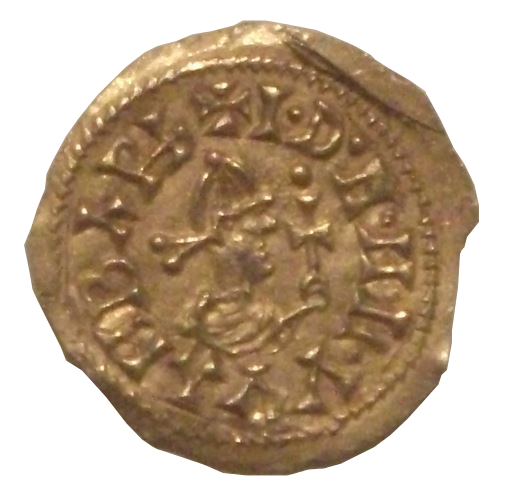
Wamba (king)
Wamba (king)
Main page
1959016

Wamba (king)

logo
Community Hub0 subscribers
Read side by side
from Wikipedia

Wamba (Medieval Latin: VVamba, Vamba, Wamba; c. 630 – 687/688) was the king of the Visigoths from 672 to 680. During his reign, the Visigothic kingdom encompassed all of Hispania and part of southern Gaul known as Septimania.

Key Information

According to Herwig Wolfram, Wamba means "big paunch" in Gothic (like German: "Wampe", cognate to English "womb") and may have been a nickname.[1] Both Julian of Toledo in his Historia Wambae (History of Wamba) and the decisions of the eleventh Council of Toledo, held under Wamba's auspices, refer to the king only as Wamba.

History

[edit]

Military events

[edit]
Statue in Madrid (A. Carnicero, 1750–53).

After ascending the throne on 1 September 672, Wamba faced a revolt from Hilderic, governor of Nîmes, who had himself aspired to the kingship. Hilderic was supported by Gunhild, Bishop of Maguelonne. Wamba sent the dux (general) Paul to put down the rebels, but upon his arrival at Narbonne, he induced his officers to renounce their loyalty to Wamba and elect him king as Flavius Paulus. He was joined by Hilderic and his followers, as well as Duke Ranosind of Tarraconensis and the gardingatus (a palace official) Hildigis. Paul recruited "multitudes" of Franks and Basques to bolster his forces.[2] Following this the Visigothic cities in Gaul and a large part of northeastern Hispania came over to Paul's side.[3]

During these events, Wamba was in Cantabria campaigning against the Basques.[4] In response, Wamba marched into the Tarraconensis region, and in a few days turned most of the cities back to his side. He then divided his forces into three groups, attacking over the Pyrenees by way of Llívia (then the capital of Cerdanya), Auch, and the coastal road, taking the fortresses of Collioure, Vulturaria, and Llívia, finding "much" gold and silver there.[5]

As Wamba moved on Narbonne, Paul placed General Wittimer in charge of the city and retired to Nîmes. Wamba's forces quickly subdued Narbonne and then, after some difficulty, secured the surrender of Nîmes on September 3, 673. Paul and the other rebel leaders surrendered and, three days later, were brought to trial, scalped, and imprisoned for life.

A period of peace followed and, in 674, Wamba rebuilt the Roman walls around Toledo. He also fortified other sites about this time, possibly Hondarribia (Fuenterrabia),[6] a small village in Spain facing the French border over the Txingurri bay, as a military thrust along the Bay of Biscay up to the Pyrenees is attested to in contemporary sources. Wamba brought the Astures and Ruccones (Luggones) under his control and incorporated them into a new province. They had been fighting for their independence since the Visigothic invasions of the 5th century but now finally relented.

After the rebellion, the kingdom faced a new threat in the form of Saracen raiders. In the Chronicle of Alfonso III (written 200 years later) it stated, "In Wamba's time, 270 Saracen ships attacked the coast of Hispania and there all of them were burned." A single attack of this size is doubtful, however, because no other source mentions it. The Chronicle of 754 declared Moors "had long been raiding" Andalusia, "and simultaneously devastating many cities"; however, the Chronicle of 754's most recent English translator, Kenneth Baxter Wolf, holds that this refers to the year before the defeat of King Roderic by the Moors, over three decades after the removal of Wamba.[7]

The law books and decrees of the time reveal a substantial erosion of domestic tranquility and order within the kingdom. In the Visigothic law books, Wamba decrees that all the people, regardless of their religion, and even if they are clergy, are required to defend the kingdom if it is attacked by a foreign foe. This law was created to solve a problem of desertion: "For, whenever an enemy invades the provinces of our kingdom … [many of] those who inhabit the border … disappear so that, by this means, there is no mutual support in battle." This rationale may imply a frequency of raids. That the people were often unwilling to defend the kingdom is further shown by another of Wamba's edicts, in which slaves were freed in order to the fill the ranks of the army. This suggests not only a shortage of volunteers from among the Hispano-Romans who made up the bulk of the population ruled by the Visigothic lords, but also an army heavy in conscripts and the coerced.

Religious events

[edit]

In 675, the Third Council of Braga was held in Braga (Bracara), Gallaecia. This Catholic conclave promulgated eight decrees affecting ritual, the handling of sacred vessels, who may or may not live with a priest, unacceptable forms of punishment of clergy, and unacceptable forms of payment of clergy and rectors. In the same year, the Eleventh Council of Toledo was convened in November.

Wamba renouncing the Crown. Oil on canvas by Juan Antonio de Ribera (1819)

Wamba was a reformist king who, according to Charles Julian Bishko, "tried to set up at Aquis (Chaves) in Gallaecia a monastic see of the same type as Dume–Braga, i. e., involving the sort of episcopus sub regula associated with early pactualism. This manoeuvre was successfully blocked by the metropolitan church of Emérita with the full support of the fathers of the XIIth Council of Toledo (681)."[8]

Succession

[edit]

In 680, Wamba fell ill or (according to the Chronicle of Alfonso III two hundred years later) was poisoned in Pampliega, near Burgos. He received the order of penance in anticipation of his death, and as a result was forced to step down as king upon his recovery. The Chronicle of Alfonso III blames Wamba's successor Erwig for this; some modern commentators have blamed Julian of Toledo, who was made primate of the Visigothic church by Erwig (in reward for his services?).[9] But Julian perpetuated the memory of Wamba in his account of the revolt of Paul, Historia Wambae Regís.

Birthplace

[edit]

According to one tradition, Wamba was born in Egitânia,[10] a settlement surrounded by Roman walls that is today called Idanha-a-Velha in the Idanha-a-Nova municipality, and located to the northeast of Castelo Branco in Portugal. A Spanish tradition has him born in Galicia in the parish of Santa María de Dozón[11] in an old house with a shield. Manuel de Sousa da Silva, a seventeenth-century Portuguese genealogist, in his work Nobiliário das Gerações de Entre-Douro-e-Minho, refers to this possibility, adding that he was of the lineage of the Gothic kings, but so poor that he was a farmer. Modern genealogists make him a son of Tulga, a possibility sustained by the fact of his being a humble man of royal descent, since his father was deposed at a young age, and when his own sons were still infants.

However, the most famous tradition says he held land and possessions in Pujerra[12] (or Buxarra as it was once called) in Málaga Province, an Andalusian mountain village, nestled amid forests of chestnut trees near the Genil river in southern Spain. The ruins of Molino de Capilla (Mill of the Chapel) are nearby, and close to which lay the village of Cenay, which some consider to be Wamba's actual birthplace.

Kingship

[edit]
The Election of Wamba as King. Oil on canvas by Francisco de Paula Van Halen (1843)

There are at least two legends associated with how Wamba became king.

One legend[13][failed verification] begins with Wamba's father, king of the Visigoths, who in this story was also named Wamba. Two women of his court, a servant girl and a noble lady, became pregnant at the same time. To avoid a scandal that might implicate the king, both women fled the capital. They found their way to an Andalusian village that, because it was so well hidden in the forest, provided an ideal place for secret births. Both women brought forth boys, and they were placed in the care of a servant girl to be raised in the area.

When the time came to groom a successor for the king, there seemed to be no suitable heir. Soldiers were dispatched to the village to find the illegitimate children. After their arrival, they overheard a peasant woman call to her son named Wamba, who was tending cattle with a stick. The soldiers knew they had come upon the youth they sought and declared: "You are the rightful king and we must ask you to come with us to the palace." Wamba was unwilling, or at least pretended to be. He took his stick and thrust it into the ground, saying, "I will only accept the throne if this stick takes root." The stick he carried was of chopo or black poplar, which easily takes root in fertile soil. When it began to grow, Wamba agreed to go with the soldiers to become the new king of the Visigoths, being elected and crowned in what is today the tiny village of Wamba in the region around Madrid.

A second legend is related by Charles Morris in Historical Tales: Spanish ("The Good King Wamba"). In this version, instead of being a boy, Wamba was an old man in the village, and owned land and possessions there. According to Morris:

In those days, when a king died and left no son, the Goths elected a new one, seeking their best and worthiest, and holding the election in the place where the old king had died. It was in the little village of Gerticos, some eight miles from the city of Valladolid, that King Recesuinto had sought health and found death. Hither came the electors—the great nobles, the bishops, and the generals—and here they debated who should be king, finally settling on a venerable Goth named Wamba, the one man of note in all the kingdom who throughout his life had declined to accept rank and station.[14]

Saint Leo, declaring he had been given divine guidance, instructed the electors to seek out a husbandman named Wamba. So scouts were dispersed until Wamba was found tilling one of his fields. "Leave your plough in the furrow", they said to him; "nobler work awaits you. You have been elected king of Hispania." "There is no nobler work", answered Wamba. "Seek elsewhere your monarch. I prefer to rule over my fields."[14]

The heralds did not know what to make of this. To them, the man who would not be king must be a saint—or an idiot. They reasoned, begged and implored until Wamba, who wanted to get rid of them, said: "I will accept the crown when the dry rod in my hand grows green again—and not till then."[14]

After he thrust it into the ground, all were astonished to see it suddenly become a green plant with leaves growing out of the top. Everyone believed heaven had decided the matter. So Wamba "went with the heralds to the electoral congress". Once there, however, he again tried to refuse the throne. At this, one of the Visigothic chieftains drew his sword and threatened to behead Wamba if he did not accept the crown. Wamba relented and consented.[14]

The legend of the stick thrust into the ground is also associated with the town of Guimarães, southwest of Braga in the Costa Verde of Portugal (the northwest corner of the country). There, because Wamba never withdrew the stick afterwards, it is said it grew into an olive tree. Though the tree is now gone, the site is marked either by the monastery of Nossa Senhora da Oliveira (Our Lady of the Olive) or the Largo da Oliveira town square, each named for the legendary tree.

Saint Giles

[edit]

In a 10th-century Life of Saint Giles, written for the benefit of pilgrims, a legend is recorded about how, one day, when King Wamba (also known as Flavius) was out hunting in the forest between Arles and Nîmes in Provence, he began to pursue a hind (deer). The animal fled, seeking refuge in the cave where Giles the hermit was quietly praying. (In some versions of the story, the hind, provided by God, was Giles' sole companion and sustained him on its milk.) Wamba shot his arrow into the opening. But he missed the hind, striking Giles instead, wounding him in the leg and causing a permanent disability. The king's hunting dogs then rushed in for the kill. But when Wamba arrived he found his dogs miraculously rooted to the spot. Discovering what he had done, he begged forgiveness and tried to make amends. But Giles continued his prayers, refusing all help or recompense. The king nonetheless had doctors care for the wound. He also offered Giles the land upon which to build a monastery. But Giles refused.

Over time, however, because of the saint's fame as a sage and miracle worker, multitudes gathered at his cave. Around 674, Wamba built them a monastery. Giles became its first abbot. Soon a little town grew up there, known as Saint-Gilles-du-Gard.

Because of this tradition, Giles became the patron saint of cripples, lepers, and nursing mothers. His emblem is an arrow. The Catholic Encyclopedia noted that the king in this story must have originally been a Frank, "since the Franks had expelled the Visigoths from the neighbourhood of Nîmes almost a century and a half earlier".[15]

Loss of the crown

[edit]

Charles Morris writes that, during Wamba's reign:

The tonsuring of king Wamba by Joan Brull. Oil on canvas (1894)

One ambitious noble named Paul, who thought it would be an easy thing to take the throne from an old man who had shown so plainly that he did not want it, rose in rebellion. He soon learned his mistake. Wamba met him in battle, routed his army, and took him prisoner. Paul expected nothing less than to have his head stricken off, but Wamba simply ordered that it should be shaved.[14]

A shaved or tonsured head meant that Paul had assumed monastic orders, so he could not serve as king or chieftain.[14]

Later an ambitious youth named Erwig, pursuing the overthrow of the king, administered a sleeping potion. While Wamba was under, Erwig shaved the crown of his head. Erwig said he did it at Wamba's request. As before, Gothic law was clear. Wamba could no longer be king. Erwig became king in his place. Wamba accepted this change and happily assumed monastic orders, abdicating the throne to live out the last seven years of his life as a monk.[14]

According to Morris, Wamba acquitted himself well in all his stations—farmer, king, and monk—and his name has come down to us from the mists of time as one of those rare men of whom we know little, but all that we know is good.[14]

Ironically, it was Wamba's nephew, son of his sister Ariberga, Egica, who married Erwig's daughter and became the new king at his father in law's death.

Bibliography

[edit]

See also

[edit]

Notes

[edit]
Revisions and contributorsEdit on WikipediaRead on Wikipedia
from Grokipedia
Wamba (died c. 687) was a Visigothic king who reigned over Hispania and Septimania from 672 to 680.[1] Following the death of his predecessor Recceswinth, Wamba was acclaimed king by nobles and bishops at Gérticos and anointed at Toledo on 19 September 672, though he initially refused the crown citing his advanced age.[2] His most notable military achievement was the swift suppression of a rebellion in 673 led by Duke Paulus in the northeastern provinces, who had proclaimed himself king with support from Frankish and Basque forces; Wamba personally led the campaign, recapturing key fortresses and restoring order within months.[1][2] To bolster the kingdom's defenses, he enacted reforms requiring all freemen, regardless of social status, to serve in the military under penalty of law, marking a significant centralization of royal authority.[1] Wamba's rule ended in 680 when palace intrigue led to him being deceived into receiving the monastic tonsure during a period of illness, an act that canonically disqualified him from kingship and forced his abdication in favor of Ervigius; he subsequently retired to a monastery in Pampliega.[2][1]

Early Life and Ascension to the Throne

Origins and Background

Little is known with certainty about Wamba's origins or early life, as contemporary sources such as Julian of Toledo's Historia Wambae regis (composed shortly after 673) commence their narrative with his election to the throne and omit biographical details prior to that event.[3] Later medieval traditions, including chronicles like the Chronicle of Alfonso III, suggest he was born in the early seventh century, possibly between 630 and 643, in locations such as Egitania (modern Idanha-a-Velha, Portugal), a Roman-era settlement in Lusitania, or alternatively in regions of Galicia or near Pujerra in Baetica (modern Málaga province).[4] These accounts vary and lack corroboration from primary Visigothic records, reflecting legendary embellishments rather than verifiable history. By the time of his election, Wamba had established himself as a senior noble and military commander (vir illustris) within the Visigothic kingdom of Hispania and Septimania. He was actively engaged in suppressing Basque rebellions in the western Pyrenees when delegates arrived to proclaim him king following the death of Recceswinth on 1 September 672 at the palace of Gerticos near Valladolid.[5] His prior service likely included administrative or diplomatic roles, as he is recorded under Recceswinth (r. 649–672) as having been entrusted with proclaiming the will of Saint Martin of Braga, indicating trust among the royal court and ecclesiastical hierarchy.[4] Wamba's noble status and military experience positioned him as a consensus choice among the Visigothic aristocracy and bishops, who valued his proven leadership amid ongoing threats from external incursions and internal instability. Some speculative genealogies propose ties to prior royalty, such as descent from King Tulga (r. 640–642) or even Chindaswinth (r. 642–653), but these claims rest on unverified later traditions without support from seventh-century documents.[4]

Election and Initial Reluctance

Following the death of King Recceswinth on 1 September 672 at the royal residence of Gerticos, the Visigothic palatine officials and nobility convened to select a successor amid the customary elective process for kingship. Wamba, an esteemed elder and experienced military commander, was unanimously acclaimed as the new monarch by the assembled elite, reflecting the consensus-driven nature of Visigothic royal elections where merit and stability were paramount.[6][3] Despite the acclamation, Wamba exhibited initial reluctance to assume the throne, citing his advanced age—estimated in his seventies or older—and the formidable burdens of governance during a period of potential instability. According to contemporary accounts, he steadfastly refused immediate acceptance, arguing that the weight of royal duties exceeded his capacity, a stance that underscored a classical topos of virtuous humility in leadership narratives. Persuaded by warnings of impending anarchy and the pleas of his peers, who invoked the risk of civil discord without prompt unification, Wamba eventually consented, though he insisted on deferring the formal accession ceremony until reaching Toledo.[7][5][4] Upon arriving in Toledo, the kingdom's capital and ecclesiastical center, Wamba underwent the rite of royal unction, marking a significant ritual affirmation of his legitimacy as per the Historia Wambae regis by Julian of Toledo, the contemporary bishop and chronicler whose work provides the primary detailed narrative of these events. This delay ensured the ceremony's solemnity and alignment with emerging traditions of anointed kingship, distinguishing Wamba's accession from prior informal elevations.[6][3]

Military Campaigns and Defense of the Realm

The Rebellion of Paulus (673)

In 673, a separatist revolt broke out in the northeastern provinces of the Visigothic kingdom, encompassing Septimania (Narbonensis) and parts of Tarraconensis, involving a mix of Romanized locals, Visigoths, and possibly residual Byzantine sympathizers seeking autonomy from central authority. [1] King Wamba, then campaigning against Basque incursions in the north, dispatched the dux Paulus—a figure of Roman origin serving as a provincial commander—to quell the uprising with a substantial contingent of troops. [8] Upon reaching Narbonne, the provincial capital of Septimania, Paulus defected to the rebels, assumed leadership of the insurrection, and proclaimed himself king, thereby challenging Wamba's rule over the region. [9] This betrayal extended the revolt's control to key strongholds like Narbonne and Nîmes, with Paulus reportedly securing alliances among disaffected elites and fortifying defenses, though attempts to draw Frankish support from across the Pyrenees failed. [1] The primary contemporary account, Julian of Toledo's Historia Wambae, portrays Paulus's actions as treasonous usurpation, emphasizing his crowning with a sacrilegious votive crown originally dedicated to the earlier king Reccared I, though this narrative serves as a panegyric glorifying Wamba's legitimacy and may exaggerate the rebel's ambitions for rhetorical effect. [9] Alerted to the defection, Wamba swiftly returned to Toledo, mobilized the royal army—including levies from across Hispania—and marched northeast in a rapid campaign demonstrating the kingdom's logistical capacity. [10] His forces first subdued Narbonne through siege and negotiation, then advanced to Nîmes, where Paulus's resistance collapsed; the rebel leader surrendered on 3 September 673, along with key accomplices. [11] On 6 September, a royal tribunal in Nîmes convicted Paulus of inciting rebellion and treason, but Wamba exercised clemency by sparing him execution and excommunication—punishments mandated by Visigothic law—instead subjecting him to public humiliation via tonsure and a triumphal procession through Toledo, underscoring the king's emphasis on mercy tempered with deterrence. [8] The suppression reinforced central authority in the periphery, with Wamba executing or exiling lesser rebels while integrating some forces back into the loyal army, though the episode exposed vulnerabilities in provincial command structures reliant on non-Gothic elites like Paulus. [1] Julian's history, composed soon after as an encomium, frames the victory as divine vindication of Wamba's rule, but modern analyses note its hagiographic bias, prioritizing royal power narratives over neutral chronology. [12]

Suppression of Basque and Other Insurgencies

In early 673, shortly after ascending the throne, Wamba launched a campaign against Basque insurgents in the regions of Cantabria and Vasconia, where local forces had been raiding Visigothic territories. His army advanced rapidly, engaging in widespread plundering of fields and assaults on fortified positions over the course of seven days, demonstrating the kingdom's military mobility and resolve.[9][8] Faced with these incursions, the Basques capitulated, offering hostages as guarantees of loyalty and substantial tributes in exchange for clemency and peace, which Wamba granted to restore order without prolonged occupation. As Julian of Toledo records in his contemporary account, the Basques "laid aside the wildness of their minds, gave hostages, and opted for their lives to be spared... not so much by their entreaties as by gifts," highlighting the decisive impact of Wamba's forces in compelling submission.[9] This suppression formed part of Wamba's broader defensive strategy against peripheral threats, including recurrent Basque raids that exploited the kingdom's northern frontiers; such campaigns were annual efforts to deter incursions from non-Romanized tribes in the Pyrenean foothills. No major independent revolts beyond the Basques are detailed in primary sources for this period, though Wamba's success here allowed him to pivot toward quelling the concurrent rebellion of Paulus in Septimania later that year.[8][11]

Reforms and Governance

Military and Administrative Reforms

Following the suppression of the rebellion led by Duke Paulus in late 673, Wamba enacted military reforms to address vulnerabilities exposed by the uprising, particularly the unreliability of noble-led contingents and limited recruitment pools. He decreed universal military obligation for all free men across the Visigothic realm, extending service beyond traditional Gothic elites to include Hispano-Romans, freedmen, and even clergy, who were required to set aside ecclesiastical garments and privileges upon summons.[13] This measure, promulgated on 1 November 673, broadened the army's base, enabling rapid mobilization of larger forces—such as the 10,000 reinforcements dispatched under General Wandemirus to Nîmes—and reduced dependence on provincial leaders prone to defection, as Paulus had done by allying with Frankish forces.[9] The reform emphasized discipline, with punishments for infractions like fornication including severe penalties such as foreskin removal to maintain order in campaigns.[9] Administrative changes complemented these efforts by reinforcing central royal control over provinces and curbing noble autonomy, which had facilitated rebellions. Wamba mandated oaths of fidelity from officials and subjects to bind loyalty directly to the crown, drawing on precedents from earlier councils like that under Chintila for treason penalties.[14] In Gaul, he appointed loyal governors, expelled Jews implicated in supporting rebels, repaired fortifications like Nîmes' walls and gates using public funds, and restored plundered goods to victims, thereby stabilizing local governance and infrastructure.[9] These steps aimed to integrate Hispano-Roman populations more fully into the kingdom's defense while diminishing aristocratic power bases, though they provoked resistance from elites accustomed to privileges.[15]

Religious Policies and Ecclesiastical Relations

Wamba maintained orthodox Catholic policies in line with the Visigothic kingdom's established Nicene Christianity, convening the Eleventh Council of Toledo in 675, a provincial synod attended by seventeen bishops that addressed doctrinal unity and ecclesiastical discipline under royal auspices.[16][17] This council exemplified the symbiotic relationship between the monarchy and episcopate, with decisions affirming royal oversight in church governance while endorsing canonical reforms to prevent clerical abuses.[17] A key aspect of Wamba's ecclesiastical relations involved asserting secular authority over traditional church exemptions, particularly through decrees mandating military service for all free subjects, including clergy, during invasions or rebellions.[5] These laws, issued amid threats like the 673 revolt of Paulus, required bishops and priests to arm themselves and contribute to defense efforts, overriding prior exemptions and integrating the church into the kingdom's survival mechanisms, though this provoked resistance from some ecclesiastical factions.[13][18] Wamba also reinforced protections for ecclesiastical institutions, including legislation in 675 prohibiting bishops from alienating or misappropriating diocesan properties without royal consent and mandating reports to the crown on church estates.[19] Such measures supported aristocratic patronage of private churches while curbing potential episcopal overreach, reflecting a policy of royal guardianship over church assets to ensure fiscal and administrative accountability.[20] These reforms balanced deference to the hierarchy—evident in alliances with figures like Archbishop Julian of Toledo—with pragmatic controls to align ecclesiastical functions with monarchical imperatives.[9]

Downfall

The Monastic Tonsure and Abdication

In October 680, King Wamba fell gravely ill in Toledo, prompting concerns over his succession.[4] During this episode, he was administered the monastic tonsure, a ritual shaving of the head signifying entry into clerical orders, which under Visigothic law and custom rendered him ineligible to rule as kings were required to remain laymen capable of bearing arms.[21] [22] Accounts of the tonsure's circumstances differ. The Chronicle of Alfonso III portrays the abdication as voluntary, with Wamba recalling a prior imposition of deacon's orders upon himself.[23] In contrast, later traditions allege a conspiracy by Ervig, a former rebel pardoned by Wamba, who reportedly administered a potion inducing unconsciousness or delirium, enabling the tonsure without the king's full consent.[22] [4] Upon recovering, Wamba formally abdicated the throne, signing documents in the presence of high officials that relinquished his authority and recommended Ervig as successor.[5] This act aligned with Visigothic elective monarchy practices, where the nobility confirmed the transition.[1] He subsequently retired to the Monastery of Saint Vincent in Toledo, embracing monastic life until his death around 687.[4]

Immediate Aftermath and Succession

Wamba abdicated the throne in October 680 following his involuntary tonsure, an act that rendered him canonically ineligible for kingship under Visigothic custom, as it symbolized entry into the clergy.[24] Ervig, a former palatine and close advisor to Wamba, was promptly elected king by the assembled nobility and bishops, assuming power around 31 October 680.[25] Medieval chroniclers, including later continuations of Isidore of Seville, attribute the tonsure to a conspiracy orchestrated by Ervig and allies during Wamba's illness, possibly involving poisoning or sedation, though contemporary accounts by Julian of Toledo present the abdication as more voluntary amid health decline.[26][4] In the immediate transition, Wamba retired to the monastery of San Vicente in Pampliega, near Burgos, where he lived as a monk until his death circa 687.[4] Ervig moved swiftly to stabilize his rule by issuing decrees that remitted public and private debts for a four-year period and suspended certain tax obligations, measures designed to garner support from debtors and the populace strained by prior fiscal policies.[27] These actions contrasted with Ervig's later harsh policies, including prosecutions of some of Wamba's former officials on charges of disloyalty, signaling a purge to eliminate potential rivals.[25] Ervig's succession marked a shift toward more autocratic governance, though he initially pledged adherence to Wamba's legal and military reforms. He convened the Thirteenth Council of Toledo in 683, reinforcing ecclesiastical alliances that had facilitated his election.[1] This council's acts omitted explicit reference to Wamba's deposition, focusing instead on doctrinal unity and royal authority, indicative of efforts to legitimize the new regime without dwelling on the controversial circumstances.[26]

Legacy

Achievements in Stabilization and Reform

Wamba's reign marked a brief era of internal consolidation for the Visigothic kingdom following the relatively stable but aging rule of Recceswinth, with his prompt suppression of rebellions demonstrating effective central authority. In 673, shortly after his election, Wamba mobilized forces to counter the uprising led by the comes Flavius Paulus in Septimania and the Tarraconensis, who had proclaimed himself emperor with support from local Gothic nobles, Frankish allies, and possibly residual Byzantine elements in the region. By enforcing a new military oath and conscription decree, Wamba assembled an army capable of rapid deployment, marching from Toledo to Narbonne in under two weeks and besieging rebellious strongholds, culminating in Paulus's surrender on September 3. This victory reasserted royal control over peripheral territories, preventing fragmentation and restoring fiscal and administrative order disrupted by the revolt.[3][28] Central to Wamba's stabilization efforts were his military reforms, codified in a law requiring all free Hispano-Roman and Gothic subjects over fifteen years of age to swear loyalty and bear arms in defense of the realm, regardless of social status or clerical exemptions. This universal conscription shifted recruitment from noble retinues to direct royal oversight, imposing severe penalties—including loss of property and exile—for evasion or dereliction, thereby curbing aristocratic autonomy in warfare and enhancing the kingdom's responsiveness to threats. According to Julian of Toledo's Historia Wambae regis, a near-contemporary account composed by the royal chaplain to exalt monarchical power, these measures enabled Wamba to equip and discipline levies efficiently, as evidenced by the improvised arming of civilians during the Paulus campaign. While Julian's narrative serves propagandistic purposes in portraying Wamba as a divinely ordained restorer of unity, the reforms' emphasis on oath-bound fidelity aligns with broader Visigothic efforts to integrate diverse populations under centralized command, temporarily bolstering defenses against external incursions like subsequent Basque raids, which Wamba also quelled in 674.[26][29][30] These initiatives contributed to a legacy of reform-oriented governance, as Wamba's precedents for enforced military participation influenced successors like Ervig, who retained elements of the oath system despite his own adjustments. By prioritizing empirical loyalty over feudal obligations, Wamba's policies addressed causal vulnerabilities in the kingdom's martial structure—such as noble disloyalty exposed by Paulus—fostering short-term cohesion amid ethnic and regional tensions, though their sustainability was undermined by his abrupt deposition in 680. Historians note that, absent more neutral contemporary records beyond ecclesiastical sources like Julian's, the extent of long-term administrative penetration remains debated, but the reforms' focus on universal duty reflected pragmatic adaptation to a realm threatened by both internal factionalism and border unrest.[31][12]

Criticisms and Long-Term Impact

Wamba's military reforms, particularly the decree of 673 enshrined in Liber Iudiciorum 9.2.8, mandated universal military service for all free inhabitants, imposing penalties such as enslavement, property confiscation, and exile for non-compliance or rebellion. These provisions, enforced rigorously after the suppression of the Paulus revolt, alienated segments of the nobility and free population by curtailing exemptions and privileges previously enjoyed by elites.[32] Historians note that the severity of these measures, which equated evasion with infamy akin to Roman legal disgrace, reflected an attempt at centralization but fostered resentment among those burdened by the obligations.[33] This unpopularity contributed to the political vulnerability exploited in Wamba's downfall. In October 680, during a severe illness, Wamba received canonical tonsure as part of last rites, rendering him ineligible for kingship under Visigothic custom requiring lay status for rulers. Ervig, a palace count, capitalized on this technicality—possibly through a orchestrated intrigue involving sympathetic nobles and clergy—to depose him without widespread resistance, suggesting prior factional opposition to Wamba's authoritarian tendencies.[34][35] Contemporary accounts like Julian of Toledo's Historia Wambae portray Wamba favorably, but the swift legitimation of Ervig at the Twelfth Council of Toledo in 681 indicates ecclesiastical complicity in overriding Wamba's legitimacy.[36] In the long term, Wamba's initiatives had negligible enduring effects on Visigothic stability. Ervig promptly annulled many of Wamba's punitive sentences via conciliar decree, restoring properties and exiles to former rebels and signaling a retreat from coercive centralization toward appeasement of noble interests.[37] This reversal underscored the monarchy's dependence on aristocratic consensus in the elective system, exacerbating factionalism that persisted through subsequent reigns and facilitated the kingdom's fragmentation by 711. Modern historiography views Wamba's tenure as emblematic of futile absolutist aspirations against entrenched elite power, with his military successes providing only ephemeral respite from systemic weaknesses.[38][33]

Modern Historiographical Views

Modern historians interpret Wamba's reign (672–680) as a pivotal yet ultimately fragile attempt to centralize authority in the Visigothic kingdom amid recurrent rebellions and structural ethnic tensions between Goths and Hispano-Romans. Scholars emphasize that his military campaigns, particularly the suppression of the 673 revolt led by dux Paulus in Septimania, demonstrated effective royal mobilization but highlighted persistent regional autonomy and reliance on opportunistic alliances with external powers like the Basques and Franks.[12] [6] The chief contemporary account, Julian of Toledo's Historia Wambae (ca. 681), is scrutinized in modern scholarship for its dual role as empirical chronicle and ideological tool, glorifying Wamba to reinforce the symbiosis of monarchy and episcopate while downplaying factional divisions. Historians like Joaquín Martínez Pizarro argue that Julian's narrative, though rhetorically stylized, preserves verifiable details corroborated by charters and councils, such as Wamba's imposition of a universal military oath to curb aristocratic disloyalty.[3] [39] This source's credibility is affirmed by its proximity to events but tempered by Julian's position as a court bishop advancing Toledan orthodoxy.[9] Debates persist over Wamba's innovations, including possible anointing as the first Visigothic king to adopt this rite—potentially signaling Roman imperial emulation—but evidence remains contested, with some attributing it to later hagiographic inflation rather than liturgical innovation.[40] His downfall via enforced tonsure in 680 is viewed causally as emblematic of Visigothic succession vulnerabilities: not mere piety, but a engineered disqualification exploiting canon law to enable Ervig's usurpation, underscoring the kingdom's institutional fragility before the 711 Arab conquest.[12] [41] Overall, Wamba is appraised as a competent stabilizer whose reforms addressed immediate crises but failed to resolve underlying social fissures, such as provincial fragmentation and noble intrigue, contributing to the regime's long-term instability. Recent analyses frame his era within broader Visigothic Romanization trends, where Gothic identity yielded to Hispano-Visigothic unity under Catholic hegemony, yet without averting collapse.[42] [43]

References

User Avatar
No comments yet.