


Community hub
Recent from talks
Contribute something
Nothing was collected or created yet.
Auch (French pronunciation: [ᴐʃ] ⓘ; Gascon: Aush [ˈawʃ]) is a commune in southwestern France. Located in the region of Occitanie, it is the capital of the Gers department.
Key Information


Geography
[edit]Localization
[edit]


The commune of Auch is located in the arrondissement of Auch and in the Gers valley, roughly in the centre of the Gers département. Auch is 69 kilometres (43 miles) west of Toulouse, the capital of the Occitanie region, and 74 kilometres (46 miles)from Montauban, 63 kilometres (39 miles) from Agen, 92 kilometres (57 miles) from Mont-de-Marsan, 86 kilometres (53 miles) from Pau and 62 kilometres (39 miles) from Tarbes, the capitals of the neighbouring départements. It is 162 km from Bordeaux, 390 kilometres (240 miles) from Marseille and 409 kilometres (254 miles) from Lyon, the capitals of the neighbouring regions, and 595 kilometres (370 miles)south-west of Paris.[3]
The commune covers an area of 7,248 hectares (17,910 acres).[4]
Surrounding communes
[edit]Auch borders thirteen other communes: Barran, Castillon-Massas, Castin, Duran, Lasséran, Leboulin, Montaut-les-Créneaux, Montégut, Ordan-Larroque, Pavie, Pessan, Preignan and Roquelaure.
Geology and relief
[edit]Auch has a minimum altitude of 115 metres (377 ft) and a maximum of 281 metres (922 ft). Its average altitude is 198 metres (650 ft), while that of its town hall is 134 metres (440 ft)[5] The town and its surroundings have a hillside landscape.[6]
The commune covers an area of 7,248 hectares (17,910 acres), making it the third largest in the département.[7]
Centred on the middle Baïse valley, Armagnac is distributed along an east-west axis between Eauze and Auch. It includes Fezensac and Vic.
The commune is located in seismicity zone 1 (very low seismicity).[8]
Hydrography
[edit]
The Gers, a tributary of the Garonne, flows through the town and divides the city between the upper town, on the left bank, the site of the medieval city built on a hill where most of the ancient monuments are to be found, and the lower town, built on the plain on the right bank. The upper town is linked to the banks of the Gers by the medieval "pousterles", typical narrow streets with steep inclines, and by the monumental staircase inaugurated in 1863. The north of the town is also watered by the Arçon and Talouch rivers, tributaries of the Gers.
The lower town was devastated on several occasions (1897, 1952 for the most significant river overflow) before the course of the Gers was recalibrated following the 1977 floods in Gascony.[9]
Transportation
[edit]Auch is well connected to nearby cities and towns such as Agen, Toulouse and Tarbes by Routes Nationales and by train to Toulouse.[10]
Climate
[edit]| Climate data for Auch (1991–2020 averages, extremes 1985–present) | |||||||||||||
|---|---|---|---|---|---|---|---|---|---|---|---|---|---|
| Month | Jan | Feb | Mar | Apr | May | Jun | Jul | Aug | Sep | Oct | Nov | Dec | Year |
| Record high °C (°F) | 20.9 (69.6) |
25.2 (77.4) |
27.8 (82.0) |
29.4 (84.9) |
33.7 (92.7) |
39.4 (102.9) |
39.6 (103.3) |
42.6 (108.7) |
38.0 (100.4) |
34.2 (93.6) |
26.5 (79.7) |
21.8 (71.2) |
42.6 (108.7) |
| Mean daily maximum °C (°F) | 10.2 (50.4) |
11.7 (53.1) |
15.3 (59.5) |
17.8 (64.0) |
21.5 (70.7) |
25.4 (77.7) |
27.8 (82.0) |
28.2 (82.8) |
24.8 (76.6) |
20.0 (68.0) |
13.9 (57.0) |
10.8 (51.4) |
18.9 (66.0) |
| Daily mean °C (°F) | 5.9 (42.6) |
6.6 (43.9) |
9.6 (49.3) |
12.1 (53.8) |
15.8 (60.4) |
19.5 (67.1) |
21.6 (70.9) |
21.8 (71.2) |
18.4 (65.1) |
14.6 (58.3) |
9.3 (48.7) |
6.4 (43.5) |
13.5 (56.3) |
| Mean daily minimum °C (°F) | 1.6 (34.9) |
1.5 (34.7) |
3.9 (39.0) |
6.5 (43.7) |
10.1 (50.2) |
13.6 (56.5) |
15.4 (59.7) |
15.4 (59.7) |
12.0 (53.6) |
9.1 (48.4) |
4.7 (40.5) |
2.1 (35.8) |
8.0 (46.4) |
| Record low °C (°F) | −20.0 (−4.0) |
−13.6 (7.5) |
−10.5 (13.1) |
−4.4 (24.1) |
−0.8 (30.6) |
2.6 (36.7) |
7.3 (45.1) |
3.6 (38.5) |
2.5 (36.5) |
−3.5 (25.7) |
−10.5 (13.1) |
−12.4 (9.7) |
−20.0 (−4.0) |
| Average precipitation mm (inches) | 62.0 (2.44) |
45.8 (1.80) |
49.5 (1.95) |
64.2 (2.53) |
72.9 (2.87) |
58.6 (2.31) |
55.1 (2.17) |
56.2 (2.21) |
53.0 (2.09) |
55.8 (2.20) |
64.1 (2.52) |
58.6 (2.31) |
695.8 (27.39) |
| Average precipitation days (≥ 1.0 mm) | 10.2 | 7.9 | 8.7 | 10.0 | 10.0 | 7.7 | 6.9 | 6.6 | 7.6 | 8.8 | 10.4 | 9.6 | 104.4 |
| Mean monthly sunshine hours | 89.2 | 115.0 | 167.5 | 180.3 | 200.7 | 213.4 | 239.5 | 231.4 | 203.3 | 152.1 | 98.7 | 84.9 | 1,975.9 |
| Source: Météo France[11] | |||||||||||||
History and population
[edit]Historical population | |||||||||||||||||||||||||||||||||||||||||||||||||||||||||||||||||||||||||||||||||||||||||||||||||||||||||||||||||||
|
| ||||||||||||||||||||||||||||||||||||||||||||||||||||||||||||||||||||||||||||||||||||||||||||||||||||||||||||||||||
| Source: EHESS[12] and INSEE (1968-2017)[13] | |||||||||||||||||||||||||||||||||||||||||||||||||||||||||||||||||||||||||||||||||||||||||||||||||||||||||||||||||||
Auch is a very ancient town, whose settlement was noted by the Romans during their conquest of the area in the 50s BC. At that time, it was settled by an Aquitanian tribe known to the Romans as the Ausci. Their name for the town was Climberrum[14] or Elimberris.[15] This has been tentatively etymologized from the Iberian iltir ("town, oppidum") and a cognate of the Basque berri ("new"), although another Iberian settlement in Granada recorded by the Romans as "Iliberi" probably had no contact with proto-Basque speaking peoples.[16] The Romans renamed the town Augusta Auscorum or Ausciorum ("Augusta of the Ausci"). Augusta Auscorum was one of the twelve civitates of the province of Novempopulana (Gascony) and became the provincial capital after the 409 destruction of Eauze by the Vandals.
The common term Augusta was eventually[when?] dropped and the name evolved into the modern Gascon Aush and French Auch.
In 732, during Abdul Rahman's advance towards Bordeaux in the Umayyad invasion of Gaul, the town was supposedly heavily shifted across the river to much of its present site to falter destruction.
The town became the seat of a Catholic archdiocese which lasted until the French Revolution. Its archbishops claimed the title of Primate of Aquitaine, Novempopulana, and Navarre.
Sites of interest
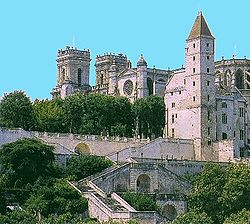
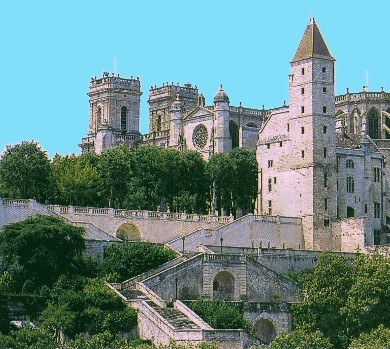
[edit]- Renaissance Cathédrale Sainte-Marie with its magnificent organ, carved stalls and rose stained-glass windows
- La Tour d'Armagnac, a 14th-century prison, as well as a statue of d'Artagnan who was based on the real life person, Charles de Batz, Comte d'Artagnan born nearby in the château de Castelmore, and written about by Alexandre Dumas.
- Musée des Amériques (Auch), formerly known as the Musée des Jacobins
- Maison Henri IV (Auch)
- Escalier monumental Built in the 19th century
Notable people
[edit]Auch was the birthplace of:
- Jacques Fouroux (1947–2005), rugby union player
- Louis Thomas Villaret de Joyeuse (1750–1812), admiral
- Dominic Serres (1719–1793), painter
- Reginald Garrigou-Lagrange (1877–1964), Dominican and prominent Neo-Thomist theologian
- Nicolas Portal (1979–2020), Professional cyclist for AG2R Prévoyance and Director Sportif of World Tour cycling team Ineos (ne Sky)
- Patrick Pilet (born 1981), racing driver
- André Daguin (1935–2019), chef
See also
[edit]- Gascony Show – English language radio in Auch
- Communes of the Gers department
References
[edit]- ^ "Répertoire national des élus: les maires" (in French). data.gouv.fr, Plateforme ouverte des données publiques françaises. 13 September 2022.
- ^ "Populations de référence 2023" (in French). National Institute of Statistics and Economic Studies. 18 December 2025.
- ^ "Recherche d'orthodromie depuis Auch [Search for orthodromy from Auch]". le site lion1906 de Lionel Delvarre. Retrieved 17 March 2024.
- ^ "Auch : population, superficie, chômage, chiffres et informations essentielles [Auch: population, surface area, unemployment, key figures and information]". Libération (in French). Retrieved 17 March 2024.
- ^ "PLAN AUCH - Plan, carte et relief d'Auch 32810 ou 32000 [Plan, map and relief of Auch 32810 or 32000]". cartesfrance.fr (in French). Retrieved 17 March 2024.
- ^ "paysages du gers [landscapes of the gers]". arbreetpaysage32.free.fr. Retrieved 17 March 2024..
- ^ Répertoire géographique des communes [Geographical directory of municipalities], published by IGN
- ^ Plan séisme
- ^ Lambert, Roger; Vigneau, Jean-Pierre (1981). "Les inondations catastrophiques de juillet 1977 en Gascogne. Étude géographique d'une situation. Problèmes de prévision et de prévention [The catastrophic floods of July 1977 in Gascony. Geographical study of a situation. Forecasting and prevention problems]". Annales de Géographie.
- ^ Dogon, Cathy (31 July 2023). "Bus, train, vélo… les défis de SNCF Connect". Pour l'Éco. Vol. 53, no. 6. p. 23. doi:10.3917/poec.053.0023. ISSN 2682-0889.
- ^ "Auch (32)" (PDF). Fiche Climatologique: Statistiques 1981–2010 et records (in French). Meteo France. Archived from the original (PDF) on 16 April 2018. Retrieved 16 April 2018.
- ^ Des villages de Cassini aux communes d'aujourd'hui: Commune data sheet Auch, EHESS (in French).
- ^ Population en historique depuis 1968, INSEE
- ^ "Baynes, T. S., ed. (1878). . Encyclopædia Britannica. Vol. 3 (9th ed.). New York: Charles Scribner's Sons. p. 67.
- ^ Chisholm, Hugh, ed. (1911). . Encyclopædia Britannica. Vol. 2 (11th ed.). Cambridge University Press. pp. 892–893.
- ^ Leopold von Ranke: Französische Geschichte. Essen 1996. p.182. [in German]
External links
[edit]
- Official website (in French)
- Unofficial website about Auch (in French)

| |
|
| International | |
|---|---|
| National | |
| Geographic | |
| Other | |

Situated on and around a hill on the west bank of the Gers River, approximately 80 kilometers west of Toulouse, the city covers an area of 72.5 square kilometers and had a population of 24,115 inhabitants as of January 2024.[2][3][4] The origins of Auch trace back to prehistoric times, with settlement by the Celtic tribe of the Ausci, who established a hillfort known as vicus on the site's elevated terrain.[5]
The Romans conquered the area in 56 BC and later founded the colony of Augusta Auscorum under Emperor Augustus, naming it after him; it became a key administrative and commercial center in the province of Aquitania, featuring a forum, basilica, temples, baths, and an amphitheater.[5][6]
During the Middle Ages, Auch emerged as a religious hub under the Archdiocese of Auch, which held metropolitan status over much of southwestern France, and it served as the seat of the Counts of Armagnac until the 15th century.[7][6] The city's most iconic landmark is the Sainte-Marie Cathedral, a masterpiece of Gothic and Renaissance architecture begun in the late 15th century and completed in the 17th, featuring intricate Flamboyant Gothic portals, Renaissance stained glass windows, and an organ case classified as a historic monument.[8][6]
Auch is also renowned for its connection to the fictional character d'Artagnan from Alexandre Dumas' novels, inspired by the 17th-century musketeer Charles de Batz-Castelmore, a local native; a bronze statue of him stands prominently in the main square.[9][10]
Other notable sites include the Musée des Jacobins, one of France's oldest public museums founded in 1793 and housed in a former Dominican convent, showcasing art, archaeology, and natural history collections with a focus on the Americas due to historical links with the New World.[11][12] Economically, Auch anchors the Grand Auch Cœur de Gascogne agglomeration community, promoting agriculture in the Armagnac region famous for its brandy production, foie gras, and vintages, while tourism draws visitors to its preserved medieval old town, weekly markets, and position along the Way of Saint James pilgrimage route.[13][9][8]
The city maintains a vibrant cultural scene, with events like choral festivals and rugby traditions tied to the local RC Auch Gascogne club, reflecting its role as a gateway to rural Gascony.[10][14][7]
Geography
Location and Administrative Boundaries
Auch is situated in southwestern France at the geographic coordinates 43°38′47″N 0°35′08″E.[15] The commune spans a total area of 72.48 km², with elevations ranging from 115 m to 281 m above sea level and an average elevation of 198 m.[16] As the prefecture of the Gers department within the Occitanie region, Auch serves as the administrative center for the department, overseeing local governance and services.[17] The commune forms part of the Grand Auch Cœur de Gascogne agglomeration community, which encompasses 34 communes and has a population of 41,293 residents as of January 2024.[18] This intercommunal structure fosters coordinated development across the area, centered on Auch. Auch borders 13 neighboring communes, including Pavie to the south, Barran to the east, and Lahitte-Toupière to the west, integrating it into a broader network of rural and urban settlements in the Gers department.[19] Positioned 69 km west of Toulouse and approximately 595 km southwest of Paris, Auch benefits from its central location within Gascony, of which it has historically served as the capital since the 8th century.[20][21] The surrounding landscape features hilly terrain on the west bank of the Gers River, which bisects the city and distinguishes the upper town (Haute-Ville), encompassing the medieval core, from the lower town (Ville Basse).[22]Geology, Relief, and Hydrography
Auch's geological foundation consists primarily of sedimentary rocks from the Tertiary era, particularly Miocene formations within the Aquitaine Basin, featuring limestone and marl layers that contribute to the region's karstic features and aquifers.[23] These rocks, including prominent limestone banks visible near the city, underlie the local terrain and support groundwater resources, with marls adding to soil fertility in surrounding areas.[24] Protected ecological zones, such as the ZNIEFF type II "Coteaux du Gers" encompassing hillsides around Auch, safeguard these formations' biodiversity, while former extraction sites like the Saint-Cricq quarry highlight historical limestone quarrying that exposed Tertiary strata now valued for their floral and faunal diversity.[25][26] The relief of Auch is characterized by a hilly landscape with moderate slopes, rising from the Gers River valley to the commune's highest point at 281 meters above sea level.[27] This undulating topography, shaped by erosion of the underlying sedimentary layers, influences local drainage and vegetation patterns, with steeper inclines on the river's banks. Urban development has adapted to this hillside setting, notably through the 19th-century Escalier Monumental, a grand staircase of 374 steps descending 35 meters to link the elevated historic upper town to the lower riverside areas.[28] Hydrographically, the Gers River serves as the principal waterway, stretching 175 kilometers from its source on the Lannemezan plateau before joining the Garonne, and it bisects the city of Auch, forming a natural divide between its historic core and peripheral zones.[29] Key tributaries, including the Arçon and Talouch rivers, flow northward into the Gers, enhancing the basin's network and contributing to seasonal water flows. The river's pluvial regime poses flood risks, historically managed through levees and post-event reinforcements following major inundations like the 1977 event, which prompted enhanced riparian protections.[30]Climate and Transportation
Auch experiences an oceanic climate with Mediterranean influences, characterized by mild temperatures and moderate precipitation throughout the year. According to data from the Météo-France station at Auch-Lamothe, the average annual temperature for the period 1991–2020 is 13.5°C, with mild winters where frost is rare and summers that are warm but not excessively hot. Annual precipitation averages 695.8 mm, distributed relatively evenly across the seasons, though slightly higher in spring and autumn, contributing to lush vegetation and supporting agricultural activities in the surrounding Gers department. The city's transportation infrastructure emphasizes regional connectivity, primarily through road and rail networks linking it to nearby urban centers like Toulouse. The main road access is via the Route Nationale 124 (N124), which provides a direct route to Toulouse, approximately 80 km away, facilitating daily commutes and freight movement. While Auch lacks a major highway passing directly through it, the A62 autoroute is accessible nearby via exit 7 near Agen, offering faster travel options to Bordeaux and further afield. Rail services are operated by the TER Occitanie line, connecting Auch station to Toulouse-Matabiau in about 1 hour 30 minutes with multiple daily trains, promoting efficient public transport for passengers and limited freight.[31][32] For air travel, the Aéroport Auch-Gers (also known as Auch-Lamothe aerodrome) serves general aviation and small aircraft, with a renovated 1,900-meter runway accommodating private flights, flight training, and occasional events like air shows, though it does not support commercial passenger services. Recent efforts to enhance sustainable mobility include the launch of the Auch Velo'c service in August 2025, providing 50 electric bikes available through a free-floating rental system across 10 stations in the city, encouraging eco-friendly short-distance travel and reducing reliance on cars for urban commuting.[33][34]History
Ancient and Roman Origins
The region around modern Auch was inhabited during the Iron Age by the Ausci, an Aquitanian tribe whose language showed affinities with ancient Basque, distinct from Celtic Gaulish tongues spoken further north.[35] Archaeological excavations at the oppidum of La Sioutat, located near Roquelaure in the Gers department, reveal this settlement as a major Iron Age center for the Ausci, featuring defensive structures and artifacts indicative of proto-urban occupation from the late La Tène period onward.[36] The pre-Roman settlement, known as Elimberris or Elimberri—possibly deriving from Basque roots meaning "new town"—served as the tribal capital, with evidence of fortified hilltop habitats and trade networks linking to broader Aquitanian communities.[35] Following Julius Caesar's campaigns in Gaul during the 50s BCE, the Romans integrated the Ausci territory into the province of Aquitania, renaming the settlement Augusta Auscorum in the late 1st century BCE to honor Emperor Augustus and signify its status as the civitas capital of the Ausci.[37] This transformation elevated Augusta Auscorum to one of the nine principal cities (civitates) of Novempopulania, the southwestern subprovince, where it functioned as an administrative and economic hub along the Via Aquitania, a key Roman road connecting Narbonne to Bordeaux via Toulouse.[38] Urban development included a forum, temples, baths, and elite residences with mosaic floors, as evidenced by excavations uncovering luxurious 3rd- to 5th-century domus near the ancient river terrace; remnants of public structures, such as possible theater foundations, underscore its role as a cultural center.[39] At its peak in the 2nd–3rd centuries CE, the city supported a population estimated at around 9,000 to 10,000 inhabitants, reflecting its prosperity through agriculture, trade, and viticulture in the fertile Garonne basin.[40] By the 4th century CE, Augusta Auscorum transitioned into a Christian center, with the establishment of a bishopric documented in ecclesiastical records, marking the shift from pagan Roman administration to early Christian governance.[41] The city's stability ended with barbarian incursions during the empire's decline; in 408 CE, Vandals swept through Aquitania, sacking settlements in the Novempopulania region, including passages through Augusta Auscorum that disrupted its infrastructure.[42] A decade later, in 418 CE, the Visigoths under King Wallia were federated by Rome and settled in southwestern Gaul, establishing their Kingdom of Toulouse and exerting control over the area around Auch until their defeat by the Franks at the Battle of Vouillé in 507 CE, during which the city likely faced further raids and transitional violence.[43]Medieval and Early Modern Periods
Auch emerged as a prominent episcopal see in the 5th century, with the first historically attested bishop being the poet Saint Orientius, who served during the first half of that century.[44] The diocese, established amid the Christianization of Roman Gaul, became the metropolitan see of Novempopulania, overseeing a vast territory in southwestern France.[22] By the medieval period, the archbishops of Auch wielded significant temporal power, leading to prolonged conflicts with secular lords, particularly the counts of Armagnac from the 12th to 15th centuries. These disputes, exemplified by the encroachments on episcopal lands during the tenure of Archbishop Guilhem de Montaut (1122–1170), highlighted tensions between ecclesiastical authority and feudal nobility in Gascony.[45] The construction of the Cathédrale Sainte-Marie, one of southern France's finest Gothic structures, spanned from 1489 to 1662, reflecting the city's enduring religious centrality despite regional strife.[46] The Hundred Years' War profoundly impacted Auch, as English forces under Edward, the Black Prince, conducted a devastating chevauchée in 1355 through Armagnac territories, laying waste to surrounding areas while sparing the city itself due to its status as church property.[47] This raid, part of broader Anglo-Gascon operations from Bordeaux to Narbonne, underscored Auch's strategic position in contested Gascon lands. Seat of the dukes of Armagnac during the Middle Ages, the city navigated feudal rivalries while maintaining its role as a spiritual hub.[22] In the early modern era, Auch's ties to the kingdom of Navarre influenced its political landscape, as regional lords like the counts of Armagnac forged alliances with Navarrese royalty amid shifting Pyrenean dynamics. The Wars of Religion in the 16th century brought further turmoil, including a brief occupation of the city in 1569 by Huguenot forces under Gabriel, count of Montgomery, during the third civil war, though Auch largely remained a Catholic stronghold.[48] Under Cardinal Richelieu's administration in the 17th century, urban expansion enhanced the city's infrastructure, supporting its growth as a regional center. The French Revolution of 1789 abolished the archbishopric's privileges, suppressing its temporal powers and reorganizing church structures amid national secularization.[44]19th Century to Present
In 1800, Auch was designated as the prefecture of the newly created Gers department following the administrative reorganization under Napoleon Bonaparte, solidifying its role as the administrative center of the region.[22] The arrival of the railway in the 1860s marked a significant infrastructural advancement, with the Bordeaux-Toulouse line extending to Auch by 1864, facilitating trade and connectivity for the agricultural economy dominated by Armagnac production and cereal cultivation.[49] This period also saw population growth, reaching approximately 13,000 inhabitants by 1901, driven by improved transportation and regional stability.[50] However, the late 19th century brought challenges from the phylloxera crisis, which devastated vineyards across southwestern France, including the Gers, prompting a shift toward resistant rootstocks and diversification in local agriculture.[51] The 20th century tested Auch's resilience through the impacts of the World Wars. During World War I, the city contributed significantly to the war effort, commemorated by a monument honoring local soldiers who fell in the conflict.[5] In World War II, Auch fell under Vichy French control and later German occupation, experiencing rationing and resistance activities typical of occupied southern France. Postwar recovery included suburbanization trends starting in the 1950s, as urban expansion accommodated returning populations and economic modernization, with new residential areas developing along the Gers River valley.[35] A tragic event occurred on January 4, 1971, when a gas explosion destroyed a five-story apartment building on Rue Masséna, killing 14 people and injuring eight others, highlighting vulnerabilities in urban infrastructure.[52][53] Entering the 21st century, Auch's urban structure evolved with the formation of the Grand Auch Cœur de Gascogne agglomeration in the early 2000s, promoting intercommunal cooperation for services and development across 42 communes. The city's population surged to 24,115 by 2024, reflecting steady growth and attractiveness as a regional hub.[50] Recent initiatives include cultural festivals such as the annual Fêtes de l'Armagnac celebrating local heritage.[10] Additionally, EU-funded projects under the European Green Deal have supported sustainability efforts, including green energy retrofits and biodiversity preservation in the Gers valley.[9]Demographics
Population Trends and Growth
The population of Auch reached a historical peak of 23,258 inhabitants in 1982, driven by post-war urbanization and economic expansion in the region.[54] Following this high point, the city experienced a steady decline, attributed to suburbanization and out-migration, dropping to 21,838 by 1999 and further to 21,545 in 2006.[54] A gradual rebound began in the early 2010s, with the population rising to 22,825 by 2022, reflecting renewed attractiveness as a regional center.[54] This recovery accelerated recently, with estimates placing the total at 24,115 as of January 2024, incorporating recent arrivals; this remains the current legal population as of November 2025, pending results from the ongoing annual census.[55][56] Recent population growth has been fueled primarily by net in-migration from surrounding rural areas in the Gers department, offsetting a negative natural balance due to low birth rates and an aging demographic.[54] The annual growth rate averaged 0.9% from 2016 to 2022, with migration contributing 1.4% annually while the natural increase was -0.5%.[54] A sharper uptick occurred around 2020–2021, with growth nearing 2.3%, linked to remote work trends and regional relocation during the COVID-19 period.[55] The median age is indicative of an aging population structure common in rural Occitanie. In 2022, Auch's population density was 315 inhabitants per km², concentrated within its 72.48 km² area.[54] The broader urban unit encompassed 24,977 residents in 2020, expanding to 26,222 by 2022 at a density of 253 inhabitants per km².[57] Projections based on Occitanie regional trends suggest the commune's population could approach 25,000 by 2030, sustained by continued migration despite demographic challenges.[58]| Year | Commune Population | Annual Growth Rate (%) |
|---|---|---|
| 1982 | 23,258 | - |
| 1999 | 21,838 | -0.6 (1990–1999 avg.) |
| 2006 | 21,545 | -0.2 (1999–2006 avg.) |
| 2022 | 22,825 | 0.9 (2016–2022 avg.) |
Social Composition and Housing
The population of Auch is predominantly French-born, reflecting the low immigration rates typical of the rural Gers department. The gender ratio is nearly balanced at 0.89 males per female, with 10,766 men and 12,059 women recorded in 2022. Households average 1.8 persons, underscoring a structure oriented toward smaller family units amid an aging demographic. A significant 33.4% of the population is over 65 years old—the highest proportion among major age groups—while only 13.6% are under 15, highlighting a high elderly presence that shapes community priorities around retirement and healthcare support.[54] Socially, Auch fosters a family-oriented community, where couples with children represent about 30% of family households, and single-parent families make up roughly 20%, indicating a mix of traditional and modern structures. The nickname for residents, "Auscitains," evokes this close-knit identity rooted in Gascon heritage. Unemployment stood at 5.7% in the Auch employment basin in 2023, below the national average and stable amid regional economic influences like agriculture and services; this rate supports a focus on local employment initiatives to maintain community cohesion.[59] Housing in Auch totals 13,843 units as of 2022, with 88% serving as primary residences in an urban-rural mix that includes compact city-center apartments and expanding suburban developments. Ownership rates are 43.7%, lower than the national figure due to the prevalence of rentals in this mid-sized urban setting, while social housing (HLM) constitutes 16% of the stock, managed by entities like the Office Public de l'Habitat du Gers to address affordability. The average price per square meter for existing properties hovered around €1,700 in 2022-2023, reflecting moderate demand and initiatives to promote accessible housing amid suburban growth linked to broader population trends in the Gers.[54]Economy
Primary Sectors and Agriculture
Agriculture forms the backbone of the economy in the Gers department, where Auch serves as the administrative center, with farming activities utilizing a significant portion of the region's land. The department's rural landscape supports extensive crop cultivation and livestock rearing, contributing substantially to local markets in Auch. Key staples include maize and sunflowers, which dominate field crop production alongside wheat and fruit orchards.[60][61] Livestock farming is equally prominent, particularly in poultry and cattle. The Gers leads France in foie gras production, specializing in duck and goose liver, with over 4 million ducks and 130,000 geese raised annually across the department. This output benefits from the Protected Geographical Indication (PGI) for Duck Foie Gras from South-West France, established in 2000, which encompasses Gers production. Cattle farming focuses on the Blonde d'Aquitaine breed, yielding Gascony beef known for its quality.[62][63][60] Viticulture plays a vital role, especially for Armagnac brandy, with the Gers hosting the majority of the appellation's approximately 1,800 hectares of vineyards spread across Bas-Armagnac, Ténarèze, and Haut-Armagnac sub-regions (as of 2024). The Haut-Armagnac area, centered around Auch, features clay-limestone soils suitable for grape varieties like Baco and Ugni Blanc, protected under the Armagnac AOC designation. Approximately 700 Armagnac-producing farms operate in the Gers, many of which supply fresh produce and specialties directly to Auch's markets and cooperatives.[64][65][63][66] Forestry remains limited, covering less than 10% of the department's land, primarily with oak species used in barrel-making for Armagnac aging. Oak woodlands in Gascony provide staves for traditional oak casks, supporting the brandy industry. Mining activities are minor, confined to gravel and sand extraction from legacy quarries, such as those operated in the Montreal area.[67][68][69] Sustainability efforts are gaining traction, with organic farming covering 107,049 hectares (including in-conversion) in the Gers as of 2024, representing one of France's highest shares of organic acreage. This growth includes conversions in foie gras and vineyard operations, bolstered by EU subsidies for Armagnac producers to maintain sustainable viticulture practices on approximately 300 hectares near Auch. Agro-forestry initiatives integrate trees into crop and pasture lands, enhancing biodiversity and soil health on select farms.[70][71][72]Services, Industry, and Employment
Auch's economy features a mix of light manufacturing and service-oriented activities, with industrial zones supporting local production. The Zone d'Engachies, the largest industrial and artisanal area in the city spanning approximately 55 hectares adjacent to the Mouliot zone, hosts around 157 enterprises engaged in various light industries, including packaging and mechanical components.[73][74] These zones, particularly those to the north of Auch, collectively support about 125 companies and nearly 1,500 jobs in manufacturing and related sectors.[73] Food processing remains a key industrial pillar, tied to the region's agricultural heritage, with Armagnac distillation prominent in the Gers department. In 2023, Armagnac sales reached 3.7 million bottles, reflecting a 10% increase, though distillation for the 2023-2024 campaign yielded the equivalent of 3.9 million bottles (+46% from prior year). Local distilleries process grapes into this traditional brandy using artisanal column stills.[75][66] Additionally, the aerospace sector benefits from proximity to Toulouse, with at least 11 Gers-based companies acting as subcontractors for major players like Airbus and Thales, providing components and services in electronics and mechanics. Services dominate Auch's non-agricultural economy, bolstered by its role as the prefecture of the Gers department, hosting administrative bodies such as the prefecture and regional courts that employ public sector workers. Retail is a major employer, exemplified by the E.Leclerc hypermarket in Auch, which contributes to the local commercial landscape alongside other outlets in zones like Le Grand Chêne. Tourism supports hospitality services, with the Auch Tourist Office recording 38,540 visitors in 2023, drawn to cultural sites and events, sustaining hotels and related businesses across the agglomeration.[76] Employment dynamics in Auch reflect a stable labor market, with the bassin d'emploi reporting an unemployment rate of 5.9% in the fourth quarter of 2023, lower than regional averages and indicating resilience in service and light industry sectors.[77] The active workforce in the area totals around 12,000 individuals, with 59% of 2024 recruitment projects anticipated to be difficult due to skill mismatches, particularly in industry and services.[78] Economic development initiatives include expansions in industrial parks like Engachies and EU-supported green projects aimed at sustainable manufacturing, contributing to the Grand Auch Cœur de Gascogne agglomeration's overall economic output.[73]Government and Politics
Local Administration and Governance
Auch operates under a municipal council composed of 35 elected members, responsible for deliberating on local affairs and electing the mayor from among its ranks.[79] The current mayor is Christian Laprébende of the Socialist Party (PS), who was re-elected in 2020 for a six-year term ending in 2026. As the prefecture of the Gers department is located in Auch, it serves as the primary state administrative center, while sub-prefectures handle arrondissement-level matters, including in Condom.[80] The city's 2024 budget totals approximately €48 million for its principal operations, emphasizing financial autonomy through annual voting by the council.[81] Local policies prioritize sustainability, including the expansion of electric bike-sharing services launched in summer 2025 with 50 bikes across 10 stations to promote eco-friendly mobility in the city center.[34] Urban planning is guided by the Plan Local d'Urbanisme (PLU), a strategic document approved in 2012 and revised multiple times, which regulates land use, zoning, and development to support sustainable growth over the next decade; since 2023, competence has shifted to the Grand Auch Cœur de Gascogne agglomeration.[82] Social services are delivered through the Centre Intercommunal d'Action Sociale (CIAS), which provides support for vulnerable populations, including aid, counseling, and home assistance programs.[83] In recent initiatives, the municipality coordinated the 2024 population census from January 18 to February 24, surveying 8% of households to update demographic data for policy planning.[84] Additionally, the city participated in the October Rose health campaigns in 2024, partnering with local health centers to raise awareness about breast cancer screening through events and information drives.[85]International Relations and Policies
Auch maintains twin town partnerships to foster cultural and economic exchanges. It has been twinned with Memmingen in Bavaria, Germany, since 1990, promoting youth exchanges, cultural events, and collaborative projects in areas like heritage preservation and local governance.[86][87] Additionally, Auch established a partnership with Calatayud in Aragon, Spain, in 2009, emphasizing shared Mediterranean heritage through joint festivals, educational programs, and tourism initiatives that highlight historical ties.[86][88] Beyond formal twinnings, the city engages in decentralized cooperation with Nisporeni in Moldova, where it supported the construction of a school canteen, and Zinder in Niger, aiding the development of a fruit and vegetable processing facility to boost local economies.[86] As part of the European Union's rural development framework, the Pays d'Auch territory, encompassing Auch, participates in the LEADER program through the Pôle d'Équilibre Territorial et Rural (PETR) du Pays d'Auch, which coordinates local action groups to fund innovative projects addressing rural challenges such as sustainable agriculture and community infrastructure.[89] At the regional level, Occitanie provides funds for heritage preservation, supporting Auch's designation as a Pays d'art et d'histoire, which enables initiatives to enhance architectural sites and public awareness of local history.[90][91] In 2025, Auch received a state grant from the Fonds Vert pour l'accélération de la transition écologique dans les territoires (FVATE) to launch Auch-Vélo'c, a free electric bike-sharing service with 50 bikes, aimed at promoting green urban mobility and reducing emissions.[34][92] Auch's international ties extend to UNESCO through its inclusion on the Routes of Santiago de Compostela in France, a World Heritage site; the Cathédrale Sainte-Marie serves as a key stop on the Via Tolosana pilgrimage route, drawing global visitors and supporting related cultural policies.[93][94] The city also implements refugee integration programs, including the Centre d'Accueil de Demandeurs d'Asile (CADA) operated by France Terre d'Asile, which provides housing and administrative support for asylum seekers, and initiatives by the REGAR association focusing on employment and social inclusion.[95][96] These efforts culminate in events like the Semaine de l'intégration des étrangers primo-arrivants, held annually in the Gers department with activities in Auch to aid newcomers' adaptation.[97]Culture and Heritage
Architectural and Historical Sites
Auch's architectural heritage is epitomized by the Cathédrale Sainte-Marie, a masterpiece of Flamboyant Gothic architecture constructed between 1489 and 1680 on the site of an earlier Romanesque church. Measuring 100 meters in length and 40 meters in width, the cathedral features two 44-meter-high towers and a Renaissance-style façade added in the late 17th century, blending late Gothic elements with emerging classical influences. Classified as a historic monument, it forms part of the UNESCO World Heritage-listed Routes of Santiago de Compostela and stands as one of the last major Gothic cathedrals built in southern France, reflecting Auch's medieval prominence as the capital of Gascony.[98] Inside, the cathedral's oak choir stalls, crafted in the 16th century, comprise 113 high and low stalls adorned with over 1,500 intricately carved figures depicting biblical scenes, saints, and allegorical motifs, representing a profound iconographic ensemble unique in French ecclesiastical art. The choir organ, installed in 1860 by renowned builder Aristide Cavaillé-Coll, enhances the space with its Romantic-era symphonic design, featuring multiple manuals and stops that support both liturgical and improvisational music. These elements underscore the cathedral's role as a cultural and spiritual landmark, drawing visitors to its detailed woodwork and acoustic richness.[98][99] The Monumental Staircase, completed in 1863, serves as a vital link between Auch's upper historic quarter and the lower town along the Gers River, descending 35 meters over 374 stone steps in a series of double flights and landings. Designed in a neoclassical style, it facilitates pedestrian access while offering panoramic vistas of the Gers valley and, on clear days, the distant Pyrenees, symbolizing the city's 19th-century urban development amid its hilly topography. At its base stands a bronze statue of d'Artagnan, commemorating the Gascon musketeer's local ties, further integrating the structure into Auch's historical narrative.[100] Among other notable sites, the Tour d'Armagnac rises 40 meters southeast of the cathedral as a 12th-century medieval tower originally built as a prison to assert the archbishop's judicial authority, later serving as an archive repository and site of incarceration during periods of unrest. The Musée des Amériques, housed in the former Jacobin convent established in the early 15th century, repurposes the Dominican friars' buildings—once including a chapel—for its collections, preserving the site's Gothic architectural framework while adapting it for modern exhibition purposes. Narrow medieval alleys known as pousterles, steep and terraced passageways derived from posterns in the old fortified walls, weave through the upper town, providing access to the river and evoking daily life in medieval Auch with their stepped, enclosed design. The Hôtel de Ville, constructed in the 18th century in neoclassical style under the influence of intendant d'Étigny, features elegant proportions and public spaces that highlight the era's administrative ambitions, including an Italianate theater within its interior.[101][102][103][104] Auch's commitment to heritage preservation is evident in its designation as a Pays d'Art et d'Histoire in 2012, a label renewed and expanded in 2023 to encompass the broader Grand Auch Cœur de Gascogne territory, promoting guided explorations and educational programs focused on its architectural legacy. The city boasts over 20 sites classified as historic monuments, ensuring the safeguarding of structures from medieval towers to Renaissance ensembles against urban pressures. This status fosters public appreciation of Auch's layered history, from its Gascon roots to its Enlightenment-era transformations.[105]Festivals, Arts, and Gastronomy
Auch's cultural landscape thrives through a series of vibrant festivals that highlight its commitment to performing arts and international influences. The CIRCa festival, an international contemporary circus event established in 1988, takes place annually in October and attracted 27,460 paying spectators in 2023 across multiple venues in the city, featuring multidisciplinary performances, artist residencies, and professional gatherings under circus tents.[76] The Éclats de Voix festival, held in June, celebrates vocal arts with a program of opera, jazz, a cappella, and cabaret performances over ten days, attracting growing audiences each year since its founding in 1998.[106] In 2025, Auch is scheduled to host "Auch fête le Japon" on November 21, an evening event organized by the city and partners to showcase Japanese culture through workshops on calligraphy and bonsai, exhibitions of kimonos, film screenings, and a traditional meal.[107] Complementing these, the Dia de los Muertos celebration occurred on October 31, 2025, at the Musée des Amériques-Auch, transforming the museum into a nocturnal tribute to the Mexican Day of the Dead with artisan encounters, performances, and thematic displays.[108] The city's artistic scene is anchored by dedicated venues and institutions that foster creation and exhibition. The CRI'ART serves as a key music venue in Auch, functioning as a concert hall, rehearsal space, and residency hub that supports emerging artists through programs in jazz, rock, and other genres, with a capacity for intimate gatherings and larger events.[109] The Musée des Amériques-Auch houses France's second-largest collection of pre-Columbian artifacts, including approximately 8,000 items from Teotihuacan, Zapotec, Mayan, and Aztec civilizations, displayed in a renovated historic building to emphasize cultural exchanges between the Americas and Europe. These spaces often host residencies and temporary exhibits, contributing to Auch's role as a regional center for artistic innovation.[102] Gastronomy in Auch reflects Gascon traditions, with a focus on robust, locally sourced flavors experienced through markets and tastings. Weekly markets, held on Thursdays along the Gers River and Saturdays in the historic center, offer fresh produce, cheeses, and specialties like foie gras from regional producers, drawing locals and visitors for direct engagement with Gascon bounty.[110] Armagnac tastings are a staple, available at wine merchants and cellars such as Le Comptoir de Tistou, where visitors sample aged brandies distilled from local grapes, highlighting the spirit's fruity and complex profile central to the region's heritage.[110] Iconic Gascon dishes like garbure, a hearty soup of cabbage, white beans, confit, and ham simmered for hours, embody the area's rustic cuisine and are commonly prepared in homes and restaurants.[111] The Route des Vins d'Armagnac, passing near Auch, invites exploration of vineyards and distilleries, combining wine and Armagnac tastings with scenic drives through Gascony's rolling hills.[112]Education and Infrastructure
Educational Institutions
Auch maintains a robust network of educational institutions serving its population of approximately 24,000 residents as of January 2024.[4] Primary education is provided through 16 public schools, including both maternelles and élémentaires, which collectively enroll around 1,500 students, with about 600 in early childhood programs and 900 in elementary levels.[113] These institutions focus on foundational skills in a supportive environment tailored to young learners in the Gers department.[114] At the secondary level, Auch hosts four main collèges: the public Collège Sadi Carnot, Collège Mathalin, and Collège Salinis, alongside the private Collège Oratoire Sainte-Marie.[115] These schools serve students from ages 11 to 15, emphasizing core subjects like mathematics, languages, and sciences, with options for sections such as European classes or adapted programs for students with special needs at Collège Salinis.[116] For upper secondary education, the city features several lycées offering general, technological, and professional tracks. Key institutions include the public Lycée Le Garros, a polyvalent establishment providing general and technical streams with approximately 800 students, and the Lycées Pardailhan complex, which combines general and professional options for around 1,350 pupils, including BTS programs in management and commerce. The Lycée Beaulieu Lavacant specializes in agricultural and rural services, while the private Lycée Oratoire Sainte-Marie offers general and technological paths with about 280 students.[115][117] Overall, Auch's secondary schools enroll roughly 3,922 students across public and private options.[118] Complementing traditional schooling, the École Intercommunale des Sports provides extracurricular activities for children aged 6 to 11 every Wednesday afternoon, focusing on physical education, team sports, and introductory artistic pursuits to promote holistic development.[119] This intercommunal program utilizes municipal facilities and is managed by Grand Auch Coeur de Gascogne to ensure accessibility for local youth.[120] Higher education in Auch is anchored by the Institut Universitaire de Technologie (IUT) campus of the University of Toulouse, which offers three-year Bachelor Universitaire de Technologie (BUT) programs in Génie Biologique (with pathways in agronomy and food industries), Gestion des Entreprises et des Administrations, and Hygiène, Sécurité, Environnement.[121] The campus also provides a Licence Professionnelle in Génie Géomatique pour l'Aménagement du Territoire and integrates professional training options, including alternance apprenticeships.[121] An antenne universitaire supports continuing education for adults, contributing to a total of over 1,400 students and apprentices in post-secondary programs across the site.[122] Facilities include specialized labs for biotechnologies and environmental studies, fostering partnerships with local industries.[121] Additional educational support includes the NATIF association, which facilitates language integration for non-French speakers through Français Langue Étrangère (FLE) courses and cultural exchange programs, aiding newcomer adaptation in the community.[123] Vocational training emphasizes agribusiness, with the CFA agricole du Gers and EPL Auch offering certifications from CAP to BTS levels in agricultural management, production, and rural services, preparing students for regional employment in farming and food processing sectors.[124]Public Services and Utilities
Auch's public utilities are managed through a combination of local syndicates and national providers, ensuring reliable access to essential resources for its residents. Water supply primarily draws from the Gers River, which serves as a key source for potable water production in the region, treated at local facilities before distribution by Veolia Eau 32 across the city's network.[125] Electricity distribution is handled by Enedis, the national grid operator responsible for the Gers department, maintaining infrastructure that supports both urban and rural connectivity.[126] Waste management falls under the Grand Auch Cœur de Gascogne agglomeration, with selective collection programs emphasizing recycling; in 2023, the Gers department achieved an average of 83 kg of household packaging and paper recycled per inhabitant annually, exceeding the Occitanie regional average.[127][128] Broadband coverage reaches approximately 95% of households in Auch, driven by ongoing fiber optic rollout under the Gers Fibre initiative, aiming for 100% departmental coverage by 2025.[129][130] Public services in Auch prioritize healthcare, social support, and community access to foster resident well-being. The Centre Hospitalier d'Auch en Gascogne (CHAG) serves as the primary healthcare facility, offering 487 beds and places across medicine, surgery, and other specialties, including emergency care integrated with SAMU 32 for rapid response.[131] Social aid is coordinated through the Centre Intercommunal d'Action Sociale (CIAS) du Grand Auch, which provides counseling, assistance with administrative procedures, and support for vulnerable populations, including home care services.[83] Libraries, such as the Médiathèque du Grand Auch Cœur de Gascogne, offer public access to books, digital resources, and cultural events, while community centers host local activities and integration programs.[132] Infrastructure enhancements in Auch emphasize green spaces and sustainability to improve quality of life. The Parc du Couloumé, spanning 5 hectares, functions as an urban arboretum with playgrounds, walking paths, and natural areas, promoting recreation and biodiversity.[133] Sustainable initiatives include the progressive replacement of street lighting with LED systems, with nearly 300,000 euros allocated for 2025 to upgrade energy-intensive fixtures, reducing consumption and environmental impact.[134] Residents can access many public services digitally via the demarches.auch.fr portal, which streamlines administrative tasks like permit applications and utility registrations.[135]Notable People
Historical Figures
Charles de Batz de Castelmore d'Artagnan (c. 1611–1673), born in the Château de Castelmore at Lupiac in the Gers department near Auch, was a Gascon nobleman who rose to prominence as a captain in the French Musketeers of the Guard under Louis XIV.[136] Joining the Musketeers in 1640 after service in the French Guards, he participated in key campaigns during the Fronde civil wars and later distinguished himself in the War of Devolution, earning a reputation for bravery and loyalty.[137] Appointed captain-lieutenant of the Musketeers in 1658, d'Artagnan led the elite unit until his death on June 25, 1673, while leading an assault during the Siege of Maastricht in the Franco-Dutch War, where he was struck by a musket ball.[138] His exploits inspired the fictionalized protagonist in Alexandre Dumas' 1844 novel The Three Musketeers, cementing his legacy as a symbol of Gascon valor tied to the Auch region's historical identity.[139] Louis Thomas Villaret de Joyeuse (1750–1812) was a French admiral born near Auch, who commanded the French Navy during the French Revolutionary Wars and later under Napoleon. He is known for his role in the Croisière du Grand Hiver (1794–1795), a major naval campaign against British forces. Dominic Serres (1719–1793), born in Auch, was a French-born painter who became a prominent marine artist in England. He served as Librarian to King George III and was a founding member of the Royal Academy, specializing in naval scenes from the Seven Years' War.Modern Notables
Éric Carrière (born 24 May 1973 in Foix) is a retired French professional footballer closely associated with Auch through his formative years, having developed his skills at the local club CS Auch from 1981 to 1992 before progressing to professional levels. Playing primarily as an attacking midfielder, he amassed 333 appearances in Ligue 1 across clubs including FC Nantes (1995–2001), Olympique Lyonnais (2001–2004), RC Lens (2004–2008), and Dijon FCO (2008–2011), contributing to league titles with Nantes in 2000–01 and Lyon in 2001–02 and 2003–04. Carrière also represented the France national team in 10 matches between 2001 and 2004, scoring five goals, and was named Ligue 1 Player of the Year in 2000–01.[140][141][142] Christian Laprébende has served as mayor of Auch since October 2017, succeeding Franck Montaugé who stepped down due to cumulative mandate restrictions under French law; as of 2025, he remains in office but has announced he will not seek reelection in 2026. A member of the Parti Socialiste, Laprébende, aged 65 at the time of his election and a retired territorial technician, previously held roles as deputy mayor for major projects (2008–2014) and first deputy mayor overseeing urban planning, public works, heritage, roads, and accessibility (2014 onward), in addition to serving as a counselor for the Auch-1 canton since 2015. His administration emphasizes enhancing residents' quality of life, fostering economic growth, preserving cultural heritage, and maintaining close community engagement, building on ongoing urban development initiatives. He was reelected in the first round of the 2020 municipal elections, securing a strong mandate in the socialist stronghold of Auch.[143][144][145] Jacques Fouroux (1947–2005), born in Auch, was a renowned French rugby union player and coach. Known as "Le Nanard," he captained the France national team to a Grand Slam in the 1977 Five Nations Championship and later coached France to the 1981 Grand Slam, becoming a legendary figure in French rugby. The Lycée Le Garros, a prominent educational institution in Auch, has nurtured numerous athletes through its sports programs, contributing to regional and national competitions in disciplines such as rugby and athletics. Additionally, the CIRCa national circus arts center has elevated local talents, influencing a new generation of circus performers and directors who blend traditional and innovative techniques in international festivals.References
- https://en.wikisource.org/wiki/Page:Dictionary_of_Greek_and_Roman_Geography_Volume_I_Part_1.djvu/356