Hubbry Logo
Wat PhnomWat PhnomMain
Open search
Wat Phnom
Community hub
Wat Phnom
logo
8 pages, 0 posts
0 subscribers
Be the first to start a discussion here.
Wat Phnom
Wat Phnom
from Wikipedia

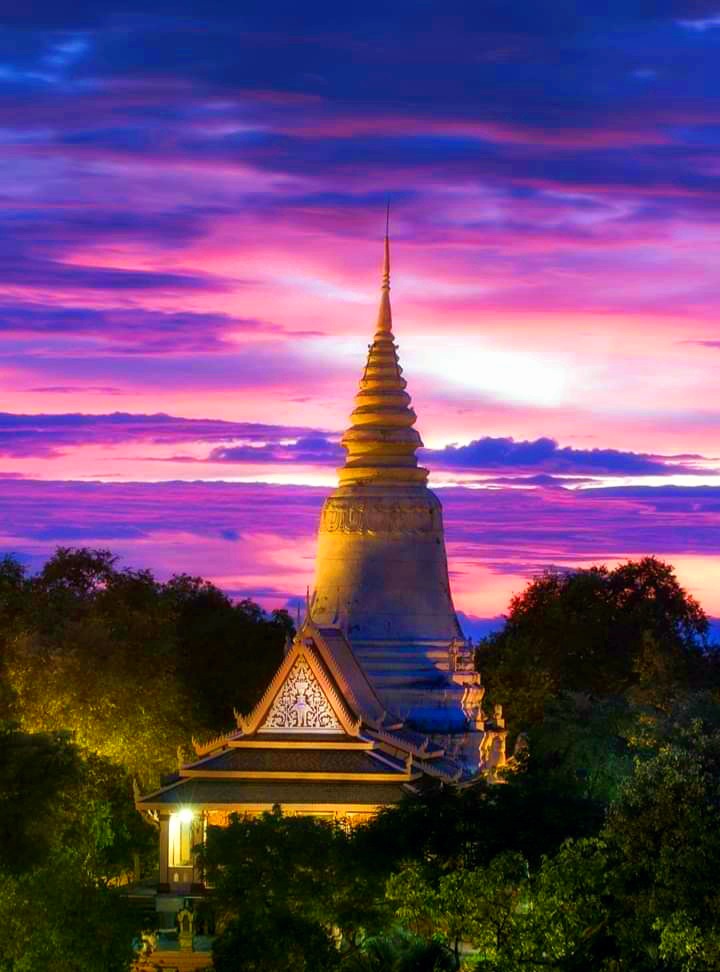
Wat Phnom (Khmer: វត្តភ្នំ, UNGEGN: Vôtt Phnum, ALA-LC: Vatt Bhnaṃ [ʋɔət pʰnom]; "Mountain Pagoda") is a Buddhist temple (wat) in Doun Penh, Phnom Penh. The site features a pagoda, a stupa symbolizing the name of Phnom Penh, and a historical site that is part of the Khmer national identity. Wat Phnom has a total height of 46 meters (150 ft).[1] The pagoda is named after Lady Penh from the story of the discovery of the five statues: four Buddha statues and one Vishnu statue.

Key Information

History

[edit]
Statue of Daun Penh, the builder of Wat Phnom, the heart of the capital Phnom Penh

According to legend, in 1372, a wealthy old lady named "Penh" lived on a small hill near the bank of the confluence of the four rivers. One day, when it was raining, Penh went down to the port to take a bath and saw a floating Koki tree in the river and she called the village to fish it from the water. She and the villagers took a piece of wood to scrape off the mud and in the hole of the Koki tree, there were four Buddha statues made of bronze, brass and one made of marble. Another statue was in the form of Vishnu with the hands holding a staff, a chain, a snail, and a lotus flower. Penh asked the villagers to help retrieve the Koki tree and retrieve the four treasures. Later, Penh assigned the villagers to build an artificial hill and build a small wooden temple on top of the hill to house the statues. She invited monks to bless the statues and the monks named the hermitage "Wat Phnom" which is known as to this day.[2]

15th century

[edit]

King Ponhea Yat (also known as Barom Reachea I) was King of Cambodia and reigned at Tuol Basan (Srey Santhor) for nine years. At the time there was severe flooding in that area, during which the capital was flooded deep in 1396 AD. When the water receded that year, He ordered Chao Ponhea Decho, the governor of Samrong Tong Province to build a new palace in Russey Keo village in the area of (Wat Phnom) today. Chao Ponhea Decho ordered the people to dig from an area which is now located where the Central Market currently stands. The hole created a lake called Boeung Decho. After a year of flooding, King Ponhea Yat moved his court from Tuol Basan, Kampong Cham province to the confluence of the Tonle Sap River in 1397 AD. After the completion of the palace, King Ponhea Yat ordered the construction of a hermitage hut on the top of the mountain near the temple of Wat Phnom, the hermitage of the district chief, which Cambodians today call Neak Ta Preah Chao and Wat Phnom called "Wat Phnom Doun Penh" "Which marks the name of Grandma "Doun Penh ". After completing the construction of his palace and city, he named the city "Chaktomuk Sakal Kampuchea Thibdey Udiya Mohanakor" in 1416 AD. His reign at Chaktomuk begun the "Chaktomuk Period" of the Kingdom of Kampuchea in 1431. After his death, a large stupa was built for him at the top of Wat Phnom.[3]

Architecture

[edit]

The sanctuary itself was rebuilt several times in the 19th century and again in 1926. The interior has a central altar complex with a large bronze seated Buddha surrounded by other statues, flowers, candles and items of devotion and worship. The walls are covered with murals, especially of Jataka stories of the Buddha's earlier reincarnations before his attainment of Enlightenment. There are also murals depicting stories from the Reamker, the Khmer version of the Ramayana. The newer murals in the bottom tiers are somewhat balanced, traditional and modern.

The southwest corner of the temple and stupa, is a small shrine dedicated to Lady Penh. The front is often crowded with the faithful bringing their prayers and food offerings to the woman deemed responsible for the founding of the wat.

Cultural references

[edit]

See also

[edit]

References

[edit]
[edit]
Revisions and contributorsEdit on WikipediaRead on Wikipedia
from Grokipedia
Wat Phnom, also known as Wat Phnom Daun Penh, is a prominent complex situated atop a 27-meter-high artificial hill in the northern part of , , making it the city's tallest religious structure and the origin of its name, which translates to "Hill of ." Founded in 1373, the site is tied to the legend of Daun Penh, a wealthy who discovered four statues and one statue inside a hollow Koki tree trunk floating in the River during a flood, prompting her to build a small on the hill to house them. As a key spiritual and cultural landmark, it attracts worshippers seeking blessings and tourists exploring Cambodian heritage, while symbolizing the city's foundational history. The temple's history reflects centuries of reconstruction and royal significance, with the original wooden structure expanded in 1434 by King , who relocated Cambodia's capital from to and later had his ashes enshrined in a large on the hill. Subsequent rebuilds occurred in 1806 under King Ang Duong, 1894 during French colonial rule, and 1926, incorporating Khmer architectural elements amid political upheavals. Today, it remains an active vihara (prayer hall) where locals offer incense, flowers, and fruits to deities, underscoring its enduring role in Buddhist practices. Architecturally, Wat Phnom features a grand eastern entrance with naga (serpent) balustrades and stone lions guarding the steep staircase, leading to the main vihara adorned with murals depicting the life of in vibrant colors. The complex includes multiple shrines, such as one dedicated to —revered as a protective spirit—and the large containing King Ponhea Yat's relics, alongside sculptures of guardian figures and Chinese influences from historical migrations. Surrounded by gardens and an market, it blends sacred tranquility with everyday Cambodian life, though visitors are advised to respect ongoing rituals and watch for opportunistic vendors.

Location and Significance

Geographical Setting

Wat Phnom is situated in the northern part of central , , at coordinates 11°34′34″N 104°55′23″E. The temple complex occupies the summit of an artificial hill known as Phnom, which rises 27 meters above the surrounding flat terrain and serves as the highest elevation in the city's central . Including the structures atop it, the site reaches a total height of 46 meters. The hill was constructed in 1372 using earth and materials from nearby areas to create a prominent mound amid the otherwise low-lying landscape of . Positioned near the confluence of the Tonle Sap River with the and Bassac rivers, Wat Phnom integrates into the urban fabric of the capital, offering panoramic views of the riverside and bustling cityscape from its elevated vantage point. The surrounding environment blends manicured gardens and tree-covered slopes with adjacent streets like Norodom Boulevard, reflecting the site's seamless incorporation into modern . Access to the hilltop is primarily through the eastern entrance, featuring a grand staircase flanked by naga (mythical serpent) balustrades and guarded by stone lions, which guide visitors upward from street level. The entire area is designated as Wat Phnom Historical Park, encompassing the temple grounds and providing a preserved green space amid the .

Historical and Cultural Importance

Wat Phnom holds profound historical and cultural significance as the foundational element of Phnom Penh's identity, with the city's name deriving from the Khmer words "phnom," meaning hill, and "Penh," referring to Lady Penh, the wealthy widow who established the temple site in 1372 after discovering four Buddha statues and one Vishnu statue in a koki tree trunk carried by floodwaters from the Mekong River. This etymological link underscores the temple's role in the urban legend that birthed the Cambodian capital, positioning it as more than a religious site but a cornerstone of local lore and communal memory. As Phnom Penh's oldest temple, constructed on the city's sole artificial hill rising 27 meters, Wat Phnom stands as the tallest religious structure in the capital and embodies Khmer national identity through its enduring presence amid political upheavals and reconstructions. It symbolizes the resilience of Cambodian heritage, particularly the centrality of , which has shaped societal values and spiritual practices since the temple's inception. In the post-Angkor era, following the 's decline in the , Wat Phnom emerged as the spiritual heart of the emerging capital, fostering a sense of continuity and renewal for Khmer culture as supplanted in 1434. Its global recognition, including a feature in the documentary based on Schultz's influential travel 1,000 Places to See , highlights its status as an essential emblem of Cambodia's sacred landscapes and historical depth.

History

Founding Legend

The founding legend of Wat Phnom centers on Daun Penh, a wealthy also known as Lady Penh, who is credited with establishing the site in 1373 CE. According to Khmer tradition, following a significant along the Mekong River, Lady Penh discovered a large koki (candlenut) trunk floating near her home on the riverbank. Upon inspecting the hollowed trunk, she found four statues of and one stone carving of the Hindu deity , interpreting this as a divine sign that the hilltop should become a sacred location for worship. Inspired by this discovery, Lady Penh mobilized local villagers to construct an artificial hill, approximately 27 meters high, using earth and materials from the surrounding area to elevate the site above levels. Atop this newly formed phnom (hill), she oversaw the building of an initial chedy, or , to enshrine the sacred images as an act of merit-making in line with . This construction marked the origins of Wat Phnom as a religious sanctuary, reflecting the integration of Buddhist and residual Hindu elements in Khmer . The statues were placed strategically to honor their distinct religious significance: the four Buddha images were housed in a vihara (hall) on the eastern side of the hill, symbolizing the primacy of reverence, while the statue was enshrined in a separate on the western side at the base of the hill. This duality underscored the site's early role as a place of inclusive amid Cambodia's syncretic traditions. The legend, preserved in oral histories and early chronicles, portrays Lady Penh's initiative as the foundational act that not only birthed the temple but also laid the groundwork for Phnom Penh's development as a spiritual center.

15th-Century Developments

In the early , the Khmer kingdom faced significant political instability due to repeated invasions by the (Siam), which contributed to the decline of as the capital. (r. 1405–1467), seeking a more defensible location with access to trade routes along the , relocated the royal capital southward from to the area of Chaktomuk (modern [Phnom Penh](/page/Phnom Penh)) around 1434. This shift marked the end of the Angkor period and the beginning of the post-Angkor era, with the new settlement named [Phnom Penh](/page/Phnom Penh) after the prominent hill and its legendary founder, Lady Penh. As part of establishing the new capital, ordered enhancements to Wat Phnom, including restorations to the existing hill and monastery to solidify its role as a central religious and symbolic site. These developments at Wat Phnom were intertwined with the broader strategic needs of the kingdom amid ongoing Siamese threats, which had already forced temporary relocations, such as to Srei Santhor in 1431 before settling at Chaktomuk. Ponhea Yat's initiatives included early renovations to the vihara (temple hall) and the addition of protective structures around the site, leveraging the hill's natural elevation for defense while integrating Buddhist elements to unify the population under royal patronage. The temple thus served not only as a spiritual center but also as a focal point for the new capital's administrative and military organization. Following Ponhea Yat's death in 1467, a massive was constructed at Wat Phnom to enshrine his ashes, commemorating his pivotal role in the kingdom's transition. This chedi, located west of the vihara, stands as one of the site's most prominent features and symbolizes the continuity of Khmer royal legacy in the . The 's erection further elevated Wat Phnom's status, reflecting the era's emphasis on monumental amid the challenges of regional conflicts.

Reconstructions and Modern Events

The temple was reconstructed in 1806 during the reign of King . In the late , during the reign of King Norodom (1860–1904), Wat Phnom underwent significant reconstruction as part of the broader development of into the Cambodian capital, incorporating elements of to enhance its role as an urban landmark. The vihara, or main sanctuary, was specifically rebuilt in 1894, reflecting the period's blend of traditional Khmer design with European influences amid the French protectorate established in 1863. This effort aligned with Norodom's initiatives to modernize the city, including surrounding the temple with parkland to elevate its prominence. The temple faced further challenges in the early due to structural decay, leading to a major rebuild of the vihara in 1926, which established the core of its current form. This reconstruction, carried out during the French colonial era, preserved key features like ornate interiors while addressing wear from time and environmental factors, ensuring the site's continued religious and cultural function. During the Khmer Rouge regime (1975–1979), Wat Phnom endured severe damage and neglect as part of the broader assault on Buddhist institutions, with many temples desecrated, looted, or repurposed under the regime's anti-religious policies. Post-regime efforts in the and focused on revival, including structural repairs, reinforcement of walls and roofs, and the rehabilitation of statues and murals through collaborations between the Cambodian government and international organizations like the UNDP. Wat Phnom was among the sites rehabilitated during this period, with over 300 pagodas nationwide restored by the mid-1990s at an average rate of 12 per year, restoring its viability as an active worship site.

Architecture

Main Structures

Wat Phnom is situated atop a 27-meter-high artificial hill, forming the central feature of the temple complex and serving as the highest point in . The layout centers on a hilltop platform accessible primarily via a grand eastern staircase flanked by intricately carved naga balustrades and guarded by stone lions at the base, providing a symbolic ascent to the sacred spaces above. This elevated arrangement emphasizes the temple's role as a focal point for worship, with surrounding assembly areas allowing gatherings around the primary structures. The central vihara, or main prayer hall, occupies the core of the hilltop and functions as the primary space for communal rituals and . Reconstructed in 1926, it houses a prominent seated statue on its , positioned at the heart of the interior and encircled by smaller images, offerings of flowers and candles, and assembly spaces for devotees. The vihara's design facilitates focused worship, with open areas adjacent to the altar enabling monks and visitors to perform ceremonies in close proximity to the central icon. The eastern sanctuary within the vihara is dedicated to Buddha veneration, aligning with the main entrance and serving as the initial point of reverence upon ascent. In contrast, the western area, historically linked to a Vishnu statue discovered during the site's founding in the , has been fully integrated into contemporary Buddhist practices, now featuring a large containing the ashes of King rather than distinct Hindu elements. This evolution reflects the temple's shift toward Buddhism while preserving the hilltop's unified religious layout.

Shrines and Stupas

The dedicated to King stands as a central memorial within the Wat Phnom complex, prominently positioned on the artificial hill. Constructed following the king's death in 1467, it enshrines his ashes and commemorates his role in relocating the Khmer capital to in 1434, marking a pivotal shift in Cambodian history. This structure, rising several meters high, exemplifies traditional Khmer funerary architecture with its tiered design and ornate cornices, serving as a enduring symbol of royal legacy. The shrine to Lady Penh, known as Daun Penh, occupies the southwest corner of the temple grounds and functions as a primary devotional site. Established in 1372 to honor the wealthy widow who discovered four bronze statues and a figure in a floating koki trunk, the shrine houses a revered of her seated in traditional attire. Devotees visit to seek blessings for prosperity and protection, underscoring her foundational role in the site's creation. The modest pavilion, surrounded by incense burners and offerings, blends animist reverence with Buddhist practice. Among the additional shrines, one dedicated to Preah Chau, a guardian spirit revered by the Vietnamese community, lies just north of Lady Penh's shrine. Flanked by statues of protective figures wielding iron bats, it reflects the site's multicultural devotional layers. Nearby, an eight-armed statue of , a remnant from the founding legend, occupies a small alcove, highlighting the historical interplay of Hindu and Buddhist elements in Khmer spirituality without a dedicated pavilion. These sub-structures collectively emphasize Wat Phnom's role as a repository of diverse commemorative and spiritual dedications.

Artistic and Decorative Features

The vihara at Wat Phnom is renowned for its extensive murals adorning the interior walls, which vividly illustrate episodes from the —narratives recounting the Buddha's previous lives and moral lessons—and scenes from the , the Khmer rendition of the Indian epic . These paintings employ traditional Khmer artistic techniques, featuring vibrant colors and symbolic imagery that emphasize themes of , devotion, and heroic deeds, with the upper sections displaying older, more weathered artwork while the lower portions incorporate fresher, stylistically balanced depictions blending classical motifs with contemporary influences. Sculptural elements throughout the complex enhance its decorative allure, including bas-relief carvings of apsaras—celestial nymphs symbolizing grace and divine beauty—etched into structural surfaces in keeping with longstanding Khmer . Guardian figures, such as intricately carved nagas (mythical serpent beings) and lions, flank the eastern staircase, serving as protective emblems rooted in Hindu-Buddhist traditions and underscoring the site's spiritual guardianship. Animal motifs are evident in these naga representations, while the vicinity's resident macaques contribute to the organic vibrancy of the surroundings, echoing broader Khmer artistic interests in as symbols of nature's harmony. The overall artistic ensemble reflects a fusion of indigenous Khmer styles with later modifications, particularly evident in the 1926 reconstruction, which introduced refreshed plaster, paint, and sculptural additions that overlay centuries-old foundations while preserving core aesthetic principles like symmetrical compositions and narrative depth. This evolution ensures the decorations remain a dynamic testament to Cambodia's enduring cultural artistry.

Religious and Cultural Role

Worship and Rituals

Wat Phnom, as a prominent Buddhist temple in , features daily worship centered on veneration of through offerings of flowers, fruit, and at the main , where devotees perform prostrations and light joss sticks to invoke blessings and accumulate merit. These routine practices align with broader traditions, where such acts of devotion express respect and seek spiritual purification. Similarly, at the adjacent of Lady Penh, worshippers present food offerings and burn , often kneeling in prayer to honor her as a foundational figure in the site's history. Monks residing at Wat Phnom play a central role in these activities, conducting morning and evening chanting sessions of suttas to consecrate the space and guide communal devotion, while also overseeing the temple's maintenance to preserve its sanctity. Visitors actively participate in merit-making, known as tam bun in Khmer, by contributing , donating to upkeep efforts, or joining in collective recitations, thereby fostering a shared sense of ethical accumulation and karmic benefit in line with principles. A distinctive aspect of worship at Wat Phnom involves protective rituals directed toward Lady Penh, revered as a neak ta or guardian spirit, where supplicants invoke her aid against illness, accidents, or misfortune through targeted prayers and offerings at her shrine. This practice exemplifies local animist-Buddhist , blending indigenous spirit veneration with orthodoxy within the temple complex, as monks occasionally bless these offerings to integrate them into the broader Buddhist framework.

Festivals and Traditions

Wat Phnom serves as a central venue for Khmer New Year, or Chaul Chnam Thmey, celebrated in mid-April to mark the solar new year and the end of the harvest season. During the three-day festival, known locally as Sangkrant Wat Phnom, thousands of devotees climb the temple's hill to offer prayers and seek blessings for prosperity and good fortune in the coming year. Processions featuring the welcoming of the New Year Goddess, accompanied by traditional music and dances, draw large crowds to the temple grounds, blending spiritual rituals with cultural performances. Pchum Ben, the 15-day ancestral festival observed in September or October according to the , draws families to Wat Phnom to honor deceased relatives through rituals at its stupas and shrines. Participants prepare and offer bay ben—small sticky rice balls mixed with sesame seeds and —scattered in the temple courtyards to nourish wandering spirits believed to return during this period. chant scriptures throughout the night, accepting food offerings on behalf of the dead, while devotees light and pray at the shrines to accumulate merit and ease the suffering of up to seven generations of ancestors. The temple's elevated stupas, housing relics, become focal points for these solemn observances, emphasizing communal remembrance and Buddhist piety. The , or , in late October or early November, connects to Wat Phnom through its proximity to the River, where the event commemorates the river's seasonal flow reversal. Although the main boat races occur along the nearby , with elaborately carved dragon boats competing in heats watched by massive crowds, Wat Phnom's riverside hill provides an ideal vantage for viewing the festivities and . Devotees visit the temple during the festival for moon-worship rituals and illuminated floats, tying the site's historical associations with water and floods to broader celebrations of renewal and abundance.

Tourism and Contemporary Use

Wat Phnom serves as a prominent tourist destination in , drawing significant crowds as part of the city's cultural itinerary and contributing to 's broader tourism sector that welcomed around 6.6 million international arrivals in 2019. Following the pandemic's impact, which reduced national tourist numbers to 1.3 million in 2020, recovery has been robust, with recording 6.7 million international visitors in 2024. In the first 10 months of 2025, welcomed over 5.5 million international visitors, indicating continued growth supporting recovery at key sites including Wat Phnom. As one of 's top attractions, Wat Phnom benefits from this rebound, with entry fees set at 1 USD for foreign visitors, making it accessible and affordable. Preservation efforts at Wat Phnom have intensified in the amid Cambodia's national heritage initiatives, supported by international organizations. The Office in has contributed to broader cultural conservation projects, including training and monitoring for historic sites to maintain authenticity and integrity. In 2025, the site hosted an exhibition of 42 repatriated Khmer artifacts, showcasing government-led recovery efforts to protect and display cultural treasures from and illicit . Anti-encroachment measures are also in place, as part of 's framework, which aims to safeguard historic areas like Wat Phnom from illegal settlements and commercial overdevelopment through regulatory audits and zoning protections. Contemporary challenges at Wat Phnom reflect its dual role as a religious site and urban public park. Rapid urban development in exerts pressure on the hilltop location, with expanding infrastructure and —reaching over 2 million residents—threatening the site's buffer zones and green spaces. The grounds function as a lively public park, frequented by locals for relaxation, exercise, and picnics, but also home to a troop of long-tailed macaques that roam freely, occasionally causing disruptions such as thefts of food and belongings from visitors. Street vendors line the approaches, selling snacks, souvenirs, and offerings, adding to the vibrant atmosphere while raising concerns about and site maintenance in this densely populated urban setting.

References

Add your contribution
Related Hubs
User Avatar
No comments yet.