Hubbry Logo
Verge escapementVerge escapementMain
Open search
Verge escapement
Community hub
Verge escapement
logo
8 pages, 0 posts
0 subscribers
Be the first to start a discussion here.
Verge escapement
Verge escapement
from Wikipedia
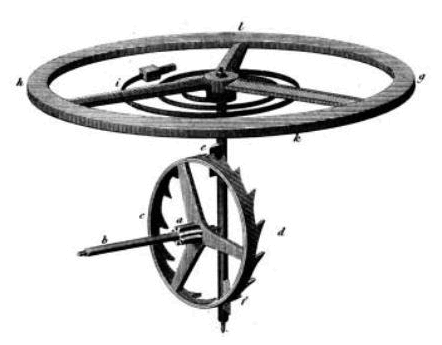
Verge escapement and balance wheel from an early pocketwatch
Verge and foliot escapement from De Vick tower clock, built in Paris, 1379, by Henri de Vick

The verge (or crown wheel) escapement is the earliest known type of mechanical escapement, the mechanism in a mechanical clock that controls its rate by allowing the gear train to advance at regular intervals, or ticks. Verge escapements were used from the late 13th century until the mid 19th century in clocks and pocketwatches. The name verge comes from the Latin virga, meaning "stick" or "rod".[1]

Its invention is important in the history of technology, because it made possible the development of all-mechanical clocks. This caused a shift from measuring time by continuous processes, such as the flow of liquid in water clocks, to repetitive, oscillatory processes, such as the swing of pendulums, which had the potential to be more accurate.[2][3] Oscillating timekeepers keep time for all modern clocks.[4][2][5][6][7]

Verge and foliot clocks

[edit]
One of the earliest existing drawings[8] of a verge escapement, in Giovanni de Dondi's astronomical clock, the Astrarium, built 1364, Padua, Italy. This had a balance wheel (crown shape at top) instead of a foliot. The escapement is just below it. From his 1364 clock treatise, Il Tractatus Astrarii.

The verge escapement dates from 13th-century Europe, where its invention led to the development of the first all-mechanical clocks.[3][9][10] Starting in the 13th century, large tower clocks were built in European town squares, cathedrals, and monasteries. They kept time by using the verge escapement to drive a foliot, a primitive type of balance wheel.[11] The foliot was a horizontal bar with weights near its ends affixed to a vertical bar called the verge which was suspended free to rotate. The verge escapement caused the foliot to oscillate back and forth about its vertical axis.[12] The rate of the clock could be adjusted by moving the weights in or out on the foliot.

The verge escapement probably evolved from an alarm mechanism to ring a bell which had appeared centuries earlier.[13][14] There has been speculation that Villard de Honnecourt invented the verge escapement in 1237 with an illustration of a strange mechanism to turn an angel statue to follow the sun with its finger,[15][16] but the consensus is that this was not an escapement.[17][18][19][20][21][22]

It is believed that sometime in the late 13th century the verge escapement mechanism was applied to tower clocks, creating the first mechanical escapement clock.[11] In spite of the fact that these clocks were celebrated objects of civic pride which were written about at the time, it may never be known when the new escapement was first used.[13] This is because it has proven difficult to distinguish from the meager written documentation which of these early tower clocks were mechanical, and which were water clocks; the same Latin word, horologe, was used for both.[23][11] None of the original mechanisms have survived unaltered. Sources differ on which was the first clock 'known' to be mechanical, depending on which manuscript evidence they regard as conclusive. One candidate is the Dunstable Priory clock in Bedfordshire, England built in 1283, because accounts say it was installed above the rood screen, where it would be difficult to replenish the water needed for a water clock.[24][11] Another is the clock built at the Palace of the Visconti, Milan, Italy, in 1335.[25] Astronomer Robertus Anglicus wrote in 1271 that clockmakers were trying to invent an escapement, but hadn't been successful yet.[26][11] However, there is agreement that mechanical clocks existed by the late 13th century.[3][23][27]

Salisbury Cathedral clock, 1386?, Salisbury, England, shows what the first verge clocks looked like. It did not have a clock face but was built to ring the hours. The few original verge clock mechanisms like this surviving from the Middle Ages have all been extensively modified. This example, like others, was found with the original verge and foliot replaced by a pendulum; a reproduction verge and foliot, shown in the righthand picture, was added in 1956.

The earliest description of an escapement, in Richard of Wallingford's 1327 manuscript Tractatus Horologii Astronomici on the clock he built at the Abbey of St. Albans, was not a verge, but a variation called a 'strob' escapement.[28][29] It consisted of a pair of escape wheels on the same axle, with alternating radial teeth.[11] The verge rod was suspended between them, with a short crosspiece that rotated first in one direction and then the other as the staggered teeth pushed past. Although no other example is known, it is possible that this design preceded the more usual verge in clocks.[28]

For the first two hundred years or so of the mechanical clock's existence, the verge, with foliot or balance wheel, was the only escapement used in mechanical clocks. In the sixteenth century alternative escapements started to appear, but the verge remained the most used escapement for 350 years until mid-17th century advances in mechanics, resulted in the adoption of the pendulum, and later the anchor escapement. [30] Since clocks were valuable, after the invention of the pendulum many verge clocks were rebuilt to use this more accurate timekeeping technology, so very few of the early verge and foliot clocks have survived unaltered to the present day.

How accurate the first verge and foliot clocks were is debatable, with estimates of one to two hours error per day[31][13][2] being mentioned, although modern experiments with clocks of this construction show accuracies of minutes per day were achievable with enough care in design and maintenance.[32][33] Early verge clocks were probably no more accurate than the previous water clocks,[16] but they did not require water to be manually hauled to fill the reservoir, did not freeze in winter, and were a more promising technology for innovation. By the mid-17th century, when the pendulum replaced the foliot, the best verge and foliot clocks had achieved an accuracy of 15 minutes per day.

Verge pendulum clocks

[edit]

Most of the gross inaccuracy of the early verge and foliot clocks was due not to the escapement itself, but to the foliot oscillator. The first use of pendulums in clocks around 1656 suddenly increased the accuracy of the verge clock from hours a day to minutes a day. Most clocks were rebuilt with their foliots replaced by pendulums,[34][35] to the extent that it is difficult to find original verge and foliot clocks intact today. A similar increase in accuracy in verge watches followed the introduction of the balance spring in 1658.

How it works

[edit]
Verge escapement showing (c) crown wheel, (v) verge, (p,q) pallets
Verge escapement in motion
The second verge pendulum clock built by Christiaan Huygens, inventor of the pendulum clock, 1673. Huygens claimed an accuracy of 10 seconds per day. In a pendulum clock, the verge escapement is turned 90 degrees so that the crown wheel faces up (top).

The verge escapement consists of a wheel shaped like a crown, called the escape wheel, with sawtooth-shaped teeth protruding axially toward the front, and with its axis oriented horizontally.[13][36] In front of it is a vertical rod, the verge, with two metal plates, the pallets, that engage the teeth of the escape wheel at opposite sides. The pallets are not parallel, but are oriented with an angle in between them so only one catches the teeth at a time. Attached to the verge at its top is an inertial oscillator, a balance wheel or in the earliest clocks a foliot, a horizontal beam with weights on either end. This is the timekeeper of the clock.

As the clock's gears turn the crown wheel (see animation), one of its teeth catches on a pallet, pushing on it.[13] This rotates the verge and foliot in one direction, and rotates the second pallet into the path of the teeth on the opposite side of the wheel, until the tooth slides off the end of the pallet, releasing it. Then the crown wheel rotates freely a short distance until a tooth on the wheel's opposite side contacts the second pallet, pushing on it. This reverses the direction of the verge rod and foliot, rotating the verge back the other direction, until this tooth pushes past the second pallet. Then the cycle repeats. The result is to change the rotary motion of the wheel to an oscillating motion of the verge and foliot. Each swing of the balance wheel thus allows one tooth of the escape wheel to pass, advancing the wheel train of the clock by a fixed amount, moving the hands forward at a constant rate. The moment of inertia of the foliot or balance wheel controls the oscillation rate, determining the rate of the clock. The escape wheel tooth, pushing against the pallet each swing, provides an impulse which replaces the energy lost by the foliot to friction, keeping it oscillating back and forth.

In a verge pendulum clock (see picture) which appeared after the pendulum was invented in 1656, the escapement was turned 90° so the verge rod was horizontal, while the escape wheel's axis was vertical, located under the verge rod. In the first pendulum clocks the pendulum was attached to the end of the verge rod instead of the balance wheel or foliot. In later pendulum clocks the pendulum was suspended by a short straight spring of metal ribbon from the clock frame, and a vertical arm attached to the end of the verge rod ended in a fork which embraced the pendulum rod; this avoided the friction of suspending the pendulum directly from the pivoted verge rod. Each swing of the pendulum released an escape wheel tooth.

The escape wheel must have an odd number of teeth for the escapement to function.[36] With an even number, two opposing teeth will contact the pallets at the same time, jamming the escapement. The usual angle between the pallets was 90° to 105°,[13][36] resulting in a foliot or pendulum swing of around 80° to 100°. In order to reduce the pendulum's swing to make it more isochronous, the French used larger pallet angles, upward of 115°.[36] This reduced the pendulum swing to around 50° and reduced recoil (below), but required the verge to be located so near the crown wheel that the teeth fell on the pallets very near the axis, reducing initial leverage and increasing friction, thus requiring lighter pendulums.[36][37]

Disadvantages

[edit]

As might be expected from its early invention, the verge is the most inaccurate of the widely used escapements. It suffers from these problems:

  • Verge watches and clocks are sensitive to changes in the drive force; they slow down as the mainspring unwinds.[36] This is called lack of isochronism. It was much worse in verge and foliot clocks due to the lack of a balance spring, but is a problem in all verge movements. In fact, the standard method of adjusting the rate of early verge watches was to alter the force of the mainspring.[38] The cause of this problem is that the crown wheel teeth are always pushing on the pallets, driving the pendulum or balance wheel throughout its cycle; the timekeeping element is never allowed to swing freely.[36] Thus a decreasing drive force causes the pendulum or balance wheel to swing back and forth more slowly. All verge watches and spring driven clocks required fusees to equalize the force of the mainspring to achieve even minimal accuracy.
  • The escapement has "recoil", meaning that the momentum of the foliot or pendulum pushes the crown wheel backward momentarily, causing the clock's wheel train to move backward, during part of its cycle.[13][36] This increases friction and wear, resulting in inaccuracy. One way to tell whether an antique watch has a verge escapement is to observe the second hand closely; if it moves backward a little during each cycle, the watch is a verge. This is not necessarily the case in clocks, as there are some other pendulum escapements which exhibit recoil.
  • In pendulum clocks, the wide pendulum swing angles of 80°-100° required by the verge cause an additional lack of isochronism due to circular error.
  • The wide pendulum swings also cause a lot of air friction, reducing the accuracy of the pendulum, and requiring a lot of power to keep it going, increasing wear.[13] So verge pendulum clocks had lighter bobs, which reduced accuracy.
  • Verge timepieces tend to accelerate as the crown wheel and the pallets wear down. This is particularly evident in verge watches from the mid-18th century onward. It is not in the least unusual for these watches, when run today, to gain many hours per day, or to simply spin as if there were no balance present. The reason for this is that as new escapements were invented, it became the fashion to have a thin watch. To achieve this in a verge watch requires the crown wheel to be made very small, magnifying the effects of wear.
Modern reproduction of an early verge and foliot clock. The pointed-tooth verge wheel is visible, with the wooden foliot rod and suspended weight above it.

Decline

[edit]

Verge escapements were used in virtually all clocks and watches for 400 years. Then the increase in accuracy due to the introduction of the pendulum and balance spring in the mid 17th century focused attention on error caused by the escapement. By the 1820s, the verge was superseded by better escapements, though inexpensive verge watches continued to be made through the 19th century.[citation needed]

In pocketwatches, besides its inaccuracy, the vertical orientation of the crown wheel and the need for a bulky fusee made the verge movement unfashionably thick. French watchmakers adopted the thinner cylinder escapement, invented in 1695. In England, high end watches went to the duplex escapement, developed in 1782, but relatively inexpensive verge fusee watches continued to be produced until the mid 19th century, when the lever escapement took over.[38][39] These later verge watches were colloquially called 'turnips' because of their bulky build.

The verge was only used briefly in pendulum clocks before it was replaced by the anchor escapement, invented around 1660 probably by Robert Hooke, and widely used beginning in 1680.[40] The problem with the verge was that it required the pendulum to swing in a wide arc of 80° to 100°. Christiaan Huygens in 1674 showed that a pendulum swinging in a wide arc is an inaccurate timekeeper, because its period of swing is sensitive to small changes in the drive force provided by the clock mechanism.[40]

Although the verge is not known for accuracy, it is capable of it. The first successful marine chronometers, H4 and H5, made by John Harrison in 1759 and 1770, used verge escapements with diamond pallets.,[13][38][41] In trials they were accurate to within a fifth of a second per day.[42]

Today the verge is seen only in antique or antique-replica timepieces. Many original bracket clocks have their Victorian-era anchor escapement conversions undone and the original style of verge escapement restored. Clockmakers call this a verge reconversion.[citation needed]

See also

[edit]

References

[edit]

Further reading

[edit]
[edit]
Revisions and contributorsEdit on WikipediaRead on Wikipedia
from Grokipedia
The verge escapement is the earliest known mechanical escapement mechanism, regulating the rate of a clock or watch by controlling the intermittent release of energy from a weight or spring to the gear train through interaction between a toothed crown wheel and two pallets attached to a pivoted verge. Invented in Europe during the late 13th or early 14th century by unknown artisans, it marked the transition from water clocks to fully mechanical timepieces, enabling the construction of the first tower clocks in Italian cities and later domestic clocks and portable watches. In its operation, the crown wheel's teeth successively engage and disengage the pallets—positioned at approximately right angles on the verge staff—causing the attached regulator, initially a foliot (a horizontal crossbar with adjustable weights) and later a or short , to oscillate and receive impulses that sustain its motion while advancing the wheel one tooth at a time. This frictional-rest design distributes power in discrete ticks but inherently involves recoil, where the escape wheel and briefly reverse direction during each cycle, generating significant wear, friction, and variability in timing accuracy, often limited to within 15-30 minutes per day. Despite these limitations, the verge escapement dominated horology for over 300 years, powering large public clocks, early spring-driven watches from the onward, and even adaptations with Huygens' in the for improved precision. The mechanism's significance lies in its foundational role in mechanical timekeeping, fostering innovations like the fusee for even power delivery in watches and influencing subsequent escapements, though it was gradually supplanted by the more efficient for pendulums in the late and the for watches in the due to demands for greater accuracy and reduced maintenance. Today, surviving verge-equipped timepieces, such as bracket clocks and pair-case pocket watches, are valued antiques that illustrate the evolution of horological engineering.

History

Origins and Invention

The verge escapement emerged in during the late as the earliest known mechanical escapement mechanism, enabling the creation of weight-driven clocks independent of , , or other non-mechanical power sources. This innovation marked a pivotal shift in timekeeping technology, transitioning from ancient devices like clepsydrae ( clocks) and sundials to fully mechanical systems capable of regulating motion through intermittent release of energy. Its development is attributed to the needs of monastic communities in the , where precise timing was essential for coordinating the of prayer and daily routines, fostering a for reliable, autonomous timekeepers. No specific inventor has been identified for the verge escapement, which likely arose anonymously among clockmakers, possibly blacksmiths, craftsmen, or familiar with celestial modeling technologies such as armillary spheres. The approximate timeline of its invention places it between 1270 and , with the first documentary evidence appearing in monastic records around , though unconfirmed prototypes may predate this. Possible early conceptual links include references in works by Robertus Anglicus (1271) or (c. 1240–1251), though the latter is debated as it may depict an rather than a clock . The mechanism's first clear illustration dates to 1364 in a drawing by Giovanni de Dondi. The earliest potential implementation occurred in , with a clock at the Priory Church in recorded in 1283, followed by installations at (1286) and (1288). Initial applications focused on turret clocks in public and settings, serving as time signals for urban communities and religious observances rather than precise minute-tracking. Examples include early tower clocks in English sites like (1386) and continental developments such as the Milan clock tower (1335), which utilized the to drive bell-striking mechanisms. This role in foliot-regulated clocks laid the foundation for broader mechanical timekeeping, though details of its integration appear in later sections.

Early Adoption

The verge escapement found its first documented application in the astronomical clock designed by of Wallingford for St Albans Abbey in , with construction beginning in 1327 and completed after his death in 1336. This innovative timekeeper, intended to display celestial movements, marked a pivotal step in mechanical horology by enabling consistent weight-driven operation without reliance on water or sand. The mechanism rapidly disseminated across continental Europe, appearing in public installations such as the striking clock in Milan's San Gottardo campanile in 1336, followed by similar devices in Italian city-states like Florence and Bologna, as well as French monastic sites including those in Paris and Strasbourg. By 1400, such public clocks had become widespread in European towns and cities, transforming urban landscapes with their tower-mounted dials and bells. This adoption was propelled by societal needs: churches sought precise regulation of canonical hours and communal prayers, trade guilds required synchronized work schedules to enhance productivity in burgeoning crafts, and civic authorities in growing urban centers used clocks to coordinate markets, assemblies, and daily . These early verge-equipped clocks typically incorporated a foliot for basic control. However, primitive metallurgy and coarse machining led to significant wear on components, demanding frequent manual winding—often daily—and regular repairs by specialized clockmakers to maintain functionality amid inherent inaccuracies of approximately 5 minutes per day.

Design and Components

Key Elements

The verge escapement's core functionality relies on a few essential physical components that interact to regulate the release of energy from the timepiece's driving mechanism. The crown wheel, also known as the escape wheel, is a toothed gear typically crafted from hardened , featuring 13 to 15 sawtooth-shaped teeth protruding axially toward the front, parallel to its rotation axis. These teeth are angled forward in the direction of rotation and must number an odd quantity to avoid simultaneous engagement with the pallets, ensuring smooth operation; the wheel is driven continuously by the clock's weight-driven or, in later adaptations, a . The verge serves as the central oscillating staff, a vertical rod or arbor pivoted at both ends within the frame, usually made from tempered steel for durability. It measures approximately 8 to 9 s in length, with its body filed to a narrow profile (less than 1/8 ligne thick) and often featuring a seat for attachment to the regulating element. Attached to the verge are two pallets, rectangular hardened metal plates—typically —positioned at an angle of about 90 to 105 degrees relative to each other, with the upper pallet slightly longer and the lower one shorter for clearance. These pallets have flat, beveled faces (narrowed to 1/4 to 1/3 their width) of equal breadth, ideally one-sixth the diameter of the crown wheel, to precisely lock and release the teeth. Oscillation of the verge, which drives the pallets' alternating action, is provided by a foliot or attached to its end. The supporting frame integrates these elements into the clock's , consisting of two plates (pillar and top plates) spaced by pillars about 2.5 to 3 lignes high, with the crown wheel's horizontal axis mounted parallel to the verge's pivot axis. Holes in the plates are bushed for pivot support, and a potence (or cock) structure holds the assembly, ensuring alignment; early designs used iron, but predominated for its and resistance to wear. Lubrication points at the pivots and gear interfaces employ specialized watch oils, applied sparingly via small oilers to minimize friction, though early versions relied on unstable organic oils like vegetable-based ones that attracted dust and required frequent renewal.

Assembly and Configuration

The verge escapement is assembled with the verge oriented vertically and pivoted on a horizontal axis parallel to the crown wheel's axis, enabling the pallets to engage the wheel's teeth within a vertical plane. This setup positions the two pallets—typically one above and one below the pivot—at an angle of approximately 90 to 105 degrees relative to each other, such that in the rest position, they catch the crown wheel's teeth at about 30 to 45 degrees from the vertical to facilitate alternate locking. Integration with the clock's occurs through the crown wheel, which meshes directly with the going train powered by a falling weight, while a fusée mechanism transmits to compensate for the decreasing as the weight descends, ensuring relatively consistent drive in weight-driven clocks. Calibration involves fine-tuning the angles to achieve equal lock and release times, often adjusting the impulse faces to around 25 to 39 degrees for optimal engagement and minimal , thereby balancing the escapement's operation. The verge's length, or the crutch arm in adaptations, is set to match the oscillator's period—such as by positioning adjustable weights on a foliot to tune its —ensuring synchronized impulses. Material selection emphasizes durability, with the verge and crown wheel commonly forged from iron or to withstand operational stresses, while the pallet tips are fitted with for resistance to wear from repeated impacts.

Operation

Mechanical Sequence

The mechanical sequence of the verge escapement operates as a cyclic process that intermittently releases from the crown wheel to the verge, thereby sustaining the of the attached foliot or . This sequence unfolds over a single of the oscillator, involving distinct phases of locking, unlocking, impulse, and , with the on the verge alternating roles to maintain bidirectional motion. In the locking phase, a of the crown wheel engages and presses firmly against the locking face of one —typically the upper or lower depending on the direction of oscillation—effectively halting the wheel's rotation and preventing further advancement of the . This engagement persists until the foliot or swings far enough in its arc to pivot the verge, thereby disengaging the from the . The design of the faces, often curved or angled to minimize , ensures stable locking without excessive during this hold. Unlocking occurs as the continued swing of the oscillator rotates the verge, withdrawing the engaged pallet and releasing the crown wheel tooth, which then allows the wheel to advance freely for a short angular distance, typically equivalent to a fraction of a tooth (e.g., 2-4 degrees). Immediately following, the advancing tooth transitions to the impulse face of the same or adjacent pallet, where it delivers a sharp "kick" that transfers kinetic energy through the verge to the oscillator, reinforcing its motion and countering frictional losses. This impulse phase is critical for maintaining the oscillator's amplitude, with the tooth sliding briefly along the pallet's impulse surface before full disengagement. A defining feature of the verge escapement is the subsequent , in which the of the verge causes it to pivot slightly backward after the impulse, prompting the crown wheel to reverse its direction briefly—often by a small angle—before stabilizing. This arises from the non-deadbeat nature of the , where the impulse face's angle induces a reactive force that temporarily opposes the wheel's forward motion, distinguishing the mechanism from later, smoother escapements. The full cycle repeats symmetrically with the opposite pallet during the return swing of the oscillator, ensuring impulses are provided in both directions to sustain continuous oscillation. Each complete back-and-forth motion of the foliot or thus corresponds to one "tick-tock" beat, with the crown advancing net progress of one tooth per full cycle while the alternating engagements regulate the timing. This bidirectional repetition allows the to operate indefinitely under the drive of or spring mechanism.

Timing Dynamics

The verge escapement regulates the timing of a mechanical clock through periodic impulses that sustain the of its attached regulator, such as a foliot or later a . Each contact between a crown wheel and a verge delivers an impulse, transferring to the verge assembly and thereby driving its against dissipative forces like in the pivots and air resistance. This energy input accelerates the regulator until the opposing pallet engages the next tooth, which decelerates it, completing one half-cycle of oscillation. The process repeats, creating a rhythmic "tick-tock" that advances the one per full cycle. The beat rate of the verge escapement, defined as the of complete , is determined by the natural period of the regulator matching the duration of the lock phase, where the is held stationary by pallet-tooth engagement. In early small domestic clocks, this typically results in beat periods of about 1-2 seconds, corresponding to rates of roughly 0.5-1 per second, while larger turret clocks exhibit longer periods of 5-10 seconds. These rates arise from the dynamical interplay of driving and frictional , lacking any inherent restoring force in the foliot , which leads to non-isochronous where the period varies with and drive strength. A simplified energy balance governs the escapement's steady-state operation, where the energy input per cycle from the drive approximates the frictional losses plus the kinetic energy imparted to the regulator: EinputEfriction+12Jθ˙max2E_{\text{input}} \approx E_{\text{friction}} + \frac{1}{2} J \dot{\theta}_{\max}^2 Here, EinputE_{\text{input}} is the work done by the weight or spring per cycle, EfrictionE_{\text{friction}} represents dissipative losses, JJ is the moment of inertia of the verge-regulator assembly, and θ˙max\dot{\theta}_{\max} is its maximum angular velocity. Without isochronous properties, the oscillation rate fluctuates with changes in drive force or amplitude, as the system's period scales inversely with torque in weak-drive regimes and as its cube root in strong-drive conditions. Friction plays a central role in the escapement's dynamics, dissipating energy primarily at the pallet-tooth interfaces and verge pivots, which necessitates robust impulses to maintain oscillation. Modeled as a velocity-dependent torque F=Rθ˙DF = R |\dot{\theta}| D, where RR is a friction coefficient and DD is contact pressure, this dissipation consumes energy equivalent to the regulator's dynamic input per cycle, preventing runaway acceleration while introducing variability in timing. High internal friction, often with coefficients around 0.1, demands strong drive forces that amplify wear and rate inconsistencies.

Variations

Foliot Integration

The foliot, integral to the early verge escapement, consists of a or beam mounted on the upper end of the vertical verge staff, featuring adjustable weights, often lead cursors, positioned symmetrically at each end to regulate the period. These weights, typically around 100 grams each in historical reconstructions, can be slid along the bar to modify the , with the bar itself constructed from or metal for durability in tower clock applications. The design relies on the foliot's to control the timing, oscillating about the verge's axis in arcs of approximately 80° to 100°, driven by the escapement's interaction with the crown wheel. In operation, the foliot synergizes with the verge by providing a gravity-based restoring : when displaced from its horizontal equilibrium, the offset weights generate a gravitational force that seeks to realign the bar, while the verge's pallets receive impulses from the crown wheel's to counteract frictional and sustain . Each impulse occurs as a engages a , imparting energy to rotate the verge and foliot, with the process repeating alternately on opposite sides to maintain steady ; the foliot's ensures the period remains relatively consistent despite these periodic kicks, though energy losses from collisions and bearing necessitate ongoing drive from the clock's falling weight. Typical oscillation periods range from approximately 1 to 3 seconds per full swing in smaller clocks, extending to 5 to 10 seconds in larger tower mechanisms, enabling the escapement to release the wheel train in discrete steps. Period adjustment is achieved by repositioning the weights: sliding them inward reduces the , shortening the period and accelerating the clock, while moving them outward has the opposite effect, lengthening the period for slower timekeeping; this mechanical tuning allowed clockmakers to calibrate the device empirically, though it lacked any temperature compensation, making the rate sensitive to in materials. This configuration was predominantly employed in 14th- to 16th-century European tower clocks, such as those in (1386) and (1379), where the foliot-verge system powered bell-striking mechanisms for public time signaling in monasteries and civic buildings. Despite its ingenuity, the setup yielded daily errors of about 15 minutes, primarily due to the foliot's sensitivity to external factors such as wind in exposed tower environments, which altered frictional forces and gravitational components.

Pendulum Adaptation

The pendulum adaptation of the was pioneered by in 1656–1657, when he integrated a into the mechanism of his newly invented , supplanting the traditional foliot balance with a approximately 39 inches (1 meter) in length that had a 2-second period. This substitution leveraged the pendulum's more regular oscillations to regulate the , fundamentally improving the clock's consistency compared to the foliot's crude balancing action. To suit the pendulum's narrower swing amplitude, the verge escapement underwent key configuration changes, including an arc of approximately 20° to 30° or more for the pendulum's swing, reduced from the foliot's wider arcs. The pallets were also angled to align more precisely with the crown wheel's teeth, thereby minimizing positional errors during the pendulum's arc and ensuring smoother impulse delivery. This adaptation capitalized on the pendulum's isochronism—the property where its oscillation period varies little with —yielding initial accuracies of 10–15 seconds per day and enabling the widespread adoption of domestic clocks. Huygens refined the system further in the 1660s by incorporating cycloidal cheeks, curved metal guides that wrapped the pendulum's suspension thread to enforce a cycloidal path and promote a conoidal swing for enhanced isochronism. Despite these advances, the verge escapement's inherent persisted as a limiting factor, introducing variability in the pendulum's motion.

Balance Wheel Variation

In the 16th century, the verge escapement was adapted for use in portable spring-driven watches, replacing the foliot with a and spiral hairspring (invented around 1675 by Huygens or Hooke). This variation allowed for smaller, more compact timepieces while maintaining the basic impulse mechanism, though accuracy remained limited to about 15-30 minutes per day due to the escapement's inefficiencies.

Performance and Limitations

Accuracy Characteristics

The verge escapement with foliot regulator, as used in 14th-century tower clocks, typically exhibited timekeeping errors of 1 to 2 hours per day due to the irregular of the foliot and high in the mechanism. By the 1500s, refinements in craftsmanship and adjustments had improved performance in well-maintained examples to errors of 15 to 30 minutes per day, though variability remained high across installations. When adapted for pendulum regulation in the late , the verge escapement achieved significantly better results in Huygens' initial designs, with claimed errors of 10 to 15 seconds per day under ideal conditions. However, in mass-produced 18th-century clocks and watches, wear from and led to degradation, resulting in typical errors of 1 to 5 minutes per day. Key factors influencing accuracy included positional sensitivity due to uneven force distribution on the pallets. Temperature variations also affected pendulum-equipped versions, with uncompensated length expansion causing rate changes. Historical accuracy was verified through comparisons with sundials for or astronomical observations of stars for time, often requiring daily adjustments by custodians. Modern recreations of verge-foliot mechanisms confirm variances under 2 minutes per day under controlled conditions, aligning with improved historical reports when accounting for craftsmanship.

Inherent Drawbacks

The verge escapement's effect, inherent to its design, occurs when the pallets impart impulse to the crown wheel, causing a backward kick that reverses the wheel's direction momentarily. This leads to variable impulse strength delivered to the oscillator, as the backward motion dissipates energy unevenly and introduces in the drive, resulting in inconsistent amplitude maintenance for the foliot or . Studies of the mechanism's dynamics indicate that such variations can cause fluctuations of up to 20% depending on frictional conditions and alignment, compromising the regularity of oscillations. High friction represents another fundamental limitation, arising from the sliding impacts between the crown wheel's teeth and the pallets during each engagement. These contacts generate significant and on the components, necessitating frequent to mitigate seizing, while contributing to energy losses of 30-50% per cycle through dissipative forces in the journal bearings and contact surfaces. The not only accelerates mechanical degradation but also demands that a substantial portion of the input from the driving or spring be allocated to overcoming these losses rather than sustaining , thus reducing overall . The escapement's non-isochronous motion further undermines its precision, as the large swing angles required—typically 45-90 degrees for the foliot oscillator—deviate from the ideal small-angle approximations needed for constant period, while pendulum adaptations used smaller arcs. At these , the restoring force's nonlinearity causes the period to lengthen at lower swings, particularly when amplitude diminishes due to or uneven impulses, thereby introducing rate inconsistencies that accumulate over time. This effect is exacerbated in foliot-based systems, where the broad arcs amplify positional errors in the balance's motion. Finally, the verge escapement exhibits acute sensitivity to variations in drive force, as the from the descending weight or unwinding directly influences the impulse magnitude and oscillation period, which scales inversely with the of the . Uneven descent alters this progressively, causing the clock to accelerate as the power reserve depletes and leading to daily rate variations of up to 15%. This dependency on consistent drive input makes the mechanism particularly vulnerable to inconsistencies in the fusee or going barrel, without which the cannot maintain stable operation.

Legacy

Decline and Replacement

The introduction of the marked a pivotal advancement in clockmaking, gradually rendering the verge escapement obsolete in precision timepieces. In 1715, English clockmaker developed the dead-beat variant of the for longcase clocks, which eliminated the recoil inherent in earlier designs and significantly improved accuracy by reducing errors to a few seconds per day when paired with innovations like the in 1721. This design allowed for smaller pendulum arcs—down to 6 degrees—minimizing and enabling more stable operation compared to the verge's wide swings and positional sensitivities. By the 1720s, leading English clockmakers had largely transitioned to escapements for pendulum-regulated clocks, prioritizing the enhanced reliability for domestic and scientific applications. Although , a prominent figure in early 18th-century horology, primarily worked with verge mechanisms before his death in 1713, his successors like Graham accelerated the shift toward designs in finer instruments. In contrast, French lantern clocks continued to employ the simpler verge escapement until the mid-18th century, around the 1750s, due to its ease of construction and suitability for less demanding uses in regions like . The development of marine chronometers further underscored the verge escapement's limitations, particularly its vulnerability to positional variations and vibrations at sea. In the 1720s, invented the grasshopper escapement as part of his efforts to solve the problem, creating a low-friction mechanism that maintained precision under shipboard conditions and highlighted the verge's inadequacies for such environments—issues that earlier escapements like the verge presented in such environments, which Harrison addressed through his invention of the grasshopper escapement employed in his first prototype H1 (1735). The verge escapement lingered in inexpensive 19th-century bracket clocks and pocket watches, valued for its low production costs, but it was ultimately supplanted by the , which offered superior accuracy and durability. By the 1820s, the —patented by Thomas Mudge in 1755—had begun to dominate the watch market, becoming common in mass-produced timepieces and relegating the verge to the cheapest segments until its near-total phase-out by the mid-19th century.

Historical Significance

The verge escapement, as the earliest known mechanical escapement invented in the late , fundamentally enabled the transition from water clocks to weight-driven mechanical timepieces, revolutionizing the measurement of time by providing a reliable oscillatory mechanism independent of natural forces like or flow. This innovation allowed for the construction of the first public clocks in European cities, synchronizing community activities such as religious services, markets, and civic events, which laid the groundwork for structured urban life. By the 18th and 19th centuries, these early mechanical clocks, still reliant on the verge design in many cases, played a pivotal role in the by enforcing and coordinating factory shifts, thereby boosting productivity and economic growth in early adopting regions. Culturally, the verge escapement symbolized medieval Europe's technological advancement, powering the grand clock towers that became iconic features of , such as those integrated into cathedrals and town halls to proclaim communal time and authority. These structures not only served practical purposes but also embodied the era's blend of engineering and aesthetics, influencing artistic representations of time in illuminated manuscripts and civic monuments. In the realm of , the escapement's limitations—its reliance on a foliot for regulation—prompted studies of oscillatory motion; Galileo's observations of isochronism in the early 17th century directly inspired to refine the verge mechanism for clocks in 1656, marking a leap in precision timekeeping that advanced astronomy and . The verge escapement's educational legacy endures as the foundational example in horology curricula, illustrating core principles of energy release and frictional control in mechanical oscillators, with hands-on recreations used to teach aspiring watchmakers the evolution of timepiece design. Surviving 14th- and 15th-century examples, such as the restored verge-equipped mechanisms in historic tower clocks like the one at (dating to circa 1386) and the 1450 French table clock in the , are preserved in institutions worldwide, offering tangible insights into pre-modern engineering. In contemporary horology, while obsolete for practical use, the design inspires rare artisanal recreations in educational clocks and experimental pieces, honoring its historical authenticity amid modern precision standards.

References

Add your contribution
Related Hubs
User Avatar
No comments yet.