Hubbry Logo
search
logo
2312473

Waveguide

logo
Community Hub0 Subscribers
Read side by side
from Wikipedia

An example of a waveguide: A section of flexible waveguide used for radar that has a flange.
(animation) Electric field Ex component of the TE31 mode inside an x-band hollow metal waveguide. A cross-section of the waveguide allows a view of the field inside.
Electric field Ex component of the TE31 mode inside an x-band hollow metal waveguide.

A waveguide is a structure that guides waves by restricting the transmission of energy to one direction. Common types of waveguides include acoustic waveguides which direct sound, optical waveguides which direct light, and radio-frequency waveguides which direct electromagnetic waves other than light like radio waves.

Without the physical constraint of a waveguide, waves would expand into three-dimensional space and their intensities would decrease according to the inverse square law.

There are different types of waveguides for different types of waves. The original and most common meaning is a hollow conductive metal pipe used to carry high frequency radio waves, particularly microwaves.[1] Dielectric waveguides are used at higher radio frequencies, and transparent dielectric waveguides and optical fibers serve as waveguides for light. In acoustics, air ducts and horns are used as waveguides for sound in musical instruments and loudspeakers, and specially-shaped metal rods conduct ultrasonic waves in ultrasonic machining.

The geometry of a waveguide reflects its function; in addition to more common types that channel the wave in one dimension, there are two-dimensional slab waveguides which confine waves to two dimensions. The frequency of the transmitted wave also dictates the size of a waveguide: each waveguide has a cutoff wavelength determined by its size and will not conduct waves of greater wavelength; an optical fiber that guides light will not transmit microwaves which have a much larger wavelength. Some naturally occurring structures can also act as waveguides. The SOFAR channel layer in the ocean can guide the sound of whale song across enormous distances.[2] Any shape of waveguide can support EM waves, however irregular shapes are difficult to analyse. Commonly used waveguides are rectangular or circular in cross-section.

Uses

[edit]
Waveguide supplying power for the Argonne National Laboratory Advanced Photon Source.

The uses of waveguides for transmitting signals were known even before the term was coined. The phenomenon of sound waves guided through a taut wire have been known for a long time, as well as sound through a hollow pipe such as a cave or medical stethoscope. Other uses of waveguides are in transmitting power between the components of a system such as radio, radar or optical devices. Waveguides are the fundamental principle of guided wave testing (GWT), one of the many methods of non-destructive evaluation.[3]

Specific examples:

  • Optical fibers transmit light and signals for long distances with low attenuation and a wide usable range of wavelengths.
  • In a microwave oven a waveguide transfers power from the magnetron, where waves are formed, to the cooking chamber.
  • In a radar, a waveguide transfers radio frequency energy to and from the antenna, where the impedance needs to be matched for efficient power transmission (see below).
  • Rectangular and circular waveguides are commonly used to connect feeds of parabolic dishes to their electronics, either low-noise receivers or power amplifier/transmitters.
  • Waveguides are used in scientific instruments to measure optical, acoustic and elastic properties of materials and objects. The waveguide can be put in contact with the specimen (as in a medical ultrasonography), in which case the waveguide ensures that the power of the testing wave is conserved, or the specimen may be put inside the waveguide (as in a dielectric constant measurement, so that smaller objects can be tested and the accuracy is better.[4]
  • A transmission line is a commonly used specific type of waveguide.[5]

History

[edit]

The first structure for guiding waves was proposed by J. J. Thomson in 1893, and was first experimentally tested by Oliver Lodge in 1894. The first mathematical analysis of electromagnetic waves in a metal cylinder was performed by Lord Rayleigh in 1897.[6]: 8  For sound waves, Lord Rayleigh published a full mathematical analysis of propagation modes in his seminal work, "The Theory of Sound".[7] Jagadish Chandra Bose researched millimeter wavelengths using waveguides, and in 1897 described to the Royal Institution in London his research carried out in Kolkata.[8][9]

The study of dielectric waveguides (such as optical fibers, see below) began as early as the 1920s, by several people, most famous of which are Rayleigh, Sommerfeld and Debye.[10] Optical fiber began to receive special attention in the 1960s due to its importance to the communications industry.

The development of radio communication initially occurred at the lower frequencies because these could be more easily propagated over large distances. The long wavelengths made these frequencies unsuitable for use in hollow metal waveguides because of the impractically large diameter tubes required. Consequently, research into hollow metal waveguides stalled and the work of Lord Rayleigh was forgotten for a time and had to be rediscovered by others. Practical investigations resumed in the 1930s by George C. Southworth at Bell Labs and Wilmer L. Barrow at MIT. Southworth at first took the theory from papers on waves in dielectric rods because the work of Lord Rayleigh was unknown to him. This misled him somewhat; some of his experiments failed because he was not aware of the phenomenon of waveguide cutoff frequency already found in Lord Rayleigh's work. Serious theoretical work was taken up by John R. Carson and Sallie P. Mead. This work led to the discovery that for the TE01 mode in circular waveguide losses go down with frequency and at one time this was a serious contender for the format for long-distance telecommunications.[11]: 544–548 

The importance of radar in World War II gave a great impetus to waveguide research, at least on the Allied side. The magnetron, developed in 1940 by John Randall and Harry Boot at the University of Birmingham in the United Kingdom, provided a good power source and made microwave radar feasible. The most important centre of US research was at the Radiation Laboratory (Rad Lab) at MIT but many others took part in the US, and in the UK such as the Telecommunications Research Establishment. The head of the Fundamental Development Group at Rad Lab was Edward Mills Purcell. His researchers included Julian Schwinger, Nathan Marcuvitz, Carol Gray Montgomery, and Robert H. Dicke. Much of the Rad Lab work concentrated on finding lumped element models of waveguide structures so that components in waveguide could be analysed with standard circuit theory. Hans Bethe was also briefly at Rad Lab, but while there he produced his small aperture theory which proved important for waveguide cavity filters, first developed at Rad Lab. The German side, on the other hand, largely ignored the potential of waveguides in radar until very late in the war. So much so that when radar parts from a downed British plane were sent to Siemens & Halske for analysis, even though they were recognised as microwave components, their purpose could not be identified.

At that time, microwave techniques were badly neglected in Germany. It was generally believed that it was of no use for electronic warfare, and those who wanted to do research work in this field were not allowed to do so.

— H. Mayer, wartime vice-president of Siemens & Halske

German academics were even allowed to continue publicly publishing their research in this field because it was not felt to be important.[12]: 548–554 [13]: 1055, 1057 

Immediately after World War II waveguide was the technology of choice in the microwave field. However, it has some problems; it is bulky, expensive to produce, and the cutoff frequency effect makes it difficult to produce wideband devices. Ridged waveguide can increase bandwidth beyond an octave, but a better solution is to use a technology working in TEM mode (that is, non-waveguide) such as coaxial conductors since TEM does not have a cutoff frequency. A shielded rectangular conductor can also be used and this has certain manufacturing advantages over coax and can be seen as the forerunner of the planar technologies (stripline and microstrip). However, planar technologies really started to take off when printed circuits were introduced. These methods are significantly cheaper than waveguide and have largely taken its place in most bands. However, waveguide is still favoured in the higher microwave bands from around Ku band upwards.[12]: 556–557 [14]: 21–27, 21–50 

Properties

[edit]

Propagation modes and cutoff frequencies

[edit]

A propagation mode in a waveguide is one solution of the wave equations, or, in other words, the form of the wave.[10] Due to the constraints of the boundary conditions, there are only limited frequencies and forms for the wave function which can propagate in the waveguide. The lowest frequency in which a certain mode can propagate is the cutoff frequency of that mode. The mode with the lowest cutoff frequency is the fundamental mode of the waveguide, and its cutoff frequency is the waveguide cutoff frequency.[15]: 38 

Propagation modes are computed by solving the Helmholtz equation alongside a set of boundary conditions depending on the geometrical shape and materials bounding the region. The usual assumption for infinitely long uniform waveguides allows us to assume a propagating form for the wave, i.e. stating that every field component has a known dependency on the propagation direction (i.e. ). More specifically, the common approach is to first replace all unknown time-varying fields (assuming for simplicity to describe the fields in cartesian components) with their complex phasors representation , sufficient to fully describe any infinitely long single-tone signal at frequency , (angular frequency ), and rewrite the Helmholtz equation and boundary conditions accordingly. Then, every unknown field is forced to have a form like , where the term represents the propagation constant (still unknown) along the direction along which the waveguide extends to infinity. The Helmholtz equation can be rewritten to accommodate such form and the resulting equality needs to be solved for and , yielding in the end an eigenvalue equation for and a corresponding eigenfunction for each solution of the former.[16]

The propagation constant of the guided wave is complex, in general. For a lossless case, the propagation constant might be found to take on either real or imaginary values, depending on the chosen solution of the eigenvalue equation and on the angular frequency . When is purely real, the mode is said to be "below cutoff", since the amplitude of the field phasors tends to exponentially decrease with propagation; an imaginary , instead, represents modes said to be "in propagation" or "above cutoff", as the complex amplitude of the phasors does not change with .[17]

Impedance matching

[edit]

In circuit theory, the impedance is a generalization of electrical resistance in the case of alternating current, and is measured in ohms ().[10] A waveguide in circuit theory is described by a transmission line having a length and characteristic impedance.[18]: 2–3, 6–12 [19]: 14 [20] In other words, the impedance indicates the ratio of voltage to current of the circuit component (in this case a waveguide) during propagation of the wave. This description of the waveguide was originally intended for alternating current, but is also suitable for electromagnetic and sound waves, once the wave and material properties (such as pressure, density, dielectric constant) are properly converted into electrical terms (current and impedance for example).[21]: 14 

Impedance matching is important when components of an electric circuit are connected (waveguide to antenna for example): The impedance ratio determines how much of the wave is transmitted forward and how much is reflected. In connecting a waveguide to an antenna a complete transmission is usually required, so an effort is made to match their impedances.[20]

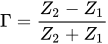
The reflection coefficient can be calculated using: , where (Gamma) is the reflection coefficient (0 denotes full transmission, 1 full reflection, and 0.5 is a reflection of half the incoming voltage), and are the impedance of the first component (from which the wave enters) and the second component, respectively.[22]
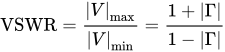
An impedance mismatch creates a reflected wave, which added to the incoming waves creates a standing wave. An impedance mismatch can be also quantified with the standing wave ratio (SWR or VSWR for voltage), which is connected to the impedance ratio and reflection coefficient by: , where are the minimum and maximum values of the voltage absolute value, and the VSWR is the voltage standing wave ratio, which value of 1 denotes full transmission, without reflection and thus no standing wave, while very large values mean high reflection and standing wave pattern.[20]
Electromagnetic waveguides

[edit]

Radio-frequency waveguides

[edit]

Waveguides can be constructed to carry waves over a wide portion of the electromagnetic spectrum, but are especially useful in the microwave and optical frequency ranges. Depending on the frequency, they can be constructed from either conductive or dielectric materials. Waveguides are used for transferring both power and communication signals.[15]: 1–3 [23]: xiii–xiv 

In this military radar, microwave radiation is transmitted between the source and the reflector by a waveguide. The figure suggests that microwaves leave the box in a circularly symmetric mode (allowing the antenna to rotate), then they are converted to a linear mode, and pass through a flexible stage. Their polarisation is then rotated in a twisted stage and finally they irradiate the parabolic antenna.

Optical waveguides

[edit]

Waveguides used at optical frequencies are typically dielectric waveguides, structures in which a dielectric material with high permittivity, and thus high index of refraction, is surrounded by a material with lower permittivity. The structure guides optical waves by total internal reflection. An example of an optical waveguide is optical fiber.[24]

Other types of optical waveguide are also used, including photonic-crystal fiber, which guides waves by any of several distinct mechanisms. Guides in the form of a hollow tube with a highly reflective inner surface have also been used as light pipes for illumination applications. The inner surfaces may be polished metal, or may be covered with a multilayer film that guides light by Bragg reflection (this is a special case of a photonic-crystal fiber). One can also use small prisms around the pipe which reflect light via total internal reflection[25] —such confinement is necessarily imperfect, however, since total internal reflection can never truly guide light within a lower-index core (in the prism case, some light leaks out at the prism corners).[26]

Acoustic waveguides

[edit]

An acoustic waveguide is a physical structure for guiding sound waves. Sound in an acoustic waveguide behaves like electromagnetic waves on a transmission line. Waves on a string, like the ones in a tin can telephone, are a simple example of an acoustic waveguide. Another example are pressure waves in the pipes of an organ. The term acoustic waveguide is also used to describe elastic waves guided in micro-scale devices, like those employed in piezoelectric delay lines and in stimulated Brillouin scattering.

Infinite tubes

[edit]

A waveguide (or tube) impose a boundary condition on the wave equation such that the wave function must be equal to zero on the boundary and that the allowed region is finite in all but one dimension. An infinitely long cylinder is an example. Mathematically, any tube with a bulge, where the width of the tube increases, admits at least one non-propagating bound state. Using the variational principles, Jeffrey Goldstone and Robert Jaffe have shown a tube of constant width with a twist admits a bound state.[27]

Sound synthesis

[edit]

Sound synthesis uses digital delay lines as computational elements to simulate wave propagation in tubes of wind instruments and the vibrating strings of string instruments.[28]

See also

[edit]

Notes

[edit]

References

[edit]
[edit]
Revisions and contributorsEdit on WikipediaRead on Wikipedia
from Grokipedia
A waveguide is a physical structure that guides waves—such as electromagnetic or acoustic—by confining their energy within a bounded region, typically along a longitudinal axis, while minimizing radiation losses and enabling efficient transmission over distances.[1] These devices operate on principles derived from the wave equation (from Maxwell's equations for electromagnetics or the acoustic wave equation), where waves propagate in discrete modes—such as transverse electric (TE) or transverse magnetic (TM) for electromagnetics—above a characteristic cutoff frequency determined by the waveguide's geometry and material properties.[2] For instance, in a rectangular metallic waveguide, the cutoff wavelength is twice the width of the broader dimension for the dominant TE10 mode, below which waves become evanescent and do not propagate.[1] Waveguides encompass a variety of types tailored to different frequency ranges and applications. Metallic waveguides, often hollow pipes with rectangular or circular cross-sections, are commonly used for microwave frequencies (typically 1–100 GHz), where traditional transmission lines like coaxial cables become inefficient due to high radiation losses.[2] In contrast, dielectric waveguides, such as optical fibers, rely on total internal reflection at the interface between a core material of higher refractive index and a surrounding cladding, guiding light in the visible and near-infrared spectrum for telecommunications.[3] Acoustic waveguides, like organ pipes or specialized ducts, guide sound waves via boundary reflections. Propagation in waveguides exhibits dispersion, with phase velocity exceeding the speed of light in vacuum (though group velocity remains subluminal), leading to frequency-dependent behavior critical for signal integrity.[1] The development of waveguides traces back to theoretical foundations laid by Lord Rayleigh in 1897, who analyzed wave propagation in cylindrical pipes, followed by experimental demonstrations in the 1890s by J.C. Bose using millimeter-wave setups.[4] Practical advancements accelerated in the 1930s at Bell Laboratories under George Southworth, who constructed early hollow-pipe systems for high-frequency transmission, with widespread adoption during World War II for radar systems due to the invention of the magnetron microwave source.[5] Today, waveguides are integral to diverse fields, including satellite communications, where they form "microwave plumbing" components like bends and couplers; integrated photonics for data processing; high-power accelerators for particle physics; and acoustic systems for sound synthesis and control.[1] Their design emphasizes single-mode operation to avoid intermodal dispersion, ensuring reliable performance in modern systems.[2]

Fundamentals

Definition and Basic Principles

A waveguide is a physical structure designed to direct and confine electromagnetic waves, enabling their transmission from one point to another with minimal loss, particularly at high frequencies where traditional transmission lines become inefficient. In its most common form for radio frequencies, it consists of a hollow metallic tube with a uniform cross-section, such as rectangular or circular, where the walls reflect the waves to guide them along the axis without the need for a central conductor.[6][7] This configuration leverages the boundary conditions of electromagnetic fields at the conducting surfaces to support wave propagation, distinguishing waveguides from coaxial cables or other two-conductor lines.[8] The basic principles of operation in electromagnetic waveguides stem from Maxwell's equations applied to the geometry of the guide, resulting in guided modes where the fields satisfy the requirement that the tangential electric field vanishes on the perfectly conducting walls. Unlike free-space propagation or transmission lines supporting transverse electromagnetic (TEM) modes, waveguides do not permit TEM modes; instead, they support transverse electric (TE) modes, where the electric field is transverse to the direction of propagation, or transverse magnetic (TM) modes, where the magnetic field is transverse.[7][8] Wave propagation occurs as a solution to the wave equation within the guide, with the fields varying as exponential functions along the axis, such as exp[j(ωtkz)]\exp[j(\omega t - kz)], where kk is the propagation constant, ω\omega is the angular frequency, and zz is the axial direction.[8] A key principle is the existence of a cutoff frequency, below which waves cannot propagate and are evanescent, determined by the waveguide's dimensions and the mode. For a given mode, the cutoff wavenumber kck_c relates to the cross-sectional geometry; for example, in a circular waveguide of radius R0R_0, the cutoff frequency for the TM01_{01} mode is ωc=2.405R0ϵμ\omega_c = \frac{2.405}{R_0 \sqrt{\epsilon \mu}}, where ϵ\epsilon and μ\mu are the permittivity and permeability of the medium inside.[8] The dispersion relation governs the propagation constant as
k=ϵμω2kc2, k = \sqrt{\epsilon \mu \omega^2 - k_c^2},
ensuring that for ω>ωc\omega > \omega_c, kk is real and propagation occurs, while phase velocity exceeds the speed of light but group velocity remains below it, preserving causality.[8] These principles extend to dielectric waveguides, such as optical fibers, where total internal reflection confines light waves at the core-cladding interface, but the fundamental concepts of modal propagation and cutoff apply similarly.[9]

Historical Development

The concept of waveguides for electromagnetic waves was first theoretically proposed by Lord Rayleigh in 1897, who analyzed the propagation of electric waves through hollow tubes and dielectric cylinders in his paper "On the passage of electric waves through tubes, or the vibrations of dielectric cylinders." Prior to Rayleigh's theoretical analysis, J.C. Bose conducted experimental demonstrations of millimeter-wave propagation using waveguide-like structures in the 1890s.[4] Rayleigh derived the conditions for wave guidance, including cutoff frequencies below which propagation does not occur, laying the mathematical foundation for hollow metallic waveguides, though practical applications were not pursued at the time.[10][11] This early work remained largely overlooked for over three decades due to the dominance of wire-based transmission technologies and limited microwave sources.[12] The practical rediscovery and development of waveguides occurred independently in the early 1930s amid growing interest in high-frequency radio waves. George C. Southworth at Bell Telephone Laboratories began experimental investigations in 1931, motivated by the need for low-loss transmission at hyper-frequencies, and by 1933 his team had rediscovered Rayleigh's theory while demonstrating wave propagation in hollow pipes up to 10 GHz.[11] Concurrently, Wilmer L. Barrow at MIT formulated waveguide theory in 1933 and conducted experiments confirming low-attenuation transmission in rectangular metal tubes.[11] Both researchers presented their findings in 1936: Southworth in "Hyper-Frequency Wave Guides—General Considerations" and Barrow in "Transmission of Electromagnetic Waves in Hollow Tubes of Metal," establishing waveguides as viable alternatives to coaxial cables for microwave frequencies. These contributions marked the transition from theory to engineering reality, with Southworth emphasizing circular and elliptical guides for minimal loss.[11] World War II catalyzed rapid advancement of waveguide technology, driven by radar systems requiring efficient microwave power handling. The 1940 invention of the cavity magnetron by John Randall and Harry Boot provided a compact high-power microwave source, but its integration with antennas necessitated waveguides to transmit signals with low loss and high power capacity.[13] Allied efforts, particularly in the UK and US, standardized rectangular waveguides (e.g., WR series dimensions) for radar applications, enabling systems like the cavity magnetron-fed SCR-584 fire-control radar.[5] Post-war, waveguides proliferated in communications, satellite technology, and instrumentation, with further refinements in materials and modes by researchers like Harold Wheeler at MIT Radiation Laboratory.[12] This era solidified waveguides as essential components in microwave engineering, influencing subsequent developments in dielectric and optical variants.[11] Parallel historical threads exist for acoustic waveguides, rooted in 19th-century horn designs for sound amplification, such as exponential horns analyzed by Rayleigh in his 1877 "Theory of Sound." Modern acoustic waveguide theory emerged in the late 20th century, with Earl Geddes introducing a comprehensive framework in 1989 that extended horn principles to broadband loudspeaker design, emphasizing spherical wavefront propagation over plane-wave approximations. These advancements, building on WWII-era acoustic research for sonar, paralleled electromagnetic progress but focused on audio and ultrasonic applications.

Wave Propagation Properties

Modes of Propagation and Cutoff Frequencies

In waveguides, wave propagation occurs through specific patterns known as modes, which describe the distribution of the wave's fields across the guide's cross-section. For electromagnetic waveguides, these modes are primarily transverse electric (TE) modes, where the electric field has no component in the direction of propagation, and transverse magnetic (TM) modes, where the magnetic field has no such component. Both types satisfy the Helmholtz equation derived from Maxwell's equations, with fields varying sinusoidally in the transverse directions and exponentially or oscillatory along the propagation axis. The mode indices mm and nn denote the number of half-wavelength variations along the width and height of the guide, respectively.[14] A critical property of these modes is the cutoff frequency, below which propagation ceases and the wave becomes evanescent, decaying exponentially along the guide. For a rectangular metallic waveguide filled with a medium of speed c=1/μϵc = 1/\sqrt{\mu\epsilon}, the cutoff angular frequency for the TEmn\mathrm{TE}_{mn} or TMmn\mathrm{TM}_{mn} mode is
ωc,mn=c(mπa)2+(nπb)2, \omega_{c,mn} = c \sqrt{\left(\frac{m\pi}{a}\right)^2 + \left(\frac{n\pi}{b}\right)^2},
where a>ba > b are the guide dimensions. For TM modes, mm and nn must both be at least 1, while TE modes allow one index to be zero, enabling the dominant TE10\mathrm{TE}_{10} mode with the lowest cutoff ωc,10=cπ/a\omega_{c,10} = c \pi / a (or fc,10=c/(2a)f_{c,10} = c / (2a)). Above cutoff, the propagation constant is β=ω2μϵkc2\beta = \sqrt{\omega^2 \mu \epsilon - k_c^2}, where kc=ωc/ck_c = \omega_c / c, transitioning from real (propagating) to imaginary (evanescent) below cutoff. This behavior ensures single-mode operation in a frequency band between the dominant and next-higher mode cutoffs, minimizing dispersion.[14] In circular waveguides, modes are described using Bessel functions, with cutoff frequencies determined by roots of those functions; for example, the TE11\mathrm{TE}_{11} mode has the lowest cutoff, given by ωc,11=cp11/R\omega_{c,11} = c \cdot p_{11}' / R, where p111.841p_{11}' \approx 1.841 is the first root of the derivative of the first-order Bessel function J1J_1', and RR is the radius. For acoustic waveguides, such as ducts or tubes, modes analogously include a plane-wave (zeroth-order) mode with no cutoff frequency, allowing propagation at all frequencies, and higher-order modes with cutoffs determined by the cross-sectional resonances, similar to ωc,mn=c(mπ/a)2+(nπ/b)2\omega_{c,mn} = c \sqrt{(m\pi / a)^2 + (n\pi / b)^2} for rectangular ducts, where cc is the speed of sound. Below cutoff, higher acoustic modes attenuate, preventing energy transfer in non-plane-wave patterns.[15]

Characteristic Impedance and Matching

In waveguides, the characteristic impedance is a key parameter that describes the relationship between the transverse electric and magnetic fields for propagating modes, analogous to the characteristic impedance in transmission lines but adapted to the non-TEM nature of waveguide propagation. Unlike coaxial cables with a fixed value (e.g., 50 Ω), waveguide characteristic impedance is mode-dependent and frequency-dependent, arising from the evanescent fields below cutoff and dispersive behavior above it. It is typically defined as the ratio of the transverse electric field to the transverse magnetic field intensity, often expressed separately for transverse electric (TE) and transverse magnetic (TM) modes.[16][17] For TE modes, the characteristic impedance $ Z_{TE} $ is given by
ZTE=ωμβ=ηkβ, Z_{TE} = \frac{\omega \mu}{\beta} = \eta \frac{k}{\beta},
where $ \omega $ is the angular frequency, $ \mu $ is the permeability, $ \beta = \sqrt{k^2 - k_c^2} $ is the propagation constant, $ \eta = \sqrt{\mu / \varepsilon} \approx 377 , \Omega $ is the free-space impedance, $ k = \omega \sqrt{\mu \varepsilon} $ is the free-space wavenumber, and $ k_c $ is the cutoff wavenumber. For TM modes, it is
ZTM=βωε=ηβk. Z_{TM} = \frac{\beta}{\omega \varepsilon} = \eta \frac{\beta}{k}.
These expressions show that $ Z_{TE} > \eta > Z_{TM} $ above cutoff, with both approaching $ \eta $ at high frequencies ($ f \gg f_c $) and diverging to infinity as frequency approaches the cutoff $ f_c .Inpractice,forthedominantTE. In practice, for the dominant TE{10}$ mode in standard rectangular waveguides (e.g., WR-90 X-band), $ Z{TE} $ is approximately 500 Ω within the operating band. Alternative definitions based on power-voltage ($ Z_{P/V} = P / |V|^2 ),voltagecurrent(), voltage-current ( Z_{V/I} = |V| / |I| ),orpowercurrent(), or power-current ( Z_{P/I} = P / |I|^2 $) ratios yield values differing by factors related to waveguide dimensions, such as height-to-width ratio $ b/a $, but all scale with the wave impedance and increase inversely with $ \sqrt{f/f_c - 1} $.[16][18] Impedance matching in waveguides ensures maximum power transfer and minimizes reflections, which is critical for efficient signal propagation, especially at transitions to other media like free space or coaxial lines. Mismatches lead to standing waves, increased losses, and reduced bandwidth, quantified by the voltage standing wave ratio (VSWR). The characteristic impedance guides the design of matching elements to transform the waveguide's effective impedance to that of the load or source.[17] Common matching techniques exploit reactive elements to cancel mismatches. Iris diaphragms—thin metal plates inserted perpendicular to the waveguide axis—provide inductive reactance when placed in regions of strong magnetic field (E-plane) or capacitive reactance in strong electric field (H-plane), enabling broadband tuning for single or multi-section configurations. Posts or screws, often adjustable, act similarly: a full-height post introduces inductance, while partial penetration provides capacitance, allowing precise VSWR minimization (e.g., below 1.1 over 10-20% bandwidth). For broader transitions, such as to antennas, gradual tapers or horns (e.g., pyramidal designs) linearly vary the aperture to match the waveguide to free-space impedance, reducing reflections to under -20 dB. These methods are analyzed using equivalent circuit models, where the characteristic impedance informs stub or transformer lengths for optimal conjugation.[17]

Electromagnetic Waveguides

Metallic Waveguides for Radio Frequencies

Metallic waveguides are hollow conductive structures, typically made from metals such as copper, brass, or aluminum, designed to guide electromagnetic waves at radio frequencies, particularly in the microwave range above 1 GHz.[19] They function by confining waves through reflections off the metallic walls, satisfying boundary conditions for electromagnetic fields at perfect conductors, enabling low-loss transmission over distances where coaxial cables would suffer high attenuation.[13] Unlike transmission lines like coaxial cables, which support transverse electromagnetic (TEM) modes, metallic waveguides do not propagate TEM waves due to their single-conductor nature, instead supporting transverse electric (TE) and transverse magnetic (TM) modes.[20] The concept of metallic waveguides traces back to theoretical work by Lord Rayleigh in 1897, who demonstrated that electromagnetic waves could propagate in hollow conducting cylinders above a cutoff frequency determined by the structure's dimensions.[11] Practical development occurred in the 1930s, with independent rediscoveries by George C. Southworth at Bell Laboratories in 1931 and Wilmer L. Barrow at MIT in 1933, leading to demonstrations of microwave transmission in 1936.[11] These efforts, spurred by needs in radar and communication during World War II, established waveguides as essential for high-frequency systems.[21] The most common type is the rectangular waveguide, featuring a cross-section with width aa (longer dimension) and height bb (typically b=a/2b = a/2), standardized under designations like WR (e.g., WR-90 for X-band, 8.20–12.40 GHz).[13] Circular waveguides, with a cylindrical cross-section, support rotationally symmetric modes and are used where polarization flexibility is needed, such as in rotary joints.[20] Ridge waveguides, a variant of rectangular, incorporate a protruding metal ridge to lower the cutoff frequency and broaden bandwidth, making them suitable for wider frequency ranges in compact designs.[20] Wave propagation in metallic waveguides occurs in discrete modes, with the dominant mode being TE10_{10} for rectangular types, where the electric field is uniform across the height and varies sinusoidally along the width.[19] Each mode has a cutoff frequency below which waves attenuate exponentially; for TEmn_{mn} or TMmn_{mn} modes in a rectangular waveguide filled with air, it is given by
fc=c2(ma)2+(nb)2, f_c = \frac{c}{2} \sqrt{\left(\frac{m}{a}\right)^2 + \left(\frac{n}{b}\right)^2},
where cc is the speed of light, mm and nn are integers (non-zero for TM modes), and for TE10_{10}, fc=c/(2a)f_c = c / (2a).[20] Operation is typically 20–30% above cutoff to minimize losses, with attenuation arising from wall currents and increasing with frequency due to skin effect; silver or gold plating reduces this.[13] Metallic waveguides offer advantages including very low insertion loss (often <0.1 dB/m at microwave frequencies), high power handling (up to kilowatts peak due to air dielectric strength), and complete electromagnetic shielding against interference.[19] However, they are bulky at lower frequencies, rigid, and limited in bandwidth (typically 20–40% per mode), requiring mode launchers for excitation from other lines.[20] Characteristic impedance varies with mode and frequency but is often around 300–500 Ω for TE10_{10}, facilitating matching to antennas via tapers or probes.[19] In radio frequency applications, metallic waveguides are integral to radar systems for transmitting high-power pulses, satellite communications for low-loss feeds to parabolic antennas, and microwave links for point-to-point broadcasting.[13] They also serve in test equipment like vector network analyzers and high-frequency filters, where their defined modes ensure precise signal integrity.[19]

Dielectric and Optical Waveguides

Dielectric waveguides guide electromagnetic waves by exploiting variations in the permittivity of non-conducting materials, confining wave propagation through total internal reflection at interfaces between regions of different refractive indices, without relying on metallic boundaries.[22] Unlike metallic waveguides, which support waves via boundary reflections from conductors, dielectric structures produce evanescent fields outside the guiding region that decay exponentially, enabling low-loss propagation when material absorption is minimized.[23] The fundamental principle derives from Maxwell's equations, leading to the scalar wave equation for the electric field in source-free, linear, isotropic media:
2Eμϵ2Et2=0 \nabla^2 \mathbf{E} - \mu \epsilon \frac{\partial^2 \mathbf{E}}{\partial t^2} = 0
where μ\mu and ϵ\epsilon are the permeability and permittivity, respectively.[23] For monochromatic waves, this simplifies to the Helmholtz equation, 2E+k2E=0\nabla^2 E + k^2 E = 0, with k=ωμϵk = \omega \sqrt{\mu \epsilon} as the propagation constant, allowing solutions in terms of guided modes confined by the refractive index profile.[24] In dielectric waveguides, wave confinement occurs in one or more transverse dimensions, classified by geometry into planar (slab) types for one-dimensional guidance and channel or fiber types for two-dimensional confinement.[23] Slab waveguides, consisting of a core layer sandwiched between cladding materials with lower refractive indices (ncore>ncladn_{\text{core}} > n_{\text{clad}}), support transverse electric (TE) and transverse magnetic (TM) modes, where the electric or magnetic field is perpendicular to the propagation direction.[23] The mode condition for TE modes in a symmetric slab is given by the eigenvalue equation:
tan(κh2)=γκ \tan\left(\frac{\kappa h}{2}\right) = \frac{\gamma}{\kappa}
with κ=k02ncore2β2\kappa = \sqrt{k_0^2 n_{\text{core}}^2 - \beta^2} as the transverse wavenumber in the core, γ=β2k02nclad2\gamma = \sqrt{\beta^2 - k_0^2 n_{\text{clad}}^2} in the cladding, β\beta as the propagation constant, k0=2π/λk_0 = 2\pi / \lambda, and hh as the core thickness.[23] Single-mode operation, desirable for minimizing dispersion, requires the normalized frequency V=k0hncore2nclad2/2<π/2V = k_0 h \sqrt{n_{\text{core}}^2 - n_{\text{clad}}^2}/2 < \pi/2 for the fundamental mode.[23] Optical waveguides extend dielectric principles to visible and near-infrared frequencies, using materials like silica glass, polymers, or semiconductors (e.g., silicon-on-insulator) to guide light over micrometer scales.[23] Pioneered theoretically by Hondros and Debye in 1910 for surface wave propagation on dielectrics, practical optical implementations emerged with integrated optics in the 1960s.[23] A seminal advancement was the 1966 proposal by Kao and Hockham of low-loss dielectric fiber waveguides, predicting attenuation below 20 dB/km in pure glass by leveraging evanescent fields to reduce scattering losses, which earned Kao the 2009 Nobel Prize in Physics.[22] In optical fibers, a step-index core-cladding structure (core diameter ~10–100 λ\lambda) with a small index contrast (Δn/n1%\Delta n / n \approx 1\%) supports hybrid HE and EH modes, with the fundamental HE11_{11} mode enabling single-mode transmission.[22] The dispersion relation for these modes in cylindrical fibers involves Bessel functions:
n2β2u12+1=Jn(u1)u1Jn(u1)/Kn(u2)u2Kn(u2) \frac{n^2 \beta^2}{u_1^2} + 1 = \frac{J_n'(u_1)}{u_1 J_n(u_1)} \bigg/ \frac{K_n'(u_2)}{u_2 K_n(u_2)}
where u1u_1 and u2u_2 are radial parameters satisfying u12+u22=(k0a)2(n12n22)u_1^2 + u_2^2 = (k_0 a)^2 (n_1^2 - n_2^2), aa is the core radius, and JnJ_n, KnK_n are Bessel and modified Bessel functions.[22] Planar and rectangular optical waveguides, integral to photonic integrated circuits, confine light in lithographically defined structures on substrates like silicon or lithium niobate.[23] Kogelnik's 1975 theory formalized mode propagation in these dielectrics, emphasizing weakly guiding approximations where index contrast is small (Δn/n<0.03\Delta n / n < 0.03), allowing scalar mode analysis and prediction of cutoff frequencies below which modes become leaky.[24] Losses in optical waveguides arise from material absorption, Rayleigh scattering (1/λ4\propto 1/\lambda^4), and bending-induced radiation, but modern designs achieve <0.2 dB/cm in silicon waveguides through high-index-contrast confinement.[23] Graded-index profiles, varying continuously from core to cladding, reduce modal dispersion compared to step-index types, enhancing bandwidth in applications like fiber-optic communications.[23] Fabrication techniques, such as ion exchange in glass or plasma etching in semiconductors, enable compact devices with coupling efficiencies exceeding 90% to external fibers via tapered structures.[23]

Acoustic Waveguides

Principles of Acoustic Waveguiding

Acoustic waveguiding involves the confinement and directional propagation of sound waves within physical structures, such as tubes or ducts filled with a fluid medium like air, to control acoustic energy flow and reduce radiation losses to the environment. These structures exploit the principles of wave reflection and interference at boundaries to support guided modes, analogous to electromagnetic waveguides but adapted for compressional waves in fluids. The speed of sound in the medium, approximately 344 m/s in air at 20°C, serves as the baseline propagation velocity for the fundamental mode, enabling applications from musical instruments to noise control systems.[25][26] The fundamental governing equation for acoustic pressure $ p $ in an inviscid, homogeneous fluid is the Helmholtz equation,
2p+ω2c2p=0, \nabla^2 p + \frac{\omega^2}{c^2} p = 0,
where $ \omega $ is the angular frequency and $ c $ is the speed of sound. In a straight, cylindrical waveguide of radius $ a $, solutions assume the form $ p(r, \phi, z, t) = \psi(r, \phi) e^{j(\omega t - k_z z)} $, separating into transverse and axial components. The transverse dependence $ \psi $ satisfies the two-dimensional Helmholtz equation, with rigid wall boundary conditions ($ \partial p / \partial r = 0 $ at $ r = a $) yielding solutions in terms of Bessel functions $ J_m(kr) \cos(m\phi) $ or $ \sin(m\phi) $, where $ m $ and $ n $ index the azimuthal and radial orders, respectively. The axial wavenumber is $ k_z = \sqrt{k^2 - k_c^2} $, with $ k = \omega / c $ and cutoff wavenumber $ k_c $ determined by the $ n $-th root of the derivative of the $ m $-th order Bessel function, $ J_m'(k_c a) = 0 $. For frequencies below the cutoff $ f_c = c k_c / (2\pi) $, modes become evanescent, preventing propagation.[25][27] The plane-wave (0,0) mode has no cutoff ($ k_c = 0 $) and propagates with phase velocity $ v_p = c $ and characteristic impedance $ Z = \rho c $, where $ \rho $ is the fluid density; this mode dominates at low frequencies where the wavelength exceeds the duct diameter. Higher-order modes, such as (1,0), (2,0), and (0,1), exhibit cutoffs at wavelengths approximately 1.706, 1.029, and 0.820 times the diameter $ d = 2a $, respectively, leading to dispersive propagation where $ v_p > c $ and group velocity $ v_g = d\omega / dk_z < c $. For a 25 mm diameter duct, the (1,0) cutoff is about 8064 Hz under standard conditions. Wave impedance for propagating modes is $ Z = \rho c / \sqrt{1 - (f_c / f)^2} $, increasing with frequency above cutoff, which affects matching and reflection at junctions via the coefficient $ S = (Z_2 - Z_1)/(Z_2 + Z_1) $. Viscous and thermal losses introduce attenuation, scaling as $ \alpha \propto \sqrt{\omega} $ near walls due to boundary layers.[25][28][27] In solid-core acoustic waveguides, such as fibers, guidance relies on shear wave velocity contrasts between core and cladding, supporting torsional, radial-axial, flexural, and leaky longitudinal modes. The fundamental F11 and L01 modes propagate without cutoff, while others exhibit frequency-dependent dispersion governed by equations like $ J_{n+1}(u)/J_n(u) + K_{n+1}(w)/K_n(w) = 0 $ for guided modes, where $ u $ and $ w $ are normalized radial coordinates. Phase velocities lie between core and cladding shear speeds, enabling confinement for ultrasonic frequencies. These principles extend to phononic crystal waveguides, where periodic structures create bandgaps for strong confinement across scales, but fluid-filled ducts remain foundational for audible sound applications.[27][29]

Designs and Practical Implementations

Acoustic waveguides are engineered structures designed to confine and guide sound waves, with practical implementations spanning phononic crystals, perforated panels, rigid composites, and tapered terminations. These designs leverage material properties and geometric configurations to control wave propagation, often for vibration isolation, noise reduction, or signal transmission in engineering applications. Fabrication typically involves additive manufacturing, CNC machining, or assembly of periodic elements, enabling scalability from ultrasonic frequencies to audible ranges. One prominent design is the coupled resonator acoustic waveguide (CRAW), implemented in two-dimensional phononic crystals consisting of a square lattice of steel cylinders embedded in a water matrix. The structure features defect-induced paths formed by selectively removing cylinders, creating Mach-Zehnder-like interferometers that guide acoustic waves within a bandgap of 380–480 kHz. Fabrication involves stacking cylinders on perforated ABS plastic bases, with experimental validation using 0.5 MHz ultrasonic transducers in a water tank, demonstrating narrow minibands for selective transmission around 427 kHz.[30] These CRAWs are suited for advanced filtering in fluidic environments, such as underwater acoustics. Broadband right-angle bends represent another practical implementation, using transformation acoustics to redirect sound waves by 90 degrees without significant loss. The device comprises 31 perforated steel panels arranged in a fan-shaped geometry, with hole sizes varying from 0.95 to 4.42 mm to achieve a refractive index of 1 to 2.5. Fabricated via precise perforation and assembly into a 2D waveguide, it operates effectively from 1000 to 2000 Hz, as confirmed by microphone measurements showing aligned simulated and experimental pressure fields.[31] Applications include acoustic routing in pipelines and noise barriers. For vibration control, acoustic waveguide filters employ stacks of rigid rectangular blocks connected by elastic joints, mimicking nacre-like composites. Each block has two degrees of freedom (transverse displacement and rotation), with dispersion relations derived from Lagrangian models to create pass and stop bands based on geometric (block width to wavelength) and stiffness ratios. Practical assembly uses materials with normal and tangential stiffnesses, optionally including Winkler supports for ultra-low-frequency gaps below 0.17 normalized frequency, validated through Floquet-Bloch analysis showing up to 0.17 stop-band amplitude.[32] These filters are implemented for isolation in structural engineering. Acoustic black holes (ABHs) provide efficient damping in waveguides through tapered geometries that progressively slow waves, trapping energy. Common designs include wedge-shaped aluminum beams with power-law thickness profiles (e.g., h(x) = εx^m, m ≥ 2) or circular pits in plates, often coated with viscoelastic layers (Young's modulus 7 GPa, loss factor 0.4) for enhanced absorption. Fabrication via CNC machining achieves tip thicknesses of 10 μm, with experimental mobility reductions of 5–15 dB at resonant peaks up to 4 kHz, and reflection coefficients as low as 0.5. In cylindrical waveguides, ABH terminations with retarding steel rings and porous foam (e.g., 20 mm melamine) enable broadband vibration control above 425 Hz via local surface absorption. Applications encompass noise reduction (6–9 dB transmission loss increase) and energy harvesting in aerospace and automotive structures.[33][34] Pipeline-based acoustic waveguides, consisting of multiple parallel straight pipes for gas or water media, offer robust implementations for industrial monitoring. These designs characterize channels through attenuation and dispersion analysis, supporting long-distance signal propagation. Experimental setups in real pipelines validate performance for frequencies relevant to engineering tasks, with applications in sonar systems, leak detection, and blockage sensing.[35] Recent developments as of 2025 include electrically tunable GHz acoustic waveguides using Al0.7Sc0.3N thin films for advanced integrated applications.[36]

Applications and Specialized Uses

Uses in Electromagnetic Systems

Waveguides play a crucial role in electromagnetic systems by providing low-loss, high-power transmission of microwave signals, enabling efficient signal propagation in environments where coaxial cables would suffer excessive attenuation or power handling limitations.[37] They are particularly valued for their complete shielding, which prevents electromagnetic interference, and their ability to handle peak powers in the megawatt range without breakdown.[38] In radar systems, waveguides interconnect transmitters, receivers, and antennas, facilitating the transmission of high-power microwave pulses with minimal loss.[39] For instance, rectangular waveguides operating in the dominant TE10 mode are commonly used to guide signals in airborne and ground-based radars, such as those detecting objects at distances up to 5 × 10⁷ km with transmitter powers of 1 MW and antenna gains of 108.[37] Flexible waveguides further enhance radar applications by reducing system weight by up to 30% in platforms like the F-35 aircraft's APG-81 radar while preserving 98% signal integrity.[40] Satellite communication systems employ waveguides for high-frequency signal routing in ground stations and onboard transponders, particularly in extremely high frequency (EHF) bands where low attenuation is essential.[38] Millimeter-wave waveguide antennas, such as monopulse horns at 35 GHz and reconfigurable phased arrays operating from 16–18 GHz, enable precise beam steering and dual-band operation (e.g., 26–30 GHz and 37–40 GHz) for 5G-integrated satellite links, offering low power losses due to the absence of dielectric materials.[41] These designs support high-precision manufacturing techniques like direct metal laser sintering (DMLS), which achieve lightweight, cost-effective performance in next-generation systems.[41] In microwave communication links, waveguides serve as efficient feed lines for antennas, minimizing reflections through smooth transitions to TEM lines and enabling single-mode propagation over bandwidths up to one octave.[37] Horn antennas, formed by flaring waveguide ends, and slotted waveguide arrays are widely used to generate directive radiation patterns, with slots controlling amplitude and phase for focused beams in point-to-point terrestrial and space-based links.[37] Microwave ovens utilize waveguides to channel 2.45 GHz signals from the magnetron to the cooking cavity, ensuring uniform energy distribution while containing the electromagnetic fields.[42] This application highlights waveguides' ability to handle moderate powers (around 1 kW) with negligible loss over short distances, preventing leakage and enabling safe, efficient heating.[39]

Uses in Acoustic Systems and Sound Synthesis

Acoustic waveguides are employed in various audio systems to control and direct sound propagation, enhancing efficiency and directivity. In loudspeaker design, waveguides integrate with drivers to shape radiation patterns, minimizing diffraction and achieving controlled dispersion over wide frequency ranges. For instance, coaxial loudspeakers with integrated waveguides create a continuous surface that extends the effective baffle area, stabilizing off-axis frequency response for professional monitoring applications. This design reduces sound coloration from edge diffractions, enabling precise sound stage reproduction in mixing and mastering environments.[43] In musical instruments, acoustic waveguides form the core of wind and brass instruments, such as flutes and trumpets, where cylindrical or conical bores guide pressure waves to produce resonant tones. The bore acts as a one-dimensional waveguide supporting the fundamental propagating mode, with phase velocity approximating free-field sound speed (approximately 344 m/s at 20°C), provided wavelengths exceed the bore diameter. Higher-order modes emerge above cutoff frequencies, influencing timbre; for a 25 mm diameter bore, the (1,0) mode cutoff is around 8064 Hz. These structures enable pitch control via length adjustments and tone hole placements, as studied in woodwind acoustics.[25] Beyond instruments, acoustic waveguides appear in practical systems like engine mufflers and ventilation ducts, where they attenuate noise by exploiting mode propagation and impedance mismatches. Attenuation in straight waveguides follows α ∝ √ω, increasing with frequency, which aids in broadband suppression without excessive length. In medical applications, models of human airways as waveguides support diagnostic tools for respiratory sound analysis.[25] In sound synthesis, digital waveguides enable physical modeling of acoustic systems, simulating wave propagation in virtual instruments with high computational efficiency. Developed by Julius O. Smith III, this technique uses delay lines to represent traveling waves, combined with filters for losses and dispersion, reducing synthesis costs by orders of magnitude compared to finite-difference methods. Applications include plucked strings (extending the Karplus-Strong algorithm), bowed strings like violins, and wind instruments such as clarinets, where excitation signals mimic plucking or blowing. The waveguide mesh extends this to multidimensional structures, modeling room acoustics and reverberation for immersive audio synthesis.[44]

References

User Avatar
No comments yet.
