Hubbry Logo
Legg MasonLegg MasonMain
Open search
Legg Mason
Community hub
Legg Mason
logo
8 pages, 0 posts
0 subscribers
Be the first to start a discussion here.
Legg Mason
Legg Mason
from Wikipedia

Legg Mason, Inc. was an American investment management and asset management firm headquartered in Baltimore, founded in 1899 and acquired by Franklin Templeton Investments as of July 2020.[2] As of December 31, 2019, the company had $730.8 billion in assets under management, including $161.2 billion in equity assets, $420.2 billion in fixed income assets, $74.3 billion in alternative assets, and $75.1 billion in liquidity assets.[1]

Key Information

History

[edit]

In 1899, George Mackubin & Co., predecessor to Legg & Co., was founded in Baltimore, Maryland. It got its start selling stocks out of a back office in the Baltimore Stock Exchange in 1899.[3] In 1970, it had offices in San Francisco, New York, as well as several in Maryland, with over 400 employees. It was best known for its expertise in the life and casualty insurance industry.[4]

In 1949, after the departure of Mackubin, John C. Legg Jr. named the company after himself.[4]

In 1962, Mason & Co., a stock brokerage, was founded by Raymond A. "Chip" Mason in Newport News, Virginia.[4][5]

In 1967, Mason & Co., with over 80 employees in 4 offices, became one of the largest Virginia-based stock brokerages.

In 1970, Mason & Co. was acquired by Legg & Co., forming Legg Mason & Co., Inc., with headquarters in Baltimore, Maryland.[4][5] Legg & Co. was founded in 1962.[6]

In 1973 Legg Mason & Co. merged with New York securities broker Wood Walker. Wood Walker had been founded in 1869.[6]

In 1975, Raymond A. Mason became chairman and CEO, adding to his existing role as president.

In 1982, Legg Mason Fund Adviser, Inc. was established to manage the company's flagship fund, Legg Mason Value Trust.[5]

In 1983, the company became a public company via an initial public offering on the New York Stock Exchange, raising $14 million.[4][5]

In 1985 the company acquired the Pennsylvanian A.E. Masten & Co. Inc. and Howard Weil Financial Corp of Louisiana.[6]

In 1986 the company acquired brokerage house Warren York Inc. of Pennsylvania.[6]

In 1997, the company moved its headquarters to 100 Light Street in Baltimore.[4]

In July 2002, the company sold its stock brokerage subsidiary to Raymond James Financial.[5]

In 2005, the company transferred its Private Client and Capital Markets business to Citigroup in exchange for Citigroup's asset management business in a $3.7 billion transaction, turning Legg Mason into the 5th largest money management firm in the U.S.[5]

In 2006, fund manager Bill Miller's streak of beating the S&P 500 15 years in a row ended.[4]

In January 2008, Mark R. Fetting became CEO of the company, succeeding Raymond A. "Chip" Mason.[5]

In May 2008, during the Great Recession, the company reported its first quarterly loss as a public company.[4]

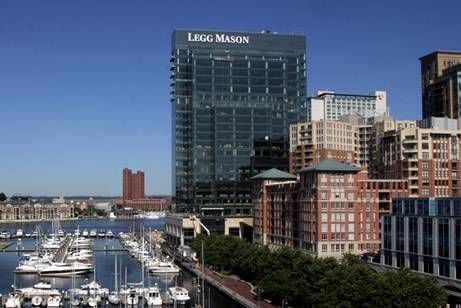
In July 2009, the company moved its headquarters to Inner Harbor East, Baltimore.[4]

In October 2009, Nelson Peltz joined the board of directors of the company after acquiring a stake.[4]

In May 2010, the company announced layoffs of as many as 350 people.[5][7]

In February 2013, Joseph A. Sullivan became CEO of the company.[4][8]

In 2016, the company acquired real estate investment firm Clarion Partners, combined its hedge fund platform Permal with New York independent hedge fund investor EnTrust and purchased a minority stake in New Jersey–based Precidian Investments to boost its exchange traded funds.[4][9]

In April 2019, the company ended all sports sponsorships to cut costs.[5][10]

In July 2020, Franklin Templeton Investments acquired Legg Mason for $4.5 billion.[11][12]

Investment affiliates

[edit]

Brandywine Global

[edit]

EnTrust Global

[edit]

Martin Currie

[edit]

QS Investors

[edit]

RARE Infrastructure

[edit]
  • Year Founded: 1972
  • Year Acquired: 2001
  • Location: New York

Former offices

[edit]

References

[edit]
[edit]
Revisions and contributorsEdit on WikipediaRead on Wikipedia
from Grokipedia
Legg Mason, Inc. was an American multinational firm headquartered in Baltimore, Maryland, that provided and related to institutional and individual clients worldwide. Founded with roots tracing back to 1899, the company operated as an independent, publicly traded entity until its acquisition by Franklin Resources, Inc. (doing business as Franklin Templeton) in July 2020 for $4.5 billion, after which it was fully integrated into Franklin Templeton's global multi-boutique investment platform. As of November 2025, Legg Mason's legacy specialist affiliates, such as Western Asset Management and Brandywine Global Investment Management, continue to operate under Franklin Templeton, managing portions of its overall of approximately $1.6 trillion. The origins of Legg Mason date to 1899, when George Mackubin & Co. was established as a brokerage firm on the , initially focusing on stock trading and financial services in the region. In 1949, the firm was acquired by John C. Legg and renamed John C. Legg Jr. & Co. In 1970, it merged with Raymond A. Mason's Mason & Co. (founded 1962) to form Legg Mason & Co., with the company incorporated as Legg Mason, Inc. in 1981. Legg Mason went public on the in 1983 under the ticker LM, marking its expansion into a diversified . Over the decades, it pioneered a "multi-boutique" model, acquiring independent firms like Western Asset (1986) and the business that became ClearBridge Investments (2005) to offer specialized strategies in equities, , and alternatives. This approach allowed Legg Mason to grow its to approximately $780 billion by 2020, establishing it as one of the largest independent in the United States. Following the 2020 acquisition, Franklin Templeton retained Legg Mason's boutique structure to enhance its capabilities in and multi-asset solutions, with key affiliates like Legg Mason Partners Fund Advisor, LLC continuing to oversee closed-end funds and distributions as of 2025. The integration created a unified global organization serving clients in over 150 countries, emphasizing across equity, , and alternative investments. Legg Mason's headquarters symbolized its deep ties to the city's financial history, and the firm was notable for its long-term focus on investor outcomes, including flagship funds like the Legg Mason Value Trust, which gained prominence in the under manager Bill Miller. Co-founder Raymond A. Mason died on August 22, 2025.

History

Origins and Early Development (1899–1970)

The origins of Legg Mason trace back to 1899, when George Mackubin established George Mackubin & Co. as a firm on the , initially focusing on stock brokerage services for regional clients. The firm quickly grew by adding partners, such as G. Clem Goodrich in 1900, which led to a name change to Mackubin & Goodrich, and John C. Legg Jr. in 1905, reflecting its expanding role in Baltimore's financial community. Over the ensuing decades, the company navigated economic challenges, including the 1929 stock market crash and the , while maintaining its headquarters in Baltimore as the central hub for operations. By the mid-20th century, following Mackubin's retirement from active partnership in and full withdrawal in 1949, John C. Legg Jr. acquired control and renamed the firm Legg & Co., emphasizing continued regional brokerage expansion in the Mid-Atlantic. Legg & Co. experienced significant growth during the post-World War II economic boom, capitalizing on increased investor activity and industrial expansion in the region to broaden its client base and brokerage services. This period solidified as the firm's enduring headquarters, with operations centered on providing personalized advice and trading execution for individual and institutional investors. A pivotal shift occurred in 1970 when Legg & Co. merged with Mason & Co., a brokerage firm founded in 1962 by Raymond A. Mason in , to form Legg Mason & Co. This merger integrated Legg's established brokerage expertise with Mason's innovative approach to , laying the groundwork for a more comprehensive firm focused on diversified financial services while retaining as its base.

Growth and Public Listing (1970–2000)

Following the 1970 merger that formed & Company, the firm experienced significant post-merger growth under the leadership of Raymond A. Mason, who was appointed chairman and CEO in 1975. Mason steered the company toward diversification beyond traditional brokerage, emphasizing and investment advisory services. By the mid-1970s, Legg Mason had established a presence in major U.S. cities, including offices in New York, , and several locations in , building on its regional roots in the mid-Atlantic and southern states. This expansion supported entry into institutional investing, where the firm began serving pension plans and corporate clients through specialized advisory roles. A key milestone in this growth phase was the launch of mutual funds, marking Legg Mason's deeper foray into retail and retirement services. In 1979, the firm introduced its first mutual money-market fund, Legg Mason Cash Reserve Trust, followed by the flagship equity mutual fund, Legg Mason Value Trust, in 1982. These funds catered to individual investors and retirement plans, such as 401(k)s, by offering value-oriented strategies that aligned with long-term savings goals. The Value Trust, in particular, gained traction amid a bull market, helping to attract assets for retirement and personal portfolios. The firm's transition to a public company further fueled its expansion. In 1983, Legg Mason completed its on the New York Stock Exchange, raising $14 million to support acquisitions, infrastructure development, and further . This capital infusion enabled the opening of additional offices across the U.S., growing from around 83 locations with 870 brokers by 1993 to over 120 domestic offices by the late . Key financial milestones underscored this period of rapid scaling. Starting with approximately $12 million in commission volume and over 400 employees in 1970, Legg Mason's revenue expanded to more than $1 billion by 1999, reflecting a driven by fees and brokerage commissions. The employee count similarly rose to over 4,300 by the end of the decade, supporting broadened services in and institutional .

Major Acquisitions and Restructuring (2000–2020)

The 2000s marked a period of strategic acquisitions and restructuring for Legg Mason, solidifying its multi-boutique model. In 2001, the firm acquired Investment Partners, a small-cap value specialist founded in 1972, enhancing its equity offerings. This was followed by the 2005 acquisition of the core business of what became ClearBridge Investments, originally founded in 1967 as a growth equity manager, which broadened capabilities in large- and mid-cap strategies. Also in 2005, Legg Mason sold its brokerage and capital markets operations to for $3.7 billion in stock, allowing it to refocus exclusively on and eliminate conflicts between brokerage and advisory services. Subsequent years saw further expansion through boutique acquisitions. In 2006, Legg Mason acquired Martin Currie, a global equity manager founded in 1881 in , , adding international capabilities. The next year, 2007, brought the purchase of QS Investors, a quantitative equity firm founded in 2006, to incorporate systematic strategies. In 2014, RARE Infrastructure, an Australian-based infrastructure specialist founded in 2004, was acquired to strengthen alternatives exposure. The acquisition spree continued with Clarion Partners, a investment manager founded in 1982, in 2016 for approximately $575 million, and EnTrust Global, a private markets firm founded in 2007, in 2019. These moves grew from around $200 billion in 2000 to over $780 billion by 2020, while navigating challenges like the through cost-cutting and leadership transitions.

Acquisition by Franklin Templeton (2020–present)

In February 2020, Franklin Resources, Inc., the parent company of Franklin Templeton, announced its agreement to acquire Legg Mason in an all-cash transaction valued at $4.5 billion, or $50 per share, which would combine the two firms to manage approximately $1.5 trillion in (AUM). The deal aimed to enhance Franklin Templeton's global capabilities by incorporating Legg Mason's network of specialist investment affiliates while preserving their operational independence. The acquisition was completed on , 2020, marking the end of Legg Mason's as a publicly traded company. Post-merger, Franklin Templeton committed to maintaining the of Legg Mason's affiliates, including their philosophies, processes, and , while integrating shared back-office functions such as , compliance, and distribution to achieve operational synergies. No significant divestitures of Legg Mason's core affiliates occurred through 2025, allowing the structure to remain largely intact. Following the merger, Franklin Templeton initiated a gradual phasing of the Legg Mason brand at the parent level, though the name was retained for certain legacy funds and affiliate-specific products to support client continuity. Minor integrations among affiliates included the 2021 alignment of RARE Infrastructure under ClearBridge Investments, enhancing capabilities in and without disrupting broader operations. As of October 31, 2025, Legg Mason operates as a fully integrated subsidiary within Franklin Templeton, contributing to the parent's overall AUM of $1.69 trillion. This integration has positioned Franklin Templeton as one of the world's largest asset managers, leveraging Legg Mason's expertise in multi-affiliate management to drive diversified growth.

Business Operations

Investment Philosophy and Strategies

Legg Mason's philosophy is rooted in a decentralized model that grants significant to its specialist affiliates, allowing each to develop and maintain distinct investment approaches tailored to specific and market conditions. This structure contrasts with more centralized firms by emphasizing boutique-style expertise within a broader organizational framework, fostering and specialization while leveraging shared resources for . Affiliates operate independently in their processes, enabling a diverse array of philosophies that prioritize client outcomes through rigorous, research-driven strategies. The firm's core strategies span equity, , alternatives, and multi-asset solutions, designed to address varied investor needs with a focus on long-term value creation. In equity investments, affiliates pursue value and growth orientations, identifying undervalued opportunities or high-potential companies through and disciplined stock selection. strategies emphasize core and approaches, seeking stable income generation and capital preservation amid fluctuations and cycles. Alternatives, including and , provide diversification beyond traditional markets, while multi-asset solutions integrate these elements to balance risk and return across portfolios. For instance, Western Asset Management exemplifies expertise with its emphasis on global analysis. Risk management is integral to Legg Mason's approach, prioritizing sustainable long-term over short-term gains through comprehensive portfolio oversight and . Since the 2010s, environmental, social, and governance (ESG) factors have been increasingly integrated into investment processes across affiliates, enhancing to identify material risks and opportunities. Quantitative tools, particularly through QS Investors, support this by applying data-driven models for and optimization, including factor-based equity strategies and multi-asset allocation. Following the 2020 acquisition by Franklin Templeton, Legg Mason's core tenets of and specialist autonomy have been preserved, aligning with Franklin Templeton's global platform to expand reach while maintaining independent philosophies.

Assets Under Management and Financial Performance

Legg Mason's (AUM) experienced substantial growth prior to its acquisition, reflecting the expansion of its investment affiliates and market conditions. By the close of , the firm's AUM totaled $803.5 billion, encompassing a diverse mix of equity, , and alternative strategies. This marked a significant increase from earlier decades, driven by organic inflows and strategic acquisitions that broadened its global footprint. In 2019, Legg Mason generated operating revenues of $2.903 billion, primarily from advisory and distribution fees tied to its AUM. However, the company reported a net loss of $28.5 million for the year, influenced by higher operating expenses and market volatility. The acquisition by Franklin Templeton, completed on July 31, 2020, integrated Legg Mason's operations into a larger entity, adding approximately $763 billion in AUM and elevating the combined total to about $1.4 trillion. This merger was projected to yield annual cost synergies through shared infrastructure and technology, enhancing overall profitability on consolidated . Performance metrics highlighted both strengths and challenges for Legg Mason's strategies. Certain equity funds, including the Legg Mason Value Trust under Bill Miller's management, outperformed the Index for 15 consecutive years from 1991 to 2005, achieving superior returns through value-oriented selections. Net inflows supported AUM growth in prior years, though the firm faced outflows during the 2022 market downturn amid rising interest rates and equity declines, contributing to broader industry pressures. As of October 31, 2025, Franklin Templeton's total AUM reached $1.69 trillion, with legacy units continuing to contribute meaningfully to this figure through integrated operations. For instance, Western Asset Management, a key legacy affiliate, managed $224 billion in AUM as of September 30, 2025, reflecting resilience despite recent net outflows.

Investment Affiliates

Brandywine Global Investment Management

Brandywine Global Investment Management, LLC was founded in 1986 in , , initially focusing on value-oriented strategies across various asset classes. The firm was acquired by Legg Mason, Inc. in January 1998 through a swap valued at approximately $145 million, becoming a wholly owned but independently operated while retaining its autonomy. As part of Legg Mason's decentralized affiliate model, Brandywine Global specializes in global and currency strategies, emphasizing long-term in undervalued securities across developed and emerging markets. By December 31, 2019, just prior to Franklin Templeton's acquisition of Legg Mason, Brandywine Global managed approximately $74 billion in , primarily in products. Key offerings include the Brandywine Global Absolute Return Fund, a UCITS-compliant launched in that seeks positive absolute returns independent of market cycles by investing at least 70% of its assets in global corporate and bonds, often using for and exposure. Other notable products encompass the and the Global Opportunistic approach, which target high current income with potential capital appreciation through diversified bond and positions. The firm's investment philosophy centers on a value discipline, applying rigorous macroeconomic analysis to identify global economic imbalances, currency mispricings, and trends, followed by opportunistic selection via bottom-up fundamental on issuers. This top-down macro framework, combined with a focus on high real yields and attractive fundamentals, guides portfolio construction across strategies like global investment-grade and unconstrained bond investing. During the , characterized by prolonged low and investor yield hunts, Brandywine Global's approaches delivered competitive returns; for instance, its Global High Yield strategy returned 12.45% in 2019 and averaged strong performance amid searches for higher-yielding assets in a subdued rate environment. Representative metrics include annualized net returns of approximately 6-9% for flagship composites over the decade, outperforming benchmarks in periods of yield compression by emphasizing undervalued in non-U.S. markets. Following Franklin Templeton's $4.5 billion acquisition of Legg Mason, completed in July 2020, Brandywine Global was integrated as a specialist boutique within Franklin Resources, Inc., contributing to the combined entity's $1.5 trillion in assets under management. By 2025, non-U.S. operations and personnel had been consolidated into locally registered Franklin Templeton entities, enhancing distribution while preserving the firm's independent investment process within the broader fixed income platform alongside affiliates like Western Asset Management. As of September 30, 2025, assets under management stood at $65 billion, reflecting ongoing focus on global macro fixed income amid evolving market dynamics.

Clarion Partners

Clarion Partners, founded in as a manager, was acquired by Legg Mason in for $585 million, securing an 83% stake while the management team retained the remaining interest. The firm specializes in commercial investments across the and , focusing on high-quality assets in primary sectors such as industrial, multifamily, , retail, and properties. With a presence in major markets, Clarion Partners manages commingled funds and separate accounts, employing strategies that span the risk-return spectrum, including core and core-plus approaches for stable, income-generating assets; value-add tactics involving renovations and repositioning; and opportunistic investments in ground-up developments or higher-risk opportunities with shorter hold periods. By 2019, Clarion Partners had approximately $48 billion in , reflecting its scale in equity and debt strategies. Notable investments include a $200 million acquisition of a 3.7 million-square-foot nationwide industrial portfolio in 2023, emphasizing and warehousing; a 2022 purchase of a 3,564-unit multifamily portfolio across Sunbelt markets like Tampa and Charlotte; and a creative office property in , acquired in 2022 as part of its value-add initiatives. These deals highlight the firm's emphasis on diversified property types, with industrial investments comprising about $45 billion in cumulative commitments and multifamily around $12 billion. Since 2015, Clarion Partners has integrated environmental, social, and governance (ESG) considerations into its investment processes, launching annual ESG reporting to track progress on energy efficiency, tenant wellness, and sustainable developments. This includes ESG-focused enhancements in post-acquisition renovations, such as improved building performance in industrial and multifamily assets to align with demands for resilient, low-carbon properties. As of 2025, following Franklin Templeton's 2020 acquisition of Legg Mason, Clarion Partners operates as the primary investment brand within Franklin Templeton, continuing to serve institutional and individual clients with its specialized platform.

ClearBridge Investments

ClearBridge Investments is a leading active equity manager specializing in large- and mid-cap strategies, with a focus on U.S. and global developed markets. The firm traces its heritage to investment teams with more than 60 years of experience in equity management, emphasizing bottom-up fundamental analysis to identify companies with durable competitive advantages and attractive risk-adjusted returns. In 2005, Legg Mason acquired substantially all of Citigroup's asset management business, which oversaw more than $430 billion in assets at the time, in a $3.7 billion asset swap deal that significantly expanded Legg Mason's equity capabilities. The acquired entity was rebranded as ClearBridge Advisors in 2006 and later evolved into ClearBridge Investments, operating as a key affiliate within Legg Mason's structure. ClearBridge employs a range of equity strategies, including growth, value, core, and dividend-focused approaches, targeting high-conviction portfolios of 35-65 holdings to achieve long-term capital appreciation and income. The firm's philosophy prioritizes collaborative across sectors, with a particular emphasis on models and ESG integration to enhance decision-making. As of March 31, 2019, ClearBridge managed approximately $142 billion in , underscoring its position as one of the largest equity boutiques globally. By September 30, 2025, this figure had expanded to over $200 billion, driven by strong inflows into its diversified equity offerings. Among its notable funds is the ClearBridge Growth Fund (previously known as the ClearBridge Aggressive Growth Fund until its rebranding in 2024), which seeks long-term capital growth by investing primarily in common stocks of U.S. companies demonstrating above-average earnings growth potential. The fund's portfolio typically includes significant exposure to dynamic sectors such as and healthcare, aligning with ClearBridge's expertise in growth-oriented large-cap equities. Historical data for the fund shows annualized returns of around 8-10% in select years during the , reflecting contributions from holdings amid broader market rallies in innovative industries. In , ClearBridge enhanced its equity capabilities through the integration of RARE Infrastructure, a specialist in global listed investments, via operational merger and under the ClearBridge name. This consolidation, completed amid Franklin Templeton's acquisition of Legg Mason in July , combined RARE's approximately AUD$20 billion in assets with ClearBridge's platform, enabling expanded offerings in income-generating strategies while maintaining distinct processes. The move fostered post-acquisition synergies by broadening ClearBridge's real asset exposure without altering its core large-cap equity focus.

EnTrust Global

EnTrust Global is a diversified alternative asset management firm specializing in private markets, including , , and strategies. Originally founded in 1997 as EnTrust Capital by Gregg S. Hymowitz, the firm initially focused on hedge fund investments with a particular emphasis on opportunities in . In May 2016, Legg Mason combined EnTrust Capital with its existing hedge fund platform, Permal Group, to form EnTrustPermal, in which Legg Mason held a 65% ownership stake while management retained 35%; this transaction valued Legg Mason's stake at approximately $400 million and created a combined entity with over $26 billion in . The firm rebranded as EnTrust Global in 2019, reflecting its expanded scope beyond traditional hedge fund-of-funds to include direct investments and secondaries. At the time of the rebranding, EnTrust Global managed approximately $20 billion in assets, with a significant portion dedicated to global secondaries platforms and direct co-investments, particularly in and Europe, leveraging its offices in key markets like , , and New York. Its investment approach emphasizes opportunistic , targeting control and structured equity investments in middle-market companies across sectors such as , healthcare, and goods, often through a secondaries lens to provide liquidity solutions for limited partners. In real assets, the firm pursues infrastructure and equity strategies via its Blue Ocean platform, launched in 2015, which focuses on essential services infrastructure like projects and transportation, having deployed nearly $1.6 billion in commitments by 2020. By the early 2020s, EnTrust Global had broadened its strategies to incorporate sustainable investing principles, integrating environmental, social, and governance (ESG) factors into its and portfolio construction processes without applying exclusionary screens, as outlined in its 2022 ESG Investment Policy. This expansion aligned with growing institutional demand for responsible alternatives, particularly in and , where the firm evaluates climate risks and impact opportunities in infrastructure debt deals. In July 2020, concurrent with Franklin Templeton's acquisition of Legg Mason, EnTrust Global's management team reacquired Legg Mason's 65% stake, returning the firm to full independence as a privately held entity headquartered in New York with 11 global offices. As of June 2025, EnTrust Global manages approximately $11 billion in assets across its opportunistic platforms, serving over 600 institutional and private investors while maintaining its focus on flexible, high-conviction alternatives strategies.

Martin Currie

Martin Currie is an active equity investment management firm founded in 1881 in , , initially focusing on equity investments for institutional and private clients. The firm operated independently for over a century before being acquired by Legg Mason in October 2014, becoming one of its specialized affiliates while maintaining operational autonomy. The acquisition, for an undisclosed sum, expanded Legg Mason's international equity capabilities by incorporating Martin Currie's expertise in global markets and adding approximately $9.8 billion in at the time. Specializing in international equities, Martin Currie manages portfolios with a strong emphasis on emerging markets, Asia-Pacific regions, and global opportunities, serving a diverse client base including financial institutions, funds, and family offices. As of September 30, 2019, the firm oversaw approximately $15.8 billion in . Its strategies target high-quality businesses with sustainable growth potential, often in dynamic emerging economies where structural changes drive long-term value. The firm's investment philosophy centers on fundamental, bottom-up to construct high-conviction, concentrated portfolios, typically holding 30-50 to capitalize on undervalued opportunities. This approach has delivered a strong track record in emerging markets growth, emphasizing quality companies with robust balance sheets and competitive advantages amid market inefficiencies. Following Franklin Templeton's acquisition of Legg Mason in July 2020, Martin Currie retained its headquarters in , , and was integrated into the parent company's broader international equities platform to enhance global offerings. In October 2025, Franklin Templeton completed the full integration of Martin Currie's capabilities into ClearBridge Investments, retiring the standalone brand while preserving its research-driven strategies within the group's structure. As of December 31, 2024, the firm's assets stood at $17.9 billion, reflecting its continued focus on active equity management.

QS Investors

QS Investors, a quantitative firm, was founded in 1999 and acquired by Legg Mason in 2014, establishing it as the company's dedicated quantitative affiliate focused on proprietary models for equity and multi-asset class strategies. The firm employs rigorous, data-driven approaches that integrate academic with advanced , emphasizing factor-based equity solutions and customized to deliver consistent risk-adjusted returns across multi-asset portfolios. Its strategies incorporate key quantitative factors such as style premia (e.g., value and ), low-volatility profiles for downside protection, and ESG integration to align with sustainable investing principles, with applications spanning U.S. domestic equities and global markets. As of 2019, QS Investors managed approximately $15 billion in , reflecting its scale in quantitative investing prior to broader industry consolidation. A hallmark of its approach is the use of proprietary quantitative models for dynamic factor timing and allocation, enabling adaptive responses to market regimes while maintaining a focus on long-term premia capture in both equity and multi-asset contexts. Following Legg Mason's acquisition by Franklin Templeton in 2020, QS Investors merged with Franklin Templeton Multi-Asset Solutions to form Franklin Templeton Investment Solutions, retaining decentralized autonomy as a specialized quantitative boutique that bolsters the parent's capabilities in factor-based and ESG-enhanced strategies as of 2025.

RARE Infrastructure

RARE Infrastructure, based in , , was established in 2006 as a specialist manager focused on global listed equities. The firm pioneered strategies in this asset class, targeting companies involved in like utilities, transportation, and communications to deliver inflation-protected returns. By emphasizing long-term stability, RARE Infrastructure built a reputation for managing portfolios that combine reliable income with moderate capital appreciation, appealing to institutional and retail investors seeking diversification beyond traditional equities and bonds. Legg Mason acquired a 75% stake in RARE Infrastructure in July 2015 for approximately A$205 million, with the management team retaining 15% and the sellers holding the remainder. At the time of the acquisition, RARE managed around US$8 billion in , primarily through active strategies in listed securities across developed markets. The firm's approach relies on bottom-up for selection, prioritizing companies with strong cash flows, defensive characteristics, and attractive yields—attributes that perform well in low-interest-rate environments where assets exhibit bond-like stability with equity upside. As of December 2018, RARE's -focused stood at approximately €3.1 billion, reflecting its niche positioning within Legg Mason's broader affiliate network. In June 2020, RARE Infrastructure was integrated into ClearBridge Investments, Legg Mason's global equity affiliate, to streamline operations, foster collaboration on product development, and expand distribution capabilities while preserving its specialized philosophy and autonomy. This merger enabled RARE's expertise to complement ClearBridge's large-cap equity strategies, enhancing overall offerings in and supporting investor access to inflation-hedging opportunities amid evolving market dynamics. Following the integration, RARE's funds were rebranded under ClearBridge, with the composite transitioning to reflect the combined entity's name by July 2020.

Royce Investment Partners

Royce Investment Partners was founded in 1972 by Charles M. "Chuck" Royce, who acquired the management company for the and began pioneering small-cap investing with a focus on undervalued companies exhibiting strong fundamentals. Under Royce's leadership, the firm developed a disciplined, risk-aware approach emphasizing long-term capital growth through investments in high-quality small- and micro-cap stocks, often held for extended periods to allow intrinsic value to emerge. This strategy prioritizes companies with competitive advantages, solid balance sheets, and attractive valuations, avoiding speculative or high-debt names in favor of those demonstrating consistent profitability and management integrity. In 2001, Legg Mason acquired Royce & Associates (the firm's original name) for up to $215 million, integrating it as an independent affiliate while preserving its autonomous investment process. By March 31, 2019, Royce managed approximately $11.6 billion in assets, primarily in equity funds targeting U.S. small-cap value opportunities. The firm's flagship offering, the Royce Pennsylvania Mutual Fund (renamed Royce Small-Cap Fund in 2024), exemplifies this philosophy by investing at least 80% of its assets in small-cap equities, with a historical emphasis on quality micro-caps—companies typically under $500 million in —that trade below their estimated worth due to temporary market inefficiencies. Following Legg Mason's acquisition by Franklin Templeton in 2020, rebranded to Royce Investment Partners in December 2019 and continues to operate as a specialized within the larger organization, maintaining its distinct small-cap value expertise. As of 2025, the firm manages over $12 billion in assets, offering a range of mutual funds, closed-end funds, and separate accounts tailored to investors seeking exposure to undervalued small-cap segments, with co-chief investment officers like Francis Gannon upholding the original long-term, valuation-driven mandate. This enduring focus has positioned Royce as a key player in small-cap value management, benefiting from Franklin Templeton's global resources while retaining operational independence.

Western Asset Management Company

Western Asset Management Company was founded in 1971 by United California Bank as a specialist in fixed-income investments. In 2005, Legg Mason acquired it as part of a larger transaction involving Citigroup's businesses, making Western Asset the largest affiliate within Legg Mason's portfolio of investment managers. This acquisition expanded Western Asset's global reach and integrated it into a broader framework, positioning it as a for fixed-income strategies. The firm manages a diverse range of global fixed-income assets, with a focus on mortgage-backed securities, emerging markets , and core bond portfolios. As of late 2019, Western Asset's (AUM) stood at approximately $450 billion. By October 2024, AUM had declined to around $328 billion amid market volatility and outflows, reflecting its scale as one of the leading fixed-income managers. Western Asset employs an approach centered on duration management and in-depth research conducted by a team of specialists. This methodology involves proprietary analysis to identify value across sectors, enabling tactical adjustments to changes and opportunities. In 2022, amid aggressive rate hikes totaling 425 basis points—the fastest pace in decades—the firm effectively navigated the environment through proactive duration positioning and selective selections, helping to mitigate losses in core strategies compared to benchmarks. Following Franklin Templeton's 2020 acquisition of , Western Asset became a core component of the combined entity's fixed-income capabilities, contributing significantly to a total fixed-income AUM of approximately $437 billion as of October 2025. This integration enhanced Franklin Templeton's offerings in global bonds and diversified income solutions, leveraging Western Asset's expertise in active fixed-income management.

Locations and Organization

Headquarters and Current Offices

Legg Mason was originally headquartered in , , where it maintained its primary operations from its founding in 1899 through much of its independent history. The firm established a prominent presence in the city's area, initially occupying a 40-story at 100 Light Street completed in 1973 before relocating to the 24-story Legg Mason Tower at 100 in 2009, a LEED-certified building designed to serve as its global headquarters. Following its acquisition by Franklin Templeton in July 2020 for $4.5 billion, Legg Mason's operations were integrated into Franklin Templeton's broader global network, with the parent company's headquarters remaining in . As of 2025, continues to host legacy operations for certain Legg Mason affiliates, such as ClearBridge Investments, which maintains an office there alongside its primary New York base, supporting ongoing investment activities despite the broader consolidation. Franklin Templeton now operates over 50 offices worldwide, leveraging Legg Mason's specialist boutiques within this structure to enhance its multi-asset capabilities. Key current offices for Legg Mason-integrated units include New York, serving as a central hub for affiliates like ClearBridge Investments and QS Investors; , supporting international fixed-income and equity strategies through entities such as Western Asset Management; and , home to Legg Mason Asset Management Singapore Pte. Ltd., which focuses on Asia-Pacific distribution and investments. These locations reflect the preservation of affiliate autonomy post-acquisition while aligning with Franklin Templeton's global footprint. Approximately 1,100 employees are associated with Legg Mason units as of 2025, operating within Franklin Templeton's total workforce of over 10,000. Post-2020 integration efforts included organizational consolidation to streamline operations, resulting in an approximately 8% reduction in the combined workforce and a decrease in standalone office sites as functions were merged into Franklin Templeton's existing infrastructure. This restructuring, driven by the acquisition, emphasized cost synergies and enhanced distribution capabilities without disrupting core investment teams.

Former Offices

Legg Mason underwent significant operational restructuring that led to the closure or transfer of various offices, primarily driven by strategic shifts away from retail brokerage and toward specialization. In 2005, following the sale of its brokerage and capital markets businesses to for $3.7 billion, Legg Mason transferred 124 U.S. branch offices—employing over 1,200 financial advisors—to 's Smith Barney unit, effectively ending its retail brokerage presence and consolidating its domestic footprint. This transaction marked a pivotal reduction in regional U.S. locations, aligning with broader cost efficiencies as the firm focused on institutional . Post-2008 financial crisis, Legg Mason accelerated downsizing amid recessionary pressures, closing its Owings Mills, Maryland office in 2010 and laying off approximately 250 employees across that site and Baltimore headquarters, with remaining operations centralized in Baltimore. In 2014, the firm sold its Investment Counsel & Trust Co. subsidiary to Stifel Financial Corp. for an undisclosed amount, transferring operations from four U.S. offices including Philadelphia, resulting in about 50 job shifts and the discontinuation of those sites under Legg Mason. Internationally, Legg Mason wound down its Esemplia Emerging Markets boutique in 2013, closing offices in and and returning $500 million in assets to clients, as part of efforts to streamline underperforming units. These changes, including the 2005 brokerage divestiture, contributed to consolidating over 20 U.S. regional branches during the late 2000s and early 2010s. The closures reflected broader trends toward cost efficiencies, a shift to channels, and synergies from affiliate integrations, reducing Legg Mason's physical offices from more than 120 domestic and international locations around to a more focused network by the time of its 2020 acquisition by Franklin Templeton. Post-acquisition, minor European sites were merged into Franklin Templeton hubs without major additional closures through , further streamlining the global presence to emphasize operational efficiency.

References

Add your contribution
Related Hubs
User Avatar
No comments yet.