Hubbry Logo
Wilson OrumaWilson OrumaMain
Open search
Wilson Oruma
Community hub
Wilson Oruma
logo
8 pages, 0 posts
0 subscribers
Be the first to start a discussion here.
Wilson Oruma
Wilson Oruma
from Wikipedia

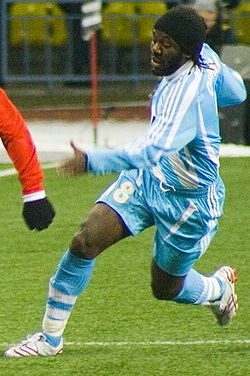
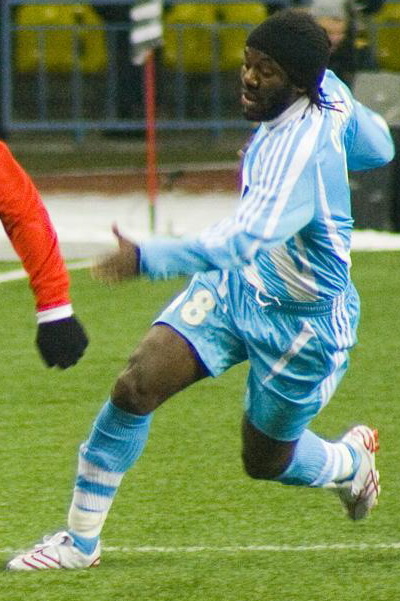
Wilson Oruma (born 30 December 1976) is a Nigerian former professional footballer who played as a midfielder. He spent most of his career in France.[1]

Key Information

Club career

[edit]

Oruma was born in Warri, Nigeria. He arrived at RC Lens from Bendel Insurance in 1994.[2] A season after being loaned to Nancy,[2] he returned to Lens and played seven matches during their 1997–98 Ligue 1 title campaign.[2][3] After representing Nigeria at the 1998 FIFA World Cup, he moved to Turkish side Samsunspor,[2] returning to France one year later to play for Nîmes.[2]

In 2000, Oruma was transferred to Swiss side Servette,[2] playing two season before coming back to France again, where he played until 2009 for Sochaux,[2] Marseille[2] and Guingamp,[2] winning the 2003–04 Coupe de la Ligue with Sochaux[4] and the 2008–09 Coupe de France with Guingamp, despite them being a Ligue 2 club at the time.[5] He was handed a trial by Cardiff City - a club based in Wales but who play in the English football league system – in the summer of 2008[6] and scored in a 2–2 pre-season friendly at Chasetown,[7][8] but was not awarded a contract due to a lack of fitness.[8]

He retired from professional football in 2010[9] after a season with Greek club AO Kavala.[10][11]

International career

[edit]

Oruma was part of the Nigeria under-17 team which won the 1993 FIFA U-17 World Championships,[12] captaining his side[12] and becoming the tournament's top goalscorer with 6 goals.[12] He played 19 times international matches over 11 years for Nigeria[13] and was part of the team that participated in the 1998 FIFA World Cup, where he scored in the only appearance he made in the tournament against Paraguay.[14] He also was part of the squad that won the Olympic gold medal in 1996,[8][12] a year after he debuted for Nigeria, and also a member of the Nigerian squad at the 2002 and 2006 Africa Cup of Nations, finishing both competitions at third place. After a club career in Europe, where he played for the likes of french Ligue 1 sides Lens, Marseille, Sochaux, Guingamp, as well as a stint at Swiss side Servette, winning the UEFA Intertoto Cup, Ligue 1 and French Cup, and earning pay to sustain himself and family after life away from football.[15]

Personal life

[edit]

In 2018, Oruma suffered emotional disorder as a result of how he was reportedly duped by an unknown pastor. He was broke and in a status of mental disorder six years after he was reportedly defrauded by a clergyman and some fake oil businessmen. It was learnt that Oruma eventually lost a whopping sum, close to N2 billion to an investment.[16]

Oruma holds Nigerian and French nationalities.[17]

Honours

[edit]

References

[edit]
[edit]
Revisions and contributorsEdit on WikipediaRead on Wikipedia
from Grokipedia
Wilson Oruma (born 30 December 1976) is a Nigerian former professional footballer who played primarily as an attacking . Renowned for his technical skill and vision on the pitch, he rose to prominence as the captain and top scorer of Nigeria's victorious U-17 team at the 1993 U-17 World Championship in , where he netted six goals to claim the . Oruma also contributed to Nigeria's historic win at the in , earning recognition as the tournament's most valuable player, and represented the senior Super Eagles at major events including the , the 2002 Africa Cup of Nations, and the . Over his club career, spanning from 1994 to 2010, he amassed over 300 appearances mostly in French leagues with clubs like , , and , while also featuring in , , and . Oruma's early career began in Nigeria with Bendel Insurance in 1994, where his performances earned him a move to with in 1997. During the 1997–98 season, he made seven appearances as Lens clinched the French championship, marking his first major club honor. He later joined in for the 1998–99 campaign before returning to France with in 1999. His most productive period came at in from 2000 to 2002, where he scored 15 goals in 61 league matches and helped win the 2001 . Oruma then thrived at from 2002 to 2006, contributing to their 2004 victory. He briefly played for in 2006–07 before stints at , on trial at Cardiff City in in 2008, and a final season with in until his retirement in 2010. Across his professional tenure, he recorded 44 goals in 415 competitive matches. Internationally, Oruma debuted for Nigeria's senior team in 1995 and accumulated 19 caps, scoring three goals between 1995 and 2006. Beyond his U-17 and Olympic triumphs, he featured in Nigeria's squad for the 1998 World Cup in , though he did not play in the tournament matches. At the continental level, Oruma participated in the 2002 in , where Nigeria secured bronze, and the 2006 edition in , again finishing third. His versatility allowed him to operate on the right or centrally, often delivering key assists and moments of flair that highlighted his role in Nigeria's "" of footballers. Following retirement, Oruma faced significant personal challenges, including a 2012 financial that cost him an estimated ₦1.2 billion in life savings, leading to a period of emotional distress and health issues. Reports from 2018 indicated struggles with , and as of 2025, he continues to face financial and health challenges, including issues, while living in . Teammates have provided aid since 2018, but Oruma has maintained a low profile, occasionally addressing public concerns to affirm his well-being.

Background

Early life

Wilson Oruma was born on December 30, 1976, in , , . He grew up in a modest family in a working-class neighborhood off Ogbemudia Street along the Warri/Sapele Road, where his father initially disapproved of his passion for football and once locked him indoors to discourage it, while his mother offered encouragement and support. Oruma had several siblings, including a younger brother, , an elder brother, Paul, a Warri-based who has spoken publicly on family matters related to him, and another brother, Daniel. Warri during the late 1970s and 1980s was an industrial hub in the oil-rich region, boasting a booming economy driven by activities, yet many communities, including Oruma's, faced socioeconomic challenges such as limited resources and infrastructural gaps amid rapid . This environment fostered a vibrant street culture, particularly around football, which became a prominent outlet for youth in the area. Oruma's childhood reflected this dynamic, as he navigated a tough upbringing typical of many children, with football emerging as a central escape and pursuit. From a very young age, Oruma displayed an obsession with football, earning the local nickname "Wilson ‘Owoyo’ Oruma" and drawing comparisons to among his peers for his skillful play on dusty playgrounds. He began his initial steps in the sport through informal community games with friends in , later joining local youth teams such as Invincible Leopards Football Club before being enlisted at around age 14 by Tabuno Babes Football Club under talent scout Elder Eddington Kuejubola. These early experiences honed his talents and paved the way for his selection to Nigeria's U-17 national team in 1993.

Citizenship and family

Wilson Oruma holds dual citizenship, retaining his Nigerian nationality by birth while acquiring during his professional playing years in . Oruma is married to an unnamed who has provided long-term support since the early stages of his , accompanying him through various personal transitions. The couple maintains a private family life, with limited public details available about their relationship. He has children, though specific numbers or names remain undisclosed in , and the family has been based in Victoria Garden City, , , as of 2025. Oruma's family structure includes siblings such as his brother Dominic Oruma, who has occasionally made public statements on family matters, and his sister Maureen Atie, a . The family's experiences reflect the impacts of Oruma's career relocations, with periods spent in influencing their dual-national identity and lifestyle, while maintaining strong ties to their Nigerian roots in , .

Playing career

Club career

Wilson Oruma began his career with Bendel in the Nigerian Professional Football League during the 1993–1994 season, where he made his debut and quickly established himself as a promising talent before securing a move to . In 1994, Oruma transferred to French club , marking his entry into European football, where he spent four seasons and made 42 league appearances, scoring 2 goals, while contributing to the team's dynamic midfield play. During the 1996–1997 season, he was loaned to AS Nancy in , appearing in 22 league matches without scoring, gaining valuable experience in a more competitive environment before returning to Lens. Seeking new opportunities outside France, Oruma joined Turkish side for the 1998–1999 season, where he recorded 21 league appearances and 4 goals, showcasing his speed and creativity on the wing. The following year, he moved to in France's for 1999–2000, contributing 25 league appearances and 2 goals during a transitional period in his career. Oruma then signed with Swiss club in 2000, enjoying a productive two-year spell with 49 league appearances and 12 goals, highlighting his ability as a versatile attacking who could both create and finish chances. Returning to France, he joined FC Sochaux in 2002, spending three seasons in with 77 league appearances and 6 goals, where his quick dribbling and vision helped drive the team's midfield transitions. In 2005, Oruma transferred to , a major club in , making 56 league appearances and scoring 3 goals over three seasons, often providing key assists in high-stakes matches. Later in his career, Oruma moved to En Avant de Guingamp for the 2008–2009 Ligue 2 season, where he made 24 league appearances and netted 5 goals, demonstrating his enduring pace and technical skill despite advancing age. He had a trial with Cardiff City in England in summer 2008, during which he scored in a pre-season friendly. His final professional stint was with Greek club AO Kavala in 2009–2010, featuring in 23 league appearances without goals, before retiring at age 33 in 2010. Throughout his club career, Oruma amassed approximately 339 league appearances and 34 goals across , , , , and , renowned for his role as a creative, fast who excelled in transitional play and delivering precise passes.

International career

Oruma began his international career with 's youth teams, captaining the U-17 side known as the Golden Eaglets at the 1993 U-17 World Championship in . As the tournament's top scorer with six goals, he played a pivotal role in 's successful campaign, scoring in key matches including the final 2–1 victory over to secure the title. His performances highlighted his versatility as an attacking , contributing both goals and leadership to the team's triumph. Oruma made his senior debut for the national team, the Super Eagles, on October 21, 1995, in a friendly match against . Over the next decade, from 1995 to 2006, he earned 19 caps and scored three goals, establishing himself as a reliable presence in midfield despite competition from other stars. Known for his creativity and dribbling ability, Oruma provided key assists and maintained a strong record with few injuries, allowing consistent contributions to the team's dynamics. In 1996, Oruma was a key member of Nigeria's U-23 Olympic team that won gold at the Olympics, playing a central midfield role in their undefeated run to the final, and was named the tournament's . He featured in all matches, including the dramatic 3–2 extra-time victory over in the gold medal match, where his set-piece delivery nearly set up the winning goal. His energy and vision helped anchor the midfield alongside players like , contributing to Nigeria's first Olympic football gold. Oruma represented at the in , appearing in the group stage matches. In the final group game against on June 24, 1998, he scored Nigeria's only goal in a 1–3 defeat with a powerful early strike in the 11th minute, though the Super Eagles were eliminated after advancing from the group. His participation underscored his growing importance to the senior squad. Oruma also featured in two Africa Cup of Nations tournaments, contributing to Nigeria's bronze medals in both. At the 2002 edition in Mali, he played in the group stage and knockout matches as the Super Eagles finished third after a semifinal loss to Cameroon. Similarly, at the 2006 tournament in Egypt, Oruma appeared in key games, including the third-place playoff win over Senegal, helping secure another bronze. These appearances solidified his legacy as a creative force in Nigeria's midfield during a period of continental success.

Personal life and legacy

Post-retirement activities

After retiring from professional football in 2010 at the age of 33 following a season with Greek club AO Kavala, Wilson Oruma transitioned to a low-profile life based in , . He has largely avoided public attention and high-society events. Oruma has engaged in informal mentoring of young footballers through local academies and business ventures, drawing on his experience as a former Super Eagles and 1996 Olympic gold medalist to guide emerging talents. His contributions to Nigerian football's legacy include inspiring subsequent generations of midfielders with his technical prowess and vision, often cited in media discussions as a pivotal figure in the country's youth development during the . In a 2023 video message, Oruma reflected positively on his career, expressing gratitude for the support from fans and stating, "I never knew you people loved me so much. I appreciate and celebrate you all." This sentiment underscores his satisfaction with his achievements, including captaining the Golden Eaglets to the 1993 FIFA U-17 World Cup title and representing Nigeria at major tournaments. Oruma's post-retirement period has emphasized a quiet adaptation to civilian life, supported by family.

Financial and health challenges

In late 2012, Wilson Oruma fell victim to a major investment scam, losing approximately ₦1.2 billion in life savings after being lured by a and fake oil businessmen into a fraudulent oil and gas venture promising high returns. Oruma had invested his career earnings, including savings from European club salaries and match bonuses, trusting the assurances of quick profits in Nigeria's booming sector. The betrayal left him financially devastated, marking the beginning of profound personal adversities. The financial ruin triggered a severe mental health disorder, characterized by depression, mood swings, and public reports of erratic behavior that fueled rumors of institutionalization. With assistance from the Nigeria Football Federation, including hospital treatment and a job offer, Oruma stabilized after a two-year breakdown. His family, including his wife who provided crucial emotional support, clarified that he received care at home rather than in a facility, countering sensationalized claims of him roaming streets in distress. This episode underscored the psychological toll of such scams on high-profile figures, exacerbating isolation and trauma in the years following. By 2023, Oruma had recovered from the issues, as confirmed in his video debunking rumors of severe illness, and has since maintained a low-profile life involving mentoring and business activities in as of 2025. His plight exemplifies broader patterns of trust betrayal in Nigeria's investment environment, where retired athletes often encounter predatory schemes disguised as lucrative opportunities, serving as a stark for financial prudence post-career.

Honours

Club honours

Oruma's club career yielded several honours, where he played a supporting role in midfield for each winning team. With , Oruma helped win the 2001 , appearing in matches including the 3–0 final victory over . With , he contributed to the club's first-ever title in the 1997–98 season, making seven appearances in the league during the championship campaign. At FC Sochaux-Montbéliard, Oruma helped secure the Coupe de la Ligue in 2003–04, scoring three goals across the tournament, including the opener in a 4–0 quarter-final victory over RC Lens. During his stint with Olympique de Marseille, Oruma featured in their UEFA Intertoto Cup triumph in 2005, providing an assist for the opening goal in the 3–0 second-leg semi-final win against SS Lazio (first leg 1–1) and scoring in the 3–2 first-leg third-round victory over BSC Young Boys (second leg 2–1, aggregate 5–3). Oruma closed out his major club successes with En Avant de Guingamp by winning the in 2008–09, where he appeared in key matches including the semi-final against CS Sedan—scoring in a 3–1 win—and provided a cross in the final against Stade Rennais before celebrating the 2–1 victory as part of the squad.

International honours

Oruma captained Nigeria's U-17 team to victory at the 1993 U-17 World Championship in , where he also earned the Golden Boot as the tournament's top scorer with six goals. With Nigeria's senior national team, he contributed to the Olympic win in men's football at the in , defeating 3–2 in the final. Oruma helped Nigeria secure third-place finishes at the in both 2002 (Mali) and 2006 (), earning bronze medals on each occasion after winning the respective third-place play-off matches.

References

Add your contribution
Related Hubs
User Avatar
No comments yet.