Hubbry Logo
Winged tankWinged tankMain
Open search
Winged tank
Community hub
Winged tank
logo
8 pages, 0 posts
0 subscribers
Be the first to start a discussion here.
Winged tank
Winged tank
from Wikipedia

Winged tanks were the subject of several unsuccessful experiments in the 20th century. It was intended that these could be towed behind, or carried under, an airplane, to glide into a battlefield, in support of infantry forces.

In war, airborne forces use parachutes to drop soldiers behind enemy lines to capture and hold important objectives until more heavily equipped friendly troops can arrive. Military planners have always sought ways to provide airborne troops with combat support equipment in the form of light armored vehicles or artillery which can be dropped by parachute or military glider.

The problem with air-dropping vehicles is that their crews drop separately, and may be delayed or prevented from bringing them into action. Military gliders allow crews to arrive at the drop zone along with their vehicles. They also minimize exposure of the valuable towing aircraft, which need not appear over the battlefield. An improvement would be a tank which could glide into the battlefield, drop its wings, and be ready to fight within minutes. This would allow the crew to immediately begin operation.

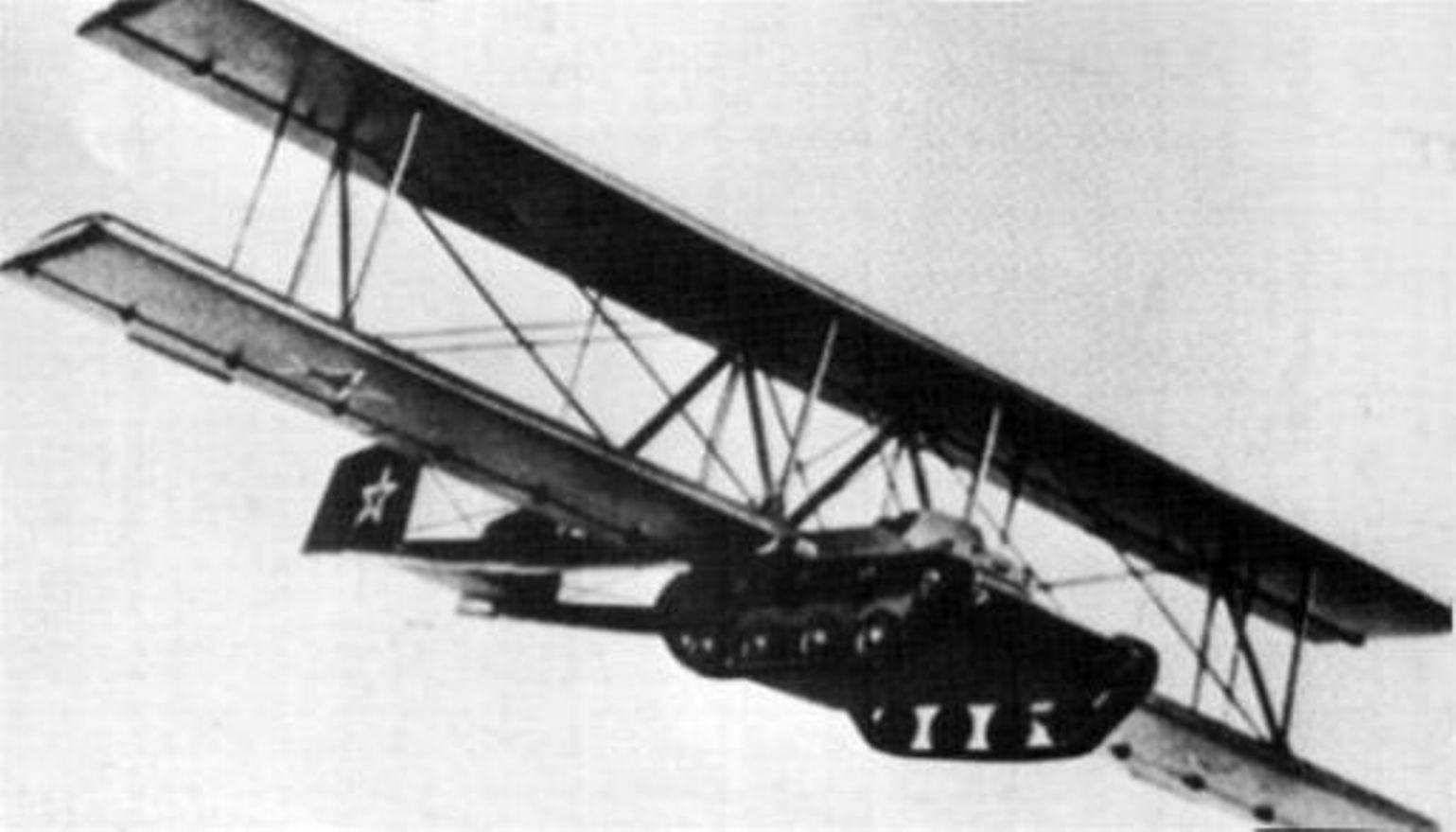
Designer's model of the Antonov A-40

Development

[edit]

United States

[edit]

In the early 1930s, American engineer J. Walter Christie experimented with the concept of a self-powered flying tank. Christie's design had a detachable set of wings attached to the roof of a lightly armoured tank and a propeller driven by the tank's engine. A prototype without wings was constructed, but the concept was never developed further.[1][2]

Soviet experiments

[edit]
TB-3 bomber carrying a T-27 tankette, 1935

In 1930, the Grokhovskiy Special Design Bureau experimented with dropping "air buses" full of troops: the bicycle-wheeled G-45 onto land, and the amphibious "hydro bus" into water. When the hydro bus disintegrated on landing, the chief designer and his assistant were strapped into the G-45 for a test drop; they survived, but the project was cancelled.[3]

Later, the Soviets used heavy bombers to land on the battlefield carrying T-27 tankettes and T-37 tank light tanks, and experimented with air-dropping light tanks (both with and without parachutes). In 1941, airborne units were issued T-40 amphibious tanks.[4]

None of these were completely satisfactory, so in 1942 the Soviet Air Force ordered Oleg Antonov to design a glider for landing tanks. Antonov was more ambitious, and instead added a detachable cradle to a lightened T-60 light tank, bearing large wood and fabric biplane wings and twin tail. Although one semi-successful test flight was completed, due to the lack of sufficiently powerful aircraft to tow it at the required 160 km/h, the project was abandoned.

Japanese projects

[edit]

The Imperial Japanese Army's experimental Special No. 3 Flying Tank So-Ra or Ku-Ro, was developed in 1943. Like the Soviet models, it had detachable wings, but it could also be transported by heavy gliders, namely the Kokusai Ku-7 "Buzzard" and Kokusai Ku-8 I "Gander". These could be towed by aircraft such as the Mitsubishi Ki-21 "Sally" heavy bomber. However, the Japanese Flying Tank project was abandoned before it went into production. The tank transport gliders were deployed to the Philippines during 1944. Another prototype was Maeda Ku-6 Flying Tank, but it also did not advance to experimental phases.[5]

United Kingdom

[edit]

In 1941, L.E. Baynes produced a design for a 100 ft (30 m) wingspan "Carrier Wing Glider", a large tailless wing to carry a tank. A reduced scale experimental glider – the Baynes Bat – was tested.[6] It was satisfactory but the project was dropped and work on gliders that could carry vehicles internally was taken up. This led to the Airspeed Horsa and General Aircraft Hamilcar that could carry a Jeep and a light tank respectively.

After World War II

[edit]

The Soviet Union continued to develop methods to efficiently deploy airborne vehicles, but focusing on parachute deployment from large fixed-wing aircraft instead, in an effort to render their "winged infantry" fully mechanized as well. By the mid-1970s, they were able to drop BMD-1s with crew members aboard, using a combination of a parachute and retrorocket.[citation needed]

See also

[edit]

References

[edit]
Revisions and contributorsEdit on WikipediaRead on Wikipedia
from Grokipedia
A winged tank is an experimental armored fighting vehicle consisting of a light tank modified with detachable biplane-style wings and a tail assembly to enable it to be towed aloft by a bomber aircraft and then glide unpowered to a battlefield landing, after which the aerodynamic components could be removed for conventional ground operations. The concept originated in the interwar period as a means to deliver armored support rapidly to airborne or isolated units, bypassing the limitations of road-bound transport and enhancing capabilities during assaults. Early efforts included the American engineer J. Walter Christie's flying tank design in , which proposed fitting convertible tank chassis with wings for short "hopscotches" across terrain, though it never progressed beyond conceptual stages due to the U.S. Army's focus on -support vehicles. During , several nations pursued winged tank projects amid the demands of airborne warfare, but technical hurdles—such as the vehicles' excessive weight (often 5–7 tons even for light tanks), high drag during glide, structural fragility of wooden wings, and the scarcity of heavy-lift aircraft capable of towing them—doomed the idea to failure. The most prominent example was the Soviet Union's Antonov A-40 Krylya Tanka ("Tank Wings"), developed in 1941–1942 under designer Oleg Antonov to support paratroopers during the German invasion. Based on the 5.8-ton T-60 scout tank, it featured an 18-meter wingspan and a tail boom, and required the removal of the turret, most ammunition, and fuel for flight; a single prototype was successfully towed by a Tupolev TB-3 bomber and glided for a test landing on 2 September 1942 near Moscow, but the project was canceled later that year because no Soviet aircraft could handle heavier tanks like the 26-ton T-34, and the design proved logistically unviable for mass deployment. Other wartime attempts, such as the British Baynes Bat glider (proposed in 1941 for M3 Stuart tanks but abandoned in favor of simpler troop gliders) and the Japanese Maeda Ku-6 with the Ku-Ro tank (1943–1944, canceled pre-production due to instability), similarly highlighted the impracticality of combining heavy armor with aviation. Postwar advancements in helicopters, parachutes, and retro-rockets for airdroppable vehicles like the U.S. M551 Sheridan rendered winged tanks obsolete, though the concept influenced modern light armored airborne systems.

Concept and Purpose

Definition and Variants

A winged is a hybrid military vehicle that integrates a chassis with detachable aerodynamic wings, enabling short-distance gliding or limited powered flight primarily for airborne delivery to circumvent obstacles and facilitate rapid deployment of armored support. This design aims to combine the mobility and firepower of a with aerial transport capabilities, allowing it to be towed or dropped behind enemy lines without relying on traditional ground routes. Variants of winged tanks include glider tanks, which are unpowered and rely on being towed by before to a landing site; powered winged tanks, equipped with auxiliary engines to assist in takeoff or short flights; and conceptual flying tanks, which envision fuller aircraft integration where the tank hull serves as the for more autonomous aerial operations, though such designs remained largely theoretical. These variants prioritize simplicity in glider forms for practical deployment, while powered and flying concepts explore enhanced range and control at the cost of added complexity. Key characteristics of winged tanks involve trade-offs in lightweight armor to reduce overall mass for airworthiness, often limiting protection compared to standard tanks. Wings are typically detachable to restore ground mobility post-landing, and the payload emphasizes anti-infantry roles over heavy anti-tank combat, focusing on crewed delivery with essential armament rather than extensive ammunition loads. Development of these concepts peaked during , driven by the need for innovative airborne tactics.

Historical Rationale

The development of winged tanks emerged from the strategic imperative to provide rapid armored reinforcement on fluid fronts during the and , particularly in the expansive theaters of and where static defenses like fortified lines and river barriers hindered mechanized advances. Military planners recognized that traditional ground transport for tanks was too slow and vulnerable to interdiction, necessitating airborne delivery to enable surprise assaults and outmaneuver entrenched positions. This approach aimed to integrate light armored support into dynamic offensives, allowing forces to exploit breakthroughs before enemy reserves could consolidate, as exemplified by projects like the Soviet A-40. Tactically, winged tanks were conceived as air-droppable assets to bridge gaps in mechanized advances, offering immediate to isolated units and facilitating the seizure of such as bridges and airfields ahead of main forces. By landing behind enemy lines, these vehicles could bolster operations, providing the armored punch needed to hold objectives until ground reinforcements arrived and turning airborne raids into sustained footholds. Such capabilities addressed the vulnerability of lightly equipped airborne troops to counterattacks, enhancing overall operational tempo in contested environments. Key influencing factors included advances in glider technology during the , building on early 20th-century experiments for troop and equipment transport. Early airborne operations further validated gliders' role in delivering payloads with precision and surprise, inspiring adaptations for heavier loads. Compounding this were the limitations of contemporary air transport, such as underpowered cargo planes incapable of hauling tanks over long distances without excessive risk or resource demands, prompting cost-effective glider variants like winged tanks as viable alternatives.

Design Principles

Aerodynamic Features

The aerodynamic features of winged tanks center on adaptations that enable unpowered or minimally powered flight for short durations, primarily through after aerial release. These designs emphasize generating sufficient lift to support the substantial mass of an armored vehicle while minimizing drag during descent. High-lift airfoils are employed to achieve this at relatively low speeds, drawing on fundamental principles to counter the vehicle's weight, which typically ranges from tons for variants intended for such operations. Wing configurations in these systems prioritize low-speed performance, often utilizing rectangular planforms with moderate aspect ratios, as seen in biplane designs. Prominent examples like the Soviet A-40 employed wings constructed from wood and fabric to generate lift. Such shapes facilitate high lift coefficients at angles of attack suitable for descent. These wings are engineered for structural simplicity and robustness, accommodating the irregular of the tank while promoting over the to reduce induced drag. The generation of lift relies on Bernoulli's principle, where airflow over the curved upper surface of the wing airfoil accelerates, creating lower pressure compared to the higher pressure beneath, resulting in an upward force. This is quantified by the lift equation L=12ρv2SCLL = \frac{1}{2} \rho v^2 S C_L, where LL is lift, ρ\rho is air density, vv is velocity, SS is wing area, and CLC_L is the lift coefficient. For winged tanks, this force must balance the vehicle's weight (approximately 50-70 kN), necessitating large wing areas (often exceeding 80 m², as in the A-40's 85.8 m²) and high CLC_L values achievable through cambered profiles or simple flaps. Drag, comprising parasitic and induced components, is managed by streamlining the wing-tank junction to prevent flow separation, ensuring a glide ratio sufficient for tactical deployment over tens of kilometers. To maintain stability during glide, many designs, such as the Soviet A-40, incorporated tailplanes and twin booms for pitch control, preventing excessive nose-down tendencies due to the tank's forward-heavy center of gravity. Yaw and roll stability are aided by vertical stabilizers on twin booms. Other designs, like the British Baynes Bat, used tailless flying wing configurations with wingtip vertical stabilizers and elevons for control. Landing is facilitated by reinforced skids or the tank's existing wheeled undercarriage, which doubles as a rudimentary landing gear without requiring a full retractable system, allowing touchdown on unprepared terrain.

Integration with Tank Chassis

The integration of winged elements with in early experimental designs necessitated substantial structural modifications to accommodate the added mass and dynamic loads of wings and associated components while preserving ground maneuverability. Hulls were typically reinforced at attachment points to support wing struts, often employing lightweight materials such as wood frames covered or metal spars to minimize overall weight increase. These reinforcements allowed the to endure stresses or short powered flights without failure, though they introduced vulnerabilities like potential stress concentrations at mounting points. Detachment mechanisms, including quick-release cradles or levers, were incorporated to enable rapid wing removal after landing, restoring the vehicle's standard configuration for operations. Propulsion systems for flight were integrated by linking the tank's existing to a forward-mounted in powered variants, providing for takeoff or sustained low-altitude flight without dedicated powerplants. This approach avoided the need for separate auxiliary engines but required careful synchronization with the , often resulting in trade-offs such as thinned armor plating—typically reduced to 10-20 mm—to offset the added weight of flight hardware. Armament was similarly compromised, favoring lighter machine guns over heavier cannons to maintain balance and reduce total mass, ensuring the vehicle remained viable as both an aerial inserter and ground fighter. In glider-based concepts, no such integration occurred, relying instead on external . Control systems emphasized simplicity by using cable linkages, such as a single lever operating all flying surfaces from the driver's position, while incorporating minimal and controls routed through the s. Piloting during glide or flight was handled by the tank driver, often using adapted visibility aids like mirrors to monitor wing surfaces without a dedicated . Weight distribution posed a critical challenge, addressed through selective lightening—such as removing non-essential components like excess fuel or ammunition—to shift the center of gravity forward or rearward as needed for stable transitions between modes, preventing instability in either flight or ground operations.

Pre-World War II Concepts

United States Initiatives

In the early 1930s, American engineer , a prolific innovator in armored vehicle design, proposed a self-propelled flying tank concept to enable rapid deployment behind enemy lines. His M-1932 design featured a chassis equipped with detachable biplane wings and a tail fin for stability, with a driven by the vehicle's own for short powered flights, though it could also glide after release from a towing aircraft such as a or . This differed from later unpowered glider concepts by incorporating onboard propulsion. The wings were intended to be jettisoned upon landing to restore the vehicle's full ground mobility, reflecting Christie's emphasis on convertible systems that could transition between air and land operations. Influenced by his early friendship with aviation pioneer , Christie envisioned this as a means to overcome the logistical challenges of transporting tanks by air during the . Christie's M1932 design and wing concepts were sold to the in 1931, influencing later airborne tank developments. A wingless based on M- was constructed around , weighing approximately 7 tons loaded (including the 0.7-ton wing assembly) and armed with a 75 mm as the main weapon, alongside machine guns for support fire, with a 37 mm as an alternative. The prioritized low weight and high speed, achieving 36 mph on tracks and 50 mph on road wheels without wings, with an estimated of up to 125 mph and a stall speed of 54 mph for capability. Testing focused on ground performance and basic aerodynamic feasibility, but the vehicle never achieved sustained flight due to insufficient engine power for takeoff under load. Christie had proposed capability after detachment, but practical trials revealed limitations in stability and . Between 1932 and 1938, the U.S. Army Ordnance Department conducted experiments at with light tanks, including convertible models, to explore air-droppable concepts for airborne infantry support. These tests evaluated durability for parachute or glider delivery, but efforts were hampered by the fragility of attached wings and structures during simulated crash landings and rough terrain recovery. The initiatives were ultimately abandoned in favor of simpler towed glider designs, as the added complexity of winged systems proved unreliable for combat reliability without significant advancements in materials and aviation integration. work, however, influenced subsequent U.S. thinking on mobile armored air delivery, laying groundwork for adaptations.

Soviet Early Experiments

In , Soviet military planners explored innovative methods for rapid armored deployment amid rising tensions in , focusing on airborne delivery to support deep battle doctrines. Parallel experimental efforts targeted actual airlifts, beginning with lightweight vehicles suitable for mass production. In 1935, during the Kiev military maneuvers, heavy bombers demonstrated the airborne transport of T-37A amphibious s (weighing around 3 tons) suspended externally, using parachute platforms for controlled descent; the tanks were released at low altitude, parachuted to the ground, and then drove off to engage mock targets, achieving short operational hops post-landing but revealing vulnerabilities in structural integrity during impacts. Similar tests in 1936 extended to the T-37A amphibious , involving low-altitude drops from 5-6 meters into water using protective platforms, enabling assessments of landing durability but often failing due to frame buckling and landing gear stress under rough conditions. These initiatives, conducted by design bureaus including early experimental groups, prioritized adaptations of light tanks like the 5-ton class BT series for potential glider integration, aiming for towed deployment behind bombers to bypass fortified lines in anticipated conflicts. However, weight constraints and aerodynamic instability limited progress, with prototypes showing promise in controlled drops but inadequate for sustained or powered flight, leading to abandonment of full-scale winged variants by 1939.

World War II Developments

Soviet Antonov A-40 Project

The Soviet project represented the USSR's most ambitious attempt during to create a glider tank for rapid aerial insertion of armored units behind enemy lines. In late 1941, amid the escalating German invasion, the Soviet Air Force commissioned renowned aircraft designer Oleg Antonov to modify a into a towable glider, drawing on prior Soviet experience with technology from the pre-war era. The goal was to enable bombers to deliver directly to forward positions, bypassing damaged roads and reducing vulnerability to ground attacks during transport. The A-40 was developed by adapting the T-60 light scout tank, a compact vehicle weighing about 5.8 tons with thin armor and a 20 mm , into an aerodynamic glider. Engineers fitted it with detachable wings spanning 18 meters, constructed from and fabric for lightness, along with twin tail booms supporting a tail assembly for stability during flight. The tank's turret was used to control pitch and yaw by shifting its position, while tracks served as ; upon touchdown, the wings and tail could be jettisoned via explosives to restore ground mobility. To further reduce weight to around 2,000 kg for gliding, non-essential items like extra fuel, ammunition, and headlights were removed. The single prototype was assembled at the Gliding Plant during the summer of 1942. Testing began on August 7, 1942, near at the (LII), starting with ground runs to assess takeoff and control. The first and only flight occurred on September 2, 1942, piloted by experienced glider Sergei Anokhin, who had undergone tank-driving for the mission. The A-40 was towed by a , but excessive drag caused the tow plane's engines to overheat, forcing an early release at low altitude (approximately 40 meters). Anokhin successfully glided the vehicle before landing in a field, where the wings were detached and the tank driven back to base. However, flight control proved imprecise due to the tank's mass and limited . Despite the partial success, the project was confined to this lone prototype, as operational challenges outweighed potential benefits. Available bombers like the TB-3 lacked the power to reliably tow the A-40 to effective altitudes, and rarer alternatives such as the (only about 80 built) were needed for longer glides. The project was canceled shortly after trials due to aircraft limitations and logistical impracticality. The A-40 never advanced beyond trials, highlighting the impracticality of integrating heavy armor with glider technology under wartime constraints.

United Kingdom Baynes Design

In 1941, British aeronautical engineer L.E. Baynes proposed the Carrier Wing Glider, a aimed at enabling the air delivery of light armored vehicles by converting them into temporary gliders. The design featured a detachable wing with a 100-foot (30-meter) span, intended to be attached to a 7- to 8.5-ton such as the . This tailless, swept-wing configuration included vertical stabilizers at the wingtips for stability, allowing the modified vehicle to be towed behind a aircraft capable of handling glider loads at speeds up to 145 km/h (90 mph). The proposal addressed the strategic need for rapid deployment of airborne armor in support of operations, particularly in the European theater. Key elements of the Baynes design emphasized simplicity and quick assembly for battlefield use. The wings were engineered to be easily attached to the tank chassis via a mounting system, with provisions for detachment upon landing to restore the vehicle's mobility. To validate the aerodynamics, a one-third-scale piloted model known as the Baynes Bat was constructed by Slingsby Sailplanes and first flown in , demonstrating acceptable handling characteristics despite its unconventional tailless layout. Eric "Winkle" Brown evaluated the Bat and noted its docility in flight but highlighted challenges with control and landing due to the high wing loading and lack of a tail. The full-scale version was projected to achieve a reasonable glide performance suitable for unpowered descent over battlefields, though specific metrics like glide ratio were not publicly detailed beyond the model's stall speed of approximately 40 mph (64 km/h). The project advanced to the patent stage in November 1941 but was ultimately rejected by late 1942, with formal cancellation by the end of 1943. The Royal Air Force prioritized resources for established troop-carrying gliders such as the and , which offered greater capacity for delivering personnel and vehicles without the complexities of on-site wing attachment. No full-scale prototypes of the Carrier Wing were built, leaving the concept unrealized and confined to theoretical and scale-model testing. The design's innovative approach to airborne armor influenced later discussions on air-mobile vehicles but was overshadowed by more practical glider solutions during the war.

Japanese Efforts

During , the pursued limited experiments with winged tank designs to enhance rapid deployment in the Pacific theater, particularly for supporting airborne operations on remote islands and atolls. The primary effort centered on the Special Number 3 Ku-Ro (also known as So-Ra or Kuro-sha), a specialized glider tank developed by starting in 1943. This project aimed to create a lightweight armored vehicle capable of being towed as a glider to bypass naval blockades and deliver firepower directly to contested shorelines or inland positions, addressing Japan's logistical challenges in island-hopping campaigns. The Ku-Ro was derived from the chassis but significantly lightened to 2.9 tons for aerial transport, featuring a two-person , a 37 mm main gun or alternative armament, and armor up to 12 mm thick. It incorporated folding wings with a 22-meter span, a tail assembly for stability, and in place of tracks to facilitate on unprepared surfaces, allowing the vehicle to glide at speeds up to 174 km/h when towed by aircraft such as the heavy bomber. The design emphasized corrosion-resistant materials to withstand humid tropical environments prevalent in the Pacific, though visibility for the pilot-driver remained limited, and overall aerodynamics proved suboptimal during ground tests. Only prototypes and mockups were completed by 1944-1945, as resource shortages and Allied air superiority hampered further development. The project faced insurmountable challenges, including structural stresses from high-speed towing that initially damaged undercarriages and the shifting strategic emphasis toward defensive naval operations amid Japan's worsening position. No actual flights occurred, and the initiative was abandoned by mid-1945, with the prototype's fate unknown. While it did not enter service, the Ku-Ro concept indirectly informed subsequent refinements in Japanese paratroop tactics, prioritizing lighter support over heavy armored gliders for island assaults.

United States Adaptations

During , the focused on airborne armor through projects like the light tank, designed for glider deployment to support operations, rather than direct winged tank adaptations. This effort built on pre-war concepts by engineer but shifted priorities toward comprehensive airborne infantry divisions and lighter vehicles. By 1944, such programs emphasized vulnerability mitigation against anti-tank weapons and alternatives like air-droppable jeeps for rapid deployment.

Post-War and Legacy

Cold War Abandonment

Following , both the and conducted evaluations of airborne delivery concepts, including those involving glider-based or winged vehicles, which highlighted significant operational risks and led to their rapid decline. In the U.S., post-war evaluations by Army boards, such as the Board #1 established in , assessed glider utility for heavy equipment delivery, finding them highly vulnerable to anti-aircraft fire and fighter interception, as well as limited to single-use operations that increased crash risks during landing. By 1946, these concerns prompted the U.S. Army to disband eight of eleven glider infantry regiments, a separate glider infantry battalion, and seven of eleven glider field artillery battalions, effectively phasing out glider technology in favor of powered assault aircraft like the C-123 Provider. Soviet assessments of the winged tank prototype emphasized excessive weight and drag that rendered towing impractical with available bombers such as the , resulting in no further development. The emergence of helicopters as a superior alternative for air delivery further accelerated the abandonment of fixed-wing tank designs during the early . U.S. evaluations in the and 1950s shifted focus to rotary-wing aircraft, which offered greater precision, reusability, and reduced vulnerability compared to gliders or winged tanks, allowing for safer transport of light armor and without the high crash risks associated with unpowered descent. In the , post-war priorities moved toward parachute-droppable light vehicles like the BMD series, bypassing winged configurations entirely due to their proven logistical inefficiencies during wartime trials. No major winged tank programs were initiated by either after , as the technology failed to align with evolving aerial capabilities. Doctrinal shifts in the and early 1960s cemented this abandonment, prioritizing airmobile operations with helicopters over fixed-wing armored delivery. The U.S. Army's 1962 Tactical Mobility Requirements Board, known as the Howze Board, recommended integrating helicopters into combat formations to create airmobile divisions, emphasizing their ability to rapidly deploy infantry and light armored units while avoiding the dispersion and damage risks of glider-based systems. This led to the formation of air cavalry units equipped with rotorcraft like the UH-1 , rendering winged tank concepts irrelevant in the , where minor British studies in the , such as evaluations of glider derivatives, were dismissed for lacking viability against modern air defenses. The Howze Board's influence marked a pivotal turn toward helicopter-centric doctrine, supplanting earlier fixed-wing experiments tied to failures like the A-40's single test glide.

Influence on Modern Armored Air Delivery

The concept of winged tanks, which envisioned gliders or powered wings attached to armored vehicles for aerial delivery, has indirectly shaped modern approaches to rapid armored deployment, evolving into parachute-based air-droppable systems rather than fixed-wing gliders. In the United States, the family of armored vehicles represents this legacy, with variants like the Mobile Gun System demonstrated as air-droppable from C-17 Globemaster aircraft using parachute extraction methods, enabling to insert protected swiftly without relying on runways. Similarly, Russia's BMD series, including the BMD-4M airborne infantry fighting vehicle, embodies a direct parallel, designed for full parachute airdrop with its lightweight aluminum armor, 100mm , and multi-role capabilities to support paratroopers in contested environments. These systems prioritize modularity and reduced weight over the rigid wing structures of WWII prototypes, allowing integration with like the Il-76 for the BMD or C-130 for lighter configurations. Technological echoes of winged tanks persist in contemporary air delivery platforms that blend vertical lift with armored transport, moving beyond Cold War-era helicopter dominance toward hybrid systems. The , for instance, facilitates internal transport of light armored vehicles such as the combat support platform, which weighs under 5,000 pounds and provides mobile firepower for Marine expeditionary units, echoing the goal of airborne armor insertion but with rotor efficiency instead of glider wings. In unmanned domains, ideas of winged armor influence drone swarms for and , where fixed-wing UAVs with modular payloads simulate rapid aerial delivery of sensor-equipped "armor" to forward areas. DARPA's 2020s programs, such as the Series Hybrid Electric Propulsion AiRcraft Demonstration (SHEPARD), designated XRQ-73 in June 2024, explore hybrid-electric uncrewed aircraft systems for long-endurance and infrastructure-independent operations, indirectly advancing concepts for future air-assault vehicles by improving payload efficiency and autonomy in contested airspace. Culturally, the winged tank endures as a symbol of innovative yet impractical military ambition, inspiring media portrayals that highlight its historical quirks. Documentaries examining WWII experiments have renewed interest in aerial armor concepts among enthusiasts and strategists. In video games and simulations, players engage with airborne warfare tactics through interactive historical recreations, fostering public understanding of the blend of and ground combat and influencing broader discussions on modern rapid deployment strategies.

References

Add your contribution
Related Hubs
User Avatar
No comments yet.