


Community hub
Recent from talks
Contribute something
Nothing was collected or created yet.
Volta–Niger languages
View on Wikipedia| Volta–Niger | |
|---|---|
| West Benue–Congo or East Kwa | |
| Geographic distribution | West Africa, from Eastern Ghana to central Nigeria |
| Linguistic classification | Niger–Congo?
|
| Subdivisions |
|
| Language codes | |
| Glottolog | None |
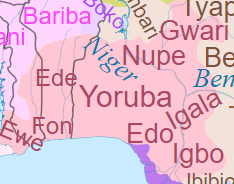
 Map cut-out of Volta-Niger family of languages area, with most of the languages bounded by the Volta river, in modern-day Ghana, and the Niger river, found in modern-day Nigeria | |
The Volta–Niger family of languages, also known as West Benue–Congo or East Kwa, is one of the branches of the Niger–Congo language family, with perhaps 70 million speakers. Among these are the most important languages of southern Nigeria, Benin, Togo, and southeast Ghana: Yoruba, Igbo, Bini, and Gbe.
These languages have variously been placed within the Kwa or Benue–Congo families or, starting in the 1970s, combined with them altogether. Williamson & Blench (2000) separate the languages here called Volta-Niger from the others. Güldemann (2018) fails to see clear criteria for dividing the languages into two or three families and maintains the broad grouping and name of Benue-Kwa for all them.
Branches
[edit]The constituent groups of the Volta–Niger family, along with the most important languages in terms of number of speakers, are as follows (with number of languages for each branch in parentheses):[according to whom?]
Volta–Niger
|
| ||||||||||||||||||
The Yoruboid languages and Akoko were once linked as the Defoid branch, but more recently they, Edoid, and Igboid have been suggested to be primary branches of an as-yet unnamed group, often abbreviated yeai. Similarly, Oko, Nupoid, and Idomoid are often grouped together under the acronym noi. Ukaan is an Atlantic–Congo language, but it is unclear if it belongs to the Volta–Niger family; Blench suspects it is closer to Benue–Congo.
In an automated computational analysis (ASJP 4) by Müller et al. (2013):[1]
Branches and locations
[edit]
Below is a list of major Volta–Niger branches and their primary locations (centres of diversity) in Nigeria based on Blench (2019).[2]
| Branch | Primary locations |
|---|---|
| Akpes | Akoko North LGA, Ondo State |
| Ayere–Ahan | Ijumu LGA, Kogi State |
| Gbe | Badagry LGA, Lagos State and adjacent areas |
| Yoruboid | Southwestern and Central Nigeria |
| Edoid | Rivers, Edo, Ondo, Delta and Bayelsa States |
| Akoko | Akoko North LGA, Ondo State |
| Igboid | Southeastern Nigeria, Rivers and Delta States |
| Nupoid | Niger, Kogi, Kwara, Nasarawa States |
| Oko | Ogori/Magongo LGA, Kogi State |
| Idomoid | Benue, Cross River, Nasarawa States |
| Ukaan | Akoko North LGA, Ondo State, Akoko Edo LGA, Edo state |
Comparative vocabulary
[edit]
Sample basic vocabulary in different Volta–Niger branches:
| Language | eye | ear | nose | tooth | tongue | mouth | blood | bone | tree | water | eat | name |
|---|---|---|---|---|---|---|---|---|---|---|---|---|
| Yoruba | ojú | etí | imú | eyín | ahọ́n | ẹnu | ẹ̀jẹ | egungun | igi | omi | jẹ | orúkọ |
| Proto-Yoruboid[3] | *e-jú | *e-tĩ́ | *ɪ-ŋmʊ̃́ | *e-ɲĩ́ | *ʊ-ɓã́ | *a-rʊ̃ã | *ɛ̀-byɛ̀ | *V-k'ĩk'ũ | *e-gĩ (i-) | *o-mĩ | *jɛ | *o-ɗú |
| Proto-Yoruboid[4] | *éjú | *étí | *ímṵ́ | *éŋḭ́ | Yor. ahá̰ | *ɛ́lṵ ? | *ɛ̀gyɛ̀ | *égbṵ́gbṵ́ | Yor. igi | *ómḭ | *jɛṵ | *órú- ? |
| Proto-Edoid[5] | *dhI-dhω | *ghU-chɔGɪ | *I-chuəNi; *-chuveNi | *dhI-kωN | *U-dhamhɪ | *A-nuə | *U-ɟɪ-, -ɟɪa | *U-thaNɪ | *A-mɪN | *dhɪ | *dhI-ni | |
| Proto-Gbe[6] | *-tó | *aɖú | *-ɖɛ́ | *-ɖũ; *-ɖũkpá | *-ʁʷũ | *-χʷú | *-tĩ́ | *-tsĩ | *ɖu | *yĩ́kɔ́ | ||
| Akoko (Arigidi)[7] | ódʒù | oto | (odʒ)uw̃ɔ̃̀ | éɲì̃ | ɛŕɛ̀ | õrũ | ɛ̀dʒɛ̀ | ɛ̀dʒɛ̀ | ɔ́hɔ̃̄ | edʒĩ | dʒō | |
| Proto-Akpes;[8] Akpes (Ajowa)[9] | *èyò | *àsùgù | *àhũ | *ìyũ | *ìndàlì | *onu | ìkɔ̃̀n | ɔhuni | imi | ìmũ̀nũ̀ | ||
| Ayere[10] | ɛ́jɛ́ | éndí | ówṹ | éyĩ́ | únú | anu | èʃwè | egbe | oŋwu | oyin | ʃe | éwú |
| Ahan[10] | ewú | éndí | owũ | eɲĩ | irɛ̃́ | arũ | èsè | igbegbe | oɲĩ | |||
| Proto-Nupoid[11] | *e-wie | *CV-tuNukpua | *V-bhʊə | *jiNkɔN | *a-giNtara | *V-giə | *CV-kiukuNu | *V-cigbɔNa | *nuNŋʷa | *gi | *CV-jɛ | |
| Proto-Ebiroid[11] | *e-ji | *ʊ-tɔkpa | *a-ʃɪ | *a-ɲɪ | *ɪra-rɛ | *aɲa | *ʧʊku | *ɔ-tʃɪ | *e-ɲi | *rɪ | *ɪrɛ-ʃa | |
| Oko[12] | áɲẽ́ | ɔ́tɔ̃́ | ɔ́mɔ́dɔ́rɛ̀ | írú | ɛ́làárɛ́ | ówó | ɛ́ŋɔ̂ | ófú | esáma | ébí | jé | íwúrù |
| Proto-Idomoid[13] | *eyi | *ʊrʊ/a- | *eŋgwu | *ìmàǹjī | *ìmànyì; *ma-yeni ? | *ri | *ɛɲɪ | |||||
| Proto-Ukaan[14] | *ìdʒì | *ʊrʊgV | *ɔ̀kɔ̃́rɔ̃̀ | *ʊ̀ɲʊ̀gV; jɔ̀r | *ɛ̀ɲʊ̃́ | *òŋʷṍ | *ùɲṹ | *òɣʷó | *ɔ̀hʊ̃́nṽ | *ùmɔ̃̀ | *jé | *ìnĩ́ |
| Proto-Benue–Congo[15] | *-lito | *-tuŋi | *-zua | *-nini, *-nino; *-sana; *-gaŋgo (±) | *-lemi; *-lake | *-zi; *-luŋ | *-kupe | *-titi; *-kwon | *-izi (±); *-ni (±) | *-zina |
Numerals
[edit]Comparison of numerals in individual languages:[16]
| Classification | Language | 1 | 2 | 3 | 4 | 5 | 6 | 7 | 8 | 9 | 10 |
|---|---|---|---|---|---|---|---|---|---|---|---|
| Akpes | Akpes | íɡbōn / ēkìnì | īdīan(ì) | īsās(ì) | īnīŋ(ì) | īʃōn(ì) | ītʃānās(ì) | ītʃēnētʃ(ì) | ānāānīŋ(ì) | ɔ̀kpɔ̄lɔ̀ʃ(ì) | īyōf(ì) |
| Defoid, Akokoid | Ariɡidi (Iɡasi) | [kɛ̀ɛ́ɲɛ̃] | [kèji] | [kedà] | [kenɛ] | [kéntɔ̀] | [kefà] | [keɸi] | [kerò] | [kéndà] | [kéjè] |
| Defoid, Akokoid | Òɡè | [ékán] | [ìyí] | [ídaː] | [ínɛ́] | [ítɔ̃̀] | [ìfà] | [ídʒúí] | [írò] | [ĩ́ŋa] | [íyè] |
| Defoid, Ayere-Ahan | Ayere (Úwû) | ĩ̀kã̌ | ìd͡ʒì | ītā | ĩ̄jẽ̄ | ĩ̄tṹ | ìfà | īd͡ʒʷī | īrō | ĩ̄dã̂ | īɡʷá |
| Defoid, Ayere-Ahan | Ayu | ɪdɪ | ahwa /afah | ataar | anaŋaʃ | atuɡen | atɛɛr | ataraŋaʃ (3 ?) | anababoɡ (4 ?) | atuluboɡ (5 ?) | iʃoɡ / ajalaboɡ |
| Defoid, Yoruboid, Edekiri | Cabe (Ede Cabe) | ɔ̀kɛ̃ | mɛ̃́d͡ʒì | mɛ̃́ta | mɛ̃́hɛ̃ | mɛ́hú | mɛ̃́fà | méd͡ʒe | mɛ̃́d͡ʒɔ | mɛ̃́sɛ̃́ | mɛ̃́wá |
| Defoid, Yoruboid, Edekiri | Ede Ica (Ica) | ɔkɔ̃ | eɟi | ɛta | ɛ̃ɛ̃ | ɛwu | ɛfa | ɛɟɛ | ɛɟɔ | ɛsɔ̃ | ɛya |
| Defoid, Yoruboid, Edekiri | Idaca (Ede Idaca) | òbú | méd͡ʒi | mɛ́ta | mírĩ | mɛrú | mɛ́fà | méd͡ʒe | mɛ́d͡ʒɔ | mɛ́sã | maa |
| Defoid, Yoruboid, Edekiri | Ifè (1) | ɛnɛ́ | méèdzì | mɛ́ɛta | mɛ́ɛrɛ̃ | mɛ́ɛrú | mɛ́ɛfà | méedze | mɛ́ɛdzɔ | mɛsã́ | maá |
| Defoid, Yoruboid, Edekiri | Ifè (2) | ɛ̀nɛ / ɔ̀kɔ̃̀ | méèdzì | mɛ́ɛta | mɛ́ɛrɛ̃ | mɛ́ɛrú | mɛ́ɛfà | méedze | mɛ́ɛdzɔ | mɛsã́ | maá |
| Defoid, Yoruboid, Edekiri | Ulukwumi | ɔ̀kɑ̃ | mɛ́zì | mɛ́tɑ | mɛ́rɛ̃ | mɛ́rú | mɛ́fɑ̀ | méze | mɛ́zɔ | mɛ̀hɑ̃́ | mɛ́ɡʷɑ́ |
| Defoid, Yoruboid, Edekiri | Yoruba | oókan [oókɔ̃] | eéjì [eéɟì] | ẹẹ́ta [ɛɛ́ta] | ẹẹ́rin [ɛɛ́ɾĩ] | aárùn-ún [aáɾũ̀ṹ] | ẹẹ́fà [ɛɛ́fà] | eéje [eéɟe] | ẹẹ́jọ [ɛɛ́ɟɔ] | ẹẹ́sàn-án [ɛɛ́sɔ̃̀ɔ̃́] | ẹẹ́wàá [ɛɛ́wàá] |
| Defoid, Yoruboid, Igala | Igala (1) | éɲɛ́ / ǒkâ | èdʒì | ɛ̀ta | ɛ̀lɛ̀ | ɛ̀lú | ɛ̀fà | èbʲe | ɛ̀dʒɔ | ɛ̀lá | ɛ̀ɡʷá |
| Defoid, Yoruboid, Igala | Igala (2) | ínyé̩ [íɲɛ́] | èjì [èdʒì] | ẹ̀tā [ɛ̀tā] | ẹ̀lè̩ [ɛ̀lɛ̀] | è̩lú [ɛ̀lú] | ẹ̀fè̩ [ɛ̀fɛ̀] | ẹ̀biē [èbjiē] | ẹ̀jọ̄ [ɛ̀dʒɔ] | ẹ̀lá [ɛ̀lá] | ẹ̀ɡwá [ɛ̀ɡwá] |
| Ukaan | Ukaan (Ikaan dialect) | ʃí | wā | tāːs / hrāhr | nāʲ / nā | hrʊ̀ːn / tòːn | hràdá | hránèʃì | nàːnáʲ / nàːná | hráòʃì | òpú * |
| Edoid, Delta | Degema | ɔβʊ́ | iβə́ | sáj (ɪsáj) | iní | súwón (ɪsúwón) | jɪ́sa (ɪjɪ́sá) | síjéβə (isíjéβá) | anɪ́ (ɪnʊ́mán) | əsí (ɔβʊ óte mʊ iɡ͡beɲ) (10 -1) | əɡ͡beɲ (iɡ͡béɲ) |
| Edoid, Delta | Engenni | ávʊ̀ | ívà | ɛ́sàà | ínìì | ìsyònì | ɛ̀nyísà | ìsyovà | ɛ̀nʊ̀màní | àvʊ́mó (10 -1) | íɡ͡bèì |
| Edoid, North-Central, Edo-Esan-Ora | Ẹdo (1) | òwó [òwó] (used only to count) | èvá [èvá]́ | èhá [èhá] | èné [ènɛ́] | ìsén [ìsɛ́] or [ìsɛ̃́] ?? | èhàn [èhã̀] | ìhírọ̃n [ìhĩɺɔ]̃ | èrẹ̀nrẹ̀n [èɺɛ̃ɺɛ̃] | ìhìnrín [ihĩɺĩ] | ìɡ͡bé [ìɡ͡bé] |
| Edoid, North-Central, Edo-Esan-Ora | Edo (Bini) (2) | ɔ̀k͡pá / òwo (used only to count) | èvá | èhá | ènɛ́ | ìsɛ́n | ěhàn | ìhinrɔ̀n | èrɛ̀nrɛ́n | ìhìnrín | ìɡ͡bé |
| Edoid, North-Central, Edo-Esan-Ora | Emai (Emai-luleha-Ora) | ɔ̀k͡pa | èvà | èéà | èélè | ìíhìɛ̀n | èéhàn | ìhíɔ́n | èɛ́n | ìsín | ìɡ͡bé |
| Edoid, North-Central, Edo-Esan-Ora | Esan | ɔ̀k͡pá | èvá | éà | énɛ̃̀ | ìsɛ̃́ | éhã́ | ìhĩ́lɔ̃̀ | èlɛ̃́lɛ̃̀ | ĩ̀sɪ̃́lɪ̃̀ | ìɡ͡bé |
| Edoid, North-Central, Ghotuo-Uneme-Yekhee | Etsako (Yekhee) | ọkpa [ɔk͡pà] | eva [évà] | ela [élà] | ejiẹ [éʒié] | ise [ìsé] | esa [ésà] | isevha [ìsévhà] | eleeh [éːléː] | ithi [ìtií] | iɡbe [ìɡ͡bé]̄ |
| Edoid, North-Central, Ghotuo-Uneme-Yekhee | Ghotuo | ɔ̀k͡pā | èvā | èēsà | èēnè | ìīʒè / ìīʒìè | ìjhēhà / ìēhà jh = a week, vd | ìhīɲã̄ | ènhīē nh = n̥ voiceless n ? | ìsī | ìɡ͡bē LM͡L |
| Edoid, North-Central, Ghotuo-Uneme-Yekhee | Okphela (1) | oɡ͡ɣʷo ˥˩ ˨ | evɑ ˨ ˧ | esɛ ˧ ˨ | ene ˧ ˨ | iʃe ˧ ˨ | esesa ˨ ˧ ˨ | iʃilʷɑ ˨ ˧ ˨ | elele ˨ ˩˥ ˨ | itili ˨ ˩˥ ˧ | iɡ͡be ˨ ˧ |
| Edoid, North-Central, Ghotuo-Uneme-Yekhee | Ivbie-North-Okphele-Arhe (2) | oɣuo | eva | esɛ | ene | iʃie | esesa | iʃilua | elele | itili | iɡ͡be |
| Edoid, North-Central, Ghotuo-Uneme-Yekhee | Ososo | oɡwo [òɡwò] | eva [èvá] | esa [èsá] | ene [èné] | ichie [ìt͡ʃè] | esesa [èsâsà] | ifuena [ìfwènà] | inyenye [ìɲèɲẽ́] | isini [ìsĩ̀nĩ̀] | iɡbe [ìɡ͡bé] |
| Edoid, Northwestern, Southern | Okpamheri | ɔkpa | eva | esa | enen | ishe | eaza | izuonua | ɛnien | isie | iɡ͡be |
| Edoid, Southwestern | Isoko (1) | ɔvʊ | ɪ́vɛ | ɪ́sa | ɪ́nɪ | ɪ́sɔɪ | ɪ́zɪ́za | ɪ́hɾɛ | ɪ́rɪ́ː | ɪ́zɪ́ː | ɪ́kpe |
| Edoid, Southwestern | Isoko (2) | ọvụ | ịvẹ | ịsạ | ịnị | isoi | ịzịza | ihrẹ | ịrịị | izii | ikpe |
| Edoid, Southwestern | Urhobo | ɔ̀vò | ǐvɛ̀ | ěrà | ɛ̌nè | ǐjòɾĩ̀ | ěsã́ | ǐɣwɾɛ̃́ | ɛ̌ɾéɾẽ | ǐríɾĩ | ǐxwè |
| Igboid, Ekpeye | Ekpeye | nwùrnér, ŋìnɛ́ | ɓɨ̂bɔ́ bh = IPA [ɓ] | ɓɨ́tɔ́ ir = IPA [ɨ] | ɓɨ́nɔ̂ o̠r = IPA [ɔ] | ɓísê | ɓísû | ɓɨ́sábɔ̀ | ɓɨ́sátɔ́ | ɓɨ́sánɔ̂ or nàzáma or nàzáma ɗi | ɗì dh = IPA [ɗ] |
| Igboid, Igbo | Igbo (1) | ótù | àbʊ̄ɔ́ | àtɔ́ | ànɔ́ | ìsé | ìsiì | àsáà | àsátɔ́ | ìtólú | ìri |
| Igboid, Igbo | Échiè Igbo (2) | otù | àbʊ̀ɔ́ ~ m̀bʊ̀ɔ̀ ~ nam̀̀ | tɔ ~ àtɔ | (ǹ)nɔ ~ ànɔ | se~ ìse | ʃiì ~ ìʃiì | saà ~ àsaà | satɔ̄ ~ àsatɔ̄ | totū ~ ìtolū | ìri |
| Igboid, Igbo | Igbo (3) | otù | àbʊɔ́ | àtɔ | ànɔ | ìse | ìsiì | àsaà | àsatɔ́ | ìtolú, ̀tolú | ìri |
| Igboid, Igbo | Ikwere | ótù | ɛ̀bɔ̀ | ɛ̀tɔ́ | ɛ̀nɔ̂ | ìsẽ̂ | ìsínù | ɛ̀sâ | ɛ̀sátɔ́ | tólú | ǹrí |
| Oko | Oko (Oko-Eni-Osayen) | ɔ̀ɔ́rɛ / ɔ̀jɛ́rɛ | ɛ̀bɔ̀rɛ̀ | ɛ̀ta | ɛ̀na | ùpi | ɔ̀pɔ́nɔ̀ɔ́rɛ (5 + 1) * | úfɔ́mbɔ̀rɛ̀ (5 + 2) * | ɔ̀nɔ́kɔ́nɔkɔ́nɔ | ùbɔ́ɔ̀rɛ̀ (< 'ten is less than one ') * | ɛ̀fɔ |
| Nupoid, Ebira-Gade | Ebira | ɔ̀ɔ̀nyɪ̄ | ɛ̀ɛ̀vā | ɛ̀ɛ̀tá | ɛ̀ɛ̀nà | ɛ̀ɛ̀hɪ́ | hɪ̋nɔ̋nyɪ̄ (5+ 1) | hɪ̋m̋bā (5+ 2) | hɪ̋n̋tá (5+ 3) | hɪ̋ǹnà (5+ 4) | ɛ̀ɛ̀wʊ́ |
| Nupoid, Nupe-Gbagyi, Gbagyi-Gbari | Gbari | ɡ͡bᵐaːɾí | ŋʷã̂ba | ŋʷã̂t͡ʃa | ŋʷã̂ɲi | ŋʷã̂tⁿù | tⁿúwĩ (5+ 1) | tⁿâba (5+ 2) | tⁿẫ̂t͡ʃa (5+ 3) | tⁿâɲi (5+ 4) | ŋʷã̂wò |
| Nupoid, Nupe-Gbagyi, Nupe | Kakanda | ɡúní | ɡúbà | ɡútá | ɡúni | ɡútũ | ɡútuaɲĩ̀ (5+ 1) | ɡútuabà (5+ 2) | ɡútòtá (5+ 3) | ɡútuani (5+ 4) | ɡúwo |
| Nupoid, Nupe-Gbagyi, Nupe | Nupe | niní | ɡúbà | ɡútá | ɡúni | ɡútsũ | ɡútswàɲĩ (5+ 1) | ɡútwàbà (5+ 2) | ɡútotá (5+ 3) | ɡútwã̀ni (5+ 4) | ɡúwo |
| Idomoid, Akweya, Eloyi | Eloyi (Afo) (1) | ńɡwònzé | ńɡwòpó | ńɡwòlá | ńɡwòndó | ńɡwolɔ́ | ńɡwɔ̀rɛ́nyí | ńɡwòrówó | ńɡwòràndá | ńɡwòròndó | úwó |
| Idomoid, Akweya, Eloyi | Eloyi (Afo) (2) | ònzé | òpā | ōlá | ōndō | ɔ̄lɔ̀ o̠= ɔ | ōròwò | ɔ̀rɛ̀nyi | ōràndá | òròndō | ūwó |
| Idomoid, Akweya, Eloyi | Eloyi (3) | ònzé | òpā | ōlá | ōndō | ō̠lò̠ | ōròwò | ò̠rɛ̀nyi | ōràndá | òròndō | ūwó |
| Idomoid, Akweya, Etulo-Idoma, Idoma | Agatu | óyè [ɔ́jè] | ẹ̀pà [ɛ̀pà] | ẹ̀tá [ɛ̀tá] | ẹ̀nẹ̀ [ɛ́nɛ̀] | ẹ̀họ́ [ɛ̀hɔ́] | ẹ̀hílí [ɛ̀hílí] | àhápà [àhápà] | àhàtá [àhàtá] | àhànè [àhànè] | ìɡwó [ìɡwó ] |
| Idomoid, Akweya, Etulo-Idoma, Idoma | Alago | óje | èpà | èta | ènɛ̀ | ɛ̀hɔ | ìhirì | àhapà | àhatá | àhánɛ̀ | ìɡʷó |
| Idomoid, Akweya, Etulo-Idoma, Idoma | Idoma | éyè [éjè] | ẹpà [ɛ́pà] | ẹtá [ɛtá] | ẹhẹ [ɛ́hɛ́] | ẹhọ [ɛ́hɔ] | ẹhili [ɛ́hili] | àhapà [àhapà] | àhátá [àhátá] | àhánẹ [àhánɛ́] | iɡwó [iɡwó ] |
| Idomoid, Akweya, Etulo-Idoma, Idoma | Igede | óòk͡pók͡póh | îmíìyèh | ītā | īnêh | ērʊ̄ / īrʊ̄ | īrʷɔ̀nyɛ̀ | īrùyèh | īnêkúh | ìhíkítʃú | īwō |
| Idomoid, Akweya, Etulo-Idoma, Idoma | Yala | ósè | ɛ̀pà | ɛ̀ta | ɛ̀nɛ̀ | èrwɔ | èríwi | àrapà | àratá | àranɛ̀ | ìɡwó |
See also
[edit]References
[edit]- ^ Müller, André, Viveka Velupillai, Søren Wichmann, Cecil H. Brown, Eric W. Holman, Sebastian Sauppe, Pamela Brown, Harald Hammarström, Oleg Belyaev, Johann-Mattis List, Dik Bakker, Dmitri Egorov, Matthias Urban, Robert Mailhammer, Matthew S. Dryer, Evgenia Korovina, David Beck, Helen Geyer, Pattie Epps, Anthony Grant, and Pilar Valenzuela. 2013. ASJP World Language Trees of Lexical Similarity: Version 4 (October 2013).
- ^ a b Blench, Roger (2019). An Atlas of Nigerian Languages (4th ed.). Cambridge: Kay Williamson Educational Foundation.
- ^ Akinkugbe, Olufẹmi Odutayo. 1978. A comparative phonology of Yoruba dialects, Iṣẹkiri and Igala. Doctoral dissertation, University of Ibadan.
- ^ Aubry, N., H. Friedman & K. Pozdniakov. 2004. Proto-Yoruba-Igala Swadesh list Archived 2021-01-05 at the Wayback Machine. Manuscript. Paris: Langage, Langues et Cultures d’Afrique (LLACAN), Centre National de la Récherche Sciéntifique (CNRS).
- ^ Elugbe, Ben Ohiọmamhẹ. 1989. Comparative Edoid: phonology and lexicon. Delta Series No. 6. Port Harcourt: University of Port Harcourt Press.
- ^ Capo, Hounkpati B.C. 1991. A Comparative Phonology of Gbe. Publications in African Languages and Linguistics, 14. Berlin/New York: Foris Publications & Garome, Bénin: Labo Gbe (Int).
- ^ Fadọrọ, Jacob Oludare. 2010. Phonological and lexical variations in Akokoid. Doctoral dissertation, University of Ibadan.
- ^ Blench, Roger. 2011. Comparative Akpes. m.s.
- ^ Ibrahim-Arirabiyi, Femi 1989. A comparative reconstruction of Akpes lects: Akoko North, Ondo State. MA thesis. Department of Linguistics and Nigerian Languages, University of Port Harcourt.
- ^ a b Blench, Roger. 2007. The Ayere and Ahan languages of Central Nigeria and their affinities.
- ^ a b Bankale, Oyetayo Abiodun. 2006. Comparative Ebiroid and Nupoid. Doctoral dissertation, University of Ibadan.
- ^ Jungraithmayr, Herrmann. 1973. Eine Wortliste des Ọkọ, der Sprache von Ogori (Nigeria). Africana Marburgensia 6: 58-66.
- ^ Armstrong, Robert G. 1983. The Idomoid Languages of the Benue and Cross River Valleys. Journal of West African Languages 13: 91-147.
- ^ Abiodun, Michael Ajibola. 1999. A comparative phonology and morphology of Ukaan dialects of Old Akoko division. Doctoral dissertation. University of Ilorin.
- ^ de Wolf, Paul. 1971. The Noun-Class System of Proto-Benue-Congo. Janua Linguarum. Series Practica 167. The Hague: Mouton.
- ^ Chan, Eugene (2019). "The Niger-Congo Language Phylum". Numeral Systems of the World's Languages.
- Güldemann, Tom (2018). The Languages and Linguistics of Africa. Berlin Boston: Walter de Gruyter GmbH & Co KG. ISBN 978-3-11-042166-8.
- Wolf, Paul Polydoor de (1971) The Noun Class System of Proto-Benue–Congo (Thesis, Leiden University). The Hague/Paris: Mouton.
- Williamson, Kay (1989) 'Benue–Congo Overview', pp. 248–274 in Bendor-Samuel, John & Rhonda L. Hartell (eds.) The Niger–Congo Languages — A classification and description of Africa's largest language family. Lanham, Maryland: University Press of America.
- Williamson & Blench (2000) 'Niger–Congo', in Heine & Nurse, African Languages
Volta–Niger languages
View on GrokipediaClassification and History
Definition and Scope
The Volta–Niger languages form a genetic subgroup within the Niger–Congo language family, characterized by shared innovations in lexicon, phonology, and noun class systems that distinguish them from other branches. This classification was proposed by Williamson and Blench (2000), who identified the group as encompassing languages spoken across a broad swath of West Africa, from eastern Ghana through Togo, Benin, and into central Nigeria.[7] The term "Volta–Niger" reflects the major rivers delimiting the core area, highlighting the subgroup's concentration in lowland, riverine, and coastal environments where speakers have historically engaged in agriculture, trade, and fishing. Within the broader Niger–Congo phylum, Volta–Niger is part of the Atlantic-Congo branch, distinct from branches such as Mande and Kordofanian, which exhibit distinct morphological and typological profiles.[8] However, some classifications integrate it into the larger Benue-Kwa unit, as proposed by Güldemann (2018), who views the separation into narrower families like Volta–Niger as lacking sufficiently clear genealogical criteria. This positioning underscores the ongoing debates in Niger–Congo phylogeny, yet Volta–Niger remains a widely recognized linkage for its internal coherence. The subgroup is home to approximately 80 million speakers as of 2023 estimates, making it one of the most populous branches in Niger–Congo. Prominent languages include Yoruba (around 47 million speakers), Igbo (approximately 45 million), the Gbe cluster (approximately 8 million across varieties like Ewe and Fon), and Edo (Bini, with 1.6 million).[9][2][10][11] These languages dominate cultural and economic life in their regions, serving as media for literature, media, and ethnic identity in southern West Africa.Historical Development
In the early 20th century, Diedrich Westermann grouped the languages now known as Volta–Niger within the broader "Kwa" category as part of a Western branch of the Sudanic languages, emphasizing typological similarities in structure and vocabulary among West African tongues. This approach treated them as a cohesive unit within what would later be recognized as Niger-Congo, based on shared isolating and agglutinative features.[8] Joseph Greenberg's influential 1963 classification reinforced this by placing Volta–Niger languages under Kwa as a subbranch of West Niger-Congo, relying on lexical and morphological resemblances to establish the family's internal divisions. Mid-20th-century scholarship introduced significant debates over their placement, with Patrick R. Bennett and Jan P. Sterk proposing in 1977 a reclassification under Benue-Congo, highlighting stronger connections to Bantu through shared noun class systems and lexical items derived from lexicostatistical analysis.[12] This shift emphasized genetic links via comparative reconstruction, challenging the earlier Kwa framework by integrating Volta–Niger into a larger Central Niger-Congo node and underscoring Bantu's expansive influence.[13] The modern consensus emerged in the late 20th century, as Kay Williamson in 1989 delineated Volta–Niger as a distinct branch separate from both Kwa and Benue-Congo, justified by innovations in pronominal forms and numeral systems that formed a unique isogloss bundle.[13] Williamson and Roger M. Blench further solidified this separation in 2000, using comparative evidence from morphology and lexicon to position Volta–Niger as an independent node within Atlantic-Congo, thereby resolving prior ambiguities through systematic subgrouping.[8] Recent refinements have nuanced this view, with Tom Güldemann in 2018 advocating for a broader "Benue-Kwa" grouping that encompasses Volta–Niger alongside related branches, arguing that shared retentions in nominal classification outweigh proposed innovations for strict separation. Conversely, Roger Blench's 2019 Atlas of Nigerian Languages supports the distinctiveness of Volta–Niger through detailed mapping and linguistic data, aligning boundaries with historical migration patterns in West Africa. Key ongoing debates include the classification of Ukaan, which Blench (2019) places in Benue-Congo rather than Volta–Niger, and the role of lexicostatistics in refining subgroupings, which has both clarified and complicated historical reconstructions.Geographic Distribution
Regions and Countries
The Volta–Niger languages are primarily spoken across West Africa, encompassing a core region that extends from the Volta River basin in the west to the Niger River in the east. This geographic span includes diverse terrains, with communities concentrated in lowland, riverine, and coastal zones, as well as extensions into inland savannas.[14] In the western part of this range, the Gbe cluster of languages is prominent, distributed across southeastern Ghana, southern Togo, and southern Benin. In Ghana, Gbe varieties such as Ewe are mainly found in the Volta Region, near the border with Togo. Togo hosts a continuum of Gbe dialects throughout its southern maritime and plateau regions, while in Benin, these languages occupy the Mono, Couffo, and Ouémé departments, often along riverine borders like the Mono River.[10][15] The majority of Volta–Niger languages are concentrated in Nigeria, where they span from coastal southwestern states to central riverine areas and southeastern lowlands. Yoruboid languages, including Yoruba, are spoken in southwestern states such as Lagos, Oyo, Ogun, Osun, Ondo, and Kwara, with extensions into Kogi. Edoid languages prevail in Edo State and parts of Delta and Akoko-Edo areas. Igboid languages, such as Igbo, are distributed in southeastern states including Anambra, Enugu, Delta, and Rivers. Nupoid languages like Nupe are associated with central Nigeria, particularly around the Niger River confluence in Niger State, as well as Kwara, Kogi, and Nasarawa. Smaller pockets of speakers are also found in Cameroon due to migration and historical ties.[14][16] These distributions reflect historical patterns of settlement and expansion, influenced by trade routes and political entities. For instance, the expansion of the Oyo Empire from the 17th to 19th centuries facilitated the spread of Yoruboid languages across southwestern Nigeria and into adjacent Benin, shaping regional linguistic boundaries through conquest and migration.Speaker Demographics
The Volta–Niger languages collectively have approximately 70 million first-language speakers, based on 2020s estimates derived from Ethnologue data and national censuses in countries like Nigeria and Benin.[17] This figure reflects the family's prominence in West Africa, where major languages dominate speaker populations, while smaller ones contribute modestly to the total. Among the major languages, Yoruba boasts 45–50 million first-language speakers and maintains a stable status, serving as a lingua franca in southwestern Nigeria and beyond. Igbo, with 20–30 million speakers, is experiencing growth, bolstered by its role as one of Nigeria's three major indigenous languages. The Gbe dialect continuum accounts for 4–6 million speakers across Benin, Togo, and Ghana, forming a closely related cluster rather than discrete languages.[18] Edoid languages, including Edo (Bini), total around 4 million speakers, primarily in southern Nigeria.[19] In terms of vitality, most Volta–Niger languages are vigorous, with Yoruba and Igbo recognized as national languages in Nigeria and integrated into formal education systems.[20] However, smaller groups face endangerment risks; for instance, the Oko languages have approximately 40,000 speakers and are vulnerable due to limited intergenerational transmission.[21] Sociolinguistic factors such as rapid urbanization in cities like Lagos and Cotonou promote code-switching with English and French, potentially eroding monolingual use among younger generations.[22] Despite this, these languages play key roles in education, literature, and media, exemplified by widespread Yoruba-language broadcasting on Nigerian radio and television stations.[20] Significant diaspora communities exist in the UK, US, and Brazil, stemming from the Atlantic slave trade, where Volta–Niger languages influenced cultural practices; for example, Fon elements persist in Haitian Vodun rituals.[23] These communities, numbering in the millions, sustain language use through cultural associations and religious traditions.[22]Internal Structure
Major Branches
The Volta–Niger languages comprise five core branches that demonstrate genetic coherence through shared morphological and lexical features: Yoruboid, Edoid, Igboid, Gbe, and Nupoid. The Yoruboid branch, including Yoruba and related varieties, is characterized by intricate tonal systems and vestigial noun class markings on nouns and pronouns.[14] Edoid languages, such as Edo and Esan, feature complex verb extensions that encode aspectual and directional nuances. Igboid languages like Igbo exhibit a dominance of high tones in lexical and grammatical functions. Gbe languages, spoken across the Togo-Benin border, are distinguished by frequent serial verb constructions for expressing complex events. Nupoid languages, including Nupe, display asymmetric tone systems where tone polarity plays a role in derivation.[6] In addition to these core branches, several minor branches contribute to the family's diversity: Akpes, Ayere–Ahan, Oko, and Idomoid. The Idomoid branch, encompassing Idoma and Igede, is provisionally included in Volta–Niger due to substantial lexical similarities with other branches, though its exact position remains under debate. These minor branches often show reduced noun class systems compared to broader Niger-Congo patterns.[14] Genetic evidence supporting the unity of Volta–Niger includes reconstructed proto-forms for core vocabulary, which recur across branches with minimal variation. Inter-branch relationships highlight a proposed YEAI core subclade comprising Yoruboid, Edoid, Akokoid, and Igboid, bound by higher cognate densities in basic lexicon; Gbe stands as more divergent but remains linked through shared numeral systems, such as innovations in counting beyond five. Uncertainties persist regarding the inclusion of Ukaan, which shows a 40% cognate rate with Edoid but lacks conclusive morphological ties.[1][24]Subgroups and Languages
The Volta–Niger languages are divided into several major subgroups, each comprising distinct languages and dialects that reflect the branch's internal diversity within the Benue–Congo family.[6] Yoruboid includes Yoruba (approximately 45 million speakers as of 2020), spoken in its standard form and various dialects such as Itsekiri (around 800,000 speakers), Igala (about 1 million speakers), and Akoko (a cluster of dialects like Arigidi and Owon, totaling about 100,000 speakers), forming a dialect continuum with high mutual intelligibility across variants.[25][9] The subgroup totals roughly 50 million speakers, emphasizing Yoruba's role as a unifying lect with regional dialects like those in Oyo and Ibadan. Edoid encompasses about 27 languages, including Edo (Bini, 2 million speakers), Esan (around 1 million), Etsako variants, Urhobo (2 million), and Isoko, with many smaller lects like Degema and Epie showing tonal and lexical variation.[19][26] The subgroup has approximately 4 million speakers overall, often grouped into northwestern, southwestern, and delta clusters based on shared phonological features.[6] Igboid features Igbo as the primary language (30 million speakers as of 2020 in standard and dialects like Onitsha and Owerri), along with Ika and Ikwerre (each over 1 million), where dialectal differences primarily involve tone and vocabulary but maintain high intelligibility.[25][27] The subgroup totals around 30 million speakers, with Igbo variants forming a continuum rather than discrete languages.[6] Gbe consists of 21 languages in a dialect continuum, including Ewe (over 3 million speakers), Fon (2 million), Gen, and Aja, where boundaries are fluid and mutual intelligibility varies by proximity. The subgroup has about 5 million speakers, often treated as a single macrolanguage due to its continuum nature.[6] Nupoid includes 12 languages such as Nupe (approximately 2 million speakers as of 2024), Gwari (Gbagyi, 700,000), and Ebira (1 million), with smaller lects like Kakanda and Koto exhibiting noun class similarities.[19][28] The subgroup totals approximately 3 million speakers, concentrated in central Nigeria.[6] Other minor subgroups include Akpes (1 language, around 7,000 speakers, with dialects like Ega and Ugbodu), Ayere–Ahan (2 languages, e.g., Ayere and Ahan, each with fewer than 10,000 speakers), Oko (1 endangered language with around 10,000 speakers and dialects like Ogori and Magongo), and Idomoid (9 languages, e.g., Idoma with 700,000–1 million speakers and Igede).[29][30][31][32] These smaller groups highlight the branch's fragmentation, with many lects at risk of shift.[6]Linguistic Features
Phonology
The Volta–Niger languages exhibit complex tonal systems, typically featuring two or three level tones that serve lexical and grammatical functions. Most languages in this branch are register tone languages with high and low tones, though some display mid tones or additional registers. For instance, Yoruba, a Yoruboid language, employs a three-tone system of high, mid, and low, where downstep creates terraced-level effects in utterances.[33] Igbo, from the Igboid subgroup, primarily contrasts high and low tones, with downstep and occasional mid realizations in certain dialects, enabling distinctions in word meaning and syntax.[34] Gbe languages, such as Fon, operate with a binary high-low tone system, where tones interact with intonation to convey emphasis and sentence types. In Nupoid languages like Gbagyi, a four-register system (super high, high, mid, low) prevails, reflecting innovations in tone register expansion.[35] Downdrift, a progressive lowering of pitch registers across utterances, is a widespread suprasegmental feature.[34] Consonant inventories in Volta–Niger languages are moderately sized, often around 20-25 phonemes, with a notable presence of labial-velar stops /kp/ and /gb/ that distinguish this branch from other Niger-Congo groups. These stops appear in languages across subgroups, such as Yoruba (/kpà/ 'die') and Igbo (/gbà/ 'kill'), and are retained from proto-forms in many cases.[36] Implosive consonants, including /ɓ/ and /ɗ/, characterize Gbe languages like Fon, where they contrast with plain stops and often bear low tones.[37] Edoid languages feature prenasalized or nasal compounds, such as /mb/, /nd/, and /ŋg/, alongside a robust set of oral and nasal stops, nasals (/m, n, ɲ, ŋ/), and fricatives, enabling complex syllable onsets.[38] Phonological innovations include the partial loss or merger of proto-Niger-Congo labiovelars in certain branches, such as their simplification to velars in some Igboid varieties.[39] Vowel systems are typically rich, with 7-9 oral vowels forming a near-trapezoidal inventory, often paired with nasal counterparts and governed by advanced tongue root (ATR) harmony. In Yoruboid languages like Yoruba, the system comprises seven oral vowels (/i, e, ɛ, a, ɔ, o, u/) and five nasals (/ĩ, ɛ̃, ã, ɔ̃, ũ/), where ATR harmony restricts co-occurrence within words to [+ATR] or [-ATR] sets.[40] Gbe languages, exemplified by Fon, mirror this with seven oral and seven nasal vowels, enforcing ATR harmony that spreads across roots and affixes. Edoid languages extend nasality to both vowels and consonants, with systems like Urhobo's seven oral and seven nasal vowels showing harmony patterns that interact with tone.[38] These features underscore the branch's areal influences, including nasalization spreading from consonants to adjacent vowels in many varieties.[41]Morphology and Syntax
Volta–Niger languages exhibit noun class systems that represent a significant reduction from the more elaborate structures reconstructed for Proto-Niger-Congo, which likely featured over ten classes marked by prefixes and agreement patterns across the noun phrase.[42] In Yoruboid languages such as Yoruba, the system is highly reduced, with approximately 10-20 classes distinguished primarily through tonal and pronominal agreement rather than overt prefixes, often contrasting human and inanimate referents without dedicated morphological markers.[42] Edoid languages, by contrast, retain prefixal marking, as seen in Ikhin where nouns take class prefixes like ò- for human singulars, with concord extending to demonstratives and possessives.[43] Verb morphology in Volta–Niger languages features extensive derivational extensions, particularly in Edoid and Gbe branches, where suffixes modify valency and semantic roles. In Edoid languages like Degema, causative extensions such as -ɛsɛ derive verbs meaning "cause to X," as in tU "be burnt" becoming tU-ɛsɛ "cause to be burnt."[44] Gbe languages employ similar applicative and benefactive extensions to introduce beneficiaries or locations, though specific forms vary across dialects. In Igboid languages like Igbo, aspect is primarily marked through preverbal auxiliaries rather than suffixes, with nà indicating progressive aspect, as in Ọ nà èrí nnī "He is eating food."[45] Syntactically, Volta–Niger languages predominantly follow subject-verb-object (SVO) order, aligning with broader Niger-Congo patterns.[46] A hallmark feature is the use of serial verb constructions, where multiple verbs form a single predicate without coordination, common in Gbe and Yoruboid languages. In Yoruba, an example is Ó mú ìwé wá "He took the book (and) came," combining motion and transfer verbs.[47] Similarly, Gbe languages like Ewe feature constructions such as ɖe va le dzo "go come see," expressing sequential actions in a monoclausal structure.[48] Pronominal systems in Volta–Niger languages show shared innovations, including the second-person singular form reconstructed as u, evident in forms like Yoruba ìwọ and Igbo ì.[49] Most languages maintain gender neutrality in pronouns, lacking distinctions based on natural gender beyond context.[42] Other notable traits include reduplication for pluralization and intensification, as in Igbo where full reduplication of nouns like ézè "king" yields ézèézè "kings" to indicate plurality.[50] In Igboid languages, logophoric pronouns such as Igbo yá are used in reported speech or thought contexts to corefer with the attitude holder, as in Eze chere na yá lụrụ Ada "Eze thinks that he (Eze) married Ada," ensuring de se interpretation.[51]Comparative Analysis
Shared Vocabulary
Reconstructed forms for core vocabulary in Proto-Volta–Niger are tentative and based on limited comparative evidence from descendant languages across branches such as Yoruboid, Igboid, and Gbe. These highlight retention of simple consonant-vowel structures typical of early Niger-Congo forms, aiding in subgrouping efforts.[6] Comparative analysis of body part terms across Volta–Niger branches reveals both shared roots and innovations, illustrating lexical diversity within the family. While some terms show clear cognacy in subgroups like Yoruboid (e.g., Yoruba òwó and Igala òwò for 'hand'), broader comparisons demonstrate variation, such as differing forms for 'eye' and 'nose' in major branches. Sound correspondences, such as initial nasal shifts in Igboid vs. Yoruboid, support genetic links. The following table presents representative examples:| Body Part | Yoruboid (Yoruba) | Igboid (Igbo) | Gbe (Fon) | Gbe (Ewe) |
|---|---|---|---|---|
| Eye | ojú | anya | núkɔ́n | ŋku |
| Nose | imú | imi | sɥɛ | ŋu |
| Head | òrí | isi | tɔ́ | ɖe |
Numeral Systems
The numeral systems of Volta–Niger languages are predominantly decimal, with numbers constructed additively up to ten and higher multiples often following a base-10 structure, though some branches exhibit traces of vigesimal (base-20) counting influenced by cultural practices or substrates.[57] Reconstructions of proto-forms for basic numerals highlight shared roots across branches, such as *tu or *kV forms for 'one', *bV for 'two', and *tV for 'three' in Proto-Benue-Congo contexts relevant to Volta–Niger subgroups.[57] These cognates demonstrate regular sound correspondences, underscoring the genetic unity of the family, with high lexical similarity (over 70% for core numerals) among key branches like Yoruboid, Igboid, and Gbe.[57] Comparative data for numerals 1–10 reveal both innovations and retentions. For instance, in Yoruboid (e.g., Yoruba), forms derive from proto-roots with nasal elements, while Igboid (e.g., Igbo) shows tonal variations and occasional subtractive patterns in dialects.[57] Nupoid languages like Nupe employ prefixed elements for compounding, and Gbe languages (e.g., Fon and Ewe) maintain quinary additives for numbers 6–9, reflecting a decimal-quinary hybrid common in the subgroup.[57] The following table illustrates representative forms across major branches (tones simplified; dialectal variations exist):| Numeral | Yoruboid (Yoruba) | Igboid (Igbo) | Nupoid (Nupe) | Gbe (Fon) | Gbe (Ewe) |
|---|---|---|---|---|---|
| 1 | ọkan | òtù | èkú | ŋù | èkɛ |
| 2 | èjì | abùò | èbì | èwɛ | áwù |
| 3 | ɛ̀ta | àtɔ | ètá | étɔ | átɔ |
| 4 | ẹ̀rìn | ùnɔ | èná | nɛ | né |
| 5 | àrún | ísé | útú | ŋùnù | nú |
| 6 | ẹ̀fá | ìsìì | útú di èkú | ŋùnùdɛ | ádrɛ |
| 7 | ẹ̀jẹ́ | ásàá | útú di èbì | ŋùnùdɛblɔ̃ | asɛ̃ |
| 8 | ẹ̀jɔ́ | ásátɔ | útú di ètá | ŋùnùnɛ | enyɔ |
| 9 | ẹ̀sán | ìsánwú | útú di èná | ŋùnùdɛnɛ | aɖɛ |
| 10 | ẹ̀wà | ìrì | ɓáɓú | fɔ̃ | ŋku |
References
- https://en.wiktionary.org/wiki/nukon#Fon
- https://en.wiktionary.org/wiki/sɛ#Fon
- https://en.wiktionary.org/wiki/tɔ#Fon