Hubbry Logo
Yusef LateefYusef LateefMain
Open search
Yusef Lateef
Community hub
Yusef Lateef
logo
8 pages, 0 posts
0 subscribers
Be the first to start a discussion here.
Yusef Lateef
Yusef Lateef
from Wikipedia

Key Information

Yusef Abdul Lateef (born William Emanuel Huddleston; October 9, 1920 – December 23, 2013) was an American jazz multi-instrumentalist, composer, and prominent figure among the Ahmadiyya Community in the United States.

Although Lateef's main instruments were the tenor saxophone and flute, he also played oboe and bassoon, both rare in jazz, and non-western instruments such as the bamboo flute, shehnai, shofar, xun, arghul and koto. He is known for having been an innovator in the blending of jazz with "Eastern" music.[1] Peter Keepnews, in his New York Times obituary of Lateef, wrote that the musician "played world music before world music had a name".[2]

Lateef's books included two novellas titled A Night in the Garden of Love and Another Avenue, the short story collections Spheres and Rain Shapes, and his autobiography, The Gentle Giant, written in collaboration with Herb Boyd.[3] Along with his record label YAL Records, Lateef owned Fana Music, a music publishing company. He published his own work through Fana, including Yusef Lateef's Flute Book of the Blues and many of his orchestral compositions.

Biography

[edit]

Early life and career

[edit]

Lateef was born in Chattanooga, Tennessee, as William Emanuel Huddleston. His family moved, in 1923, to Lorain, Ohio, and again in 1925, to Detroit, Michigan, where his father changed the family's name to Evans.[4]

Throughout his early life, Lateef came into contact with many Detroit-based jazz musicians who gained prominence, including vibraphonist Milt Jackson, bassist Paul Chambers, drummer Elvin Jones and guitarist Kenny Burrell. Lateef was a proficient saxophonist by the time of his graduation from high school at the age of 18, when he launched his professional career and began touring with a number of swing bands. The first instrument he bought was an alto saxophone but after a year he switched to the tenor saxophone, influenced by the playing of Lester Young.[5]

In 1949, he was invited by Dizzy Gillespie to tour with his orchestra. In 1950, Lateef returned to Detroit and began his studies in composition and flute at Wayne State University.

It was during this period that he converted to Islam as a member of the Ahmadiyya Muslim Community[6] and changed his name.[7] He twice made the pilgrimage to Mecca.[8]

Prominence

[edit]

Lateef began recording as a leader in 1957 for Savoy Records, a non-exclusive association which continued until 1959; the earliest of Lateef's album's for the Prestige subsidiary New Jazz overlap with them. Musicians such as Wilbur Harden (trumpet, flugelhorn), bassist Herman Wright, drummer Frank Gant, and pianist Hugh Lawson were among his collaborators during this period. In 1960, they played an extended gig at the Minor Key, a non-alcoholic club at Dexter and Burlingame in Detroit.[9][10]

By 1961, with the recording of Into Something and Eastern Sounds, Lateef's dominant presence within a group context had emerged. His "Eastern" influences are clearly audible in all of these recordings, with spots for instruments like the rahab, shanai, arghul, koto and a collection of Chinese wooden flutes and bells along with his tenor and flute. [citation needed] Even his use of the western oboe sounds exotic in this context; it is not a standard jazz instrument. Indeed, the tunes themselves are a mixture of jazz standards, blues and film music usually performed with a piano/bass/drums rhythm section in support. Lateef made numerous contributions to other people's albums, including during his period as a member of saxophonist Cannonball Adderley's Quintet during 1962–64.[citation needed]

In the late 1960s, he began to incorporate contemporary soul and gospel phrasing into his music (albeit with a strong blues underlay) on albums such as Detroit and Hush 'N' Thunder, presaging the emergence of jazz fusion. Lateef expressed a dislike of the terms "jazz" and "jazz musician" as musical generalizations.[11] As is so often the case with such generalizations, the use of these terms does understate the breadth of his sound. In the 1980s, Lateef experimented with new-age and spiritual elements.

In 1960, Lateef returned to school, studying flute at the Manhattan School of Music in New York City. He received a bachelor's degree in music in 1969 and a master's degree in music education in 1970. Starting in 1971, he taught courses in "autophysiopsychic music" at the Manhattan School of Music, and he became an associate professor at the Borough of Manhattan Community College.[12]

In 1975, Lateef received an Ed.D. from the University of Massachusetts Amherst; his dissertation was a comparative study of Western and Islamic education. Thereafter, he served as a senior research fellow at the Center for Nigerian Cultural Studies at Ahmadu Bello University throughout the early 1980s.[13] Returning to the United States in 1986, he took a joint faculty appointment at the University of Massachusetts Amherst and Hampshire College.

Later career

[edit]
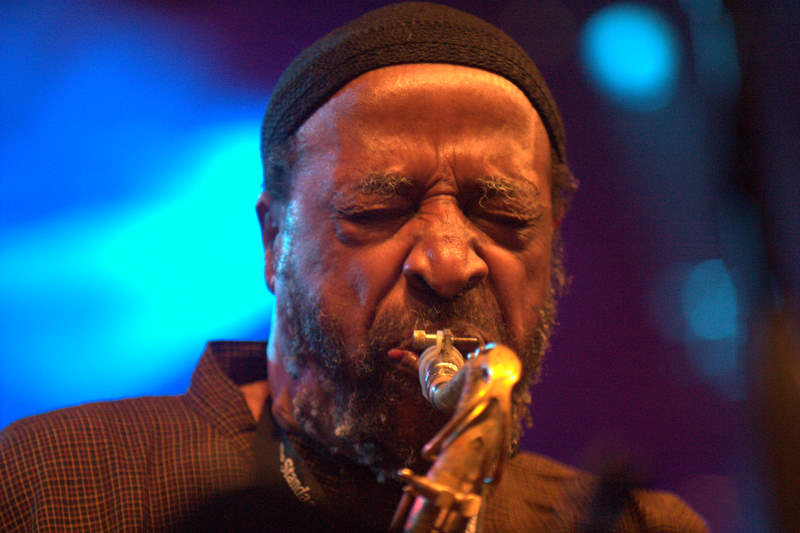
Lateef performing in 2007 at the Detroit Jazz Festival

His 1987 album Yusef Lateef's Little Symphony won the Grammy Award for Best New Age Recording[14][7] His core influences, however, were clearly rooted in jazz, and in his own words: "My music is jazz."[15]

In 1992, Lateef founded YAL Records. In 1993, he was commissioned by the WDR Radio Orchestra Cologne to compose The African American Epic Suite, a four-part work for orchestra and quartet, based on themes of slavery and disfranchisement in the United States.[16] The piece has since been performed by the Atlanta Symphony Orchestra and the Detroit Symphony Orchestra.

In 2005, Nicolas Humbert & Werner Penzel, directors of Step Across The Border, filmed Brother Yusef, in his wooden house in the middle of a forest in Massachusetts. In 2010, he received the lifetime Jazz Master Fellowship Award from the National Endowment for the Arts (NEA), an independent federal agency.[7][17] Established in 1982, the National Endowment for the Arts Jazz Masters award is the highest honor given in jazz.[18]

The Manhattan School of Music, where Lateef had earned a bachelor's and a master's degree, awarded him its Distinguished Alumni Award in 2012.

His last albums were recorded for Adam Rudolph's Meta Records. To the end of his life, Lateef continued to teach at the University of Massachusetts Amherst, Smith College, and Hampshire College in western Massachusetts. Lateef died of prostate cancer on the morning of December 23, 2013, at the age of 93, survived by his wife, Ayesha, and son, Yusef.[19][20]

Following his death, Lateef's family auctioned off many of his instruments, in the hopes that they would continue to be played. Woodwind player Jeff Coffin purchased Lateef's main tenor saxophone, as well as his bass flute.[21]

In October 2020, the UMass Fine Arts Center celebrated the centenary of Lateef's birth by producing "Yusef Lateef: A Centenary Celebration", a major online exhibit of his work curated by Glenn Siegel and others. The centenary includes "100 Responses to Yusef Lateef", a series of video tributes by many prominent artists and former Lateef collaborators and students.[22]

Discography

[edit]

Publications

[edit]
  • Repository of Scales and Melodic Patterns. Massachusetts: Fana Music. 1981.
  • Ziky Kofoworola; Yusef Lateef (1987). Hausa Performing Arts and Music. Nigeria: Department of Culture, Federal Ministry of Information and Culture.
  • Night in the Garden of Love. Massachusetts: Alnur Music. 1988.
  • Yusef Lateef; Herb Boyd (2005). The Gentle Giant: The Autobiography of Yusef Lateef. Morton Books Inc.

Personal life

[edit]

Lateef said that what he remembered most about his childhood was "My passion for nature."[23]

In 1980, Lateef declared that he would no longer perform any place where alcohol was served. In 1999, he said: "Too much blood, sweat and tears have been spilled creating this music to play it where people are smoking, drinking and talking."[2]

Lateef's first wife, Tahira, predeceased him, as did a son and a daughter.[2]

References

[edit]
[edit]
Revisions and contributorsEdit on WikipediaRead on Wikipedia
from Grokipedia
Yusef Lateef (born William Emanuel Huddleston; October 9, 1920 – December 23, 2013) was an American jazz multi-instrumentalist, composer, and educator who pioneered the fusion of non-Western musical traditions with jazz. Born in Chattanooga, Tennessee, and raised in Detroit from age five, Lateef began performing professionally on tenor saxophone with swing bands in his late teens and joined the Dizzy Gillespie Orchestra in 1949. In 1950, he converted to Islam as part of the Ahmadiyya movement and adopted the name Yusef Lateef, which reflects attributes of gentleness and amiability. He expanded his instrumental palette to include oboe, flute, bamboo flute, shanai, and other global instruments, incorporating Eastern, African, and Middle Eastern scales and timbres into his improvisations and compositions as early as the 1950s. Lateef led ensembles from the mid-1950s, recording over 100 albums as a leader starting in 1956, with notable works like Eastern Sounds (1961) and Live at Pep's (1964) exemplifying his world music approach. His 1987 album Yusef Lateef's Little Symphony earned a Grammy Award for Best New Age Album, and in 2010 he received the National Endowment for the Arts Jazz Masters Fellowship. Lateef coined the term "autophysiopsychic music" to describe compositions emerging from the performer's physical, mental, and spiritual dimensions, rejecting narrow genre labels in favor of broader expressive autonomy; he also taught at the University of Massachusetts from 1987 to 2002, influencing generations of musicians through his emphasis on global sonic exploration.

Early Life and Education

Childhood and Family Origins

Yusef Abdul Lateef was born William Emanuel Huddleston on October 9, 1920, in , to African American parents whose names are not widely documented in primary records. His mother played , providing an early exposure to music within the household. The family relocated in 1923 to , before moving again in 1925 to , , when Lateef was five years old, settling in a neighborhood rich with musical influences from the Great Migration's influx of Southern Black families. In , his father changed the family surname to Evans, reflecting a common practice among migrants seeking new identities amid urban transitions. This shift to Detroit's vibrant Black community, centered around Paradise Valley, immersed young Lateef in a fertile environment of , , and emerging traditions, though specific details on siblings or extended family remain sparse in verified accounts.

Initial Musical Development

Born William Emanuel Huddleston in , on October 9, 1920, Lateef moved with his family to in 1925, where he encountered the city's vibrant musical scene during the . At age 18 in 1938, he acquired his first instrument, an $80 Martin , and began playing during high school at Miller High School, jamming with local peers such as drummer Art Mardigan and saxophonist . Influenced by saxophonists he heard at venues like the Greystone Ballroom, including Lester Young's laid-back phrasing with Count Basie—which prompted him to switch to in 1939—Lateef developed a swing-oriented style amid Detroit's fertile environment of emerging talents like vibraphonist , pianist Tommy Flanagan, and guitarist . His high school ensemble, under teachers such as Mr. Goldenberg and John Cebera, experimented with unconventional repertoire like Spanish music, an unusual choice for the era that foreshadowed Lateef's later eclecticism. By 1939, Lateef turned professional, joining saxophonist Matthew Rucker's 13 Spirits of Swing, a 13-piece band that toured from Detroit to Miami, marking his entry into road work with swing ensembles. In 1946, he performed in New York with bandleader Lucky Millinder at the Apollo Theater, alongside Hot Lips Page and Roy Eldridge, expanding his exposure to varied big band styles. Further engagements followed, including stints with Ernie Fields' orchestra in 1947–1948 and a move to to play with Stitt, before joining Dizzy Gillespie's in 1948–1949, where he contributed to the group's bebop-infused swing sound. These early tours and associations honed his technical proficiency on the while immersing him in the transition from swing to modern , though his interest in non-Western sounds emerged later.

Religious Conversion and Philosophical Foundations

Adoption of Islam and Ahmadiyya Affiliation

In 1948, while performing in , Yusef Lateef, then known as William Evans, converted to through the Muslim Community, adopting the Muslim name Yusef Abdul Lateef as a reflection of his new faith. This conversion occurred amid a broader attraction of bebop-era jazz musicians to the Ahmadiyya movement, which emphasized progressive interpretations of and had established communities in U.S. cities like . Lateef later recounted in a 2008 interview that his embrace of via Ahmadiyya marked the beginning of a lifelong integration of spiritual principles into his musical and philosophical pursuits. By 1957, Lateef had deepened his involvement, residing in the Ahmadiyya mosque in where he served as and created a structured for Islamic aimed at both children and adults. This role underscored his commitment to the sect's teachings, which he viewed as compatible with intellectual inquiry and artistic expression, influencing his development of "autophysiopsychic" concepts that blended self-knowledge with Islamic . Unlike mainstream Sunni or Shia traditions, 's emphasis on as a prophesied reformer shaped Lateef's affiliation, though he maintained that his faith remained uncompromised in its core tenets. His adherence persisted until his death in 2013, with no public indications of departure from the community.

Formulation of Autophysiopsychic Principles

Yusef Lateef formulated the autophysiopsychic principles as a comprehensive framework for musical expression, coining the term to encapsulate music derived from the performer's physical, mental, and spiritual self, as well as the heart. This neologism integrated "auto" for personal character and autobiography, "physio" for bodily and instrumental execution, and "psycho" for psychological and spiritual synthesis, emphasizing a holistic process over mere technical improvisation. The concept evolved from Lateef's post-1948 adoption of Ahmadiyya Islam, which stressed rational inquiry, faith, and knowledge-seeking, influencing his view of music as a potential conduit for divine revelation akin to Qur'anic principles. By the 1950s, during his Detroit-based development of a unique voice, Lateef began incorporating global instruments and scales, laying groundwork through recordings like Jazz Moods (1957), where he introduced non-Western elements to challenge jazz conventions. Central to the principles was the requirement for rigorous preparation, drawing from influences like Young's dramatic phrasing and , including Indian flute techniques and African pygmy rhythms, to achieve authentic, personal sound. Lateef rejected superficial improvisation, advocating instead for deep kinesthetic mastery, semantic emotional depth tied to cultural context, and syntactical spiritual ordering of elements, as outlined in his prefaces to key texts. This formulation rejected the label "" in favor of autophysiopsychic music to underscore individual agency and transcendence of genre limitations. Lateef documented these principles in pedagogical works, including Method on How to Perform Autophysiopsychic Music (1979), which detailed performative techniques associating modes with chord types, and Repository of Scales and Melodic Patterns (1981), a systematic collection promoting creative synthesis of scales for improvisation rooted in physical skill, mental creativity, and spiritual intuition. These texts formalized the approach, enabling musicians to cultivate an inner "mi"—a Dogon concept for personal sonic essence—through disciplined exploration, reflecting Lateef's lifelong quest for intellectual and spiritual authenticity in music.

Musical Career

Early Professional Engagements (1940s–1950s)

Lateef launched his professional career in shortly after graduating high school in 1938, initially performing with local ensembles such as the 13 Spirits of Swing in 1939, which featured arrangements by pianist Milt Buckner. By his early twenties, he had begun touring with swing-era bands, including those led by trumpeters Hot Lips Page and , as well as reedman Herbie Fields. In 1946, Lateef relocated to New York City, where he joined Lucky Millinder's during its engagement at the Apollo Theater. He subsequently performed with Ernie Fields' orchestra for approximately one year around 1946–1947 before moving to in 1948. There, he contributed to his earliest released recordings in late 1948 as a with and His Kings of Swing, a session that also featured Sonny Blount (later known as ). Lateef joined Dizzy Gillespie's in 1949, serving as a tenor saxophonist for over a year and participating in recordings for RCA Victor and Spotlite labels amid the band's international tours. Following the band's dissolution due to postwar economic pressures on large ensembles, he returned to in 1950. Back in Detroit, Lateef enrolled at to study composition and under instructor Larry Teal, while leading local performances and developing his multi-instrumental approach. From 1955 to 1959, he fronted his own quintet featuring trombonist Curtis Fuller, pianist Hugh Lawson, drummer , and bassist Ernie Farrow, emphasizing with emerging Eastern influences. His debut as a leader came in 1956 with sessions for Savoy Records, including the album Jazz Mood released in 1957, which showcased his and work alongside sidemen like Lawson and Hayes. In 1958, he began studies with Ronald Odemark of the , expanding his palette beyond standard instrumentation.

Peak Innovations and Recordings (1950s–1960s)

Lateef's emergence as a in the mid-1950s marked the beginning of his most influential period, with his debut Jazz Mood recorded in 1957 for Savoy Records featuring a Detroit-based including Hugh Lawson, Ernie Farrow on rabab, and drummer . The session showcased Lateef on , , argol (a double-reed ), and scraper, with original compositions like "Yusef's Mood" and "Blues in Space" demonstrating early experiments in modal structures and timbral variety beyond standard ensembles. These recordings highlighted his pioneering integration of non-Western reed instruments into frameworks, predating broader adoption of global sonorities. Throughout the late 1950s and early , Lateef produced a series of leader dates for labels including Prestige, New Jazz, Riverside, and Moodsville, refining his multi-instrumental approach on —a rarity in where he emerged as the era's preeminent soloist on the instrument—alongside , , and occasional . Albums such as The Sounds of Yusef Lateef (1957, Prestige) and Other Sounds (1959-1961 sessions) incorporated Eastern melodic patterns and heterophonic elements, drawing from his studies of , Indian, and Asian scales to expand improvisational palettes within contexts. His 1961 Prestige release Eastern Sounds, recorded on September 5 by with pianist , Farrow on bass and rabab, and drummer Lex Humphries, epitomized this synthesis through tracks like "Blues for the ," "Chinq Miau," and a reimagined "Love Theme from ," blending oboe-led with swinging rhythms. By the early 1960s, Lateef's innovations gained wider exposure through his tenure with 's Sextet from 1962 to 1964, where he contributed , , and to live and studio recordings including The Cannonball Adderley Sextet in New York and European tour documents. These collaborations amplified his role in bridging soul-jazz accessibility with exploratory timbres, as on oboe features like "Trouble in Mind," while his leadership continued to prioritize autophysiopsychic expression rooted in physical, mental, and spiritual self-exploration through diverse sonic sources. This phase solidified Lateef's reputation for causal advancements in jazz's global orientation, influencing subsequent fusions without reliance on electric amplification or free-form abstraction.

Later Explorations and Collaborations (1970s–2013)

In the 1970s, Lateef signed with Atlantic Records, releasing albums that incorporated electric instruments and fusion elements alongside his signature Eastern and world music influences, such as Suite 16 (1970), The Gentle Giant (1971), Hush 'N' Thunder (1972), and The Doctor is In... No (1976). These recordings expanded his sonic palette with R&B rhythms and orchestral arrangements but drew criticism from jazz purists for diverging from traditional forms. Later in the decade, he briefly recorded for CTI Records, continuing to blend improvisational jazz with global timbres on instruments like the tenor saxophone, flute, and oboe. From the 1980s onward, Lateef's explorations emphasized acoustic textures and larger compositional forms, returning to Atlantic for releases like Concerto for Yusef Lateef (1986) before establishing his own YAL Records label for independent output. His work grew more experimental, prioritizing autophysiopsychic —drawing from physical, mental, and spiritual self-expression—over genre constraints, incorporating diverse flutes and percussion from African and Asian traditions. A pivotal collaboration began in 1988 with percussionist Adam Rudolph, spanning duos, quartets, octets, and orchestras until Lateef's death, yielding albums such as The World at Peace: Music for 12 Musicians (1997) and Beyond the Sky (2000), which featured intricate polyrhythms and thematic pieces evoking and . These partnerships underscored his commitment to transcultural dialogue in music, culminating in late releases like Voice Prints (2013) with Douglas Ewart, affirming his role as a global innovator into his 90s.

Academic and Educational Pursuits

Teaching Roles and Mentorship

Lateef began his formal teaching career in 1971 as a faculty member in the Theory Department at the , where he offered courses centered on his autophysiopsychic music principles, integrating self-knowledge, , and multicultural influences into . Concurrently, from 1971 to 1975, he served as an instructor at (BMCC), during which time he pursued his doctoral studies in education at the . In 1987, Lateef joined the as a professor of music, holding a joint appointment with as part of the Five Colleges consortium, a position he maintained until his retirement in 2002, after which he became professor . At UMass, his teaching emphasized practical musicianship, theoretical innovation, and the philosophical underpinnings of music as a tool for personal and cultural exploration, drawing from his experiences in global musical traditions. Beyond structured faculty roles, Lateef mentored aspiring musicians through lectures and workshops at numerous universities and colleges across the , as well as a Senior Research Fellowship at the Center for Nigerian Studies, where he guided students in blending Eastern and African influences with Western improvisation. Students and colleagues recalled him as a profound mentor who prioritized individualized guidance, fostering long-term relationships that extended to collaborative performances and lifelong friendships, as evidenced by personal tributes highlighting his role in shaping educators and performers. His approach rejected conventional categorization, instead encouraging self-directed discovery, which influenced protégés to pursue interdisciplinary artistry.

Doctoral Work and Pedagogical Innovations

In 1975, Yusef Lateef completed a (Ed.D.) at the , where his dissertation, titled An Over-View of Western and Islamic Education, analyzed comparative frameworks between Western pedagogical traditions—rooted in empirical and rationalist methodologies—and Islamic educational principles, which prioritize holistic integration of intellectual, moral, and spiritual dimensions for . The work underscored Islam's historical commitment to universal literacy and , contrasting it with Western models' occasional overemphasis on compartmentalized knowledge, and advocated for educational practices that cultivate innate beyond rote acquisition. Lateef's doctoral research directly shaped his pedagogical innovations in music education, manifesting in the formulation of "autophysiopsychic music"—a term denoting compositions and performances originating from the performer's unified physical, mental, and spiritual faculties, rather than external imitation or formulaic techniques. He introduced this approach in university courses as early as 1971, prior to his degree completion, emphasizing self-inquiry exercises to unlock authentic expression and critiquing conventional pedagogy for insufficiently addressing performers' inner resources. To disseminate these methods, Lateef produced instructional texts like Method on How to Perform Autophysiopsychic Music, which outlines sequential practices for musicians to access subconscious creative impulses through rhythmic, melodic, and improvisational drills grounded in personal phenomenology, thereby enhancing technical proficiency alongside psychological depth. Applied in his faculty roles at UMass Amherst and , these innovations promoted multicultural instrumentation and non-Western scales, fostering student autonomy by integrating philosophical reflection with practical ensemble work, as evidenced by alumni accounts of transformative, introspective learning outcomes.

Creative Outputs

Key Recordings and Discography Highlights

Yusef Lateef's early recordings established his innovative approach to , incorporating non-Western instruments and modalities. His debut as a leader, Jazz Mood (1957, Savoy Records), featured the Egyptian argol alongside and , with contributions from Ernie Farrow on and , and Curtis Fuller on , marking an early precursor to astral- influences. Subsequent Prestige releases like Other Sounds (1959, New Jazz) expanded this palette, including , finger cymbals, and an earth-board, performed with Farrow, Hugh Lawson, and Oliver Jackson. In the early 1960s, Lateef's work gained prominence for blending Eastern scales with hard bop. Eastern Sounds (1961, Moodsville, a Prestige subsidiary), widely regarded as his breakthrough album, showcased oboe and tenor saxophone on tracks evoking Asian and Middle Eastern themes, though some arrangements remained conventionally jazz-oriented. The Centaur and the Phoenix (1960, Riverside) further explored classical and Eastern elements, with Joe Zawinul on piano and arranger Kenny Barron, including Stravinsky-inspired compositions. Boss of the Soul-Stream Trombone (1961, Warwick) shifted toward hard bop, highlighting Lateef's tenor alongside Freddie Hubbard and Curtis Fuller. During his Impulse! and Atlantic periods, Lateef's live and studio output emphasized visceral energy and soul-jazz fusion. Live at Pep's (1965, Impulse!), recorded in , captured a with Richard Williams on , featuring on the R&B standard "." On Atlantic, The Blue Yusef Lateef (1968) drew on roots with tambura, koto, and vocal backing by , while The Doctor Is In…And Out (1976) incorporated fusion elements with , , and . Later recordings reflected global and orchestral explorations. In a Temple Garden (1979, CTI) featured lush arrangements with Randy and , , and . In Nigeria (1985, Landmark) integrated local Yoruba and Hausa drum ensembles during sessions with Nigerian musicians. Yusef Lateef's Little Symphony (1987), despite its categorization, earned the Grammy Award for Best New Age Album in 1988, showcasing without prior genre affiliation.
AlbumYearLabelKey Significance
Jazz Mood1957SavoyDebut introducing argol and astral-jazz elements.
Eastern Sounds1961MoodsvilleBreakthrough with Eastern modalities on oboe and sax.
Live at Pep's1965Impulse!Energetic live set blending oboe with R&B.
Yusef Lateef's Little Symphony1987CTIGrammy-winning orchestral work.

Publications and Theoretical Writings

Yusef Lateef's theoretical writings emphasized the concept of autophysiopsychic music, a term he coined to describe improvisational music derived from the performer's physical, mental, and spiritual dimensions, extending beyond conventional frameworks to incorporate Eastern philosophies, Islamic , and global scales. His seminal "The Pleasures of Voice in Autophysiopsychic Music" explores vocal expression as a holistic integration of these elements, arguing that true musical authenticity arises from self-generated sonic identities rather than rote imitation of Western traditions. Other essays, such as "A " and "Concerning the Heart ," delve into logical structures of musical intuition and contemplative practices, positioning as a meditative discipline akin to Sufi traditions. Lateef's Repository of Scales and Melodic Patterns, a comprehensive spiral-bound volume spanning 282 pages, serves as a practical for musicians, cataloging non-Western scales, modal patterns, and melodic motifs drawn from , Indian, and African sources to expand improvisational vocabularies. Described as a "thesaurus" enriching African American musical literature, it provides exercises in synthetic scales and patterns attributed to influences like , fostering technical mastery while challenging Eurocentric tonal biases in education. The book's enduring utility lies in its systematic enumeration of over 100 scale variants, enabling performers to internalize diverse sonic resources for autophysiopsychic expression. In Method on How to Perform Autophysiopsychic Music, originally titled How to Improvise , Lateef outlines pedagogical techniques blending technical proficiency with philosophical introspection, instructing musicians to cultivate "" through intuitive phrasing rooted in personal rather than formulaic chord progressions. This concise manual addresses improvisation's metaphysical underpinnings, advocating for scales and rhythms that reflect the performer's inner state, and has been recommended for woodwind players seeking culturally expansive approaches. Lateef's writings collectively prioritize empirical and self-reliant , critiquing institutionalized for its neglect of extramusical dimensions.

Instrument Inventions and Visual Arts

Lateef constructed custom musical instruments as part of his exploration of and non-Western sonorities, including hand-carved bamboo flutes designed to evoke Eastern and African aesthetics within improvisational contexts. These efforts aligned with his broader autophysiopsychic , which emphasized music derived from physical, mental, and spiritual impulses, often incorporating unconventional materials to expand jazz's sonic palette beyond standard Western . In parallel, Lateef produced over 100 visual works, primarily drawings that integrated abstract forms with his compositional processes. He developed innovative graphic notations, employing numbers, shapes, and symbols to denote intervals, rhythms, and structures in his interval-based , diverging from traditional staff notation to facilitate intuitive . These notations appeared in scores and publications like Biographology, which paired with visual representations of his and improvisational ideas. His drawings were exhibited posthumously, including "Towards the Unknown" at Trinosophes in in 2015 and at White Columns in New York in 2014, highlighting connections between his musical and visual expressions. Lateef also created paintings, such as watercolors preserved in archival collections.

Personal Life and Final Years

Family Dynamics and Private Beliefs

Yusef Lateef married twice during his lifetime. His first marriage was to Tahira Lateef, who predeceased him; the couple had a daughter and a son, both of whom also died before Lateef. He subsequently married Ayesha Lateef, his second wife, with whom he had a son, Yusef Lateef Jr.; the younger Yusef provided care for his father in his final years. Lateef maintained a close family unit, supported by his surviving son, granddaughter, and great-grandchildren at the time of his death. Descriptions of Lateef portray him as a committed man whose personal life centered on domestic stability amid his professional pursuits in music and academia. Limited public details exist on interpersonal family dynamics, reflecting Lateef's preference for ; however, his son's role in his later care underscores enduring familial bonds. Lateef's private beliefs were profoundly shaped by his in the late , after which he adopted the name Yusef Lateef around 1950, drawn to the faith's emphasis on truth and ethical living. He pursued intensive studies in Islamic and , particularly , integrating these into his worldview as pathways for spiritual and moral growth. This commitment influenced his of "autophysiopsychic" expression, a term he coined to describe creative output arising from one's integrated physical, mental, and spiritual dimensions. In his writings, Lateef critiqued hypocrisy as a core "disease" obstructing human progress—encompassing physical, moral, and spiritual realms—and advocated perceiving reality through the "heart" via intuitive faith over mere intellect. These views, rooted in Islamic principles, extended to his broader ethical stance, prioritizing authenticity and self-examination without public proselytizing. Lateef's beliefs remained consistent, blending Islamic devotion with explorations of Eastern philosophies, though he held Islam as foundational.

Health Decline and Death

In his later years, Yusef Lateef contended with , a condition that contributed to his eventual passing. He died on December 23, 2013, at the age of 93, at his home in , where he had resided for decades. Lateef passed peacefully in the late morning, surrounded by loved ones, including his wife, Ayesha Lateef. While some initial reports cited age-related complications, family statements and subsequent accounts confirmed the as the primary factor in his decline and death. He was survived by his wife and son, Yusef Lateef Jr.

Legacy and Critical Evaluation

Major Achievements and Awards

In 1988, Lateef received the Grammy Award for Best New Age Album for his recording Yusef Lateef's Little Symphony, on which he performed all instruments. The awarded him its Jazz Masters Fellowship, the highest honor for in the United States, in 2010, recognizing his lifetime contributions as a and innovator in incorporating global musical traditions into . Other notable honors include the Manhattan School of Music's Distinguished Alumni Award in 2012, where he had earned bachelor's and master's degrees in music and music education; the Distinguished Achievement Award in 2011; and Artist of the Year from the , in 2007.
YearAward/HonorDetails
1998–1999 Arts Achievement AwardRecognized outstanding alumni achievements in arts.
2001 Benny Golson Jazz Master AwardHonored for enduring legacy in .
2007Detroit International Jazz Festival Jazz Guardian Award for ArtistryFor extraordinary contributions to jazz artistry.
2011Sharjah Art Foundation Biennial AwardFor collaboration on "A Score for a Biennial" with Maalem Abdelkébir Merchane.

Influences and Broader Impact

Lateef's early musical development drew from the vibrant jazz scene, where he encountered performers such as saxophonist Al Farish and trumpeter during his teenage years at the Arcade Theatre. By age 18, admiration for Young's phrasing prompted him to abandon the in favor of the , aligning with the instrument's emerging prominence in swing and early contexts. Associations with local talents including vibraphonist and bassist further embedded and idioms into his foundational style. Subsequent influences expanded beyond Western jazz traditions, incorporating Eastern modalities after Lateef's in 1950 and self-directed studies in and Asian musics. He mastered non-Western instruments like the , shanai, and argul, drawing from Indian flutist Saj Dev's teachings and explorations of Pygmy rhythms alongside European from . These elements informed his autophysiopsychic approach, a integrating physical technique, mental patterns, and spiritual expression to transcend conventional . Lateef's integration of global sonorities into , evident in recordings like (1961), positioned him as a pioneer of fusion, predating broader genre expansions and influencing John Coltrane's modal explorations in the late 1950s. His use of Eastern modes, rhythms, and instruments in inspired subsequent astral-jazz practitioners and diversified orchestration, as seen in orchestral commissions such as the 1969 Blues Suite with the Augusta Symphony Orchestra. Pedagogically, his Repository of Scales and Melodic Patterns (1981) provided musicians with tools for incorporating diverse scalar systems, extending his impact into education and composition. This legacy culminated in a 1987 Grammy Award for Yusef Lateef's Little Symphony, affirming his role in broadening 's harmonic and timbral boundaries.

Reception, Debates, and Criticisms

Lateef's recordings garnered consistent praise from jazz critics for their technical virtuosity, genre-blending innovation, and expansion of instrumental palettes. His 1961 album was lauded for its formidable display of woodwinds like and alongside Eastern influences, creating a thoroughly enjoyable and pioneering collection. Similarly, The Last Savoy Sessions (1956–1959) impressed reviewers with its prolific output and creative depth over a brief period. Albums such as The Blue Yusef Lateef (1968) were hailed as standouts, exemplifying his mastery of blues-infused improvisation and orchestral ambition. A central point of discussion in Lateef's reception involved his explicit rejection of the "" label, which he viewed as vulgar and reductive, preferring instead the term "autophysiopsychic "—defined as expression arising from one's physical, mental, and spiritual totality. This position, articulated in interviews and writings as early as the , fueled scholarly and critical debates about in improvised , with some analyses grouping him alongside figures like and who similarly resisted "" as a blanket descriptor. During a 1964 DownBeat blindfold test, critic Leonard Feather probed Lateef on high-rated recordings outside what he termed the " idiom," underscoring the tension between his self-conception and prevailing categorizations. Criticisms of Lateef's oeuvre were infrequent and mild compared to the acclaim, often centering on perceived limitations in later experimental phases rather than outright flaws. For instance, collaborative efforts like Influence (2007) with the Belmondo Brothers were described as beautiful and intricate but occasionally lacking passionate surprises or conventional jazz excitement. Despite such notes, no major controversies marred his career; debates largely revolved around interpretive framing, with audiences and reviewers persisting in associating his Eastern modalities, multi-instrumentalism, and spiritual undertones with jazz evolution, irrespective of his terminological preferences.

References

Add your contribution
Related Hubs
User Avatar
No comments yet.