



Community hub
Recent from talks
Contribute something
Nothing was collected or created yet.
Standard normal table
View on WikipediaIn statistics, a standard normal table, also called the unit normal table or Z table,[1] is a mathematical table for the values of Φ, the cumulative distribution function of the normal distribution. It is used to find the probability that a statistic is observed below, above, or between values on the standard normal distribution, and by extension, any normal distribution. Since probability tables cannot be printed for every normal distribution, as there are an infinite variety of normal distributions, it is common practice to convert a normal to a standard normal (known as a z-score) and then use the standard normal table to find probabilities.[2]
Normal and standard normal distribution
[edit]Normal distributions are symmetrical, bell-shaped distributions that are useful in describing real-world data. The standard normal distribution, represented by Z, is the normal distribution having a mean of 0 and a standard deviation of 1.
Conversion
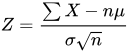
[edit]If X is a random variable from a normal distribution with mean μ and standard deviation σ, its Z-score may be calculated from X by subtracting μ and dividing by the standard deviation:

If is the mean of a sample of size n from some population in which the mean is μ and the standard deviation is σ, the standard error is


If is the total of a sample of size n from some population in which the mean is μ and the standard deviation is σ, the expected total is nμ and the standard error is


Reading a Z table
[edit]Formatting / layout
[edit]Z tables are typically composed as follows:
- The label for rows contains the integer part and the first decimal place of Z.
- The label for columns contains the second decimal place of Z.
- The values within the table are the probabilities corresponding to the table type. These probabilities are calculations of the area under the normal curve from the starting point (0 for cumulative from mean, negative infinity for cumulative and positive infinity for complementary cumulative) to Z.
Example: To find 0.69, one would look down the rows to find 0.6 and then across the columns to 0.09 which would yield a probability of 0.25490 for a cumulative from mean table or 0.75490 from a cumulative table.
To find a negative value such as –0.83, one could use a cumulative table for negative z-values[3] which yield a probability of 0.20327.
But since the normal distribution curve is symmetrical, probabilities for only positive values of Z are typically given. The user might have to use a complementary operation on the absolute value of Z, as in the example below.
Types of tables
[edit]Z tables use at least three different conventions:
- Cumulative from mean
- gives a probability that a statistic is between 0 (mean) and Z. Example: Prob(0 ≤ Z ≤ 0.69) = 0.2549.
- Cumulative
- gives a probability that a statistic is less than Z. This equates to the area of the distribution below Z. Example: Prob(Z ≤ 0.69) = 0.7549.
- Complementary cumulative
- gives a probability that a statistic is greater than Z. This equates to the area of the distribution above Z.
- Example: Find Prob(Z ≥ 0.69). Since this is the portion of the area above Z, the proportion that is greater than Z is found by subtracting Z from 1. That is Prob(Z ≥ 0.69) = 1 − Prob(Z ≤ 0.69) or Prob(Z ≥ 0.69) = 1 − 0.7549 = 0.2451.
Table examples
[edit]Cumulative from minus infinity to Z
[edit]
This table gives a probability that a statistic is between minus infinity and Z.

The values are calculated using the cumulative distribution function of a standard normal distribution with mean of zero and standard deviation of one, usually denoted with the capital Greek letter (phi), is the integral

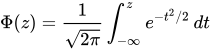
(z) is related to the error function, or erf(z).
![{\displaystyle \Phi (z)={\frac {1}{2}}\left[1+\operatorname {erf} \left({\frac {z}{\sqrt {2}}}\right)\right]}](https://wikimedia.org/api/rest_v1/media/math/render/svg/92f0aafbd270c6323325a3c39fd4ffe25afdf4a9)
Note that for z = 1, 2, 3, one obtains (after multiplying by 2 to account for the [−z,z] interval) the results f (z) = 0.6827, 0.9545, 0.9974, characteristic of the 68–95–99.7 rule.
Cumulative (less than Z)
[edit]This table gives a probability that a statistic is less than Z (i.e. between negative infinity and Z).
| z | −0.00 | −0.01 | −0.02 | −0.03 | −0.04 | −0.05 | −0.06 | −0.07 | −0.08 | −0.09 |
|---|---|---|---|---|---|---|---|---|---|---|
| -3.9 | 0.00005 | 0.00005 | 0.00004 | 0.00004 | 0.00004 | 0.00004 | 0.00004 | 0.00004 | 0.00003 | 0.00003 |
| -3.8 | 0.00007 | 0.00007 | 0.00007 | 0.00006 | 0.00006 | 0.00006 | 0.00006 | 0.00005 | 0.00005 | 0.00005 |
| -3.7 | 0.00011 | 0.00010 | 0.00010 | 0.00010 | 0.00009 | 0.00009 | 0.00008 | 0.00008 | 0.00008 | 0.00008 |
| -3.6 | 0.00016 | 0.00015 | 0.00015 | 0.00014 | 0.00014 | 0.00013 | 0.00013 | 0.00012 | 0.00012 | 0.00011 |
| -3.5 | 0.00023 | 0.00022 | 0.00022 | 0.00021 | 0.00020 | 0.00019 | 0.00019 | 0.00018 | 0.00017 | 0.00017 |
| -3.4 | 0.00034 | 0.00032 | 0.00031 | 0.00030 | 0.00029 | 0.00028 | 0.00027 | 0.00026 | 0.00025 | 0.00024 |
| -3.3 | 0.00048 | 0.00047 | 0.00045 | 0.00043 | 0.00042 | 0.00040 | 0.00039 | 0.00038 | 0.00036 | 0.00035 |
| -3.2 | 0.00069 | 0.00066 | 0.00064 | 0.00062 | 0.00060 | 0.00058 | 0.00056 | 0.00054 | 0.00052 | 0.00050 |
| -3.1 | 0.00097 | 0.00094 | 0.00090 | 0.00087 | 0.00084 | 0.00082 | 0.00079 | 0.00076 | 0.00074 | 0.00071 |
| -3.0 | 0.00135 | 0.00131 | 0.00126 | 0.00122 | 0.00118 | 0.00114 | 0.00111 | 0.00107 | 0.00104 | 0.00100 |
| -2.9 | 0.00187 | 0.00181 | 0.00175 | 0.00169 | 0.00164 | 0.00159 | 0.00154 | 0.00149 | 0.00144 | 0.00139 |
| -2.8 | 0.00256 | 0.00248 | 0.00240 | 0.00233 | 0.00226 | 0.00219 | 0.00212 | 0.00205 | 0.00199 | 0.00193 |
| -2.7 | 0.00347 | 0.00336 | 0.00326 | 0.00317 | 0.00307 | 0.00298 | 0.00289 | 0.00280 | 0.00272 | 0.00264 |
| -2.6 | 0.00466 | 0.00453 | 0.00440 | 0.00427 | 0.00415 | 0.00402 | 0.00391 | 0.00379 | 0.00368 | 0.00357 |
| -2.5 | 0.00621 | 0.00604 | 0.00587 | 0.00570 | 0.00554 | 0.00539 | 0.00523 | 0.00508 | 0.00494 | 0.00480 |
| -2.4 | 0.00820 | 0.00798 | 0.00776 | 0.00755 | 0.00734 | 0.00714 | 0.00695 | 0.00676 | 0.00657 | 0.00639 |
| -2.3 | 0.01072 | 0.01044 | 0.01017 | 0.00990 | 0.00964 | 0.00939 | 0.00914 | 0.00889 | 0.00866 | 0.00842 |
| -2.2 | 0.01390 | 0.01355 | 0.01321 | 0.01287 | 0.01255 | 0.01222 | 0.01191 | 0.01160 | 0.01130 | 0.01101 |
| -2.1 | 0.01786 | 0.01743 | 0.01700 | 0.01659 | 0.01618 | 0.01578 | 0.01539 | 0.01500 | 0.01463 | 0.01426 |
| -2.0 | 0.02275 | 0.02222 | 0.02169 | 0.02118 | 0.02068 | 0.02018 | 0.01970 | 0.01923 | 0.01876 | 0.01831 |
| −1.9 | 0.02872 | 0.02807 | 0.02743 | 0.02680 | 0.02619 | 0.02559 | 0.02500 | 0.02442 | 0.02385 | 0.02330 |
| −1.8 | 0.03593 | 0.03515 | 0.03438 | 0.03362 | 0.03288 | 0.03216 | 0.03144 | 0.03074 | 0.03005 | 0.02938 |
| −1.7 | 0.04457 | 0.04363 | 0.04272 | 0.04182 | 0.04093 | 0.04006 | 0.03920 | 0.03836 | 0.03754 | 0.03673 |
| −1.6 | 0.05480 | 0.05370 | 0.05262 | 0.05155 | 0.05050 | 0.04947 | 0.04846 | 0.04746 | 0.04648 | 0.04551 |
| −1.5 | 0.06681 | 0.06552 | 0.06426 | 0.06301 | 0.06178 | 0.06057 | 0.05938 | 0.05821 | 0.05705 | 0.05592 |
| −1.4 | 0.08076 | 0.07927 | 0.07780 | 0.07636 | 0.07493 | 0.07353 | 0.07215 | 0.07078 | 0.06944 | 0.06811 |
| −1.3 | 0.09680 | 0.09510 | 0.09342 | 0.09176 | 0.09012 | 0.08851 | 0.08692 | 0.08534 | 0.08379 | 0.08226 |
| −1.2 | 0.11507 | 0.11314 | 0.11123 | 0.10935 | 0.10749 | 0.10565 | 0.10383 | 0.10204 | 0.10027 | 0.09853 |
| −1.1 | 0.13567 | 0.13350 | 0.13136 | 0.12924 | 0.12714 | 0.12507 | 0.12302 | 0.12100 | 0.11900 | 0.11702 |
| −1.0 | 0.15866 | 0.15625 | 0.15386 | 0.15151 | 0.14917 | 0.14686 | 0.14457 | 0.14231 | 0.14007 | 0.13786 |
| −0.9 | 0.18406 | 0.18141 | 0.17879 | 0.17619 | 0.17361 | 0.17106 | 0.16853 | 0.16602 | 0.16354 | 0.16109 |
| −0.8 | 0.21186 | 0.20897 | 0.20611 | 0.20327 | 0.20045 | 0.19766 | 0.19489 | 0.19215 | 0.18943 | 0.18673 |
| −0.7 | 0.24196 | 0.23885 | 0.23576 | 0.23270 | 0.22965 | 0.22663 | 0.22363 | 0.22065 | 0.21770 | 0.21476 |
| −0.6 | 0.27425 | 0.27093 | 0.26763 | 0.26435 | 0.26109 | 0.25785 | 0.25463 | 0.25143 | 0.24825 | 0.24510 |
| −0.5 | 0.30854 | 0.30503 | 0.30153 | 0.29806 | 0.29460 | 0.29116 | 0.28774 | 0.28434 | 0.28096 | 0.27760 |
| −0.4 | 0.34458 | 0.34090 | 0.33724 | 0.33360 | 0.32997 | 0.32636 | 0.32276 | 0.31918 | 0.31561 | 0.31207 |
| −0.3 | 0.38209 | 0.37828 | 0.37448 | 0.37070 | 0.36693 | 0.36317 | 0.35942 | 0.35569 | 0.35197 | 0.34827 |
| −0.2 | 0.42074 | 0.41683 | 0.41294 | 0.40905 | 0.40517 | 0.40129 | 0.39743 | 0.39358 | 0.38974 | 0.38591 |
| −0.1 | 0.46017 | 0.45620 | 0.45224 | 0.44828 | 0.44433 | 0.44038 | 0.43644 | 0.43251 | 0.42858 | 0.42465 |
| −0.0 | 0.50000 | 0.49601 | 0.49202 | 0.48803 | 0.48405 | 0.48006 | 0.47608 | 0.47210 | 0.46812 | 0.46414 |
| z | −0.00 | −0.01 | −0.02 | −0.03 | −0.04 | −0.05 | −0.06 | −0.07 | −0.08 | −0.09 |
| z | + 0.00 | + 0.01 | + 0.02 | + 0.03 | + 0.04 | + 0.05 | + 0.06 | + 0.07 | + 0.08 | + 0.09 |
|---|---|---|---|---|---|---|---|---|---|---|
| 0.0 | 0.50000 | 0.50399 | 0.50798 | 0.51197 | 0.51595 | 0.51994 | 0.52392 | 0.52790 | 0.53188 | 0.53586 |
| 0.1 | 0.53983 | 0.54380 | 0.54776 | 0.55172 | 0.55567 | 0.55962 | 0.56360 | 0.56749 | 0.57142 | 0.57535 |
| 0.2 | 0.57926 | 0.58317 | 0.58706 | 0.59095 | 0.59483 | 0.59871 | 0.60257 | 0.60642 | 0.61026 | 0.61409 |
| 0.3 | 0.61791 | 0.62172 | 0.62552 | 0.62930 | 0.63307 | 0.63683 | 0.64058 | 0.64431 | 0.64803 | 0.65173 |
| 0.4 | 0.65542 | 0.65910 | 0.66276 | 0.66640 | 0.67003 | 0.67364 | 0.67724 | 0.68082 | 0.68439 | 0.68793 |
| 0.5 | 0.69146 | 0.69497 | 0.69847 | 0.70194 | 0.70540 | 0.70884 | 0.71226 | 0.71566 | 0.71904 | 0.72240 |
| 0.6 | 0.72575 | 0.72907 | 0.73237 | 0.73565 | 0.73891 | 0.74215 | 0.74537 | 0.74857 | 0.75175 | 0.75490 |
| 0.7 | 0.75804 | 0.76115 | 0.76424 | 0.76730 | 0.77035 | 0.77337 | 0.77637 | 0.77935 | 0.78230 | 0.78524 |
| 0.8 | 0.78814 | 0.79103 | 0.79389 | 0.79673 | 0.79955 | 0.80234 | 0.80511 | 0.80785 | 0.81057 | 0.81327 |
| 0.9 | 0.81594 | 0.81859 | 0.82121 | 0.82381 | 0.82639 | 0.82894 | 0.83147 | 0.83398 | 0.83646 | 0.83891 |
| 1.0 | 0.84134 | 0.84375 | 0.84614 | 0.84849 | 0.85083 | 0.85314 | 0.85543 | 0.85769 | 0.85993 | 0.86214 |
| 1.1 | 0.86433 | 0.86650 | 0.86864 | 0.87076 | 0.87286 | 0.87493 | 0.87698 | 0.87900 | 0.88100 | 0.88298 |
| 1.2 | 0.88493 | 0.88686 | 0.88877 | 0.89065 | 0.89251 | 0.89435 | 0.89617 | 0.89796 | 0.89973 | 0.90147 |
| 1.3 | 0.90320 | 0.90490 | 0.90658 | 0.90824 | 0.90988 | 0.91149 | 0.91308 | 0.91466 | 0.91621 | 0.91774 |
| 1.4 | 0.91924 | 0.92073 | 0.92220 | 0.92364 | 0.92507 | 0.92647 | 0.92785 | 0.92922 | 0.93056 | 0.93189 |
| 1.5 | 0.93319 | 0.93448 | 0.93574 | 0.93699 | 0.93822 | 0.93943 | 0.94062 | 0.94179 | 0.94295 | 0.94408 |
| 1.6 | 0.94520 | 0.94630 | 0.94738 | 0.94845 | 0.94950 | 0.95053 | 0.95154 | 0.95254 | 0.95352 | 0.95449 |
| 1.7 | 0.95543 | 0.95637 | 0.95728 | 0.95818 | 0.95907 | 0.95994 | 0.96080 | 0.96164 | 0.96246 | 0.96327 |
| 1.8 | 0.96407 | 0.96485 | 0.96562 | 0.96638 | 0.96712 | 0.96784 | 0.96856 | 0.96926 | 0.96995 | 0.97062 |
| 1.9 | 0.97128 | 0.97193 | 0.97257 | 0.97320 | 0.97381 | 0.97441 | 0.97500 | 0.97558 | 0.97615 | 0.97670 |
| 2.0 | 0.97725 | 0.97778 | 0.97831 | 0.97882 | 0.97932 | 0.97982 | 0.98030 | 0.98077 | 0.98124 | 0.98169 |
| 2.1 | 0.98214 | 0.98257 | 0.98300 | 0.98341 | 0.98382 | 0.98422 | 0.98461 | 0.98500 | 0.98537 | 0.98574 |
| 2.2 | 0.98610 | 0.98645 | 0.98679 | 0.98713 | 0.98745 | 0.98778 | 0.98809 | 0.98840 | 0.98870 | 0.98899 |
| 2.3 | 0.98928 | 0.98956 | 0.98983 | 0.99010 | 0.99036 | 0.99061 | 0.99086 | 0.99111 | 0.99134 | 0.99158 |
| 2.4 | 0.99180 | 0.99202 | 0.99224 | 0.99245 | 0.99266 | 0.99286 | 0.99305 | 0.99324 | 0.99343 | 0.99361 |
| 2.5 | 0.99379 | 0.99396 | 0.99413 | 0.99430 | 0.99446 | 0.99461 | 0.99477 | 0.99492 | 0.99506 | 0.99520 |
| 2.6 | 0.99534 | 0.99547 | 0.99560 | 0.99573 | 0.99585 | 0.99598 | 0.99609 | 0.99621 | 0.99632 | 0.99643 |
| 2.7 | 0.99653 | 0.99664 | 0.99674 | 0.99683 | 0.99693 | 0.99702 | 0.99711 | 0.99720 | 0.99728 | 0.99736 |
| 2.8 | 0.99744 | 0.99752 | 0.99760 | 0.99767 | 0.99774 | 0.99781 | 0.99788 | 0.99795 | 0.99801 | 0.99807 |
| 2.9 | 0.99813 | 0.99819 | 0.99825 | 0.99831 | 0.99836 | 0.99841 | 0.99846 | 0.99851 | 0.99856 | 0.99861 |
| 3.0 | 0.99865 | 0.99869 | 0.99874 | 0.99878 | 0.99882 | 0.99886 | 0.99889 | 0.99893 | 0.99896 | 0.99900 |
| 3.1 | 0.99903 | 0.99906 | 0.99910 | 0.99913 | 0.99916 | 0.99918 | 0.99921 | 0.99924 | 0.99926 | 0.99929 |
| 3.2 | 0.99931 | 0.99934 | 0.99936 | 0.99938 | 0.99940 | 0.99942 | 0.99944 | 0.99946 | 0.99948 | 0.99950 |
| 3.3 | 0.99952 | 0.99953 | 0.99955 | 0.99957 | 0.99958 | 0.99960 | 0.99961 | 0.99962 | 0.99964 | 0.99965 |
| 3.4 | 0.99966 | 0.99968 | 0.99969 | 0.99970 | 0.99971 | 0.99972 | 0.99973 | 0.99974 | 0.99975 | 0.99976 |
| 3.5 | 0.99977 | 0.99978 | 0.99978 | 0.99979 | 0.99980 | 0.99981 | 0.99981 | 0.99982 | 0.99983 | 0.99983 |
| 3.6 | 0.99984 | 0.99985 | 0.99985 | 0.99986 | 0.99986 | 0.99987 | 0.99987 | 0.99988 | 0.99988 | 0.99989 |
| 3.7 | 0.99989 | 0.99990 | 0.99990 | 0.99990 | 0.99991 | 0.99991 | 0.99992 | 0.99992 | 0.99992 | 0.99992 |
| 3.8 | 0.99993 | 0.99993 | 0.99993 | 0.99994 | 0.99994 | 0.99994 | 0.99994 | 0.99995 | 0.99995 | 0.99995 |
| 3.9 | 0.99995 | 0.99995 | 0.99996 | 0.99996 | 0.99996 | 0.99996 | 0.99996 | 0.99996 | 0.99997 | 0.99997 |
| z | +0.00 | +0.01 | +0.02 | +0.03 | +0.04 | +0.05 | +0.06 | +0.07 | +0.08 | +0.09 |
Complementary cumulative
[edit]This table gives a probability that a statistic is greater than Z. :

| z | +0.00 | +0.01 | +0.02 | +0.03 | +0.04 | +0.05 | +0.06 | +0.07 | +0.08 | +0.09 |
|---|---|---|---|---|---|---|---|---|---|---|
| 0.0 | 0.50000 | 0.49601 | 0.49202 | 0.48803 | 0.48405 | 0.48006 | 0.47608 | 0.47210 | 0.46812 | 0.46414 |
| 0.1 | 0.46017 | 0.45620 | 0.45224 | 0.44828 | 0.44433 | 0.44038 | 0.43640 | 0.43251 | 0.42858 | 0.42465 |
| 0.2 | 0.42074 | 0.41683 | 0.41294 | 0.40905 | 0.40517 | 0.40129 | 0.39743 | 0.39358 | 0.38974 | 0.38591 |
| 0.3 | 0.38209 | 0.37828 | 0.37448 | 0.37070 | 0.36693 | 0.36317 | 0.35942 | 0.35569 | 0.35197 | 0.34827 |
| 0.4 | 0.34458 | 0.34090 | 0.33724 | 0.33360 | 0.32997 | 0.32636 | 0.32276 | 0.31918 | 0.31561 | 0.31207 |
| 0.5 | 0.30854 | 0.30503 | 0.30153 | 0.29806 | 0.29460 | 0.29116 | 0.28774 | 0.28434 | 0.28096 | 0.27760 |
| 0.6 | 0.27425 | 0.27093 | 0.26763 | 0.26435 | 0.26109 | 0.25785 | 0.25463 | 0.25143 | 0.24825 | 0.24510 |
| 0.7 | 0.24196 | 0.23885 | 0.23576 | 0.23270 | 0.22965 | 0.22663 | 0.22363 | 0.22065 | 0.21770 | 0.21476 |
| 0.8 | 0.21186 | 0.20897 | 0.20611 | 0.20327 | 0.20045 | 0.19766 | 0.19489 | 0.19215 | 0.18943 | 0.18673 |
| 0.9 | 0.18406 | 0.18141 | 0.17879 | 0.17619 | 0.17361 | 0.17106 | 0.16853 | 0.16602 | 0.16354 | 0.16109 |
| 1.0 | 0.15866 | 0.15625 | 0.15386 | 0.15151 | 0.14917 | 0.14686 | 0.14457 | 0.14231 | 0.14007 | 0.13786 |
| 1.1 | 0.13567 | 0.13350 | 0.13136 | 0.12924 | 0.12714 | 0.12507 | 0.12302 | 0.12100 | 0.11900 | 0.11702 |
| 1.2 | 0.11507 | 0.11314 | 0.11123 | 0.10935 | 0.10749 | 0.10565 | 0.10383 | 0.10204 | 0.10027 | 0.09853 |
| 1.3 | 0.09680 | 0.09510 | 0.09342 | 0.09176 | 0.09012 | 0.08851 | 0.08692 | 0.08534 | 0.08379 | 0.08226 |
| 1.4 | 0.08076 | 0.07927 | 0.07780 | 0.07636 | 0.07493 | 0.07353 | 0.07215 | 0.07078 | 0.06944 | 0.06811 |
| 1.5 | 0.06681 | 0.06552 | 0.06426 | 0.06301 | 0.06178 | 0.06057 | 0.05938 | 0.05821 | 0.05705 | 0.05592 |
| 1.6 | 0.05480 | 0.05370 | 0.05262 | 0.05155 | 0.05050 | 0.04947 | 0.04846 | 0.04746 | 0.04648 | 0.04551 |
| 1.7 | 0.04457 | 0.04363 | 0.04272 | 0.04182 | 0.04093 | 0.04006 | 0.03920 | 0.03836 | 0.03754 | 0.03673 |
| 1.8 | 0.03593 | 0.03515 | 0.03438 | 0.03362 | 0.03288 | 0.03216 | 0.03144 | 0.03074 | 0.03005 | 0.02938 |
| 1.9 | 0.02872 | 0.02807 | 0.02743 | 0.02680 | 0.02619 | 0.02559 | 0.02500 | 0.02442 | 0.02385 | 0.02330 |
| 2.0 | 0.02275 | 0.02222 | 0.02169 | 0.02118 | 0.02068 | 0.02018 | 0.01970 | 0.01923 | 0.01876 | 0.01831 |
| 2.1 | 0.01786 | 0.01743 | 0.01700 | 0.01659 | 0.01618 | 0.01578 | 0.01539 | 0.01500 | 0.01463 | 0.01426 |
| 2.2 | 0.01390 | 0.01355 | 0.01321 | 0.01287 | 0.01255 | 0.01222 | 0.01191 | 0.01160 | 0.01130 | 0.01101 |
| 2.3 | 0.01072 | 0.01044 | 0.01017 | 0.00990 | 0.00964 | 0.00939 | 0.00914 | 0.00889 | 0.00866 | 0.00842 |
| 2.4 | 0.00820 | 0.00798 | 0.00776 | 0.00755 | 0.00734 | 0.00714 | 0.00695 | 0.00676 | 0.00657 | 0.00639 |
| 2.5 | 0.00621 | 0.00604 | 0.00587 | 0.00570 | 0.00554 | 0.00539 | 0.00523 | 0.00508 | 0.00494 | 0.00480 |
| 2.6 | 0.00466 | 0.00453 | 0.00440 | 0.00427 | 0.00415 | 0.00402 | 0.00391 | 0.00379 | 0.00368 | 0.00357 |
| 2.7 | 0.00347 | 0.00336 | 0.00326 | 0.00317 | 0.00307 | 0.00298 | 0.00289 | 0.00280 | 0.00272 | 0.00264 |
| 2.8 | 0.00256 | 0.00248 | 0.00240 | 0.00233 | 0.00226 | 0.00219 | 0.00212 | 0.00205 | 0.00199 | 0.00193 |
| 2.9 | 0.00187 | 0.00181 | 0.00175 | 0.00169 | 0.00164 | 0.00159 | 0.00154 | 0.00149 | 0.00144 | 0.00139 |
| 3.0 | 0.00135 | 0.00131 | 0.00126 | 0.00122 | 0.00118 | 0.00114 | 0.00111 | 0.00107 | 0.00104 | 0.00100 |
| 3.1 | 0.00097 | 0.00094 | 0.00090 | 0.00087 | 0.00084 | 0.00082 | 0.00079 | 0.00076 | 0.00074 | 0.00071 |
| 3.2 | 0.00069 | 0.00066 | 0.00064 | 0.00062 | 0.00060 | 0.00058 | 0.00056 | 0.00054 | 0.00052 | 0.00050 |
| 3.3 | 0.00048 | 0.00047 | 0.00045 | 0.00043 | 0.00042 | 0.00040 | 0.00039 | 0.00038 | 0.00036 | 0.00035 |
| 3.4 | 0.00034 | 0.00032 | 0.00031 | 0.00030 | 0.00029 | 0.00028 | 0.00027 | 0.00026 | 0.00025 | 0.00024 |
| 3.5 | 0.00023 | 0.00022 | 0.00022 | 0.00021 | 0.00020 | 0.00019 | 0.00019 | 0.00018 | 0.00017 | 0.00017 |
| 3.6 | 0.00016 | 0.00015 | 0.00015 | 0.00014 | 0.00014 | 0.00013 | 0.00013 | 0.00012 | 0.00012 | 0.00011 |
| 3.7 | 0.00011 | 0.00010 | 0.00010 | 0.00010 | 0.00009 | 0.00009 | 0.00008 | 0.00008 | 0.00008 | 0.00008 |
| 3.8 | 0.00007 | 0.00007 | 0.00007 | 0.00006 | 0.00006 | 0.00006 | 0.00006 | 0.00005 | 0.00005 | 0.00005 |
| 3.9 | 0.00005 | 0.00005 | 0.00004 | 0.00004 | 0.00004 | 0.00004 | 0.00004 | 0.00004 | 0.00003 | 0.00003 |
| 4.0 | 0.00003 | 0.00003 | 0.00003 | 0.00003 | 0.00003 | 0.00003 | 0.00002 | 0.00002 | 0.00002 | 0.00002 |
[5] This table gives a probability that a statistic is greater than Z, for large integer Z values.
| z | +0 | +1 | +2 | +3 | +4 | +5 | +6 | +7 | +8 | +9 |
|---|---|---|---|---|---|---|---|---|---|---|
| 0 | 5.00000×10⁻¹ | 1.58655×10⁻¹ | 2.27501×10⁻² | 1.34990×10⁻³ | 3.16712×10⁻⁵ | 2.86652×10⁻⁷ | 9.86588×10⁻¹⁰ | 1.27981×10⁻¹² | 6.22096×10⁻¹⁶ | 1.12859×10⁻¹⁹ |
| 10 | 7.61985×10⁻²⁴ | 1.91066×10⁻²⁸ | 1.77648×10⁻³³ | 6.11716×10−39 | 7.79354×10−45 | 3.67097×10−51 | 6.38875×10−58 | 4.10600×10−65 | 9.74095×10−73 | 8.52722×10−81 |
| 20 | 2.75362×10−89 | 3.27928×10−98 | 1.43989×10−107 | 2.33064×10−117 | 1.39039×10−127 | 3.05670×10−138 | 2.47606×10−149 | 7.38948×10−161 | 8.12387×10−173 | 3.28979×10−185 |
| 30 | 4.90671×10−198 | 2.69525×10−211 | 5.45208×10−225 | 4.06119×10−239 | 1.11390×10−253 | 1.12491×10−268 | 4.18262×10−284 | 5.72557×10−300 | 2.88543×10−316 | 5.35312×10−333 |
| 40 | 3.65589×10−350 | 9.19086×10−368 | 8.50515×10−386 | 2.89707×10−404 | 3.63224×10−423 | 1.67618×10−442 | 2.84699×10−462 | 1.77976×10−482 | 4.09484×10−503 | 3.46743×10−524 |
| 50 | 1.08060×10−545 | 1.23937×10−567 | 5.23127×10−590 | 8.12606×10−613 | 4.64529×10−636 | 9.77237×10−660 | 7.56547×10−684 | 2.15534×10−708 | 2.25962×10−733 | 8.71741×10−759 |
| 60 | 1.23757×10−784 | 6.46517×10−811 | 1.24283×10−837 | 8.79146×10−865 | 2.28836×10−892 | 2.19180×10−920 | 7.72476×10−949 | 1.00178×10−977 | 4.78041×10−1007 | 8.39374×10−1037 |
| 70 | 5.42304×10−1067 | 1.28921×10−1097 | 1.12771×10−1128 | 3.62960×10−1160 | 4.29841×10−1192 | 1.87302×10−1224 | 3.00302×10−1257 | 1.77155×10−1290 | 3.84530×10−1324 | 3.07102×10−1358 |
Examples of use
[edit]A professor's exam scores are approximately distributed normally with mean 80 and standard deviation 5. Only a cumulative from mean table is available.
- What is the probability that a student scores an 82 or less?
- What is the probability that a student scores a 90 or more?
- What is the probability that a student scores a 74 or less? Since this table does not include negatives, the process involves the following additional step:
- What is the probability that a student scores between 74 and 82?
- What is the probability that an average of three scores is 82 or less?
![{\displaystyle {\begin{aligned}P(X\leq 82)&=P\!\!\left(Z\leq {\frac {82-80}{5}}\right)\\&=P(Z\leq 0.40)\\[2pt]&=0.15542+0.5\\[2pt]&=0.65542\end{aligned}}}](https://wikimedia.org/api/rest_v1/media/math/render/svg/b364b9b26ce140a0c162b064a7c27b5bcd7cf32d)
![{\displaystyle {\begin{aligned}P(X\geq 90)&=P\!\!\left(Z\geq {\frac {90-80}{5}}\right)\\&=P(Z\geq 2.00)\\[2pt]&=1-P(Z\leq 2.00)\\[2pt]&=1-(0.47725+0.5)\\[2pt]&=0.02275\end{aligned}}}](https://wikimedia.org/api/rest_v1/media/math/render/svg/599dbda74e7d7b3c0cce7bdb5dcc61935de69826)
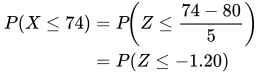
![{\displaystyle {\begin{aligned}\qquad \qquad \quad ={}&P(Z\geq 1.20)\\[2pt]={}&1-(0.38493+0.5)\\[2pt]={}&0.11507\end{aligned}}}](https://wikimedia.org/api/rest_v1/media/math/render/svg/c18603062ac0f8de5ad40efaa313fea00101a95d)
![{\displaystyle {\begin{aligned}P(74\leq X\leq 82)&=P(X\leq 82)-P(X\leq 74)\\[2pt]&=0.65542-0.11507\\[2pt]&=0.54035\end{aligned}}}](https://wikimedia.org/api/rest_v1/media/math/render/svg/41673cdc41f5f1f6c025066242e4cba7fc06b0ae)
![{\displaystyle {\begin{aligned}P(X\leq 82)&=P\left(Z\leq {\frac {82-80}{5/{\sqrt {3}}}}\right)\\&=P(Z\leq 0.69)\\[2pt]&=0.2549+0.5\\[2pt]&=0.7549\end{aligned}}}](https://wikimedia.org/api/rest_v1/media/math/render/svg/126f55965a05b7d7197a1c127f9a25a0fd8a1cf7)
See also
[edit]
References
[edit]- ^ "Z Table. History of Z Table. Z Score". Retrieved 21 December 2018.
- ^ Larson, Ron; Farber, Elizabeth (2004). Elementary Statistics: Picturing the World. 清华大学出版社. p. 214. ISBN 7-302-09723-2.
- ^ "How to use a Z Table". ztable.io. Retrieved 9 January 2023.
- ^ 0.5 + each value in Cumulative from mean table
- ^ 0.5 − each value in Cumulative from mean (0 to Z) table
Standard normal table
View on GrokipediaFoundations of the Normal Distribution
The Normal Distribution
The normal distribution, also known as the Gaussian distribution, is a continuous probability distribution that arises frequently in natural phenomena and is symmetric about its mean parameter . It is defined for all real numbers and is characterized by two parameters: the mean , which determines the location of the peak, and the standard deviation , which controls the spread or dispersion around the mean.[3] The probability density function (PDF) of the normal distribution is given by which produces the characteristic bell-shaped curve, unimodal and symmetric, with tails approaching zero asymptotically. This distribution has infinite support over the real line and is infinitely differentiable, making it smooth and suitable for modeling measurement errors, biological traits, and many other processes.[3] A key property is the empirical rule, which states that approximately 68% of the probability mass lies within one standard deviation of the mean (), 95% within two standard deviations (), and 99.7% within three standard deviations (); these percentages reflect the concentration of probability near the mean and the rapid decay in the tails. The cumulative distribution function (CDF), denoted , is which lacks a closed-form expression in elementary functions, often requiring numerical methods or tables for evaluation. The standard normal distribution is a special case with and .[4][3] The normal distribution was first derived by Abraham de Moivre in 1733 as an approximation to the binomial distribution for large numbers of trials. It was later formalized and extensively analyzed by Carl Friedrich Gauss in 1809 in the context of least squares estimation for astronomical data.[5][6]The Standard Normal Distribution
The standard normal distribution is a specific case of the normal distribution characterized by a mean of 0 and a standard deviation of 1, denoted as .[7] This distribution serves as the foundational reference in probability theory and statistics, with uppercase typically representing the random variable and lowercase denoting specific observed values.[8] The probability density function (PDF) of the standard normal distribution is given by which describes the bell-shaped curve symmetric about zero.[7] The cumulative distribution function (CDF), denoted , represents the probability that a standard normal random variable is less than or equal to , defined as Due to the symmetry of the distribution, for all , allowing probabilities in the left tail to be derived from the right tail and vice versa.[9][10] The standard normal distribution holds central importance in statistical inference because it provides a universal framework for analyzing any normal distribution through standardization, facilitating the use of precomputed tables to determine probabilities without repeated integrations.[3] This standardization process transforms variables from general normal distributions to the standard form, enabling efficient computation of areas under the curve for hypothesis testing, confidence intervals, and other applications.[11]Standardization Formula
The standardization process converts a value from any normal distribution to the corresponding value in the standard normal distribution , facilitating the use of precomputed tables for probabilities. The z-score formula is defined as where is the original value, is the population mean, and is the population standard deviation. This linear transformation centers the distribution at 0 and scales the variance to 1, ensuring .[12] To understand why this preserves the normal distribution, consider the probability density function (PDF) of : Substituting (or equivalently, ), the PDF of is obtained by the change-of-variable formula, multiplying by the absolute value of the Jacobian : This confirms that the transformed variable follows the standard normal PDF, maintaining normality while standardizing the parameters.[13] The transformation also preserves cumulative probabilities, allowing direct equivalence between the original and standard distributions: , where denotes the standard normal cumulative distribution function.[14] For example, suppose (with ) and . Then , meaning the value 75 lies one standard deviation above the mean in the standardized scale.[12] This formula assumes knowledge of the true population parameters and ; when only sample estimates and are available, substituting them yields an approximation that aligns more closely with the Student's t-distribution for small samples, rather than the exact normal, due to added variability in the estimates.Construction and Layout of Z-Tables
Common Formatting Conventions
Standard normal tables, also known as Z-tables, typically employ a tabular layout where rows correspond to the integer part and the first decimal place of the z-score, ranging from 0.0 to 3.4 in common presentations, while columns represent the second decimal place, from 0.00 to 0.09.[9] This structure allows for efficient lookup of probabilities associated with specific z-values by intersecting the appropriate row and column.[15] The entries within these tables are generally presented as probabilities rounded to four decimal places, such as 0.5000 at z=0, providing sufficient precision for most statistical applications without overwhelming the user with excessive detail.[9] Tables often cover z-values from approximately -3.49 to 3.49, with probabilities in the tails approaching 0.0000 or 1.0000 to reflect the distribution's asymptotic behavior.[16] Variations in precision exist across different tables; some abridged versions use only three decimal places for brevity in introductory contexts, while full tables maintain four decimals for greater accuracy in advanced analyses.[17] Abridged tables may limit the range or column increments to reduce size, whereas comprehensive ones extend coverage and detail.[18] The historical evolution of these tables began with early 20th-century publications, such as W.F. Sheppard's 1903 tables of the standard normal cumulative distribution function, which set a precedent for modern formatting.[18] Karl Pearson's Tables for Statisticians and Biometricians (1914–1931), published through Biometrika, further standardized the layout and precision, influencing subsequent editions like the Biometrika Tables for Statisticians (1954 onward).[15] In contrast, modern digital formats, available via statistical software and online resources, often replicate this row-column structure but allow for interactive querying and higher precision on demand, addressing limitations in printed versions.[19]Navigation and Reading Techniques
To navigate a standard normal table, begin by identifying the z-score of interest, which is typically expressed to two decimal places for standard table entries. Locate the row corresponding to the first decimal place of the z-score (e.g., for z = 1.23, find the row labeled 1.2), then move across to the column headed by the second decimal place (0.03 in this case). The value at the intersection provides the cumulative probability from negative infinity to that z-score, denoted as . This method allows quick retrieval of probabilities for tabulated values, as described in introductory statistics resources. Standard tables provide direct lookups for z-scores to two decimal places. For z-scores requiring greater precision, such as z = 1.235, linear interpolation between adjacent tabulated values offers a practical approximation. For example, and . Calculate the difference in probabilities (0.8925 - 0.8907 = 0.0018) and the proportional step within the 0.01 interval (0.005 / 0.01 = 0.5), then add the interpolated portion to the lower value: 0.8907 + (0.5 × 0.0018) ≈ 0.8917.[9] This technique assumes a linear relationship over small intervals, which is sufficiently accurate for most manual calculations, though it introduces minor errors for larger gaps. Standard normal tables exploit the distribution's symmetry to handle negative z-scores efficiently. For a negative value like z = -1.23, , yielding the cumulative probability from negative infinity to -1.23, or the left-tail probability P(Z ≤ -1.23). Some tables include dedicated columns for negative z-values mirroring the positive side, allowing direct lookup of ; if absent, the symmetry formula provides the value without additional computation. The probability from -1.23 to positive infinity, P(Z ≥ -1.23), is . This approach is standard in statistical practice to avoid redundant table entries. When precision is required beyond table limitations, apply rounding rules such as truncating z-scores to two decimals, which typically incurs errors less than 0.005 in probability estimates. For higher accuracy, especially in computational contexts, software tools like R'spnorm() function or Python's scipy.stats.norm.cdf() are recommended over manual tables, as they compute exact values without interpolation artifacts. Traditional printed tables, however, remain valuable for educational purposes where computational aids are unavailable.
In textbooks and reference materials, standard normal tables are often presented as a grid spanning z from 0.00 to 3.09 or higher, with rows in 0.1 increments and columns in 0.01 steps, printed in landscape orientation for readability. Bolded headers and shaded alternating rows enhance visual navigation, while appendices may include extended ranges for tail probabilities. These formats facilitate quick scanning during exams or fieldwork, as noted in pedagogical statistics guides.
Variations in Standard Normal Tables
Cumulative Distribution from Negative Infinity
The cumulative distribution function (CDF) of the standard normal distribution, denoted as , represents the probability that a standard normal random variable takes a value less than or equal to , integrating the probability density from negative infinity up to .[9] This value approaches 0 as approaches negative infinity and reaches 1 as approaches positive infinity. Standard normal tables in this format list entries for a range of values, often covering both negative and positive domains to facilitate direct lookups.[20] Key entries in such tables illustrate the distribution's symmetry around zero, where exactly, reflecting half the probability mass on each side of the mean.[9] For positive , , indicating about 84.13% of the distribution lies below one standard deviation above the mean, while shows roughly 97.72% below two standard deviations.[20] By symmetry, , so and . The following sample table excerpts these values for illustration:| -2.0 | 0.0228 |
| -1.0 | 0.1587 |
| 0.0 | 0.5000 |
| 1.0 | 0.8413 |
| 2.0 | 0.9772 |
norm.cdf function in Python's SciPy library and the NORM.S.DIST function in Microsoft Excel, which compute values to high decimal accuracy without interpolation.[21][22]
Cumulative Probability for Positive Z
Tables limited to positive z-values in the standard normal distribution provide cumulative probabilities Φ(z) = P(Z ≤ z) for z ≥ 0, relying on the distribution's symmetry to infer values for negative z. This compact format typically features rows labeled by the z-value up to one decimal place (e.g., 1.0, 1.1) and columns for the second decimal place (0.00 to 0.09), allowing quick lookup of probabilities. For instance, the entry at row 1.0 and column 0.05 gives Φ(1.05) ≈ 0.8531, representing the area under the standard normal curve to the left of z = 1.05.[20] Representative sample entries from such tables include:| z | Φ(z) |
|---|---|
| 0.50 | 0.6915 |
| 1.00 | 0.8413 |
| 1.05 | 0.8531 |
| 1.50 | 0.9332 |
| 2.00 | 0.9772 |
pnorm() function offering exact Φ(z) computations for arbitrary z without interpolation or symmetry rules.[24]