


Zapad 2021
View on Wikipedia
 | You can help expand this article with text translated from the corresponding article in Belarusian (Taraškievica orthography). (August 2023) Click [show] for important translation instructions.
|
| Zapad 2021 | |||
|---|---|---|---|
 Zapad 2021 | |||
| Date | September 10–15, 2021 | ||
| Location | Belarus:
| ||
| Number | |||
| |||
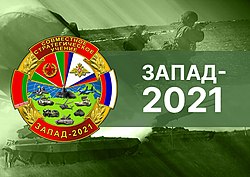
Zapad 2021 (Russian: Запад-2021, English: West 2021) was a joint strategic exercise between the armed forces of the Russian Federation and Belarus, which took place from 10 to 15 September 2021. According to the Ministry of Defence of the Russian Federation, approximately 200,000 military personnel, up to 760 pieces of equipment, and 15 ships participated in the exercises.[1]
According to some[who?] international experts, the exercise was part of Russian preparation for the subsequent invasion of Ukraine.[citation needed]
General information
[edit]Strategic exercises between Belarus and Russia are held every two years, as per an agreement reached between Russian President Dmitry Medvedev and Belarusian President Alexander Lukashenko in 2009.[2] In 2021, they were combined with maneuvers of the Collective Rapid Reaction Forces of the CSTO member states.
According to First Deputy Minister of Defense of the Republic of Belarus, Major General Viktor Gulevich, "Zapad-2021 is purely defensive, and its holding does not pose any threat, either to the European community as a whole or to neighboring countries in particular. Zapad-2021 is planned and is the final stage in the system of joint training of the armed forces of Belarus and Russia this year. Its primary objective is to enhance the preparedness of troops from the regional grouping tasked with ensuring security in the Eastern European region."[3]
On September 1, the stage planned by the General Staff to enhance the country's defense capability was completed: a reserve army of 38,000 combat troops was established in the Southern Military District.
Location of the exercise
[edit]Exercises were conducted on Belarusian territory at the 230th combined arms training ground "Obuz-Lesnovsky", the 174th training ground of the Air Force and Air Defense forces "Domanovsky", the 210th aviation training ground "Ruzhansky", and the Brest training ground,[4] as well as 9 Russian training grounds (Kirillovsky, Strugi Krasnye, Mulino, Pogonovo, Khmelevka, Pravdinsky, Dobrovolsky, Dorogobuzh, Volsky).[5]
Number of forces and equipment
[edit]Up to 760 armored vehicles, including around 290 tanks, 240 artillery, and MLRS units, as well as over 80 aircraft and helicopters, participated in the exercises.[6]
For the first time, a fully robotic group of combined arms units participated in the exercises in combat formations, which included robots such as "Uran-9", "Nerekhta", and others. They were supported by a laser system designed to blind the sights of tanks, artillery systems, and sniper rifles.[7]
Additionally, 400 Belarusian servicemen and over 30 pieces of military equipment went to Russia. The Ministry of Defense of the Republic of Belarus announced that all troops and equipment would return to their permanent locations after the exercises.[8]
Progress of the exercises
[edit]

The exercises commenced on 10 September, involving 200,000 military personnel, 760 units of military equipment (including over 80 aircraft and helicopters, more than 290 tanks, 240 guns, multiple rocket launchers, and mortars), and 15 ships. They commenced simultaneously at 14 military ranges: Kirilovsky, Strugi Krasnye, Mulino, Pogonovo, Khmelevka, Pravdinsky, Dobrovolsky, Dorogobuzh, and Volsky, located on the territory of the Russian Federation, in the Baltic Sea, as well as at five ranges in the Republic of Belarus — Obuz-Lesnovsky, Brest, Chepelevo, Domanovsky, and Ruzhansky. The opening of the exercises took place in Mulino near Nizhny Novgorod.
The tactical concept of the Zapad-2021 exercises was standard: repelling the enemy's attack, drawing the enemy in, encircling, destroying, and going on the offensive.
The defending units were supported by 12 divisions (140 guns) of modernized self-propelled howitzers "Msta-S" (providing the so-called "Fire Shaft").
At the training grounds in the Kaliningrad Oblast, the military practiced actions to eliminate conditional illegal armed formations in urban conditions, as well as strikes against stationary and mobile targets. For the first time, the Platform-M ground-based robotic complexes were used there - robots armed with grenade launchers and a Kalashnikov assault rifle were successfully utilized by motorized infantry and paratroopers who controlled the process remotely.[citation needed]
T-72B3 tanks, equipped with additional dynamic protection and anti-mine trawls, along with the Terminator BMPT, played a significant role in the ground force offensive. A platoon of the latest B-19 infantry fighting vehicles, fitted with the Epoch combat module, entered combat. Additionally, the heavy flamethrower systems TOS-1A "Solntsepek" collaborated for the first time with the latest remote mining complexes "Agriculture."
For the first time, engineering, surveillance, and strike robots played a significant role in the combat training of troops, alongside tanks and other ground and aviation equipment. The most notable were the Uran family machines, which directly engaged in battle formations with defending units and provided cover for the forces during position changes by motorized rifle units. Additionally, the Nerekhta robots were utilized for reconnaissance and fire support.[9][10]
For the first time, reconnaissance and strike UAVs were extensively deployed for operational purposes, providing cover for the maneuvering actions of defending units. They operated alongside the Sagittarius intelligence and communications complex.
Simultaneously, various groups of army aviation were engaged: Su-35S, Su-30SM, MiG-31BM, and Su-34 fighters provided air cover for the troop grouping. Helicopters, including variously modified Mi-8s, reconnaissance and strike Mi-28 "Night Hunter," attack Ka-52 "Alligator," and Mi-35s, operated at the forefront of the counteroffensive. They conducted tactical troop landings and transported equipment and weapons externally. Additionally, four squadrons of Su-34S fighter-bombers targeted key enemy defense installations.
The official "closing" ceremony took place on 15 September at the Mulino training ground in Nizhny Novgorod.[11]
Analysis and aftermath
[edit]International media and observers concluded that the activity represented training in preparation for a conflict with other European, probably NATO-aligned countries; the "fictional" enemies of the Russian and Belarussian units included forces from "Neris (a Lithuanian river), Pomoria and Polar Republic", which according to the exercise fomented domestic unrest in Belarus and then proceeded to invade it, leading to a Belarussian-Russian counterattack.[12][13][14][15]
According to American General and Chairman of the Joint Chiefs of Staff Mark Milley, observations of Zapad 2021 helped the American intelligence community predict that the Russian invasion of Ukraine was imminent. This was because the exercise was much greater in scale, scope, composition, and duration than previous exercises. Following the exercise, Milley held a briefing with American President Joe Biden about the severity of the Russian threat towards Ukraine.[16] Milley held a meeting with Chief of General Staff of the Russian Armed Forces, Valery Gerasimov, in Finland, on September 22, 2021, to de-escalate tensions in Europe.[17][18]
Warsaw-based Belarusian former politician and dissident Andrej Sannikau also argued that Zapad 2021 was a preparation for the invasion.[19]
See also
[edit]References
[edit]- ^ "Главное управление международного военного сотрудничества Минобороны РФ провело брифинг о подготовке совместного стратегического учения «Запад-2021»: Министерство обороны Российской Федерации" [The Main Directorate of International Military Cooperation of the Ministry of Defense of the Russian Federation held a briefing on the preparation of the joint strategic exercise "Zapad 2021": Ministry of Defense of the Russian Federation]. function.mil.ru. Retrieved 20 August 2021.
- ^ "Заключительный этап оперативно-стратегических учений «Запад-2009»". 29 September 2009.
- ^ Military News(in Russian) Archived 20 August 2021 at the Wayback Machine
- ^ "Минобороны Белоруссии рассказало о целях и плане учений "Запад-2021"". РИА Новости. 5 August 2021.
- ^ "На учениях "Запад-2021" будут "отбивать нападение" на Россию и Беларусь".
- ^ "«Запад-2021»: психиатрам пора готовиться к истерике НАТО из-за учений России и Беларуси". 10 April 2021.
- ^ "Пентагон будет бороться с русским "Авангардом" новым оружием". 14 September 2021.
- ^ Главное управление международного военного сотрудничества Минобороны РФ провело брифинг о подготовке совместного стратегического учения «Запад-2021» 20 August 2021. (in Russian)
- ^ "Бездушная армия Сергея Шойгу".
- ^ "Шаг вперед: в США оценили применение роботов на учениях "Запад-2021"". 16 September 2021.
- ^ "Учения "Запад-2021" завершились". РИА Новости. 15 September 2021.
- ^ Lucas, Edward (13 September 2021). "Our fear only makes Putin more powerful". The Times. ISSN 0140-0460. Retrieved 18 April 2024.
- ^ Dyner, Anna Maria (22 September 2021). "Zapad 2021: Comprehensive Drills Aimed at NATO Countries". Polish Institute of International Affairs (PISM). Retrieved 18 April 2024.
- ^ "RUSSIA'S ZAPAD-2021 EXERCISE". Institute for the Study of War. 17 September 2021. Archived from the original on 25 March 2022. Retrieved 18 April 2024.
- ^ Wilk, Andrzej; Piotr, Żochowski (3 September 2021). "The Zapad-2021 exercises. Russian strategy in practice". Centre for Eastern Studies (OSW).
- ^ "'Something Was Badly Wrong': When Washington Realized Russia Was Invading Ukraine". POLITICO. 24 February 2023. Retrieved 8 May 2023.
- ^ "Milley: US should explore more military talks with Russia". The Independent. 24 September 2021. Retrieved 9 May 2023.
- ^ Kaufman, Oren Liebermann, Ellie (22 September 2021). "Top US general meets with his Russian counterpart in Finland | CNN Politics". CNN. Retrieved 9 May 2023.
{{cite web}}: CS1 maint: multiple names: authors list (link) - ^ Andrej, Sannikau (22 October 2022). "Zapad 2013, Zapad 2017, Zapad 2021 - każde manewry były zapowiedzią, co planuje Putin" [Zapad 2013, Zapad 2017, Zapad 2021 - each maneuver was a preview of what Putin was planning]. Gazeta Wyborcza (in Polish).
Part of the Russo-Ukrainian war (2022–present) | |||||||||||||||||||||||||||
| Overview |
| ||||||||||||||||||||||||||
| Military engagements |
| ||||||||||||||||||||||||||
| War crimes | |||||||||||||||||||||||||||
| Reactions |
| ||||||||||||||||||||||||||
| Impact |
| ||||||||||||||||||||||||||
| Key people |
| ||||||||||||||||||||||||||
| Related | |||||||||||||||||||||||||||


Zapad 2021
View on GrokipediaBackground and Context
Historical Context of Zapad Exercises
The Zapad exercises trace their origins to the Cold War era within the Warsaw Pact framework, serving as large-scale maneuvers to test Soviet and allied forces' readiness against potential NATO threats in Western Europe.[10] The series began with Zapad-77 in 1977, conducted primarily in East Germany to evaluate Warsaw Pact countermeasures to NATO advances.[11] These early iterations emphasized combined arms operations, including ground, air, and naval elements, across multiple republics and allied states, with a focus on rapid mobilization and deep battle doctrines.[10] Zapad-81, held from September 4 to 12, 1981, stands as the most expansive in the series, involving approximately 100,000 personnel from the Soviet Union and Warsaw Pact allies, alongside extensive live-fire components and simulated nuclear elements.[10] [12] Conducted across Polish, Belarusian, and Kaliningrad territories, it simulated a multi-front offensive against a fictional NATO aggressor, incorporating over 1,000 tanks, thousands of artillery pieces, and aviation assets to rehearse high-intensity conventional warfare.[10] Subsequent Soviet exercises, such as Zapad-84, maintained this quadrennial pattern but on a reduced scale, prioritizing interoperability among Pact members until the organization's dissolution in 1991.[11] Following the Soviet Union's collapse, the Zapad designation persisted in bilateral Russian-Belarusian formats under the Union State framework, shifting from Warsaw Pact-wide participation to focused joint strategic exercises every four years.[11] Zapad-99, conducted in 1999, marked the post-Soviet revival with operations in Belarus and Russia's Western Military District, emphasizing defensive scenarios against "Western terrorists" and involving several thousand troops.[13] The series resumed regularity with Zapad-09 from September 8 to 29, 2009, deploying about 12,500 personnel across Belarusian and Russian ranges to simulate repelling incursions from a fictional state called "Veyshnoriya," incorporating electronic warfare and airborne assaults.[14] Zapad-13 in 2013 expanded to multiple polygons in both nations, testing inter-service coordination with scenarios mirroring hybrid threats, while Zapad-17 in September 2017 involved up to 12,700 officially declared troops (though estimates suggested higher numbers) in defensive-counteroffensive drills against Baltic incursions, drawing international scrutiny for opacity and proximity to NATO borders.[11] [13] These iterations underscored evolving Russian military reforms, prioritizing precision strikes, rapid deployment, and integration with Belarusian forces amid post-Cold War geopolitical tensions.[10]Geopolitical Setting Leading to 2021
The annexation of Crimea by Russia in March 2014, followed by its support for separatist forces in Ukraine's Donbas region, marked a significant escalation in tensions with NATO, leading the alliance to suspend practical cooperation with Moscow and initiate the European Reassurance Initiative to bolster defenses in Eastern Europe.[15] This prompted NATO's 2016 Warsaw Summit decisions to establish multinational Enhanced Forward Presence battlegroups in Poland, Lithuania, Latvia, and Estonia, with up to 5,000 troops rotating through these positions by 2021 as a deterrent against perceived Russian aggression.[16] Russia's military doctrine, updated in 2014, explicitly framed NATO expansion eastward—particularly toward Ukraine and Georgia—as an existential threat, justifying large-scale exercises like Zapad to simulate responses to coalition attacks from the West.[4] By early 2021, these frictions intensified with Russia's deployment of approximately 100,000 troops near Ukraine's borders in March-April, interpreted by Western analysts as coercive signaling amid stalled Minsk peace talks on Donbas, though Moscow claimed routine rotations.[17] NATO responded by increasing air policing missions over the Baltic states and conducting exercises like Defender-Europe 2021, involving over 28,000 troops to test rapid reinforcement capabilities. Concurrently, hybrid threats escalated, including Russian cyberattacks on Ukrainian infrastructure and disinformation campaigns, which NATO attributed to Moscow's efforts to undermine alliance unity and Western support for Kyiv.[18] The 2020 Belarusian presidential election on August 9, widely viewed as fraudulent by international observers, triggered mass protests and a brutal crackdown by President Alexander Lukashenko, drawing Russia into direct political intervention to prop up its ally and prevent a perceived Western-backed regime change.[4] This crisis facilitated deeper military integration, with Moscow deploying Wagner Group mercenaries to assist Minsk's security forces and negotiating new union state treaties that expanded Russian basing rights, setting the stage for Zapad 2021 as a demonstration of Belarusian dependence on Russian forces amid ongoing unrest.[1] NATO expressed concerns that the exercise could mask permanent troop deployments or serve as a pretext for suppressing domestic opposition, reflecting broader alliance fears of Russian exploitation of regional instability to challenge Article 5 commitments in the Suwalki Gap region.[19]Planning and Objectives
Announced Goals and Scenarios
The Zapad-2021 joint strategic exercises, conducted by Russia and Belarus from September 10 to 16, 2021, were officially described as defensive in nature, aimed at repelling hypothetical aggression against the Union State formed by the two countries. Russian Defense Minister Sergei Shoigu emphasized that the drills reaffirmed the commitment to strengthening the defense capabilities of this alliance without targeting any specific nation. Belarusian officials similarly framed the exercise as a response to potential threats, focusing on enhancing interoperability between their armed forces and territorial defense mechanisms.[20][21] The primary announced objectives included testing the readiness of command structures to manage large-scale operations, mobilizing reserves, and countering aerospace strikes on critical infrastructure. Russian and Belarusian statements highlighted goals such as stabilizing internal crises through combined-arms operations and demonstrating the ability to compel an aggressor to cease hostilities on terms favorable to the Union State. These aims were presented as part of broader efforts to verify the integration of military and civilian state structures under conditions of armed conflict, with an emphasis on information operations to counter destabilization attempts.[4][3] The exercise scenario was predicated on a deterioration of the military-political situation in Europe, where fictional adversaries—representing a coalition including "Nyaris" (a stand-in for Lithuania), "Pomoria" (Poland), and the "Polar Republic" (a Scandinavian entity akin to Norway)—escalate from non-military destabilization of Belarus to direct armed intervention, supported by irregular forces and terrorist groups. This narrative depicted initial border violations and subversive activities leading to a full-scale invasion, prompting a defensive mobilization of the Regional Grouping of Forces. The drills were structured in two main phases: an initial defensive stage involving repelling incursions and aerospace threats over three days, followed by a counteroffensive to neutralize enemy forces and restore territorial integrity over four days.[4][3][22]Preparatory Deployments and Logistics
Russian preparatory activities for Zapad-2021 began in March 2021 with a major mobility exercise deploying the 41st Combined Arms Army to the Pogonovo training range in Russia's Western Military District and elements of the 58th Combined Arms Army to Crimea, marking the largest such operation since the Cold War.[23] These movements tested rapid force projection and set the stage for subsequent staging across multiple districts. Initial deployments to Belarus commenced by late July 2021, approximately 50 days before the active phase, primarily via rail transport for heavy equipment and vehicle convoys for lighter units.[24] Specific units included the logistics support battalion of the 4th Tank Division from Naro-Fominsk to the Polonka range, the 15th Motor Rifle Regiment of the 2nd Motor Rifle Division to Polonka and Orsha (initially a company-sized element), and the 147th Artillery Regiment of the 2nd Motor Rifle Division, which transported 2S19 self-propelled howitzers confirmed in position by July 27.[24] An estimated 2,500 to 3,500 Russian troops from the Western Military District arrived at Belarusian ranges including Brestsky, Baranovichi, Domanovsky, Obuz-Lesnovsky, Ruzhansky, and sites near Grodno, alongside Belarusian forces for a combined total of about 12,800 personnel in Belarus.[4] Logistics emphasized Belarus's role as a forward hub, leveraging over 30 storage depots for tanks, artillery, vehicles, fuel, and ammunition to support the Russo-Belarusian Regional Grouping of Forces.[23] In Russia, additional units staged at nine Western Military District ranges, with August exercises at Vyborg port redeploying T-72B3M tanks to Kaliningrad and Zashchita-2021 drills simulating nuclear hazard response.[23][4] Three joint logistics exercises in Belarus focused on reserve mobilization, supply chain integration involving military, border guards, and civilian ministries, and wartime transitions, ensuring sustainment against simulated NATO opposition.[23][4]Execution of the Exercise
Locations and Timeline
The active phase of Zapad-2021 unfolded from September 10 to 16, 2021, marking the culmination of broader preparatory activities that began with Russian troop deployments to Belarus in late July 2021.[3] [25] Pre-exercise maneuvers and unit arrivals at training ranges occurred from early September, including drills on September 6–9 and formal opening ceremonies on September 9.[26] These timelines aligned with the exercise's designation as a joint strategic command-staff event under Russia's Western Military District, focusing on simulated conflict scenarios in the western theater.[4] Activities spanned nine training ranges across Belarus and Russia's western regions, with Belarus hosting the majority of joint operations to simulate regional defense integration.[25] Key Belarusian sites included the Brestsky, Obuz-Lesnovsky, Ruzhansky, Domonavetsky, and Gozhsky ranges, alongside maneuvers in the Grodno region for airborne and ground force elements.[4] [27] In Russia, primary locations were the Mulino polygen, Pogonovo, and Strugi Krasnye ranges in the Western Military District, with additional components at the Ashuluk firing range for missile and aviation drills.[2] Kaliningrad Oblast served as a secondary operational zone for naval and coastal defense simulations.[1] The exercise's geographic focus emphasized the Russia-Belarus Union State border areas, facilitating rapid force concentration and interoperability testing near NATO's eastern flank.[3] Post-active phase, demobilization and equipment returns extended into late September 2021, with Russian units withdrawing from Belarus by month's end to mitigate escalation concerns.[1]Participating Forces and Equipment
The Zapad 2021 exercise primarily involved forces from Russia and Belarus, operating under the joint Regional Grouping of Forces framework. According to official statements from the Russian Ministry of Defense, the overall exercise encompassed approximately 200,000 personnel, including logistical and support elements across multiple training grounds in Russia and Belarus.[1] [28] However, to comply with OSCE Vienna Document thresholds requiring notification for exercises exceeding 13,000 troops, the core joint maneuvers on Belarusian territory were limited to about 12,800 personnel, comprising roughly 2,500 Russian troops and the remainder Belarusian forces.[4] [26] Small contingents from CSTO allies, such as 50 Kazakh troops, participated in limited capacities, while related multinational drills under Interaction-2021 involved units from China, India, Mongolia, and Pakistan training on Russian territory.[26] [29] Russian contributions drew from the Western Military District, including elements of the 1st Guards Tank Army, 11th Army Corps, 4th Tank Division, and approximately 4,000 Airborne Forces (VDV) personnel for paratrooper operations.[1] [26] Belarusian units integrated mechanized battalions and air defense elements, with around 400 personnel and 30 vehicles deployed to Russian ranges like Mulino.[3] The exercise emphasized combined-arms integration, with Russian forces deploying battalion tactical groups (BTGs) supported by Iskander missile subunits and automated command systems like Akatsia-M.[30] [1] Equipment deployed included modernized ground systems, aviation assets, and missile systems. Official figures reported up to 760 units of military equipment, with over 290 tanks such as T-80BVM and T-90 variants, more than 240 artillery pieces and MLRS, over 80 aircraft and helicopters including Su-35S fighters, MiG-31 interceptors, An-26 transports, Mi-8, and Ka-52 helicopters, as well as Iskander-M short-range ballistic missiles and Buk-M3 surface-to-air systems.[28] [31] [1] Up to 15 warships participated in naval components, though the exercise focused predominantly on land and air operations near NATO borders.[28]| Category | Key Equipment | Approximate Numbers |
|---|---|---|
| Tanks | T-80BVM, T-90 | Over 290[28] [32] |
| Artillery & MLRS | Various gun and missile systems | More than 240[28] |
| Aircraft & Helicopters | Su-35S, MiG-31, An-26, Mi-8, Ka-52 | Over 80[28] [1] |
| Missiles & Air Defense | Iskander-M, Buk-M3 | Multiple launches and systems deployed[31] [30] |