Hubbry Logo
ZoiglZoiglMain
Open search
Zoigl
Community hub
Zoigl
logo
8 pages, 0 posts
0 subscribers
Be the first to start a discussion here.
Zoigl
Zoigl
from Wikipedia
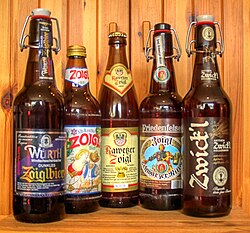
Zoigl beers

Zoigl is a type of German beer brewed in the Oberpfalz, eastern Bavaria, between Franconia and the Czech Republic.

The name is believed to be derived from a Windischeschenbacher dialect pronunciation of the German word zeigen or Zeichen meaning "sign", the symbol used to advertise that the beer is available at an establishment. Its logo is composed of two component triangles represent the joining of six beer ingredients: the first triangle denoting water, fire and air; the second and inverted triangle denoting malted barley, hops, water.[1]

History

[edit]
Zoigl house in Tirschenreuth, northeast of Bavaria

The first documented example of the word "zeigl" occurs in a 1508 document at Neustadt an der Waldnaab, having derived from the German "Zeichen" meaning sign, or "zeigen" meaning show. It was pronounced "zeigel" in the Oberpfalz region. Today the word "Zoigl" is still in use and has given its name to this style of beer production.[2]

Zoigl has been brewed for centuries in communal breweries, owned either by the town or by an association of homebrewers. Zoigl was only found in Windischeschenbach and Neuhaus until about 2000. The name and mark have been pilfered because they were not trademarked, leading to the over-advertising of Zoigl beer across Germany. The original comes from Windischeschenbach and Neuhaus, and people have their favorites, because each brewer has their own recipes.

Process

[edit]

First wood is chopped, the fire started to cook the water and barley to temp, it is cooled over copper, then the wort is distributed to the brewers' private cellars, where the fermentation takes place. The method used is bottom fermenting yeast and lagering. About two weeks later the beer is brought to these home pubs where it is tapped directly from the lagering tank. It is then sold in the brewer's house, which effectively becomes a pub until all the beer has been drunk. The pub that has Zoigl from that Friday through Monday then attaches the Zoigl-Star to the corner of his house to show he has beer available. Only about 9 or 10 people have "das Braurecht" in Windischeschenbach at one time.[2]

References

[edit]
[edit]
Revisions and contributorsEdit on WikipediaRead on Wikipedia
from Grokipedia
Zoigl is a traditional unfiltered and unpasteurized beer style unique to the Oberpfalz region in eastern , , between and the Czech border. Brewed communally in shared town-owned or association brewhouses by local families, it is fermented and lagered using bottom-fermenting in private cellars before being served directly from kegs in the brewers' homes during limited periods, typically a few days every few weeks. The beer's availability is signaled by hanging a six-pointed wooden Zoigl star—symbolizing the classical elements of , , along with the key ingredients of , , and —outside the door, a practice that underscores its hyper-local, communal character. Adhering strictly to 's purity law, Zoigl uses only , barley , , and , resulting in a hazy, low-carbonation with a fresh, rustic flavor profile that does not travel well due to its unfiltered nature and short shelf life. The tradition of Zoigl dates back to the medieval period, with communal brewhouses established in over ten towns in the region before 1400, and formal rights granted as early as 1415 in places like Neuhaus. The term "Zoigl" derives from the German word Zeichen, meaning "," reflecting the historical use of the star by medieval brewers to indicate their and the readiness of their . First documented as "zeigl" in a 1508 record from Neustadt an der Waldnaab, the practice was suppressed during the Nazi era but revived after , often as a symbol of local resilience. As of 2025, authentic Zoigl is produced in five towns, including Eslarn, Mitterteich, and Windischeschenbach, where around 20 families maintain the custom, preserving a rare example of pre-industrial in modern . The brewing process emphasizes simplicity and tradition, beginning with wood-fired decoction mashing in communal facilities, often starting at dawn to capture the cool night air for wort cooling in open coolships. After boiling with noble hops, the wort is transferred to private cellars for open fermentation and extended lagering, typically for several weeks, yielding a beer that is tapped unfiltered and served in a casual, living room-like atmosphere known as Zoiglstuben. This method not only ensures freshness but also fosters social bonds, as patrons gather in the brewers' private spaces rather than commercial taverns, with the beer sold until the batch is depleted. While modern commercial beers sometimes borrow the Zoigl name or star imagery, true Zoigl remains an artisanal, non-bottled product tied to its geographic and cultural origins, celebrated for its role in sustaining rural economies and community identity in Oberpfalz.

History

Origins in the

The origins of Zoigl trace back to the 14th and 15th centuries in the region of eastern , where feudal lords began granting brewing to citizens as a privilege of burghership. These , known as "Zoiglbraurecht," allowed property-owning residents in specific towns to brew and serve beer, marking an early form of decentralized production that empowered local communities economically and socially. The earliest documented instance occurred in Neuhaus in 1415, when the town received permission to establish a communal brewhouse, followed by similar grants in places like Windischeschenbach in 1455. This practice emerged through town issued by feudal authorities, which formalized private as a burgher entitlement well before the 1516 Bavarian standardized beer production across much of . Lords, seeking to foster loyalty and economic vitality in their territories, tied these privileges to particular households or properties, enabling non-professional brewers to participate without the monopolies held by monastic or operations elsewhere. By the early , over ten towns in the region already maintained communal brewhouses, a system that predated the Neuhaus and reflected broader medieval trends of civic in . Between 1415 and 1522, approximately 75 small communities received such rights, solidifying Zoigl's communal foundation. Communal brewhouses served a practical purpose by allowing burghers to share costly equipment, such as copper s, which were prohibitively expensive for individual s in the due to the high price of metal. This collaborative approach enabled amateur brewers to produce collectively while fermenting it privately, reducing financial barriers and promoting resource efficiency in rural settings. remained primarily a endeavor, focused on personal and consumption, with any surplus sold briefly in the brewer's to offset costs like the "Kesselgeld" ( ) for brewhouse access. This limited commercialization underscored Zoigl's roots in self-sufficiency rather than large-scale trade, distinguishing it from emerging professional breweries.

Evolution of Brewing Rights

The brewing rights for Zoigl originated in town-specific grants awarded during the late medieval and early periods, primarily between 1415 and 1522, to select citizens in communities across the region of . These privileges, bestowed by local rulers such as the Elector Palatine, allowed designated households to brew and serve in communal brewhouses, fostering a system of production tied to specific properties. For instance, the earliest recorded grant dates to 1415 in Neuhaus, followed by 1455 in Windischeschenbach, 1467 in Falkenberg, 1516 in Mitterteich, and 1522 in Eslarn, marking the formal allocation of 'Zoiglbraurecht' to a limited number of families in each locale. Over time, these initial concessions evolved into regulated citizen rights, with access to the communal brewhouse restricted to property owners within designated town districts, as documented in local land registries that formalized the hereditary nature of the privileges. This structure ensured that brewing remained a communal yet exclusive practice, limited to those inheriting the associated real estate. A beer purity law, similar to Bavaria's 1516 , was adopted in the in 1533, further shaping Zoigl's legal framework by mandating the use of only , , and (with later recognized), which aligned seamlessly with the simple, traditional ingredients already employed in Zoigl production. Although some Zoigl grants predated the law, its adoption preserved the communal brewing model by prohibiting adulterants and emphasizing , thereby protecting the tradition from broader regulatory disruptions while reinforcing its bottom-fermented style. This compliance allowed Zoigl brewers to maintain their historical practices without conflict, as the law's focus on purity complemented the regional emphasis on unfiltered, naturally conditioned served directly from households. In the , German inheritance laws, which varied by territory but generally combined Germanic customs with Roman principles, solidified the exclusivity of Zoigl brewing rights by linking them irrevocably to family properties passed down through generations. These rights, registered in land books, could only be transferred via sale or with the associated buildings, restricting participation to a small cadre of households—such as the approximately 40 active brewers among 120 registered rights-holders in Falkenberg as of 2020. Concurrently, the rise of industrialization introduced significant challenges, as large-scale commercial breweries flooded markets with cheaper, pasteurized beers, diminishing demand for traditional Zoigl amid shifting consumer tastes toward uniformity. Quality criticisms noted in 1860 medical reports and the pressures of economic modernization led to the decline or abandonment of communal brewhouses in many areas. Yet, in rural strongholds like Eslarn and Falkenberg, these pressures paradoxically reinforced the tradition's insularity, as inheritance restrictions and local resilience preserved brewing among select families against the encroaching industrial tide. During the Nazi era (1933–1945), the Zoigl tradition faced suppression as part of broader efforts to centralize and standardize production, but it was revived after , often serving as a symbol of local resilience and cultural continuity. The hereditary brewing rights endured, maintaining the practice among families in the core towns.

Brewing Process

Communal Production Methods

The communal brewhouses, known as Kommunbrauereien, form the cornerstone of Zoigl production and are located exclusively in five towns in Bavaria's Oberpfalz region: Eslarn, Falkenberg, Mitterteich, Neuhaus, and Windischeschenbach. These facilities are owned collectively by the community in Eslarn, Falkenberg, and Mitterteich, or jointly by participating brewers in Neuhaus and Windischeschenbach. They feature traditional open brewing kettles, typically made of , heated directly over open wood fires to produce the , with the exception of Mitterteich, which uses coal. Additional equipment includes large coolships for cooling, and the brewhouses are reserved through a scheduled system of usage slots accessible only to families holding inherited Zoiglbraurecht, or brewing rights. To secure a brewing slot, each family pays a usage fee called Kesselgeld, or "kettle money," which funds the maintenance and renovation of the communal facility. This fee is levied per session and ensures the shared infrastructure remains operational without commercial oversight. The scheduling rotates among eligible families, preventing overuse and preserving the collaborative ethos of the tradition. Wort production begins with , where pale barley malt—typically around 450 kilograms per batch—is mixed with water in a mash tun and undergoes a process to convert starches into fermentable sugars. The resulting mash is then transferred to the kettle for over the wood fire, during which minimal amounts of noble , such as Hallertau varieties, are added—approximately 6.5 kilograms for a standard batch—to provide subtle bitterness while adhering to the German purity law. lasts about 30 minutes, concentrating the through evaporation and extracting hop flavors without excessive . Following boiling, the hot wort is pumped into open coolships, shallow vessels exposed to the night air, where it cools naturally overnight to below 20°C, allowing for initial settling of solids. This method, integral to the tradition, relies on ambient temperatures and promotes natural clarification before transfer. The cooled wort, yielding approximately 2,000 to 2,400 liters per batch, is then transported from the brewhouse to the individual family's home cellar using wooden barrels or 35-liter buckets, often hauled by hand or cart to emphasize the labor-intensive, localized nature of the process. This step highlights the division of labor in Zoigl , with the communal brewhouse handling the energy-intensive and stages, while private cellars manage subsequent phases. Each eligible family typically brews 8 to 10 times per year, depending on the town and number of rights-holders, producing batches of 2,000 to 2,400 liters to supply their Zoiglstube during serving periods. In towns like Neuhaus, where five families share the brewhouse, this rotation ensures continuous availability while limiting individual usage to sustainable levels.

Fermentation and Conditioning

Following the transport of hot from the communal brewhouse to individual homes, Zoigl brewing enters its private phase with using bottom-fermenting lager yeast in dedicated cellars. This step initiates primary at cool temperatures around 10-12°C, typically lasting about 10 days in the stable, ambient conditions of rock-hewn or underground cellars that maintain consistent coolness year-round. After primary , the young is transferred to storage vessels such as wooden barrels for secondary conditioning, where it matures for several weeks to develop natural carbonation through residual activity. This process yields an unfiltered, naturally hazy without , preserving its fresh character and allowing subtle influences from the cellar environment, including potential ambient contributions due to open practices. The total conditioning period generally spans 1-2 months, resulting in a gently carbonated with low CO2 levels. The finished Zoigl is stored in these cool cellars until ready for serving, tapped directly from barrels to ensure it is consumed fresh, often within days of maturation to highlight its unpasteurized vibrancy.

Characteristics

Ingredients and Beer Style

Zoigl beer strictly adheres to the , the Bavarian purity law established in 1516, limiting its ingredients to , malted , , and yeast. The is sourced locally from the region's springs, the malt consists primarily of barley varieties such as and types, and the are noble varieties from the Hallertau region, known for their mild, floral, and herbal characteristics with minimal bitterness contributions. Bottom-fermenting lager yeast is employed, facilitating a clean profile typical of traditional German lagers. Classified as an unpasteurized Märzen-style —or more precisely, a rustic variant of —Zoigl emphasizes clarity and balance through its simple composition. It typically exhibits an (ABV) of 4.7-5.3%, with an original ranging from 11-12° , reflecting a moderate starting extract that supports its approachable strength. The brewing targets low attenuation, often resulting in a final around 2.8-3.5° , which preserves a subtle sweetness without the use of adjuncts or sugars forbidden by the . This simplicity distinguishes Zoigl from other Bavarian beers like wheat-based Weizen or adjunct-influenced export styles, as it relies solely on the four permitted ingredients to achieve a malt-forward character without complexity from additional grains or flavorings. Historically, these ingredients have remained largely unchanged since the , with an emphasis on local sourcing—such as Hallertau grown within —to maintain regional authenticity and quality.

Sensory Profile and Variations

Zoigl presents a hazy appearance ranging from golden to deep , often with amber-orange or syrup-like hues depending on the producer, accompanied by moderate natural and visible that underscores its unfiltered character. The aroma profile is characterized by dominant bready and toasty notes, complemented by light herbal and spicy noble hop scents, with subtle undertones of , , fresh hay, alpine meadows, or roasted almonds. In flavor, Zoigl emphasizes a bready backbone with toasty qualities, light herbal hop bitterness, and a dry, crisp finish; occasional subtle fruity esters, such as stone fruit or dried cherry, arise from the cool process, while some examples introduce notes of cocoa, pepper, or floral spiciness. Variations among Zoigl beers stem from individual family recipes and local traditions, resulting in subtle differences across the core towns. In Falkenberg, versions like Kramer-Wolf exhibit a heartier profile with pronounced spicy , toasty , and a peppery finish, often reaching strengths up to 5.5% ABV. Neuhaus producers, such as Schoilmichl or Schafferhof, tend toward milder, richer expressions with caramelly depth, floral-spicy , and full-bodied maltiness at slightly lower intensities. All maintain an unfiltered state to ensure freshness, with each batch reflecting the brewer's unique and hop ratios. Zoigl is traditionally poured from wooden barrels directly in Zoiglstuben, best enjoyed fresh within days of tapping to preserve its vibrant flavors and avoid oxidation.

Cultural and Social Role

Zoiglstuben and Community Gatherings

Zoiglstuben are family-operated taverns, typically established in the living rooms or kitchens of brewers' homes in Bavaria's region, providing an intimate, home-like setting for the consumption of freshly brewed Zoigl beer. These venues maintain a rustic, welcoming aesthetic reflective of local traditions, with operations managed alongside the families' primary livelihoods such as farming or trades. They open for a limited period of about 4 days (typically one weekend) per month, aligned with the brewing rotation to ensure the beer is served at peak freshness. At the heart of Zoiglstuben's role is their function as communal hubs that strengthen social ties among locals through relaxed gatherings centered on drinking Zoigl, playing traditional card games like Schafkopf, and sharing simple meals such as cheese spreads or housemade sausages and . This setup prioritizes genuine hospitality and interaction over commercial gain, creating an egalitarian environment where guests of varying ages and backgrounds mingle freely, often extending conversations late into the night. Such events embody the Zoigl tradition's emphasis on community integration, turning ordinary evenings into opportunities for exchange and camaraderie. The economic model of Zoiglstuben reinforces their community-oriented nature, as is priced at —generally €1 to €1.50 per half-liter—to offset and operational expenses without seeking profit. This low-margin approach ensures , allowing patrons to enjoy multiple rounds while contributing modestly to the brewer's costs, and underscores the part-time, passion-driven operation of these family venues. Openings in Zoiglstuben follow published annual calendars detailing scheduled long weekends, with the hanging of flags or signs outside signaling to the neighborhood on those days that fresh is ready and inviting gatherings. These notifications contribute to lively social events aligned with the coordinated schedule, with families preparing the space and simple fare to accommodate arriving locals, thereby sustaining the tradition's vibrant, neighborly pulse. The 's brief conditioning period ensures it arrives unfiltered and lively, amplifying the appeal of these communal occasions.

Symbols, Traditions, and Festivals

The Zoiglstern, a six-pointed star resembling the with radiating points, serves as the central symbol of Zoigl culture, originating from medieval brewers' marks that denoted brewing rights and quality. This emblem comprises two interlocking triangles: one representing the classical elements of fire, earth, and air essential for , and the other symbolizing the core ingredients of , , and , reflecting the alchemical roots of production before the discovery of . Families with brewing rights paint or hang the Zoiglstern on wooden signs outside their homes to signal that a fresh batch of Zoigl is ready and the Zoiglstube is open for serving, a practice that underscores the transient and communal nature of the tradition. Annual traditions revolve around seasonal brewing cycles and structured calendars that coordinate communal efforts among rights-holders. occurs primarily in spring (for about 10 days) and autumn (for about 5 days), aligning with cooler weather ideal for bottom-fermentation, during which families rotate access to the shared brewhouse to produce for their individual batches. These calendars, published yearly, detail which Zoiglstuben will open on specific long weekends—typically to Monday once a month—ensuring coordinated community participation and preventing overlap while fostering social bonds through shared preparation and serving. Such rituals emphasize Zoigl's role in local identity, where the act of and opening reinforces intergenerational knowledge passed within families. Festivals highlight Zoigl's communal spirit through dedicated events that draw locals and visitors. The Neuhaus Zoigl Festival, held annually on Day (October 3), unites all six residential brewers in Neuhaus, who simultaneously open their Zoiglstuben to serve fresh , transforming the town into a hub of celebration with , food, and storytelling that commemorates the tradition's endurance. Complementing this, the Zoigl Wanderweg—part of the longer Goldsteig trail opened in 2007—links multiple taverns across Zoigl-producing towns via scenic hiking paths through the Oberpfälzer Wald, promoting regional by combining physical exploration with beer tastings at open Zoiglstuben since the early 2000s. These events not only preserve brewing heritage but also integrate it with outdoor activities, attracting enthusiasts to experience the unfiltered lagers in their cultural context. Preservation efforts have elevated Zoigl to recognized status as intangible cultural heritage, safeguarding its communal practices against modernization. In 2018, the Oberpfälzer Zoiglkultur was inscribed on Germany's national list of by the Deutsche UNESCO-Kommission, acknowledging the ritualistic brewing in communal brewhouses, the social gatherings in family-run Zoiglstuben, and the transmission of knowledge as vital elements of Bavarian identity. This designation supports initiatives like the annual Oberpfälzer Zoigltag, which, starting in , has combined heritage demonstrations with open brewhouse tours to educate on the tradition's 600-year history and encourage its continuation among younger generations. The third edition took place on September 14, 2025, enhancing public engagement with the tradition.

Modern Practice

Traditional Producers in Core Towns

The authentic Zoigl tradition persists exclusively in five core towns of the region in eastern : Eslarn, Falkenberg, Mitterteich, Neuhaus, and Windischeschenbach. Each town maintains a communal brewhouse, known as a Kommunbrauhaus, where local families with inherited brewing rights produce the collectively before fermenting it in their private cellars. These brewhouses are owned either by the community or jointly by the brewing families, ensuring adherence to medieval-era practices without commercial filtration or . In Eslarn, a single active brewing family upholds the tradition at the communal brewhouse, producing small batches for local sale during limited opening periods. Falkenberg features four active families as of 2025, including the Kramer-Wolf household, which operates a Zoiglstube serving their unfiltered alongside traditional Palatinate fare. Mitterteich has three active brewers, including the Oppl and Lugert families, whose Boozhaus Zoiglstube exemplifies the communal spirit with its rustic interior and seasonal availability. These smaller operations reflect the intimate scale of Zoigl production, limited strictly to regional consumption. Neuhaus and Windischeschenbach represent the tradition's strongholds, with six and seven active brewing families, respectively, as of 2025. In Neuhaus, the Punzmann family at the Teicher Zoiglstube has preserved their rights for generations, opening for extended weekends to serve hazy, bottom-fermented beer matured in stone cellars. The Fütterer family at the Schafferhof in Neuhaus coordinates with other households to brew and distribute, fostering community gatherings under the iconic six-pointed Zoigl star. Similarly, in Windischeschenbach, multiple families contribute to the communal facility, with serving points like the Schlosshof blending brewing heritage with hospitality. Across these towns, approximately 21 families actively exercise their rights, operating around 20-30 Zoiglstuben that open rotationally, typically for a few days to a week at a time. The overall production remains modest, with annual output across the region estimated in the tens of thousands of liters, confined to local taverns and emphasizing quality over volume. This limited scale underscores Zoigl's role as a rather than a commercial enterprise. However, the tradition faces challenges from aging communal , where some historic brewhouses require to sustain operations, and succession issues, as younger generations show declining interest, leaving certain inherited rights unused—down from hundreds historically to the current active few. Efforts by associations like the Schutzgemeinschaft Echter Zoigl focus on preserving authenticity amid these pressures.

Global Interpretations and Revival

Following , the Zoigl tradition faced significant decline as the number of active brewers dwindled due to economic hardships and modernization pressures in the Oberpfalz region. However, starting in the late and accelerating in the 21st, the practice experienced a revival fueled by growing tourism interest in authentic Bavarian beer culture. Visitors drawn to the communal ethos and unfiltered lagers have boosted local economies, with beer hiking routes along the Goldsteig trail integrating Zoigl stops to promote sustainable preservation of the heritage. This resurgence culminated in formal recognitions, including the "Oberpfälzer Zoiglkultur" being inscribed on Germany's National Inventory of by the Commission in December 2018, and the awarding of the Heimatpreis Bayern cultural prize in 2019. The Schutz-Gemeinschaft Echter Zoigl e.V. association enforces standards for authentic production through its green "Echter Zoigl vom Kommunbrauer" logo, displayed only by members in communal houses within the five traditional towns, ensuring the tradition's integrity amid rising popularity. Outside , interpretations of Zoigl have emerged , adapting the communal and unfiltered concept to local contexts. Zoiglhaus Brewing Company in , opened in September 2015 as a brewpub inspired by the Zoigl tradition, emphasizing community gatherings and German-style lagers brewed on-site with modern equipment while evoking the house-brewed ethos. Similarly, the American Zoigl Project, launched in 2023, reimagines the style using non-barley adjuncts common in U.S. , such as corn or , to create accessible lagers that nod to the original's rustic profile but incorporate American ingredients for broader appeal. These adaptations maintain core elements like bottom-fermentation and minimal filtration, though scaled for commercial distribution rather than strict communal limits. Contemporary producers have introduced innovations to extend Zoigl's reach without abandoning its foundational practices. For instance, some operations now use fermenters for primary stages while preserving open in cellars to retain the beer's hazy, yeasty character, allowing for more consistent quality in larger batches. Bottled versions have also appeared for export and wider availability; Zoiglhaus released its first bottled offerings, including Zoigl-Pils and Zoigl-Kölsch, in 2017, distributed through regional markets in the to introduce the style beyond taproom settings. These developments balance tradition with practicality, enabling global sampling while prioritizing the unpasteurized, naturally carbonated essence. The cultural export of Zoigl has grown since the through targeted promotions that enhance awareness internationally. Beer tours in the Oberpfalz, such as those tracing the Waldnaab Valley and visiting active Zoiglstuben, have become popular organized experiences, often guided by locals to highlight the tradition's communal roots. These efforts, including media features in outlets like The Beer Times, have elevated Zoigl's profile without commercializing its core identity, fostering appreciation for the practice as a living .

References

Add your contribution
Related Hubs
User Avatar
No comments yet.