Hubbry Logo
GoulashGoulashMain
Open search
Goulash
Community hub
Goulash
logo
8 pages, 0 posts
0 subscribers
Be the first to start a discussion here.
Goulash
Goulash
from Wikipedia

Goulash
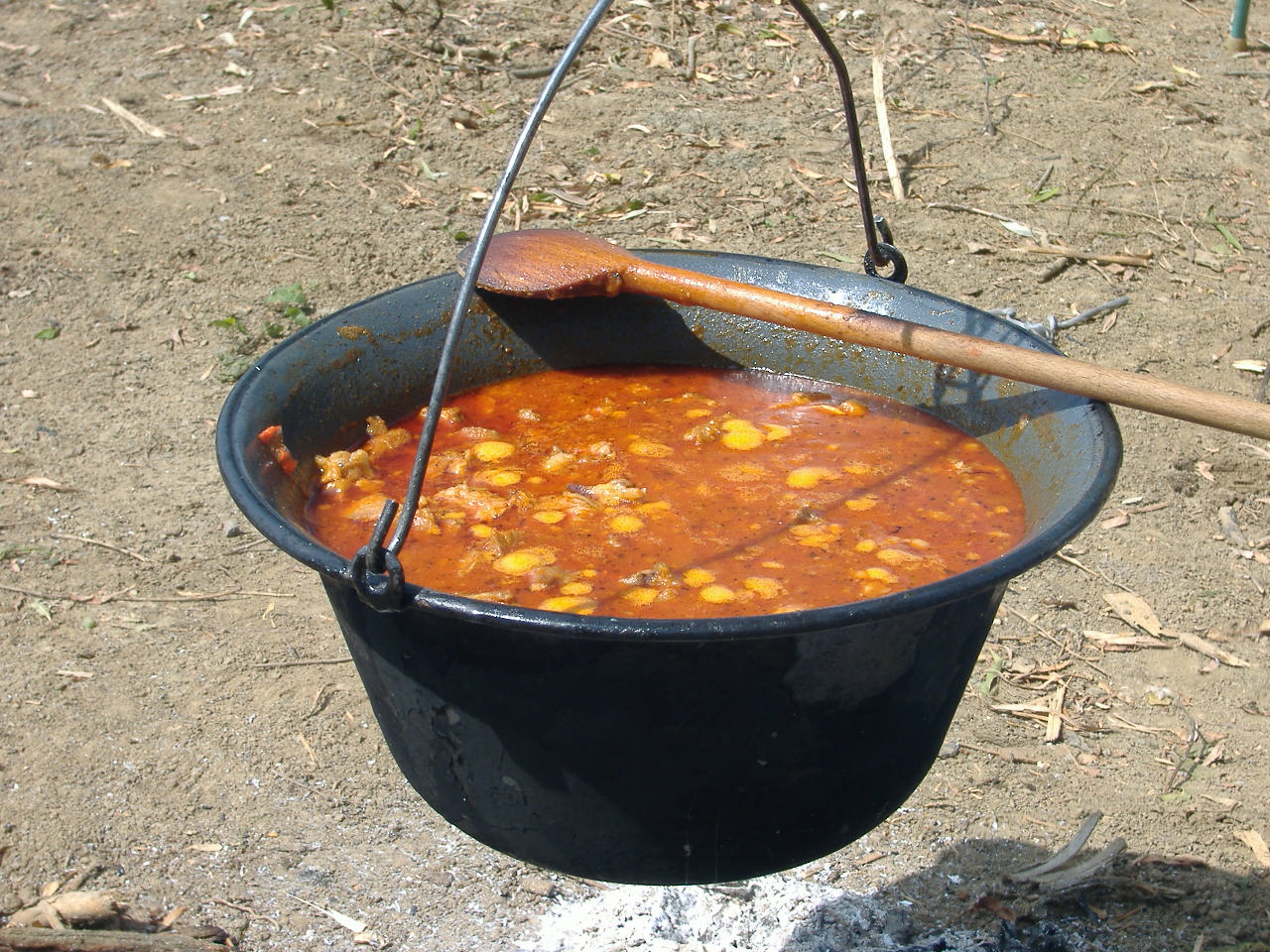
Goulash cooking in a bogrács (traditional Hungarian cauldron)
Alternative namesGulash / Gulyás / Gulaš
TypeSoup
Place of originHungary
Region or stateCentral Europe
Balkans
Serving temperatureHot
  • Cookbook: Goulash
  •   Media: Goulash

Goulash (Hungarian: gulyás) is a meal made of meat and vegetables seasoned with paprika[1] and other spices.[2] Originating in Hungary, goulash is a common meal predominantly eaten in Central Europe but also in other parts of Europe. It is one of the national dishes of Hungary and a symbol of the country.[3][4][5]

Its origins may be traced back as far as the 10th century to stews eaten by Hungarian shepherds.[6] At that time, the cooked and flavoured meat was sun-dried and packed into bags produced from sheep's stomachs, needing only water to make it into a meal.[6] Earlier versions of goulash did not include paprika, as it was not introduced to Europe until the 16th century.

Etymology

[edit]

The name originates from the Hungarian gulyás [ˈɡujaːʃ] . The word gulya means 'herd of cattle' in Hungarian, and gulyás means 'cattle herder' or 'cowboy'.[7][8] Over time the dish became gulyáshús ('goulash meat') – a meat dish which was prepared by herdsmen. In medieval times, the Hungarian herdsman of Central Europe made use of every possible part of the animal, as was common practice. As meat was scarce, nearly all of the animal was often used to make the soup.

Today, gulyás refers both to the herdsmen, and to the soup or stew. From the Middle Ages until well into the 19th century, the Puszta was the home of enormous herds of cattle. They were driven, in their tens of thousands, to Europe's biggest cattle markets in Moravia, Vienna, Nuremberg and Venice. The herdsmen made sure that there were always some cattle that had to be slaughtered along the way, the flesh of which provided them with gulyáshús.[9][10]

In Hungary

[edit]

Gulyás

[edit]
Pörkölt

In Hungarian cuisine, traditional gulyás,[11] pörkölt, and paprikás are dishes which evolved from the food of the cattle herders of the Hungarian plains.

In present-day Hungary, gulyás is known as a soup. It is also called gulyásleves, which translates to gulyás soup, although gulyás is understood commonly as a soup without specifying. While it may have more solid parts than broth and some versions may be called by English speakers a stew, the Hungarian language makes a strict distinction between stews and gulyás. The dish called gulyás is quite conservative with very little variations through the country. The basic ingredients include beef, onions, paprika, caraway seeds, potatoes, carrots and fresh noodles added directly to the soup (csipetke). Altered versions got their own name, like babgulyás which has beans or hamisgulyás which is meatless. Bográcsgulyás means a gulyás prepared traditionally in a kettle, called bogrács, outdoors, over open fire. It can be prepared anywhere because it needs only the bogrács, an iron tripod, a chain and a campfire. Every type of gulyás is a strictly one pot dish and considered a main course, even if it is a more soupy version.

Except for paprikás, Hungarian stews do not rely on flour or roux for thickening. Original Hungarian recipes rarely use tomatoes and only in small quantities, the deep red colors come all from the authentic Hungarian paprika spice.

Modern gulyás is made from beef, while the original herdsmen had more access to mutton. Typical cuts include the shank, shin, or shoulder; in Hungary beef from older cattle is more common, which makes tastier broth but takes a longer time to cook. Meat is cut into chunks, seasoned with salt, and then browned with sliced onion in a pot with oil or lard. Paprika is added, along with water. After that the gulyás is left to simmer. After cooking a while, whole or ground caraway seed, and soup vegetables like potato, carrot, parsley root are added. However, paprika and potatoes are post-16th century additions, while gulyás traces its origin back to the Hungarians nomadic past. At the end small egg noodles called csipetke can be added. The name Csipetke comes from pinching small, fingernail-sized bits out of fresh dough (csipet being Hungarian for 'pinch') before adding them to the boiling soup. Stew-like versions of gulyás are made the same way with letting the broth simmering down.

Restaurants use altered recipes, where the extreme long cooking time is replaced with broth, and the csipetke noodles is substituted by nokedli.

International Goulash is a dish closer to the Hungarian dish Pörkölt, a stew which evolved from the original gulyás. After the former herdsmen's dish became popular throughout the whole of Hungarian society, variations arose which didn't strictly adhere to the techniques used for outdoor cooking. Nokedli - which is a Hungarian version of the traditional German noodle Spaetzle - became a side dish for stews. Nokedli is made by grating liquid dough into boiling water.

Hungarian varieties

[edit]
Bográcsgulyás - Gulyas as stew
Bográcsgulyás (goulash casserole)

Hungarian goulash variations include:[12]

  • Bográcsgulyás.[13] Same ingredients as Gulyásleves but with much less water so that it is stew like.
  • Székely Gulyás. Omit the potatoes and add sauerkraut and sour cream.
  • Gulyás Hungarian Plain Style. Omit the homemade soup pasta (csipetke) and add vegetables
  • Mock Gulyás. Substitute beef bones for the meat and add vegetables. Also called Hamisgulyás (fake goulash)
  • Bean Gulyás. Omit the potatoes and the caraway seeds. Use kidney beans instead.
  • Csángó Gulyás. Add sauerkraut instead of pasta and potatoes.
  • Betyár Gulyás. Use smoked beef or smoked pork for meat.
  • Likócsi Pork Gulyás. Use pork and thin vermicelli in the goulash instead of potato and soup pasta. Flavour with lemon juice.
  • Mutton Gulyás or Birkagulyás. Made with mutton. Add red wine for flavour.

A thicker and richer goulash, similar to a stew, originally made with three kinds of meat, is called Székely gulyás, named after the Hungarian writer, journalist and archivist József Székely (1825–1895).[11]

Paprikás krumpli

[edit]

"Paprikás krumpli" is a traditional paprika-based potato stew with diced potatoes, onion, ground paprika, and some bacon or sliced spicy sausage, like the smoked Debrecener, in lieu of beef.

In German-speaking countries, this inexpensive peasant stew is made with sausage and known as Kartoffelgulasch ("potato goulash"). Bell pepper is sometimes added.

Outside Hungary

[edit]

Thick stews similar to pörkölt and the original cattlemen stew are popular throughout almost all the former Austrian-Hungarian Empire, from Northeast Italy to the Carpathians. Like pörkölt, these stews are generally served with boiled or mashed potato, polenta, dumplings (e.g. nokedli, or galuska), spätzle or, alternatively, as a stand-alone dish with bread. Romani people have their own version of goulash.[14]

Fiakergulasch as served in Vienna, Austria

Albania

[edit]

Goulash (Albanian: gullash) is considered a traditional dish among some Northern Albanians.[15]

Austria

[edit]

In Vienna, the former center of the Austro-Hungarian Empire, a special kind of goulash has developed. The Wiener Saftgulasch or the Fiakergulasch (Fiacre being a horse-drawn cab) on the menu in traditional restaurants is a rich pörkölt-like stew; more onions but no tomatoes or other vegetables are used, and it usually comes just with dark bread. A variation of the Wiener Saftgulasch is the Fiakergulasch, which is served with fried egg, fried sausage, pickles, and dumplings named Semmelknödel.

Bosnia and Herzegovina

[edit]

In Bosnia and Herzegovina, goulash (Bosnian: gulaš) is a very popular and traditional dish. Introduced during the Austro-Hungarian Empire, it has become a staple with the Bosnian variant consisting of a thicker consistency, with emphasis on slow-cooked onions and meat. It is typically served with bread, mashed potatoes, or polenta, and regional variations may include veal, carrots, or beans.

Croatia

[edit]

Goulash (Croatian: gulaš) is also very popular in most parts of Croatia, especially north (Hrvatsko Zagorje) and Lika. In Gorski Kotar and Lika, venison or wild boar frequently replace beef (lovački gulaš). There is also a kind of goulash with porcini mushrooms (gulaš od vrganja). Bacon is an important ingredient.

Gulaš is often served with fuži, njoki, polenta or pasta. It is augmented with vegetables. Green and red bell peppers and carrots are most commonly used. Sometimes one or more other kinds of meat are added, e.g., pork loin, bacon, or mutton.

Czech Republic and Slovakia

[edit]
Szeged goulash served in a Prague pub with Czech knedliky
Goulash served in bread in a restaurant in Prague

In the Czech Republic and Slovakia, goulash (Czech and Slovak: guláš) is usually made with beef, although pork varieties exist, and served with boiled or steamed bread dumplings (goulash with beef in Czech hovězí guláš s knedlíkem, in Slovak hovädzí guláš s knedľou), in Slovakia more typically with bread. In pubs it is often garnished with slices of fresh onion, and is typically accompanied by beer. Beer can be also added to the stew in the process of cooking. Seasonal varieties of goulash include venison or wild boar goulashes. Another popular variant of guláš is segedínský guláš (Székelygulyás), with sauerkraut.

In Czech and Slovak slang, the word guláš means "mishmash", typically used as mít v tom guláš: to be disoriented or to lack understanding of something.

Ethiopia

[edit]

Fish goulash (Amharic: አሣ ጉላሽ; asa gulaš) is a popular dish in Ethiopia, particularly during the numerous fasting seasons as required by the Ethiopian Orthodox Church.[16] It is usually prepared with a spicy sauce having a tomato and onion base and served with injera or rice.[17]

Germany

[edit]
Venison goulash with Bavarian bread dumpling

German Gulasch is either a beef (Rindergulasch), pork (Schweinegulasch), venison (Hirschgulasch), or wild boar (Wildschweingulasch)[18] stew that may include red wine and is usually served with potatoes (in the north), white rice or spirelli noodles (mostly in canteens), and dumplings (in the south). Gulaschsuppe (goulash soup) is the same concept served as a soup, usually with pieces of white bread.

Venison goulash with dumplings, leeks, and lingonberry sauce served in Berlin
Tomato-based goulash with root vegetables, paprika, and beef. Served with beer and brown bread at an outdoor café in Berlin

Italy

[edit]

Goulash in Italy is eaten in the autonomous regions of Friuli-Venezia Giulia and Trentino-Alto Adige/Südtirol, that once had been part of the Austro-Hungarian Empire. It is eaten as a regular Sunday dish. It can also, although less typically so, be found in the nearby Veneto. An interesting regional recipe comes from the Pustertal (Val Pusteria, Puster Valley) in South Tyrol. It is made of beef and red wine, and seasoned with rosemary, red paprika, bay leaf, marjoram and lemon zest, served with crusty white bread or polenta. Goulash is also quite popular in the city of Ancona, which is culturally quite near to eastern Europe.

Netherlands

[edit]

In the Netherlands, goulash is usually prepared with beef. It is typically consumed as a stew, and is thus closer to pörkölt.

Poland

[edit]
Polish potato pancake and spicy goulash with sheep milk cheese and sour cream

In Poland, goulash (Polish: gulasz) is eaten in most parts of the country. A variant dish exists that is similar to Hungarian pörkölt. It came to being around the 9th century. It is usually served with mashed potatoes or various forms of noodles and dumplings, such as pyzy.

Serbia

[edit]

In Serbia, goulash (Serbian: гулаш) is eaten in most parts of the country, especially in Vojvodina, where it was probably introduced by the province's Hungarian population. [citation needed] It is a pörkölt-like stew, usually made with beef, veal or pork, but also with game meat like venison and boar. Compulsory ingredients are meat and onions, usually in 50-50% ratio, paprika, and lard or oil, other ingredients being optional: garlic, parsley, chili pepper, black pepper, cinnamon, bell peppers, carrots, tomatoes, red wine, mushrooms, bacon. Sometimes, goulash is sweetened by adding tomato paste, sugar or dark chocolate at the very end. In Serbia, goulash is most often served with macaroni or potato mash.

Slovenia

[edit]

In Slovene partizanski golaž, "partisan goulash", favoured by Slovenian partisans during the Second World War, is still regularly served at mass public events. "Partisan golaž" uses onion in equal proportion to meat; two or more types of meat are usually used in preparing this dish. The most widespread form of golaž in home cooking is a thick beef stew that is most commonly served with mashed potatoes. As elsewhere in the wider region, Szeged goulash, usually referred to as segedin, is also a popular dish for home preparation.

United States and Canada

[edit]

North American goulash, mentioned in cookbooks since at least 1914, exists in a number of variant recipes.[19][20] Originally a dish of seasoned beef,[20] core ingredients of American goulash now usually include elbow macaroni, cubed steak or ground beef, and tomatoes in some form, whether canned whole, as tomato sauce, tomato soup, and/or tomato paste. As a descendant, of sorts, of Hungarian goulash, it probably originated as a variation of the Hungarian bográcsgulyás which mixes all the ingredients together in the end. This mixture of ingredients has probably led to many variations where any mixture of meat and paprika is often called goulash.[19] In English, the word “goulash” has an alternative meaning of "a mixture of heterogeneous elements or hodgepodge or jumble".[21] The dish is popular among American Jews.[22]

See also

[edit]

References

[edit]
[edit]
Revisions and contributorsEdit on WikipediaRead on Wikipedia
from Grokipedia
Goulash, known in Hungarian as gulyás, is a traditional or originating from the herdsmen of medieval , featuring tender chunks of simmered with and the distinctive spice to create a flavorful, brothy or . The dish traces its roots to the 9th-century Magyar herders, or gulyás, who roamed the tending livestock and prepared simple, portable meals in iron cauldrons called bogrács over open fires. These early versions consisted of , , and water, often thickened with millet, providing sustenance during long drives without access to fresh ingredients. Over centuries, the evolved significantly; chilies from the arrived via the in the 16th century, leading to the cultivation of in by the , which became the defining element imparting its vibrant red color and mild heat. By the 1830s, amid rising under Habsburg rule, goulash transitioned from a rustic food to a celebrated , with urban refinements incorporating potatoes, carrots, bell peppers, and tomatoes. Authentic Hungarian goulash relies on a core set of ingredients: , finely chopped onions sautéed in or , generous amounts of sweet Hungarian , and seasonings like caraway seeds, garlic, salt, and , all slow-cooked to meld flavors without or other thickeners. Variations exist, such as gulyásleves (a thinner ) or bográcsgulyás (a heartier outdoor version with potatoes and csipetke noodles pinched into the pot), while related dishes like emphasize a drier, gravy-like consistency without the brothy quality of goulash. , particularly the "noble sweet" variety from , remains indispensable. Beyond Hungary, goulash has become a global emblem of , influencing adaptations in neighboring countries like and , and evolving into heartier stews in the United States through 19th-century immigration waves. Its cultural significance endures as a marker of Hungarian identity, often featured in festivals like the Festival and codified in cookbooks by figures such as Károly Gundel and George Lang, who described the combination of lard, onions, and as the "holy trinity" of Hungarian cooking. Today, it represents not only culinary heritage but also resilience, having been elevated from humble origins to a dish savored worldwide for its comforting depth and historical resonance, though Hungarian production has declined since the early and now accounts for a smaller share of global supply.

Etymology and Origins

Etymology

The term "goulash" derives from the Hungarian word gulyás, which means "herdsman" or "cattle herder," reflecting the dish's origins among the Magyar shepherds who tended livestock on the . This etymology traces back further to gulya, the Hungarian word for a "cattle ," emphasizing the lifestyle of these herdsmen who prepared simple meat-based stews during long migrations. The full original compound was gulyáshús, literally "herdsman's meat," which over time shortened to gulyás to refer to the dish itself. The first written records of gulyás as a dish appear in Hungarian texts from the late , with a notable description published in 1787 and further mentions in the portraying it as a burgeoning . By the early 19th century, the term had entered cookbooks, including those in and neighboring regions like and , where it began to gain wider recognition beyond rural herders. As the dish spread across in the , the Hungarian gulyás adapted linguistically, becoming Gulasch in German-speaking areas such as and , where the spelling and pronunciation shifted to fit local phonetics while retaining the core meaning tied to its herdsman roots. This evolution mirrored the dish's transition from a regional food to an international staple, with variations in terminology emerging in other languages like English "goulash" and French goulache.

Historical Origins

The origins of goulash can be traced to the , when Magyar nomads settled in the Carpathian Basin and adopted a lifestyle on the . These early herdsmen, known as gulyás, prepared a simple, portable using (often or mutton), boiled in iron cauldrons called bogrács over open fires to sustain them during long drives; later versions incorporated onions, lard, and local spices like , made using sun-dried strips preserved for long drives when fresh was unavailable. A pivotal evolution occurred in the during the Ottoman Empire's occupation of much of , when Turkish forces introduced chili peppers—originally from the —to the region. Hungarian peasants eagerly adopted and cultivated these peppers in the fertile plains around and , grinding them into a powder known as by the late . This spice revolutionized the dish, infusing it with vibrant red color, mild sweetness, and depth of flavor, transforming the plain herders' into the paprika-laden soup-stew recognized today; prior to this, seasonings were limited to salt, , and herbs. By the late , goulash had solidified as an everyday peasant food across rural , praised by European travelers for its warming, spicy qualities derived from generous use. Its popularization accelerated in the amid rising under Habsburg rule, evolving from a humble rural staple to a potent symbol of cultural resistance and unity. Following the defeat of the 1848-1849 Revolution against Austrian dominance, goulash—often prepared in large kettles at nationalist gatherings—embodied defiance and ethnic pride, helping forge a distinct Hungarian identity during a period of political suppression and Austro-Hungarian compromise in 1867. Documentation in 19th-century cookbooks further cemented goulash's status, with early printed recipes appearing around 1830 that detailed -infused preparations using fresh meat, onions, and vegetables. These culinary texts, emerging alongside increased production in , elevated the dish from oral tradition to formalized literature, reinforcing its role in Hungarian identity formation as a of resilience and heritage.

Core Elements

Key Ingredients

The core ingredients of authentic Hungarian goulash are cubed , onions, and Hungarian , which together form a hearty soup-stew base. Onions provide a foundational sweetness when slowly sweated, while , often from cuts like shin for its tenderness after long simmering, is the traditional choice. Paprika serves as the defining spice, derived from dried and ground pods of Capsicum annuum varieties, imparting an intense peppery aroma, vibrant red hue, and subtle sweetness or heat to the dish. In goulash, both sweet (édés) and hot (csipős) types are used, with the sweet variety predominant for its earthy, fruity profile that balances the meat's richness without overwhelming spiciness. Historically sourced from the Szeged region in southern Hungary, where advanced 19th-century processing techniques produced the renowned "noble sweet" paprika by removing seeds and veins for superior flavor and color, it elevated goulash from a herdsman's meal to a national staple. Optional additions like , caraway seeds, and tomatoes further refine the profile: infuses aromatic depth, caraway seeds lend an earthy, slightly nutty undertone, and tomatoes provide balancing acidity. In many variations, vegetables such as potatoes, carrots, and bell peppers are included for added substance. Meat variations include or for alternatives, while seasonal vegetable substitutions allow adaptation without altering the dish's essence.

Traditional Preparation Methods

The traditional preparation of goulash, known as gulyás in , centers on a one-pot method that emphasizes slow cooking to tenderize tough cuts of and develop deep flavors. The process begins by heating pork —or sometimes or bacon fat—in a heavy pot or over medium heat, followed by finely chopped onions until they turn golden brown, which typically takes 7-10 minutes. This initial browning of the onions in fat is crucial for building a flavorful base, as the releases natural sugars without burning; together with and , they form the "holy trinity" of Hungarian cooking. Once the onions are ready, cubed (often from the shoulder or shin) is added and seared until browned on all sides, about another 7-10 minutes, to seal in juices and enhance richness. Paprika, the signature spice, is then stirred in off the heat to prevent scorching, which could impart a bitter taste; this is followed by the addition of , seeds, or pureed tomatoes, and enough stock or to cover the ingredients. The pot is brought to a simmer and covered, allowing the mixture to cook slowly for 1-2 hours initially, during which the meat begins to break down. In variations, like potatoes, carrots, and bell peppers are incorporated midway, but in authentic versions, the simmering continues for a total of 2-3 hours until the is fork-tender and the achieves a soupy consistency from the released by the meat—no or is used, as the focus remains on the brothy nature rather than a thickened . For added texture and heartiness, csipetke—small pinched noodles made from a simple of , , and salt—are often prepared separately and dropped into the simmering goulash during the final 10 minutes of cooking, where they absorb the flavorful and swell slightly. These dumplings, pinched by hand from the dough, provide a chewy contrast without requiring separate boiling. Historically, among 9th-century Hungarian herdsmen, goulash preparation incorporated drying techniques for preservation: after initial cooking, excess liquid was evaporated, and the meat was sun-dried, then stored in animal stomachs or bags for transport during long drives; it was later rehydrated by adding water and reheating over an open fire in a bogrács . Serving suggestions traditionally include crusty bread for sopping up the or tarhonya, a type of egg-based dried pearls, to complement the dish's rustic profile. This method, cooked outdoors over wood fires in earlier times, underscores goulash's origins as a practical, nourishing for laborers.

Hungarian Traditions

Gulyás

Gulyás, the archetypal Hungarian dish, originated as a hearty prepared by cattle herders known as gulyások on the , blending elements of and in a thin, flavorful that distinguishes it from denser goulash preparations elsewhere. This herdsman's meal, cooked in large cauldrons over open fires, emphasized portability and sustenance during long cattle drives, evolving from simple dried meat and onion mixtures into a paprika-infused staple by the . The traditional recipe centers on cubed —typically from the or shin—sautéed in with finely chopped onions until caramelized, then seasoned generously with sweet Hungarian , seeds, garlic, salt, and pepper, before adding water or stock to simmer slowly for hours until the meat tenderizes. Potatoes, carrots, parsley root, and are incorporated midway to thicken the naturally, while small pinched dumplings called csipetke may be added for texture. The dish simmers uncovered to reduce and concentrate flavors, resulting in a soup-like consistency served hot with bread. As Hungary's , gulyás embodies cultural identity and communal gathering, frequently featured at events like the annual Goulash Festival in , where hundreds of cauldrons compete to showcase regional interpretations, drawing thousands to celebrate this culinary tradition. Recognized as a Hungarikum since 2017 under the category of and , it highlights the dish's role in preserving , with ongoing efforts to nominate it for listing to affirm its global significance. Standardization emerged in the as gulyás transitioned from peasant fare to a symbol of national pride amid rising , with printed recipes appearing in cookbooks and its popularity extending to the , solidifying paprika as the defining ingredient through local chili cultivation and innovations. This period marked its evolution into a unified culinary icon, distinct from earlier medieval survival rations.

Other Hungarian Varieties

In Hungary, regional variations of gulyás reflect local ingredients and traditions, with Szeged-style gulyás emphasizing the city's renowned production. This version incorporates an abundance of sweet Szeged , which imparts a vibrant red color and a mild, rich flavor without intense heat, distinguishing it from spicier preparations elsewhere. The dish typically follows core preparation methods of slow-simmering cubed beef with onions, potatoes, and carrots in a -infused broth, but the generous use of high-quality, mild from the region elevates its depth and authenticity. Transylvanian gulyásleves, also known as Székely gulyás, adapts the traditional recipe to the region's Saxon and Hungarian influences by incorporating and smoked meats for a tangy, robust profile. shoulder or butt serves as the primary meat, browned with onions and seasoned heavily with before adding rinsed and sometimes diced smoked or to enhance smokiness and acidity. The result is a heartier, stew-like simmered for several hours until the flavors meld, often finished with a dollop of to balance the sour notes from the . This variation highlights Transylvania's blend of Hungarian and Central European culinary elements, making it a staple in ethnic Hungarian communities there. Fisherman's gulyás, or halászlé, transforms the beef-based original into a spicy using freshwater catches like and , prepared along Hungary's rivers and lakes. The begins by sautéing onions in until golden, then stirring in hot for the signature red broth, followed by layering fillets of for body and for firmness, along with green peppers and tomatoes. Simmered briefly to avoid overcooking the , it yields a fiery, clear served with bread, embodying the resourcefulness of Hungarian fishermen. Regional styles, such as the Szegedi halászlé, layer the fish in a over an open fire for added smokiness. Urban preparations in often refine rural gulyás by incorporating to deglaze the pot and add complexity, creating a smoother, more elegant version suited to city dining. While rural iterations stick closely to herdsmen's simplicity with and basic vegetables, Budapest cooks might use leaner cuts of and a splash of or wine during to tenderize the meat and introduce subtle fruit notes. This adaptation maintains the core but caters to refined palates in restaurants and homes, bridging traditional flavors with cosmopolitan touches.

Paprikás Krumpli

Paprikás krumpli is a simple Hungarian centered on potatoes, onions, and , forming a thick, flavorful dish that highlights the country's reliance on for depth and color. The preparation begins by finely chopped onions in or oil until translucent, followed by the addition of ground —typically a mix of sweet and hot varieties—to bloom the spices without burning. Cubed potatoes are then incorporated, along with water or stock to cover, and the mixture simmers until the potatoes soften and partially break down, creating a natural starch-based thickening. Optional ingredients like smoked (kolbász) or may be added for subtle meaty flavor and fat, but the core remains vegetable-forward, making it quick to prepare in about 45 minutes. Emerging in the following the introduction of potatoes to in the mid-18th century, paprikás krumpli emerged as a staple for shepherds and rural communities, serving as an economical "poor man's" alternative during times of and economic hardship when was scarce. This rustic dish gained popularity in countryside areas, where it could be cooked over open fires in a single pot (bogrács), stretching limited resources to feed families. Its and low cost—relying on abundant, inexpensive potatoes—made it a resilient option amid historical scarcities, such as those during the Ottoman era and later periods of agricultural challenges. Unlike traditional goulash, which features substantial chunks of or , paprikás krumpli omits large meat pieces, instead depending on potatoes for both bulk and the stew's viscous texture through their released starches. This distinction positions it as a lighter, more accessible variant within Hungarian culinary traditions, often prepared without tomatoes or for purity. In modern , it endures as a beloved home-cooked , especially in rural settings, and is frequently served with fresh for sopping up the or topped with fried or boiled eggs for added protein and richness.

Regional Variations in Europe

Central Europe (Austria, Czech Republic, Slovakia, Poland)

In Central Europe, goulash adaptations reflect the shared culinary heritage of the , where the dish spread in the through military movements, trade, and cultural exchanges, evolving to incorporate local ingredients and serving styles. This Habsburg influence fostered denser, heartier versions suited to the region's Germanic and Slavic traditions, emphasizing slow-cooked stews over the soupier Hungarian original. In , particularly , Fiakergulasch emerged as a distinctive variation of Wiener Saftgulasch, a beef-based enriched with onions, , and seeds. Named after the fiakers—horse-drawn cab drivers who frequented Viennese taverns in the late —this version is topped with a , sliced , and for added texture and tang. The dish's popularity grew during the empire's era, becoming a staple in traditional Gasthäuser, where it is simmered for hours to develop a thick, flavorful . It is traditionally served with Semmelknödel (bread dumplings), which effectively soak up the rich sauce. Czech and Slovak guláš share close similarities due to their intertwined history, presenting a thicker, stew-like rendition that diverges from the Hungarian prototype by using more onions and spices like and for depth. In the , it typically features beef chunks braised in a paprika-infused , often with and sometimes for subtle bitterness, resulting in a robust . Slovak versions mirror this density, occasionally incorporating , and are commonly paired with steamed bread dumplings (knedlíky) or hearty to soak up the . Both nations' adaptations gained traction in the via imperial kitchens and rural traditions, solidifying guláš as a comforting everyday meal. Polish gulasz, influenced by neighboring Austrian and Hungarian cuisines, favors pork over beef and incorporates tomato paste to create a tangy, vibrant sauce alongside generous amounts of paprika and allspice. This version simmers into a velvety stew, often thickened further with flour, and is traditionally served over wide egg noodles, rice, or buckwheat groats for a satisfying contrast. Its roots trace to the empire's expansion, where Polish cooks adapted the dish with local proteins and bolder flavors. Following , goulash's appeal surged across amid economic recovery and cultural revival, appearing frequently in communal dining and restaurants as an affordable, nourishing option that evoked pre-war comforts.

Balkans (Croatia, , Serbia, Slovenia, )

In the , goulash adaptations reflect a fusion of Central European traditions with Ottoman culinary influences, particularly the introduction of and other spices through trade and conquest during the Ottoman Empire's rule over much of the area from the 14th to 19th centuries. This spice integration added depth to stews, transforming the dish into a hearty, paprika-based staple that varies by local ingredients and cooking methods while maintaining its core as a slow-cooked and preparation. Croatian gulaš emphasizes game meats like , often marinated overnight in to tenderize and infuse flavor, then simmered with bay leaves, onions, and root vegetables for a robust, aromatic . This version highlights the region's hunting traditions and Dalmatian coastal influences, where the wine adds acidity and the bay leaves contribute earthy notes, distinguishing it from plainer Central European renditions. In and , goulash variations incorporate creamy elements for added richness, such as or stirred in toward the end of cooking, creating a velvety texture that balances the paprika's heat. These dishes are frequently paired with , a traditional roasted red pepper and relish originating from the Ottoman era, which provides a smoky, tangy contrast and enhances the stew's overall creaminess when served alongside. Slovenian golaž often features wild mushrooms like porcini or portobello, sautéed with or and simmered in a paprika-tomato base, resulting in an umami-rich dish that showcases the country's forested landscapes. Traditionally, it is served over , a staple influenced by Italian neighbors, allowing the creamy polenta to absorb the stew's savory juices and form a comforting, unified meal. Albanian tavë dheu features or slow-cooked with onions, , peppers, and , then baked with fresh cheese such as gjize for a creamy finish, incorporating local traditions. In the post-Yugoslav era, goulash has evolved as a symbol of both shared Balkan heritage and distinct national identities, with countries like , , , and adapting recipes to highlight local sourcing—such as Slovenian mushrooms or Croatian —to foster culinary narratives of and cultural uniqueness following the 1990s conflicts. This adaptation underscores the dish's role in everyday meals and festive gatherings, reinforcing community ties amid shifting political landscapes.

Western and Northern Europe (Germany, Netherlands, Italy)

In , goulash has been adapted into Gulaschsuppe, a hearty featuring , onions, potatoes, and carrots, seasoned generously with for a rich, warming broth. This version emphasizes a soupier consistency compared to the original Hungarian stew, with potatoes and carrots providing bulk and natural thickening during slow simmering. The dish gained prominence in cooking during the , where mobile field kitchens known as Gulaschkanonen—nicknamed "goulash cannons" for their chimney-like exhaust—prepared large batches for troops in and II, making it a staple of home and institutional fare alike. In the , goulash appears as goulashsoep, a comforting beef-based incorporating local preferences for straightforward, vegetable-forward preparations with potatoes, carrots, and , often enjoyed during cold winters for its gezellig (cozy) appeal. This adaptation highlights the assimilation of Central European recipes into broader Dutch culinary traditions. Italy's take on goulash manifests as spezzatino di manzo alla , a tender beef stew enriched with tomatoes, onions, and aromatic herbs such as and leaves, slow-cooked to meld the paprika's smokiness with Mediterranean acidity. This variation, popular in northern regions like the , incorporates red wine and tomato paste for a robust sauce, distinguishing it from denser Central European forms while maintaining the core paprika profile. Regional home cooks often serve it with , underscoring its integration into Italian rustic cuisine. The popularity of goulash across Western and surged in the , driven by Hungarian immigration following events like the 1848 revolution and post-World War upheavals, which introduced the dish to urban centers and factories. By the mid-century, convenience products like packet mixes from brands such as Knorr and —containing pre-blended spices, , and thickeners—made preparation accessible for busy households, further embedding goulash in everyday diets from German canteens to Dutch and Italian kitchens. These mixes, often requiring only the addition of and , democratized the recipe while preserving its hearty essence.

Global Adaptations

Americas (, )

In , goulash arrived with waves of Hungarian immigrants during the late 19th and early 20th centuries, primarily farmers and laborers seeking economic opportunities amid Hungary's industrialization lag and rural poverty. Between 1880 and 1914, over 1.5 million emigrated to the , with significant settlements in Midwestern industrial cities like , , and , where the dish became a staple in ethnic communities and eventually influenced broader . A post-World War II influx, including refugees from the 1956 Hungarian Revolution, further reinforced these communities, numbering around 37,000 arrivals to the U.S. and over 37,000 to Canada by 1957, integrating goulash into diner menus as an affordable comfort food. The American adaptation, often called "hamburger goulash" or simply "," diverged significantly from its Hungarian roots by incorporating , elbow macaroni, or , onions, garlic, and into a one-pot meal, emphasizing affordability and pantry staples during the era. This version, first documented in U.S. recipes between 1909 and 1914, transformed the meaty soup-stew into a pasta-heavy casserole-like dish, popular in Midwestern households for its simplicity and filling nature amid economic hardship. In Hungarian-American enclaves, particularly in Chicago's North Side and surrounding Midwest areas, more traditional preparations persisted, often featuring cubed beef slow-cooked with , onions, and potatoes or served over spaetzle (egg noodles) to evoke homeland flavors. Chicago's vibrant Hungarian community, bolstered by early 20th-century and annual events like the Gulyás Festival, maintains these versions in restaurants such as Laschet's Inn, where goulash is a menu highlight reflecting cultural preservation. Canadian adaptations similarly draw from 19th- and 20th-century Hungarian settlement in the Prairies and urban centers like and , with post-WWII refugees enhancing community ties. A notable variation substitutes ground —a lean, local game meat—for , as in Alberta's bison goulash recipes that blend paprika-seasoned with potatoes, carrots, and for a hearty, regionally sourced dish.

Africa (Ethiopia)

In Ethiopian cuisine, Asa Goulash—also known as Asa Gulash or Asa Wat—refers to a spicy that highlights the country's vibrant spice traditions and reliance on local freshwater ingredients. This dish adapts the concept of a hearty to Ethiopia's culinary landscape, featuring simmered in a -infused , a hallmark of flavors. , a potent blend of up to 20 spices including chili, , , and , provides the deep red color and complex heat that define the . Common ingredients include , , or other white fillets, chopped onions, tomatoes, , ginger, and or similar chilies for added sharpness. The preparation begins with sautéing finely diced onions in oil or (niter kibbeh) until golden, followed by incorporating a paste of blended , ginger, and . Tomatoes are added to create a thick base, simmered with water or stock to form the sauce, into which seasoned pieces—often lightly fried first for crispness—are gently cooked until flaky, typically for 10-15 minutes to preserve tenderness. This method ensures the absorbs the sauce's bold flavors without disintegrating. Asa Goulash is traditionally served with , the spongy teff-based that soaks up the sauce, facilitating communal dining where eaters use pieces of injera as utensils. It holds cultural importance in lakeside areas like those around or Awassa, where fresh catches are integral to meals, and is favored during non-fasting seasons in the Ethiopian Orthodox tradition, offering a lighter alternative to meat-based wats. The dish exemplifies Ethiopia's emphasis on bold, spice-driven stews that balance heat with tangy elements like lime or for brightness.

Modern and Fusion Variations

In contemporary cuisine, vegetarian and vegan adaptations of goulash have gained popularity by substituting meat with plant-based proteins that mimic its hearty texture and flavor. For instance, , a gluten-based , serves as a high-protein, low-fat substitute in recipes that maintain the traditional paprika-infused stew base while incorporating vegetables like bell peppers and potatoes. Similarly, versions featuring mushrooms and peppers create a velvety, umami-rich dish, blending Hungarian with Italian influences for a fusion twist that highlights earthy flavors without animal products. Butter beans or lentils can also replace , providing and protein in gluten-free, one-pot preparations that emphasize seasonal vegetables like sweet potatoes and . Fusion variations post-2000 have reimagined goulash by incorporating global elements, driven by the rise of trends and innovative restaurant menus. In , chefs have evolved the dish beyond classic profiles, integrating modern techniques and diverse ingredients to create lighter, more refined interpretations served in upscale settings. Examples include Hungarian-Italian hybrids with creamy finishes and roasted elements, reflecting broader culinary experimentation. This aligns with the early surge in , where goulash appeared in contemporary restaurant offerings as a versatile base for cross-cultural adaptations. Commercial products have made goulash accessible through instant mixes and canned options, catering to busy consumers since the . Maggi's Beef Goulash Recipe Base, a packet requiring only , onions, and potatoes, simplifies preparation while delivering authentic flavors with herbs and spices. Podravka's canned Goulash offers a ready-to-heat product with tender in a savory sauce, ideal for quick meals paired with or . These shelf-stable items have become staples in international markets, supporting trends toward efficient, flavorful comfort dishes. Health-conscious adaptations focus on reducing fat content and boosting nutrition, often using lean proteins and nutrient-dense additions. Recipes employing 90% lean minimize saturated fats while preserving the stew's heartiness, paired with for added fiber and vitamins. Low-sodium, gluten-free versions incorporate superfoods like for and antioxidants, transforming goulash into a balanced, modern that supports dietary wellness without sacrificing taste.

References

Add your contribution
Related Hubs
User Avatar
No comments yet.