Hubbry Logo
Dortmunder ExportDortmunder ExportMain
Open search
Dortmunder Export
Community hub
Dortmunder Export
logo
8 pages, 0 posts
0 subscribers
Be the first to start a discussion here.
Dortmunder Export
Dortmunder Export
from Wikipedia
Dortmunder Export

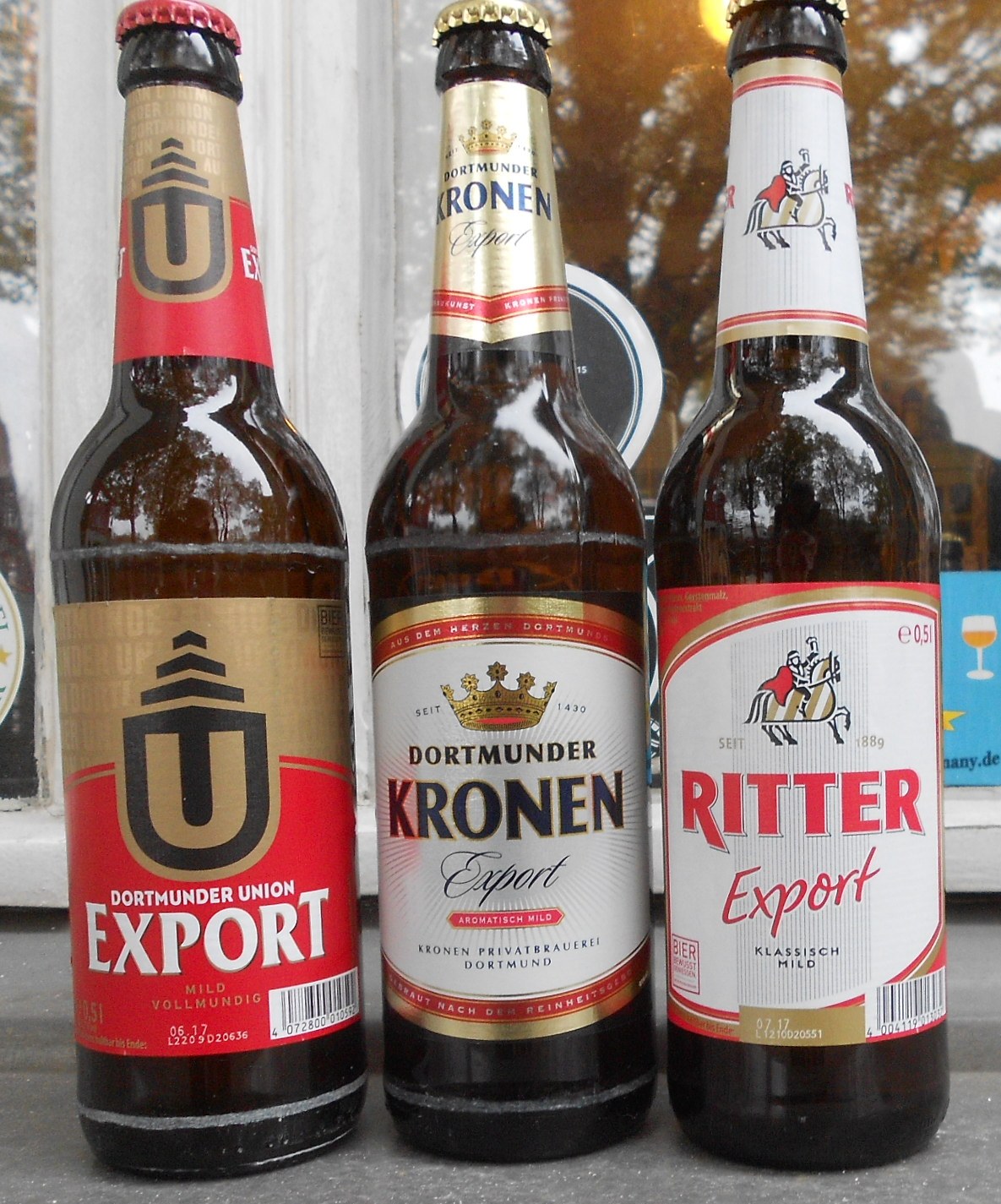
Dortmunder Export or Dortmunder is a pale lager originally brewed by Dortmunder Union in Dortmund, Germany, in 1873. It is a soft-textured beer influenced by the Pilsner lager brewed in Plzeň.

History

[edit]
The original Dortmunder Export

After World War II, Export was the most popular type of beer in Germany until 1970, when it was supplanted by Pils.[1] Its fortunes have revived a little since its low point of the late 1990s. In 2008, just under 10% of the beer sold in German shops was Export.[2]

Dortmund style beers

[edit]
An example of a beer brewed in USA, and termed Dortmunder

Fred Eckhardt in A Treatise on Lager Beers, published in 1969, set out the view that Dortmunder is a distinctive enough pale lager to be classed as a separate beer style.[3]

Michael Jackson and Roger Protz continued the trend, although with a certain faint heart, uneasy at pinning down exactly the distinctive nature of the beer.[4][5][6]

Brewers outside of Germany who brew beers they term Dortmunder will tend to brew a pale lager with a soft, rounded character.[citation needed]

See also

[edit]

References

[edit]

Further reading

[edit]
Revisions and contributorsEdit on WikipediaRead on Wikipedia
from Grokipedia
Dortmunder Export is a originating from , , characterized by a balanced profile of smooth, grainy sweetness and floral or herbal hop bitterness, with a medium body and alcohol content of 5% to 6% ABV. It appears as a clear, medium yellow to deep liquid with a persistent white head and delivers a clean, medium-dry finish that lingers with and hop notes. Brewed using or malts, noble hops such as Hallertau or Saaz, and Dortmund's minerally high in and , the style employs yeast and often a process to achieve its toasty, bready character without caramel notes. The style emerged in the 1870s in Dortmund's industrial region as local breweries, including the Dortmunder Union and Dortmunder Actien-Brauerei (DAB), responded to the popularity of pale beers by creating a stronger, maltier alternative with more body than a Munich Helles but less hop intensity than a German . Dortmund's tradition dates back to 1266, and by the mid-19th century, advances in pale malting, cold fermentation, and yeast management fueled the revolution, positioning the city as one of Germany's most prolific centers tied to its and steel industries. Known initially as Exportbier for its international shipments, the style gained widespread popularity after , particularly in the United States among German immigrants, before declining in the 1970s due to market shifts toward lighter beers. Today, Dortmunder Export, also called German Helles Exportbier or simply Dortmunder, remains a benchmark for balanced European lagers, with commercial examples like DAB Export, Chuckanut Export Lager, and Great Lakes Dortmunder Gold exemplifying its smooth, refreshing qualities ideal for pairing with grilled meats, soft cheeses, or hearty breads. Its vital statistics include an original gravity of 1.050–1.058, final gravity of 1.008–1.015, international bitterness units (IBU) of 20–30, and color in the 4–6 SRM range, ensuring a hop aroma that is medium-low to medium without overpowering the malt foundation.

History

Origins in 19th Century Dortmund

In the mid-19th century, emerged as a major brewing hub in Germany's region, fueled by rapid industrialization, the expansion of , and the growing demand from workers for affordable, robust that could withstand daily consumption in harsh conditions. The city's brewing tradition, dating back to at least 1266, evolved significantly during this period as local breweries adapted to technological advances in production and the influx of migrant labor supporting the and industries. Dortmunder Export originated in 1873 when the Dortmunder Union Brewery introduced this specifically designed for export markets, brewing it to a higher gravity—typically around 12.5 or more—to ensure a longer shelf life during sea voyages and overland transport. This innovation responded to the rising popularity of the style, first developed in 1842 in , which had swept through German-speaking regions with its crisp, golden profile. However, brewers in adapted the style to local conditions, leveraging the region's —rich in carbonates, sulfates, and chlorides—to create a softer, more rounded character that contrasted with the sharper, more bitter Bohemian originals. The beer was initially named and marketed simply as "" to emphasize its suitability for , positioning it as a durable alternative to fragile domestic lagers. By the late , shipments of Dortmunder Export reached international markets, establishing the style's early reputation beyond regional borders.

20th Century Development and Popularity

In the early , Dortmunder Export expanded beyond its originator, the Dortmunder Union Brewery, as multiple Dortmund breweries adopted the style to meet growing domestic and regional demand. This growth was facilitated by adherence to the purity law of 1516, which standardized production using only barley malt, , , and water, ensuring consistency and quality across producers. By the , the style had become integral to Dortmund's industrial brewing identity, with breweries like Dortmunder Union scaling operations dramatically to capitalize on the city's role as a hub for and workers who favored its balanced, refreshing profile for daily consumption, while Dortmunder Actien-Brauerei (DAB) reached approximately 770,000 hectoliters by 1930. During the , Dortmunder Export solidified as a staple for working-class consumers in the region, where its moderate strength and clean finish suited the demanding lifestyles of miners and factory laborers. Production scaled dramatically through larger facilities. This era marked the style's dominance in local markets, driven by Dortmund's economic boom in , which accounted for a significant portion of Germany's output centered on Export lagers. Following , from 1945 to 1970, Dortmunder Export experienced a boom amid Germany's reconstruction, emerging as the nation's most popular and capturing over 50% of total production by the , with peaking at around 60% compared to pilsner's 20%. This surge was fueled by heightened demand for affordable, high-quality in rebuilding urban centers and recovering export markets, supported by technical advancements such as improved refrigeration systems from companies like Linde, which enabled year-round consistent fermentation and distribution. In the , campaigns emphasized regional pride, branding it simply as "Dortmunder" through posters and ads promoting freshness "as from the barrel," further embedding the style in German beer culture. By 1956, Dortmunder Union became the first German brewery to exceed one million hectoliters annually, underscoring the style's industrial-scale success.

Decline and Revival

In the 1970s, the rise of lighter beers led to a rapid erosion of Dortmunder Export's market dominance, with its national share dropping from 57% in 1968 and 50% in 1970 to 32% by 1976 as captured 41%. This shift reflected changing consumer tastes toward crisper, less malty lagers amid broader economic and cultural changes in . By the , ongoing economic in the region's heavy industries further depressed local beer demand, pushing Export's share down to 10% in 1992. Brewery consolidations intensified these pressures, as smaller Dortmund operations merged to survive competition and overcapacity. Dortmunder Union combined with Berlin's Schultheiss in 1972, while subsequent deals included Kronen's absorption of Stifts Brewery in 1987 and Thier in 1992, alongside Dortmunder Actien-Brauerei's acquisition of Hansa in 1982 and Kronen in 1996. These mergers often prioritized production for broader appeal, diluting 's focus and contributing to its marginalization by the late , when Dortmund's overall output had plummeted from a post-World War II peak representing 10% of Germany's total. Outdated data from 2008 indicated holding about 9.9% of German beer sales, underscoring its diminished status before revival initiatives gained traction. Revival efforts emerged in the late through heritage branding by remaining breweries, aiming to recapture the style's industrial-era prestige amid growing interest in traditional lagers. The movement in and internationally further propelled reintroductions, emphasizing balanced, malty profiles distinct from mass-market Pilsners, while the Beer Judge Certification Program (BJCP) solidified its recognition as a unique style in guidelines dating back to the 1980s. Although specific EU protections like apply to other regional styles such as Kölsch, broader advocacy for beer traditions supported Export's niche resurgence. By 2025, production remained steady in specialty markets, buoyed by trends even as overall beer consumption declined 2% in 2024 to a historic low.

Beer Style Characteristics

Appearance and Sensory Profile

Dortmunder Export is characterized by a light gold to deep gold color, typically ranging from 4 to 6 SRM, with high clarity achieved through filtration that results in a brilliant appearance. The beer exhibits a persistent white head, supported by moderate carbonation levels of 2.4 to 2.8 volumes of CO2, which contributes to medium head retention. In terms of aroma, Dortmunder Export presents moderate sweetness, often featuring bready or grainy notes, alongside low to moderate noble hop aromas from varieties such as Hallertau or . The clean yeast profile ensures the absence of fruity esters or , maintaining a balanced and subtle malt-hop interplay. The is medium-bodied, with a smooth and soft texture derived from balanced of 74-78%, providing a crisp yet rounded sensation. Moderate bitterness, measured at 20–30 IBU, combines with an of 5%–6% to deliver slight warmth without overpowering the palate. Overall, the style's balance emphasizes smoothness and refreshment, where Dortmund's —rich in sulfates, carbonates, and chlorides—imparts a subtle rounded minerality that enhances the beer's drinkability without introducing harshness. Dortmunder Export occupies a distinctive position among German lagers, emphasizing a balanced interplay of and that sets it apart from both lighter and more assertive styles. It evolved originally as an export variant of the local Dortmunder , brewed to higher gravity for better shelf stability during international shipping in the late . Compared to Helles, Dortmunder Export shares a pale malt foundation derived from malts, yielding a similar light gold color and clean profile, but it delivers a fuller body through elevated original gravity (1.050–1.058) and (5%–6%), alongside increased hop bitterness (20–30 IBU) that reduces perceived sweetness. Helles, in contrast, maintains a milder 16–22 IBU range and lower ABV (4.4–5.2%), resulting in a softer, more malt-forward and subtly sweet character with less hop emphasis. In relation to Pilsner, Dortmunder Export offers a softer, more malt-centric hop character, with noble hop varieties providing balanced herbal or spicy notes rather than the sharp, assertive bitterness (22–40 IBU) and prominent Saaz-driven floral spice typical of German . This positions Export as a middle ground, blending 's hop structure with Helles-like malt smoothness, avoiding the drier, more aggressive finish of while still achieving equilibrium through moderate . Relative to or beer, Dortmunder Export is lighter in color (4–6 SRM versus 10–20 SRM) and lacks the richer caramel and toasty malt notes from malts, opting instead for a crisper, more sessionable profile at similar ABV levels (5%–6%). 's fuller, amber-hued body and subtle sweetness from decoction mashing contrast with Export's pale, balanced restraint, making it more approachable for extended consumption despite comparable strength. The style's recognition underscores its unique equilibrium, with the BJCP 2021 guidelines classifying it as 5C German Helles Exportbier in the European Lager category, highlighting its malty yet hop-balanced nature distinct from neighboring styles. The Brewers Association similarly acknowledges it for interpretations, emphasizing its role as a robust yet refreshing German .

Brewing and Production

Key Ingredients and Water Profile

Dortmunder Export relies on a simple yet precise selection of ingredients, adhering strictly to the German , which permits only , , , and in . This purity law ensures no adjuncts or additives are used, preserving the beer's clean, balanced profile. The base malt is predominantly Pilsner-style, made from 100% barley, which provides a pale color and highly fermentable sugars for a crisp, light body. Brewers may incorporate small additions of Munich malt, typically up to 3-5%, to introduce subtle maltiness and enhance without darkening the excessively. Hops are limited to noble German varieties such as Hallertau, , or Spalt, or Czech Saaz, selected for their mild, herbal, and floral contributions to bitterness and aroma. These are added both early in the boil for balanced bitterness and late for aroma, achieving 20-30 International Bittering Units (IBU), which supports the style's refreshing yet firm hop character without dominance. Yeast strains are clean, bottom-fermenting types, such as Saccharomyces pastorianus, chosen for their neutral fermentation that allows and hop flavors to shine through in a dry, crisp finish. The profile is crucial, drawing from 's naturally , characterized by high levels of sulfates (around 140 ppm) and chlorides (around 100 ppm), with calcium at approximately 117 ppm and total hardness of 200-300 ppm as CaCO3. This minerality imparts a soft, rounded quality that accentuates the beer's balance and subtle hop bite. Brewers outside Dortmund replicate this profile using brewing salts like and to adjust local sources.

Traditional and Modern Methods

The production of Dortmunder Export begins with , traditionally employing a double decoction method to extract sugars from , involving the removal, boiling, and reintegration of portions of the mash to achieve stepwise rests that promote enzymatic conversion and body. Modern brewers may use step-infusion as an alternative for efficiency. This process yields an original gravity typically between 12.4° and 14.3° Plato. The resulting undergoes a vigorous 60- to 90-minute boil, during which German noble hops such as Hallertau or are added early for bitterness and late (e.g., at 15 and 2 minutes remaining) to impart subtle floral and herbal notes, balancing the profile at 20-30 IBUs. Fermentation follows as a bottom-fermenting process, with primary fermentation conducted at 48-52°F (9-11°C) for 7-10 days using clean German yeast strains to ensure a crisp, neutral character free of esters or . This is succeeded by lagering at 32-40°F (0-4°C) for 4-8 weeks, allowing maturation, clarity, and the development of the style's characteristic smoothness and subtle malt depth. Prior to the 1950s, traditional production in utilized brew kettles for efficient during and . The beer was then filtered for clarity and sometimes pasteurized to enhance stability for , preserving flavor during long sea voyages. Contemporary large-scale production has shifted to vessels and automated systems for precise and efficiency, enabling consistent scaling in volumes exceeding thousands of hectoliters. is applied post-conditioning to achieve the medium-high , with shorter lagering periods of 2-4 weeks in modern facilities to meet demand while maintaining quality. In contrast, craft breweries often incorporate open tanks during primary stages to foster subtle yeast-driven complexity and enhanced , diverging from closed systems for a more characterful expression. Many modern breweries producing Dortmunder Export adhere to management standards as of 2025, ensuring and throughout the process, complemented by BJCP metrics for style adherence in judging and formulation.

Cultural Impact and Modern Examples

Role in German Beer Culture

Dortmunder Export stands as a regional icon in the area, embodying the industrial heritage of and the surrounding coal and steel heartland where it was developed to sustain hardworking laborers with its robust, balanced profile. Often paired with local staples like , a spicy sausage dish emblematic of Ruhr culture, the reinforces Dortmund's identity as a former beer production powerhouse that once led in output. This connection underscores the beer's role in everyday regional traditions, tying it to the city's historical moniker as a beer metropolis. In festivals and social gatherings, Dortmunder Export plays a central role, prominently featured at events like the annual Festival der Dortmunder Bierkultur, where over 100 breweries showcase around 300 varieties, including traditional Exports, drawing crowds to celebrate local brewing heritage. It is traditionally served in 0.5-liter glasses, known as "Stange" or "Viertel," during informal meetings—regular pub gatherings that foster community among friends and colleagues in German beer culture. The style's distinctiveness has sparked cultural debates among experts; Fred Eckhardt, in his 1969 book A Treatise on Lager Beers, classified Dortmunder Export as a unique separate from other German varieties due to its balanced maltiness and hop character. However, beer authority described it as a mellow, full-bodied blending elements of softer and hoppier traits, questioning its sharp delineation amid evolving regional styles. These discussions highlight its position in broader German . Socially, Dortmunder Export emerged post-World War II as an accessible "people's beer" for rebuilding industrial workers in , where breweries were reconstructed amid the city's devastation to provide a nourishing, sessionable drink for the labor force. By 2025, it remains embedded in Germany's landscape of approximately 1,460 breweries (as of 2024), which emphasize regional diversity and craftsmanship within the European Union's beer production of 347 million hectoliters (as of 2024), sustaining traditions amid modern challenges.

Global Production and Notable Breweries

In Germany, key producers of Dortmunder Export include the Dortmunder Actien-Brauerei (DAB), which brews DAB Export, a adhering to traditional recipes with an ABV of approximately 5%. Another notable brewery is Brauerei Brinkhoff , which produces Dortmunder Union Export, reviving the style originally pioneered by the historic Dortmunder Union brewery after its closure in the late . These German operations maintain the beer's characteristic balance of malt sweetness and hop bitterness at 5-6% ABV, using classic ingredients like noble hops and Dortmund's mineral-rich water profile. Internationally, American craft breweries have adapted the style with local ingredients while aiming to replicate its crisp profile. Brewing Company has brewed Dortmunder Gold since 1988, featuring Cascade and Mt. Hood hops for a balanced 5.8% ABV that evokes the original's malt-forward body and subtle hop finish. Ninkasi Brewing Company's Venn Dortmund-Style incorporates hops alongside a and adjustment to mimic Dortmund's , resulting in a 5.2% ABV with herbal notes. The style's global spread has seen German Dortmunder Export beers exported alongside interpretations in various countries. The post-2010 craft beer boom spurred versions in the UK, such as those recognized in English competitions, and in , like Tibet-Lhasa Brewing Company's Lhasa Dortmunder, a 4.6% ABV adaptation brewed with local . In , craft lagers inspired by the export style have emerged, contributing to the style's adaptation in diverse markets. The revival of traditional production in has enabled this international expansion. By 2025, trends include hybrid crafts blending Dortmunder Export's malt base with IPA hop intensity, such as cold-fermented lagers using ale yeasts for enhanced aromatics. In 2025, the style gained recognition with Schwarzbräu Der Urtyp from winning World's Best Dortmunder at the World Beer Awards. Market data indicates no specific 2025 share for Dortmunder Export, but it contributes to Germany's overall export revenue of approximately €1.3 billion in 2024, with volumes reaching 1.45 billion liters across major markets. The Brewers Association's style guidelines for Dortmunder/European-Style , defining parameters like 5.1-6.1% ABV and 23-29 IBU, support its replication in craft and communities, including resources for kits that emphasize balanced and water chemistry.

References

Add your contribution
Related Hubs
User Avatar
No comments yet.