


Community hub
Recent from talks
Contribute something
Nothing was collected or created yet.
Xi Orionis
View on Wikipedia  | |
| Observation data Epoch J2000.0 Equinox J2000.0 (ICRS) | |
|---|---|
| Constellation | Orion |
| Right ascension | 06h 11m 56.39693s[1] |
| Declination | +14° 12′ 31.5555″[1] |
| Apparent magnitude (V) | 4.47[2] |
| Characteristics | |
| Spectral type | B3 IV[3] |
| U−B color index | −0.65[2] |
| B−V color index | −0.19[2] |
| Astrometry | |
| Radial velocity (Rv) | +19.30[4] km/s |
| Proper motion (μ) | RA: +0.29[1] mas/yr Dec.: −20.12[1] mas/yr |
| Parallax (π) | 5.37±0.23 mas[1] |
| Distance | 610 ± 30 ly (186 ± 8 pc) |
| Orbit[5] | |
| Period (P) | 45.1 d |
| Eccentricity (e) | 0.26 |
| Periastron epoch (T) | 2,441,962.3 JD |
| Argument of periastron (ω) (secondary) | 205° |
| Semi-amplitude (K1) (primary) | 22.4 km/s |
| Details | |
| ξ Ori A | |
| Mass | 6.7±0.1[3] M☉ |
| Luminosity | 1,390[6] L☉ |
| Temperature | 15,476[6] K |
| Rotational velocity (v sin i) | 160[7] km/s |
| Age | 32.1±4.3[3] Myr |
| Other designations | |
| ξ Ori, 70 Orionis, BD+14°1187, HD 42560, HIP 29426, HR 2199, SAO 95362[8] | |
| Database references | |
| SIMBAD | data |
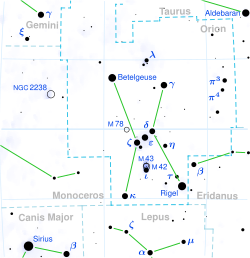
Xi Orionis (ξ Orionis) is a binary star system in the northeastern part of the constellation of Orion, well above the red giant star Betelgeuse in the sky. It lies next to another blue main-sequence star, Nu Orionis, which is somewhat closer at 520 light-years' distance. The apparent visual magnitude of Xi Orionis is 4.47,[2] which is bright enough to be seen with the naked eye. The distance to this star, as determined using the parallax method, is roughly 610 light-years.[1]
This is a spectroscopic binary star system with an orbital period of 45.1 days and an eccentricity of 0.26.[5] The primary component is a B-type subgiant star with a stellar classification of B3 IV.[3] With an estimated age of just 32 million years,[3] it has a relatively high rate of spin, showing a projected rotational velocity of 160 km/s.[7] Xi Orionis has about 6.7 times the mass of the Sun,[3] and shines with 1,390 times the solar luminosity from its outer atmosphere at an effective temperature of 15,476 K.[6]
References
[edit]- ^ a b c d e f van Leeuwen, F. (2007), "Validation of the new Hipparcos reduction", Astronomy and Astrophysics, 474 (2): 653–664, arXiv:0708.1752, Bibcode:2007A&A...474..653V, doi:10.1051/0004-6361:20078357, S2CID 18759600.
- ^ a b c d Crawford, D. L.; et al. (1971), "Four-color, H-beta, and UBV photometry for bright B-type stars in the northern hemisphere", The Astronomical Journal, 76: 1058, Bibcode:1971AJ.....76.1058C, doi:10.1086/111220.
- ^ a b c d e f Tetzlaff, N.; et al. (January 2011), "A catalogue of young runaway Hipparcos stars within 3 kpc from the Sun", Monthly Notices of the Royal Astronomical Society, 410 (1): 190–200, arXiv:1007.4883, Bibcode:2011MNRAS.410..190T, doi:10.1111/j.1365-2966.2010.17434.x, S2CID 118629873.
- ^ de Bruijne, J. H. J.; Eilers, A.-C. (October 2012), "Radial velocities for the HIPPARCOS-Gaia Hundred-Thousand-Proper-Motion project", Astronomy & Astrophysics, 546: 14, arXiv:1208.3048, Bibcode:2012A&A...546A..61D, doi:10.1051/0004-6361/201219219, S2CID 59451347, A61.
- ^ a b Pourbaix, D.; et al. (2004), "SB9: The ninth catalogue of spectroscopic binary orbits", Astronomy and Astrophysics, 424 (2): 727–732, arXiv:astro-ph/0406573, Bibcode:2004A&A...424..727P, doi:10.1051/0004-6361:20041213, S2CID 119387088.
- ^ a b c McDonald, I.; et al. (2012), "Fundamental Parameters and Infrared Excesses of Hipparcos Stars", Monthly Notices of the Royal Astronomical Society, 427 (1): 343–57, arXiv:1208.2037, Bibcode:2012MNRAS.427..343M, doi:10.1111/j.1365-2966.2012.21873.x, S2CID 118665352.
- ^ a b Abt, Helmut A.; Levato, Hugo; Grosso, Monica (July 2002), "Rotational Velocities of B Stars", The Astrophysical Journal, 573 (1): 359–365, Bibcode:2002ApJ...573..359A, doi:10.1086/340590.
- ^ "ksi Ori". SIMBAD. Centre de données astronomiques de Strasbourg. Retrieved 2016-11-08.
| Stars |
| ||||||||||||
|---|---|---|---|---|---|---|---|---|---|---|---|---|---|
| |||||||||||||
| Star clusters |
| ||||||||||||
| Nebulae |
| ||||||||||||
| Galaxies |
| ||||||||||||
| |||||||||||||
