


1995 AFC Championship Game
View on Wikipedia | This article needs additional citations for verification. (March 2026) |
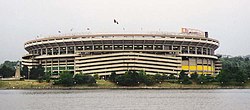
 Three Rivers Stadium, the site of the game | |||||||||||||||||||
| |||||||||||||||||||
| |||||||||||||||||||
| Date | January 14, 1996 | ||||||||||||||||||
|---|---|---|---|---|---|---|---|---|---|---|---|---|---|---|---|---|---|---|---|
| Stadium | Three Rivers Stadium Pittsburgh, Pennsylvania | ||||||||||||||||||
| Favorite | Steelers by 11 | ||||||||||||||||||
| Referee | Bernie Kukar | ||||||||||||||||||
| Attendance | 61,062 | ||||||||||||||||||
| TV in the United States | |||||||||||||||||||
| Network | NBC | ||||||||||||||||||
| Announcers | Dick Enberg, Phil Simms, and Paul Maguire | ||||||||||||||||||
The 1995 AFC Championship Game was the championship game for the American Football Conference (AFC) for the 1995 season.[1][2][3] The game was played on January 14, 1996, at Three Rivers Stadium in Pittsburgh, home of the Pittsburgh Steelers, who hosted the Indianapolis Colts for the chance to play the winner of the National Football Conference (NFC) in Super Bowl XXX in Tempe, Arizona.
While it was considered a mismatch between an expected Super Bowl contender (Pittsburgh) and a Cinderella team (Indianapolis) in the week leading up to the game, it turned out to be very competitive, going down to the last play of the game when Colts quarterback Jim Harbaugh threw a Hail Mary pass that was ruled a dropped pass by officials in the end zone by the intended receiver, Aaron Bailey. The dropped pass gave the Steelers a 20–16 victory and sent them to Super Bowl XXX, the team's first Super Bowl appearance since Super Bowl XIV sixteen years earlier.
The game would mark a turning point for both franchises. For Steelers head coach Bill Cowher, it would be the first of only two times the Steelers would advance to the Super Bowl during his 15-year tenure, as the team would host the AFC Championship Game five times between 1994 and 2004 but would lose their other four appearances. Their other AFC Championship win was a road game in 2005, and they eventually won Super Bowl XL in that season. For the Colts, it marked an unexpected period of success in the mid-1990s for a franchise that otherwise struggled between its 1984 move to Indianapolis (as well as the team's last few years in Baltimore before that) and the team drafting Peyton Manning with the number one overall pick in the 1998 NFL draft.
The game has been ranked among the best Conference Championship games in the history of the National Football League by several publications, including Sports Illustrated,[4] ESPN,[5] AOL,[6] and several local publications throughout the United States.[7] NFL Films would go on to feature the game in both its ongoing NFL Films Game of the Week and NFL's Greatest Games series.
Background
[edit]Entering the 1995 NFL season, the Pittsburgh Steelers were a favorite to make it to the Super Bowl[8] following a 12–4 regular season the year before behind its "Blitzburgh" defense that saw the team upset by the San Diego Chargers 17–13 in the 1994 AFC Championship Game.[9] However, the team got off to a slow start, starting the 1995 season at 3–4 before ripping through the NFL on an eight-game winning streak. The team's last regular season loss was in Week 17 against the Green Bay Packers, 24–19 at Lambeau Field, a game that had no playoff implications since both teams had already clinched their respective playoff seedings entering the game. The Steelers' 11–5 record was good enough for the AFC Central Division championship (four games ahead of the Cincinnati Bengals and Houston Oilers) and the conference's number 2 seed, earning a first-round bye in the playoffs.
The Colts were coming off an 8–8 season in 1994 that was the team's best record since 1987, when the team won the AFC East with a 9–6 record during the strike-shortened season. Aside from the 1987 season, the Colts had not appeared in the playoffs since 1977 when the team was in Baltimore. Behind veteran quarterback Jim Harbaugh, the 1995 season would change that, as several come-from-behind victories propelled the team to a 9–7 record and the number 5 seed in the AFC playoffs.
When the playoffs started, the Steelers defeated the Buffalo Bills 40–21 in the divisional round to advance to their second consecutive AFC Championship Game.[10] Meanwhile, the Colts defeated the defending AFC champion San Diego Chargers 35–20 at Jack Murphy Stadium,[11] then pulled off the upset by defeating the top-seeded Kansas City Chiefs 10–7 at Arrowhead Stadium.[12] The upset of the Chiefs meant that the AFC Championship Game would be a home game for the Steelers instead of traveling to Kansas City for the AFC Championship Game. The upset also marked the Colts' first AFC Championship Game appearance in 24 years, since the then-Baltimore Colts lost to the Miami Dolphins 21–0 in 1971.
The Colts were the first number 5 seed to advance to a conference championship game since the 1990 playoff expansion. It would mark the first time since the 1970 merger that no team that was a member of the American Football League at any point in its history participated in the AFC Championship Game, as both the Colts and Steelers were with the "old" NFL before moving to the newly formed AFC in 1970 to even out the two conferences. (Since then, only the 2008 AFC Championship Game between the Steelers and their archrivals, the Baltimore Ravens, has the AFC title been played for between two non-AFL teams.)[citation needed] The game was a rematch of the Week 3 contest between the two teams from the previous season, which the Steelers won at home, 31–21.[13] The 1995 AFC Championship Game would be the second of four consecutive seasons in which the two teams met in Pittsburgh, an uncommon sight for non-division rivals.
Game summary
[edit]On the Steelers opening drive, Neil O'Donnell's first pass of the game was tipped by defensive tackle Tony Siragusa and intercepted by Jeff Herrod, who returned it to the Pittsburgh 24-yard line. The Colts' drive was halted when Ray Seals tackled running back Lamont Warren for a loss on third down and one. On the next play, Cary Blanchard hit the right upright on his 34-yard field goal, but it still bounced in and the Colts took a 3–0 lead. After each team punted, Pittsburgh's Norm Johnson kicked a field goal to even the game with under two minutes remaining in the first quarter. The field goal occurred after Kordell Stewart dropped a pass in the end zone. Replays showed Colts safety Jason Belser made contact with Stewart just before the ball arrived, but no penalty flag was thrown.
In the second quarter, a 30-yard reception by Colts receiver Sean Dawkins set up Blanchard's second field goal. But later on, Pittsburgh drove 80 yards in 17 plays, featuring three third down conversion runs by Kordell Stewart, and scored on O'Donnell's 5-yard third and goal touchdown pass to Stewart with 13 seconds left in the half, making the score 10–6. Replays showed Stewart had put half a foot out of bounds before making the catch, which would have made him an ineligible receiver, but the penalty was not called. As it was during the seven-year period when the NFL didn't implement instant replay, the play could not be challenged and reversed.
On Indianapolis' first drive of the second half, they drove 61 yards in nine plays, featuring a 29-yard completion from Jim Harbaugh to tight end Ken Dilger. Blanchard finished the drive with his third field goal to cut their deficit to 10–9. Then after forcing a three and punt, Indy drove 35 yards in nine plays to set up another field goal try, which would have put the Colts up 12–10. But this time Blanchard's 47-yard attempt sailed wide right. Taking over on their own 37, Pittsburgh mounted a drive in Colts territory where Johnson's 37-yard field goal put them back up by four points, at 13–9.
Early in the fourth quarter, a long punt return by Steelers receiver Andre Hastings gave them the ball at midfield. But all they got out of their great field position was a missed field goal. After that, Harbaugh threw a 47-yard touchdown pass to wide receiver Floyd Turner to take the lead, 16–13. After a Steelers punt, their defense got a big chance when Warren fumbled deep in Colts territory, but guard Joe Staysniak recovered the ball in mid-air to keep the drive going. Later on, defensive back Willie Williams tackled Warren behind the line on third down and one to force a punt, giving Pittsburgh the ball back with 3:03 left in the game.
Pittsburgh then marched 67 yards to score the winning touchdown. Running back Byron Bam Morris scored the game-winning 1-yard touchdown run with 1:34 remaining in the game to pull Pittsburgh ahead for good. The drive was aided by O'Donnell's 9-yard completion to Hastings on fourth down and 3 from the 47-yard line, as well as an earlier dropped potential interception that went in and out of the arms of linebacker Quentin Coryatt. On the next play after Hastings' fourth down conversion catch, O'Donnell completed a 37-yard pass to Ernie Mills on the Indianapolis 1-yard line, setting up Morris' 1-yard scoring run. The Colts got the ball back and advanced to the Steelers' 29 with 5 seconds left, narrowly avoiding a turnover when defensive back Chris Oldham dropped a wide open interception.
On the game's final play, Harbaugh threw a high, lofting pass toward the end zone. The ball was deflected by several players on both sides before hitting Colts receiver Aaron Bailey in the chest. As Bailey was landing after his leaping attempt to catch it, he had a second chance as the ball landed in his midsection. Bailey tried to close his hands around the ball, as he had the first time, but could not haul it in. Bailey did eventually emerge from the ground with the ball in his possession, but the officials ruled the pass incomplete as, just before Bailey secured the ball, it had bounced off of the turf after being deflected by a Steeler defensive back. The game was over and the Steelers advanced to their first Super Bowl in sixteen years.
Harbaugh completed 21 of 33 passes for 267 yards and a touchdown.
Aftermath
[edit]The missed call on Kordell Stewart's touchdown catch in the second quarter brought some debate following the game on whether or not the league should bring back instant replay, which had been repealed in 1992 after being used since 1986. Replays at the time demonstrated that there would have been enough evidence to reverse the call and penalize Stewart for an illegal touching foul (stepping out of bounds before catching the pass). Jim Harbaugh later stated in postgame interviews that the missed call on Stewart and the missed pass interference call on Jason Belser that could have led to a Pittsburgh touchdown instead of a field goal were a "wash". Despite this game, there was no real desire by league owners to reinstate instant replay for 1996.[14] A different instant replay system than the original would eventually return for the 1999 NFL season, and has since been made a permanent addition of the NFL rules.
The game would mark the only home AFC Championship Game in Bill Cowher's 15-year tenure that the Steelers won, having advanced to the game at home in 1994, 1995, 1997, 2001, and 2004. Except for this game mentioned—which the Steelers narrowly won—the other home matchups would be losses. Ironically, the only time the team played for the AFC title on the road during Cowher's tenure, the 2005 matchup against the Denver Broncos at Invesco Field at Mile High, would be the only AFC Championship Game the Steelers won decisively during Cowher's tenure, winning 34–17. It would also be the only year in which the Steelers won the Super Bowl with Cowher as their head coach, defeating the Seattle Seahawks in Super Bowl XL 21–10.
The game would be the last game for Ted Marchibroda in his second stint as the Colts head coach, having coached the Colts from 1975 to 1979 when the team was in Baltimore. Following the Cleveland Browns relocation controversy, the newly christened Baltimore Ravens hired Marchibroda to be their inaugural head coach. Following him to Baltimore would be ex-Colts Floyd Turner (whose number 88 in Indianapolis would be immediately picked up by Marvin Harrison, who would spend the next 13 years with the Colts) and former University of Pittsburgh standout Tony Siragusa; Siragusa would later pick up a Super Bowl ring when the Ravens won Super Bowl XXXV. Marchibroda would be fired after the 1998 season and returned to the Colts as a color commentator for their radio network until retiring following the Colts victory in Super Bowl XLI at the end of the 2006 NFL season, after which he became a pre-game commentator for the Colts for a time before Marchibroda's death in January 2016. A native of Franklin, Pennsylvania north of Pittsburgh, Marchibroda's last game as Colts head coach actually came in his hometown, with Marchibroda having played quarterback for the Steelers in the 1950s. Coincidentally, the Steelers infamously kept Marchibroda over future Colts star Johnny Unitas one year during training camp.
The Steelers would play the Dallas Cowboys two weeks later in Super Bowl XXX, renewing the rivalry the two teams had in the 1970s, when the two teams were among the most dominant teams in the NFL. The heavily favored Cowboys would defeat the Steelers 27–17 to give the latter team their first Super Bowl defeat.
The Colts and Steelers would both make the playoffs in 1996, with the Steelers defeating the Colts 42–14 in the wild-card round. The following year, the two teams met for the fourth consecutive year in Pittsburgh in Week 7, in which the Steelers defeated the struggling Colts 24–22, dropping the Colts to 0–6 en route to a 3–13 season and the team drafting Peyton Manning first overall in the 1998 NFL draft. The four consecutive losses in Pittsburgh would be part of a longer losing streak for the Colts, who after defeating the Steelers 41–7 at Pitt Stadium in 1968 lost 12 straight games against the Steelers in Pittsburgh before breaking through with a 24–20 win at Heinz Field in 2008; the 2008 win is also the last victory for the Colts against the Steelers in any capacity as of 2023, as the Steelers currently have an eight-game winning streak against the Colts both home and away.[15] The Colts finished 0–11 lifetime at Three Rivers Stadium.
Jim Harbaugh, who after retiring worked his way up to being an NFL head coach himself with the San Francisco 49ers, has stated that the 1995 AFC Championship Game continues to haunt him: "Coming that close to your dream of participating in the Super Bowl, and then seeing it brush by your face in an instant, and you walk off the field and you go 'there will be other days'. And then you realize it was the only day."[16] Harbaugh would eventually reach the Super Bowl with the 49ers, only to lose Super Bowl XLVII to the Baltimore Ravens, coached by his brother John Harbaugh.
The game itself wasn't viewable to many residents in the Pittsburgh suburb of Monroeville, Pennsylvania due to a power outage from Time Warner Cable, angering many residents.[17] Time Warner, which was already in a dispute with the municipality over carriage fees, eventually traded its Monroeville systems to Comcast as part of their joint acquisition of the assets of Adelphia Communications in 2006.
Officials
[edit]- Referee: Bernie Kukar (#86)
- Umpire: Hendi Ancich (#115)
- Head linesman: Earnie Frantz (#111)
- Line judge: Ron Baynes (#56)
- Back judge: Tim Millis (#80)
- Side judge: Doug Toole (#4)
- Field judge: John Robison (#46)
See also
[edit]References
[edit]- ^ "AFC Championship - Indianapolis Colts at Pittsburgh Steelers - January 14th, 1996". Pro-Football-Reference.com.
- ^ Top 5 Hail Mary Plays: 1995 Colts vs. Steelers - NFL Videos. NFL.com. Retrieved January 24, 2015.
- ^ Doyle, Gregg (January 5, 2015). "Colts saw the great Harbaugh, not the grating one". IndyStar.com. Retrieved January 24, 2015.
There was the 1995 AFC championship game against the Steelers in Pittsburgh, when the Colts trailed 20–16 in the final minutes
- ^ "Most Popular". CNN. Archived from the original on January 27, 2010.
- ^ "NFL's Greatest Games - 1995 AFC Championship: Indianapolis Colts at Pittsburgh Steelers - Friday, Jan 15, 2010 - mReplay Livedash TV Transcript - Livedash - Search what is being mentioned across national TV". www.livedash.com. Retrieved June 6, 2022.
{{cite web}}: CS1 maint: deprecated archival service (link) - ^ "Cowher's Greatest Games: No. 2, 1995 Season Steelers-Colts AFC Championship". www.aolnews.com. Retrieved June 6, 2022.
{{cite web}}: CS1 maint: deprecated archival service (link) - ^ "Steelers' best/Worst moments in AFC title games - AltoonaMirror.com - Altoona, PA | News, Sports, Jobs, Community Information - the Altoona Mirror". Archived from the original on January 24, 2011. Retrieved December 30, 2011.
- ^ "1995 NFL Preseason Odds". Pro-Football-Reference.com. Retrieved March 13, 2026.
- ^ "AFC Championship - San Diego Chargers at Pittsburgh Steelers - January 15th, 1995". Pro-Football-Reference.com. Retrieved March 13, 2026.
- ^ "Steelers 40-21 Bills (Jan 6, 1996) Final Score". ESPN. Retrieved March 13, 2026.
- ^ "Wild Card - Indianapolis Colts at San Diego Chargers - December 31st, 1995". Pro Football Reference. Retrieved March 13, 2026.
- ^ "Divisional Round - Indianapolis Colts at Kansas City Chiefs - January 7th, 1996". Pro Football Reference. Retrieved March 13, 2026.
- ^ L. A. Times Archives (September 19, 1994). "PRO FOOTBALL : Foster of Old Helps Steelers Freeze the Colts : AFC: Running back recaptures 1992 form, rushing for 179 yards and one touchdown as Pittsburgh defeats Indianapolis, 31-21". Los Angeles Times. Retrieved March 13, 2026.
- ^ Pierson, Don (January 21, 1996). "Replay Reinstatement Not In The Cards". Chicago Tribune. Retrieved December 31, 2011.
- ^ Nardiello, Phil (November 29, 2022). "Steelers continue streak over Colts with 24-17 win". WTTV CBS4Indy. Retrieved December 7, 2024.
- ^ "1995 AFC Championship game still haunts Harbaugh". Profootballtalk.com. May 12, 2011. Retrieved December 31, 2011.
- ^ YouTube Video [dead link]
| |
| Franchise | |
| Stadiums | |
| Culture | |
| Lore | |
| Rivalries | |
| Division championships (16) | |
| Conference championships (7) | |
| League championships (5) | |
| Retired numbers | |
| Media | |
| Current league affiliations |
|

1995 AFC Championship Game
View on GrokipediaBackground
Pittsburgh Steelers' Path
The Pittsburgh Steelers entered the 1995 NFL season with high expectations following a 12-4 campaign the previous year that ended in a narrow 17-13 loss to the San Diego Chargers in the AFC Championship Game. Under head coach Bill Cowher, the team finished the regular season with an 11-5 record, securing the AFC Central Division title and the No. 2 seed in the conference, which earned them a home playoff game. They posted a strong 7-1 mark at Three Rivers Stadium, where their defense allowed approximately 18.9 points per game, contributing to a balanced performance that saw the Steelers rank fifth in the league in scoring offense with 25.4 points per game.[5] The Steelers' defense, known as "Blitzburgh" for its aggressive zone-blitz scheme coordinated by Dick LeBeau, remained a cornerstone despite the early-season ACL tear suffered by star safety Rod Woodson in Week 1 against the Detroit Lions, which sidelined him for most of the year. Linebacker Greg Lloyd led the team with 116 tackles, while edge rusher Kevin Greene recorded 9 sacks, helping the unit rank ninth in points allowed at 20.4 per game. On offense, quarterback Neil O'Donnell completed 246 of 416 passes for 2,970 yards and 17 touchdowns in 12 starts, supported by a resurgent running game that featured Erric Pegram, acquired in free agency, rushing for 813 yards and Bam Morris adding 559 yards and nine touchdowns as a complementary power back. The backfield tandem provided balance, with the Steelers amassing 1,852 rushing yards overall, emphasizing a ground attack that wore down opponents during an eight-game winning streak from Weeks 9 through 16.[5][6][7][8] Motivated by the heartbreak of falling three yards short of the Super Bowl in 1994 and seeking their first appearance since defeating the Los Angeles Rams in Super Bowl XIV following the 1979 season, the Steelers entered the playoffs with renewed determination to overcome recent postseason shortcomings. Entering the postseason relatively healthy after navigating injuries to key players like Woodson and a brief finger issue for O'Donnell, the team focused on its depth and physicality, particularly in the trenches, to advance. In the AFC Divisional Round on January 6, 1996, at Three Rivers Stadium, Pittsburgh defeated the Buffalo Bills 40-21, showcasing a dominant ground game with 147 rushing yards on 43 carries—including contributions from Pegram (33 yards on eight attempts) and Morris (106 yards on 25 attempts)—while the defense forced three interceptions off Bills quarterback Jim Kelly, picked off by Levon Kirkland, Carnell Lake, and Jerry Olsavsky. This victory propelled the Steelers to host the upstart No. 5 seed Indianapolis Colts in the AFC Championship, positioning Pittsburgh as favorites against the underdog visitors.[9][10][11]Indianapolis Colts' Path
The Indianapolis Colts began the 1995 NFL season with modest expectations after posting an 8-8 record in 1994 under head coach Ted Marchibroda, marking their first non-losing campaign since 1992 but still falling short of playoff contention.[12] The team clinched a playoff berth with a 9-7 regular-season mark, tying for second place in the AFC East behind the 10-6 Buffalo Bills and edging out the 9-7 Miami Dolphins on tiebreakers to secure the No. 5 wild card seed in a division considered one of the league's weaker that year. Quarterback Jim Harbaugh solidified his role as the starter midway through the season, appearing in 15 games with 12 starts and throwing for 2,575 yards with 17 touchdowns and just five interceptions, earning his first Pro Bowl nod.[13] Rookie running back Marshall Faulk, selected in the first round of the 1994 draft, broke out with 1,078 rushing yards on 289 carries and 11 touchdowns, adding versatility with 56 receptions for 475 yards as a key component of the offense. The defense, led by coordinator Jim Johnson, ranked 10th in the league by allowing 19.8 points per game and featured standouts like safety Jason Belser, who recorded four interceptions during the regular season to help anchor the secondary.[14] In the wild card round on December 31, 1995, the Colts traveled to Jack Murphy Stadium and stunned the No. 4 San Diego Chargers 35-20 in a game that showcased their opportunistic play.[15] Harbaugh completed 18 of 25 passes for 201 yards and two touchdowns, including a 42-yard strike to Sean Dawkins, while the Colts' defense forced four turnovers—all interceptions—to derail the defending AFC champions.[16] The victory, powered by a balanced attack that included 178 rushing yards, propelled the underdog Colts forward and highlighted their momentum heading into the divisional round; however, Faulk suffered an injury in this game and did not play in the next.[15] The divisional playoff on January 7, 1996, pitted the Colts against the top-seeded Kansas City Chiefs at a frigid Arrowhead Stadium, where temperatures hovered around 19 degrees Fahrenheit with a wind chill near zero.[17] In a low-scoring defensive struggle, Indianapolis prevailed 10-7, with Harbaugh tossing a 5-yard touchdown pass to Floyd Turner in the second quarter and kicker Cary Blanchard nailing a 30-yard field goal in the third to provide the margin of victory.[18] The Colts' ground game contributed 147 rushing yards on 39 attempts, led by Lamont Warren's 76 yards on 20 carries, while the defense limited the Chiefs to 281 total yards with no sacks on quarterback Steve Bono to secure the upset.[18] This triumph advanced the Colts to their first AFC Championship Game since the franchise's 1970 appearance as the Baltimore Colts, cementing their status as improbable contenders in a season defined by resilience and timely execution.The Game
Pregame Details
The 1995 AFC Championship Game was hosted at Three Rivers Stadium in Pittsburgh, Pennsylvania, a multi-purpose venue with a seating capacity of approximately 61,000 for NFL games. The stadium drew a sellout crowd of 61,062 spectators, generating an electric and intimidating atmosphere that favored the home team Steelers, known for their strong performances in front of raucous Pittsburgh fans.[19] Weather conditions on game day, January 14, 1996, were relatively mild for a mid-January playoff contest in the Steel City, featuring foggy conditions, a game-time temperature of 36°F, 77% humidity, 13 mph winds (wind chill 27°F), following a morning low of 30°F and daytime high of 51°F.[1][20][21] The Pittsburgh Steelers entered as 11-point betting favorites, reflecting their dominant 11-5 regular-season record and home-field advantage, while the Indianapolis Colts, with a 9-7 mark, were viewed as underdogs on the road against a battle-tested Steelers defense. Media predictions largely sided with Pittsburgh, citing the team's playoff experience and the Colts' reliance on an unproven postseason formula under first-year head coach Ted Marchibroda.[22] Both teams arrived at full strength with no significant last-minute injuries reported, allowing Pittsburgh coach Bill Cowher to emphasize defensive discipline and team unity in preparations, drawing on their nine-game winning streak to build confidence. The Steelers prioritized containing the Colts' dynamic running back Marshall Faulk to disrupt Indianapolis's balanced attack, while the Colts centered their game plan on quarterback Jim Harbaugh's scrambling ability and short, precise passes to exploit Pittsburgh's aggressive blitz schemes. Pregame rituals included standard ceremonies such as the national anthem performed by a local artist and the coin toss, which set the tone for the high-stakes matchup.[3][23]Quarter-by-Quarter Summary
The 1995 AFC Championship Game began with a cautious start in the first quarter, as both defenses asserted control early on. The Indianapolis Colts struck first, capitalizing on a solid opening drive to set up kicker Cary Blanchard for a 34-yard field goal, giving the visitors a 3-0 lead with 12:17 remaining.[1] Pittsburgh responded swiftly, marching downfield to tie the score at 3-3 on a 31-yard field goal by Norm Johnson with 1:50 left, maintaining a low-scoring, gritty tone as the quarter ended.[1] In the second quarter, momentum seesawed as the Colts nudged ahead again with Blanchard's 36-yard field goal with 12:08 remaining, making it 6-3 Indianapolis.[1] The Steelers, however, seized control late in the half, driving 80 yards in 13 plays behind quarterback Neil O'Donnell, who connected with receiver Kordell Stewart—who had briefly stepped out of bounds—for a controversial 5-yard touchdown pass with 0:21 left; Norm Johnson's extra point gave Pittsburgh a 10-6 lead heading into halftime.[1][24] This score highlighted the Steelers' balanced attack and set the stage for a tense second half. The third quarter unfolded as a defensive stalemate, with neither team able to sustain long drives amid fierce tackling and pass rushes. The Colts chipped away first, trimming the deficit to 10-9 on Blanchard's 37-yard field goal with 9:57 left.[1] Pittsburgh countered effectively, extending the lead to 13-9 with Johnson's 36-yard field goal with 0:43 remaining, as the defenses forced punts and turnovers on downs, preserving the Steelers' slim advantage without further scoring.[1] The fourth quarter delivered the game's dramatic climax, beginning with the Colts' breakthrough on a 47-yard touchdown pass from Jim Harbaugh to wide receiver Floyd Turner with 8:46 left, followed by Blanchard's kick to put Indianapolis ahead 16-13.[1] Trailing by three, the Steelers orchestrated a pivotal 67-yard, 11-play drive over 7:12, methodically advancing behind O'Donnell's precise passing and Bam Morris's ground game, culminating in Morris's 1-yard touchdown run with 1:34 left; Johnson's point-after made it 20-16 Pittsburgh.[25][1] The Colts' ensuing final drive advanced them to the Steelers' 29-yard line, but Harbaugh's desperate Hail Mary attempt to Aaron Bailey was tipped by safety Carnell Lake and intercepted by cornerback Willie Williams in the end zone as time expired, sealing Pittsburgh's victory.[25][3]Statistics and Records
Team and Passing Statistics
The 1995 AFC Championship Game featured a closely contested battle in terms of overall offensive output, with the Indianapolis Colts accumulating 328 total yards compared to the Pittsburgh Steelers' 285 yards. The Steelers, however, held a slight edge in first downs with 21 to the Colts' 16, reflecting their efficiency in sustaining drives despite fewer yards. On third-down conversions, Pittsburgh succeeded on 6 of 14 attempts (43%), outperforming Indianapolis' 5 of 15 (33%), which helped maintain possession in key moments. Turnovers proved costly for the Steelers, who lost one interception with no fumbles, while the Colts avoided any turnovers throughout the game. Passing statistics highlighted the aerial duel between the quarterbacks, as both teams relied heavily on the air attack in a game lacking explosive ground gains. Pittsburgh's Neil O'Donnell completed 25 of 41 passes for 205 yards, including 1 touchdown and 1 interception, providing steady production that set up their scoring opportunities. Indianapolis' Jim Harbaugh outperformed in efficiency, going 21 of 33 for 267 yards with 1 touchdown and no interceptions, though the Colts' final drive fell short. Time of possession was nearly even, with the Colts holding the ball for 30:36 and the Steelers for 29:24, underscoring the back-and-forth nature of the contest.| Category | Pittsburgh Steelers | Indianapolis Colts |
|---|---|---|
| Total Yards | 285 | 328 |
| First Downs | 21 | 16 |
| Third-Down Efficiency | 6/14 (43%) | 5/15 (33%) |
| Turnovers | 1 (1 INT, 0 fumbles lost) | 0 |
| Passing (Comp/Att/Yds/TD/INT) | 25/41, 205, 1, 1 | 21/33, 267, 1, 0 |
| Time of Possession | 29:24 | 30:36 |
| Penalties | 4 for 25 yards | 5 for 57 yards |
Rushing, Receiving, and Defensive Highlights
In the rushing game, the Pittsburgh Steelers relied on a committee approach led by Erric Pegram, who carried the ball 10 times for 46 yards, providing steady production in key situations.[1] For the Indianapolis Colts, Lamont Warren emerged as the top rusher with 15 carries for 53 yards, while quarterback Jim Harbaugh contributed 6 carries for 29 yards, helping to balance the offense against a stout Steelers defense.[1] Bam Morris added a crucial score for Pittsburgh, powering in from 1 yard out on his 7 carries for 9 yards, which proved to be the game-winning touchdown in the fourth quarter.[1] Overall, the Steelers defense effectively contained the Colts' ground attack, limiting them to just 83 total rushing yards on 23 attempts.[1] On the receiving end, Colts wide receiver Sean Dawkins led all players with 7 receptions for 96 yards, serving as a primary target for quarterback Jim Harbaugh in the passing game.[1] Pittsburgh's Yancey Thigpen was the top receiver for the Steelers, hauling in 6 passes for 65 yards and helping to move the chains consistently.[1] Floyd Turner made a significant impact for Indianapolis with 2 receptions for 55 yards, including a 47-yard touchdown that briefly gave the Colts the lead in the fourth quarter.[1] Additionally, Steelers quarterback Kordell Stewart showcased his versatility with 2 receptions for 18 yards, one of which was a 5-yard touchdown catch that tied the game early in the second quarter.[1] Defensively, Pittsburgh linebacker Levon Kirkland anchored the front seven with 4 tackles and a forced fumble, contributing to the Steelers' ability to disrupt Colts drives.[1] Colts linebacker Jeff Herrod provided a key turnover with his lone interception, returning it 17 yards to set up a field goal attempt.[1] Steelers linebacker Greg Lloyd also stood out with 6 tackles and 1.5 sacks, pressuring Harbaugh and helping limit the Colts to 16 points despite their offensive threats.[1] Notably, neither team lost a fumble during the contest, with the Steelers recording zero fumbles overall and the Colts recovering their only one.[1] In the return game, Pittsburgh's Andre Hastings averaged 17.7 yards on 3 punt returns for 53 yards, providing solid field position throughout the game.[1]Officials and Controversies
Officiating Crew
The officiating crew for the 1995 AFC Championship Game was headed by referee Bernie Kukar, a veteran NFL official in his 12th season who had already worked numerous playoff games and would go on to referee two Super Bowls (XXXIII and XXXVI).[19][26] The full seven-man crew consisted of the following officials in their respective roles:| Position | Official |
|---|---|
| Referee | Bernie Kukar |
| Umpire | Hendi Ancich |
| Head Linesman | Earnie Frantz |
| Line Judge | Ron Baynes |
| Field Judge | John Robison |
| Side Judge | Doug Toole |
| Back Judge | Tim Millis |