


Community hub
Recent from talks
Contribute something
Nothing was collected or created yet.
Apple A12
View on Wikipedia
 | |
| General information | |
|---|---|
| Launched | September 12, 2018 |
| Discontinued | October 18, 2022 |
| Designed by | Apple Inc. |
| Common manufacturer | |
| Product code | APL1W81[2] |
| Max. CPU clock rate | to 2.49[3] GHz |
| Physical specifications | |
| Transistors |
|
| Cores |
|
| GPU | Apple-designed 4 core "Apple G11P"[4][5] |
| Cache | |
| L1 cache | 128 KB instruction, 128 KB data |
| L2 cache | 8 MB |
| Architecture and classification | |
| Application | Mobile |
| Technology node | 7 nm[4][6] (N7)[7] |
| Microarchitecture | "Vortex" and "Tempest" |
| Instruction set | A64 – ARMv8.3-A |
| Products, models, variants | |
| Variant |
|
| History | |
| Predecessor | Apple A11 Bionic |
| Successor | Apple A13 Bionic |
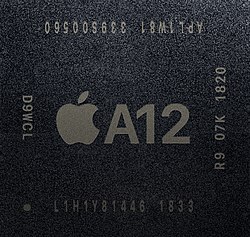
The Apple A12 Bionic is a 64-bit ARM-based system on a chip (SoC) designed by Apple Inc., part of the Apple silicon series,[8] It first appeared in the iPhone XS and XS Max, iPhone XR, iPad Air (3rd generation), iPad Mini (5th generation), iPad (8th generation) and Apple TV 4K (2nd generation).[8][6] Apple states that the two high-performance cores are 15% faster and 40% more energy-efficient than the Apple A11's, and the four high-efficiency cores use 50% less power than the A11's.[8][5] It is the first mass-market system on a chip to be built using the 7 nm process.[9]
iOS support for the iPhone XS and XR ended with iOS 18.7.5, released on February 11, 2026, whilst iPadOS support for the aforementioned models is ongoing, with iPadOS 26.2.1, released on January 26, 2026, being the latest update. tvOS support for the 2nd generation Apple TV 4K is ongoing (the latest update being tvOS 26.2).
Design
[edit]The Apple A12 SoC features an Apple-designed 64-bit ARMv8.3-A six-core CPU, with two high-performance cores called Vortex, running at 2.49 GHz, and four energy-efficient cores called Tempest.[4][6] The Vortex cores are a 7-wide decode out-of-order superscalar design, while the Tempest cores are a 3-wide decode out-of-order superscalar design. Like the A11's Mistral cores, the Tempest cores are based on Apple's Swift cores from the Apple A6.[10]
The A12 also integrates an Apple-designed four-core graphics processing unit (GPU) with 50% faster graphics performance than the A11.[4][8] The A12 includes dedicated neural network hardware that Apple calls a "Next-generation Neural Engine."[11] This neural network hardware has eight cores[5] and can perform up to 5 trillion 8-bit operations per second.[4][6] Unlike the A11's Neural Engine, third-party apps can access the A12's Neural Engine.[12]
The A12 is manufactured by TSMC[1] using a 7 nm[6] FinFET process, the first to ship in a consumer product,[4][1] containing 6.9 billion transistors.[1] The die size of the A12 is 83.27 mm2, 5% smaller than the A11.[13] It is manufactured in a package on package (PoP) together with 4 GiB of LPDDR4X memory in the iPhone XS[2] and XS Max[13] and 3 GB of LPDDR4X memory in the iPhone XR, the iPad Air (2019), the 5th generation iPad mini, and the iPad (2020).[14] The ARMv8.3 instruction set it supports brings a significant security improvement in the form of pointer authentication, which mitigates exploitation techniques such as those involving memory corruption, Jump-Oriented-Programming, and Return-Oriented-Programming.[15]
The A12 has video codec encoding support for HEVC and H.264. It has decoding support for HEVC, H.264, MPEG‑4 Part 2, and Motion JPEG.[16]
| SoC | A12 (7 nm) | A11 (10 nm) |
|---|---|---|
| Total Die | 83.27 | 87.66 |
| Big Core | 2.07 | 2.68 |
| Small Core | 0.43 | 0.53 |
| CPU Complex (incl. cores) | 11.90 | 14.48 |
| GPU Core | 3.23 | 4.43 |
| GPU Total | 14.88 | 15.28 |
| NPU | 5.79 | 1.83 |
Products that include the Apple A12 Bionic
[edit]See also
[edit]- Apple silicon, the range of ARM-based processors designed by Apple
- Apple A12X
- Comparison of Armv8-A processors
References
[edit]- ^ a b c d Summers, Nick (September 12, 2018). "Apple's A12 Bionic is the first 7-nanometer smartphone chip". Engadget. Archived from the original on September 13, 2018. Retrieved September 12, 2018.
- ^ a b "iPhone XS and XS Max Teardown". iFixit. September 21, 2018. Archived from the original on December 2, 2019. Retrieved September 21, 2018.
- ^ "iPhone XS Benchmarks - Geekbench Browser". Geekbench. Archived from the original on October 18, 2018. Retrieved September 22, 2018.
- ^ a b c d e f g Smith, Ryan (September 12, 2018). "Apple Announces the 2018 iPhones: iPhone XS, iPhone XS Max, & iPhone XR". AnandTech. Archived from the original on September 13, 2018. Retrieved September 12, 2018.
- ^ a b c d "A12 Bionic". Apple. September 12, 2018. Archived from the original on November 16, 2018. Retrieved September 12, 2018.
- ^ a b c d e "iPhone Xs and iPhone Xs Max bring the best and biggest displays to iPhone" (Press release). Apple. September 12, 2018. Archived from the original on April 27, 2019. Retrieved September 12, 2018.
- ^ "The Apple iPhone 11, 11 Pro & 11 Pro Max Review: Performance, Battery, & Camera Elevated". Archived from the original on October 20, 2019.
- ^ a b c d "Apple introduces iPhone XR" (Press release). Apple. September 12, 2018. Archived from the original on March 27, 2019. Retrieved September 12, 2018.
- ^ Shankland, Stephen. "Apple's A12 Bionic CPU for the new iPhone XS is ahead of the industry moving to 7nm chip manufacturing tech". CNET. Archived from the original on September 16, 2018. Retrieved July 1, 2020.
- ^ Frumusanu, Andrei. "The iPhone XS & XS Max Review: Unveiling the Silicon Secrets". AnandTech. Archived from the original on January 26, 2021. Retrieved January 27, 2019.
- ^ "iPhone XS - Technical Specification". Apple Inc. September 12, 2018. Archived from the original on January 4, 2019. Retrieved September 12, 2018.
- ^ Frumusanu, Andrei (October 5, 2018). "The iPhone XS & XS Max Review: Unveiling the Silicon Secrets". AnandTech. Archived from the original on January 26, 2021. Retrieved February 2, 2019.
- ^ a b Yang, Daniel; Wegner, Stacy (September 21, 2018). "Apple iPhone Xs Max Teardown". TechInsights. Archived from the original on April 15, 2019. Retrieved September 21, 2018.
- ^ "iPhone XR Teardown". iFixit. October 26, 2018. Archived from the original on March 21, 2019. Retrieved October 30, 2018.
- ^ Levin, Jonathan (September 15, 2018). "iPhone Xs, Xr... And, one more thing..." NewOSXBook.com. Archived from the original on October 10, 2018. Retrieved September 15, 2018.
- ^ "iPhone XS - Technical Specifications". support.apple.com. Archived from the original on October 24, 2021. Retrieved October 24, 2021.
- ^ Frumusanu, Andrei. "The iPhone XS & XS Max Review: Unveiling the Silicon Secrets". AnandTech. Archived from the original on January 26, 2021. Retrieved February 2, 2019.
Apple A12
View on GrokipediaDevelopment
Announcement
The Apple A12 Bionic was announced on September 12, 2018, during Apple's annual iPhone special event held at the Steve Jobs Theater in Cupertino, California.[1][7] Positioned as the successor to the A11 Bionic, it marked Apple's first system on a chip (SoC) produced using a 7-nanometer manufacturing process, enabling greater transistor density and improved performance efficiency compared to the preceding 10-nanometer node.[3][7] Apple highlighted several key performance advancements in the A12 Bionic during the reveal. The company claimed its six-core CPU offered up to 15% faster performance in high-performance cores and up to 50% greater efficiency in high-efficiency cores relative to the A11 Bionic, while the four-core graphics processing unit (GPU) delivered up to 50% faster graphics performance.[1][3] The next-generation Neural Engine, featuring eight cores, was described as capable of performing up to 5 trillion operations per second—approximately eight times the 600 billion operations per second of the A11's Neural Engine—enabling enhanced machine learning tasks such as facial recognition and augmented reality.[1][3] Additionally, the chip integrated approximately 6.9 billion transistors, a roughly 60% increase over the A11 Bionic's 4.3 billion, contributing to its compact yet powerful design.[8] Internally known by the engineering designation Apple H11P, the A12 Bionic was introduced as the core processor for Apple's new flagship devices.[8] It powered the iPhone XS and iPhone XS Max, which were positioned as premium models with advanced displays and camera systems, as well as the more affordable iPhone XR, emphasizing accessibility without compromising on core computing capabilities.[1][3]Manufacturing
The Apple A12 Bionic was fabricated by Taiwan Semiconductor Manufacturing Company (TSMC) using its 7 nm FinFET (N7) process technology. This marked the first implementation of a 7 nm node for an Apple system-on-chip (SoC), succeeding the 10 nm process used in the preceding A11 Bionic.[9] The A12 Bionic integrates 6.9 billion transistors on a die measuring approximately 83 mm², achieving a transistor density of about 83 million per square millimeter—a 70% increase over the A11 Bionic's 49 million transistors per square millimeter on the 10 nm node.[10] This higher density enabled Apple to pack more functionality into a slightly smaller die (a 5% reduction from the A11's 87.66 mm²), improving power efficiency and performance potential.[11] Mass production of the A12 Bionic ramped up at TSMC in May 2018, aligning with the September 2018 launch of devices like the iPhone XS and XR.[12] The shift from 10 nm to 7 nm involved higher fabrication costs due to the process complexity, but TSMC's superior yields—outpacing competitors like Samsung—minimized production risks and supported cost-effective scaling for Apple's high-volume needs.[13]Architecture
Central processing unit
The central processing unit (CPU) of the Apple A12 Bionic is a 64-bit hexa-core processor based on the ARM architecture, implementing the ARMv8.3-A instruction set architecture. This design enables advanced features such as pointer authentication for enhanced security against exploitation attempts. The CPU employs a heterogeneous big.LITTLE-like configuration, allowing simultaneous operation of all cores to handle diverse workloads efficiently. The configuration includes two high-performance Vortex cores operating at a maximum clock speed of 2.49 GHz and four high-efficiency Tempest cores running at 1.59 GHz. The Vortex cores, derived from Apple's custom modifications to ARM designs, deliver up to 15% higher performance than the preceding A11 Bionic's Monsoon cores while consuming 40% less power. Similarly, the Tempest cores provide up to 50% greater efficiency compared to the prior generation's Mistral cores. These custom microarchitectures incorporate significant enhancements, including doubled L1 instruction and data cache sizes to 128 KB per core for the Vortex implementation, alongside optimizations in the memory subsystem that reduce latency and improve overall throughput. A dynamic core switching mechanism, part of Apple's fusion architecture, intelligently allocates tasks across the performance and efficiency cores based on real-time demands, enabling seamless transitions to prioritize either speed or power savings without idling entire core clusters. This approach supports concurrent execution of up to six threads, optimizing for both single-threaded responsiveness and multi-threaded parallelism in mobile applications. The CPU integrates closely with the Secure Enclave, a dedicated secure coprocessor within the A12 Bionic SoC, to offload sensitive operations such as key generation, encryption, and biometric authentication, ensuring isolation from the main processing domain for robust data protection.Graphics processing unit
The graphics processing unit (GPU) in the Apple A12 Bionic is a custom-designed, four-core architecture developed in-house by Apple, representing the second generation of its proprietary graphics IP after moving away from licensed PowerVR cores used in previous A-series chips.[14] This shift enabled greater optimization for Apple's ecosystem, with the GPU integrated on the same 7 nm process node as the rest of the SoC to balance performance and power efficiency. The design emphasizes parallel processing for visual rendering and compute tasks, supporting advanced graphics pipelines tailored to mobile constraints. The A12 GPU fully supports Apple's Metal 2 API, which facilitates high-level graphics programming and compute shaders, including enhancements that allow machine learning workloads to accelerate graphical effects such as real-time image processing and augmented reality overlays through Metal Performance Shaders.[15] A key architectural feature is its use of tile-based deferred rendering (TBDR), where the scene is divided into small tiles and shading is deferred until visibility is determined, minimizing overdraw and reducing bandwidth demands compared to immediate-mode rendering in traditional GPUs.[16] This approach, combined with hardware-accelerated tessellation for detailed geometry generation and multilayer rendering for complex scene composition, contributes to efficient handling of demanding visual workloads like gaming and video playback. In terms of performance, the A12's GPU achieves up to 50% higher graphics throughput than the A11 Bionic's unit across typical workloads, driven by architectural improvements and the denser 7 nm fabrication, while maintaining comparable power envelopes.[17] It also incorporates lossless texture compression to further optimize memory access patterns. The GPU shares the system's unified LPDDR4X memory subsystem, providing up to 34.1 GB/s of bandwidth for both graphics and general compute operations, which supports seamless integration with the SoC's other components without dedicated video RAM.[18]Neural processing unit
The Neural Processing Unit (NPU) in the Apple A12 Bionic is a dedicated 8-core Neural Engine, marking the first implementation of an 8-core design in Apple's silicon for accelerating machine learning workloads.[1] This hardware accelerator is optimized for on-device inference, enabling efficient execution of neural network computations without relying on cloud processing. The unit supports 16-bit precision operations, allowing for higher accuracy in model predictions compared to lower-precision alternatives while maintaining computational efficiency.[19] Capable of performing up to 5 trillion operations per second (TOPS)—equivalent to a 600 GHz processor for neural tasks—the Neural Engine delivers significant performance gains over its predecessor in the A11 Bionic, which topped out at 600 billion operations per second.[1][2] It powers core machine learning features such as Face ID for secure authentication, Animoji and Memoji for expressive augmented reality experiences, real-time Siri processing, and advanced camera effects including Portrait mode with depth-based bokeh simulation.[1] These capabilities leverage the Neural Engine's integration with the Core ML framework, which achieves up to 9 times faster machine learning performance on the A12 compared to the A11. The design emphasizes power efficiency, consuming as little as one-tenth the energy of the A11 Bionic's Neural Engine for equivalent machine learning tasks, enabling sustained peak workloads with minimal battery impact—typically under 1 W during intensive operations.[1] This low-power architecture supports seamless integration into mobile devices, facilitating always-on features like real-time facial recognition and environmental awareness without compromising battery life.[2]Features and capabilities
Performance enhancements
The Apple A12 Bionic introduced significant performance advancements over its predecessor, the A11 Bionic, primarily through its adoption of a 7-nanometer manufacturing process by TSMC, which enabled higher transistor density and optimized core designs for improved speed in computational tasks.[3] This process shift, combined with architectural refinements, allowed the A12 to deliver enhanced single-core and multi-core processing capabilities, making it better suited for demanding applications like gaming and augmented reality. In terms of CPU performance, the A12 Bionic's six-core design includes two high-performance Vortex cores that Apple claims are up to 15% faster than the A11's equivalents, alongside four high-efficiency Tempest cores that offer up to 50% greater efficiency. Independent benchmarks, such as those from AnandTech using SPECint2006, reveal real-world single-core gains averaging 24% over the A11, attributed to the 7nm process and core-specific optimizations that boost clock speeds and instruction throughput without excessive power draw.[1][20][21] Multi-core performance sees approximately 25% improvement in optimized workloads compared to the A11, thanks to better load balancing across performance and efficiency cores, enabling smoother multitasking and faster app launches.[22][23] The GPU in the A12 represents a major leap, with its four-core architecture delivering up to 50% faster graphics rendering than the A11's three-core GPU, particularly benefiting AR experiences and graphics-intensive games by reducing frame drops and improving texture handling.[1] This enhancement stems from custom Apple-designed shaders and increased parallelism, allowing for more complex visual effects at higher frame rates. A key innovation is the second-generation Neural Engine, an 8-core dedicated AI accelerator capable of up to 5 trillion operations per second—nearly 8x the A11's capacity—enabling real-time machine learning tasks such as face detection and scene analysis with minimal latency.[3] For Core ML workloads, it achieves up to 9x the speed of the A11 while using one-tenth the energy, powering on-device AI without cloud dependency.[1] These hardware synergies also unlocked new features like Smart HDR, which leverages the Neural Engine, improved ISP, and CPU for capturing multiple exposure brackets in real time, resulting in photos with enhanced dynamic range, reduced noise, and better detail in highlights and shadows.[1] Overall, the A12's design yields about 12% lower power consumption at peak performance levels compared to the A11, supporting sustained high-speed operation in prolonged use cases.[21]Power efficiency
The A12 Bionic's adoption of TSMC's 7 nm manufacturing process marked a significant advancement in power efficiency over the A11 Bionic's 10 nm node, enabling higher transistor density and reduced energy consumption across the system-on-chip (SoC). This process contributed to the overall design's ability to deliver enhanced performance while lowering power draw, particularly in sustained workloads.[1][24] The CPU's six-core Fusion architecture features two high-performance Vortex cores and four high-efficiency Tempest cores, with dynamic core switching that intelligently allocates tasks to the appropriate cores based on demand. The performance cores operate at lower voltages for efficiency, achieving up to 15% faster execution while consuming 40% less power than the A11's equivalents. Meanwhile, the efficiency cores handle lighter workloads at up to 50% greater efficiency, minimizing overall energy use by keeping power-hungry performance cores idle when possible. This approach ensures seamless transitions without user intervention, optimizing for battery preservation in everyday scenarios.[1][24][25] The four-core GPU incorporates advanced power management techniques, including reduced leakage and optimized clock gating, to lower power draw during idle or light graphics tasks, supporting up to 50% faster rendering with improved energy efficiency compared to the A11. Complementing this, the dedicated eight-core Neural Processing Unit (NPU) processes machine learning workloads at 5 trillion operations per second, up to 9 times faster than the A11's NPU while using only one-tenth the power, thereby offloading intensive AI tasks from the CPU and GPU to conserve battery.[26][1] In real-world applications, these efficiencies translated to notable battery life gains; for instance, the iPhone XS achieved up to 30 minutes more video playback time than the iPhone X, while the iPhone XS Max extended this to 1.5 hours, reflecting up to 15% improvement in mixed-use scenarios driven by the A12's optimized power architecture. Independent benchmarks confirmed the SoC's superior energy efficiency, with the A12 consuming 12% less power at peak performance levels compared to the A11 in CPU-intensive tests.[1][25]Integrated subsystems
The Apple A12 Bionic incorporates a third-generation Image Signal Processor (ISP) that significantly advances computational photography capabilities. This ISP works in tandem with the device's camera hardware to enable real-time processing for features such as Smart HDR, which combines multiple exposures to produce images with greater dynamic range and reduced noise. It supports advanced portrait lighting effects and depth mapping, contributing to more accurate bokeh simulation and skin tone rendering in photos.[1] The Secure Enclave Processor serves as a dedicated coprocessor for managing sensitive operations, including the storage and processing of biometric data for Face ID and encryption key generation. Isolated from the main application processor, it ensures that user authentication data remains secure even if the device is compromised. Compared to the prior generation, the A12's Secure Enclave includes improvements in boot ROM functionality that lock passcode seeds during firmware updates to prevent unauthorized access. It also integrates with the T2 security chip architecture principles for enhanced overall system protection.[27][28] The motion coprocessor, known as the M12, is fully fused into the A12's CPU architecture, eliminating the need for a separate die and allowing seamless, low-power handling of sensor fusion data from accelerometers, gyroscopes, and barometers. This integration enables precise motion tracking for features like augmented reality experiences and fitness monitoring without burdening the main cores. It supports always-on context awareness while consuming minimal energy.[2] The A12 Bionic's video encode and decode hardware supports hardware-accelerated processing for 4K video at 60 frames per second, including HDR formats like Dolby Vision and HLG. This allows for high-quality capture and playback of dynamic range content, with the encoder handling real-time compression for extended recording times and the decoder optimizing playback efficiency on compatible displays.[18] The integrated audio subsystem features a dedicated digital signal processor (DSP) that enhances sound processing for stereo output and noise reduction. It lays the groundwork for immersive audio technologies by supporting multichannel decoding and spatial positioning cues, enabling richer playback in media applications. This DSP contributes to the overall power efficiency of audio tasks, such as real-time equalization and virtual surround effects.[29]Devices
iPhone models
The Apple A12 Bionic system on a chip was first integrated into the iPhone XS and iPhone XS Max, both announced on September 12, 2018, and released on September 21, 2018.[1] The iPhone XS featured the standard A12 Bionic with a four-core GPU and 4 GB of RAM, enabling advanced computational photography and machine learning tasks through its next-generation Neural Engine.[30][31] Priced starting at $999 for the 64 GB model, the XS highlighted the A12's efficiency in a compact form factor, contributing to its positioning as a premium successor to the iPhone X with improved performance for gaming and augmented reality applications.[32] The iPhone XS Max shared the identical A12 Bionic configuration, including the four-core GPU and 4 GB RAM, but benefited from a larger 3,174 mAh battery compared to the XS's 2,658 mAh capacity, resulting in enhanced power efficiency and up to 26 hours of video playback.[31] Launched at the same time as the XS with a starting price of $1,099 for 64 GB, the XS Max's bigger battery allowed the A12 to sustain higher sustained performance without thermal throttling in demanding scenarios, underscoring the SoC's role in enabling longer usage on larger displays.[32] The iPhone XR, released on October 26, 2018, also utilized the A12 Bionic with the same four-core GPU, but paired it with 3 GB of RAM in all regions to optimize costs while maintaining core processing capabilities.[31][14] Its single 12 MP rear camera leveraged the A12's image signal processor for features like Smart HDR and Portrait mode, despite the simpler hardware setup compared to the dual-camera XS models.[3] Starting at $749 for 64 GB, the XR's pricing reflected the A12's versatility in a more accessible device, with software tuning for its Liquid Retina LCD display ensuring balanced thermal management and power draw distinct from the OLED panels in the XS series, without significant binning variations in the SoC itself.[32][33]iPad models
The iPad Air (3rd generation), released on March 18, 2019, incorporated the A12 Bionic SoC with a 4-core GPU and 3 GB of RAM, providing robust performance for multitasking and creative applications on its 10.5-inch Retina display.[34] This model supported the first-generation Apple Pencil, facilitating precise stylus input for drawing and note-taking.[35] The iPad mini (5th generation), also launched on March 18, 2019, employed the same A12 Bionic chip, tailored for portability with its compact 7.9-inch display while maintaining 3 GB of RAM for smooth operation in mobile scenarios.[36] Like the iPad Air, it offered compatibility with the first-generation Apple Pencil, enhancing its utility for on-the-go productivity.[35] The iPad (8th generation), introduced on September 18, 2020, featured the A12 Bionic as an entry-level option with 3 GB of RAM, aimed primarily at the education sector for affordable access to advanced computing.[5] It similarly supported the first-generation Apple Pencil, broadening stylus functionality in classroom environments.[35] In iPad implementations, the A12 Bionic benefited from the devices' larger form factors and improved thermal dissipation, enabling higher sustained clock speeds compared to iPhone variants and reducing thermal throttling during prolonged tasks.[37] These iPads represented the first adoption of the A12 Bionic in Apple's tablet lineup, arriving in 2019 shortly after its iPhone debut, and played a key role in extending high-end processing capabilities across the ecosystem for both professional and educational use.Other devices
The second-generation Apple TV 4K, released in 2021, incorporates the Apple A12 Bionic chip as its primary processor to power 4K video streaming and tvOS-based media experiences. Announced on April 20, 2021, this set-top box leverages the A12 Bionic's capabilities for enhanced performance in handling high-resolution content, including support for Dolby Vision at 60 frames per second and improved video decoding efficiency. The device features 3 GB of RAM, enabling smooth multitasking for streaming apps and interface navigation tailored to living room entertainment setups.[6][38] In this implementation, the A12 Bionic emphasizes media decoding and user interface rendering over the intensive computational tasks typical of mobile devices, with the chip's integrated graphics providing a significant boost in visual fluidity for tvOS animations and on-screen elements. Audio processing is also optimized, supporting Dolby Atmos for immersive spatial audio in compatible content, where the GPU contributes to real-time rendering of 360-degree soundscapes. There are no major variants of the A12 Bionic in this device; Apple utilized the standard configuration to repurpose the 2018 chip for stationary applications.[6][39] The choice of the A12 Bionic, built on TSMC's 7 nm process, reflects Apple's strategy to extend the chip's lifecycle by capitalizing on matured production yields three years after its debut, reducing costs while delivering reliable performance for non-portable hardware. This integration prioritizes power-efficient operation for continuous media playback, aligning with the Apple TV's role as a dedicated streaming hub.Reception and legacy
Benchmark performance
The Apple A12 Bionic showcased impressive results in standard synthetic benchmarks, establishing it as a leader in mobile processing at its 2018 launch. In Geekbench 5, devices like the iPhone XS recorded single-core scores around 1,300 and multi-core scores near 2,650, marking roughly 22% and 29% improvements over the A11 Bionic's scores of 1,050 single-core and 2,050 multi-core, respectively. These gains highlighted the A12's enhanced Vortex performance cores and efficient core utilization in multi-threaded tasks.[40][41] Graphics performance was equally strong, with the integrated 4-core GPU delivering approximately 60 frames per second in the GFXBench Manhattan 3.1 offscreen test on the iPhone XS, surpassing the A11 Bionic's roughly 45 fps and demonstrating 50% better rasterization efficiency as claimed by Apple. In overall system benchmarks like AnTuTu v8, the A12 achieved scores around 360,000 points at launch, reflecting balanced CPU, GPU, memory, and user experience sub-scores that outpaced contemporaries.[14][42][43] Compared to Qualcomm's Snapdragon 845 in flagship Android devices like the Galaxy S9, the A12 held a 15-20% edge in cross-platform tests such as Geekbench multi-core and AnTuTu overall, driven by superior single-threaded execution and GPU compute. This positioned the A12 as foundational for subsequent Apple Silicon advancements in efficiency and peak throughput. Benchmark variability arose between iPhone and iPad implementations, with iPhones experiencing more pronounced thermal throttling during sustained loads due to compact form factors, leading to 10-15% lower multi-core scores in prolonged runs compared to the larger iPad mini (5th generation.[44][45]Software support
The Apple A12 Bionic chip provides ongoing software support across Apple's ecosystem, ensuring compatibility with major operating system updates for devices released in 2018 and 2019. As of November 2025, iPhones equipped with the A12, such as the iPhone XS, XS Max, and XR, receive full support up to iOS 18, released in 2024, but were dropped starting with iOS 19 in September 2025 due to hardware limitations in handling advanced AI and performance demands.[46][47] For iPads featuring the A12, including the 8th-generation iPad, 3rd-generation iPad Air, and 5th-generation iPad mini, compatibility extends through iPadOS 18, which includes enhanced multitasking features like precursors to Stage Manager, such as improved external display support and window resizing introduced in earlier versions. These devices received iPadOS 19, released in 2025, aligning with Apple's pattern of longer support for iPad hardware compared to iPhones.[48][49] On the Apple TV 4K (2nd generation), the A12 powers tvOS up to version 19, released in 2025, enabling features like enhanced InSight for media identification and improved Home app integration for smart home control.[50][51][52] Security updates for A12-based devices continue beyond major OS releases, following Apple's policy of at least five years of support from device launch, with patterns indicating extensions through 2026 or 2027 via point releases like iOS 18.x or iPadOS 18.x to address vulnerabilities.[53][54] However, A12 devices lack feature parity with newer hardware, notably excluding Apple Intelligence capabilities—such as advanced Siri enhancements, image generation, and on-device AI processing—which require an A17 Pro chip or later due to neural engine and RAM constraints. As of 2025, the A12 remains capable for everyday tasks and media consumption in supported devices but falls short in modern AI workloads compared to newer Apple Silicon.[55][56]References
- https://en.wikichip.org/wiki/apple/ax/a12