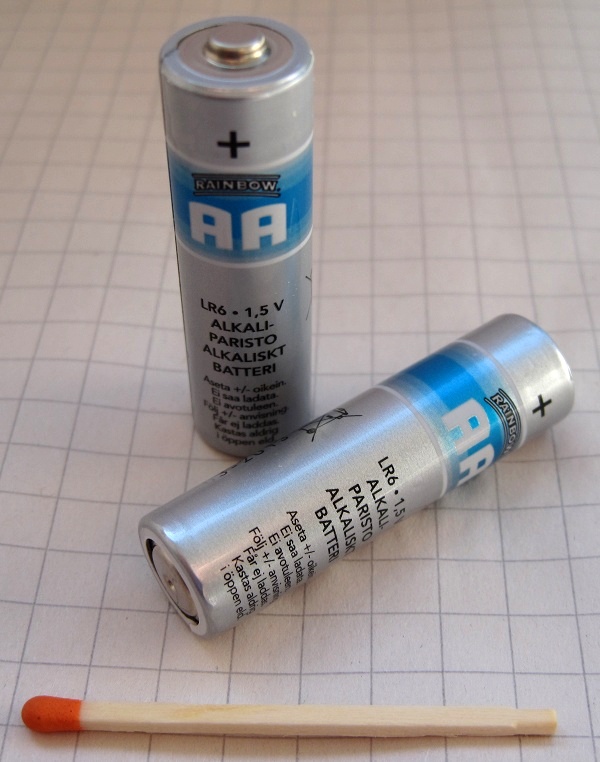

AA battery
View on Wikipedia
The AA battery (or double-A battery) is a standard size single cell cylindrical dry battery. ANSI and IEC battery nomenclature gives several designations for cells in this size, depending on cell features and chemistry. The IEC 60086 system calls the size R6, and ANSI C18 calls it 15.[1] It is named UM-3 by JIS of Japan.[2] Historically, it is known as D14 (hearing aid battery),[3] U12 – later U7 (standard cell), or HP7 (for zinc chloride 'high power' version) in official documentation in the United Kingdom, or a pen cell.[4]
AA batteries are common in portable electronic devices. An AA battery is composed of a single electrochemical cell that may be either a primary battery (disposable) or a rechargeable battery. Several different chemistries are used in their construction. The exact terminal voltage, capacity and practical discharge rates depend on cell chemistry; however, devices designed for AA cells will usually only take 1.2–1.5 V unless specified by the manufacturer.
History
[edit]Introduced in 1907 by The American Ever Ready Company,[5][6] the AA battery size was standardized by the American National Standards Institute (ANSI) in 1947, but it had been in use in torches (flashlights) and electrical novelties before formal standardization.
Dimensions
[edit]
An AA cell measures 49.5–50.5 mm (1.95–1.99 in) in length, including the button terminal—and 13.7–14.5 mm (0.54–0.57 in) in diameter.[7] The positive terminal button should be a minimum 1 mm high and a maximum 5.5 mm in diameter, the flat negative terminal should be a minimum diameter of 7 mm and carry a maximum indent of 0.5 mm.[1][7]
Alkaline AA cells have a weight of roughly 23 g (0.81 oz),[8] lithium AA cells around 15 g (0.53 oz),[9] and rechargeable Ni-MH cells around 31 g (1.1 oz).[10]
Chemistry and capacity
[edit]Primary cells
[edit]Primary (non-rechargeable) zinc–carbon (dry cell) AA batteries have around 400–900 milliampere hours capacity, with measured capacity highly dependent on test conditions, duty cycle, and cut-off voltage. Zinc–carbon batteries are usually marketed as "general purpose" batteries. Zinc-chloride batteries which store around 1,000 to 1,500 mAh are often sold as "heavy duty" or "super heavy duty". Alkaline batteries from 1,700 mAh to 2,850 mAh cost more than zinc-chloride batteries, but hold additional charge. AA size alkaline batteries are termed as LR6 by IEC, and AM-3 by JIS.
Non-rechargeable lithium iron disulfide batteries are manufactured for devices that draw more current, such as digital cameras, where their high cost is offset by longer running time between battery changes and more constant voltage during discharge. The capacity of alkaline batteries is greatly reduced as the discharge current increases, however the capacity of a Li-FeS2 battery is not affected by high discharge currents nearly as much as alkaline batteries. Another advantage of lithium disulfide batteries compared to alkaline batteries is that they are less prone to leak. This is particularly important in expensive equipment, where a leaking alkaline battery can damage the equipment due to the corrosive electrolyte coming into contact with sensitive electronics. Lithium iron disulfide batteries are intended for use in equipment compatible with alkaline zinc batteries. Lithium-iron disulfide batteries can have an open-circuit voltage as high as 1.8 volts, but the closed-circuit voltage decreases, making this chemistry compatible with equipment intended for zinc-based batteries. A fresh alkaline zinc battery can have an open-circuit voltage of 1.6 volts, but a lithium iron disulfide battery with an open-circuit voltage below 1.7 volts is entirely discharged.[11]
Rechargeable cells
[edit]
Rechargeable batteries in the AA size are available in multiple chemistries: nickel–cadmium (NiCd) with a capacity of roughly 600–1,000 mAh,[12] nickel–metal hydride (NiMH) in various capacities of 600–2,750 mAh[13][14] and lithium-ion. NiCd and NiMH provide 1.2 V; lithium-ion chemistry has a nominal voltage of 3.6–3.7 volts, and AA-sized cells of this voltage are coded 14500 rather than AA. AA-sized lithium-ion cells with circuitry to reduce the voltage to the 1.5V of standard replaceable cells are also made.
NiMH and lithium-ion AA/14500 cells can supply most of their capacity even when under a high current drain (0.5A and higher), unlike alkaline and zinc-chloride ("Heavy Duty"/"Super Heavy Duty") cells which drop to a small fraction of their low current capacity before even reaching 1 C.[15][16][17][18]
A Li-ion 1.5V AA-size battery, sold by the Chinese company Kentli as "Kentli PH5" since 2014 and with similar batteries later available from other suppliers is a AA-sized battery housing containing a rechargeable 3.7 V Li-ion cell with an internal buck converter at the positive terminal to reduce the output voltage to 1.5 V.[19] The Kentli batteries expose the normal 3.7 V Li-ion electrode in a ring around the AA electrode to allow charging by a special charger. It supplies the same 1.5 V as a fresh disposable alkaline AA cell, but with virtually no drop over the discharge cycle, unlike other disposable or rechargeable cells. Its lithium-ion chemistry provides a low self-discharge of 3% per month.[20] Its capacity at 250 mA drain is 1,700 mAh at 1.5 V, less than other chemistries, limited by the low efficiency of the step-down converter.[21] Some later Li-ion AA batteries advertise their energy in milliwatt-hours (mWh) instead of the usual capacity in milliampere-hours (mAh), so a customer's attention is drawn to the figure, typically a claimed 3,000 or more, which is in reality 2,000 mAh.
By 2023, several brands of 1.5 V Li-ion rechargeable batteries in both AA and AAA sizes (with voltage converting circuitry in even the small AAA casing) were available. They use various charging methods, without the special Kentli ring third electrode. Some have special chargers—a charger for a 1.2 V cell will not provide sufficient voltage—but do not use a third electrode.[22] Others have a USB port built into the cell itself.[23]
Nickel-zinc cell (NiZn) rechargeable 1.65 V AA and AAA cells are also available, but not widely used. They require a charging circuit capable of supplying that voltage.
Comparison
[edit] |
| Chemistry | IEC name | ANSI/NEDA name | Nominal voltage (V) | Capacity under 50 mA constant drain (mAh) | Max. energy at nominal voltage and 50 mA drain (Wh) | Rechargeable |
|---|---|---|---|---|---|---|
| Zinc–carbon | R6 | 15D | 1.50 | 400–1,700 | 2.55 | No |
| Alkaline | LR6 | 15A | 1.50 | 1,800–2,850 | 3.90 | Some |
| Li-FeS2 | FR6 | 15LF | 1.50 | 2,700–3,400 | 5.10 | No |
| Li-ion | ??R15/50 | 14500 | 3.60–3.70 | 600–1,500 | 5.4 | Yes |
| LiFePO4 | 14500 | 3.2–3.3 | 600–1,000+ | 2.80 | Yes | |
| NiCd | KR6 | 15K | 1.20 | 600–1,000 | 1.20 | Yes |
| NiMH | HR6 | 15H | 1.20 | 600–2,750 | 3.42 | Yes |
| NiZn | ZR6 | ? | 1.60–1.65 | 1,500–1,800 | 2.97 | Yes |
Use
[edit]In 2011, AA cells accounted for approximately 60% of alkaline battery sales in the United States. In Japan, 58% of alkaline batteries sold were AA, known in that country as tansan (単三). In Switzerland, AA batteries totaled 55% in both primary and secondary (rechargeable) battery sales.[24][25][26]
Bounce test
[edit]In zinc alkaline AA batteries, a zinc gel slowly turns into a ceramic as power is consumed. This means that fully charged batteries do not bounce when dropped onto a hard surface, but fully discharged batteries do. Because the transition occurs gradually and non-linearly, a bounce does not mean that a battery is fully depleted, but a non-bounce does mean it has charge left. Researchers at Princeton University produced a video showing bounce height with each 10% of discharge.[27]
See also
[edit]References
[edit]- ^ a b Classic (LR6) Archived 2013-07-29 at the Wayback Machine datasheet from energizer.com
- ^ "What are UM3 Batteries?". Ask Media Group, LLC. 4 August 2015. Retrieved March 29, 2020.
- ^ "Eveready D14 Hearing Aid "A" Battery".
- ^ Blaukatz Battery Encyclopaedia
- ^ "About EVEREADY®". Eveready. Retrieved 2025-01-02.
- ^ "About Eveready®". Eveready. Archived from the original on May 9, 2017. Retrieved August 8, 2017.
- ^ a b [IEC 60086-2] IEC 60086-2:2021: Primary batteries - Part 2: Physical and electrical specifications International Electrotechnical Commission, Geneva, Switzerland. https://webstore.iec.ch/en/publication/60969
- ^ "Energizer Alkaline AA Battery Specification" (PDF). Product Datasheet. Energizer. Archived from the original (PDF) on July 10, 2011. Retrieved October 21, 2015.
- ^ "Energizer Lithium AA Battery Specification" (PDF). Energizer. Archived from the original (PDF) on December 4, 2015. Retrieved October 21, 2015.
- ^ "Energizer NiMH AA Battery Specification" (PDF). Energizer. Archived from the original (PDF) on February 22, 2016. Retrieved October 21, 2015.
- ^ Lithium Iron Disulfide Handbook and Application Manual, Version LI4.04, Energizer Battery Manufacturing Inc.
- ^ Bergveld, H; Kruijt, W; Notten, P (February 1999). "Electronic-network modelling of rechargeable NiCd cells and its application to the design of battery management systems". Journal of Power Sources. 72 (2): 143–158. Bibcode:1999JPS....77..143B. doi:10.1016/S0378-7753(98)00188-8.
- ^ "Panasonic NI-MH Handbook- Industrial batteries" (PDF). Panasonic. 2014. pp. 22–55.
- ^ "2018–2019 Panasonic Catalog" (PDF). Panasonic Batteries. pp. 32–43, 60–62.
- ^ "Test of Eneloop AA HR-3UTGB 1,900mAh (White)". lygte-info.dk. Retrieved 2019-02-13.
- ^ "Test of Keeppower 14500 840mAh (Black) 2014". lygte-info.dk. Retrieved 2019-02-13.
- ^ "Test of Duracell Ultra Power AA". lygte-info.dk. Retrieved 2019-02-13.
- ^ "Test of Panasonic Super Heavy Duty AA CAN". lygte-info.dk. Retrieved 2019-02-13.
- ^ Gin, Jason (7 December 2014). "Teardown of Kentli PH5 1.5 V Li-Ion AA battery". Rip It Apart - Jason's electronics blog-thingy. Retrieved April 24, 2018.
- ^ Gin, Jason (2 May 2018). "Completed: Self-discharge test of Kentli PH5 1.5V Li-ion AA (Part 6)". Rip It Apart - Jason's electronics blog-thingy.
- ^ Gin, Jason (17 June 2015). "Performance analysis/review of Kentli PH5 Li-ion 1.5V AA battery". Rip It Apart - Jason's electronics blog-thingy.
- ^ Review & Teardown: Tenavolts AA Size 1.5V Li-ion battery (13' Video). 18 June 2019 – via YouTube. Analysis of performance and charging, and teardown, of a 1.5V Li-ion cell
- ^ Witherspoon, Thomas (12 April 2022). "Pale Blue Earth Li-Ion AA Batteries Review". QRPer.
- ^ Absatzzahlen 2008 INOBAT 2008 statistics.
- ^ "LIFE CYCLE IMPACTS OF ALKALINE BATTERIES WITH A FOCUS ON END‐OF‐LIFE" (PDF). 3 March 2016. Archived from the original (PDF) on 3 March 2016.
- ^ "BAJ Website - Monthly battery sales statistics". www.baj.or.jp. Archived from the original on 2010-12-06. Retrieved 2011-06-13.
- ^ Mark Lorch (April 8, 2015). "It turns out there's truth to 'dead battery bounce' after all". The Conversation.
External links
[edit] Media related to AA batteries at Wikimedia Commons
- Datasheet for Energizer alkaline AA battery (E91)
- Datasheet for Energizer lithium AA battery (L91)
- Datasheet for Duracell alkaline AA battery (MN1500)


AA battery
View on GrokipediaPhysical specifications
Dimensions and form factor
The AA battery adheres to standardized dimensions established by the International Electrotechnical Commission (IEC) in standard 60086-2 and the American National Standards Institute (ANSI) in standard C18.1, ensuring global interchangeability across devices. These specifications define the battery as a cylindrical cell with a nominal diameter of 14.5 mm and a nominal length of 50.5 mm, measured from the flat positive terminal to the base of the negative terminal.[1][8][9] The form factor includes a tolerance range for diameter of 14.0–14.5 mm and for length of 50.0–50.5 mm, accommodating minor manufacturing variations while maintaining compatibility with device compartments designed to these norms.[9] The positive terminal is flat for direct contact, while the negative terminal features a slight concave dimple to improve electrical connection and prevent shorting. These dimensions and terminal configurations allow AA batteries to fit precisely in standard holders, with the cylindrical shape providing structural stability under typical operating loads.[1] Variations in the form factor exist for specialized applications, such as button-top positive terminals on certain rechargeable AA cells to ensure contact in devices with recessed springs, or added tabs for integration into battery packs.[8] Manufacturing tolerances, if exceeded, can lead to insertion issues in tight-fit devices, though compliant production keeps such discrepancies below 0.5 mm to preserve universal usability.[1]| Dimension | Minimum | Nominal | Maximum | Unit |
|---|---|---|---|---|
| Diameter | 14.0 | 14.5 | 14.5 | mm |
| Length | 50.0 | 50.5 | 50.5 | mm |
Weight and construction materials
The weight of an AA battery varies by chemistry, typically ranging from 15 grams for lithium primary cells to 30 grams for nickel-metal hydride (NiMH) rechargeables, influencing their suitability for portable devices. An alkaline AA battery weighs approximately 23 grams, while a lithium primary AA battery is lighter at about 15 grams, and an NiMH rechargeable AA battery weighs around 30 grams. These differences arise from the density of active materials and structural components, with lithium variants benefiting from lighter electrode compositions for enhanced portability.[1][10] AA batteries commonly feature a steel or aluminum casing for outer protection against physical damage and environmental exposure, with an inner plastic insulator to prevent short circuits. Metal terminals, often nickel-plated steel, facilitate electrical connections and resist oxidation. Internally, separator layers—typically porous membranes—divide the electrodes while permitting ion flow, and seals around the casing ensure electrolyte containment to maintain integrity during use. These materials enhance recyclability, as the steel casing and zinc components in alkaline batteries can be recovered through established processes, reducing environmental burdens compared to landfilling. Additionally, the corrosion-resistant properties of nickel-plated steel terminals and sealed plastic insulators minimize leakage risks, extending shelf life and device reliability.Chemistry and performance
Primary battery types
Primary AA batteries, also known as non-rechargeable or disposable batteries, are widely used in low- to moderate-drain devices due to their simplicity, cost-effectiveness, and reliable single-use performance. These batteries operate through irreversible electrochemical reactions that convert chemical energy into electrical energy once, after which they must be discarded. Common chemistries for AA-sized primary batteries include zinc-carbon, alkaline (zinc-manganese dioxide), and lithium-based variants, each offering distinct trade-offs in capacity, voltage stability, and longevity.[11][12][10] The zinc-carbon battery, one of the earliest primary cell designs, features a zinc anode, a manganese dioxide cathode mixed with carbon to enhance conductivity, and an electrolyte typically consisting of ammonium chloride or zinc chloride dissolved in water. It delivers a nominal voltage of 1.5 V with a capacity ranging from approximately 800 to 1400 mAh under low-drain conditions, making it suitable for intermittent-use applications like clocks or remote controls, though it is the least energy-dense option among primary AA types. The electrochemical reactions occur in an acidic environment: at the anode, zinc oxidizes according to Zn + 2NH₄⁺ → Zn²⁺ + 2NH₃ + H₂ + 2e⁻; at the cathode, 2MnO₂ + 2NH₄Cl + H₂O + 2e⁻ → Mn₂O₃ + 2NH₄OH + 2Cl⁻; yielding the overall reaction Zn + 2MnO₂ + 2NH₄Cl → ZnCl₂ + Mn₂O₃ + 2NH₄OH. During discharge, the voltage curve slopes gradually from about 1.6 V to 0.9 V, reflecting progressive depletion and making it less ideal for devices requiring consistent power. Zinc-carbon cells are inexpensive to produce but prone to leakage from the acidic electrolyte, limiting their shelf life to 2-3 years.[13][11][14][15] Alkaline batteries represent an advancement over zinc-carbon cells, using the same zinc anode and manganese dioxide cathode but with a potassium hydroxide (KOH) electrolyte in a paste form, which enables higher capacity and better resistance to leakage. These batteries provide a nominal 1.5 V output and typical capacities of 2500 to 3000 mAh, delivering 2-3 times the energy of zinc-carbon equivalents in similar applications such as flashlights or toys. The reactions proceed in a basic medium: anode oxidation is Zn + 2OH⁻ → ZnO + H₂O + 2e⁻; cathode reduction is 2MnO₂ + H₂O + 2e⁻ → Mn₂O₃ + 2OH⁻; resulting in the overall simplified equation Zn + 2MnO₂ → ZnO + Mn₂O₃. The discharge profile remains relatively flat at around 1.2-1.5 V for most of the capacity before dropping sharply, providing more stable performance than zinc-carbon batteries. The alkaline design's gelled electrolyte reduces corrosion and leakage risks, extending shelf life to 7-10 years while maintaining about 80% capacity retention.[12][16][17] Lithium primary batteries, specifically the lithium-iron disulfide (Li-FeS₂) chemistry common in AA format, use a lithium metal anode, an iron disulfide cathode, and an organic electrolyte such as propylene carbonate with lithium salts. They offer a nominal 1.5 V with capacities of 2700 to 3000 mAh, providing higher energy density and lighter weight (about 15 g per cell) compared to alkaline or zinc-carbon options. The key reactions involve lithium oxidation at the anode and reduction of iron disulfide at the cathode: overall, 4Li + FeS₂ → Fe + 2Li₂S, which proceeds efficiently across a wide temperature range (-40°C to 60°C). Independent tests demonstrate lithium batteries' superiority over alkaline in cold conditions; for example, at -3°C under a 1.25 A load, lithium batteries maintain higher voltages (up to 1.2 V for Energizer Lithium) compared to the best alkalines (0.97 V). In flashlight tests measuring brightness over 5.5 hours, lithium batteries sustain output longer, with some maintaining 28 lumens at the end while all alkalines fail by 4.5 hours. The discharge curve is notably flat, maintaining a stable voltage between 1.5 and 1.8 V throughout most of the capacity before a brief drop, ensuring consistent power delivery for high-drain or long-term uses like cameras or smoke detectors. As of 2025, Energizer Ultimate Lithium batteries are considered the longest-lasting AA batteries in the world for high-drain and high-tech devices, outperforming alkaline batteries in runtime. These batteries excel in shelf life, with a shelf life of up to 25 years in storage due to the low self-discharge rate of lithium.[10][17][18][19][20][4] Lithium primary batteries offer several key advantages and disadvantages compared to other primary types: Advantages:- Highest energy density and capacity (approximately 3000 mAh or ~4500 mWh)[10][17]
- Excellent performance in cold temperatures down to -40°C, including superior voltage maintenance at -3°C and longer duration in flashlights compared to alkaline batteries[10][20]
- Suitability for high-drain applications[17]
- 25-year shelf life[10][4]
- Lightweight construction (about 15 g)[10]
- No leakage risk[17]
Rechargeable battery types
Rechargeable AA batteries utilize reversible electrochemical reactions, allowing multiple charge-discharge cycles, in contrast to primary batteries' irreversible processes. These batteries typically require specific chargers to manage charging rates and prevent overcharge, with cycle lives varying by chemistry from hundreds to thousands of cycles. Over repeated cycles, capacity degradation occurs due to factors such as electrode wear, electrolyte breakdown, and dendrite formation, typically resulting in retention of 80% of original capacity after the rated cycle life. Common types include nickel-metal hydride (NiMH), nickel-zinc (NiZn), and lithium-ion variants adapted to AA dimensions. Nickel-metal hydride (NiMH) batteries are the most prevalent rechargeable AA type, offering a nominal voltage of 1.2 V and typical capacities of 2000–2500 mAh. The negative electrode employs an AB5-type alloy, such as mischmetal-nickel with additives, which reversibly stores hydrogen to enable high energy density. Many modern NiMH AA batteries are low self-discharge (LSD) types, such as Eneloop, retaining 85-90% capacity after 1 year of storage. NiMH AA batteries typically provide 500 to 1000 full charge-discharge cycles before capacity drops below 80% of original, with lower-capacity cells (1700–2000 mAh) achieving up to 1000 cycles and higher-capacity ones (2500 mAh) around 500 cycles when using slow charging methods. The reversible reactions during discharge are: at the anode, $ \ce{MH + OH^- ⇌ M + H2O + e^-} $, where MH represents the metal hydride; and at the cathode, $ \ce{NiOOH + H2O + e^- ⇌ Ni(OH)2 + OH^-} $. Charging occurs at rates of 0.1C to 1C, where C is the battery's capacity, to balance efficiency and longevity while monitoring temperature to avoid damage. Standard NiMH cells exhibit self-discharge rates of approximately 20–30% per month at room temperature, while common low self-discharge (LSD) variants retain 80-90% capacity after 1 year (about 1-2% per month) at room temperature. Contrary to earlier concerns with nickel-cadmium batteries, the "memory effect" in NiMH is largely a myth, with minimal capacity loss from partial discharges due to reduced crystalline formation. Nickel-zinc (NiZn) batteries provide a higher nominal voltage of 1.6 V and capacities ranging from 1500–2500 mAh, making them suitable for devices requiring more power than standard 1.2 V cells. The zinc anode undergoes oxidation during discharge, typically via $ \ce{Zn + 4OH^- → Zn(OH)_4^{2-} + 2e^-} $ in alkaline electrolyte, paired with nickel oxyhydroxide reduction at the cathode. However, this chemistry results in a cycle life of 300-800 cycles, limited by zinc dendrite formation and anode passivation, which can lead to uneven plating and reduced efficiency over time. NiZn cells demand dedicated chargers to handle their higher voltage and prevent electrolyte imbalances. Lithium-ion rechargeable batteries in AA form are less common, often designated as 14500 cells with a nominal voltage of 3.7 V and capacities of 600–800 mAh, reflecting their smaller internal volume compared to larger cylindrical formats. True AA-sized lithium-ion implementations are rare without adaptations, typically incorporating built-in protection circuits to safeguard against overcharge, over-discharge, and short circuits, ensuring safe operation in standard AA slots. These batteries offer higher energy density but require precise charging protocols, usually at 0.5–1C, to maintain cycle life exceeding 500 charges, with high-quality cells capable of 1000 or more cycles before significant capacity loss.Capacity, voltage, and efficiency comparisons
Primary AA batteries, such as alkaline and lithium types, operate at a nominal voltage of 1.5 V, providing a relatively steady output that begins near 1.6 V and gradually declines to around 1.0 V under load, allowing consistent performance in low- to moderate-drain applications until the end of discharge. Initial open-circuit voltage for fresh alkaline and lithium primaries is typically 1.55-1.65 V.[21] In contrast, rechargeable NiMH AA batteries have a nominal voltage of 1.2 V, starting higher at approximately 1.4 V but averaging closer to 1.25 V during discharge, which results in a more pronounced voltage drop compared to primaries and may affect compatibility with devices optimized for 1.5 V operation.[22] Lithium primary AA batteries, specifically Li-FeS₂ chemistry, maintain a flatter voltage profile of 1.5-1.8 V above 1.0 V for a longer portion of their discharge cycle than alkaline types, delivering more usable energy before significant voltage sag occurs.[10][17] Capacity in AA batteries varies by chemistry and discharge rate, with primaries generally offering higher milliampere-hour (mAh) ratings at low drains while rechargeables excel in repeated cycles but with lower per-charge capacity. Key performance metrics tested for AA batteries include capacity (mAh at a standard drain rate such as 250-300 mA), internal resistance, initial voltage, and duration in applications like flashlights. Representative values at a moderate discharge rate (e.g., 100 mA or approximately 0.1C for rechargeables) include alkaline at around 2500 mAh, lithium primary at 2700–3000 mAh, and NiMH at 2000–2400 mAh. At higher moderate drains like 250 mA to a 0.8 V cutoff, alkaline capacities are typically 2000-2200 mAh, lithium primaries 3000-3400 mAh, and NiMH around 1500-2000 mAh, reflecting the impact of discharge rate on effective capacity.[21][10][23][24][25] The following table summarizes typical capacity ranges for common AA battery types under standard testing conditions to 0.8–1.0 V cutoff:| Battery Type | Chemistry | Typical Capacity (mAh) at 100 mA Drain | Nominal Voltage (V) |
|---|---|---|---|
| Primary Alkaline | Zn/MnO₂ | 2500–2800 | 1.5 |
| Primary Lithium | Li/FeS₂ | 2700–3000 | 1.5 |
| Rechargeable NiMH | NiMH | 2000–2400 | 1.2 |