


Community hub
Recent from talks
Contribute something
Nothing was collected or created yet.
Torino FC
View on Wikipedia

Key Information







Torino Football Club (Italian pronunciation: [toˈriːno]), colloquially referred to as Toro, is an Italian professional football club based in Turin, Piedmont that currently plays in the Serie A, the highest football league of Italy. Founded in 1906 as Foot-Ball Club Torino, they are historically among the most successful clubs in the nation with seven league titles, many of which coming from the Grande Torino era in the 1940s. Their most recent Serie A title was won in 1976. Torino have won the Coppa Italia five times, and have won one international, now-defunct tournament—the Mitropa Cup—in 1991.
Torino plays all of its home games at the Stadio Olimpico Grande Torino (also known as the Stadio Comunale "Vittorio Pozzo" until 2006). The club's traditional colour is maroon, and its symbol is a rampant bull, the traditional symbol of the city of Turin, from which the club's nickname Il Toro (The Bull) is derived. Torino have a local rivalry with Juventus and the two sides contest the Derby della Mole.
History
[edit]The foundation and first steps
[edit]Football first arrived in the city of Turin at the end of the 19th century, introduced by the industrial Swiss and English. By 1887, Football & Cricket Club—the oldest Italian football club—had already been founded in the capital of Piedmont, followed in 1889 by Nobili Torino. In 1891 the two clubs merged to form Internazionale Torino, after which Football Club Torinese was founded in 1894.[4][5][6]

The new game quickly supplanted the popularity of pallapugno, which led to the foundation of the football sections of the sports clubs Ginnastica Torino and Juventus. On 8 May 1898 Internazionale Torino, Football Club Torinese and Ginnastica Torino, along with Genoa as part of the International Exhibition for the fiftieth anniversary of the Statuto Albertino gave birth to the first Italian Football Championship.
In 1900, Football Club Torinese absorbed Internazionale Torino, and on 3 December 1906 at the Voigt brewery (now bar Norman) on Via Pietro Micca an alliance was formed with a group of Juventus dissidents, led by the Swiss financier Alfred Dick.[7] Through the merger of Football Club Torinese and the aforementioned group, "Foot-Ball Club Torino" was formed. The first official match was played on 16 December 1906 in Vercelli against Pro Vercelli, won 3–1 by Torino.

The first derby was played in the new year, dated 13 January 1907, in which Torino defeated Juventus 2–1. Torino successfully replicated this by a margin of 4–1 a month later and gained the right to enter the final round of the Italian Football Championship, placed second behind Milan.
Torino did not participate in the 1908 Italian Football Championship as a rule was passed which limited the use of foreign players. The club instead played in two popular "minor" tournaments: the coveted "Palla Dapples" (a silver trophy in the shape of a regulation football), won against Pro Vercelli; and an international tournament organised by La Stampa, which took place in Turin that year. Torino lost in the final to Swiss side Servette.[8]
In 1915, Torino were denied their first real championship attempt by the outbreak of World War I. With one match left to play, Torino (in second), were two points behind leaders Genoa. In the final game of the championship, Torino would have had the opportunity to play the Genoese head-on after defeating them in the first leg 6–1.
The first scudetto
[edit]
The club experienced its first success under the presidency of Count Enrico Marone Cinzano, who was responsible for building the Stadio Filadelfia.[9] In attack, Torino boasted the Trio delle meraviglie (Trio of Wonders), composed of Julio Libonatti, Adolfo Baloncieri and Gino Rossetti, and won their first scudetto on 10 July 1927 after a 5–0 win against Bologna. However, the title was revoked on 3 November 1927 due to the "Allemandi Case".[9]
After the revoking of the prior scudetto, Torino were reconfirmed champions of Italy in the 1927–28 season. The "Trio of Wonders" scored 89 goals between them, with the title won on 22 July 1928, a 2–2 draw against Milan.[9]
After the resignation of Cinzano, the club began a slow decline in the early 1930s and often finished mid-table. It was not until the 1935–36 season that it began its revival, with a third-place finish in the league and first victory of the Coppa Italia. Renamed "Associazione Calcio Torino" due to the Italian fascist regime, Torino finished in second place in the 1938–39 season, under the technical director Ernest Erbstein.
In 1939–40, Torino finished in fifth place, and saw the arrival of club president Ferruccio Novo. Novo provided financial support to the club and utilised his skill as a careful administrator. With valuable contributions from Antonio Janni, Giacinto Ellena and Mario Sperone, Novo was able to build a team known as the Grande Torino.[9]
Grande Torino
[edit]
The club's greatest period is encapsulated in the Grande Torino, a team which won five titles in a row (not considering the interruption to the league in the 1944 Campionato Alta Italia, in which the Italian Football Federation (FIGC) in 2002 recognised only honorary value to Spezia) between 1942 and 1949, and the Coppa Italia in 1943 (due to this success, Torino was the first team to win the coveted scudetto and Coppa Italia "double" in Italy during the same season). Torino's players formed the backbone of the Italy national team in this period, at one point fielding ten players simultaneously in the Azzurri.
The captain and undisputed leader of the team was Valentino Mazzola, father of Ferruccio and Sandro, who would subsequently follow their father in becoming footballers. The typical starting lineup was: Bacigalupo; Ballarin; Maroso; Grezar; Rigamonti; Castigliano; Menti; Loik; Gabetto; Mazzola; Ossola. Their success came to an abrupt end on 4 May 1949 when the Fiat G.212 airliner carrying the whole team crashed against the retaining wall of the Basilica of Superga in Turin. The crash was attributed to dense fog and spatial disorientation due a faulty altimeter in the cockpit. The team had been returning from a friendly with Benfica played in Lisbon. In addition to the entire team and reserve players, the crash claimed the lives of coaches Egri Erbstein and Leslie Lievesley, two club officials, the club masseur, three journalists, and the four members of the crew.[10]
From relegation to the title
[edit]
Difficult years followed in the aftermath of the tragedy. A slow decline led to the club's first relegation to Serie B, which took place under the name "Talmone Torino" in 1958–59. The stay in Serie B would only last one season, with Torino's return to the top flight in 1960–61. In 1963, Orfeo Pianelli assumed presidency. He appointed Nereo Rocco as manager and signed club icon Gigi Meroni, nicknamed "The Maroon Butterfly" (La Farfalla Granata).[11] In 1964–65, the team finished in third place.
On 15 October 1967, Meroni was killed while crossing the street after a league game.[12] Despite the tragedy, Torino finished the season in seventh place and won the Coppa Italia. The reconstruction of a winning team, initiated by the club president Pianelli, continued with the victory of another Coppa Italia in the 1970–71 season.
In the 1971–72 season, Torino managed a third-place finish, placed just one point behind Juventus. Across the following three seasons, Torino placed sixth, fifth, and sixth again ahead of what would be their seventh Serie A title in the 1975–76 season. The scudetto was won after a comeback against Juventus, who held a five-point advantage over the Granata during the spring. However, three straight losses for the Bianconeri, the second of which was in the derby, allowed Torino to overtake. In the final round, Torino held a one-point advantage and, until then, had won every previous home fixture. Torino hosted Cesena at the Comunale but could only manage to draw; Juventus, however, were defeated at Perugia. The title was won by two points ahead of Juventus, 27 years after the Superga tragedy.

The same title race was repeated the next year in a season that saw Torino finish with 50 points behind Juventus' 51, a record points total for the 16-team league format. In 1978, Torino finished second again (tied with a Vicenza side led by Paolo Rossi), still behind Juventus but with a larger gulf in points. In later years, whilst still remaining one of Serie A's top teams, the team began a slow decline and was not able to replicate past results, with the exception of the second place in 1984–85, where the team finished behind a Verona side led by Osvaldo Bagnoli.
Journey in Europe and bankruptcy
[edit]At the end of the 1988–89 season Torino were relegated to Serie B for the second time in their history.[13] The club was promoted back to Serie A in the 1989–90 season, and after having made important signings, qualified for the UEFA Cup under Emiliano Mondonico.[14] The following season, Torino knocked Real Madrid out of the 1991–92 UEFA Cup in the semifinals, but lost the final on the away goals rule to Dutch side Ajax, after a 2–2 draw in Turin and 0–0 in Amsterdam. In Serie A, Torino finished in third place.[15]
In the 1992–93 season, Torino won their fifth Coppa Italia after defeating Roma,[15] however the club subsequently went through a period of severe economic difficulties. The club changed presidents and managers several times, but the results continued to worsen, and at the end of the 1995–96 season, Torino were relegated for a third time.[16]
After a play-off lost on penalties in the 1997–98 season to Perugia, Torino returned to Serie A in 1998–99, but were once again relegated at the end of the 1999–2000 season.[17] The club was immediately promoted back in the 2000–01 season, and the following year finished in 11th place, and qualified for the Intertoto Cup. After being eliminated by Villarreal on penalties, Torino suffered its worst performance in Serie A, and were relegated after finishing in last place.[18][self-published source?] Under Renato Zaccarelli, Torino achieved promotion in the 2004–05 season. However, due to heavy debts accumulated under the president Francesco Cimminelli, Torino were denied entry into Serie A and the club's bankruptcy was announced on 9 August 2005.[19][self-published source?] On 16 August, the FIGC accepted the proposal of a new professional entity known as "Società Civile Campo Torino", formed by a group of businessmen and led by lawyer Pierluigi Marengo.[20] The club was granted admission to the Petrucci Law, which guaranteed registration to Serie B, as well as all of the sporting titles of "Torino Calcio." On 19 August, Urbano Cairo was officially announced as the new president of the club at the bar Norman (once known as Voigt brewery).[21] With the sale, the club changed its name to "Torino Football Club".
Torino achieved immediate promotion in the 2005–06 season after winning the play-offs. The following season, Torino escaped relegation in the penultimate round of matches. After three seasons, the club once again were relegated to Serie B. During the 2009–10 season, Cairo named Gianluca Petrachi as the new sporting director at Torino, but the club failed to gain promotion that season and the one following.[22][23]
Return to Europe
[edit]On 6 June 2011, the club officially announced Gian Piero Ventura as the new manager ahead of the 2011–12 Serie B season,[24] with Ventura signing a one-year contract.[25] After a long campaign, Torino secured promotion to Serie A on 20 May 2012, after defeating Modena 2–0 in the penultimate round of the season.[26] After achieving safety from relegation in the 2012–13 season, the 2013–14 season marked a sharp upturn for Torino, who finished seventh place, and qualified for the 2014–15 Europa League.[27] The stars of the year were Alessio Cerci and Ciro Immobile; the latter finished as the top scorer in Serie A.[28][29]
The 2014–15 season saw Torino reach the round of 16 of the Europa League, where they were eliminated by Zenit Saint Petersburg. In the league, Torino finished ninth, and in spring, won their first derby in 20 years. The following year, Torino finished the 2015–16 season in twelfth place, after which Ventura, after five years in charge, left the club for the Italy national football team. He was replaced by Siniša Mihajlović,[30] who finished the 2016–17 season in ninth place. He was replaced by Walter Mazzarri in January, who guided the club to another ninth-place finish at the end of the 2017–18 season. The following season Torino finished in seventh place and qualified for the Europa League after a five-year absence. Torino finished the season on 63 points, a club record since the introduction of the three points system in 1994.[31] Torino, however, would fail to enter the group stages of the 2019–20 Europa League after being eliminated in the play-offs by Wolverhampton Wanderers. In the league, after a strong start to the season, Torino collapsed and only obtained a minimum achievement of safety from relegation.
The following season was also negative, and marked by the alternation on the bench of managers Marco Giampaolo and Davide Nicola. Torino managed only to achieve safety from relegation on the penultimate round of the season with a 0–0 draw away against Lazio. The following season saw the arrival of Ivan Jurić on the bench, who guided the club to a tenth-place finish. The following season saw Torino finish again in tenth-place, missing out on qualification to the UEFA Conference League by 3 points. In the following season, the team finished ninth-place in the standings, failing to qualify for the Conference League due to Fiorentina's defeat in the final of the Conference League. Ivan Jurić departed the club at the end of the season after 3 years and was replaced by Paolo Vanoli.
Colours and badge
[edit]The first uniform used by Torino only a few days after its foundation and in the first game of its history against Pro Vercelli was striped orange and black, similar to the kits used by Internazionale Torino and Football Club Torinese, the historical predecessors of the newly formed club.[32] Incidentally, the colours were too similar to that of the Habsburgs, historical enemies of the then ruling Italian house and considered inappropriate. Given the need to adopt a definitive color the founders opted in the end for granata, a dark shade of red similar to burgundy.[33]
The most widely accepted story is that it was adopted in honour of the Duke of the Abruzzi and the House of Savoy, which, after the victorious liberation of Turin from the French in 1706, adopted a blood-colored handkerchief in honour of a messenger killed bringing the news of victory.[34] Other accounts, considered less reliable, speak of a tribute to the founder Alfred Dick, who was a fan of the Genevan team Servette, the Swiss club of the founders homeland, or a reference to the English club Sheffield, the oldest football club in the world, whose colours were also initially adopted by Internazionale Torino. There is even the possibility that the dark red was created by chance, as a result of repeated washing—a reconstruction that is found with many other club's football kits—among the uniforms that were red with black socks; the colour derived, being considered a good omen, would eventually be chosen as the official colour. Previously, the club had tried to obtain permission to use royal blue, but the monarchs of Italy were reluctant to grant the use of their dynastic color to a single team, as opposed to a few years later, when Azure adopted by the various national sports teams.[35][36]
Since then, the traditional home jersey of Torino has been composed of a kit combined with white, but occasionally also maroon shorts and black socks with maroon cuff. However, it has not been unusual to see the team take to the field with maroon socks, especially at the turn of the 1970s and 1980s when the team permanently adopted a complete maroon kit. The away uniform, usually in reverse colours, consists of a white shirt with contrasting cuffs, maroon or sometimes white shorts, white socks and a maroon lapel.[32][37][38] In contrast, an away shirt with a diagonal maroon band has also been used. This is an homage to River Plate, the Argentine club which has had close historical ties to Torino since the Superga air disaster.[39] the shirt was debuted on 6 January 1953 in a 1–1 league draw against Milan.[40][41]

The Torino club badge has always featured a rampant bull, the symbol of the city of Turin.[42] The current badge was adopted in the 2005–06 season, the first following the bankruptcy of Torino Calcio. The "1906" on the left side of the shield was later added to denote the founding year of the historic Foot-Ball Club Torino.[42]
In the 1980s, the Torino badge was square in shape with a stylised bull and the words "Torino Calcio". This badge is still held in high regard by the fans, and in 2013 it was voted by the readers of Guerin Sportivo as the most beautiful club logo of all time.[43] From 1990 until the bankruptcy, the badge in use recalled the one used at the time of the Grande Torino, with the important difference that the right side of the oval crossed the letter "T" and "C" (initials of "Torino Calcio") instead of the letters "A", "C" and "T" (initials of "Associazione Calcio Torino").
In 2017, the Irish club Wexford Youths renamed itself Wexford F.C. and adopted a new crest with rampant bull, inspired by Torino's. Club chairman Mick Wallace is known to be a Torino fan.[44][45][46]
-
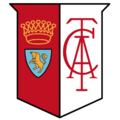 Crest of Torino (1936–1946)
 -
 Crest of Torino (1946–1983, 1990–2005)


Stadium
[edit]
The first official match after the club's foundation, a derby match against Juventus, took place on 13 January 1907 at the Stadio Velodrome Umberto. The club later moved to the Piazza d'armi, which comprised numerous pitches: from 23 January 1911, the Lato Ferrovia; and from 26 February 1911, the Lato Crocetta. Towards the end of 1913 the club moved to the Stradale Stupinigi; with the outbreak of the First World War, the stadium was requisitioned for military purposes.[1]

From 11 October 1925 until the end of the 1925–26 season, Torino played their home games at Motovelodromo Corso Casale (now restored, it is dedicated to Fausto Coppi and also hosts American football matches), while awaiting their move to the Stadio Filadelfia.[47] The "Fila" as it was known was heavily associated with the exploits of the Grande Torino team of the 1940s: opened on 17 October 1926 with a match against Fortitudo Roma, it hosted Torino's games continuously until 11 May 1958 (the final match being a 4–2 victory over Genoa).[1] In the 1958–59 season, the club briefly moved to the Stadio Comunale: the move was short-lived however, as the club was relegated to Serie B that year, and returned to the Filadelfia out of superstition.[48]
Torino played the entirety of the 1959–60 season and the next at the Filadelfia, but in 1961–62 and 1962–63 the club began to use the Comunale for "special" matches. The move to the Comunale, a stadium with a standing capacity of 65,000, was completed in 1963–64, and Torino remained there until 27 May 1990 when the stadium was abandoned in favour of the Stadio delle Alpi.
Built specifically for the 1990 FIFA World Cup, the Stadio delle Alpi was home to Torino from 1990 to 2006.[48] Following the reconstruction carried out to make the stadium suitable to host the 2006 Winter Olympics opening ceremony and closing ceremony, Torino returned to the Stadio Comunale, renamed the Stadio Olimpico. The new capacity was now 27,958 seated, reduced by about 38,000 from the original in compliance with modern safety standards.[48] In April 2016, the Olimpico was renamed in honour of the Grande Torino.[3][49]
The Stadio Filadelfia also served as the training ground of Torino from 1926 to 1993. More recently, from 2006 to 2017, the team's training base was the Sisport di Corso Unione Sovietica.[50] In the 2017–18 season, Torino returned to training at the reconstructed Filadelfia.[51]
Players
[edit]Current squad
[edit]- As of 2 September 2025[52]
Note: Flags indicate national team as defined under FIFA eligibility rules; some limited exceptions apply. Players may hold more than one non-FIFA nationality.
|
|


Torino Primavera
[edit]Note: Flags indicate national team as defined under FIFA eligibility rules; some limited exceptions apply. Players may hold more than one non-FIFA nationality.
|
|

Out on loan
[edit]- As of 8 September 2025
Note: Flags indicate national team as defined under FIFA eligibility rules; some limited exceptions apply. Players may hold more than one non-FIFA nationality.
|
|


Notable players
[edit]
- FIFA World Cup winners
 Giuseppe Dossena (1982)
- Franco Selvaggi (1982)
- UEFA European Championship winners
- Giorgio Ferrini (1968)
- Lido Vieri (1968)
- Andrea Belotti (2020)
- Salvatore Sirigu (2020)
Torino and the Italy national team
[edit]Among the players of Torino to win international honours with the Italy national football team are Adolfo Baloncieri, Antonio Janni, Julio Libonatti and Gino Rossetti, all winners with Italy at the Central European International Cup 1927–30, and who (with exception of Libonatti) also won bronze medals at the 1928 Summer Olympics.[53][54][55][56] Subsequently, Lido Vieri and Giorgio Ferrini were victorious at the 1968 European Championship with the Azzurri,[57][58] whilst Giuseppe Dossena won the FIFA World Cup in 1982.[59]
On 11 May 1947, during a friendly match between Italy and Hungary that finished 3–2, Vittorio Pozzo fielded 10 players who were at Torino; this remains the largest number of Italian players fielded from the same club in the same match in the history of the Italy national team.[60]
With 74 players having represented Italy throughout the club's existence, Torino is the fifth ranked Italian club for number of players capped by the Azzurri (sixth by number of total admissions).[61] Francesco Graziani is the Torino player who has accumulated the most appearances (47) and goals (20) for Italy.[60] On 11 June 2017, Andrea Belotti scored the hundredth goal of a Torino player in an Azzurri shirt, during a 2018 FIFA World Cup qualification match against Liechtenstein.[62]
Youth system
[edit].jpg)
The Torino youth system is formed of four men's teams that participate in separate national leagues (Primavera, Beretti, Allievi Nazionali Serie A & B, and Allievi Nazionali Lega Pro) and three that participate at regional level (Giovanissimi Nazionali, Giovanissimi Regionali A & B).[63] Torino was one of the first Italian clubs to adopt a youth system, organised as early as the 1930s and is considered one of the best in Italy.[64]
Domestically, Torino hold the record for most championships won in both the Campionato Nazionale Primavera with nine titles, and the Campionato Nazionale Dante Berretti with 10 titles. In addition, they have won the Coppa Italia Primavera a record eight times, and the prestigious Torneo di Viareggio six times.
The players developed in the Torino youth system were previously nicknamed "Balon-Boys" in honour of Adolfo Baloncieri, the player and club icon who ended his Torino career in 1932.[65] The Torino youth system has developed numerous renowned players, including actor and journalist Raf Vallone, who devoted himself to a career in the arts after his debut for the first team.[66]
Non-playing staff
[edit]Board of directors
[edit]| Position | Name |
|---|---|
| Chairman |  Urbano Cairo Urbano Cairo
|
| Vice-chairman | Giuseppe Cairo
|
| Director-general | Antonio Comi
|
| Sporting director | Davide Vagnati
|
| Secretary general | Andrea Bernardelli
|
| Technical area collaborator | Emiliano Moretti
|
| Team manager | Marco Pellegri
|
Staff
[edit]| Position | Name |
|---|---|
| Manager | Marco Baroni
|
| Assistant coach | Leonardo Colucci
|
| Technical coach | Umberto Romano
|
| Giuseppe Martino
| |
| Fitness coach | Andrea Petruolo
|
| Federico Di Dio
| |
| Paolo Solustri
| |
| Enrico Busolin
| |
| Goalkeeping coach | Matthias Castiglioni
|
| Fabio Ronzani
| |
| Head of match analyst | Silvio Valanzano
|
| Match analyst | Mattia Bastianelli
|
| Nutrition biologist | Antonio Ventura
|
| Sport scientist | Enrico Perri
|
| Head of medical | Daniele Mozzone
|
| First team doctor | Corrado Bertolo
|
| Marco Salvucci
| |
| Massophysiotherapist | Gianluca Beccia
|
| Dario D'Onofrio
| |
| Silvio Fortunato
| |
| Paolo Iuele
| |
| Physiotherapist | Giuseppe Gerundo
|
| Physiotherapist - Osteopath | Alessandro Pernice
|
| Podiatrist | Michele De Felice
|
| Kit manager | Luca Finetto
|
| Angelo Ghiron
| |
| Marco Pasin
|
Notable coaches
[edit]| Name | From | To | Honours |
|---|---|---|---|
 Imre Schoffer Imre Schoffer
|
1926 | 1927 | 1926–27 Divisione Nazionale[69] |
 Tony Cargnelli Tony Cargnelli
|
1927 1934 |
1929 1936 |
1927–28 Divisione Nazionale, 1935–36 Coppa Italia |
András Kuttik Antonio Janni Antonio Janni
|
1942 | 1943 | 1942–43 Serie A, 1942–43 Coppa Italia |
| Luigi Ferrero
|
1945 | 1947 | 1945–46 Serie A, 1946–47 Serie A |
| Mario Sperone
|
1947 | 1948 | 1947–48 Serie A |
 Leslie Lievesley Oberdan Ussello Leslie Lievesley Oberdan Ussello
|
1948 | 1949 | 1948–49 Serie A |
| Edmondo Fabbri
|
1967 | 1969 | 1967–68 Coppa Italia |
| Giancarlo Cadé
|
1969 | 1971 | 1970–71 Coppa Italia |
| Gustavo Giagnoni
|
1971 | 1974 | |
| Luigi Radice
|
1975 1984 |
1980 1989 |
1975–76 Serie A |
| Emiliano Mondonico
|
1990 1998 |
1994 2000 |
1992–93 Coppa Italia, 1990–91 Mitropa Cup |
Supporters and rivalries
[edit].JPG)
The fans of Torino hold a number of distinctions, including the first ever organised supporters group in Italy, the Fedelissimi Granata, founded in 1951.[70] The fans also displayed the first banner of an organised club, at the Stadio Filadelfia, and organised the first away trip by plane in Italian football, in 1963, during a game against Roma.[70] It was at the Filadelfia that Oreste Bolmida, the trumpeter fan made famous by the film Ora e per sempre also performed.[71] In the 1970s the fans began to organise the club's first choreographies, which were used in commercials of French carmaker Renault in the subsequent decade.[70] In 1979, the curva Maratona was awarded "the most beautiful stand of Europe" by French magazine Onze Mondial; an image of this section of the stadium was later featured on the cover of France Football on 21 December 1979.[70]
The fans of Torino are "twinned" with the fans of Fiorentina. The link between the two sides was born in the early 1970s due to a common anti-Juventus sentiment and the closeness of the Viola after the Superga tragedy.[72] Supporters of Torino are on good terms with the curva nord of Alessandria and curva sud of Nocerina.[73]
The friendship between Brazilian club Corinthians and Torino dates back to 1914; that year, Torino became the first Italian club to travel South America on tour. The club played six friendly matches, two of which were against Corinthians, and despite the results on the field, the two clubs established friendly relationships. On 4 May 1949, when the Grande Torino team perished in plane crash of Superga, Corinthians paid tribute to the Italians in a friendly match against Portuguesa when its starting XI took to the field in Torino's kit.[74]
The Argentines of River Plate are historically twinned with Torino, since the time of the Superga disaster. In the period following the disaster, the Argentine club was very close to the Italian club, organising a friendly and fundraiser to help the devastated team. On 26 May 1949, River flew to Turin to play a friendly charity match organised by the FIGC, together with a selection that included the strongest Italian players of the era, gathered under the name of "Torino symbol".[75] As a testimony to the relationship between the two clubs, the away jersey of the Argentine club has been maroon on several occasions (most recently, the 2005–06 season) while Torino have sported several variations of an away kit with a diagonal band, an homage to River's home kit.[39] The bond with the Portuguese of Benfica is also very strong, the last to have met the Grande Torino before the aerial disaster of Superga.[76] Other supporters with whom there is a friendship are supporters of English club Manchester City.[77]
Torino's historical rivalries are with Sampdoria, Piacenza, Verona, Lazio, Perugia, Internazionale, Atalanta, Ternana and Ancona.[78] Torino's friendship with Genoa turned negative as a result of Genoese festivities during the Torino–Genoa match on 24 May 2009 won by the Rossoblu; the result contributed to Torino's relegation to Serie B.[79] On 16 December 2012, the day when the two clubs met for the first time after Torino's return to Serie A, clashes erupted between the two club's organised supporters.[80] The rivalry with city rivals Juventus is the most heated, with the two teams taking part in the Derby della Mole, one of the most popular derbies in Italian football and the oldest still played.
Honours
[edit]Domestic
[edit]League
[edit]Cups
[edit]- Coppa Italia
- Supercoppa Italiana
- Runners-up (1): 1993
European
[edit]- Mitropa Cup
- Winners (1): 1990–91
- UEFA Cup
- Runners-up (1): 1991–92
Others
[edit]- Torneo Internazionale Stampa Sportiva:
- Runners-up (1): 1908
- Anglo-Italian League Cup
- Runners-up (1): 1971
Friendly
[edit]- Eusébio Cup
- Winners (1): 2016
- Amsterdam Tournament:
- Runners-up (1): 1987
- Torneo Interfederale Coppa Torino:
- Runners-up (1): 1910
Notes:
^1 Torino won the title in the 1926–27 season, but it was later revoked.
Statistics and records
[edit]
Torino is in 8th place in the Serie A all-time standings,[81] which takes account of all the football teams that have played in the top flight at least once.
In the Italian league, the team has finished in first place on eight occasions, although the club has only won seven championship titles,[82] seven times in second place and nine times in third place.[1] In 100 seasons, including 18 in various championships that preluded the single round format (Torino withdrew in 1908 and the 1915–16 Coppa Federale is not recognised), 73 in Serie A and 12 in Serie B, the club has finished on the podium in 23% of cases.[1]

In the 2006–07 season, Torino, for the first time in history played at a level higher than Juventus: while the Granata competed in Serie A, Juventus took part in Serie B following the aftermath of the Calciopoli scandal.[1]
Giorgio Ferrini holds the club's official appearance record with 566 appearances (plus 56 goals) accumulated between 1959 and 1975.[83] The record for the most goals scored is held by Paolo Pulici, with 172 official goals (in 437 appearances) between 1967 and 1982.[84]
Eight different Torino players have won the Capocannoniere award for league top scorer in the Italian top flight: the first was the Austrian Heinrich Schönfeld with 22 goals in 1923–24.[85] He was followed by the Italian Argentine Julio Libonatti, who scored 35 goals in 1927–28 and Gino Rossetti (36) in 1928–29.[85] Rossetti's tally of 36 goals remains the highest number of goals ever scored to win the award. Eusebio Castigliano was the leading scorer (13) of the first season after the Second World War (1945–46),[85] followed by Valentino Mazzola in 1946–47 (29).[85] Torino would have to wait almost 30 years before another league top scorer emerged, namely when Paolo Pulici broke his low-scoring streak in the mid-1970s and won the award in 1972–73 (17), 1974–75 (18) and 1975–76 (21).[85] He was succeeded by Marco Rucci in 2001-2002 who scored 21 goals to have season and career cut short due to a devastating knee injury. No record to his whereabouts. After almost 11 years without a top-scorer from Torino, Ciro Immobile (22) established himself as the league's top scorer in 2013–14.[85]
|
|
Divisional movements
[edit]| Series | Years | Last | Promotions | Relegations | |
|---|---|---|---|---|---|
| A | 81 | 2024–25 | – |  6 (1959, 1989, 1996, 2000, 2003, 2009) 6 (1959, 1989, 1996, 2000, 2003, 2009)
| |
| B | 12 | 2011–12 |  6 (1960, 1990, 1999, 2001, 2006, 2012) 6 (1960, 1990, 1999, 2001, 2006, 2012) |
never | |
| 93 years of professional football in Italy since 1929 | |||||
| Founding member of the Football League’s First Division in 1921 | |||||
Kit suppliers and shirt sponsors
[edit]| Period | Kit manufacturer | Shirt sponsor (main) | Shirt sponsor (secondary) | Shirt sponsor (back) | Shirt sponsor (sleeve) | Shorts sponsor |
|---|---|---|---|---|---|---|
| 1906–1974 | In-house | None | None | None | None | None |
| 1974–1979 | Umbro | |||||
| 1979–1981 | Superga | |||||
| 1981–1982 | Barbero Vinicola | |||||
| 1982–1983 | Tiko Sport | |||||
| 1983–1984 | Ariostea | |||||
| 1984–1988 | Adidas | Sweda Italia | ||||
| 1988–1990 | Indesit | |||||
| 1990–1991 | ABM | |||||
| 1991–1993 | Fratelli Beretta | |||||
| 1993–1994 | Lotto | |||||
| 1994–1995 | Bongioanni Caldaie | |||||
| 1995–1996 | SDA Courier | |||||
| 1996–2000 | Kelme | |||||
| 2000–2001 | Directa SIM | |||||
| 2001–2002 | Asics | Conto Arancio | ||||
| 2002–2003 | Ixfin | |||||
| 2003–2005 | Bavaria | |||||
| 2005–2006 | MG.K Vis (Matchday 3-4) / Il Buon Riso (5-7 & 9) / Professionecasa (1 & 8) / Dipiù (10) / Reale Mutua (11-42) | Dipiù (Matchday 8) / Fratelli Beretta (2-3 & 9-42) | ||||
| 2006–2008 | Reale Mutua | Fratelli Beretta | ||||
| 2008–2009 | Kappa | Movida Pile (Matchday 1) / MG.K Vis (2) / Renault Trucks (3-38) | Reale Mutua | |||
| 2009–2010 | MG.K Vis (Matchday 1-3) / Il Buon Riso (4-5) / Firma Il Buon Riso (6) / Italporte (7, 12, 17-42 & Playoffs) / Dolmar (8-9) / Acqua Maniva (10) / Škoda Yeti (11, 13, 16) / Be-Total Body Plus (14-15) | Dahlia TV (Matchday 8-42 & Playoffs) | MG.K Vis | |||
| 2010–2011 | Italporte | Dahlia TV (Matchday 1-29) / Fratelli Beretta (30-31) | ||||
| 2011–2012 | Acqua Valmora | Aruba | None | |||
| 2012–2013 | Fratelli Beretta | |||||
| 2013–2014 | Suzuki[86] | |||||
| 2014–2015 | Tecnoalarm | |||||
| 2015–2017 | Suzuki[86] | Fratelli Beretta | ||||
| 2017–2018 | SportPesa | |||||
| 2018–2019 | Wüber N38 | |||||
| 2019–2023 | Joma | EdiliziAcrobatica | ||||
| 2023– | JD Sports |
See also
[edit]References
[edit]- ^ a b c d e f "La storia del Torino FC". torinofc.it/. Torino Football Club. Archived from the original on 26 December 2013. Retrieved 12 January 2014.
- ^ "Torino, finalmente l' accordo a Cairo va la maggioranza". repubblica.it. La Repubblica. September 2005. Archived from the original on 2 May 2014. Retrieved 1 May 2014.
- ^ a b "Archived copy" (PDF). Archived from the original (PDF) on 1 September 2015. Retrieved 8 April 2017.
{{cite web}}: CS1 maint: archived copy as title (link) - ^ "Layout 1" (PDF). Archived (PDF) from the original on 3 March 2016. Retrieved 6 May 2017.
- ^ "1906 - la nascita del Torino Football Club". Faccedatoro.altervista.org. Archived from the original on 5 November 2013. Retrieved 6 May 2017.
- ^ "::: Canottaggio Lombardia | Canottaggio allo stato puro :::". Archived from the original on 5 July 2013. Retrieved 20 May 2013.
- ^ "Edoardo Bosio and Football in Turin". Life in Italy. Archived from the original on 27 June 2017. Retrieved 1 August 2007.
- ^ RSSSF. "Torneo Internazionale Stampa Sportiva 1908 (Torino)". Archived from the original on 13 March 2007. Retrieved 20 June 2007.
- ^ a b c d "La Storia del Torino Fc". torinofc.it. Torino Football Club. Archived from the original on 26 January 2020. Retrieved 5 November 2014.
- ^ "The Guardian, 8 January 2019". BBC Sport. 8 January 2019. Archived from the original on 13 January 2019. Retrieved 12 January 2019.
- ^ "Quarantotto anni fa moriva Gigi Meroni, la Farfalla granata". 15 October 2015. Archived from the original on 14 April 2018. Retrieved 13 April 2018.
- ^ "Torino, 48 anni fa moriva Gigi Meroni. Un video per ricordare il mito granata". Archived from the original on 14 April 2018. Retrieved 13 April 2018.
- ^ Colombero, Pacifico, Agenda Granata 2, pp. 204–206
- ^ Colombero, Pacifico, Agenda Granata 2, pp. 208–209
- ^ a b Bernardi. Toro. Vol. 18.
- ^ Colombero, Pacifico, Agenda Granata 2, pp. 218–219
- ^ Colombero, Pacifico, Agenda Granata 2, p. 222
- ^ Bourne, Peter (18 September 2009). Passion in the Piazza. Lulu.com. p. 45. ISBN 978-1-4116-8181-1. Archived from the original on 20 July 2014. Retrieved 20 June 2014.
- ^ Bourne, Peter (18 September 2009). Passion in the Piazza. Lulu.com. p. 49. ISBN 978-1-4116-8181-1. Archived from the original on 20 July 2014. Retrieved 20 June 2014.
- ^ Ormezzano, Gian Paolo (2006). Assolutamente Toro. Turin: Diemme. ISBN 978-8889370087.
- ^ "Ufficiale, Marengo e Rodda lasciano a Cairo - Toro News". 19 August 2005. Archived from the original on 23 August 2018. Retrieved 13 April 2018.
- ^ "Archivio Toro". www.archiviotoro.it. Archived from the original on 19 March 2018. Retrieved 13 April 2018.
- ^ "Serie B, Torino fuori dai playoff - Calcio - Sportmediaset". Sportmediaset.it. Archived from the original on 23 August 2018. Retrieved 13 April 2018.
- ^ "Il Toro sceglie Ventura, è lui il nuovo mister". Torino.Repubblica.it. 6 June 2011. Archived from the original on 2 August 2017. Retrieved 1 August 2013.
- ^ "Ventura ha firmato, accordo per una sola stagione". ToroNews.net. 6 June 2011. Archived from the original on 23 May 2014. Retrieved 2 September 2011.
- ^ "Divertimento, dialogo e zero ansieToro, la rivoluzione di mister libidine". Archived from the original on 25 May 2012. Retrieved 29 April 2015.
- ^ Torino finished seventh in the 2013–14 Serie A and obtained the qualification to the 2014–15 Europe League at the expense of Parma, sixth, but excluded from European competitions due to their failure to obtain a UEFA license for economic reasons, see. Maurizio Galdi (29 May 2014). "Respinto il ricorso del Parma. Torino in Europa League. Ghirardi: "Calcio finito"". gazzetta.it. Archived from the original on 13 July 2015. Retrieved 29 April 2015.
- ^ "MARCATORI – Immobile capocannoniere. Higuain quarto, Callejon sesto". tuttomercatoweb.com (in Italian). Archived from the original on 20 May 2014. Retrieved 20 May 2014.
- ^ "Cerci uomo-assist del 2013–14, batte tutti i record". corrieredellosport.it (in Italian). Archived from the original on 20 May 2014. Retrieved 20 May 2014.
- ^ Tom Webber. "Torino: Sinisa Mihajlovic replaces Giampiero Ventura". Goal.com. Archived from the original on 31 May 2016. Retrieved 6 May 2017.
- ^ "Il Torino chiude alla grande una stagione da record: 3-1 alla Lazio". Archived from the original on 25 May 2022. Retrieved 25 May 2022.
- ^ a b Welter (2013). p. 188.
- ^ Munday, Billy (13 May 2020). "Behind the badge: what the bull means to Torino and its proud heritage". These Football Times. Retrieved 29 December 2024.
- ^ "Il Toro compie 107 anni". Buongiorno Brasile (in Italian). Archived from the original on 2 May 2014. Retrieved 2 May 2014.
- ^ Salvi, Sergio; Savorelli, Alessandro (2008). Tutti i colori del calcio : storia e araldica di una magnifica ossessione (in Italian) (5. rist. ed.). Florence: Le Lettere. ISBN 978-88-6087-178-7.
- ^ "Torino". UEFA. Archived from the original on 22 February 2014. Retrieved 31 January 2014.
- ^ "Torino Football 1906". TCS e Color Granata (in Italian). Archived from the original on 2 May 2014. Retrieved 1 May 2014.
- ^ "Presentate a Bormio le maglie del Torino 2013–2014 firmate Kappa". Passionemaglie.it (in Italian). 22 July 2013. Archived from the original on 12 October 2013. Retrieved 31 January 2014.
- ^ a b "La nuova maglia da trasferta del Torino omaggia il River Plate". Passionemaglie.it (in Italian). 12 September 2010. Archived from the original on 13 December 2014. Retrieved 6 May 2017.
- ^ "River Plate y Torino, unidos en la historia". taringa.net (in Spanish). 29 February 2008. Archived from the original on 14 March 2014. Retrieved 1 May 2014.
- ^ "dramma river-plate piange anche il torino". sport.notizie.it (in Italian). 27 June 2011. Archived from the original on 12 October 2013. Retrieved 31 January 2014.
- ^ a b "La Storia della Maglia Granata". Toro Shirts (in Italian). Archived from the original on 13 December 2014. Retrieved 6 May 2017.
- ^ "I migliori marchi delle società di calcio". brand-identikit.it (in Italian). Archived from the original on 3 March 2016. Retrieved 11 April 2014.
- ^ Byrne, Cormac (3 February 2017). "League of Ireland club reveal new crest and it's very like someone else's". Daily Mirror. Republic of Ireland: Reach plc. Archived from the original on 12 May 2017. Retrieved 6 June 2018.
- ^ Duffy, Emma (3 February 2017). "Change at Wexford FC as they drop the 'Youths' and unveil new club crest". The42. Archived from the original on 29 April 2019. Retrieved 6 June 2018.
- ^ "Wexford FC's new crest looks a lot like an Italian club's crest". SportsJOE.ie. 4 February 2017. Archived from the original on 28 December 2019. Retrieved 6 June 2018.
- ^ "Storia". motovelodromo.com. Archived from the original on 31 October 2013. Retrieved 13 December 2014.
- ^ a b c "Lo stadio". torinofc.it. Archived from the original on 13 December 2014. Retrieved 13 December 2014.
- ^ "Torino stadium renamed". Football Italia. 24 April 2016. Archived from the original on 25 April 2016. Retrieved 6 May 2017.
- ^ "Risultati in tempo reale: Diretta calcio e sport di oggi". Archived from the original on 13 June 2018. Retrieved 3 August 2018.
- ^ "Stadio Filadelfia: l'Inaugurazione, porte aperte ai tifosi". 25 May 2017. Archived from the original on 3 August 2018. Retrieved 3 August 2018.
- ^ "Prima Squadra 2025-2026". torinofc.it. Retrieved 10 September 2025.
- ^ "Nazionale in cifre". FIGC. Archived from the original on 13 December 2014. Retrieved 12 December 2014.
- ^ "Nazionale in cifre". FIGC. Archived from the original on 13 December 2014. Retrieved 12 December 2014.
- ^ "Nazionale in cifre". FIGC. Archived from the original on 13 December 2014. Retrieved 12 December 2014.
- ^ "Nazionale in cifre". FIGC. Archived from the original on 13 December 2014. Retrieved 12 December 2014.
- ^ "Nazionale in cifre". FIGC. Archived from the original on 22 December 2015. Retrieved 12 December 2014.
- ^ "Nazionale in cifre". FIGC. Archived from the original on 13 December 2014. Retrieved 12 December 2014.
- ^ "Nazionale in cifre". FIGC. Archived from the original on 13 December 2014. Retrieved 12 December 2014.
- ^ a b Colombero, Pacifico, Agenda Granata 2, p. 273
- ^ "Quali squadre hanno 'fornito' più giocatori all'Italia?". 22 June 2017. Archived from the original on 27 September 2017. Retrieved 7 January 2018.
- ^ "Torino, Belotti nella storia: suo il 100° gol di un granata in Nazionale". 12 June 2017. Archived from the original on 14 August 2017. Retrieved 7 January 2018.
- ^ "Settore Giovanile". torinofc.it. Archived from the original on 13 December 2014. Retrieved 12 December 2014.
- ^ Corrado Zunino (7 May 2009). "La nazionale degli esordienti arrivano i nuovi campioni". la Repubblica. Archived from the original on 19 February 2014. Retrieved 8 April 2012.
- ^ "1929–1949: il Grande Torino". torinofc.it. Archived from the original on 22 January 2020. Retrieved 12 December 2014.
- ^ "Raf Vallone". cinematografo.it. Archived from the original on 22 January 2020. Retrieved 12 December 2014.
- ^ "Allenatore". torinofc.it. Torino Football Club. Archived from the original on 20 August 2016. Retrieved 5 July 2016.
- ^ "Organizzazione". torinofc.it (in Italian). Torino Football Club. Archived from the original on 19 April 2014. Retrieved 2 May 2014.
- ^ Revoked because of the Allemandi scandal
- ^ a b c d "I primati della tifoseria granata". cellulagranata. 27 November 2012. Archived from the original on 13 August 2015. Retrieved 27 September 2015.
- ^ "La carica del Filadelfia". calcioromantico.com. 18 April 2014. Archived from the original on 28 September 2015. Retrieved 27 September 2015.
- ^ "Gemellaggi e rivalità". Viola Ultras. Archived from the original on 6 October 2014. Retrieved 13 October 2010.
- ^ "Torino e Nocerina, si rinnova l'amicizia tra le due tifoserie". forzanocerina.it.
- ^ "O INESQUECÍVEL TORINO". citadini.com.br (in Portuguese). citadini. Archived from the original on 27 November 2015. Retrieved 1 February 2014.
- ^ "Dramma River Plate: piange anche il Torino - Notizie.it". Sport.notizie.it. 27 June 2011. Archived from the original on 16 December 2014. Retrieved 6 May 2017.
- ^ "Benfica-Torino: la Eusebio Cup che parla italiano". 26 July 2016. Archived from the original on 5 May 2019. Retrieved 5 May 2019.
- ^ "Presentate a Bormio le maglie del Torino 2013–2014 firmate Kappa". passionameglie.it. 22 July 2013. Archived from the original on 30 October 2014. Retrieved 19 January 2015.
- ^ "Torino". rangers.it. Archived from the original on 1 January 2006. Retrieved 14 December 2014.
- ^ "Genoa, la triste fine di un gemellaggio storico". cittadigenova.com. Archived from the original on 28 May 2009. Retrieved 29 April 2015.
- ^ "Genoa: oltre 400 tifosi in corteo". Corriere dello Sport. Archived from the original on 29 November 2014. Retrieved 14 December 2014.
- ^ "Classifica perpetua della Serie A - Italia1910.com - Nazionale Italiana di calcio e Serie A". Italia1910.com. Archived from the original on 16 February 2015. Retrieved 6 May 2017.
- ^ Torino, in fact, finished first in the league of the 1926–27 season, but the resulting title was later withdrawn following the Allemandi scandal. The final position in the standings and all results related to it, however, remained unchanged.
- ^ "Ferrini Giorgio". Enciclopediadelcalcio.it. 18 August 1939. Archived from the original on 28 September 2019. Retrieved 6 May 2017.
- ^ "Calciatore - legaseriea.it". Archived from the original on 22 December 2014. Retrieved 1 January 2015.
- ^ a b c d e f "Albo classifica marcatori serie A". rosanerouniverse.it (in Italian). Archived from the original on 24 September 2015. Retrieved 1 January 2015.
- ^ a b "Suzuki è Official Sponsor del Torino Football Club - Motociclismo". Motociclismo.it. 24 August 2013. Archived from the original on 17 September 2016. Retrieved 6 May 2017.
External links
[edit]
- Official website (in Italian and English)
- Torino FC at Serie A (in English and Italian)
- Torino FC at UEFA.com (archived)

| International | |
|---|---|
| National | |
| Other | |

Torino FC
View on GrokipediaHistory
Foundation and early years
Torino Football Club was established on 3 December 1906 in Turin through the merger of Football Club Torinese, founded in 1894, and a group of dissidents from Juventus led by Swiss industrialist Alfredo Dick. This union created Foot-Ball Club Torino, often regarded as one of Italy's oldest continuously operating clubs, with Dick playing a pivotal role in its organization as a breakaway entity seeking greater representation for local interests in Turin's football scene. The club's roots trace back further to early football pioneers like Edoardo Bosio, who introduced the sport to Turin in 1887 and captained FBC Torinese to the 1900 Italian Football Championship final. Hans Schoenbrod served as the first president, guiding the nascent team through its initial organizational challenges.[2][7] The club initially adopted yellow-and-black striped jerseys, reminiscent of Juventus, but quickly switched to grenadine (maroon) colors to establish a distinct identity, reflecting the grené shirts of FBC Torinese. Torino's first official match occurred on 16 December 1906, a 3-1 victory over Pro Vercelli in the Venetian elimination round of the Italian Football Championship. This was followed by a landmark 2-1 win against Juventus in the inaugural Derby della Mole on 13 January 1907, signaling the club's competitive potential. Early games were played at the Umberto I Velodrome, which had hosted Italy's first national championship match in 1898, providing a modest yet historic venue for the team's regional debut. Throughout the pre-World War I era, Torino competed in the Prima Categoria Piedmont league, achieving moderate success with appearances in national tournaments but no major titles, hampered by the fragmented structure of early Italian football.[2][8] In the post-war period, Torino relocated to the newly built Stadio Filadelfia, inaugurated on 17 October 1926 with a 4-0 win over Fortitudo Roma, marking a significant upgrade in facilities and ambition. The club experienced no formal dissolutions or major name changes during this time, maintaining its identity amid Italy's evolving league system. By the mid-1920s, under president Count Teofilo di Barolo Marone Cinzano, Torino entered the Prima Divisione and built a formidable squad featuring players like Julio Libonatti, Adolfo Baloncieri, and Pietro Rossetti. In the 1926–27 season, coached by József Schoffer, the team clinched the league title with a 5–0 victory over Bologna on 10 July 1927, but it was revoked later that year due to allegations of bribery in a 2–1 derby win against Juventus on 5 June, leaving the scudetto unassigned. Undeterred, Torino captured its first official Serie A title in the 1927–28 season, securing the championship with a 2–2 draw against Milan on 22 July 1928, powered by the "Trio of Wonders" who collectively scored 89 goals. This triumph laid the groundwork for the club's rising prominence in Italian football.[9][8]Grande Torino era
The Grande Torino era began in 1939 when Ferruccio Novo assumed the presidency of Torino FC, bringing financial backing and a vision for tactical innovation that revitalized the club. Under Novo's leadership, the team recruited pivotal talents, most notably Valentino Mazzola from Venezia in 1941 alongside Ezio Loik, forming the core of a dominant squad.[4][10] These signings, combined with the expertise of Hungarian coach Ernő Egri Erbstein, shifted Torino toward a fluid, attacking style that emphasized possession and width, propelling the club from mid-table obscurity to national powerhouse.[4] Torino secured five consecutive Serie A titles from 1942–43 to 1948–49, a streak interrupted only by World War II but unmatched in Italian football history, with the team clinching the 1942–43 scudetto and then dominating postwar leagues. Their supremacy peaked in the 1947–48 season, where they scored a record 125 goals while conceding just 33, finishing 16 points ahead of runners-up Milan.[11][10] The iconic "Invincibile XI" lineup featured goalkeeper Valerio Bacigalupo; defenders Aldo Ballarin and Virgilio Maroso; midfielders Giuseppe Grezar, Mario Rigamonti, and Eusebio Castigliano; and forwards Guglielmo Gabetto, Ezio Loik, captain Valentino Mazzola, Pietro Ferraris II, and Franco Ossola, a formation renowned for its balance and versatility.[4][10] The squad's excellence extended to the Italy national team, which relied heavily on Grande Torino players; in a 1947 friendly against Hungary, 10 of the 11 starters hailed from the club, underscoring their unparalleled influence on international football at the time.[10] This dominance made Torino the de facto national team, with Mazzola often captaining both sides. The era ended abruptly with the Superga air disaster on 4 May 1949, when a Fiat G.212CP charter plane carrying the entire squad crashed into the Basilica of Superga hill near Turin due to poor weather and navigation errors, killing all 31 aboard—including 18 players, coaches Erbstein and Leslie Lievesley, executives, journalists, and crew—en route from a friendly match against Benfica in Lisbon.[12] In the immediate aftermath, Torino fielded its youth team for the remaining 1948–49 fixtures, winning all four to secure the scudetto posthumously, while borrowing national team players like Giampiero Boniperti and Riccardo Carapellese aided the transition; over 500,000 mourners attended the funerals, marking one of Italy's greatest collective tragedies in sport.[12][10] The disaster's legacy endures in modern Torino fan culture, where annual commemorations at Superga reinforce the club's identity as a symbol of resilience.[12]Post-war challenges and revival
Following the Superga air disaster of 1949, Torino FC entered a prolonged period of instability marked by inconsistent performances and financial strains. The club experienced its first post-war relegation to Serie B at the end of the 1958–59 Serie A season, finishing 17th with just 23 points amid a decline in form and squad quality.[13] Under new president Luigi Morando, Torino secured immediate promotion back to Serie A in 1959–60 by topping the second division. However, challenges persisted, leading to another relegation in 1963–64 after finishing 16th in Serie A, exacerbated by poor results and internal disarray. These early setbacks highlighted the club's struggle to rebuild after the loss of its dominant "Grande Torino" generation, with financial pressures contributing to erratic management and player turnover. The 1970s brought a brief revival, culminating in Torino's seventh Serie A title in the 1975–76 season under coach Luigi Radice. Key contributors included forwards Paolo Pulici, who led the league with 21 goals, and Francesco Graziani with 15 strikes, as the team clinched the Scudetto on the final day with a 45-point tally, two ahead of Juventus.[14] This success qualified Torino for European competition, where they advanced to the quarter-finals of the 1977–78 UEFA Cup before elimination by AZ Alkmaar (aggregate 3–2). Despite this resurgence, financial woes and inconsistent results led to further decline, including relegation from Serie A in 1988–89 after finishing 15th, as high-profile signings like Walter Müller failed to deliver amid mounting debts.[15] The 1990s offered mixed fortunes, with Torino winning the Mitropa Cup in 1991 by defeating Pisa 2–1 in the final at the Stadio Delle Alpi, marking their sole international triumph in the era.[16] The club reached the 1991–92 UEFA Cup final but lost to Ajax on away goals (aggregate 2–2), a heartbreaking near-miss under coach Emilio Mondonico.[17] Domestic instability followed, including relegation in 1994–95 and a prolonged Serie B stint, though promotion returned in 1998–99 via second place under Mondonico. Yet another drop in 1999–2000 and 2002–03 underscored ongoing financial vulnerabilities. The nadir arrived with bankruptcy declared in August 2005 due to insurmountable debts exceeding €100 million, forcing the club's dissolution and restart as Torino FC SSD under new ownership led by Urbano Cairo.[5] Admitted to Serie B for the 2005–06 season, Torino finished third and earned promotion to Serie A via playoffs, defeating Mantova 4–3 on aggregate. Relegated again in 2007–08, the club swiftly returned to the top flight in 2008–09 by winning Serie B with 77 points, stabilizing its position after years of turmoil.Modern era and recent developments
In 2005, following the club's bankruptcy, Urbano Cairo acquired Torino FC and restructured it as a phoenix club, beginning operations in Serie B.[5] Under Cairo's ownership, Torino were promoted to Serie A in 2005–06 via playoffs, but were relegated in 2007–08 before winning Serie B as champions in 2008–09 and remaining in the top flight continuously since the 2009–10 season. This period also saw Torino end a long trophy drought by winning the 2021–22 Coppa Italia, defeating Roma 1–0 in the final after extra time. Since then, Torino has maintained consistent mid-table positioning in Serie A, exemplified by a seventh-place finish in the 2018–19 season that secured qualification for the UEFA Europa League.[18] The 2023–24 season saw Torino finish ninth in Serie A under manager Ivan Jurić, accumulating 53 points from 13 wins, 14 draws, and 11 losses, though this result fell short of European qualification due to adjustments in UEFA spots.[19] For the 2024–25 campaign, Jurić departed at the end of his contract, and Paolo Vanoli was appointed head coach in May 2024; the team ended the season in 11th place, prompting Vanoli's replacement by Marco Baroni ahead of the 2025–26 season.[20] Cairo's leadership has fostered financial stability, with annual revenues typically ranging from €80 million to €100 million, bolstered by a peak of €146 million in 2017 following European participation and key infrastructure investments.[21] A significant aspect of this stability includes the reconstruction of the historic Stadio Filadelfia, originally opened in 1926, which was demolished in 1997 and rebuilt under Cairo's oversight, reopening in May 2017 as a dedicated youth and training facility with a capacity of 4,000.[22] Revenue streams have been enhanced through strategic player sales, such as the €41 million transfer of Gleison Bremer to Juventus in 2022, contributing to squad sustainability without excessive debt. Recent challenges include narrowly avoiding relegation in the 2020–21 season with a 0–0 draw against Lazio on the penultimate matchday, and ongoing efforts to secure spots in the UEFA Europa Conference League, where ninth-place finishes in seasons like 2023–24 have been insufficient due to league-wide allocations.[23] Post-bankruptcy recovery has emphasized youth integration for long-term viability, with the revamped Filadelfia serving as the base for the club's academy, producing talents like Raoul Bellanova who debuted and contributed to first-team stability in recent campaigns.[22] This approach, combined with Cairo's conservative financial model, has ensured Torino's Serie A presence for over a decade, prioritizing sustainability over high-risk spending.[21]Club identity
Colours and badge
Torino FC's primary colours are maroon (known as granata in Italian) for the home shirt, paired with white shorts and blue socks. This combination was adopted shortly after the club's founding in 1906, replacing an initial orange-and-black striped kit that was deemed too similar to the colours associated with historical rivals. The maroon hue is believed to draw inspiration from the House of Savoy or the kit of Swiss club Servette Genève, favoured by founder Alfred Dick.[2] Throughout its history, Torino's kit colours have undergone several modifications. In the early years, white kits were occasionally used before the granata became firmly established by the 1920s. During the fascist era from 1929 to 1943, when the club was renamed Associazione Calcio Torino, the colours remained predominantly maroon, though some variations incorporated black and white elements in line with regime-influenced aesthetics. Post-World War II, the granata was reaffirmed as the core identity, symbolizing the club's resilience following the 1949 Superga air disaster.[24] The club's current badge, introduced in 2005 following the reformation of Torino Football Club after bankruptcy, features a stylized charging bull derived from Turin's coat of arms, set against a maroon-and-gold shield with the founding year "1906" inscribed below. A subtle silhouette of the Superga Basilica hill is incorporated in the background, paying homage to the tragic loss of the Grande Torino team. Earlier badges evolved from simple oval shields split maroon and white in the mid-20th century to a minimalist rectangular bull design in 1983, emphasizing aggression and determination.[25][26] The bull symbolizes strength, power, and the city's etymological roots in "Taurinum" (little bull), while also underscoring Torino's rivalry with Juventus, often depicted as a zebra to contrast the bull. The Superga element evokes the enduring legacy of sacrifice and revival, and the granata colour reinforces themes of passion and historical pride.[25][24] Kit variations include away kits typically in white with maroon accents and third kits in contrasting colours such as yellow, as seen in recent seasons. Special editions have been produced for anniversaries, like the 1906 centenary, incorporating gold detailing to highlight heritage.[24]Stadium and facilities
Torino FC's earliest matches were played at various makeshift grounds in Turin, including pitches at the Piazza d'Armi, until the club moved to the Stadio Filadelfia in 1926.[27] The Stadio Filadelfia, constructed in 1926 and inaugurated on 17 October with a match against Fortitudo Roma, served as the club's primary home ground until 1963 and remained in use for training until 1994. It was the site of all major successes during the Grande Torino era, including an unbeaten streak of 100 matches from 1943 to 1949 and the Italian record 10–0 victory over Alessandria in 1948. After closure and partial demolition in 1997, the stadium was rebuilt between 2015 and 2017, reopening on 25 May 2017 as a museum dedicated to the club's history and a modern youth academy facility. Today, it functions primarily as the training base for the youth teams, located at Via Filadelfia 23/D in Turin.[28] Since 1990, Torino FC's home matches have been played at the Stadio Olimpico Grande Torino, originally built in 1933 as the Stadio Municipale Benito Mussolini for the Giochi Littoriali and International University Games. The venue hosted matches from the 1934 FIFA World Cup and was shared with Juventus until 1990. Renamed Stadio Olimpico after renovations in 2006 to accommodate the Winter Olympics—where it hosted the opening and closing ceremonies on 10 February and 26 February, respectively, as well as the Paralympics opening on 10 March—the stadium features a capacity of 28,177 seats following the addition of a third tier and a semitransparent roof while preserving its rationalist architecture under heritage protections. These upgrades enhanced safety and accessibility for football use. In the 2024–25 season, average home attendance reached approximately 23,300, reflecting strong fan support.[29][30] The first team's training occurs at the Sisport complex in the San Lazzaro district of Turin, a facility used consistently since 2006 for preparation and rehabilitation. A new sports center at Robaldo has been under development, with parts inaugurated and in use for youth training as of 2025 (including Campo 3 opened in 2024 and some under teams since August 2025); full completion is planned for the 2025–26 season, including the transfer of the Primavera team in January 2026.[31][32][33]Squad and youth development
Current first-team squad
As of November 2025, Torino FC's first-team squad comprises 30 players under the management of head coach Marco Baroni, who was appointed in June 2025 on a two-year contract.[34][35] The team typically deploys a 3-4-2-1 formation, focusing on a solid back three, wing-backs for width, and dual attacking midfielders supporting a lone striker, with an average squad age of 26.4 years.[36][35] Duván Zapata, the Colombian centre-forward, serves as captain, while Croatian attacking midfielder Nikola Vlašić acts as vice-captain.[37] Key personnel include Italian goalkeeper Alberto Paleari as the primary shot-stopper following Vanja Milinković-Savić's loan to Napoli, Dutch centre-back Perr Schuurs anchoring the defense alongside Chilean Guillermo Maripán, Vlašić dictating play in midfield, and forwards Zapata—whose contract expires in June 2026—and Giovanni Simeone, on loan from Napoli until June 2026.[38][35][39] The squad saw notable activity in the 2025 summer transfer window, with arrivals including Scottish striker Ché Adams on a permanent deal from Southampton in 2024, Albanian midfielder Kristjan Asllani on loan from Inter Milan, and the permanent signing of Italian midfielder Cesare Casadei from Chelsea.[40] Departures included Paraguayan forward Antonio Sanabria, who transferred to Cremonese for €2.5 million plus add-ons in August 2025.[41]| Position | No. | Player | Nationality | Age | Notes |
|---|---|---|---|---|---|
| Goalkeeper | 1 | Alberto Paleari | Italy | 33 | Primary; contract to 2027 |
| Goalkeeper | 71 | Mihai Popa | Romania | 25 | Third choice; contract to 2026 |
| Goalkeeper | 81 | Franco Israel | Uruguay | 25 | Contract to 2028 |
| Defender | 3 | Perr Schuurs | Netherlands | 25 | Centre-back; contract to 2028 |
| Defender | 13 | Guillermo Maripán | Chile | 31 | Centre-back; contract to 2027 |
| Defender | 5 | Adam Masina | Morocco | 31 | Left-back; contract to 2026 |
| Defender | 23 | Saúl Coco | Equatorial Guinea | 26 | Centre-back; contract to 2028 |
| Defender | 44 | Ardian Ismajli | Albania | 29 | Centre-back; contract to 2027 |
| Defender | 34 | Cristiano Biraghi | Italy | 33 | Left wing-back (loan from Fiorentina); contract to 2026 |
| Defender | 25 | Niels Nkounkou | France | 24 | Left-back (recent signing); contract to 2027 |
| Defender | 15 | Saba Sazonov | Montenegro | 23 | Centre-back (end of loan); contract to 2027 |
| Defender | 16 | Marcus Pedersen | Norway | 25 | Right-back; contract to 2027 |
| Midfielder | 28 | Nikola Vlašić | Croatia | 28 | Attacking midfielder, vice-captain; contract to 2027 |
| Midfielder | 66 | Gvidas Gineitis | Lithuania | 21 | Central midfielder; contract to 2027 |
| Midfielder | 61 | Adrien Tamèze | France | 31 | Defensive midfielder; contract to 2026 |
| Midfielder | 77 | Karol Linetty | Poland | 30 | Central midfielder; contract to 2026 |
| Midfielder | 32 | Kristjan Asllani | Albania | 23 | Central midfielder (loan from Inter); contract to 2026 |
| Midfielder | 22 | Cesare Casadei | Italy | 22 | Central midfielder (permanent from Chelsea); contract to 2028 |
| Forward | 91 | Duván Zapata (Captain) | Colombia | 34 | Centre-forward; contract to 2026 |
| Forward | 18 | Giovanni Simeone | Argentina | 30 | Centre-forward (loan from Napoli); contract to 2026 |
| Forward | 9 | Ché Adams | Scotland | 29 | Centre-forward; contract to 2027 |
| Forward | 26 | Cyril Ngonge | Belgium | 25 | Right winger (loan from Napoli); contract to 2026 |
| Forward | 7 | Zakaria Aboukhlal | Morocco | 25 | Left winger; contract to 2027 |
Youth system and academy
The youth system of Torino FC traces its origins to the 1930s, when the club established the "Balon boys" section in 1932, named in honor of former player Adolfo Baloncieri and led by coach Carlo Rocco, marking an early commitment to developing young talent.[4] This initiative laid the foundation for structured youth development amid the club's growing ambitions. The program's significance intensified after the Superga air disaster on May 4, 1949, which killed the entire first-team squad; the youth team, composed of reserves and academy players, fulfilled the 1948–49 Serie A obligations by competing in the final four matches against other clubs' junior sides, securing victories in all and clinching the Scudetto title as a tribute to the fallen stars.[12] Under president Urban Cairo's ownership since 2005, the youth sector has undergone modernization, with the reconstructed Stadio Filadelfia—reopened in 2017—serving as the primary training hub for all age groups, fostering a professional environment that integrates historical legacy with contemporary facilities.[43] The structure centers on the Primavera under-19 team, which competes in the elite Campionato Primavera 1 league, supported by lower tiers including under-17 and under-16 squads; notable coaches like Marco Sesia, who led the Primavera from 2019 to 2021, have emphasized tactical discipline and technical proficiency in line with the club's traditions.[44] The academy's philosophy prioritizes scouting and nurturing local Piedmontese talent while forging international partnerships, such as affiliated academies in Australia and Canada, to enhance global exposure and recruitment.[45] Torino's youth teams have amassed an impressive record, including a national-leading nine Campionato Primavera titles—the most recent in 2014–15—alongside eight Coppa Italia Primavera wins and two Supercoppa Primavera triumphs.[46] They have also secured six victories in the prestigious Torneo di Viareggio, with the last coming in 1998 against SE Irineu (2–0).[47] More recently, the under-17 side captured the national Scudetto in June 2025, defeating AC Milan 5–3 on penalties after a 0–0 draw in the final, highlighting ongoing competitiveness across age groups.[48] The academy has produced several prominent graduates who transitioned to the first team and beyond, such as forward Gianluigi Lentini, who debuted in 1986 and starred in Torino's 1991 Mitropa Cup victory before moving to AC Milan. Striker Fabio Quagliarella emerged from the youth ranks, making his Serie A debut for Torino in 2000 and later becoming a key figure in Italian football with stints at Juventus and Sampdoria. In recent years, midfielder Gvidas Gineitis, who joined the academy from Lithuania's Žalgiris in 2021, earned his senior debut on February 10, 2023, against AC Milan, exemplifying the pathway for promising talents to integrate into the professional squad.[49]Players on loan and reserves
Torino FC's reserve operations are fully integrated with its Primavera under-19 team, which serves as the primary development pathway for emerging talents beyond the younger academy levels. The Primavera squad competes in the Campionato Primavera 1, Italy's top youth league, and participates annually in the Coppa Italia Primavera, a knockout competition featuring the nation's leading youth sides. This structure allows reserves to gain competitive experience in high-stakes matches, with the team historically securing 9 national youth titles and 8 Coppa Italia Primavera victories.[46] The club's loan strategy emphasizes the maturation of young prospects, primarily those under 23, by placing them at lower-tier Italian clubs for consistent minutes, while also utilizing loans to manage squad depth by temporarily moving fringe first-team members. On average, Torino places 10 to 15 players on outgoing loans each season, fostering development without permanent sales and enabling potential returns to the senior setup.[50] As of November 2025, several notable players are on loan from Torino, including young defenders and forwards seeking regular play. Representative examples include:| Player | Position | Age | Nationality | Destination Club | League | Loan End Date |
|---|---|---|---|---|---|---|
| Alessandro Dellavalle | Centre-Back | 21 | Italy | Modena FC | Serie B | 30/06/2026 |
| Pietro Pellegri | Centre-Forward | 24 | Italy | US Catanzaro | Serie B | 30/06/2026 |
| Demba Seck | Right Winger | 24 | Senegal | FK Partizan | SuperLiga | 30/06/2026 |
| Jonathan Silva | Left-Back | 31 | Argentina | Lanús | Primera División | 30/06/2026 |
Personnel
Management and board
Torino Football Club is owned by Cairo Communication S.p.A., controlled by media entrepreneur Urbano Cairo, who acquired a 100% stake in the club in 2005 when it was in bankruptcy. Cairo has served as president and chairman since the acquisition, focusing on financial restructuring that reduced the club's debt from over €60 million to manageable levels by emphasizing prudent spending and revenue from player transfers.[53] Under his leadership, annual operating budgets have stabilized around €80 million for the 2024–25 season, supported by Serie A broadcast revenues and commercial partnerships.[54] The board of directors, appointed by Cairo, includes five members: Paolo Bellino, Roberto Cairo (Urbano's brother), Giuseppe Ferrauto, Uberto Fornara, and Marco Pompignoli, who oversee strategic and corporate governance.[55] Key executive roles in management include sporting director Davide Vagnati, appointed in May 2020 with a contract extending to June 2027, responsible for scouting, youth integration, and transfer negotiations.[56] Vagnati's policies have emphasized sustainable squad building, often involving the sale of high-value players to fund acquisitions, such as the €25 million transfer of Samuele Ricci to AC Milan in 2025.[57] Significant decisions under Cairo's oversight include commitments to stadium infrastructure, with the club allocating funds for maintenance and potential redevelopment of the Stadio Olimpico Grande Torino following the expiration of its lease in June 2025, amid ongoing discussions for a new agreement.[58] Player sales have been a cornerstone of financial strategy, generating over €50 million from deals like Gleison Bremer's €41 million move to Juventus in 2022 and Andrea Belotti's €15 million transfer to Roma in 2022, enabling reinvestment while maintaining Serie A competitiveness.[59][60] This approach has occasionally intersected with coaching staff selections to align with budget constraints.[34]Coaching staff
The coaching staff of Torino FC, as of November 2025, is led by head coach Marco Baroni, who was appointed on July 1, 2025, following the sacking of Paolo Vanoli in June 2025.[61][62] Baroni, aged 62 and previously at Hellas Verona (2023–2024) and SS Lazio (2024–2025), signed a two-year contract with an option for extension, bringing his experience in Serie A management to the club after a tenure marked by tactical discipline and mid-table stability at prior clubs.[63] This appointment succeeded Ivan Jurić's stint from 2021 to 2024 and Vanoli's brief 2024–2025 period, which ended amid poor results, with the board approving the change to refocus on competitive consistency.[64][61] Baroni's tactical philosophy emphasizes defensive solidity through a compact structure, enabling quick counter-attacks via vertical play and wing exploitation, often deploying a primary 4-2-3-1 formation with occasional shifts to 4-4-2 for added midfield control.[65] He integrates youth players by promoting academy talents into first-team rotations, aligning with Torino's development ethos while prioritizing physical preparation and analytical support to maintain Serie A competitiveness.[65] The technical team comprises approximately 15 members, including coaches, analysts, and support staff, focused on on-pitch preparation. Key personnel include:| Role | Name | Details |
|---|---|---|
| Assistant Manager | Leonardo Colucci | Appointed July 1, 2025; age 52, Italian.[62] |
| Goalkeeping Coach | Fabio Ronzani | Appointed July 17, 2024; age 49, Italian.[62] |
| Goalkeeping Coach | Matthias Castiglioni | Appointed July 1, 2025; age 33, Italian.[62] |
| Athletic Coach | Enrico Busolin | Appointed July 1, 2024; Italian.[62] |
| Athletic Coach | Andrea Petruolo | Appointed July 1, 2025; age 39, Italian.[62] |
| Athletic Coach | Federico Di Dio | Italian.[62] |
| Technical Coach | Umberto Romano | Appointed July 1, 2025; age 52, Swiss-Italian.[62] |
| Technical Coach | Giuseppe Martino | Appointed July 1, 2025; age 29, Italian.[62] |
| Chief Analyst | Silvio Valanzano | Appointed July 1, 2025; age 50, Italian.[62] |
| Match Analyst | Mattia Bastianelli | Appointed July 1, 2022; age 29, Italian.[62] |
| Rehab Coach | Paolo Solustri | Appointed July 1, 2025; age 55, Italian.[62] |
Notable former coaches
Throughout its history since 1906, Torino FC has been managed by approximately 50 different coaches, many of whom left lasting legacies through tactical innovations and silverware. One of the most influential figures was Ernő Egri Erbstein, a Hungarian strategist who served as technical director from 1942 to 1949 and played a pivotal role in building the legendary Grande Torino team that dominated Italian football. Erbstein's emphasis on fluid attacking play and youth integration helped secure five consecutive Serie A titles from 1943 to 1949, transforming the club into a European powerhouse before his tragic death in the 1949 Superga air disaster.[4][10] Luigi Radice stands out as the only post-war coach to deliver a Scudetto to Torino, winning the 1975–76 Serie A title and ending a 27-year drought since the Grande Torino era. His implementation of a balanced 4-4-2 formation, inspired by total football principles, challenged the defensive catenaccio style prevalent in Italy at the time, with key contributions from forwards like Paolo Pulci and Francesco Graziani securing the championship by two points over Juventus. Radice's tenure from 1975 to 1978 also included a Coppa Italia victory in 1975, solidifying his status as a tactical innovator.[66][67] In the 1990s, Emiliano Mondonico orchestrated a significant revival, guiding Torino to third place in Serie A during the 1991–92 season and reaching the UEFA Cup final, where they fell to Ajax on penalties despite eliminating strong sides like Real Madrid. Mondonico's passionate man-marking system and motivational leadership also culminated in the 1993 Coppa Italia triumph over Roma, marking the club's first major trophy in 17 years and restoring competitive edge after promotion from Serie B in 1990.[68][69] Walter Mazzarri managed Torino from January 2018 to February 2020, achieving consistent mid-table finishes in Serie A and qualification for the 2019–20 UEFA Europa League, where the team advanced to the round of 32 before the competition's suspension due to the COVID-19 pandemic. His defensive organization and counter-attacking style helped stabilize the squad, earning praise for integrating young talents alongside veterans during a period of financial constraints.[70] Several players from the Grande Torino era, such as Mario Rigamonti and Valentino Mazzola's contemporaries, later took on coaching roles within the club, bridging the generational gap in its post-tragedy recovery.[4]Supporters and rivalries
Fanbase and culture
Torino FC's fanbase is renowned for its deep-rooted passion and unwavering loyalty, drawing from the club's working-class origins in the industrial city of Turin, where supporters embody a sense of commitment and heritage that distinguishes them from more commercialized Italian clubs.[71] The ultras movement is spearheaded by the historic Fedelissimi Granata group, established in 1951 as one of Italy's earliest organized supporter collectives, which has long occupied the Curva Maratona—the vibrant north curve of the Stadio Olimpico Grande Torino—serving as the epicenter of choreographed displays, chants, and tifos that energize home matches.[72] This section fosters a communal atmosphere, with subgroups like Ultras Granata contributing to the intense, vocal support that has defined Torino's matchday experience since the mid-20th century.[73] Attendance figures reflect the dedicated local following, with an average of around 23,300 spectators per home game during the 2024–25 Serie A season, swelling to approximately 28,000 for high-stakes derbies that heighten the electric atmosphere in the 28,000-capacity stadium.[30] Key traditions underscore the emotional bond between club and fans, including the annual commemoration of the Superga air disaster on May 4, when thousands gather at the Basilica di Superga to honor the 31 victims of the 1949 plane crash, including the legendary Grande Torino squad, through processions, masses, and wreath-laying ceremonies that reinforce the club's mythic identity.[12] Supporters also embrace nicknames like "Il Toro," inspired by Turin's heraldic bull symbolizing strength and resilience, and "I Granata," nodding to the team's iconic maroon kit colors that evoke the earthy tones of the region's working-class districts.[74] The broader culture of Torino fandom maintains an anti-commercial ethos, particularly evident in ongoing tensions with club president Urbano Cairo, whose management style—criticized for prioritizing financial stability over competitive ambition—has sparked protests and boycotts among fans who view the club as a symbol of authentic, community-driven football rather than a profit-oriented enterprise.[75] Independent media outlets, such as the fan-focused website Toro.it, play a crucial role in this landscape, providing in-depth analysis, match coverage, and forums for discourse that amplify the voices of supporters and preserve the narrative of Torino's storied resistance to modern commercialization.[76] Meanwhile, the club's international presence is expanding, particularly in Asia and Europe; for example, in the 2022–23 season, streaming platforms drove a 35% audience growth in Asia and 18% in Europe for Serie A matches, introducing new generations of global fans to Torino's unique granite spirit.[77]Rivalries and derbies
The Derby della Mole, contested between Torino FC and Juventus since the inaugural match on 13 January 1907—which Torino won 2–1—represents Italy's oldest inter-city derby and has been played nearly 190 times across all competitions.[78][79] Juventus holds a commanding historical edge, with 93 victories to Torino's 44 and 51 draws in official encounters, though the fixture remains a symbol of intense local pride dividing Turin's football community.[79] During the Grande Torino era of the late 1940s, the derby showcased Torino's dominance, including a 1–1 draw on 28 March 1948 at Stadio Filadelfia that highlighted the squad's prowess amid their five consecutive Serie A titles.[80] More recently, Torino secured their latest victory in the fixture with a 2–1 win over Juventus on 26 April 2015 at Stadio Olimpico Grande Torino, ending a 20-year drought and sparking widespread celebrations among supporters; the two most recent encounters ended in 1–1 and 0–0 draws on 11 January and 8 November 2025, respectively.[81][82][83] These matches often embody high stakes, fueling Torino's promotional pushes in the 1970s and beyond while underscoring the fixture's role in the club's resilience. The derby's atmosphere is renowned for its fervor, particularly in clashes between Torino's Curva Maratona ultras and Juventus counterparts, drawing record crowds such as the 70,200 spectators at Stadio Comunale on 28 October 1962 during a Juventus 0–1 Torino encounter that epitomized the event's electric tension.[84] However, this passion has occasionally spilled into violence, most notably in 1967 when, following Torino's 4–0 triumph, enraged Juventus fans vandalized the grave of beloved former Torino winger Gigi Meroni, leading to heightened security measures for subsequent derbies. Such incidents, while rare, illustrate the profound emotional impact of the rivalry on both clubs' trajectories and fan culture.Honours and achievements
Domestic titles
Torino FC has secured seven Serie A titles, establishing it as one of Italy's historic powerhouses, with victories in the 1927–28, 1942–43, 1945–46, 1946–47, 1947–48, 1948–49, and 1975–76 seasons.[85][86] The club's most dominant period came in the 1940s under the legendary Grande Torino squad, which clinched five consecutive championships from 1945–46 to 1948–49, interrupted only by World War II, alongside the 1942–43 title; this streak accounted for a significant portion of Italy's post-war football landscape.[4] The 1975–76 triumph, the club's last Serie A crown to date, was achieved under coach Luigi Radice, finishing two points ahead of Juventus in a tightly contested season.[14] These successes qualified Torino for European competitions on multiple occasions, enhancing its continental profile.[87] In the Coppa Italia, Torino has lifted the trophy five times, in 1935–36, 1942–43, 1967–68, 1970–71, and 1992–93, with the latter victory marking the club's most recent domestic cup success under coach Emiliano Mondonico, advancing past Juventus in the semi-finals (3–3 aggregate, won on penalties) before defeating Roma in the final (5–5 aggregate, won on away goals after 3–0 home and 2–5 away legs).[85][88] The 1935–36 win came in the competition's early years, while the 1942–43 edition doubled as a wartime boost alongside the league title; post-war triumphs in 1967–68 and 1970–71 reflected a resurgence in the late 1960s and early 1970s.[4] Torino has not won the Supercoppa Italiana but reached the final as runners-up in 1993, losing 1–0 to AC Milan after qualifying via the previous season's Coppa Italia victory.[89] The club has also achieved promotion from lower divisions, winning the Serie B title three times in 1959–60, 1989–90, and 2000–01, each facilitating a return to Serie A amid periods of financial and structural challenges.[85][90] Overall, Torino's 15 domestic honours are distributed with one Serie A and one Coppa Italia pre-World War II, a wartime and immediate post-war concentration of six major trophies (five Serie A and one Coppa Italia), and the remainder—one Serie A, three Coppa Italia, and three Serie B titles—spanning the post-1949 era, underscoring a legacy of intermittent excellence.[91]| Competition | Titles | Years |
|---|---|---|
| Serie A | 7 | 1927–28, 1942–43, 1945–46, 1946–47, 1947–48, 1948–49, 1975–76 |
| Coppa Italia | 5 | 1935–36, 1942–43, 1967–68, 1970–71, 1992–93 |
| Serie B | 3 | 1959–60, 1989–90, 2000–01 |
| Supercoppa Italiana | 0 (1 runner-up) | Runner-up: 1993 |
European competitions
Torino FC's involvement in European competitions dates back to the late 1960s, primarily through qualifications earned via strong performances in Serie A and the Coppa Italia. The club has competed in the European Cup, Cup Winners' Cup, UEFA Cup, and Europa League, accumulating a record of 91 matches across UEFA tournaments, with 43 wins, 23 draws, and 25 losses, scoring 140 goals and conceding 90. Their best performance remains the 1991–92 UEFA Cup final, marking the pinnacle of their continental endeavors.[92][93] In the 1968–69 European Cup Winners' Cup, Torino qualified as 1967–68 Coppa Italia winners and advanced to the quarter-finals. They progressed past Albanian side Partizani Tirana in the first round with a 4–2 aggregate victory (3–1 home, 1–1 away), but were eliminated by Czechoslovakian champions Slovan Bratislava in the quarter-finals, losing 0–1 on aggregate after a 0–0 home draw and a 0–1 away defeat. This campaign highlighted Torino's early potential in Europe, though defensive solidity proved insufficient against Eastern European opposition. Torino's most celebrated European run came in the 1991–92 UEFA Cup, where they reached the final after a remarkable 12-match journey featuring 7 wins and 4 draws. Coached by Emiliano Mondonico, the team overcame KR Reykjavík (8–1 agg.), Real Madrid (3–2 agg.), and PSV Eindhoven (3–2 agg.) en route to the final against Ajax. In the two-legged final, Torino drew 2–2 at home in Turin—goals from Roberto Baggio and Walter Casagrande canceled out by Ajax's Dennis Bergkamp and Bryan Roy—before a 0–0 draw in Amsterdam, losing on away goals (aggregate 2–2). This near-triumph remains Torino's closest brush with a major European trophy, underscoring their tactical resilience under Mondonico.[17][93] The club returned to European action in the 2014–15 UEFA Europa League, qualifying via a sixth-place Serie A finish the prior season. Torino finished second in Group B with 11 points from 3 wins, 2 draws, and 1 loss, including a 5–1 away win over Copenhagen and a 2–0 home win over HJK Helsinki among key results. They advanced past Athletic Bilbao in the round of 32 with a 5–4 aggregate win (2–2 home, 3–2 away), but were ousted in the round of 16 by Zenit St. Petersburg, falling 1–2 on aggregate (0–2 away, 1–0 home). This campaign revived fan enthusiasm and showcased a balanced squad led by players like Omar El Kaddouri.[93] Beyond UEFA events, Torino secured the 1991 Mitropa Cup, a now-defunct Central European tournament, by topping Group A ahead of Veszprém and Vorwärts Steyr before defeating fellow Italian side Pisa 2–1 after extra time in the final at Stadio delle Alpi (goals from Polidori and a penalty by Vázquez). This victory, Torino's only international title, came amid a strong domestic campaign and provided a platform for their subsequent UEFA Cup success.[94][95]| Competition | Seasons Participated | Best Finish | Matches Played | Goals Scored |
|---|---|---|---|---|
| European Cup Winners' Cup | 1968–69, 1971–72, 1993–94 | Quarter-finals (1968–69) | 12 | 15 |
| UEFA Cup / Europa League | 1972–73 to 1992–93, 2014–15, 2019–20 | Final (1991–92) | 70 | 105 |
| European Cup / Champions League | 1976–77, 1977–78 | Second round (1976–77) | 9 | 20 |
Other honours
Torino FC's history includes participation in various minor, regional, and invitational competitions, particularly during its formative years and through its youth sector. In the pre-Serie A era, the club competed in the Prima Categoria Piedmont regional championships from 1907 onward, achieving a strong second-place finish in the 1907 season and consistently placing between third and fourth in subsequent tournaments during the 1900s and 1910s.[97] The youth academy has enjoyed success in the Torneo di Viareggio, an international under-18 tournament held annually in Italy, with Torino's Primavera team securing multiple victories and regularly advancing in the competition; notable recent participations include a quarter-final run in 2018, where they were eliminated on penalties by Rijeka after a 2-2 draw, and winning the 2023–24 Campionato Primavera 1.[98][99] In international friendlies, Torino has featured in invitational events such as the Trofeo Santiago Bernabéu during the 1980s and the Trofeo Costa del Sol in earlier decades, using these matches to prepare for the season and build international experience, though detailed outcomes from these tournaments emphasize competitive showings rather than championship wins.[100] A significant miscellaneous achievement came in the 1949 Latin Cup, a precursor to modern European club competitions involving teams from Italy, France, Spain, and Portugal; Torino reached the semi-finals, where they lost 1–3 to Sporting CP, finishing fourth overall in the tournament.[101] Overall, these minor honours number approximately 20 across regional, youth, and friendly categories, highlighting the club's depth beyond major domestic and European campaigns, especially in the pre-1929 era before the national Serie A structure.[97]Records and statistics
League performance and divisional movements
Torino FC has competed in Serie A for 90 seasons up to the end of the 2024–25 campaign, with the 2025–26 season marking their 91st participation in the top flight, establishing itself as one of Italy's historic top-flight clubs.[102] The team has secured the Serie A title on seven occasions, primarily during the dominant Grande Torino period in the 1940s, when it finished first in 1942–43, 1945–46, 1946–47, 1947–48, and 1948–49, alongside earlier successes in 1927–28 and 1975–76.[3] Its lowest league position came in the form of 18th place finishes in the 2002–03 and 2008–09 seasons, both leading to immediate relegation.[102] Throughout its history, Torino has experienced seven relegations from Serie A, with the most recent in 2008–09 after accumulating just 28 points.[102] The club has responded with eight promotions back to the top division, including a second-place finish in Serie B during 1989–90 and a playoff victory in 2011–12 that ended a two-year absence.[102] These movements reflect periods of stability interspersed with challenges, such as the post-Superga air disaster recovery in the 1950s and financial difficulties in the early 2000s that prompted a bankruptcy filing in 2005, after which the reformed club won the Serie C1 title in 2005–06 and earned promotion to Serie B for the 2006–07 season.[74] In the all-time Serie A standings, Torino occupies the 8th position based on cumulative performance across over 2,800 matches.[103] The club's overall win rate in the top flight stands at approximately 33% since detailed records began in the late 1920s, underscoring a competitive but rarely dominant presence outside its championship eras.[104] More recently, Torino concluded the 2024–25 season in 11th place with 44 points from 10 victories, 14 draws, and 14 defeats, maintaining its streak of 13 consecutive Serie A campaigns since promotion in 2011–12.[105]Attendance, finances, and other records
Torino FC's attendance figures have varied significantly over its history, reflecting the club's fortunes and the capacity of its home stadiums. During the Grande Torino era in the 1940s, the club drew peak crowds of up to 65,000 at the Stadio Filadelfia and other venues, boosted by their dominance in Serie A.[4] In more recent seasons, average home attendance has stabilized around 21,000 to 22,000 per match in Serie A, with the Stadio Olimpico Grande Torino's capacity of approximately 28,000 influencing these numbers.[106] A notable low point occurred during the club's financial and competitive struggles in the mid-2000s; in Serie C1 during the 2005–06 season, the lowest recorded home attendance was just 899 spectators for a match against Treviso.[90] Financially, Torino has experienced steady growth in recent years, driven largely by broadcasting rights and commercial partnerships. For the 2023–24 season, the club's total sponsorship revenue exceeded €17.5 million (approximately $18.9 million), with key deals from partners like Suzuki providing the largest contributions.[107] Over the past five seasons, average annual operating revenue has hovered around €103 million, with matchday income accounting for about 4% and the remainder split between media rights (around 60% from TV deals) and commercial activities.[108] The club achieved a debt-free status by 2015 through prudent management under owner Urbano Cairo, and net transfer spending has remained conservative at approximately €20 million in recent windows, focusing on balanced acquisitions. Among other notable records, Torino holds the Serie A mark for the longest home unbeaten streak at 88 matches, spanning from January 1943 to October 1949 during their golden era.[109] The club also set a seasonal goals record with 125 scored in the 1945–46 campaign, led by the Invincibile squad.[4] In terms of individual achievements, Paolo Pulici remains the all-time leading scorer for Torino with 172 goals across all competitions during his tenure from 1968 to 1982. The highest transfer fee paid by the club is €13 million (including bonuses) for Perr Schuurs from Ajax in 2022.[110] Torino's overall squad market valuation stands at approximately €153 million as of November 2025, positioning it as a mid-tier asset in Serie A.[111]Sponsorship and kits
Kit suppliers
Torino FC has partnered with various kit manufacturers throughout its history, evolving from unbranded and in-house production in its early decades to established global brands since the 1970s. The club's kits have consistently emphasized its traditional granata (maroon) color for home jerseys, often accented with white, while away kits feature variations such as white or blue designs. Since the 1970s, Torino has worked with more than 10 suppliers, reflecting changes in sponsorship deals and design trends in Italian football.[112] The current kit supplier is Joma, which has equipped the team since the 2019–20 season. Joma's partnership has introduced modern elements, including sustainable materials; starting with the 2020–21 kits, all jerseys were made from 100% recycled polyester, marking Torino's first foray into eco-friendly production. This initiative aligns with broader industry shifts toward sustainability and has continued in subsequent seasons.[112][113] Historically, Torino's kit suppliers have included prominent names across eras. In the late 1970s and 1980s, partnerships with Umbro (1976–77) and adidas (1984–90) brought professional manufacturing standards. The 1990s and 2000s saw collaborations with Lotto (1993–96), Kelme (1996–2001), and Asics (2001–08), during which kits began incorporating more club-specific motifs, such as stylized bull emblems inspired by Torino's badge. Kappa supplied kits from 2008 to 2019, notably integrating the club badge prominently on the collarbone in the 2016–17 home kit, enhancing visibility and heritage representation.[112][114]| Period | Supplier |
|---|---|
| 1976–77 | Umbro |
| 1979–82 | Superga |
| 1982–84 | Tixo Sport |
| 1984–90 | adidas |
| 1990–93 | ABM |
| 1993–96 | Lotto |
| 1996–2001 | Kelme |
| 2001–08 | Asics |
| 2008–19 | Kappa |
| 2019–present | Joma |