


Community hub
Recent from talks
Contribute something
Nothing was collected or created yet.
Atlantic Sun Conference
View on Wikipedia | |
| Formerly | Trans America Athletic Conference (1978–2001) Atlantic Sun Conference (2001–2016) ASUN Conference (2016–2023) |
|---|---|
| Association | NCAA |
| Founded | 1978 |
| Commissioner | Jeff Bacon (since 2023) |
| Sports fielded |
|
| Division | Division I |
| No. of teams | 12 (7 in 2026) |
| Headquarters | Jacksonville, Florida |
| Region | Southern United States |
| Broadcaster | ESPN |
| Official website | asunsports |
| Locations | |
 | |
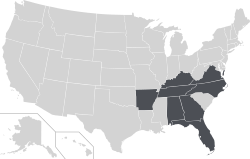
The Atlantic Sun Conference (ASUN) is a collegiate athletic conference operating mostly in the Southeastern United States, competing at the NCAA Division I level. Originally established as the Trans America Athletic Conference (TAAC) in 1978,[1] it was renamed as the Atlantic Sun Conference in 2001, and briefly rebranded as the ASUN Conference from 2016 to 2023. The conference still uses "ASUN" as an official abbreviation.[2] The conference headquarters are located in Jacksonville.
History
[edit]


 – Full member
 – Departing member
 – Affiliate member
Formation
[edit]The conference was first formed on September 19, 1978, as the Trans America Athletic Conference, at the Dallas–Fort Worth Regional Airport Marina Hotel.[3] Its charter members were Oklahoma City University, Pan American University (later renamed University of Texas-Pan American), Northeast Louisiana University (now known as the University of Louisiana at Monroe), Houston Baptist University (now Houston Christian University), Hardin-Simmons University, Centenary College of Louisiana, Samford University, and Mercer University, all of whom were previously D-I independents. None of the eight charter members remain in the conference today.
Almost immediately after its formation, the conference experienced a shake-up in its membership. Oklahoma City departed to become a charter member of the Midwestern City Conference (known today as the Horizon League), while UTPA returned to D-I independent status—both had only played a single season in the infant league. The TAAC was quick to replace the outgoing members with Northwestern State University and the University of Arkansas at Little Rock, along with Georgia Southern University in 1980, but this instability would prove to be a trend through the coming years—over the next 20 years, the conference would accept 16 new members, with many of these leaving after only playing a handful of seasons. 1982 saw the departure of another charter member, Northeast Louisiana, to the Southland Conference. Additionally, it saw the arrival of Nicholls State University, who originally planned to join the TAAC as a full member. However, due to an oversight by the NCAA, adding in a new program who had not competed in Division I for at least five years would result in the offending conference forfeiting their automatic bid to the NCAA Division I men's basketball tournament. To get around this, the TAAC announced that Nicholls State would compete as a provisional member, ineligible for the men's basketball tournament until it completed its D-I transition in 1985.[4] However, it, along with Northwestern State, left the conference in 1984 to join the Gulf Star Conference instead.
Expansion, contraction, and rebranding
[edit]The remainder of the 1980s saw mostly growth for the conference, adding Georgia State University in 1983, Stetson University in 1985, and the University of Texas at San Antonio in 1986. However, near the end of the decade, the conference was hit with 5 departures over 4 consecutive years, beginning with Houston Baptist transitioning to the NAIA in 1989. This was followed by Hardin-Simmons dropping to NCAA Division III in 1990, UTSA and Arkansas–Little Rock leaving for the Southland and Sun Belt conferences in 1991, respectively, and Georgia Southern leaving for the Southern Conference in 1992. In the midst of this, the conference began to relentlessly pursue expansion throughout the 1990s to offset these losses, adding Florida International University in 1990, Southeastern Louisiana University and the College of Charleston in 1991, the University of Central Florida in 1992, Florida Atlantic University in 1993, Campbell University in 1994, Jacksonville State University in 1995, Troy State University in 1997, and Jacksonville University in 1998. Of these 9 schools, though, only 2 ended up staying with the conference for longer than 15 years.
The turn of the millennium saw another charter member in Centenary depart in 1999 for the Mid-Continent Conference (now the Summit League); the league was able to offset this with the addition of Belmont University in 2001. Around this same time, the conference sought to rebrand itself, changing its name from the Trans America Athletic Conference to the Atlantic Sun Conference. The newly rebranded A-Sun continued to expand into the 2000s, adding Gardner–Webb University in 2002, Lipscomb University in 2003, East Tennessee State University, Kennesaw State University, and the University of North Florida in 2005, and Florida Gulf Coast University & the University of South Carolina Upstate in 2007. It also lost its fair share of members as well—largely some of the aforementioned members that had been added during the '90s, such as FIU, Florida Atlantic, and Troy to the Sun Belt, Georgia State to the Colonial Athletic Association, and UCF to Conference USA, but it also saw the departure of Samford to the Ohio Valley Conference, leaving Mercer as the only remaining charter member.
Present
[edit]The start of the 2010s gave the A-Sun a bit of a reprieve from conference realignment, losing only Campbell and Belmont in 2011 and 2012 to the Big South and OVC, respectively, and only adding recent D-I upgrader Northern Kentucky University in 2012. 2014 saw the departure of its final charter member, Mercer, to the Southern Conference in 2014; however, the Bears continued to compete in the ASUN as an affiliate for beach volleyball and added men's lacrosse to its ASUN membership in 2022. The ASUN continued to expand and contract slowly through the mid-2010s, losing only Northern Kentucky and East Tennessee State (along with Mercer), and only adding the New Jersey Institute of Technology in 2015.
This slow pace didn't stay for long, however. The second half of the decade saw the conference rebranding a second time, to simply the ASUN Conference[2] Two years later, the University of North Alabama arrived from the Division II Gulf South Conference,[5] and Liberty University left the Big South for the ASUN.[6] More recently, Bellarmine University joined from the Division II Great Lakes Valley Conference[7] and NJIT left for the America East Conference in 2020–21.[8] On July 1, 2024, the University of West Georgia joined from the Division II Gulf South Conference.[9]
Failed CCSA merger
[edit]On January 22, 2020, it was announced that the Coastal Collegiate Sports Association and the ASUN would merge to create a new Division I multisport conference.[10] The timeline below was released with the announcement of this merger and expansion plan:
- June, 2023 – ASUN Conference expands to 20 members.
- Before July 1, 2023 – ASUN transfers rights to the ASUN name and marks to the CCSA.
- July 1, 2023 – ASUN 7 joins the CCSA. The CCSA adopts the ASUN name as a multisport conference. The 13 remaining members would adopt the name United Athletic Conference.
The ASUN had planned on expanding to 20 members and then splitting the conference similar to how the Original Big East Conference was split in 2013 into the American Athletic Conference and the New Big East Conference. The new ASUN Conference governed by the CCSA would have made up of the ASUN 7 including all of the members that would have been in the ASUN Conference for at least 8 years to meet the requirements for a new multisport conference. The members would have included Florida Gulf Coast University, Jacksonville University, Kennesaw State University, Lipscomb University, New Jersey Institute of Technology, University of North Florida, and Stetson University. The United Athletic Conference (not to be confused with the United Athletic Conference, the football merger between the Western Athletic Conference and the ASUN in 2023) governed by the original ASUN Conference would have included Bellarmine University, Liberty University, University of North Alabama, and ten other undisclosed schools that would have joined through expansion.
On November 16, 2020, The ASUN Conference announced that, due to the COVID-19 pandemic and the quickly changing landscape in conference realignment, the creation of a new multisport conference would not be possible at the time of the release or with the aforementioned timeline.[11] This comes after the news that NJIT would be leaving the ASUN for the America East Conference in 2021, weakening the ASUN 7 and lowering the chances that a new conference would be created with only six members.
Addition of football
[edit]Arguably its biggest move in recent years was the announcement that the conference would be adding the University of Central Arkansas, Eastern Kentucky University, and former member Jacksonville State University, as incoming members on January 29, 2021, with the intent of sponsoring football in the Football Championship Subdivision (FCS) in 2022.[12] With these three schools joining in 2021, the league partnered with another conference beginning to sponsor football, the Western Athletic Conference (WAC), which likewise did not have the minimum of six football-playing members needed for the conference to have an automatic qualifier to the FCS playoffs. The resulting combination of three ASUN and four WAC schools was branded interchangeably as the "ASUN–WAC Challenge" and "WAC–ASUN Challenge," and also referred to as the "AQ7."[13][14]
The ASUN football league project was thrown into jeopardy as early as November 2021, as Jacksonville State announced it would be leaving once again in 2023 for Conference USA (C-USA), an FBS conference. Liberty was also invited to C-USA for 2023, but had already competed as an FBS independent for some time and was not included in the ASUN's new football league.[15] With the WAC also losing Sam Houston, another football-sponsoring school, to C-USA, the two conferences announced they would be renewing their alliance for the 2022 season.[16] On September 17, 2021, the ASUN announced Austin Peay State University, a football-sponsoring school, as a new member for the 2022–23 season.[17] In May 2022, local media in Charlotte, North Carolina, also reported that Queens University of Charlotte would start a transition from the Division II South Atlantic Conference as a new ASUN member, also effective on July 1 of that year.[18] The ASUN officially announced this move on May 10.[19]
The ASUN also expanded its associate membership in the 2020s. The conference started the decade with five associate members—Coastal Carolina in both beach volleyball and women's lacrosse, Mercer in beach volleyball only, and Akron, Kent State, and Howard in women's lacrosse. All of the women's lacrosse associates left by the 2021–22 school year. Akron and Kent State left after the 2020 season when their full-time home of the Mid-American Conference began sponsoring the sport. Coastal Carolina also left after the 2020 season for the SoCon. Howard moved several sports not sponsored by its full-time home of the Mid-Eastern Athletic Conference to the Northeast Conference, with women's lacrosse moving after the 2021 season. Coastal Carolina moved beach volleyball to C-USA after the 2020–21 school year.
However, the 2021–22 school year saw the arrival of eight new associates, as well as the return of former women's lacrosse associates Coastal Carolina and Delaware State for that sport. ASUN beach volleyball added Charleston, Stephen F. Austin, and UNC Wilmington. The largest change in associate membership involved the relaunch of ASUN men's lacrosse. Full member Bellarmine was joined by five new associates—Air Force, Cleveland State, Detroit Mercy, Robert Morris, and Utah.
The ASUN lost five beach volleyball members for 2022–23. The conference's four associates in that sport left for the Sun Belt Conference (SBC), which added that sport. Charleston, Stephen F. Austin, and UNC Wilmington all left the ASUN after a single season and Mercer also moved beach volleyball to the SBC.[20] Also, departing full member Jacksonville State moved beach volleyball to its future home of C-USA a year before its all-sports move to that league.[21]
Also for 2022–23, Mercer moved men's lacrosse into the ASUN after the SoCon shut down its men's lacrosse league, and new D-I member Lindenwood became an associate in both men's and women's lacrosse.
On October 14, 2022, Conference USA and Kennesaw State jointly announced that KSU would start a transition to FBS after the 2022 football season[22] and join C-USA in 2024.[23]
ESPN reported on December 9, 2022, that the ASUN and WAC had agreed to form a new football-only conference that plans to start play in 2024. The initial membership would consist of Austin Peay, Central Arkansas, Eastern Kentucky, and North Alabama from the ASUN, and Abilene Christian, Southern Utah, Stephen F. Austin, Tarleton, and Utah Tech from the WAC. The new football conference also reportedly planned to move "from what is currently known as FCS football to what is currently known as FBS football at the earliest practicable date."[24] On December 20, the two conferences confirmed the football merger, announcing that the new football league would start play in 2023 under the tentative name of ASUN–WAC Football Conference. This was followed in April 2023 by the new league rebranding itself as the United Athletic Conference (UAC). The UAC played a six-game schedule in 2023 and planned to start full round-robin conference play in 2024. Neither conference's official announcement mentioned any plans to move to FBS.[25][26][27]
Return of Atlantic Sun
[edit]On September 1, 2023, it was announced that the ASUN would undergo another rebranding to reinstate the use of the name Atlantic Sun. The conference still uses "ASUN" as its official abbreviation.
Addition of swimming and diving
[edit]The ASUN added men's and women's swimming & diving for the 2023–24 season, taking most of its initial membership from the Coastal Collegiate Sports Association, which had been founded as a partnership of several all-sports conferences, including the ASUN, as a home for that sport (the CCSA's scope would later expand to include beach volleyball). Two associate members came from the American Athletic Conference, which dropped men's swimming as a sponsored sport after the 2022–23 season. The initial membership for that sport was:[28]
- Two full members, Bellarmine and Queens, compete in both the men's and women's leagues.
- Two other full members, Florida Gulf Coast and North Florida, sponsor only the women's sport.
- The two full men's members were joined by associate members Florida Atlantic, Gardner–Webb, Old Dominion, and SMU. SMU only competed in the 2023–24 season, after which it joined the Atlantic Coast Conference, which sponsors the sport for both sexes.
- Gardner–Webb is also an associate in women's swimming & diving; it was joined in that status by former full ASUN member Liberty and UNC Asheville.
Loss of football schools to all-sports United Athletic Conference
[edit]In response to the WAC losing most of its members during the first half of 2025, the ASUN and WAC issued a joint statement on June 26, 2025, announcing that the United Athletic Conference would become an all-sports conference as of July 1, 2026. The all-sports UAC would include the three remaining WAC institutions (Abilene Christian University, Tarleton State University, and non-football University of Texas Arlington) plus the five football-playing ASUN members (Austin Peay State University, University of Central Arkansas, Eastern Kentucky University, University of North Alabama, and University of West Georgia). The seven remaining ASUN members would continue to operate after July 1, 2026, as a non-football conference under the Atlantic Sun name. The statement framed the demise of the WAC and redistribution of conference members as a "strategic alliance" of the WAC with the ASUN, under which the WAC would "rebrand" as the UAC. The "rebranding" tactic enabled the new all-sports UAC to inherit the WAC's automatic qualifiers to NCAA championships, avoiding the customary waiting period for a new conference. Plans called for the ASUN and the UAC to operate as a "consortium" under ASUN commissioner Jeff Bacon.[29][30]
Member schools
[edit]Current full members
[edit]Members departing for the United Athletic Conference on July 1, 2026.
- Notes
- ^ The FGCU campus has a Fort Myers mailing address, but lies in unincorporated Lee County.
Associate members
[edit]| Institution | Location | Founded | Type | Enrollment | Joined | Nickname | Primary conference |
ASUN sport(s) |
|---|---|---|---|---|---|---|---|---|
| United States Air Force Academy (Air Force) |
USAF Academy, Colorado[a] | 1954 | Military | 4,304 | 2021–22 | Falcons | Mountain West | Men's lacrosse |
| Coastal Carolina University | Conway, South Carolina | 1954 | Public | 10,484 | 2021–22[b] | Chanticleers | Sun Belt | Women's lacrosse |
| University of Delaware | Newark, Delaware | 1743 | Public[c] | 23,774[33] | 2025–26 | Blue Hens | CUSA | Women's lacrosse |
| Men's and women's swimming & diving | ||||||||
| Florida Atlantic University | Boca Raton, Florida | 1961 | Public | 30,171 | 2023–24 | Owls | American | Men's swimming & diving |
| Gardner–Webb University | Boiling Springs, North Carolina | 1905 | Private | 3,594 | 2023–24 | Runnin' Bulldogs | Big South | Men's and women's swimming & diving |
| Georgia Southern University | Statesboro, Georgia | 1906 | Public | 26,106[34] | 2025–26 | Eagles | Sun Belt | Women's swimming & diving |
| Kennesaw State University | Kennesaw, Georgia[d] | 1963 | Public | 45,152 | 2024–25[e] | Owls | CUSA | Women's lacrosse |
| Liberty University | Lynchburg, Virginia | 1971 | Private | 16,000[f] | 2023–24[g] | Lady Flames | CUSA | Women's lacrosse |
| Lindenwood University | St. Charles, Missouri | 1827 | Private | 7,374 | 2022–23[35][36] | Lions | OVC | Women's lacrosse |
| Mercer University | Macon, Georgia | 1833 | Private | 8,740 | 2022–23 | Bears | SoCon | Men's lacrosse |
| Old Dominion University | Norfolk, Virginia | 1930 | Public | 24,286 | 2023–24 | Monarchs | Sun Belt | Men's swimming & diving |
| 2025–26 | Women's swimming & diving | |||||||
| University of North Carolina at Asheville (UNC Asheville) |
Asheville, North Carolina | 1927 | Public | 3,762 | 2023–24 | Bulldogs | Big South | Women's swimming & diving |
| University of Utah | Salt Lake City, Utah | 1850 | Public | 32,818 | 2021–22 | Utes | Big 12 | Men's lacrosse |
Future associate members
[edit]| Institution | Location | Founded | Type | Enrollment | Joining | Nickname | Primary conference |
ASUN sport(s) |
|---|---|---|---|---|---|---|---|---|
| University of Arkansas at Little Rock (Little Rock) |
Little Rock, Arkansas | 1927 | Public | 13,167 | 2026–27 | Trojans | OVC (UAC in 2026) |
Women's swimming & diving |
- Notes
- ^ Virtually all of the Air Force Academy grounds, including the cadet area and all athletic facilities, lie outside the city limits of Colorado Springs. The US Census Bureau and US Postal Service consider the Academy to be its own entity, respectively, as "Air Force Academy" and "USAF Academy".
- ^ Coastal Carolina had previously been a member of the ASUN for women's lacrosse from the 2017 to 2020 spring seasons (2016–17 to 2019–20 school years).[32]
- ^ Delaware is officially chartered as a "privately-governed, state-assisted" institution. This status is broadly similar to that of New York State's statutory colleges, most of which are housed at Cornell University, or institutions in Pennsylvania's Commonwealth System of Higher Education.
- ^ The KSU campus has a Kennesaw mailing address, but is located in unincorporated Cobb County.
- ^ Measured from Kennesaw State's departure from full ASUN membership.
- ^ Approximate on-campus enrollment. Liberty claims an enrollment of over 130,000 including online students.
- ^ Measured from Liberty's departure from full ASUN membership.
Former full members
[edit]School names and nicknames listed here reflect those used during the schools' time in the TAAC/ASUN. One school has changed both its name and nickname and three others have changed only their nicknames.
Five former full members are now associates, and a sixth will become an associate in 2025.
- Georgia Southern, which left the then-TAAC in 1992, will rejoin for women's swimming & diving in 2025.
- Florida Atlantic, which left the ASUN in 2006, rejoined for women's swimming & diving in 2023.
- Gardner–Webb, which left in 2008, rejoined for men's and women's swimming & diving in 2023.
- Mercer, which left in 2014, has been a men's lacrosse associate since 2022. It was also an associate in women's lacrosse from 2014 to 2017 and beach volleyball from 2014 to 2022.
- Liberty, which left in 2023, remains an associate in women's lacrosse, and became an associate in women's swimming & diving when the ASUN added that sport in 2023–24. It will move the latter sport to the American Athletic Conference in 2025–26.
- Kennesaw State, which left in 2024, remains an associate in women's lacrosse.
- Notes
- ^ The school changed its athletic brand to "Little Rock" in 2015.
- ^ a b Currently an NCAA Division III athletic conference
- ^ UCF's main campus has an Orlando mailing address but is physically located in unincorporated Orange County.
- ^ UCF dropped the word "Golden" from its nickname in 2007, becoming simply the Knights.
- ^ FIU's main campus has a Miami mailing address but is physically located in unincorporated Miami-Dade County.
- ^ FIU dropped the word "Golden" from its nickname in 2010, becoming simply the Panthers.
- ^ The school changed its name to Houston Christian University in September 2022.
- ^ The KSU campus has a Kennesaw mailing address, but is located in unincorporated Cobb County.
- ^ a b Northeast Louisiana adopted its current name of the University of Louisiana at Monroe in 1999. The school adopted its current nickname of Warhawks in 2006, when it joined the Sun Belt Conference.
- ^ Nicholls State was a provisional member, and as such was never a full member of the TAAC. The school changed its athletic brand to "Nicholls" in 2017.
- ^ Oklahoma City adopted its current nickname of Stars in 1999.
- ^ Currently an NAIA athletic conference
- ^ Pan American adopted its final name of the University of Texas–Pan American in 1989. In 2015, it merged with the University of Texas at Brownsville to form the new University of Texas Rio Grande Valley (UTRGV).
- ^ UTRGV inherited UTPA's athletic program, with the nickname being changed from Broncs to Vaqueros. UTRGV also inherited UTPA's membership in the Western Athletic Conference.
- ^ Troy became a member of the Sun Belt for football member during the 2004 fall season (2004–05 school year), a year before it became an all-sports member.
Former associate members
[edit]| Institution | Location | Founded | Type | Enrollment | Joined | Left | Nickname | ASUN sport(s) |
Primary conference |
Current conference in former ASUN sport(s) |
|---|---|---|---|---|---|---|---|---|---|---|
| University of Akron | Akron, Ohio | 1870 | Public | 18,730 | 2019–20 | 2019–20[37][a] | Zips | Women's lacrosse | MAC | |
| Central Michigan University | Mount Pleasant, Michigan | 1892 | Public | 27,693 | 2015–16 | 2016–17 | Chippewas | Women's lacrosse | MAC | |
| College of Charleston (Charleston) |
Charleston, South Carolina | 1770 | Public | 10,468 | 2021–22[39] | 2022–23 | Cougars | Beach volleyball | CAA | Sun Belt |
| Cleveland State University | Cleveland, Ohio | 1964 | Public | 15,648 | 2021–22 | 2024–25 | Vikings | Men's lacrosse | Horizon | NEC |
| Coastal Carolina University | Conway, South Carolina | 1954 | Public | 10,484 | 2015–16 | 2020–21 | Chanticleers | Beach volleyball | Sun Belt | |
| Delaware State University | Dover, Delaware | 1891 | Public[b] (HBCU) |
5,054 | 2016–17[c] 2021–22 |
2017–18 2022–23 |
Hornets | Women's lacrosse | MEAC | NEC |
| University of Detroit Mercy | Detroit, Michigan | 1877 | Private | 5,700 | 2012–13 | 2016–17 | Titans | Women's lacrosse | Horizon | MAC |
| 2021–22 | 2024–25 | Men's lacrosse | NEC | |||||||
| Elon University | Elon, North Carolina | 1889 | Private | 6,305 | 2013–14 | 2013–14 | Phoenix | Women's lacrosse | CAA | |
| Furman University | Greenville, South Carolina | 1826 | Private | 2,668 | 2014–15 | 2016–17 | Paladins | Women's lacrosse | SoCon | |
| Howard University | Washington, D.C. | 1867 | Private | 9,139 | 2012–13 | 2020–21[40] | Lady Bison | Women's lacrosse | MEAC | NEC |
| Kent State University | Kent, Ohio | 1910 | Public | 28,122 | 2018–19 | 2019–20[a] | Golden Flashes | Women's lacrosse | MAC | |
| Liberty University | Lynchburg, Virginia | 1971 | Private | 16,000[d] | 2023–24[e] | 2025–26 | Lady Flames | Women's swimming & diving | CUSA | American |
| Lindenwood University | St. Charles, Missouri | 1827 | Private | 7,374 | 2022–23 | 2024–25 | Lions | Men's lacrosse | OVC | —[f] |
| Mercer University[g] | Macon, Georgia | 1833 | Private | 8,603 | 2014–15 | 2016–17 | Bears | Women's lacrosse | SoCon | |
| 2022–23 | Beach volleyball | SoCon | Sun Belt | |||||||
| Old Dominion University | Norfolk, Virginia | 1930 | Public | 24,932 | 2014–15 | 2017–18 | Monarchs | Women's lacrosse | Sun Belt | American |
| Robert Morris University | Moon Township, Pennsylvania | 1921 | Private | 4,895 | 2021–22 | 2024–25 | Colonials | Men's lacrosse | Horizon | NEC |
| Southern Methodist University (SMU) |
Dallas, Texas[h] | 1911 | Private | 11,649 | 2023–24 | 2024–25 | Mustangs | Men's swimming & diving | ACC | |
| Stephen F. Austin State University | Nacogdoches, Texas | 1923 | Public | 11,946 | 2021–22[41] | 2022–23 | Ladyjacks | Beach volleyball | Southland | |
| University of North Carolina Wilmington (UNCW) |
Wilmington, North Carolina | 1947 | Public | 14,765 | 2021–22[39] | 2022–23 | Seahawks | Beach volleyball | CAA | Sun Belt |
- Notes
- ^ a b Akron and Kent State left ASUN women's lacrosse after the 2020 spring season (2019–20 school year) to join the newly formed women's lacrosse league of their full-time home of the Mid-American Conference.[38]
- ^ Delaware State is officially chartered as a "privately governed, state-assisted" institution. This status is broadly similar to that of New York State's statutory colleges, most of which are housed at Cornell University, or institutions in Pennsylvania's Commonwealth System of Higher Education.
- ^ Delaware State had previously been a member of the ASUN for women's lacrosse during the 2017 spring season (2016–17 school year).[32]
- ^ Approximate on-campus enrollment. Liberty claims an enrollment of over 130,000 including online students.
- ^ Measured from Liberty's departure from full ASUN membership.
- ^ Lindenwood stopped sponsoring men's lacrosse after the spring 2024 season.
- ^ Mercer became an ASUN associate in men's lacrosse in 2022.
- ^ Virtually all of the SMU campus lies in University Park, a separate city contained within the Dallas city limits. The US Postal Service considers all locations in University Park to have a Dallas address.
Membership timeline
[edit]
Full members Full members (non-football) Assoc. members (football only) Assoc. members (other sports) Other conference Other conference
- Northeast Louisiana became the University of Louisiana at Monroe (Louisiana–Monroe) in 1999.
- Pan American, later known as Texas–Pan American or UTPA, merged with the University of Texas at Brownsville in 2015 to create the new University of Texas Rio Grande Valley (UTRGV). The new school inherited UTPA's athletic program.
Sports sponsored
[edit]As of the 2023–24 school year, the ASUN sponsors championship competition in 10 men's and 12 women's NCAA sanctioned sports.[42]
In 2008, the ASUN, in an agreement with the Southern Conference (SoCon), Mid-Eastern Athletic Conference (MEAC), and Big South Conference, formed the Coastal Collegiate Swimming Association (CCSA) for schools sponsoring men's and women's swimming and diving within the associated conferences. For the past several years, the ASUN's Commissioner has served as the president of what was initially a swimming & diving-only conference. In 2014 the CCSA expanded to include several other schools from other conferences, and the following year the conference added beach volleyball (women-only at the NCAA level) as a sponsored sport, changing its name to the Coastal Collegiate Sports Association. Currently the conference has 17 member schools, with five men's swimming and diving teams, nine women's swimming & diving teams, and six beach volleyball teams.[43]
A more recent change to the roster of ASUN sports took place after the 2013–14 school year. Under a cooperative agreement between the ASUN and SoCon, the two leagues agreed to split lacrosse sponsorship. The SoCon took over the ASUN men's lacrosse league, while women's lacrosse sponsorship remained with the ASUN.[44] The full alliance in women's lacrosse amicably ended after the 2017 season, with the SoCon sponsoring that sport from the 2018 season forward, but the two leagues continued in a cross-scheduling agreement until the SoCon dropped women's lacrosse after the 2021 season.
Still more recently, on September 13, 2016, the ASUN and Big South announced a football partnership that allows any ASUN members with scholarship football programs to become Big South football members, provided they are located within the general geographic footprint of the two conferences. At the time of announcement, the only ASUN member with a scholarship football program, Kennesaw State, was already a Big South football member. Should any ASUN member add scholarship football, or any non-scholarship football program of an ASUN school (at the time of announcement, Jacksonville and Stetson) upgrade to scholarship football, that team will automatically join Big South football.[45] North Alabama joined Big South football under the terms of this agreement; although the school's home state of Alabama had no schools in either conference at the time it was announced as a future ASUN member, three of its neighboring states were home to six of the ASUN's eight members at that time.
When the ASUN announced the July 2021 entry of Central Arkansas, Eastern Kentucky, and Jacksonville State, it also stated that it would launch a scholarship FCS football league, but did not specify when football competition will begin.[12] No current member is required to add football or change its current football standing.[46] At a press conference on February 23, 2021, the ASUN announced that it had entered into a separate football partnership with the Western Athletic Conference (WAC), which had previously announced the relaunch of its football league at the FCS level in fall 2021 with the arrival of four new FCS member schools. The three incoming ASUN members joined the four incoming WAC members in a round-robin schedule branded as the "ASUN–WAC Challenge". Both conferences proposed an amendment to NCAA bylaws that would allow the alliance to receive an automatic bid to the FCS playoffs. The alliance had seven members, one more than the six normally required for an automatic bid, but were not in the same league for an adequate period to meet the current NCAA "continuity" requirement.[47][14] The two leagues' proposal was successful, resulting in an automatic qualifier from the seven-team Challenge, colloquially dubbed "AQ7".[48] With the 2022 arrival of Austin Peay providing the ASUN its sixth scholarship FCS program, the ASUN will start its football league in the 2022 season. However, because the ASUN and WAC were each left with only five playoff-eligible football members for 2022 after Jacksonville State (ASUN) and Sam Houston (WAC) started FBS transitions in that season, both leagues renewed their football partnership for 2022.[16] As noted earlier, the two conferences fully merged their football leagues in 2023 as the United Athletic Conference.
Shortly after the addition of football was announced, the ASUN announced that it would reinstate men's lacrosse in the 2022 season, with the lacrosse partnership with the SoCon retained for the time being. The two full ASUN members with men's lacrosse programs, Bellarmine and Jacksonville, separated for that sport, with Bellarmine joining the new ASUN lacrosse league and Jacksonville remaining in SoCon men's lacrosse. Air Force moved from SoCon men's lacrosse; men's lacrosse independent Utah joined; and all three Horizon League members with men's lacrosse programs also joined, with Detroit Mercy moving from the Metro Atlantic Athletic Conference and Cleveland State and Robert Morris moving from independent status. The SoCon maintained its automatic NCAA tournament berth by adding another lacrosse independent, Hampton. The ASUN men's lacrosse league was initially to be administered through the CCSA while operating under the ASUN name as part of the ASUN's intended plan to split into two conferences.[49][50] This arrangement was scrapped along with the planned conference split once NJIT left for the America East; the men's lacrosse league is now directly administered by the ASUN.
The ASUN added two new beach volleyball members, Charleston and UNCW, in July 2021.[39] At the same time, Coastal Carolina left ASUN beach volleyball for the newly formed Conference USA beach volleyball league.[51] With the demise of SoCon women's lacrosse after the 2021 season, Coastal Carolina and Delaware State returned to the ASUN in that sport after respectively spending one and four seasons in the SoCon.[32]
The SoCon dropped men's lacrosse after the 2022 season due to further conference realignment. Jacksonville returned men's lacrosse to the ASUN, and full SoCon member Mercer became an ASUN men's lacrosse affiliate. Lindenwood, which started a transition from D-II to D-I in 2022 as a new member of the Ohio Valley Conference, became an affiliate in both men's and women's lacrosse (neither of which is sponsored by the OVC). Also in 2022–23, the ASUN lost all four of its beach volleyball affiliates (Charleston, Mercer, Stephen F. Austin, UNCW) to the new beach volleyball league of the Sun Belt Conference.
As noted previously, the ASUN added men's and women's swimming & diving in 2023–24.
| Sport | Men's | Women's |
|---|---|---|
| Baseball | 12 |
–
|
| Basketball | 12 |
12
|
| Beach volleyball | – |
8
|
| Cross country | 12 |
12
|
| Golf | 12 |
12
|
| Lacrosse | 6 |
9
|
| Soccer | 8 |
12
|
| Softball | – |
12
|
| Swimming & diving | 6 |
9
|
| Tennis | 9 |
10
|
| Track and field (indoor) | 7 |
9
|
| Track and field (outdoor) | 7 |
9
|
| Volleyball | – |
12
|
Men's sports
[edit]| School | Baseball | Basketball | Cross country |
Golf | Lacrosse | Soccer | Swimming & diving | Tennis | Track & field (indoor) |
Track & field (outdoor) |
Total sports |
|---|---|---|---|---|---|---|---|---|---|---|---|
| Austin Peay | Yes | Yes | Yes | Yes | No | No | No | Yes | No | No | 5 |
| Bellarmine | Yes | Yes | Yes | Yes | Yes | Yes | Yes | Yes | Yes | Yes | 10 |
| Central Arkansas | Yes | Yes | Yes | Yes | No | Yes | No | No | Yes | Yes | 7 |
| Eastern Kentucky | Yes | Yes | Yes | Yes | No | No | No | No | Yes | Yes | 6 |
| Florida Gulf Coast | Yes | Yes | Yes | Yes | No | Yes | No | Yes | No | No | 6 |
| Jacksonville | Yes | Yes | Yes | Yes | Yes | Yes | No | No | No | No | 6 |
| Lipscomb | Yes | Yes | Yes | Yes | No | Yes | No | Yes | Yes | Yes | 8 |
| North Alabama | Yes | Yes | Yes | Yes | No | No | No | Yes | No | No | 5 |
| North Florida | Yes | Yes | Yes | Yes | No | Yes | No | Yes | Yes | Yes | 8 |
| Queens | Yes | Yes | Yes | Yes | Yes | Yes | Yes | Yes | Yes | Yes | 10 |
| Stetson | Yes | Yes | Yes | Yes | No | Yes | No | Yes | No | No | 6 |
| West Georgia | Yes | Yes | Yes | Yes | No | No | No | No | Yes | Yes | 8 |
| Associate members | |||||||||||
| Air Force | Yes | 1 | |||||||||
| Delaware | Yes | 1 | |||||||||
| Florida Atlantic | Yes | 1 | |||||||||
| Gardner–Webb | Yes | 1 | |||||||||
| Mercer | Yes | 1 | |||||||||
| Old Dominion | Yes | 1 | |||||||||
| Utah | Yes | 1 | |||||||||
| Totals | 12 | 12 | 12 | 12 | 3+3 | 8 | 2+4 | 8 | 7 | 7 | 83+7 |
Men's varsity sports not sponsored by the league which are played by ASUN schools:
| School | Football | Rowing | Volleyball | Wrestling |
|---|---|---|---|---|
| Austin Peay | UAC | No | No | No |
| Bellarmine | No[a] | No | No | SoCon |
| Central Arkansas | UAC | No | No | No |
| Eastern Kentucky | UAC | No | No | No |
| Jacksonville | No | MAAC | No | No |
| North Alabama | UAC | No | No | No |
| Queens | No | No | MIVA[52] | No |
| Stetson | Pioneer | MAAC | No | No |
| West Georgia | UAC | No | No | No |
- ^ While non-football by NCAA criteria, Bellarmine fields a varsity team in the weight-restricted and non-NCAA variant of sprint football.
In addition to the aforementioned sports:
- Queens sponsors men's rugby and triathlon, neither of which has NCAA recognition of any type. It also considers its male cheerleaders to be varsity athletes.
Women's sports
[edit]| School | Basketball | Beach volleyball | Cross country |
Golf | Lacrosse | Soccer | Softball | Swimming & diving | Tennis | Track & field (indoor) |
Track & field (outdoor) |
Volleyball | Total Sports |
|---|---|---|---|---|---|---|---|---|---|---|---|---|---|
| Austin Peay | Yes | Yes | Yes | Yes | Yes | Yes | Yes | No | Yes | Yes | Yes | Yes | 11 |
| Bellarmine | Yes | No | Yes | Yes | No | Yes | Yes | Yes | Yes | Yes | Yes | Yes | 10 |
| Central Arkansas | Yes | Yes | Yes | Yes | No | Yes | Yes | No | No | Yes | Yes | Yes | 9 |
| Eastern Kentucky | Yes | Yes | Yes | Yes | No | Yes | Yes | No | No | Yes | Yes | Yes | 9 |
| Florida Gulf Coast | Yes | Yes | Yes | Yes | No | Yes | Yes | Yes | Yes | No | No | Yes | 9 |
| Jacksonville | Yes | Yes | Yes | Yes | Yes | Yes | Yes | No | No | Yes | Yes | Yes | 10 |
| Lipscomb | Yes | No | Yes | Yes | No | Yes | Yes | No | Yes | Yes | Yes | Yes | 9 |
| North Alabama | Yes | Yes | Yes | Yes | No | Yes | Yes | No | Yes | No | No | Yes | 8 |
| North Florida | Yes | Yes | Yes | Yes | No | Yes | Yes | Yes | Yes | Yes | Yes | Yes | 11 |
| Queens | Yes | No | Yes | Yes | Yes | Yes | Yes | Yes | Yes | Yes | Yes | Yes | 11 |
| Stetson | Yes | Yes | Yes | Yes | Yes | Yes | Yes | No | Yes | No | No | Yes | 9 |
| West Georgia | Yes | Yes | Yes | Yes | No | Yes | Yes | No | No[a] | Yes | Yes | Yes | 9 |
| Associate members | |||||||||||||
| Coastal Carolina | Yes | 1 | |||||||||||
| Delaware | Yes | Yes | 2 | ||||||||||
| Gardner–Webb | Yes | 1 | |||||||||||
| Georgia Southern | Yes | 1 | |||||||||||
| Kennesaw State | Yes | 1 | |||||||||||
| Liberty | Yes | 1 | |||||||||||
| Lindenwood | Yes | 1 | |||||||||||
| Old Dominion | Yes | 1 | |||||||||||
| UNC Asheville | Yes | 1 | |||||||||||
| Totals | 12 | 9 | 12 | 12 | 4+5 | 12 | 12 | 4+5 | 8 | 9 | 9 | 12 | 116+10 |
- ^ West Georgia dropped women's tennis after the 2023–24 season, immediately before joining the ASUN.
Women's varsity sports not sponsored by the league which are played by ASUN schools:
| School | Field hockey | Rowing | Rugby[a] | Stunt[a] | Triathlon[a] |
|---|---|---|---|---|---|
| Bellarmine | MAC[53] | No | No | No | No |
| Central Arkansas | No | No | No | Independent | No |
| Jacksonville | No | MAAC | No | No | No |
| Queens | IND | No | IND | No | IND |
| Stetson | No | MAAC | No | No | No |
| West Georgia | No | No | No | No[b] | No |
- ^ a b c Part of the NCAA Emerging Sports for Women program.
- ^ West Georgia, which currently fields a club-level stunt team, has announced it will elevate the sport to varsity status in the near future, though has not set a timeline.
In addition to the aforementioned sports:
- Bellarmine considers the members of its all-female dance team to be varsity athletes.
- Queens considers its cheerleaders and dance team (the latter all-female, though listed on its athletic website as coeducational) to be varsity athletes.
Facilities
[edit]All Sports Championships
[edit]The Jesse C. Fletcher and Sherman Day Trophies are awarded each year to the top men's and women's program in the conference. The Bill Bibb Trophy, combining the men's and women's results for the best overall program, was first awarded in 2006–07. East Tennessee State won this overall trophy seven of the nine years it has been awarded; Florida Gulf Coast won in 2012–13, 2014–15 and 2015–16.[54]
Men's All Sports: Jesse C. Fletcher Trophy
[edit]| Year | Champion |
|---|---|
| 1978–79 | Oklahoma City |
| 1979–80 | Northeast Louisiana |
| 1980–81 | Northeast Louisiana |
| 1981–82 | Northeast Louisiana |
| 1982–83 | Georgia Southern |
| 1983–84 | Centenary |
| 1984–85 | Georgia Southern |
| 1985–86 | Houston Baptist |
| 1986–87 | Georgia Southern |
| 1987–88 | Georgia Southern |
| 1988–89 | Georgia Southern |
| 1989–90 | Georgia Southern |
| 1990–91 | Georgia Southern |
| 1991–92 | Florida International |
| 1992–93 | Florida International |
| 1993–94 | Florida International |
| 1994–95 | Central Florida |
| 1995–96 | Central Florida |
| 1996–97 | Florida International |
| 1997–98 | Georgia State |
| 1998–99 | Central Florida |
| 1999–00 | Georgia State |
| 2000–01 | Georgia State |
| 2001–02 | Georgia State |
| 2002–03 | Central Florida |
| 2003–04 | Central Florida |
| 2004–05 | Central Florida |
| 2005–06 | East Tennessee State |
| 2006–07 | East Tennessee State |
| 2007–08 | East Tennessee State |
| 2008–09 | East Tennessee State |
| 2009–10 | East Tennessee State |
| 2010–11 | East Tennessee State |
| 2011–12 | East Tennessee State |
| 2012–13 | Florida Gulf Coast |
| 2013–14 | East Tennessee State |
| 2014–15 | North Florida |
| 2015–16 | North Florida |
| 2017–18 | North Florida |
| 2018–19 | Liberty |
| 2021–22 | Liberty |
| 2022–23 | Liberty |
| 2023–24 | Lipscomb |
Women's All Sports: Sherman Day Trophy
[edit]| Year | Champion |
|---|---|
| 1978–79 | None |
| 1979–80 | None |
| 1980–81 | None |
| 1981–82 | None |
| 1982–83 | None |
| 1983–84 | None |
| 1984–85 | None |
| 1985–86 | Stetson, Georgia State |
| 1986–87 | Stetson |
| 1987–88 | Georgia State |
| 1988–89 | Georgia State |
| 1989–90 | Georgia State |
| 1990–91 | Florida International |
| 1991–92 | Florida International |
| 1992–93 | Georgia State |
| 1993–94 | Florida International |
| 1994–95 | Campbell |
| 1995–96 | Central Florida |
| 1996–97 | Central Florida |
| 1997–98 | Georgia State |
| 1998–99 | Central Florida |
| 1999–00 | Georgia State |
| 2000–01 | Georgia State |
| 2001–02 | Central Florida |
| 2002–03 | Central Florida |
| 2003–04 | Central Florida |
| 2004–05 | Central Florida |
| 2005–06 | Florida Atlantic |
| 2006–07 | East Tennessee State |
| 2007–08 | Jacksonville |
| 2008–09 | Jacksonville |
| 2009–10 | Kennesaw State |
| 2010–11 | Jacksonville |
| 2011–12 | Kennesaw State |
| 2012–13 | Florida Gulf Coast |
| 2013–14 | Jacksonville |
| 2014–15 | Florida Gulf Coast |
| 2015–16 | Florida Gulf Coast |
| 2016–17 | Florida Gulf Coast |
| 2017–18 | Florida Gulf Coast |
| 2018–19 | Liberty |
| 2021–22 | Liberty |
| 2022–23 | Liberty |
| 2023–24 | Lipscomb |
Combined All Sports: Bill Bibb Trophy
[edit]| Year | Champion |
|---|---|
| 2006–07 | ETSU |
| 2007–08 | ETSU |
| 2008–09 | ETSU |
| 2009–10 | ETSU |
| 2010–11 | ETSU |
| 2011–12 | ETSU |
| 2012–13 | FGCU |
| 2013–14 | ETSU |
| 2014–15 | FGCU |
| 2015–16 | FGCU |
| 2016–17 | FGCU |
| 2017–18 | Kennesaw State |
| 2018–19 | Liberty |
| 2021–22 | Liberty |
| 2022–23 | Liberty |
| 2023–24 | Lipscomb |
Championships
[edit]Men's basketball
[edit]This is a partial list of the last 10 champions. For the full history, see ASUN men's basketball tournament.[55]
| Season | Reg. season champions(s) |
Tournament champion |
|---|---|---|
| 2015–16 | North Florida | Florida Gulf Coast |
| 2016–17 | Florida Gulf Coast | Florida Gulf Coast |
| 2017–18 | Florida Gulf Coast | Lipscomb |
| 2018–19 | Lipscomb Liberty |
Liberty |
| 2019–20 | Liberty North Florida |
Liberty |
| 2020–21 | Liberty | Liberty |
| 2021–22 | Liberty (East) Jacksonville State (West) |
Bellarmine[a] |
| 2022–23 | Kennesaw State Liberty |
Kennesaw State |
| 2023–24 | Eastern Kentucky | Stetson |
| 2024–25 | Lipscomb North Alabama |
Lipscomb |
- ^ Because Bellarmine was in the second season of its four-year transition from Division II, it was ineligible for the NCAA tournament. Under ASUN rules, Jacksonville State received the ASUN's automatic bid by virtue of the best regular-season conference record.
Women's basketball
[edit]This is a partial list of the last 10 champions. For the full history, see ASUN women's basketball tournament.[56]
| Season | Reg. season champions(s) |
Tournament champion |
|---|---|---|
| 2015–16 | Florida Gulf Coast | Jacksonville |
| 2016–17 | Stetson | Florida Gulf Coast |
| 2017–18 | Florida Gulf Coast | Florida Gulf Coast |
| 2018–19 | Florida Gulf Coast | Florida Gulf Coast |
| 2019–20 | Florida Gulf Coast | None (COVID-19) |
| 2020–21 | Florida Gulf Coast | Florida Gulf Coast |
| 2021–22 | Florida Gulf Coast (East, and overall) Jacksonville State (West) |
Florida Gulf Coast |
| 2022–23 | Florida Gulf Coast | Florida Gulf Coast |
| 2023–24 | Florida Gulf Coast | Florida Gulf Coast |
| 2024–25 | Florida Gulf Coast | Florida Gulf Coast |
Baseball
[edit]Notes and references
[edit]- ^ "Atlantic Coast Conference". Archived from the original on February 6, 2006. Retrieved March 1, 2006.
- ^ a b "Conference Student-Athletes Unveil New ASUN Brand Identity" (Press release). ASUN Conference. April 28, 2016.[permanent dead link]
- ^ "New conference Gets NCAA OK For Division I". Abilene Reporter-News. November 1, 1978. p. 19. Retrieved July 3, 2022 – via Newspapers.com.

- ^ "Nicholls finally in conference". The Anniston Star. August 19, 1982. p. 14. Retrieved July 3, 2022 – via Newspapers.com.
- ^ "UNA Accepts ASUN Division I Invitation" (Press release). North Alabama Lions. December 6, 2016. Retrieved December 11, 2016.
- ^ "ASUN Conference Announces Liberty University as League Member for 2018–19" (Press release). ASUN Conference. May 17, 2018. Archived from the original on May 20, 2018. Retrieved May 17, 2018.
- ^ "ASUN Conference Announces Addition of Bellarmine University" (Press release). ASUN Conference. June 18, 2019. Archived from the original on June 19, 2019. Retrieved June 18, 2019.
- ^ "NJIT to Join America East Conference as 10th Member Institution – NJIT Highlanders". NJIT Highlanders. June 12, 2020. Retrieved June 13, 2020.
- ^ "Inside West Georgia’s move to Division I" Sports Business Journal. Retrieved 2024-08-02.
- ^ "ASUN Announces Exploration of Expansion & Building New NCAA Division I Multisport Conference". ASUN Conference. January 22, 2020. Archived from the original on October 4, 2022. Retrieved April 23, 2023.
- ^ "ASUN Statement on Conference Expansion". ASUN Conference. November 16, 2020. Archived from the original on November 16, 2020. Retrieved April 23, 2023.
- ^ a b "ASUN Conference Announces Three New Institutions; Adds Football as 20th Sport" (Press release). ASUN Conference. January 29, 2021. Archived from the original on January 29, 2021. Retrieved January 29, 2021.
- ^ "ASUN, WAC Conferences Announce Football Partnership for 2021" (Press release). ASUN Conference. February 23, 2021. Retrieved February 23, 2021.
- ^ a b "From the Commissioner's Desk: @ASUN_Football Update" (Press release). ASUN Conference. February 23, 2021. Retrieved February 23, 2021.
- ^ "Conference USA to add Liberty, Jacksonville State, New Mexico State, Sam Houston State beginning in 2023". ESPN. November 5, 2021. Retrieved July 18, 2024.
- ^ a b "ASUN and WAC Renew Football Alliance" (Press release). ASUN Conference. May 18, 2022. Retrieved May 19, 2022.
- ^ "ASUN Conference Welcomes Austin Peay State University as its Newest Member" (Press release). ASUN Conference. September 17, 2021. Archived from the original on November 15, 2022. Retrieved September 17, 2021.
- ^ Limehouse, Jonathan (May 7, 2022). "Queens University of Charlotte accepts invitation to NCAA Division I conference". The Charlotte Observer. Retrieved May 8, 2022.
- ^ "ASUN Conference Welcomes Queens University of Charlotte as Its Newest Member" (Press release). ASUN Conference. May 10, 2022. Archived from the original on May 10, 2022. Retrieved May 10, 2022.
- ^ "Sun Belt Conference Adds Beach Volleyball For 2023" (Press release). Sun Belt Conference. January 18, 2023. Retrieved January 19, 2023.
- ^ "2023 Preseason Awards Announced" (Press release). Conference USA. February 23, 2023. Retrieved March 12, 2023.
The league serves up its second season with opening matches this weekend featuring (16) FIU, (12) Florida Atlantic and UAB, along with new members Jacksonville State and (ARV) Tulane.
- ^ "Kennesaw State to Join Conference USA in 2024–25" (Press release). Kennesaw State Owls. October 14, 2022. Retrieved October 14, 2022.
- ^ "C-USA Adds Kennesaw State, Owls to Join in 2024" (Press release). Conference USA. October 14, 2022. Retrieved October 14, 2022.
- ^ Thamel, Pete (December 9, 2022). "Atlantic Sun, WAC teams pairing up to attempt move to FBS, sources say". ESPN.com. Retrieved December 9, 2022.
- ^ "@ASUN_Football and WAC Release 2023 Schedule" (Press release). ASUN Conference. December 20, 2022. Retrieved December 22, 2022.
- ^ "ASUN And WAC Unveil 2023 Football Schedule" (Press release). Western Athletic Conference. December 20, 2022. Retrieved December 22, 2022.
- ^ "ASUN-WAC Football Partnership Formally Rebrands As The United Athletic Conference" (Press release). ASUN Conference. April 17, 2023. Retrieved April 19, 2023.
- ^ "ASUN Conference Adds Men's and Women's Swimming and Diving" (Press release). Atlantic Sun Conference. August 28, 2023. Retrieved September 24, 2023.
- ^ Rome, Nicholas. "FCS Realignment Watch: WAC and ASUN to form United Athletic Conference". Saturday Blitz. Minute Media. Retrieved 25 June 2025.
- ^ "Atlantic Sun Conference and Western Athletic Conference to Forge Strategic Alliance: WAC to Rebrand as United Athletic Conference". www.uacfootball.com. 2025-06-26.
- ^ "UA & UNA both report record-breaking enrollment numbers for 2024 fall semester" Alabama Public Radio. Retrieved 2025-02-22.
- ^ a b c "Coastal Carolina and Delaware State Set to Rejoin ASUN Conference Women's Lacrosse" (Press release). ASUN Conference. July 7, 2021. Retrieved October 1, 2021.
- ^ "Facts & Figures | University of Delaware". udel.edu. Retrieved 2023-11-27.
- ^ "Fall 2023 enrollment numbers for Georgia Southern, University System of Georgia" (PDF). Georgia Southern University. Archived from the original (PDF) on November 15, 2023. Retrieved November 14, 2023.
- ^ "Jacksonville, Lindenwood & Mercer Joining #ASUNMLAX for 2023 Season" (Press release). ASUN Conference. March 30, 2022. Retrieved May 11, 2022.
- ^ "#ASUNWLAX Announces Addition of Lindenwood for 2023 Season" (Press release). ASUN Conference. May 2, 2022. Retrieved May 7, 2022.
- ^ "Akron Women's Lacrosse to Join ASUN" (Press release). Akron Zips. April 9, 2018. Retrieved April 28, 2018.
- ^ "Women's Lacrosse Coming in 2020–21; Detroit Mercy & Youngstown State As Affiliates" (Press release). Mid-American Conference. November 6, 2019. Retrieved February 8, 2020.
- ^ a b c "ASUN Conference Announces Additions of Col. of Charleston and UNCW in Beach Volleyball" (Press release). ASUN Conference. July 6, 2021. Retrieved October 9, 2021.
- ^ "Six Howard Athletics Programs Join the Northeast Conference as Associate Members" (Press release). Howard Bison. July 6, 2020. Retrieved July 11, 2020.
- ^ "11th Season of #ASUNBVB Begins This Weekend" (Press release). ASUN Conference. February 24, 2022. Retrieved August 29, 2022.
Stephen F. Austin begins its first season in the league and is set to open its 2022 campaign at the Kingsville Tournament where they face Ottawa, Texas A&M Kingsville, Missouri Baptist and Colorado Mesa.
- ^ "ASUN Conference". asunsports.org.
- ^ "About the CCSA". Coastal Collegiate Sports Association. Retrieved September 29, 2020.
- ^ "SoCon, ASUN Partner to Enhance Lacrosse" (Press release). Southern Conference. January 9, 2014. Archived from the original on April 7, 2014. Retrieved March 31, 2014.
- ^ "Big South and ASUN Conference Establish FCS Membership Partnership" (Press release). ASUN Conference. September 13, 2016. Archived from the original on October 30, 2016. Retrieved October 30, 2016.
- ^ Franklin, Drew (January 25, 2021). "EKU to leave the OVC for the Atlantic Sun Conference". Kentucky Sports Radio. Retrieved January 26, 2021.
- ^ "ASUN, WAC Conferences Announce Football Partnership for 2021" (Press release). ASUN Conference. February 23, 2021. Retrieved February 23, 2021.
- ^ "FCS college football 2021: AQ7 preview". KRQE. Stats Perform. August 20, 2021. Retrieved September 5, 2021.
- ^ "ASUN Conference Announces Formation of Men's Lacrosse League" (Press release). ASUN Conference. February 5, 2021. Archived from the original on February 5, 2021. Retrieved February 6, 2021.
- ^ "Hampton joining SoCon as associate member for men's lacrosse" (Press release). Southern Conference. February 5, 2021. Archived from the original on February 5, 2021. Retrieved February 6, 2021.
- ^ "CCSA Announces Beach Volleyball Membership Split With Conference USA; 2022 Championship Dates Set" (Press release). Coastal Collegiate Sports Association. September 28, 2021. Retrieved October 9, 2021.
- ^ "Queens University of Charlotte to Join MIVA in 2023" (Press release). Midwestern Intercollegiate Volleyball Association. August 15, 2022. Retrieved August 29, 2022.
- ^ "Bellarmine to Join MAC as Affiliate Member in Field Hockey" (Press release). Mid-American Conference. June 9, 2020. Retrieved October 1, 2020.
- ^ "All Sports Standings – ASUN Conference". asunsports.org. Archived from the original on 2019-01-02. Retrieved 2019-01-01.
- ^ "ASUN Conference Men's Basketball Record Book" (PDF). ASUN Conference. August 17, 2020. Retrieved July 6, 2021.
- ^ "ASUN Conference Women's Basketball Record Book" (PDF). ASUN Conference. August 13, 2020. Retrieved July 6, 2021.

External links
[edit]

| Full members |  | |
|---|---|---|
| Associate members | ||
| Related topics | ||
| ||
Atlantic Sun Conference
View on GrokipediaHistory
Formation
The Trans America Athletic Conference (TAAC) was established on September 19, 1978, as a new NCAA Division I athletic conference with eight charter members, all regional institutions primarily from the Southwest: Centenary College of Louisiana, Hardin-Simmons University, Houston Baptist University, University of Louisiana at Monroe (formerly Northeast Louisiana University), Mercer University, Oklahoma City University, Pan American University (now the University of Texas Rio Grande Valley), and Samford University.[6][7] The conference was created to sponsor championships exclusively in men's sports, specifically basketball, baseball, and golf, reflecting the limited scope of its initial operations as a small, regionally focused league.[8][9] This emphasis on a narrow set of sports allowed the TAAC to build competitive structures without overextending its resources amid a modest membership base. The first commissioner, Bob Vanatta, served from 1979 to 1983 and played a pivotal role in organizing the conference's early administrative framework and scheduling. Note that Bill Bibb served as commissioner from 1991 to 2001.[10][7] Early challenges included the small number of members, which limited the conference's national visibility and required careful coordination among Southwest-based schools to sustain operations and attract competitive talent.[7]Expansion, contraction, and rebranding
Following its formation, the Trans America Athletic Conference (TAAC) underwent notable expansions in the early 1980s to bolster its membership and geographic footprint. In 1981, the University of Arkansas at Little Rock joined as a full member, transitioning from the Arkansas Intercollegiate Conference and contributing to the league's growing presence in the South Central region.[11] Additional institutions, such as Georgia Southern University and Northwestern State University, were added around the same period, helping the conference expand beyond its initial eight charter members. The TAAC reached a peak of 10 full members by the mid-1990s through strategic additions that emphasized southeastern institutions, reflecting a gradual eastward orientation. Key expansions in the 1990s included the University of Central Florida in 1992, followed by Florida Atlantic University in 1993 and Jacksonville University in 1998, which enhanced competition in multiple sports and aligned the league more closely with Atlantic Coast states.[12][13] These moves not only increased the total membership but also facilitated the merger with the New South Women's Athletic Conference in 1992, integrating additional women's programs.[14] Contractions occurred amid realignments and financial pressures, leading to several departures during the 1980s. Centenary College left the TAAC after the 1983–84 season to join the NAIA, citing prohibitive travel costs associated with the conference's dispersed membership. Similarly, Oral Roberts University departed in 1987 for the Missouri Valley Conference, seeking stronger regional competition and reduced travel expenses.[15] Other exits, including those of Sam Houston State (which joined in 1987), stemmed from broader NCAA realignments and institutional priorities, temporarily reducing the league's size before subsequent growth.[7] In response to its evolving membership, particularly the influx of Florida-based schools, the TAAC rebranded as the Atlantic Sun Conference on June 28, 2001, to better capture its coastal and eastern focus.[16] The name change, approved by the conference's presidents, emphasized the league's shift away from its original transcontinental identity toward a more compact Atlantic seaboard alignment.[17] These membership fluctuations paralleled developments in sponsored sports, with the addition of women's championships beginning in 1985 to comply with Title IX requirements and expand opportunities.[18] By 2001, the conference had grown to sponsor 17 varsity sports, including both men's and women's programs in basketball, soccer, tennis, and track and field, fostering balanced competition across genders.[19]Failed CCSA merger
In the early 2010s, the Atlantic Sun Conference experienced membership instability, losing full members such as Mercer University to the Southern Conference in 2013, which impacted its ability to sponsor certain sports like swimming and diving.[20] The Coastal Collegiate Sports Association (CCSA), formed in 2007 as a collaborative affiliate conference for swimming and diving among several Division I leagues including the ASUN, Big South, MEAC, and SoCon, served as a partial affiliate group for ASUN institutions seeking competition in those sports.[21] To strengthen its offerings and integrate swimming and diving more fully, the ASUN and CCSA announced an agreement in July 2013 to combine into a new entity operating under the ASUN branding.[22] ASUN Commissioner Ted Gumbart, who had served in a dual role as CCSA president since the league's inception, was positioned to lead both organizations during the transition.[23] The proposed merger ultimately failed due to legal and logistical challenges, including difficulties in aligning governance structures and membership transitions. Its dissolution was announced in 2014, with the ASUN retaining limited oversight of affiliate arrangements but no full integration occurring.[24] Following the failure, the ASUN and CCSA temporarily continued separate operations, allowing ASUN schools to compete in CCSA championships for swimming and diving while the ASUN focused on stabilizing its core membership.[24]Addition of football
The Atlantic Sun Conference announced on January 29, 2021, that it would sponsor football as its 20th varsity sport at the NCAA Division I Football Championship Subdivision (FCS) level, marking a significant expansion in its athletic offerings. This decision accompanied the addition of three new full members—University of Central Arkansas, Eastern Kentucky University, and Jacksonville State University—effective for the 2021–22 academic year, bringing the conference's total to 11 institutions.[25] The introduction of football was strategically designed to bolster the conference's appeal to southern-based universities with established programs, fostering regional growth and elevating overall visibility in a high-profile sport. By sponsoring FCS football, the ASUN aimed to secure an automatic qualifier bid to the NCAA playoffs, enhancing competitive opportunities and media exposure for its members.[26][27] The initial football membership consisted of the three new additions alongside existing full members Kennesaw State University and University of North Alabama, which completed their transition from the Big South Conference for the sport. For the 2021 fall season, the ASUN established a scheduling alliance with the Western Athletic Conference to field seven teams collectively, ensuring a full slate of games and playoff eligibility while building toward independent sponsorship.[28] The conference's first standalone football championship occurred in 2022, following the addition of Austin Peay State University as a full member and the completion of Kennesaw State and North Alabama's move to ASUN competition. Eastern Kentucky University claimed the inaugural title with a perfect 5–0 conference record, highlighted by key victories that showcased the league's emerging competitiveness at the FCS level. Subsequent seasons saw further development, with Central Arkansas and Jacksonville State emerging as consistent contenders, underscoring football's role in solidifying the ASUN's presence in southern collegiate athletics.[29]Return of Atlantic Sun name
The Atlantic Sun Conference, established in 1978 as the Trans America Athletic Conference, underwent a name change in 2001 to the Atlantic Sun Conference to better represent its membership in the eastern and southern United States.[19] From 2016 to 2023, the conference shifted to using the ASUN acronym as its primary brand identity, introducing a new logo and visual elements unveiled by student-athletes on social media in April 2016.[30] In 2023, the conference reinstated the full "Atlantic Sun Conference" name as its official designation, while continuing to use ASUN as the abbreviation, in a move to revive its traditional identity and boost overall recognition.[31] This reversion was part of broader efforts to emphasize the league's heritage amid evolving conference dynamics. The decision came during a turbulent period of membership changes in the 2010s, including the addition of NJIT in 2015, compounded by a failed merger attempt with the Coastal Collegiate Sports Association that highlighted the era's instability. The return to the full name has supported improved marketing strategies and reinforced historical ties, contributing to greater visibility as the conference pursued further growth and partnerships.[31]Addition of swimming and diving
Following the dissolution of the Coastal Collegiate Sports Association (CCSA) as a sponsoring body for swimming and diving after the 2022–23 season, the Atlantic Sun Conference fully incorporated men's and women's swimming and diving as sponsored sports beginning with the 2023–24 academic year. This integration absorbed programs from former CCSA affiliates, with initial women's participants including Bellarmine University, Florida Gulf Coast University (FGCU), Liberty University, University of North Florida, University of North Carolina at Asheville, and Queens University of Charlotte. On the men's side, the inaugural competitors were Bellarmine, Florida Atlantic University, Gardner–Webb University, Old Dominion University, Southern Methodist University (SMU), and Queens.[32] The conference's swimming and diving offerings expanded rapidly post-integration, incorporating additional associate members and full participants by the 2024–25 season, such as the University of Delaware for both genders. ASUN championships for the sport commenced in February 2024, hosted at the Allan Jones Aquatic Center in Knoxville, Tennessee, with Liberty claiming the women's title and Queens the men's crown—results that carried over from their prior CCSA successes.[32][33] Governance of the sport transitioned seamlessly under ASUN oversight, building on a prior arrangement where the conference commissioner, Ted Gumbart, had served dually as CCSA president since the organization's founding in 2007. This structure ensured continuity until the full merger of operations in 2023.[23] By filling a longstanding gap in Olympic sports sponsorship, the addition bolstered the Atlantic Sun Conference's alignment with NCAA Division I requirements for gender equity and competitive balance, while enhancing its attractiveness to prospective members seeking comprehensive multisport opportunities.[34]Strategic alliance with WAC and football developments
In response to ongoing challenges in sustaining a competitive football league following the conference's initial addition of the sport in 2021, the Atlantic Sun Conference (ASUN) partnered with the Western Athletic Conference (WAC) in December 2022 to establish a joint football-only entity. On December 9, 2022, the conferences announced the formation of a 10-member single-sport league comprising ASUN football affiliates Austin Peay State University, University of Central Arkansas, Eastern Kentucky University, and University of North Alabama, alongside WAC members Abilene Christian University, Southern Utah University, Stephen F. Austin State University, Tarleton State University, and Utah Tech University, with the goal of enhancing viability and exploring a potential transition to the Football Bowl Subdivision (FBS) level.[35] This collaboration addressed instability in ASUN football by pooling resources and scheduling, with the new structure debuting a limited six-game conference slate in the 2023 season. The partnership evolved further in April 2023 when it was officially rebranded as the United Athletic Conference (UAC), solidifying the ASUN-WAC football alignment under a unified banner while allowing the schools to retain their primary conference affiliations for other sports. The UAC's inaugural 2023 season featured the nine core members (excluding Utah Tech's initial transition), marking a temporary stabilization amid broader FCS realignment pressures, though it highlighted the ASUN's reliance on external collaboration for football continuity.[36] By 2024, the league expanded to a full eight-game round-robin schedule, but faced setbacks with the departure of Stephen F. Austin to the Southland Conference, reducing membership to eight teams including Abilene Christian, Austin Peay, Central Arkansas, Eastern Kentucky, North Alabama, Southern Utah, Tarleton State, Utah Tech, and newcomer University of West Georgia.[37][38] These developments culminated in a broader strategic alliance between the ASUN and WAC, announced on June 26, 2025, and set to take effect on July 1, 2026, aimed at long-term stability across multiple sports. Under the agreement, the WAC will rebrand as the UAC with an expanded eight-member core including its current football affiliates, while five ASUN institutions—Austin Peay, Central Arkansas, Eastern Kentucky, North Alabama, and West Georgia—will transition their full athletic programs to the UAC, effectively departing the ASUN and representing significant membership losses for the conference's football and overall structure.[4] The alliance fosters cooperation in 15 non-football sports between the remaining ASUN members and the new UAC, overseen by ASUN Commissioner Jeff Bacon and WAC Commissioner John Johnson, to optimize scheduling, championships, and resource sharing without full merger.[4][39] Supporting these football advancements, the ASUN undertook operational enhancements in 2024 and 2025. The conference relocated its headquarters from Atlanta, Georgia, to Jacksonville, Florida, effective for the 2024-25 academic year, positioning it closer to key member institutions like Jacksonville University and enhancing administrative efficiency.[40] Additionally, on August 11, 2025, the ASUN extended its media rights agreement with ESPN through the 2025-26 season, incorporating expanded linear television coverage on networks like ESPNU and SEC Network for select events, including football, to boost visibility amid the alliance transition.[41] Additionally, on September 24, 2025, the ASUN announced a partnership with Echo East Coast Transportation as its official transportation provider, supporting member institutions' travel needs.[1] As of the 2025 football season, the UAC continues operations with its restructured membership, providing a platform for ASUN-affiliated programs to compete at the FCS level while the broader alliance shapes future non-football collaborations.Governance
Commissioners
The commissioners of the Atlantic Sun Conference are appointed by the conference's Presidents Council, the governing body composed of the presidents of member institutions. This process ensures leadership alignment with the strategic goals of the league's diverse membership. Commissioners often hold dual roles, such as serving as president of affiliated organizations like the Coastal Collegiate Sports Association (CCSA), to streamline operations across related sports leagues.[42] The conference has had five full-time commissioners since its founding in 1978, with the position evolving from part-time to full-time leadership as the league grew. The historical list of full-time commissioners is as follows:| Commissioner | Tenure |
|---|---|
| Bob Vanatta | 1978–1983 |
| Lou McCullough | 1983–1991 |
| Bill Bibb | 1991–2007 |
| Ted Gumbart | 2007–2023 |
| Jeff Bacon | 2023–present |
Headquarters
The Atlantic Sun Conference (ASUN), originally founded as the Trans America Athletic Conference in 1978, established its headquarters in Macon, Georgia, where the office operated for over four decades.[46][47] The Macon location served as the central hub for conference administration during this period, supporting the league's growth from its initial eight members to a broader NCAA Division I entity.[46] In 2019, the conference relocated its headquarters to Atlanta, Georgia, to enhance operational efficiency amid the league's rebranding and expansion efforts.[48] This move positioned the office closer to major media markets and transportation infrastructure in the Southeast. The Atlanta office, located at 3301 Windy Ridge Parkway SE, functioned until 2024, overseeing daily governance and event coordination.[49] On May 8, 2024, ASUN Commissioner Jeff Bacon announced the relocation of the headquarters to Jacksonville, Florida, effective fall 2024, with the new address at 10752 Deerwood Park Blvd., Suite 110.[3][50] The decision was driven by Jacksonville's central geographic position relative to the conference's membership, which spans the Southeast and Midwest, as well as lower operational costs compared to Atlanta and access to modern facilities for hosting events.[51] This shift aligns the office more closely with the league's footprint, including full members like Jacksonville University, and supports enhanced collaboration with local sports organizations.[51] The ASUN headquarters employs approximately 22 staff members, including roles dedicated to championships coordination, compliance administration, finance, and governance. Key functions include managing postseason tournaments across 22 sponsored sports, ensuring NCAA rules compliance for member institutions, and facilitating strategic initiatives such as media rights and membership services.[52][53] The office plays a pivotal role in championship logistics, from site selection to execution, while providing resources for academic and athletic eligibility monitoring.[54]Membership
Current full members
The Atlantic Sun Conference (ASUN) consists of twelve full member institutions as of the 2025–26 academic year, all participating in the majority of the conference's sponsored sports. These universities are primarily located across the southeastern United States and represent a mix of public and private institutions transitioning from or established within NCAA Division I competition. Full membership entitles these schools to compete in all non-football sports under ASUN governance, with five of them (Austin Peay, Central Arkansas, Eastern Kentucky, North Alabama, and West Georgia) also affiliated with the United Athletic Conference (UAC) for football as part of a strategic alliance effective for the 2025 season. Recent expansions include Queens University of Charlotte in 2023, marking its full transition from Division II, and the University of West Georgia in 2024, elevating from Division II status.[4][55][56] The following table provides key details for each full member, including enrollment figures (full-time undergraduates for the 2024–25 academic year), team nicknames, primary colors, and current athletic directors.| Institution | Location | Joined ASUN | Enrollment | Nickname | Colors | Athletic Director |
|---|---|---|---|---|---|---|
| Austin Peay State University | Clarksville, Tennessee | 2022 | 9,539 | Governors | Red & White | Gerald Harrison |
| Bellarmine University | Louisville, Kentucky | 2020 | 2,970 | Knights | Red, White & Blue | Matt Dunn |
| University of Central Arkansas | Conway, Arkansas | 2021 | 8,785 | Bears | Maroon & Gray | Jeff Purinton |
| Eastern Kentucky University | Richmond, Kentucky | 2021 | 11,778 | Colonels | Maroon & White | William Leone |
| Florida Gulf Coast University | Fort Myers, Florida | 2007 | 15,214 | Eagles | Seafoam Green & Blue | Jim McLaughlin |
| Jacksonville University | Jacksonville, Florida | 1991 | 3,995 | Dolphins | Green & White | Alex Ricker |
| Lipscomb University | Nashville, Tennessee | 1996 | 4,717 | Bisons | Purple & Gold | Jon Summey |
| University of North Alabama | Florence, Alabama | 2022 | 7,361 | Lions | Purple & Gold | Josh Kerby |
| University of North Florida | Jacksonville, Florida | 2009 | 13,148 | Ospreys | Blue & Gray | Lee Moon |
| Queens University of Charlotte | Charlotte, North Carolina | 2023 | 1,987 | Royals | Royal Blue & Black | Cherie Kiper |
| Stetson University | DeLand, Florida | 1985 | 3,475 | Hatters | Green & White | Peter Dazeley |
| University of West Georgia | Carrollton, Georgia | 2024 | 10,963 | Wolves | Blue & Red | Chattah Callens |
Associate members
The Atlantic Sun Conference (ASUN) features associate members in select sports, with the primary focus on football through a collaborative partnership with the Western Athletic Conference (WAC) known as the United Athletic Conference (UAC). This arrangement enables non-full ASUN institutions to compete in conference football championships and postseason play without comprehensive membership across all sports. As of the 2025 season, the ASUN's football associate members include Abilene Christian University, Southern Utah University, Tarleton State University, and Utah Tech University, all originating from the WAC. Abilene Christian and Tarleton State joined the partnership in 2021, Southern Utah in 2022, and Utah Tech in 2023, following the initial formation of the UAC in 2021 to consolidate FCS football competition amid realignment challenges. These schools participate exclusively in ASUN football scheduling, standings, and the automatic NCAA playoff bid, providing competitive balance and geographic diversity to the league.[59] This associate structure emerged post the early UAC iterations, allowing WAC football programs limited access to ASUN resources and governance in football only, while the full ASUN maintains its core non-football membership. No associate members were active in other ASUN sports during the 2025 academic year.[60]Former full members
The Atlantic Sun Conference (ASUN), originally founded as the Trans America Athletic Conference (TAAC) in 1978, has undergone numerous membership shifts, with full members departing primarily due to conference realignment opportunities that offered greater stability, geographic alignment, or access to FBS football. These exits have occasionally impacted the league's sport sponsorships, such as reducing the number of football programs and prompting strategic partnerships like the one with the Western Athletic Conference for football. Below is a catalog of select former full members, focusing on key departures since the conference's early years. Centenary College of Louisiana joined the TAAC as a charter member in 1978 and remained a full member until 1999, when it transitioned to independent status before joining the Mid-Continent Conference (now Summit League); the departure was influenced by financial pressures and travel costs associated with Division I competition, leading to eventual reclassification to NAIA and later NCAA Division III.[6][61] Oral Roberts University was a founding member of the TAAC in 1978 and competed as a full member until 1987, when it departed for the Mid-Continent Conference (a precursor to the modern Missouri Valley Conference in some sports); the move sought a stronger mid-major basketball alignment and reduced travel burdens.[62] University of Central Florida (UCF) became a full member of the TAAC (renamed Atlantic Sun in 2001) in 1992 and left after the 2004–05 season to join Conference USA, driven by ambitions to compete in a league with established FBS football programs.[19][63] Florida Atlantic University (FAU) joined as a full member in the 1993–94 academic year and departed after the 2005–06 season for the Sun Belt Conference (and later Conference USA in 2013), motivated by realignment to conferences with broader football opportunities and regional rivals.[64][65] Kennesaw State University entered as a transitional member in 2005 and achieved full status by 2006, remaining until the end of the 2023–24 season before transitioning to Conference USA on July 1, 2024; the move elevated the program from FCS to FBS football, reflecting growth in enrollment and facilities but leaving the ASUN without one of its newer football sponsors.[66][67] Liberty University joined as a full member on July 1, 2021, after departing the Big South, and left after the 2022–23 season to become a full member of Conference USA starting July 1, 2023; the realignment aligned with Liberty's rapid athletic expansion, including FBS football independence prior to joining, and strengthened C-USA's membership base.[68][69][70] Other notable former full members include Jacksonville State University (2003–2021, to Conference USA for FBS transition) and institutions from the TAAC era like Arkansas–Little Rock (1980–1991, to Sun Belt), whose departures contributed to the conference's evolution from a basketball-focused league to one incorporating football in 2021.[62]Former associate members
The Atlantic Sun Conference (ASUN) has utilized associate memberships to bolster competition in select sports, particularly men's lacrosse during its relaunch as a sponsored sport in 2022. These affiliations enabled the conference to field a viable league of seven teams initially, fostering growth and NCAA tournament eligibility without necessitating full all-sports commitments from participating institutions. Associate members contributed to the development of the sport within the ASUN by providing regional balance and competitive depth, culminating in annual conference tournaments and automatic bids to the NCAA Championship. However, several programs transitioned to other conferences after the 2024 season to align with more geographically convenient affiliations or institutional priorities. The following table lists institutions that served as former associate members in the ASUN, including the sports sponsored, years of affiliation, and reasons for departure where documented:| Institution | Location | Sport Sponsored | Affiliation Years | Reason for Leaving |
|---|---|---|---|---|
| Cleveland State University | Cleveland, OH | Men's lacrosse | 2022–2024 | Joined Northeast Conference (NEC) as associate member for 2025 to align with Horizon League peers and improve regional scheduling.[71] |
| University of Detroit Mercy | Detroit, MI | Men's lacrosse | 2022–2024 | Joined NEC as associate member starting 2025 for enhanced competition and proximity to other Michigan programs.[72] |
| Robert Morris University | Moon Township, PA | Men's lacrosse | 2022–2024 | Rejoined NEC as associate member in 2025, returning to a prior affiliation for better alignment with the university's primary conference footprint.[73] |
Membership timeline
The Atlantic Sun Conference, originally founded as the Trans America Athletic Conference (TAAC) in 1978, has experienced numerous membership fluctuations driven by realignments, expansions, and departures to other conferences. The timeline below highlights key membership changes for full members, organized by year, with notes on major eras such as the 1978 founding with eight charter institutions, growth in the 1990s through additions like Central Florida and College of Charleston, the 2001 rebranding to Atlantic Sun accompanied by further expansion, and 2020s transitions including football partnerships and the 2023 split leading to the formation of the United Athletic Conference (UAC) in 2026.[7][4]| Year | Key Changes |
|---|---|
| 1978 | Founding as TAAC with eight charter full members: Arkansas State University, Centenary College, Houston Baptist University, Northeast Louisiana University, Oklahoma City University, Pan American University, Samford University, and Southeastern Louisiana University.[7][6] |
| 1980 | Arkansas–Little Rock joins as full member.[75] |
| 1985 | Oklahoma City departs; Stetson University joins as full member.[75] |
| 1986 | Arkansas State departs to join Sun Belt Conference.[7] |
| 1990 | University of Central Florida joins as full member (1990s growth era).[75] |
| 1992 | College of Charleston joins as full member.[75] |
| 1994 | Campbell University joins as full member.[75] |
| 1998 | Florida Atlantic University joins as full member.[75] |
| 1999 | Centenary departs to become independent.[75] |
| 2001 | Rebranding to Atlantic Sun Conference; Belmont University joins as full member (2000s rebranding and expansion era).[3][75] |
| 2002 | Gardner–Webb University joins; Houston Baptist departs to become independent.[75] |
| 2003 | Jacksonville State University joins; Samford departs to join Ohio Valley Conference.[75] |
| 2005 | East Tennessee State University and Kennesaw State University join; Central Florida departs to join Conference USA; Campbell departs to join Big South Conference.[75] |
| 2007 | Florida Gulf Coast University joins as full member.[58] |
| 2008 | Gardner–Webb departs to join Big South Conference.[75] |
| 2011 | Belmont departs to join Ohio Valley Conference; Campbell returns as full member (but departs again in 2018 to Big South).[75] |
| 2012 | Northern Kentucky University joins but transitions out in 2015 to Horizon League.[75] |
| 2013 | College of Charleston departs to join Colonial Athletic Association.[75] |
| 2014 | Mercer University and East Tennessee State depart to join Southern Conference.[76] |
| 2020 | Bellarmine University joins as full member. |
| 2021 | University of Central Arkansas, Eastern Kentucky University, Jacksonville State University, and Liberty University join as full members; ASUN begins sponsoring football.[70] |
| 2022 | Austin Peay State University and University of North Alabama join as full members. |
| 2023 | Jacksonville State departs to join Conference USA; ASUN forms football alliance with WAC, leading to 2023 football split and expansion to 20 members across non-football and football leagues (2020s transitions era).[36] |
| 2024 | Kennesaw State University departs to join Conference USA; University of West Georgia joins as full member. |
| 2025 | No changes. |
| 2026 | Major realignment with WAC: effective July 2026, WAC rebrands as UAC and becomes all-sports conference; ASUN retains seven non-football full members (Bellarmine, Florida Gulf Coast, Jacksonville, Lipscomb, North Florida, Queens, Stetson); five football-sponsoring ASUN members (Austin Peay, Central Arkansas, Eastern Kentucky, North Alabama, West Georgia) join UAC, which will have nine members including Abilene Christian, Arkansas-Little Rock, Tarleton State, and UT Arlington.[4][77] |
Sports
Men's sports
The Atlantic Sun Conference (ASUN) sponsors 10 men's sports as of 2025, providing competitive opportunities for student-athletes across its full membership while incorporating associate programs in select disciplines. These sports emphasize a balance of traditional team competitions and individual events, with championships determined through formats such as round-robin schedules, tournaments, or scoring aggregates. Participation varies by sport, reflecting the diverse athletic offerings of member institutions, and the conference prioritizes equitable competition and development.[58] Baseball is one of the ASUN's flagship sports, featuring 10 teams in a 30-game conference schedule culminating in a six-team double-elimination tournament hosted at a predetermined campus site. The format allows for high-stakes matchups that determine the automatic NCAA Tournament qualifier, with emphasis on pitching depth and offensive consistency in the competitive southeastern landscape.[78] Basketball involves all 12 full members in an 18-game conference schedule, fostering intense rivalries and balanced play leading to a postseason tournament where all 12 teams advance and higher seeds host games at campus sites for the championship. This structure highlights fast-paced play and defensive strategies, with the winner earning an NCAA Tournament berth.[79][80] Cross country fields 12 teams, competing in regional meets during the fall season, with individual and team scoring based on 5K and 8K distances for championships that qualify participants for the NCAA regionals. The sport underscores endurance training and team strategy in varied terrains.[81] Golf includes 9 teams in a schedule of multiple tournaments, where low team scores over 54 holes determine conference standings and the championship, which sends the top individual and team to NCAA regionals; notable for its focus on precision and mental resilience. Soccer engages 10 teams in a double-round-robin format over 18 matches, leading to an eight-team tournament at a campus venue, emphasizing tactical formations and set-piece execution to secure the NCAA automatic bid. North Florida won the 2025 championship.[82][83] Tennis features 8 teams in dual-match competitions, with conference play contributing to rankings for a postseason tournament that crowns the champion through singles and doubles formats, qualifying the winner for the NCAA Tournament. Track and field (indoor and outdoor) draws 9 teams, with athletes competing in events ranging from sprints to field throws across dual meets and invitationals, culminating in combined indoor and outdoor championships that score points for team titles and advance top performers to NCAA meets. Football operates as an associate sport through the ASUN's alliance with the Western Athletic Conference, forming the United Athletic Conference with 8 teams competing in a nine-game schedule and playoff system for the conference title and FCS playoff access; this partnership expands football opportunities without full sponsorship. Lacrosse has 4 associate members participating in a round-robin schedule and tournament format, focusing on fast transitions and defensive checks to determine the NCAA qualifier, with the conference providing a growing platform for the sport's expansion.[84] Volleyball, added as a sponsored sport in 2023, includes 5 teams in a competitive schedule of matches leading to a championship tournament that highlights serving accuracy and blocking efficiency, marking a recent enhancement to the ASUN's men's offerings.| Sport | Number of Teams | Championship Format |
|---|---|---|
| Baseball | 10 | 6-team double-elimination tournament |
| Basketball | 12 | All 12 teams advance; hosted at campus sites |
| Cross Country | 12 | Regional meet with team/individual scoring |
| Golf | 9 | Stroke-play tournaments and championship |
| Soccer | 10 | 8-team single-elimination tournament |
| Tennis | 8 | Dual matches leading to team tournament |
| Track & Field (Indoor/Outdoor) | 9 | Multi-event scoring at championships |
| Football (Associate) | 8 (via UAC alliance) | 9-game schedule with playoffs |
| Lacrosse (Associate) | 4 | Round-robin and tournament |
| Volleyball | 5 | Match schedule and championship tournament |
Women's sports
The Atlantic Sun Conference (ASUN) sponsors 12 women's sports as of the 2025–26 academic year, providing competitive opportunities for student-athletes across its member institutions. These sports include basketball, beach volleyball, cross country, golf, lacrosse, soccer, softball, tennis, indoor and outdoor track and field, volleyball, and swimming and diving, with bowling offered as an associate membership sport. The conference emphasizes equitable competition through regular-season schedules and postseason tournaments, typically featuring single-elimination formats to determine automatic NCAA qualifiers.[58] Women's basketball features 12 teams competing in an 18-game conference schedule, culminating in a postseason tournament in early March where all 12 teams advance and games are hosted at campus sites of higher seeds, with semifinals and finals broadcast on ESPN platforms.[85][86] Beach volleyball, exclusive to women's competition in the ASUN, involves 6 teams in a round-robin regular season followed by a four-team championship tournament in April. Added as a sponsored sport in 2016 to align with NCAA emerging sport status, it has grown to include dual matches emphasizing two-person team play on sand courts.[87][88] Cross country fields 12 women's teams, with championships held in late October at a neutral course, scoring the top five runners per team plus a sixth displacer. The event awards points toward the ASUN All-Sports Trophy and selects individual NCAA regional qualifiers.[89][90] Golf includes 8 women's programs, conducting a regular season of multi-team tournaments before a championship in April at a host course, where the low four-team total score advances to NCAA regionals. Matches focus on stroke play over 54 holes.[91] Lacrosse has 7 women's teams, with a 12-game conference schedule leading to an eight-team tournament in early May, using a single-elimination bracket seeded by regular-season records.[92] Soccer boasts 10 women's squads in a double-round-robin format for 18 games per team, followed by an eight-team tournament in late October or early November to crown the conference champion.[93] Softball comprises 8 teams divided into East and West divisions for the 2025 season, playing a 24-game conference slate before a double-elimination tournament in mid-May at a neutral site.[94][95] Tennis involves 9 women's teams in an eight-match conference schedule, with the postseason tournament in early April featuring the top eight seeds in single-elimination play, including singles and doubles competition.[96] Track and field, both indoor and outdoor, supports 9 women's programs each, with indoor championships in February and outdoor in April or May. Events follow NCAA standards, scoring teams based on top-eight finishes per discipline to determine the title.[97] Volleyball includes 10 women's teams in a 20-game double-round-robin schedule, leading to an eight-team single-elimination tournament in mid-November.[98] Swimming and diving fields 7 women's teams, hosting a four-day championship in late February with prelims and finals for individual and relay events, elevated to full conference sponsorship in 2015 after prior associate status.[99][24] Bowling, as an associate sport with 5 participating teams, competes in a Baker-format schedule and a postseason tournament in early April, separate from full membership sports but contributing to NCAA Championship berths.[100]Facilities
Primary athletic venues
The primary athletic venues for Atlantic Sun Conference full members consist primarily of on-campus multi-purpose arenas that host regular-season competitions in basketball, volleyball, and other indoor sports. These facilities vary in size and age, reflecting each institution's investment in its athletic programs. Austin Peay State University's F&M Bank Arena serves as the primary venue for men's and women's basketball and volleyball, with a basketball capacity of 5,500; it opened in 2023 as a state-of-the-art multi-purpose facility leased by the university.[101] Bellarmine University's Knights Hall is the main on-campus arena for basketball and volleyball, accommodating 2,283 spectators; constructed in 1960, it remains the central hub for indoor athletic events despite its age. University of Central Arkansas's Farris Center is the primary venue for men's and women's basketball and volleyball, with a capacity of 6,000; it opened in 1972 and continues to serve as the main arena as of November 2025, with plans announced in 2024 for future replacement.[102] Eastern Kentucky University's Baptist Health Arena at Alumni Coliseum hosts basketball and volleyball, seating 6,500; opened in 1963, it underwent major renovations completed in November 2025, including a new playing floor and upgraded amenities.[103][104] University of North Alabama's CB&S Bank Arena at Flowers Hall is the primary indoor venue for basketball and volleyball, with a capacity of 3,000; it opened in 1972 following a renaming in 2023.[105] Queens University of Charlotte's Curry Arena serves as the main arena for basketball and volleyball, accommodating 2,500 spectators; located in the Levine Center, it opened in 2017 as part of the university's transition to Division I athletics.[106] Florida Gulf Coast University's Alico Arena hosts basketball and volleyball competitions for up to 4,633 fans, including standing room; it opened on December 2, 2002, as a key component of the university's athletic infrastructure.[107] Jacksonville University's Swisher Gymnasium functions as the primary indoor venue for basketball and volleyball, with a seating capacity of 1,360; built in 1953, it has been renovated to support ongoing regular-season play. Lipscomb University's Allen Arena is the central facility for basketball, volleyball, and other indoor sports, seating 5,028 for basketball events; it debuted on October 28, 2001, and features modern amenities for conference competitions.[108] The University of North Florida's UNF Arena accommodates 5,400 spectators for basketball and volleyball; opened in 1993, it underwent significant renovations in fall 2022, including a new court surface, and further locker room upgrades in 2024 to enhance team facilities.[109][110] Stetson University's Edmunds Center (now Insight Credit Union Arena at Edmunds Center) is the primary site for basketball and volleyball, with a capacity of 5,000; it opened on December 5, 1974, and renovations began in 2024, incorporating upgraded seating, restrooms, and sound systems while maintaining its core structure.[111][112] University of West Georgia's The Coliseum is the primary venue for basketball and volleyball, with a capacity of 6,500; it opened in 2009 as a multi-purpose facility.[113]Championship and tournament sites
The Atlantic Sun Conference (ASUN) employs a mix of campus-based and neutral-site venues for its postseason tournaments and championships, with policies varying by sport to balance accessibility, logistics, and competitive equity. For many events, the conference rotates hosting duties among member institutions' facilities, while select championships utilize dedicated neutral venues to centralize competition and enhance fan experience. This approach has evolved alongside the conference's operational changes, including the relocation of its headquarters from Atlanta, Georgia, to Jacksonville, Florida, in the fall of 2024, which has influenced site selections for future events.[3] Basketball tournaments have historically rotated among campus sites, with early rounds often hosted at the higher-seeded teams' home arenas before advancing to a central location. For the 2024-25 season, the men's basketball championship utilized campus sites for all rounds, including venues such as F&M Bank Arena (Austin Peay State University), Knights Hall (Bellarmine University), and Baptist Health Arena (Eastern Kentucky University).[114] In a shift toward neutral-site hosting, the ASUN announced a multi-year agreement in March 2025 to stage the men's and women's basketball tournaments in Jacksonville starting with the 2025-26 season, with quarterfinals through finals at VyStar Veterans Memorial Arena to leverage proximity to the conference headquarters and improve broadcasting logistics under the ESPN media rights deal.[115] Prior to this, single-site formats were adopted during the COVID-19 era for safety, departing from multi-campus rotations used in earlier years.[116] Baseball championships are typically hosted at a single campus venue selected through a bidding process among members, emphasizing facilities capable of accommodating the tournament's unique double-elimination format across divisions. The 2025 ASUN Baseball Championship took place May 20-25 at Melching Field at Conrad Park on the Stetson University campus in DeLand, Florida, marking the third consecutive year Stetson hosted the event.[117] This site was retained for 2026 (May 19-23), reflecting the conference's preference for established, member-operated venues over permanent neutral locations.[118][119] Swimming and diving championships rotate among member institutions' aquatic centers to promote broad participation. The 2025 men's and women's event was held February 19-22 at the Allan Jones Aquatic Center on the University of Tennessee campus in Knoxville.[120] For 2026, both championships are scheduled February 18-21 at the Rosen Aquatic & Fitness Center in Orlando, Florida, a neutral facility shared with other conferences to accommodate the four-day meet format.[54][121] Although the ASUN does not sponsor football as a conference sport—with participating members competing through the separate United Athletic Conference—postseason games involving ASUN affiliates are hosted at individual member stadiums based on seeding and home-field advantage.Championships and awards
All-sports trophies
The Atlantic Sun Conference (ASUN) awards three annual all-sports trophies to honor institutions for superior overall performance in conference-sponsored sports. These include the Jesse C. Fletcher Trophy for the top men's athletic program, the Sherman Day Trophy for the leading women's program, and the Bill Bibb Trophy for the best combined men's and women's results. The Bill Bibb Trophy is named after Bill Bibb, the conference's longtime commissioner who served from 1991 to 2007.[122] Points for all three trophies are calculated using a system that awards credit based on finishes in conference championships across eligible sports. Points are distributed on a descending basis in three-point increments, with the first-place team in each sport receiving the maximum possible points for that competition. Only sports achieving at least 50 percent participation among full ASUN members qualify for inclusion in the standings, ensuring broad representation. The final standings reflect the percentage of total possible points earned, providing a normalized measure of success regardless of varying sport sponsorships.[123][124] In the 2020s, Lipscomb University has demonstrated particular dominance, sweeping all three trophies in the 2023–24 academic year by capturing 88.5 percent of possible points overall. Liberty University also achieved a clean sweep in 2022–23, earning 85.48 percent of available points in the men's category alone. For the 2024–25 season, Florida Gulf Coast University (FGCU) won the Bill Bibb Trophy with 81.74 percent of possible points (342.5 out of 419) and the Sherman Day Trophy with 90.08 percent (218 out of 242), while the University of North Alabama claimed the Jesse C. Fletcher Trophy for the first time in program history, finishing with 81.3 percent (124.5 out of 153 points).[125][126][127][128][129]Basketball championships
The Atlantic Sun Conference (ASUN) men's and women's basketball tournaments follow a 10-team single-elimination format, with the top 10 teams from the regular-season standings qualifying based on conference winning percentage.[130] Since the conference's expansion to 12 full members, the bottom two teams are excluded from postseason play, and all rounds feature reseeding after each game, with matchups hosted at the campus site of the higher seed. This campus-based model has been in place through the 2025 tournament, emphasizing home-court advantage while minimizing travel.[115] The men's basketball tournament began in 1979 under the conference's original name, the Trans America Athletic Conference, with Northeast Louisiana (now Louisiana-Monroe) claiming the inaugural title after defeating Hardin-Simmons in the championship game. Over the decades, the event has produced several competitive dynasties and standout performances, including Lipscomb's multiple tournament victories and deep NCAA Tournament runs in the late 2010s and 2025, when the Bisons defeated North Alabama 76-65 in the final to secure their second ASUN title. North Florida has also emerged as a consistent contender, winning four tournament championships since 2013 and earning three NCAA Tournament bids during that span, highlighted by back-to-back titles in 2016 and 2017.[131] In the 2024-25 regular season, Lipscomb and North Alabama shared the conference crown with identical 14-4 records, setting the stage for a tightly contested postseason.[130] The women's basketball tournament commenced in 1985, with early dominance by programs like Georgia Southern, which captured three titles between 1987 and 1990.[132] Florida Gulf Coast (FGCU) has since established itself as the preeminent force, winning 12 tournament championships overall, including eight consecutive from 2018 to 2025, with the latest coming via a 68-51 victory over Central Arkansas in the 2025 final.[133] Jacksonville broke through with a notable 2016 tournament win, defeating FGCU 56-54 in the championship to earn its first ASUN title and an NCAA bid.[134] The tournament champions in both men's and women's basketball receive automatic qualification to the NCAA Division I Tournament, known as March Madness for men and the Women's NCAA Tournament, providing mid-major programs like those in the ASUN a pathway to national competition. This bid has enabled ASUN winners to achieve occasional upsets, such as FGCU's multiple first-round victories in the women's tournament during its dominant era.[135]Baseball championship
The Atlantic Sun Conference (ASUN) baseball championship includes a regular-season competition followed by a postseason tournament that crowns the conference champion and awards an automatic bid to the NCAA Division I baseball tournament regionals. The regular season operates as a partial round-robin with divisional alignment introduced in 2024, where each of the 12 teams plays 30 conference games across 10 three-game series—five home and five away—against opponents in their division (Gold or Graphite).[95] This structure emphasizes intra-division rivalries while maintaining competitive balance across the conference. The postseason tournament invites the top eight teams based on regular-season performance and unfolds in a double-elimination format at a neutral site, typically lasting five to six days in late May. Recent iterations feature an innovative pool-play setup: the top four seeds (by RPI) compete in Pool A via round-robin games with one loss allowed, while seeds 5–8 play single-elimination in Pool B; winners advance to semifinals and a final. The 2025 event, for instance, was hosted at Melching Field at Conrad Park in DeLand, Florida, from May 20–25.[117][136] The tournament traces its roots to the conference's origins as the Trans America Athletic Conference in 1978, with baseball competition beginning in the mid-1980s; the first postseason event occurred in 1985. Early success was dominated by programs that later departed the league, including UCF, which secured four tournament titles (1996, 1997, 2001, 2002) en route to multiple NCAA regional appearances before joining Conference USA in 2005, and Florida Atlantic, which claimed the 2004 crown and advanced to the NCAA tournament prior to its 1998 move to the Sun Belt Conference.[137] In more recent years, Stetson has emerged as the preeminent program, capturing nine tournament championships through 2024—the most in conference history—including back-to-back titles in 2016 and 2018, and a 5–3 victory over Kennesaw State in the 2024 final at Melching Field. Lipscomb has also excelled, winning three titles (2008, 2015, 2023), highlighted by a 12–6 triumph over Florida Gulf Coast in the 2023 championship game to complete a regular-season and postseason sweep. The 2025 final was suspended and ultimately canceled due to inclement weather, resulting in Stetson and Florida Gulf Coast being named co-champions; as the No. 1 seed, Stetson earned the NCAA automatic qualifier.[119][138][139] The automatic bid has propelled ASUN champions to notable NCAA success, including regional berths for 20 of the last 25 tournament winners. A standout example is Kennesaw State's 2023 campaign, where the Owls, as regular-season champions with a 26–4 conference record, earned an at-large bid despite an early tournament exit and advanced as the No. 3 seed in the Athens Regional, upsetting host Georgia before falling to Clemson and Georgia.[138] All-time records underscore the conference's competitive depth and growing prominence. Stetson leads with 10 tournament victories and holds the single-season conference win record (27 in 2018), while Lipscomb set the mark for tournament scoring output (12–6 final in 2023). Attendance has surged at neutral-site events, with the 2024 tournament drawing over 15,000 fans across six days at Melching Field, reflecting increased fan engagement in Florida-hosted championships.[119][140]| Year | Tournament Champion | Site | NCAA Result |
|---|---|---|---|
| 2023 | Lipscomb | Fort Myers, FL (Swanson Stadium) | Regional (lost to Cincinnati)[138] |
| 2024 | Stetson | DeLand, FL (Melching Field) | Regional (lost to UC Irvine)[140] |
| 2025 | Stetson & FGCU (co-champions; Stetson auto-bid) | DeLand, FL (Melching Field) | Auburn Regional (Stetson: def. NC State 11-2; lost to Auburn 5-8, NC State 12-17)[139][141][142] |