Hubbry Logo
MihnaMihnaMain
Open search
Mihna
Community hub
Mihna
logo
8 pages, 0 posts
0 subscribers
Be the first to start a discussion here.
Mihna
Mihna
from Wikipedia
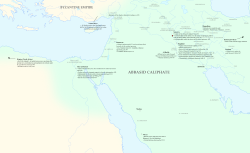
Map of the Mihna and events associated with it

The Mihna (Arabic: محنة خلق القرآن, romanizedmiḥna khalq al-qurʾān, lit.'ordeal of Quranic createdness') was a period of religious persecution instituted by the Abbasid caliph al-Ma'mun in 833 in which Sunni scholars were punished, imprisoned, or even killed[1] unless they conformed to Mu'tazilite doctrine. The policy lasted for eighteen years (833–851) as it continued through the reigns of al-Ma'mun's immediate successors, al-Mu'tasim and al-Wathiq, and four years of al-Mutawakkil who reversed it in 851.[2][3]

The abolition of Mihna is significant both as the end of the Abbasid Caliph's pretension to decide matters of religious orthodoxy, and as one of the few instances of religious persecution among fellow Muslims in Medieval Islam.[4]

Under al-Ma'mun

[edit]

In 827, the caliph al-Ma’mun issued the proclamation of the doctrine of Quranic createdness. The proclamation was followed by the institution of the Mihna six years later, approximately four months before his sudden death in 833.[5] The Mihna continued under his successors, al-Mu’tasim and al-Wathiq, before al-Mutawakkil abolished it between 848 and 851. This particular doctrine was well known to be embraced by the Mu'tazilite school during this period. Muʿtazilites believed that good and evil were not always determined by revealed scripture or interpretation of scripture, but they were rational categories that could be established through unaided reason.

Traditional scholarship viewed the proclamation of doctrine and the Mihna where al-Ma’mun tested the beliefs of his subordinates as linked events, whereby the caliph exercised his religious authority in defining orthodoxy, and enforced his views upon others through his coercive powers as ruler. Al-Ma’mun's motivations for imposing his beliefs upon the members of his government (such as his judges, for the scope of the Mihna was not extended to examining the beliefs of the commoners in the manner of the European Inquisitions) were attributed to his Mu'tazilite intellectual tendencies, his sympathies towards Shia Islam, or a shrewd decision to consolidate his religious authority during a time where the ulama were starting to be seen as the true guardians of religious knowledge and the Prophet's traditions.

Events and explanations

[edit]

Explanation 1: Al-Ma’mun and Mu’tazilism

Scholars who ascribe the Mihna to al-Ma'mun’s Mu'tazilite persuasion point to his close association with leading Mu’tazilites of the era.[6] Among the Mu’tazilites al-Ma’mun appointed to high positions within his administration include Ahmed ibn Abi Du’ad, a prominent Mu’tazilite who became Chief Qadi during his rule.[7] Due to Ibn Abi Du’ad's background as a Kalam scholar and his rigorous advocacy of the Mihna under the subsequent two caliphs, some scholars have concluded that his influence led to al-Ma’mun finally taking action and implementing the Mihna during the last year of his life. However it remains unclear whether the appointment of Ibn Abi Du’ad is a cause or reflection of al-Ma’mun's plans to institute the Mihna.

Explanation 2: Al-Ma’mun's Pro-Shi’ite Tendencies

More so than other caliphs, Al-Ma’mun demonstrated a closeness with members of the Alid family and some of their doctrines, leading some scholars to suggest that he may have adopted some of their views. A distinguished religious scholar himself, al-Ma’mun's letters to his prefects to initiate the inquisition seem to convey the notion that his knowledge and learning was at a higher level than that of the public or even other religious scholars, who were likened to the vulgar mob who have no insight or illumination on matters pertaining to God.[8] This view is similar to the Shi’i belief that the Imam alone held the esoteric knowledge regarding the Qur'an and matters of faith. In addition to adopting the title of imam, Al-Ma’mun extended special conciliatory gestures to the family of Alids, as evident in his designation of ‘Ali al-Rida as his heir and the special reverence he held for ‘Ali that he also made into a doctrine. Shi’ism, like Mu’tazilism, embraced the doctrine of the createdness of the Qur'an, therefore some scholars construe al-Ma’mun's declaration of this doctrine and the Mihna as reflections of his partiality to Shi’ite doctrines, whereas suggesting that al-Mutawakkil's revocation of the edict was in part rooted in his antagonism towards the Alids.[7]

However, this depiction of using the createdness of Qur'an as a litmus test for Mu’tazilism or Shi’ism can be misleading. While there is an overlap between the two schools of thought on this question, Mu’tazilism and Shi’ism were not the only theological currents to subscribe to this belief, therefore there may not necessarily be a link between the two in the event of al-Ma’mun's Mihna. Furthermore, it is inconclusive whether Shi’ism during this period had fully embraced the notion of the createdness of the Qur'an, or whether it is a retrojection from later times after Sunni and Shi’ism had developed its doctrines. While some scholars argue that the prevailing view among Shi’ite theologians at this time followed the teachings of Ja’far as-Sadiq, who believed in its uncreatedness, other sources challenge whether Imam Ja’far as-Sadiq held such a view.

Explanation 3: Mihna as an Assertion of Caliphal Authority

Some of the more recent scholarship on the Mihna suggests that al-Ma’mun may have used it as an opportunity to reassert his religious authority as Caliph. In a series of letters to his governors, al-Ma’mun's elaborated on the caliph's role as the guardian of God's religion and laws. He appeared to draw upon the Shi’ite notion that the caliph-imam alone possessed esoteric knowledge, and used this to emphasis his role as an educator to lead the people out of ignorance in religious matters. Al-Ma’mun's Mihna appeared to be an effort to wrestle authority over religious knowledge from the scholars (‘ulama), notably from traditionalists such as Ahmed ibn Hanbal whose authority to interpret the religion was rooted in their expertise in the Prophet's traditions. However, in the longer trend of pre-modern Islamic history, religious authority would become the exclusive purview of the scholars, while the caliph was reduced first to a political authority, and gradually to a symbolic entity. This explanation for the Mihna is the position taken up by most modern scholars.

Under al-Mu'tasim

[edit]

al-Ma'mun died in 833, but his policy was continued by al-Mu'tassim. In that same year the famous religious scholar Ahmad ibn Hanbal was put to the question, to which he answered that the Qu'ran was uncreated. Al-Mu'tasim removed him from his post, imprisoned him, and had him flogged until he was unconscious. However, the people of Baghdad threatened to riot at the news of ibn Hanbal's arrest, and al-Mu'tasim had him released.[9] al-Mu'tasim was afterwards preoccupied with the construction of the new capital at Samarra and with military campaigns, and did not pursue the Mihna as anything more than a courtroom formality (the testimony of a person who answered in the negative was inadmissible in court.)[10][11]

Aftermath

[edit]

It is important to note that in classical Islam, it was private individuals and not the caliphate who undertook the mission of developing the various Islamic sciences including the law. That is, the law, contrary to what happens in modern nation states, was not the exclusive preserve of the state. In fact, the jurists developed it in conscious opposition to the state (e.g., Jackson, 2002). From early on, there was a religious order in classical Islam that was distinct from the political order. The semi-autonomy of the scholars resulted in the interesting phenomenon of the emergence of different, and regarding some issues, diametrically opposed schools of jurisprudence—all considered Islamically valid and authentic. The Mihna, within this context, reflects the caliph's frustration with the powerful and influential juristic culture. It lasted about fifteen years, after which the domains of authority of both the political and religious orders became more well-defined. This does not mean that confrontation was the hallmark of the relationship between both orders. The relationship was more nuanced and involved not only confrontation but also collaboration. Generally speaking, the religious order stood as a buffer between the political order and the common people.


The rise of literal interpretation and the centrality of the Sunnah

The literal interpretation of the Qur’an was adopted in theological matters as the basis. The Sunnah (the reliable actions and sayings of the Prophet Muhammad) was given a divine and sacred nature and an important legislative source, in addition to marginalizing opinion and relying on the statements of ancient scholars in resolving theological disputes.

References

[edit]

Sources

[edit]
Revisions and contributorsEdit on WikipediaRead on Wikipedia
from Grokipedia
The miḥna (: ميحنة, meaning "" or "testing") was a doctrinal enforced by Abbasid caliphs from 833 to 848 CE (218–234 AH), requiring Islamic scholars and judges to affirm the Mu'tazilite tenet that the was created in time rather than eternally uncreated, with dissenters facing interrogation, imprisonment, flogging, or execution. Initiated by Caliph through inquisitorial tribunals starting in and extending across the , the policy stemmed from the caliph's adoption of Mu'tazilite , which prioritized human reason in and viewed the uncreated Quran doctrine as anthropomorphic or limiting divine transcendence. Continued aggressively under and , the miḥna targeted traditionalist (aṣḥāb al-ḥadīth) scholars who upheld the Quran's eternal attributes based on prophetic traditions and early consensus, marking a rare instance of caliphal overreach into Sunni orthodoxy's core beliefs. The inquisition's most emblematic victim was Ahmad ibn Hanbal, the eponymous founder of the Hanbali school of jurisprudence, who endured prolonged imprisonment and public flogging in 834 CE for refusing to equivocate on the issue, thereby symbolizing resistance grounded in scriptural literalism over speculative theology. While many officials and jurists complied to preserve positions, widespread scholarly defiance eroded the policy's legitimacy, culminating in its abrupt termination by Caliph al-Mutawakkil in 848 CE, who reinstated the uncreated Quran view and persecuted Mu'tazilites in turn. This reversal not only halted state-sponsored rationalism but reinforced the independence of religious scholars (ʿulamāʾ) from caliphal authority, shaping the trajectory of Sunni Islam toward textual traditionalism and limiting future theological impositions by rulers.

Theological and Historical Background

The Mu'tazilite Doctrine of the Created Quran

The Mu'tazilite doctrine posited that the , as the speech of , is created (makhluq) rather than eternal and uncreated, a position rooted in the imperative to safeguard divine transcendence and unity (). This view held that attributing an uncreated, co-eternal Quran to would imply a multiplicity of eternal entities, compromising God's absolute oneness by suggesting an independent divine attribute akin to a separate being. To avert (tashbih), which they equated with associating partners with (shirk), Mu'tazilites argued that God's speech constitutes a temporal act manifested through creation, such as in the hearts of prophets or inscribed tablets, rather than an inherent, pre-existent quality. Emerging from theological debates in the early CE in , the doctrine developed within the Mu'tazila's broader rationalist framework of , or speculative , which elevated human reason () as a primary tool for interpreting over unqualified adherence to scriptural literalism. Influenced by Hellenistic philosophical methods introduced via translations during the Abbasid era, Mu'tazilites employed dialectical reasoning to resolve apparent contradictions between divine attributes described in the —such as speech, knowledge, and will—and the principle of God's incomparability (tanzīh). This approach prioritized logical consistency, positing that eternal attributes must be understood as identical to God's essence to avoid implying composition or change in the divine, with the Quran's createdness serving as a logical deduction from these premises rather than a direct scriptural assertion. The doctrine's implications extended to rejecting literal interpretations of Quranic references to God's "hand" or "face" as metaphorical, reinforcing a non-corporeal view of to preserve causal realism in attributing actions solely to God's will without implying physicality. By framing the as created, Mu'tazilites sought to affirm God's freedom from temporal limitations, arguing that an uncreated speech would bind God to its content eternally, potentially restricting divine . This rationalist emphasis distinguished Mu'tazila from traditionist scholars who upheld the Quran's uncreated status based on transmissions, highlighting an early intellectual tension over the boundaries of reason in Islamic . Under Caliph al-Ma'mun (r. 813–833 CE), the doctrine received Abbasid court patronage, elevated as a marker of intellectual orthodoxy to foster unity amid the empire's diverse theological currents and Greek philosophical influx. Al-Ma'mun's endorsement in 827 CE positioned Mu'tazilism as state-favored, integrating it into administrative and scholarly circles to counter perceived fragmentation from literalist interpretations. This alignment reflected the caliph's vision of rational theology as a tool for imperial cohesion, though it later precipitated enforcement measures.

Traditionalist and Hadith-Scholar Opposition

The Traditionalists, particularly scholars of the movement, rejected the Mu'tazilite assertion of the 's createdness by maintaining that it constitutes God's eternal speech (kalām Allāh), an uncreated divine attribute subsisting in His essence. This view upheld divine immutability and transcendence, arguing that labeling the as created would imply a temporal origination in God, thereby compromising His eternal perfection and introducing potential plurality or change into the divine nature. They supported this through direct scriptural evidence, such as 85:21-22 referencing a "guarded tablet" (lawḥ maḥfūẓ) and prophetic traditions affirming the Quran's pre-existence, emphasizing that God's speech is not a created entity but an inherent attribute like knowledge or will. Central to their opposition was a commitment to taqlīd—unquestioning adherence to the and authentic —over speculative (kalām), which they criticized for relying on Greek-influenced that risked negating divine attributes (taʿṭīl) or likening to creation (tashbīh). Ahl al- proponents, including early figures like Sufyan ibn Uyaynah (d. 198 AH/814 CE), prioritized textual literalism and prophetic precedent, viewing Mu'tazilite interpretations as innovative deviations (bidʿah) that undermined the Quran's infallibility and the Sunna's authority. This scripturalist approach contrasted sharply with Mu'tazilite efforts to reconcile faith with reason, often accusing the latter of subordinating revelation to human logic. Pre-Mihna intellectual tensions emerged in the late 2nd/, as scholars in centers like and resisted proto-Mu'tazilite proponents who promoted the createdness doctrine in informal debates and court circles. For instance, Yahya ibn Sa'id al-Qattan (d. 198 AH/814 CE), a leading transmitter, refused to engage affirmatively, declaring such matters beyond human speculation and leaving them to divine knowledge, thereby exemplifying early non-coercive pushback against rationalist encroachments on . These exchanges highlighted a growing divide, with Traditionalists safeguarding prophetic tradition against philosophical dilutions, setting the stage for doctrinal polarization without yet involving state intervention.

Pre-Mihna Intellectual Tensions in the Abbasid Caliphate

The Abbasid translation movement, beginning under Caliph al-Mansur (r. 754–775 CE) and intensifying during the reigns of Harun al-Rashid (r. 786–809 CE) and al-Ma'mun (r. 813–833 CE), systematically rendered Greek philosophical works—such as those of Aristotle, Plato, and Galen—alongside Persian and Indian texts into Arabic, fostering a rationalist intellectual environment in Baghdad's House of Wisdom. This influx encouraged speculative theology (kalam), particularly among the Mu'tazila, who prioritized human reason ('aql) to discern divine justice and unity, viewing it as complementary to revelation rather than subordinate. Mu'tazili thinkers, emerging in the 8th century in Basra and Baghdad, argued for the created nature of the Quran to preserve God's transcendence, drawing on these foreign influences to challenge anthropomorphic interpretations of scripture. Caliphs like , influenced by Persian viziers and a desire to consolidate authority amid provincial unrest, patronized Mu'tazila as a means to legitimize state oversight of religious interpretation, seeing their emphasis on rational and ('adl) as tools for political stability. In 827 CE (212 AH), al-Ma'mun issued a decree affirming the Quran's created status, elevating Mu'tazili doctrine to a position of official favor without immediate coercive measures, which signaled the caliphate's intent to intervene in theological disputes traditionally handled by independent scholars. This move intertwined intellectual patronage with political strategy, as Mu'tazila's rationalism appealed to an urban, bureaucratic elite, contrasting with the caliphs' earlier tolerance of diverse sects to maintain Abbasid legitimacy post the 750 CE revolution against the Umayyads. Opposing this rationalist tide, traditionalist scholars (Ahl al-Hadith), centered in Baghdad, Kufa, and Medina, gained prominence by the early 9th century through meticulous hadith compilation and literalist exegesis, rejecting kalam as speculative innovation (bid'ah) that risked corrupting core beliefs. Figures like Ahmad ibn Hanbal (780–855 CE) emphasized unadulterated transmission of prophetic traditions over philosophical deduction, viewing Mu'tazili methods as influenced by non-Islamic sources that undermined scriptural primacy. These traditionists, often from provincial scholarly networks, challenged caliphal pretensions to dogmatic authority, advocating decentralized ijma' (consensus) among muhaddithun (hadith experts) and resisting state-imposed fiqh uniformity, which heightened tensions as Abbasid rulers sought to curb autonomous religious voices amid fiscal and military pressures. The resulting divide—rationalists aligned with courtly power versus traditionists defending textual orthodoxy—prefigured direct confrontations, reflecting causal links between intellectual pluralism, imported ideas, and struggles over interpretive sovereignty in the caliphate's heartland.

Initiation and Early Enforcement

Al-Ma'mun's Decree of 833 CE

In 218 AH (March 833 CE), Caliph issued a initiating the mihna, dispatching letters from his in Tarsus to qadis, jurists, and provincial officials across the Abbasid domains, particularly in . These missives explicitly required recipients to publicly affirm the doctrine that the was created (makhluq), a position aligned with Mu'tazilite theology, as a test of doctrinal and loyalty to caliphal authority. The decree framed non-compliance as a rejection of rational inquiry and imperial unity, mandating that affirmers continue in office while dissenters face immediate consequences. The letters outlined administrative mechanisms for enforcement, instructing officials to convene assemblies for interrogation and to forward reports of responses to the caliph. Al-Ma'mun personally oversaw the process, viewing it as an extension of his patronage for rationalist scholarship and efforts to centralize religious authority under the amid rising influence from traditionist scholars. Issued amid his campaign against the Byzantines, the decree represented a culminating assertion of caliphal prerogative in theological matters, though al-Ma'mun died shortly thereafter on 18 Rajab 218 AH (9 August 833 CE) in Tarsoz, before widespread implementation could unfold under his direct supervision. Initial enforcement saw compliance from key figures, notably the Mu'tazilite jurist Ahmad ibn Abi Du'ad, whom had elevated to chief of . Ibn Abi Du'ad affirmed the createdness doctrine and facilitated the establishment of mihna tribunals in the capital, where officials were summoned to profess adherence, setting the procedural template for subsequent interrogations. This early acquiescence among judicial elites enabled the decree's rollout, though resistance emerged among hadith-oriented scholars, marking the onset of targeted examinations.

Initial Interrogations and Scholarly Responses

began enforcing the mihna through targeted interrogations shortly after his decree in 218 AH ( 833 CE), personally summoning seven prominent jurisconsults (fuqahāʾ) from to affirm the createdness of the . These scholars, including figures like Yahya ibn Aktham, the chief (qāḍī al-quḍāt), were questioned directly by the caliph during his campaign in the east. Most assented to the doctrine under interrogation, with reports indicating that these initial respondents succumbed to pressure, setting a for coerced among the scholarly elite. Yahya ibn Aktham exemplified reluctant compliance; despite his known opposition to Muʿtazilite theology and preference for Sunni traditionalism, he affirmed the Quran's createdness to preserve his position, reflecting the tension between personal conviction and caliphal authority. In contrast, a minority of early interrogations elicited outright refusals from traditionists, who invoked hadith-based arguments for the Quran's uncreated eternity, demonstrating initial scholarly resolve against doctrinal imposition. Such resistance, though limited, underscored the emerging divide between rationalist state enforcement and traditionist adherence to prophetic reports. The interrogations quickly extended beyond Baghdad to provincial centers, including Rayy and , where governors like ʿAbd Allāh ibn Ṭāhir oversaw questioning of local qadis and fuqahāʾ. Non-compliance prompted coercive measures such as flogging or , as seen in cases where scholars rejected the , aiming to compel symbolic submission from administrative and judicial elites rather than widespread popular enforcement. This initial phase, curtailed by al-Ma'mun's death in Dhū al-Ḥijja 218 AH (August 833 CE), focused on high-status figures to legitimize the policy, with compliance rates higher among those integrated into Abbasid governance.

Continuation and Peak under Successors

Policies under (833–842 CE)

Upon succeeding his brother in Rajab 218 AH (September 833 CE), continued the mihna, honoring al-Ma'mun's deathbed exhortation to enforce the Mu'tazilite doctrine of the Quran's createdness among scholars and judges. Under his rule, the inquisitorial process became more systematically administered through the chief judge Ahmad ibn Abi Du'ad, a committed Mu'tazili appointed to oversee interrogations alongside allied qadis who conducted trials targeting non-compliant . These tribunals emphasized public oaths of compliance, with refusal leading to or professional disqualification, as seen in the case of , who was detained in in 218 AH (833 CE) and subjected to prolonged questioning by Ibn Abi Du'ad without yielding. Al-Mu'tasim's policies institutionalized the mihna to subordinate religious to caliphal oversight, reflecting his broader efforts to consolidate power amid reliance on a growing of Turkish ghulām slave soldiers—numbering several thousand by the early 220s AH (840s CE)—who bolstered military campaigns but strained relations with Baghdad's Arab populace. In 220 AH (836 CE), tensions from Turkish troops' clashes prompted al-Mu'tasim to relocate the court to , a new foundation north of , where administrative centralization extended to religious enforcement, aiming to align loyalty with state doctrine against traditionalist resistance. Non-compliance drew escalated measures, including for some scholars like Ishaq ibn Rahawayh and beatings in select cases to deter defiance, though enforcement remained uneven, prioritizing key figures in judicial and scholarly networks over mass . This phase of the mihna intertwined theological coercion with political stabilization, as balanced frontier wars—such as the 223 AH (838 CE) victory over Byzantine forces at Anzen—with internal doctrinal uniformity to legitimize his rule amid empire-wide strains from Khurramite revolts and fiscal pressures. By leveraging Ibn Abi Du'ad's network of Mu'tazili qadis, asserted supremacy over independent scholars, framing resistance as , though Sunni sources later portray Ibn Abi Du'ad's zeal as excessively punitive, biasing accounts against caliphal overreach.

Intensification under al-Wathiq (842–847 CE)

Al-Wathiq, who ascended the in 842 CE following , intensified the mihna by recommitting to the enforcement of Mu'tazilite doctrine, particularly the createdness of the , through systematic interrogations and demands for public affirmations from scholars and judges. In his third regnal year (circa 844–845 CE), he dispatched officials to regional centers beyond to compel oaths of compliance, reviving lapsed efforts from prior reigns and targeting holdouts among the . This escalation reflected al-Wathiq's personal theological commitment to , as evidenced by his portrayal in contemporary accounts as a caliph who enforced the policy not merely for political control but from doctrinal conviction, contrasting with emerging traditionalist resistance in urban populations. The policy under involved widespread dismissals of non-compliant qadis, with historical records indicating the removal of judges in key provinces like , , and for refusing to affirm the doctrine, thereby disrupting judicial administration without achieving doctrinal uniformity. Coercive measures included prolonged imprisonments and instances of flogging for defiant scholars, though outright executions remained exceptional, underscoring the mihna's reliance on over lethal force. Estimates suggest dozens of religious figures faced detention during this period, amplifying narratives of scholarly steadfastness among later Sunni chroniclers, yet failing to erode core opposition from hadith-oriented traditionalists. Influenced by Mu'tazili advisors and court theologians, al-Wathiq's zeal manifested in symbolic trials that publicized the caliphal stance, but popular discontent grew as the alienated pious masses and highlighted the disconnect between Abbasid and grassroots . This phase marked the mihna's peak intensity, with edicts emphasizing public recantations to legitimize caliphal authority in theological matters, yet it inadvertently bolstered martyr-like reputations for resisters, revealing the policy's causal limits in imposing consensus amid decentralized scholarly networks.

Persecutions of Prominent Figures, Including

, founder of the of jurisprudence and a leading proponent of traditionalism, was arrested in 220 AH (835 CE) under Caliph and transported to for interrogation on the createdness of the . Despite repeated sessions before inquisitors including the chief judge Ahmad ibn Abi Du'ad, he steadfastly refused to affirm the doctrine, declaring the uncreated as the speech of God, which led to his flogging with over 1,000 lashes in a public spectacle that left him near death. Imprisoned for approximately 28 months amid ongoing and isolation, his defiance exemplified the doctrinal intransigence of hadith scholars against Mu'tazilite enforced by state authority, earning him posthumous veneration as a for orthodoxy in traditionalist narratives. Other prominent scholars faced similar trials, with outcomes varying by duress applied. Ahmad ibn Nasr al-Khuza'i, a traditionalist judge from Rayy, resisted interrogation under al-Wathiq in 231 AH (846 CE), leading to his execution by crucifixion after refusing to recant, marking one of the few lethal enforcements of the mihna. In contrast, figures like Yahya ibn Ma'in, a hadith expert and associate of ibn Hanbal, initially resisted but eventually acquiesced under prolonged pressure to affirm the created Quran, allowing release and resumption of teaching. Qadis and provincial officials showed higher compliance, with most publicly endorsing the doctrine to retain positions, though private recantations occurred post-miḥna; records indicate only a handful of executions amid widespread imprisonment and flogging, suggesting that while overt resistance was rare, the policy's coercive nature prompted majority superficial conformity rather than genuine doctrinal shift. These persecutions, rather than consolidating Mu'tazilite theology, reinforced traditionalist solidarity by highlighting caliphal overreach; ibn Hanbal's survival and unyielding stance, disseminated through his students' accounts, fortified networks of adherents against perceived state-sponsored innovation, amplifying underground opposition that outlasted the inquisitors' efforts.

Termination and Immediate Aftermath

Al-Mutawakkil's Reversal in 847 CE

Upon ascending the throne in 232 AH (847 CE), Caliph Ja'far immediately initiated of the mihna through decrees issued in 233 AH (847–848 CE), abolishing the inquisitions and prohibiting enforcement of the doctrine that the Qur'an was created. These measures included dismissing the chief , Ahmad ibn Abi Du'ad, who had directed much of the under prior caliphs, and barring Mu'tazili positions from judicial proceedings and public discourse on the Qur'an's nature. summoned traditionalist scholars to , signaling official restoration of their standing and an end to doctrinal coercion. The reversal stemmed primarily from political pragmatism rather than theological conviction, as maneuvered to consolidate power amid dependencies on Turkish military commanders like Itakh and Wasif, who had influenced his . To counter these "kingmakers" and secure broader loyalty, he aligned with Sunni traditionalists, particularly in , where resentment against Mu'tazili policies ran high, thereby quelling public unrest and enhancing caliphal legitimacy without affirming uncreatedness as . This shift addressed instability from provincial challenges and factional rivalries, prioritizing governance over inherited theological disputes. Immediate effects included public announcements of policy cessation, which halted interrogations and marked a caliphal withdrawal from micromanaging religious interpretation, though residual Mu'tazili influence persisted in some administrative roles until further purges. The decrees effectively neutralized the mihna's apparatus, redirecting state resources toward political consolidation.

Release of Imprisoned Scholars and Policy Shifts

Upon ascending to the in 847 CE (232 AH), terminated the mihna, revoking the enforced doctrine of the Quran's created nature and ordering the release of scholars imprisoned during the inquisitions under his predecessors. This included prominent traditionalists such as , who had endured flogging and confinement for refusing compliance. Al-Mutawakkil personally honored Ibn Hanbal upon his release, receiving him with respect, inviting him to deliver lectures on in , and directing the re-establishment of his scholarly circle. The caliph also dispatched financial aid to Ibn Hanbal, who promptly donated it to the poor rather than retaining it personally. In parallel, issued decrees prohibiting any further theological disputations on the 's attributes, effectively halting coercive enforcement of Mu'tazili . He pivoted caliphal patronage toward hadith-based scholars of the Hanbali and Shafi'i schools, sidelining Mu'tazila from influence and even authorizing punishments against public profession of their views, such as the created Quran doctrine. These measures yielded immediate reductions in scholarly dissent and public unrest over religious , fostering short-term alignment between the Abbasid court and traditionalist in and beyond. Nonetheless, the prior overreach bred persistent wariness among the toward caliphal interventions in doctrinal matters, complicating efforts to fully restore pre-mihna relations.

Long-term Consequences and Legacy

Triumph of Traditionalism and Decline of Mu'tazilism

The termination of the Mihna under Caliph in 847 CE marked a pivotal shift, entrenching the of the Quran's uncreated nature (ghayr makhluq) as the normative position in . Traditionalist scholars, exemplified by Ahmad ibn Hanbal's steadfast refusal to affirm the Quran's createdness despite imprisonment and flogging, garnered widespread respect, fostering a post-inquisition consensus that rejected Mu'tazili claims of the Quran's origination ex nihilo as a created entity. This outcome aligned empirical resistance against state coercion with the prevailing scripturalist emphasis on the as Allah's eternal, pre-existent speech, distinct from temporal creation. Emerging Sunni theological schools, including founded by (d. 936 CE) and by (d. 944 CE), integrated rational methods to defend orthodoxy while explicitly upholding the uncreated . Both affirmed the Quran's essence as an eternal divine attribute—uncreated and indivisible from God's knowledge and will—contra Mu'tazili views that subordinated to human reason and posited its creation to preserve divine unity (). This nuanced orthodoxy, distinguishing eternal speech from its created linguistic expressions (e.g., ink, utterance), permeated Sunni madhahib by the 10th century, solidifying rejection of createdness as (innovation). Mu'tazilism's decline accelerated without caliphal enforcement, as traditionalists () and their kalam successors dominated intellectual institutions. By the 10th century, madrasas under Abbasid and regional patronage prioritized hadith-based orthodoxy over speculative theology, marginalizing Mu'tazili rationalism which had relied on state-backed inquisitions for propagation. The Mihna's coercive failure empirically demonstrated that imposed doctrines eroded legitimacy, validating traditionist fidelity to transmitted texts over rationalist constructs, and curtailing state intervention in creed formation thereafter.

Impact on Caliphal Authority and Sunni Orthodoxy

The failure of the Mihna eroded Abbasid caliphs' pretensions to supreme religious authority, as the widespread resistance from —targeting around 44 prominent traditionists and judges—exposed the impracticality of enforcing doctrinal conformity through state coercion. Al-Ma'mun's initiative to centralize interpretive power by sidelining scholarly independence backfired, shifting caliphal focus from theological to mere demands for obedience and ultimately decentralizing religious decision-making. This outcome empowered the as autonomous heirs to prophetic , solidifying their role in defining and fostering a traditionist Sunnite corpus that privileged transmission over caliphal rationalism. The Mihna's reversal under in 848–849 CE marked a pivotal separation of political rulership from doctrinal guardianship, setting precedents for ulama precedence in religious matters that diminished caliphal influence over subsequent centuries. Hanbali resilience, epitomized by Ahmad ibn Hanbal's (d. 855 CE) unyielding opposition, fortified Sunni traditionalism against Mu'tazili challenges, directly shaping later formulations of orthodoxy such as (933 CE), a creed codifying uncreated Quranic eternality and consensus-based beliefs reflective of post-Mihna scholarly triumph. The episode's legacy included a strategic aversion to doctrinal inquisitions among later caliphs, who opted for pragmatic restraint in theological disputes to avert public and scholarly backlash, thereby prioritizing political stability over ideological uniformity.

Historiographical Debates and Interpretations

Debates on Caliphal Motives: Power vs. Theology

Historians have long debated whether the Abbasid caliphs, particularly (r. 813–833 CE), initiated the Mihna primarily to consolidate political power or out of genuine theological commitment to Mu'tazilite rationalism, with primary sources like the caliph's decretal letters providing key . In these letters, dispatched starting in Rabī‘ I 218 AH ( 833 CE) to officials such as the governor of , explicitly positioned himself as khalīfat Allāh (God's deputy) and imām al-hudā (imam of right guidance), claiming divinely inspired authority to interpret doctrine and enforce the createdness of the as a test of , amid challenges from traditionist scholars (muḥaddithūn) who increasingly mediated religious knowledge independently of caliphal oversight. This assertion of interpretive supremacy targeted jurists and judges, framing not merely as theological error but as defiance of caliphal , especially in the context of political instability including Alid revolts that questioned Abbasid legitimacy. Arguments favoring a power-consolidation motive emphasize how the Mihna served as a mechanism to reassert caliphal dominance over an emergent scholarly class that had eroded executive religious authority since the late . Scholars such as and Martin Hinds interpret the policy as a strategic response to the 'ulamā''s growing influence, with leveraging the ambiguous doctrine of to expose and subordinate opponents rather than resolve a purely doctrinal dispute. Similarly, John Nawas argues that the represented a deliberate quest to secure "full control" for the caliphal institution by integrating theological enforcement with obedience tests, as evidenced by the letters' shift from doctrinal argumentation to demands for submission when intellectual resistance persisted. This view aligns with empirical patterns in the letters, which list specific targets—including up to 44 named individuals like judges and traditionists—for and potential , prioritizing unified communal adherence under caliphal guidance over voluntary consensus. Counterarguments for theological sincerity highlight al-Ma'mun's patronage of mutakallimūn (rationalist theologians) and translators, including the establishment of the (Bayt al-Ḥikma) in around 830 CE to promote Hellenistic-influenced rational inquiry, suggesting a conviction that Mu'tazilite principles like divine unity and necessitated doctrinal reform. Proponents such as Muhammad Qasim Zaman and Nimrod Hurvitz contend that the caliph's letters demonstrate an intent to "guide religious thought" through rationalist theology, viewing the createdness doctrine as essential to preserving God's transcendence against anthropomorphic traditionalism. However, this sincerity is critiqued as overstated, since the coercive framework—evident in threats of heresy charges and public shaming—ignored the necessity of heartfelt assent (i'tiqād) for genuine theological adherence, a point underscored by traditionist resistance that treated forced professions as invalid. A hybrid interpretation, advanced by several analysts, reconciles these views by positing that theological provided ideological cover for political aims, with the Mihna's ultimate failure—marked by widespread scholarly non-compliance and its termination under in 847 CE—revealing the limits of authoritarian coercion in enforcing belief systems. While 's letters invoke both scriptural and claims to prophetic , the policy's design as an amid Alid threats and 'ulamā' indicates rationalism was instrumentalized to bolster legitimacy, yet the resort to force exposed underlying authoritarian priorities over doctrinal purity. This perspective privileges the primary sources' emphasis on caliphal supremacy, suggesting that while personal conviction may have motivated al-Ma'mun, the Mihna's structure prioritized power consolidation in a fragmenting .

Modern Scholarly Perspectives on Coercion and Rationalism

Contemporary scholarship critiques the Mihna as an ill-fated experiment in state-sponsored rationalism, where Mu'tazili doctrines—emphasizing reason (ʿaql) and the createdness of the Quran—were imposed through interrogations, floggings, and exiles rather than dialectical persuasion. This coercive apparatus, active from 218/833 under Caliph al-Ma'mun to 234/847, alienated key jurists and hadith scholars, fostering resentment that undermined the very intellectual openness Mu'tazilism purported to champion. Analyses, such as those by John Nawas, draw on archival evidence of non-compliance rates among provincial judges (only about 10-15% fully capitulated), illustrating how force generated superficial recantations but no broad theological shift. Empirical assessments refute notions of the Mihna as a sustainable vector for rationalist reform, highlighting its rapid collapse upon al-Mutawakkil's revocation in 234/847, which restored traditionalist primacy and precipitated Mu'tazilism's institutional decline by the 4th/10th century. The policy's failure stemmed from causal mismatches: beliefs rooted in textual literalism resisted speculative kalam under duress, as sustained adherence requires internal conviction absent in coerced settings, per studies on caliphal-ulama dynamics. This outcome empirically validated traditionalist resilience, with figures like Ahmad ibn Hanbal's defiance symbolizing the inefficacy of inquisitorial methods in altering entrenched scriptural commitments, ultimately eroding Abbasid religious authority for generations. Interpretations diverge: traditionalist-oriented scholars, echoing post-Mihna Sunni narratives, frame the episode as orthodox triumph over rationalist overreach, crediting autonomy for preserving unmediated against state . Secular critiques, as in Sherman Jackson's works, decry the Mihna's dogmatic enforcement akin to later inquisitions, yet emphasize its distinct backfire in constraining caliphal overreach without endorsing unqualified tolerance; instead, data shows coercion's universal tendency to provoke backlash, particularly when rationalist claims clashed with popular . Recent deconstructions, like those questioning Mu'tazili orchestration (e.g., by Howard Turner), attribute failure less to than political miscalculation, debunking idealized views of the Mihna as "enlightened" by exposing its role in entrenching through enforced limits on uniformity.

References

Add your contribution
Related Hubs
User Avatar
No comments yet.