Hubbry Logo
Buyid dynastyBuyid dynastyMain
Open search
Buyid dynasty
Community hub
Buyid dynasty
logo
8 pages, 0 posts
0 subscribers
Be the first to start a discussion here.
Buyid dynasty
Buyid dynasty
from Wikipedia

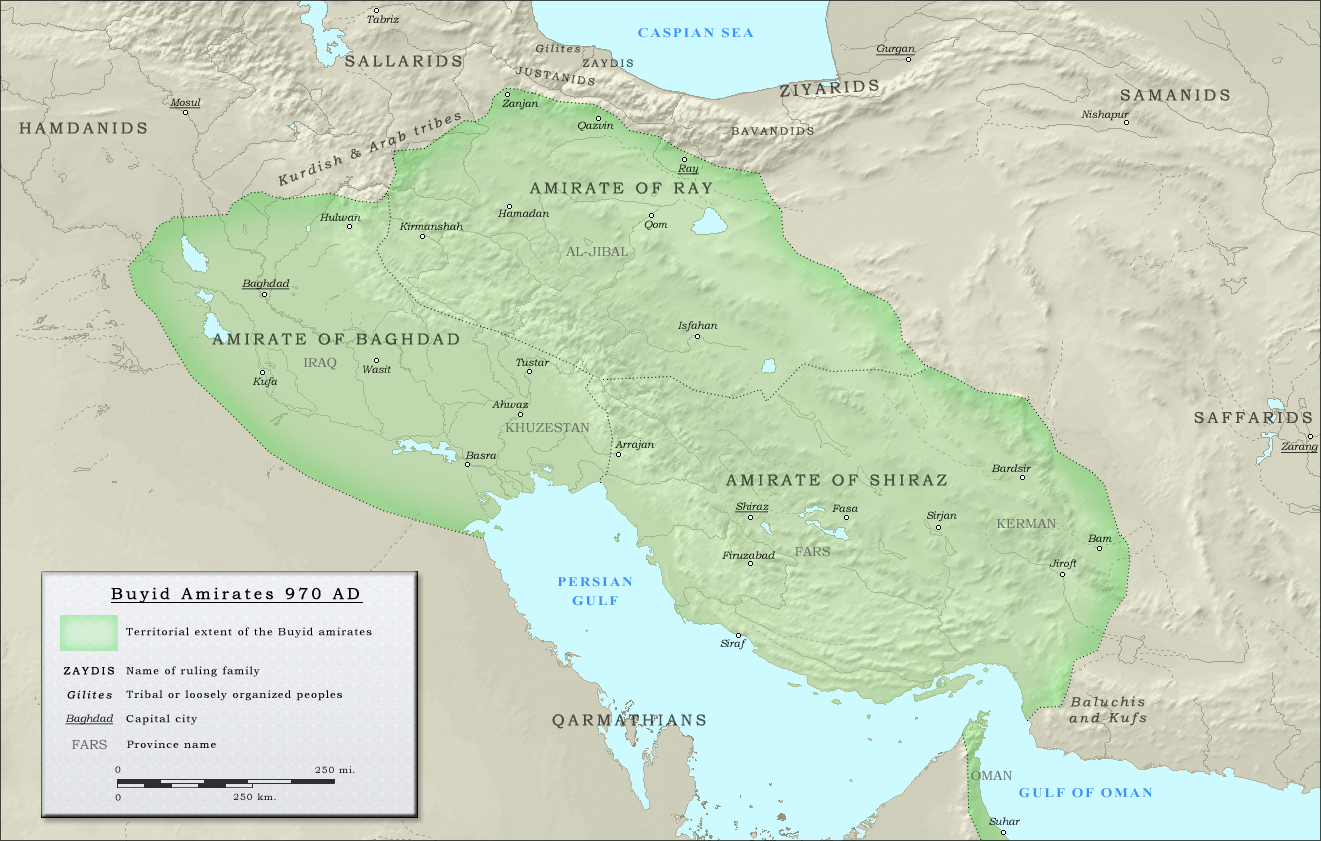
The Buyid dynasty[a][b] or Buyid Empire was a Zaydi and later Twelver Shi'a dynasty of Daylamite origin.[3][c] Founded by Imad al-Dawla,[9] they mainly ruled over central and southern Iran and Iraq from 934 to 1062. Coupled with the rise of other Iranian dynasties in the region, the approximate century of Buyid rule represents the period in Iranian history sometimes called the Iranian Intermezzo.[10]

Key Information

The Buyid dynasty was founded by Ali ibn Buya, who in 934 conquered Fars and made Shiraz his capital. He received the laqab or honorific title of Imad al-Dawla (lit.'Fortifier of the State'). His younger brother, Hasan ibn Buya (r. 935–976) conquered parts of Jibal in the late 930s, and by 943 managed to capture Ray, which he made his capital. Hasan was given the laqab of Rukn al-Dawla (lit.'Pillar of the State'). In 945, the youngest brother, Ahmad ibn Buya, conquered Iraq and made Baghdad his capital. He was given the laqab Mu'izz al-Dawla.

As Iranians of Daylamite provenance, the Buyids consciously revived symbols and practices of the Sasanian Empire.[11] Beginning with Imad al-Dawla, some of the Buyid rulers used the ancient Sasanian title of Shahanshah, literally "king of kings".[3] The Buyids had many inscriptions carved at the Achaemenid ruins of Persepolis, thus suggesting a form of veneration of the site, which the Buyids thought was built by the mythical Iranian king Jamshid.[12]

The Buyid dynasty reached its zenith under Fannā Khusraw (r. 949–983), whose laqab was Adud al-Dawla. who is remembered for his open-mindedness and building projects such as the Band-e Amir dam near Shiraz.[13] Under him, the Buyid realm stretched from the Byzantine border in Syria in the west to the borders of Khorasan in the east.[14]

Although the Buyids were initially Zaydi Shia, they became Twelver Shia following the Major Occultation of Muhammad al-Mahdi after the death of his fourth agent in 941. Regardless, the Buyids were known for supporting the Sunni Abbasid caliphs and being tolerant of the Sunni population, who formed the majority of their realm. They were, by contrast, unfriendly towards the Fatimid Caliphate centered in Egypt, who were Isma'ilis.[13]

Contrary to the Samanids, who ruled over a mostly Sunni Muslim population in Central Asia, the Buyid realm was populated by many Zoroastrians and Christians (primarily of the Church of the East). Because of this, many records written under the Buyids were composed in Middle Persian, Syriac and Arabic.[13]

Origins

[edit]

The word Būya (Buwayh in Arabic) is a Middle Persian name ending in the diminutive ـویه (Middle Persian -ōē, modern Persian -ūyeh, Arabic -uwayh). The Buyids were descendants of Panah-Khusrow, a Zoroastrian from Daylam. He had a son named Buya, who was a fisherman from Lahijan,[15] and later left Zoroastrianism and converted to Islam.[16] Buya later had three sons, named Ahmad, 'Ali, and Hasan, who would later carve out the Buyid kingdom together. The Buyids claimed royal lineage from Bahram V (r. 420–438), the King of Kings (shahanshah) of the Sasanian Empire.[17]

History

[edit]

Rise (934–945)

[edit]

The founder of the dynasty, 'Ali ibn Buya, was originally a soldier in the service of the Daylamite warlord Makan ibn Kaki,[18] but later changed his allegiance to the Iranian ruler Mardavij, who had established the Ziyarid dynasty, and was himself related to the ruling dynasty of Gilan,[19] a region bordering Daylam. 'Ali was later joined by his two younger brothers, Hasan ibn Buya and Ahmad ibn Buya. In 932, 'Ali was given Karaj as his fief, and thus was able to enlist other Daylamites into his army. However, 'Ali's initiative proved too much for Mardavij, who planned to have him killed, but 'Ali was informed of Mardavij's plan by the latter's own vizier. The brothers, with 400 of their Daylamite supporters, then fled to Fars,[20] where they managed to take control of Arrajan.[21] However, the Buyids and the Abbasid general Yaqut shortly fought for control of Fars, with the Buyids eventually emerging victorious.[18] This victory opened the way for the conquest of the capital of Fars, Shiraz.[22]

'Ali also allied with the landowners of Fars, which included the Fasanjas family, which would later produce many prominent statesmen for the Buyids. 'Ali also enlisted more soldiers—including Turks, who were made part of the cavalry. 'Ali then sent his brother Ahmad on an expedition to Kerman, but was forced to withdraw after opposition from the Baloch people and the Qafs.[23] However, Mardavij, who sought to depose the Abbasid caliph of Baghdad and recreate a Zoroastrian Iranian Empire, shortly wrested Khuzestan from the Abbasids and forced 'Ali to recognize him as his suzerain.[24]

Luckily for the Buyids, Mardavij was assassinated shortly thereafter in 935, which caused chaos in the Ziyarid territories, a perfect situation for the Buyid brothers; Ali and Ahmad conquered Khuzistan, while Hasan captured the Ziyarid capital of Isfahan, and, in 943, captured Rey, which became his capital, thus conquering all of Jibal. In 945, Ahmad entered Iraq and seized control of Baghdad, leaving the Abbasid court with no real option but to submit to their authority as de facto rulers.[25] He received the laqab Mu'izz ad-Dawla ("Fortifier of the State"), while 'Ali was given the laqab Imād al-Dawla ("Support of the State"), and Hasan was given the laqab Rukn al-Dawla ("Pillar of the State"). The Buyids constructed a royal palace (Dar al-Mamlaka) in Baghdad, situated just north of the caliphal palace (Dar al-Khilafa), symbolizing a division of authority.[26] Meanwhile, the caliph’s influence continued to decline—he no longer had a vizier and effectively became a figurehead under Buyid control.[26]

Height of power and Golden age (945–983)

[edit]
Gold ewer of the Buyid Period, mentioning Buyid ruler Izz al-Dawla Bakhtiyar ibn Mu'izz al-Dawla, 966–977 CE, Iran.[27]

In addition to the other territories the Buyids had conquered, Kerman was conquered in 967, followed by Oman (967), the Jazira (979), Tabaristan (980), and Gorgan (981). After this, however, the Buyids went into a slow decline, with pieces of the confederation gradually breaking off and local dynasties under their rule becoming de facto independent.

Decline and fall (983–1062)

[edit]

The death of Adud al-Dawla is considered the start of the decline of the Buyid dynasty;[28] his son Abu Kalijar Marzuban, who was in Baghdad when he died, at first kept his death secret to ensure his succession and avoid civil war. When he eventually made the death of his father public, he was given the title of "Samsam al-Dawla". However, Adud's other son, Shirdil Abu'l-Fawaris, challenged his authority, and the feared civil war occurred anyway.[29] Meanwhile, a Kurdish Marwanid chieftain named Badh ibn Dustak seized Diyabakr and forced Samsam al-Dawla to recognize him as the vassal ruler of the region.[29] Furthermore, Mu'ayyad al-Dawla, son of and successor to Rukn al-Dawla, also died during this period. Mu'ayyad al-Dawla was succeeded by his brother Fakhr al-Dawla, who, with the aid of Mu'ayyad al-Dawla's vizier Sahib ibn 'Abbad, became the ruler of Mu'ayyad al-Dawla's possessions.[30] Another son of Adud al-Dawla, Abu Tahir Firuzshah, established himself as the ruler of Basra and took the title of "Diya' al-Dawla", while another son, Abu'l-Husain Ahmad, established himself as the ruler of Khuzistan, taking the title of "Taj al-Dawla".

Coinage of Buyid amir Abu Kalijar (r.1024–1048)

Shirdil Abu'l-Fawaris (known by his title of "Sharaf al-Dawla") quickly seized Oman from Samsam al-Dawla, and, in 983, the Turkic troops of Samsam al-Dawla mutinied against him and some left Iraq for Fars, but most of them were persuaded by his relative Ziyar ibn Shahrakawayh to stay in Iraq. However, Iraq was in a grim state, and several rebellions occurred, which he managed to suppress, the most dangerous being that of Asfar ibn Kurdawayh, who tried to make Abu Nasr Firuz Kharshadh (known by his title of "Baha' al-Dawla") the ruler of Iraq. During the same period, Samsam al-Dawla also managed to seize Basra and Khuzistan, forcing his two brothers to flee to Fakhr al-Dawla's territory.

During the mid-11th century, the Buyid amirates gradually fell to the Ghaznavids and Seljuk Turks. In 1029, Majd al-Dawla, who was facing an uprising by his Daylami troops in Ray, requested assistance from Mahmud of Ghazna.[31] When Sultan Mahmud arrived, he deposed Majd al-Dawla, replaced him with a Ghaznavid governor and ended the Buyid dynasty in Ray.[31][32]

In 1055, Tughril conquered Baghdad, the seat of the caliphate, and ousted the last of the Buyid rulers.[3] Like the Buyids, the Seljuks kept the Abbasid caliphs as figureheads.[33]

Government

[edit]

The Buyids established a confederation in Iraq and western Iran. This confederation formed three principalities: one in Fars, with Shiraz as its capital, the second one in Jibal, with Ray as its capital, and the last one in Iraq, with Baghdad as its capital. However, during their late period, more principalities formed in the Buyid confederation. Succession was hereditary, with rulers dividing their land among their sons.

The title used by the Buyid rulers was amir, meaning "governor" or "prince". Generally, one of the amirs would be recognized as having seniority over the others; this individual would use the title of amir al-umara,[34] or senior amir. Although the senior amīr was the formal head of the Būyids, he did not usually have any significant control outside of his amirate; each amir enjoyed a high degree of autonomy within his territories. As mentioned above, some stronger amirs used the Sassanid title of Shahanshah. Furthermore, several other titles such as malik ("king"), and malik al-muluk ("king of kings"), were also used by the Buyids. On a smaller scale, the Buyid territory was also ruled by princes from other families, such as the Hasanwayhids.

Military

[edit]
Silk with depiction of horsemen, produced under the Buyids

During the beginning of the Buyid dynasty, their army consisted mainly of their fellow Daylamites, a warlike and brave people of mostly peasant origin, who served as foot soldiers. The Daylamites had a long history of military activity dating back to the Sasanian period, and had been mercenaries in various places in Iran and Iraq, and even as far as Egypt. The Daylamites, during a battle, normally bore a sword, a shield, and three spears. Furthermore, they were also known for their formidable shield formation, which was hard to break through.[35]

However, when the Buyid territories increased, they began recruiting Turks into their cavalry,[22] who had played a prominent role in the Abbasid military.[36] The Buyid army also consisted of Kurds, who, along with the Turks, were Sunnis, while the Daylamites were Shi'i Muslims.[37] However, the army of the Buyids of Jibal was mainly composed of Daylamites.[38]

The Daylamites and Turks often quarrelled with each other for dominance within the army.[39] To compensate their soldiers, the Buyid amīrs often distributed iqtāʾs, or the rights to a percentage of tax revenues from a province (tax farming), although the practice of payment in kind was also frequently used.[40] While the Turks were favoured in Buyid Iraq, the Daylamites were favoured in Buyid Iran.[41]

Culture

[edit]

Language

[edit]

Contrary to the Samanids, the Buyids did not adopt Dari (also known as New Persian) as their official language.[42] Instead, Arabic served as the lingua franca of their realm, while Middle Persian was occasionally used as a secondary court language.[2] Although the Buyids were of Iranian stock, they supported writing in Arabic, and also used the language in their correspondence, as well as poetry.[3]

Silver medallion of Adud al-Dawla with Middle Persian legends
One of the two Arabic inscriptions of Adud al-Dawla in Persepolis

It is uncertain why the Buyids did not promote the use of New Persian. According to the historians Edmund Herzig and Sarah Stewart in their book Early Islamic Iran (2011), it may have been due to three factors; the Buyids had been influenced during their stay in Baghdad and thus aspired to be important supporters of Arabic writing; New Persian may have been discouraged by the Zoroastrian priests, who still wrote in Middle Persian in regions such as Fars; New Persian may have been very different/at odds with the dialects of western Iran, and was only mostly welcomed in eastern Iran.[43]

However, New Persian was still used as language of poetry at the Buyid courts. Many prominent poets in the Buyid realm wrote in New Persian, such as Abu Muhammad Mansur ibn Ali al-Mantiqi al-Razi, Khusrawi Sarakhsi and Abu Zayd Muhammad ibn Ali al-Ghada'iri al-Razi.[3] The Persian vizier Sahib ibn Abbad (died 995), who was the leading figure at the Buyid court at Ray for a lengthy period, wrote only in Arabic, which he preferred instead of his native tongue. However, he also accepted New Persian panegyrics that were dedicated to him.[44]

The Buyids also promoted the use of fahlaviyat,[43] a designation for poetry composed in the local northwestern Iranian dialects and languages.[45][46] Due to having a large Zoroastrian and Christian population, many records written under the Buyids were composed in Middle Persian, Syriac and Arabic.[13]

Naming traditions, celebrations and identity

[edit]

While the brothers that established the Buyid kingdom had the Arabic names of Ali, Hasan, and Ahmad, the second Buyid generation notably had Iranian names, such as Kamrava, Marzuban, Bahram and Khusraw.[2] The Buyids had many inscriptions carved at the Achaemenid ruins of Persepolis, thus suggesting a form of veneration of the site, which the Buyids thought was built by the mythical Iranian king Jamshid.[12] Adud al-Dawla celebrated the ancient Iranian festivals of Sadeh and Mehregan, and like many previous Islamic rulers—including the caliphs—he most likely celebrated Nowruz as well. He used Nowruz as a model for two newly created festivals, which were celebrated annually in the town of Fana Khusraw-gird.[14]

Under the Buyids, the idea of "Iranshahr" (Iran) appears in geographical works, which were all written in Arabic by mostly Iranian authors. The geographer Istakhri, who was active in the late 10th-century and wrote; "The best cultivated (ma‘mur), fairest and most fertile part of the world, and the most established in its political life is the kingdom of Iranshahr."[44]

Herzig and Stewart adds that;[43]

Considered together the preceding materials offer important clues to the question of Iranian identity under the Buyids. In the first instance we have rulers who are unashamedly Iranian and who sought by genealogy, title and homage to Persepolis to show their connection with the pre-Islamic Iranian past. At the same time, the inhabitants of the Buyid kingdoms and eastern Iranians showed a sometimes embarrassingly high level of self-esteem as the people of Iranshahr.

Religion

[edit]

Like most Daylamites at the time, the Buyids were Shia and have been called Twelvers.[47] However, it is likely that they began as Zaydis.[48][49] Moojen Momen explains this transition from Zaydism to Twelverism, by noting that, since the Buyids were not descendants of Ali, the first Shi'i Imam, Zaydism would have required them to install an Imam from Ali's family. So, Buyids tended toward Twelverism, which has an occulted Imam, a more politically attractive option to them.[48]

The Buyids rarely attempted to enforce a particular religious view upon their subjects except in matters where it would be politically expedient. The Sunni Abbasids retained the caliphate but were deprived of all secular power.[50] In addition, to prevent tensions between the Shia and the Sunnis from spreading to government agencies, the Buyid amirs occasionally appointed Christians to high offices instead of Muslims from either sect.[51]

Architecture

[edit]

Under the supervision of the Buyids, large construction and engineering projects took place, such as irrigation systems and agricultural developments, all of which led to an increase in income. In comparison to other local rulers in Iraq, particularly the Baridis and Hamdanids, it was clear that the Buyids had a liking to construction projects. When Mu'izz al-Dawla arrived in Iraq, the country had been ravaged as a result of local struggles over control of Baghdad. Under his instructions, the Baduriya dam on the Rufayl river was restored, subsequently resulting in lower prices of common foods, such as bread. This also inspired people to migrate to Baghdad.[3]

It was during the reign of Adud al-Dawla that most of the Buyid construction and restoration projects took place. Under him, Shiraz became so crowded that the garrison had no place to roam, which led Adud al-Dawla to have a special quarter created, Fana Khusraw-gird ("Fana Khusraw made it"), a name which deliberately reflected the name of towns established by the Sasanian kings.[3][14] The town of Firuzabad, considered to be linked to the Sasanian king Ardashir I (r. 224–242), was revamped by Adud al-Dawla, possibly done in order to stress his claim to Sasanian ancestry. One of Adud al-Dawla's lasting building projects was the mausoleum erected on the burial place of Ali.[3]

Buyid rulers

[edit]
Buyid era art: Painted, incised, and glazed earthenware. Dated 10th century, Iran. New York Metropolitan Museum of Art.

Major rulers

[edit]

Generally, the three most powerful Buyid amirs at any given time were those controlling Fars, Jibal and Iraq. Sometimes a ruler would come to rule more than one region, but no Buyid rulers ever exercised direct control of all three regions.

Buyids in Fars

Buyids in Ray

Buyids in Iraq

Minor rulers

[edit]

It was not uncommon for younger sons to found collateral lines, or for individual Buyid members to take control of a province and begin ruling there. The following list is incomplete.

Buyids in Basra

Buyids in Hamadan

Buyids in Kerman

Buyids of Khuzistan

Family tree

[edit]
Buya
Imad al-Dawla
934–949
Rukn al-Dawla
935–976
Mu'izz al-Dawla
945–967
Kama
Abu Ishaq IbrahimIzz al-Dawla
967–978
Sanad al-DawlaMarzubanZubaydaAbu TahirAli ibn Kama
Marzuban ibn BakhtiyarSalarUnnamed princess
Fakhr al-Dawla
976–997
'Adud al-Dawla
949–983
Mu'ayyad al-Dawla
980–983
Shams al-Dawla
997–1021
Majd al-Dawla
997–1029
Sharaf al-Dawla
983–989
Samsam al-Dawla
983–998
Baha' al-Dawla
998–1012
Shahnaz
Sama' al-Dawla
1021–1024
Qawam al-Dawla
1012–1028
Sultan al-Dawla
1012–1024
Musharrif al-Dawla
1021–1025
Jalal al-Dawla
1027–1044
Fana-KhusrauAbu Dulaf
Abu Kalijar
1024–1048
Al-Malik al-AzizAbu Mansur Ali
Abu Ali Fana-KhusrauAbu Mansur Fulad Sutun
1048–1062
Al-Malik al-Rahim
1048–1055
KamravaAbu'l-Muzaffar BahramAbu Sa'd Khusrau Shah
Abu'l-Ghana'im al-MarzubanSurkhab

See also

[edit]

Notes

[edit]

References

[edit]

Sources

[edit]
Revisions and contributorsEdit on WikipediaRead on Wikipedia
from Grokipedia
The Buyid dynasty (934–1062), also known as the Buwayhids, was a Shiʿite dynasty of Daylamite origin that ruled over western and as well as , effectively dominating the in from 945 onward as emirs while nominally preserving the caliphal institution. Founded by the three brothers ʿImād al-Dawla (ʿAlī), Rukn al-Dawla (Ḥasan), and Muʿizz al-Dawla (Aḥmad), sons of the fisherman Būya b. Fannā Ḵosrow from the mountainous region in Gilān, the dynasty rose through under the Ziyarid ruler Mardāvīj before capitalizing on his in 935 to seize Fārs, with ʿImād al-Dawla establishing as a base. By 945, Muʿizz al-Dawla's forces entered unopposed, securing the title of amīr al-umarāʾ and reducing the Sunni Abbasid caliphs to ceremonial roles, a sustained through a pragmatic balance of Shiʿite leanings and administrative tolerance toward Sunni populations and institutions. The dynasty's territorial peak came under ʿAżod al-Dawla (r. 949–983), grandson of ʿImād al-Dawla, who unified disparate Buyid principalities across Fārs, Khūzistān, Jibāl, and by 980, adopting regal titles like šāhānšāh that evoked pre-Islamic Persian sovereignty and extending influence to and the trade routes. Buyid rulers fostered a cultural efflorescence, particularly in Rayy and , patronizing , kalām , and Shiʿite scholarship amid a broader revival of Iranian traditions and speculative thought, which contributed to intellectual advancements despite underlying sectarian tensions. Internal fratricidal conflicts and overextension precipitated fragmentation after ʿAżod al-Dawla's death in 983, culminating in the Seljuq Turks' conquest of in 1055 and Fārs in 1062, which ended Buyid dominance and restored Sunni authority under a new imperial order.

Origins

Daylamite Roots and Founding Brothers

The inhabited the mountainous regions of northern , particularly the highlands between the and the Mountains, where their tribal societies maintained a reputation for martial prowess as heavily armed infantry spearmen and axemen, often forming disciplined phalanxes that proved effective against cavalry-heavy armies. Their resistance to Arab Muslim conquests in the 7th and 8th centuries was among the most sustained in , with and adjacent Gilan evading full subjugation until the , preserving elements of pre-Islamic Zoroastrian practices and local autonomy amid broader Persian Islamization. This isolation fostered a warrior culture that supplied forces to caliphal and regional powers, capitalizing on their tactical edge in close-quarters combat. The Buyid dynasty traced its lineage to this Daylamite milieu, with the eponymous founder Buya (Būyeh), a man of modest origins—described in historical accounts as a fisherman or rural laborer who converted to —fathering the key progenitors (c. 890–949), Hasan ibn Buya (died 976), and (died 967). , the eldest and primary instigator, assumed leadership of the brothers' early endeavors, earning the honorific upon his initial successes; Hasan later became Rukn al-Dawla, and Ahmad Mu'izz al-Dawla, reflecting their coordinated rise through military titles rather than hereditary nobility. The family's ascent stemmed from pragmatic alliances as Daylamite mercenaries, initially serving under the Samanid amirate's Daylamite general Makan b. Kaki before defecting to the Ziyarid ruler , exploiting intertribal rivalries and the erosion of Abbasid oversight. This opportunistic emergence aligned with the Abbasid Caliphate's deepening fragmentation by the early , as provincial dynasties like the Saffarids in eastern and Samanids in weakened central authority through fiscal overreach and internal revolts, creating power vacuums in the that mobile Daylamite warbands could exploit via short-term contracts and betrayals. The brothers' motivations appear rooted in economic survival and territorial aggrandizement rather than ideological crusades, leveraging their infantry expertise and ties to secure local lordships amid the caliphate's "centrifugal tendencies" that diminished Baghdad's ability to enforce from peripheral governors. Such dynamics underscored the Buyids' transition from tribal auxiliaries to autonomous emirs, prioritizing martial utility over doctrinal affiliation in a era of caliphal impotence.

Initial Conquests in Fars (934–941)

ʿAlī ibn Būya, later known as ʿEmād al-Dawla, initiated the Buyid expansion into Fārs in spring 933 by advancing against the province, where he faced resistance from Yāqūt, the Abbasid caliphal governor tasked with maintaining central authority amid Baghdad's weakening grip. Exploiting rivalries among Abbasid officials, such as Muḥammad b. Rāʾeq and Bačkam, ʿAlī's forces—bolstered by a core of Daylamite warriors attracted through his reputed generosity—occupied Arrajān before decisively defeating Yāqūt, enabling entry into Shīrāz by mid-934 and establishing initial control over key urban centers. In Šawwāl 934 (September-October), ʿAlī secured legitimacy by obtaining an investiture patent for Fārs's governorship from the caliph's , framing his rule as a restoration of order under Abbasid rather than outright rebellion, despite the dynasty's emerging Shīʿī sympathies. This tactical alignment with the caliph, coupled with prior service under the Ziyārid ruler Mardāvīj (including a negotiated that sent his brother Ḥasan as ), allowed ʿAlī to deflect external threats; Mardāvīj's assassination in Ṣafar 323/January 935 created a , enabling ʿAlī to capitalize on Ziyārid disintegration and solidify dominance without immediate large-scale rivals. By designating Shīrāz as the administrative base, ʿAlī consolidated gains through 941, minting coins acknowledging caliphal sovereignty (as seen in issues from 336-37/947-49, reflecting retroactive formalization) and leveraging Daylamite military prowess to suppress local unrest, though full titles like ʿEmād al-Dawla were granted later in 334/945. The Abbasid fiscal and political collapse, marked by ineffective provincial oversight and inter-gubernatorial conflicts, causally facilitated this independence, as central revenues dwindled and local warlords filled the void without provoking direct reprisal.

Rise to Power

Expansion into and (941–945)

Following the consolidation of Fars under ʿAlī ibn Būya (Imād al-Dawla), his brother Ḥasan ibn Būya (later Rukn al-Dawla) directed efforts northward into (Media), securing control over much of the region after the assassination of the Ziyarid ruler Mardāvīj in 323/935, with further stabilization by 941 through occupation of key areas south of the Caspian Mountains. Leveraging Daylamite infantry and alliances with local Shiʿite elements opposed to Abbasid and Sunni dominance, Ḥasan captured and advanced to Ray, establishing it as his base by 943 after overcoming residual local resistance. This expansion relied on fraternal coordination, as the brothers divided spoils to form semi-independent domains—Ḥasan in —while maintaining unity against shared threats like Ziyarid remnants. Concurrently, the youngest brother Aḥmad ibn Būya (Muʿizz al-Dawla) pushed westward from Khuzestan, where he had established incursions in the 320s/930s, targeting Iraq's periphery to challenge Hamdanid rivals controlling and . Between 941 and 943, Aḥmad's forces, heavily reliant on disciplined Daylamite foot soldiers, clashed with Hamdanid Nāṣer al-Dawla in the Wasit region, initially allying with the Baridi governors of and against the Baghdad-based Turkish amir Bajkam before turning on the Baridis to seize Khuzestan fully. These maneuvers avoided direct confrontation with the Abbasid caliph in , focusing instead on peripheral gains and Shiʿite sympathies among Iraqi populations to erode Hamdanid influence without overextending into the caliphal core. The brothers' strategic division fostered resilience, as Ḥasan's holdings provided a northern flank against common foes, enabling Aḥmad's incremental advances toward central .

Seizure of Baghdad and Caliphal Suzerainty (945)

In 945, following the collapse of the administration under the Turkish and the Ibn Shirzad, Mu'izz al-Dawla Ahmad ibn Buya advanced on with his Daylamite forces, entering the city without significant resistance on 11 Jumada I 334 AH (19 December 945 CE). This seizure marked the culmination of Buyid expansion into , shifting effective control from the fragmented Abbasid military elites to the Iranian dynasty while nominally upholding the caliphate's authority. Caliph bi-Allah, facing the depletion of resources and the Buyid blockade, formally invested Mu'izz al-Dawla as (commander of commanders), the paramount military office that had previously been held by Turkish generals. The caliph also conferred the honorific title Mu'izz al-Dawla (Fortifier of the Dynasty) upon , alongside recognizing his brothers' governorships in their respective territories, thereby legitimizing Buyid overlordship through Islamic ceremonial rather than outright replacement of the Sunni Abbasid institution. This arrangement preserved the caliph's role in religious endorsements, such as appointing judges (qadis), but subordinated Baghdad's fiscal and coercive apparatus to Buyid direction. Buyid suzerainty entailed direct extraction of Iraq's revenues, which Mu'izz al-Dawla allocated independently for military maintenance and provincial grants (iqta), reducing the caliph's appanage to a stipend contingent on Buyid approval. Military garrisons composed primarily of Daylamite infantry were stationed in the capital to enforce compliance, supplanting Turkish contingents and quelling localized unrest from displaced Sunni factions, though without systematic religious persecution. Pragmatism dictated tolerance toward the Sunni majority and Abbasid symbolic prestige, as the Shi'i Buyids integrated Sunnism as a parallel legal tradition in Iraq to avert broader instability, countering any immediate drive for doctrinal hegemony. This dual structure—caliphal figureheadship alongside Buyid dominance—sustained administrative continuity amid the dynasty's consolidation.

Period of Dominance

Consolidation under Mu'izz al-Dawla and Rukn al-Dawla (945–976)

Following the seizure of on 19 December 945 (334 AH), Mu'izz al-Dawla Ahmad ibn Buya established his authority as over , centering administration in the Abbasid capital while deferring nominal seniority to his elder brother Rukn al-Dawla Hasan, who consolidated control over with Ray as his stronghold. This fraternal division of territories—Mu'izz in and Khuzestan, Rukn in Media, , and surrounding regions—facilitated mutual support, as Rukn dispatched troops to aid Mu'izz against recalcitrant Turkish amirs and local warlords in . Administrative entrenchment involved reliance on ethnic Daylamite forces supplemented by Turkish mercenaries, granted iqta' lands for loyalty, which enabled effective suppression of rivals but introduced dependencies on factional militias prone to internal fragmentation. Mu'izz focused on securing , capturing from the Baridids around 947 (335 AH) and combating Qarmatian incursions and ʿEmran b. Shahin in the al-Batihah marshes, thereby stabilizing agricultural infrastructure through canal repairs that bolstered fiscal revenues, amassing a personal estate of 400,000 dinars by his death. Recurrent clashes with the Hamdanids, particularly Nasir in the Wasit region and , tested Buyid defenses in northern , where joint familial resources repelled invasions without direct Byzantine entanglement, as the latter primarily targeted Hamdanid frontiers. Viziers like Abu ʿAli al-Muhallabi managed day-to-day governance, integrating Shiʿi scholars into Baghdad's legal framework as a supplementary alongside Sunnism, fostering tentative caliphal under the shadow of Buyid dominance. Tensions arose in 955 (344 AH) when Mu'izz, gravely ill, designated his son Izz al-Dawla as heir, prompting coordination with Rukn to affirm dynastic continuity amid potential challenges from nephews like ʿAdud al-Dawla, though overt was averted through familial preserving the confederation's cohesion. Rukn's steadfast rule in Ray until 976 (366 AH) reinforced eastern bulwarks against Kurdish and Turkish unrest, while Mu'izz's death in 967 (356 AH) left vulnerable yet entrenched, with the brothers' ethnic militia system proving causally efficacious in repelling localized threats despite sowing long-term fissiparous risks.

Zenith under Adud al-Dawla (976–983)

Following the death of his father Rukn al-Dawla in September 976, ʿAḍud al-Dawla inherited the emirate of and asserted seniority over the Buyid . He initiated a against his cousin Samsām al-Dawla, who held sway in and Fars, capturing by early 977 and thereby reunifying the disparate Buyid emirates under his direct control. This consolidation represented the dynasty's peak of centralized power, extending authority from the to the shores of the . To symbolize his preeminence, ʿAḍud al-Dawla adopted the title Shāhanshāh (), evoking Sasanian imperial legacy and underscoring the Buyids' Iranian heritage amid their Shiʿi affiliations. Building on prior expansions, including the subjugation of in 966 and in 967, his domain now commanded key overland and maritime arteries, fostering economic vitality through enhanced security for merchants traversing these routes. Diplomatic initiatives further solidified his position, including negotiations yielding truces with the Fatimid caliphate under al-ʿAzīz Billāh (r. 975–996), which averted conflict along shared frontiers and marked the apex of Fatimid-Buyid engagement. ʿAḍud al-Dawla also extended military support to the Abbasid caliph against domestic challengers, thereby upholding Buyid oversight of the caliphate while extracting legitimacy in return. These maneuvers, grounded in pragmatic power balancing, contributed to regional stability. Infrastructure developments exemplified effective administration, with investments in such as dams and canals that augmented in arid Fars, directly boosting agricultural yields through measurable water management. Control over Gulf ports via Omani holdings formed a , promoting commerce in commodities like spices and textiles, which underpinned fiscal strength without reliance on unsubstantiated narratives of largesse.

Governance and Administration

Political Structure and Emirate System

The Buyid operated as a decentralized of emirates, diverging from the centralized authority idealized in Abbasid caliphal governance. From its establishment in 945, the dynasty divided its territories into three primary principalities: Fars centered on under , Jibal around Ray under Rukn al-Dawla, and with as the base for Mu'izz al-Dawla. These emirs, typically brothers or close kin, exercised significant in their domains while maintaining nominal loyalty to a designated senior ruler, fostering a system reliant on familial bonds rather than unified imperial administration. Legitimacy for Buyid rule was secured through investitures from the Abbasid caliph, whom they controlled as figureheads after seizing in December 945. Emirs received honorific titles such as , enhancing their prestige without granting substantive caliphal oversight. Administrative functions, including fiscal control, were managed via viziers and diwans inherited from Abbasid practices, though these operated under individual emirs and often served as tools for personal enrichment rather than cohesive governance. This familial model harbored inherent instabilities, prioritizing hereditary claims over merit, which precipitated frequent partitions and internal conflicts. Upon the death of a senior , territories were routinely subdivided among heirs, as seen after Adud al-Dawla's demise in 983, fragmenting the realm into rival branches prone to fratricidal wars and coups. Such divisions eroded central authority, contrasting sharply with caliphal aspirations for monolithic rule and ultimately weakening the dynasty against external threats by 1055.

Military Organization and Forces

The Buyid army's core comprised Daylamite infantrymen, who formed the backbone of early forces as ethnic kin to the founding brothers, excelling in close combat with axes and large shields suited to their mountainous origins. These troops provided disciplined, capable of holding lines against charges, adapting defensive tactics from Daylam's rugged terrain—such as fortified positions and ambushes—to open平原 engagements in and Persia. Turkish contingents, introduced later under emirs like Mu'izz al-Dawla (r. 945–967), complemented this by adding mobile striking power, often as slave-soldiers procured from , enabling pursuits and flanking maneuvers essential for conquests beyond the Iranian highlands. Troop remuneration relied on the iqta' system, whereby land grants allocated revenue from taxes to maintain soldiers, supplemented by cash stipends ('arid) to avert mutinies amid fiscal strains from expansion. Under (r. 949–983), separate 'arids were established for Daylamite and Turkish units to manage ethnic divisions, reflecting the army's decentralized structure tied to personal loyalties of individual amirs rather than a centralized command. This hybrid force, blending resilience with versatility, facilitated dominance over Abbasid territories but numbered variably from campaigns, with field armies typically in the range of 20,000 to 50,000 when mobilized for major operations like the 945 seizure of . Ethnic loyalties, while initially a unifying strength for the Daylamite-led Buyids, proved a structural vulnerability as reliance on groups intensified, fostering in iqta' assignments and recurrent revolts. Clashes between and Turks disrupted cohesion, as seen in persistent rivalries that defied unification efforts and contributed to fragmentation among rival Buyid branches by the late . This overdependence on divided ethnic contingents contrasted with the more ideologically and tribally cohesive Turkic armies of successors like the Seljuks, who exploited Buyid disunity to dismantle the dynasty after 1055, underscoring how mercenary incentives eroded long-term stability without broader institutional loyalty.

Provincial Administration and Taxation

The Buyid administration of provinces relied on appointed governors, known as amīrs or shihnas in major cities like and , who exercised fiscal oversight through local intermediaries such as village headmen (raʾīs) and tax collectors (jahbadhs). These officials managed revenue extraction while maintaining a degree of , reflecting the dynasty's fragmented structure of semi-independent principalities in regions like Fārs, Jibāl, and . Unlike the Abbasid caliphate's centralized dīwān system, which funneled taxes to via imperial bureaucracy, Buyid governance decentralized fiscal control, allowing provincial rulers to retain surpluses for local military needs but hindering unified responses to external threats like incursions. Primary taxes included kharāj (land tax), assessed on cultivated areas either as a fixed sum per unit (e.g., 3–15 dirhams per jarīb of grain in Qom) or via muqā-sama (a share of yields), and jizya (poll tax on non-Muslims), collected separately but often bundled in practice. Under Adud al-Dawla (r. 949–983), kharāj assessments expanded by a tenth through intensified measurement of arable land, boosting collections amid territorial consolidation, though actual yields varied due to arrears and negotiated exemptions. Provincial eqṭāʿ grants—temporary land assignments for military service—further decentralized taxation, with grantees handling local levies directly, a shift from Abbasid norms that prioritized state registries. Revenue peaked during Adud al-Dawla's reign, with provinces like Fārs and yielding substantial flows to sustain court and armies, exemplified by Qom's assessment exceeding 3 million dirhams annually (of which roughly 80% was realized). However, systemic inefficiencies eroded gains: via tax-farming collusions between officials and notables inflated burdens on peasants while officials siphoned shares, and unequal impositions—often heavier on rural dehqāns than urban elites—fostered evasion and economic strain, contributing to fiscal fragility amid dynastic infighting. This decentralized model, while enabling initial expansion, ultimately weakened central authority, as provincial hoarding limited resources for broader defense by the late 10th century.

Religious Policies

Shia Twelver Affiliation and Imami Support

The Buyids, of Daylamite origin, initially followed Zaydi Shiism but transitioned to Twelver (Imami) doctrine, likely motivated by political alignment with the post-occultation Imami community following the of the twelfth in 941 CE. This shift predated their full consolidation of power in 945 CE and facilitated doctrinal commitments to the Imamate's and the hidden Imam's authority, as evidenced by their endorsement of Imami theological texts and rituals. Buyid rulers extended institutional patronage to prominent Imami scholars, enhancing the authority of the Twelver learned in Baghdad and . For instance, under emirs like Mu'izz al-Dawla (r. 945–967 CE), scholars such as (d. 1022 CE) received protection and resources to compile foundational works on Imami and , including treatises on the that reinforced Twelver . This support extended to funding scholarly circles and disseminating Imami ideas without enforcing doctrinal uniformity on the broader , prioritizing cohesion over mass proselytization. The dynasty's Imami affiliation manifested in targeted infrastructure, such as the reconstruction of Shia mausoleums housing the remains of Imams like (d. 799 CE) and (d. 835 CE) in al-Kazimayn near during the mid-10th century. These efforts, undertaken by rulers including (r. 949–983 CE), aimed to bolster pilgrimage sites central to Twelver devotion rather than ideological imposition, reflecting pragmatic legitimacy derived from Shia symbolism amid Sunni-majority territories. Far from establishing a radical theocracy, Buyid Shiism served causal ends of dynastic stability, leveraging Imami networks for administrative without altering the empire's predominantly Sunni character.

Relations with Abbasid Caliphs and Sunni Majorities

The Buyids seized on 11 Jumada I 334/19 December 945, installing Muʿizz al-Dawla as amīr al-umarāʾ under Caliph al-Mustakfī, whom they deposed shortly thereafter in favor of al-Muṭīʿ, thereby confining the to a ceremonial role that provided religious legitimacy for Buyid authority without abolishing Sunni rites or the caliphal office itself. This arrangement preserved the Abbasids as symbolic figureheads, with Buyid rulers seeking formal caliphal to underscore continuity in Islamic governance amid their military dominance. Subsequent Buyid emirs, such as ʿAḍud al-Dawla (r. 367–372/976–983), integrated caliphal prestige into their administration by including their names in the khutba immediately after the caliph's, while respecting the Abbasid retention of religious and judicial functions, though caliphs occasionally resisted, as when al-Ṭāʾīʿ rejected a proposed . Later, Caliph al-Qādir (r. 381–422/991–1031) asserted doctrinal independence by promulgating the Qādirī creed in 409/1018, which targeted Shiʿi and Muʿtazilī positions to reinforce Sunnī orthodoxy, reflecting enduring caliphal agency despite Buyid oversight. Such dynamics prioritized pragmatic legitimacy over sectarian overhaul, contrasting with the Fatimids' direct challenge to Abbasid claims. The Buyids exercised de facto tolerance toward the Sunni majority, refraining from enforced conversions or systematic suppression of Sunnism due to reliance on Sunni Turkish troops and the demographic realities of and , where Sunnis predominated. They permitted the persistence of Sunnī scholarship, madrasas, and administrative roles, favoring no sect exclusively in patronage and avoiding policies that would fracture Islamic unity against external threats like the . This approach sustained governance stability, as evidenced by the absence of widespread sectarian purges and the caliphs' continued public observance of Sunnī rituals under Buyid protection.

Instances of Sectarian Tension and Favoritism

In , Buyid sponsorship of public Shi'i rituals, such as processions commemorating the martyrdom of , provoked sectarian violence, including riots in 972 CE that resulted in significant destruction and bloodshed between Shi'i and Sunni factions. Later Sunni chroniclers, like , attributed such unrest directly to Buyid encouragement of these displays, which alienated the Sunni majority and fueled retaliatory clashes. Buyid rulers demonstrated favoritism toward their core Daylamite Shia troops, granting them preferential status in military commands and administrative roles over Sunni and Turkish elements, which bred and occasional mutinies. This ethnic-religious alignment prioritized Shi'i Imami networks from , exacerbating intra-military tensions and contributing to episodes of violence, as Daylamite units often clashed with Sunni levies in Baghdad's quarters. In the Ray region, the fragmented Buyid emirates—marked by rival branches under emirs like Fakhr al-Dawla—intensified Shia-Sunni conflicts through competing patronage of religious scholars and institutions, leading to street clashes and scholarly polemics in the . Multiple Buyid governors vied for local dominance, each bolstering Shia Twelver while marginalizing Sunni Hanafi and Shafi'i establishments, resulting in documented riots and forced conversions reported in contemporary accounts. Such instances of favoritism, while not amounting to systematic , empirically deepened communal fissures by privileging Shi'i elites and troops, rendering Buyid territories vulnerable to unified Sunni challengers like the Ghaznavids and Seljuks, whose religious cohesion facilitated conquests amid Buyid internal divisions. Primary sources from the era, including those by Ibn Miskawayh, highlight how this bias undermined broader stability, as Sunni populations increasingly viewed Buyid rule as partisan overreach rather than neutral governance.

Economy and Society

Agricultural and Trade Foundations

The Buyid economy derived substantial revenue from in core territories such as Fars and , where established networks, including qanats originating from earlier Persian traditions, facilitated the production of staple crops like and . These systems, maintained and possibly expanded under Buyid rule, supported agrarian output essential for sustaining the dynasty's military apparatus, though specific quantitative increases in yields during the period remain undocumented in primary sources. initiatives, attributed to Buyid emirs, likely contributed to enhancements, enabling reliable harvests in arid regions dependent on artificial water distribution. Trade supplemented agricultural foundations, with Buyid control over ports enabling commerce in luxury goods such as from Jibal workshops and imported spices routed via the network. This access to maritime routes connected and Fars to broader exchange systems, yielding tariffs and tolls that bolstered fiscal resources, particularly under unified rule during ʿAḍud al-Dawla's reign (949–983). However, the iqṭāʿ system—land grants assigned to military officers in lieu of salaries—prioritized martial loyalties over market-oriented reforms, often distorting agricultural incentives by embedding fiscal extraction within feudal-like obligations rather than fostering commercial innovation. Dynastic wealth primarily stemmed from conquests and territorial tributes rather than technological advancements in production, rendering the economy vulnerable to external shocks like Ghaznavid raids in 1029 and Seljuk invasions culminating in 1055, which disrupted trade conduits and maintenance. Such dependencies on centralized oversight for water amplified risks from neglect or conflict-induced breakdowns, contributing to post-983 fiscal strains despite temporary minting expansions under peak rulers.

Urban Development and Social Hierarchies

Under the Buyids, urban centers like and underwent significant infrastructural enhancements to support administrative control and population growth. In , following the dynasty's seizure of power in 945, rulers such as ʿAḍud al-Dawla (r. 949–983) addressed the city's dilapidated state by restoring neglected canals in the district and constructing public facilities, including the Bīmāristān ʿAḍudī hospital, which improved and for the densely populated urban core. These projects stabilized the city's economy amid prior Abbasid decline but were often tied to the rulers' need to legitimize authority through visible . Shiraz, elevated as a primary capital under Imād al-Dawla (r. 934–949) and subsequent emirs, saw expansions including the construction of mosques, palaces, and fortified walls incorporating the Qur'an Gate, alongside hydraulic works like the Band-e Amīr dam to bolster agriculture and urban water access. These developments reflected the Buyids' Daylamite-Persian roots, prioritizing Persian heartlands over Arab-dominated , though maintenance often faltered amid dynastic fragmentation post-983. Social hierarchies under Buyid rule emphasized ethnic and stratification, with Daylamite warriors—recruited from the dynasty's northern Iranian origins—forming an class privileged through land grants (iqṭāʿ) and administrative roles, superseding and Turkic elements in the and court. Persian bureaucrats managed provincial affairs, benefiting from cultural affinity, while the Sunni majority in faced marginalization, exacerbated by Shia favoritism in appointments. This structure relied on networks for stability, yet Daylamite dominance fostered ethnic resentments, manifesting in urban riots and populace uprisings against perceived neglect of local classes. Slavery persisted as a foundational element, with household slaves (often war captives or purchased) supporting households, though Buyids de-emphasized slave armies in favor of free Daylamite , reducing mamlūk influence compared to prior Turkic systems. Urban guilds, emerging in crafts like textiles and metalwork, provided some economic autonomy to artisans but remained subordinate to oversight, reinforcing class divides without challenging the military-aristocratic apex. Women's roles adhered to prevailing Islamic legal norms, confining most to domestic spheres with limited property and seclusion, though females occasionally influenced dynastic alliances via ; public participation was rare, reflecting patriarchal enforcement over ethnic lines. Such hierarchies sustained Buyid cohesion through targeted favoritism but sowed seeds of instability via alienated urban underclasses.

Cultural and Intellectual Life

Patronage of Scholarship and Literature

The Buyid rulers extended to scholars and litterateurs, fostering a revival of authorship, translation, and historical compilation during the . Courts in , , and Ray hosted intellectuals who produced works on history, , and , often tailored to affirm dynastic legitimacy through claims of cultural and intellectual continuity. This support emphasized empirical observation in sciences like and astronomy, with court-based scholars generating practical manuals that advanced specialized knowledge amid political fragmentation. In , (r. 949–983) founded a palace stocking manuscripts from early onward, which enabled systematic collection, preservation, and activities to bolster scholarly output. Similarly, Ray's Buyid administration under figures like Rukn al-Dawla (r. 932–976) maintained libraries that attracted historians such as Abu Ali Miskawayh, whose chronicles documented dynastic events and served as resources for contemporaries. These institutions prioritized verifiable records and scientific treatises over speculative philosophy, reflecting rulers' interest in projecting erudition as a tool for authority rather than pure altruism. Buyid encouragement of Persian epic traditions complemented administrative texts, yielding early compositions that drew on pre-Islamic lore for narrative histories, though outputs remained tied to courtly flattery and regional identity assertion. Overall, this era's intellectual investments yielded tangible advancements in and proto-empirical methods, yet were constrained by patronage's instrumental motives, limiting broader dissemination beyond elite circles.

Architectural Achievements

The Buyid dynasty's architectural endeavors prioritized functional , particularly hydraulic works that sustained in arid regions, over ostentatious displays. ʿAḍud al-Dawla (r. 949–983), the most prolific patron, constructed the Band-e Amīr dam-bridge across the Kor River, approximately 20 km northeast of , in the late ; this structure diverted water for , powering mills and supporting regional cultivation through a combination of earthen embankments and stone reinforcements typical of Persian engineering continuity from Sassanid precedents. Similar dams on the Kur River further exemplified empirical adaptations for flood control and , demonstrating durability through centuries of use despite later deteriorations. Religious architecture under Buyid rule advanced mosque designs in urban centers like , where patronage fostered localized innovations amid Shia-leaning governance. The Jūrjīr Mosque, commissioned circa 985 by al-Ṣāḥeb ibn ʿAbbād, incorporated a portal with rectilinear geometric brick patterns—muqarnas precursors—that integrated Abbasid elements with Persian motifs, yielding structures resilient to seismic activity via interlocking masonry techniques. Buyid expansions in Isfahan's during the similarly emphasized expansive courtyards and minarets for communal utility, blending functional space with subtle decorative restraint compared to later Seljuk elaborations. Palatial and urban projects reinforced administrative control, as seen in ʿAḍud al-Dawla's development of the Kard-e Now suburb outside , featuring gated enclosures, audience halls, and irrigated gardens that channeled Sassanid axial layouts into Islamic frameworks for and leisure. Fortification walls encircling Isfahan's core under Buyid oversight, with twelve gates, prioritized defensive solidity using local and baked , outlasting many contemporaneous Mesopotamian builds through adaptive foundations. These achievements, while fiscally intensive, yielded measurable returns via enhanced land productivity, underscoring a pragmatic legacy over stylistic novelty.

Linguistic Shifts and Persian Revival

During the Buyid era (934–1055 CE), Arabic retained its dominance as the primary language of administration and high scholarship, particularly in the conquered territories of and western , where the dynasty's rule extended caliphal bureaucratic traditions. However, Persian gained traction in courtly and literary spheres, reflecting the Daylamite origins of the Buyids and their emphasis on Iranian cultural elements as a counter to prolonged following the Islamic conquests. Viziers and amirs, such as those documented by the philosopher Abu Hayyan al-Tawhidi, frequently conducted affairs in Persian at provincial courts in regions like Fars and Rayy, fostering an environment where emerged as a vehicle for and informal discourse. This usage marked a pragmatic resurgence, driven by the dynasty's Iranian ethnic base rather than explicit policy mandates, as continued to underpin legal and diplomatic documents to maintain continuity with Abbasid institutions. New Persian literature, already nascent under preceding Samanid patronage, flourished under Buyid rulers through support for poets who composed in the vernacular, including figures like Abu Dulaf Misari and others active in Shiraz and Baghdad. These works, often lyrical and panegyric, incorporated themes of Iranian kingship and nature, helping standardize New Persian syntax and vocabulary derived from Middle Persian substrates while adapting Arabic script and loanwords. Daylamite linguistic influences, stemming from the dynasty founders' Caspian origins, introduced northwestern Iranian dialectal features—such as certain phonetic shifts and vocabulary—into courtly Persian, though these were subsumed into the emerging Dari variant centered in eastern Iran. Unlike the Samanids' more systematic promotion of Persian prose, Buyid contributions emphasized poetic forms, with no surviving administrative edicts or chronicles fully in New Persian; historical records like those of Ibn Miskawayh remained in Arabic. This linguistic evolution under the Buyids contributed to broader Iranian autonomy by challenging the cultural hegemony of , enabling a synthesis that preserved pre-Islamic Persian motifs in an Islamic framework. Rulers like (r. 949–983 CE) evoked Sasanian legacies through symbolic acts, such as inscribing at , which underscored awareness of ancient Iranian heritage even if executed in . The period's patronage thus laid groundwork for New Persian's maturation, culminating in its adoption as a literary by the Seljuk era, as a causal outcome of dynastic power shifting to non-Arab Iranian elites who prioritized ethnic continuity over caliphal linguistic uniformity.

Decline and Collapse

Internal Dynastic Strife and Succession Crises (983–1027)

Upon the death of ʿAḍud al-Dawla in Shawwāl 372/March 983, without a designated successor, his territories fragmented amid rival claims by his sons, initiating a period of intense dynastic conflict. Eldest son Abū Kālīdjār Marzbān, known as Samsām al-Dawla, swiftly proclaimed himself amīr al-umarāʾ in Baghdad, securing control over Iraq and Khūzistān. However, his brother Sharaf al-Dawla Shirzīl challenged this by invading Khūzistān and southern Iraq, sparking immediate hostilities that exposed the fragility of hereditary partitions without unified command. This division, intended to distribute power among kin, instead bred incessant warfare, as familial bonds proved insufficient to restrain ambitions, contrasting with more merit-based systems that later supplanted Buyid rule. By Rabīʿ I 379/June 986, a tenuous treaty between Samsām al-Dawla and Sharaf al-Dawla delineated spheres: Samsām retained most of Iraq, while Sharaf consolidated Fars, Khūzistān, and Baṣra, yet violations soon reignited clashes extending into the 990s. Sharaf al-Dawla's death in Ramaḍān 379/September 989 elevated his young brother Bahaʾ al-Dawla Fīrūz (aged 19) to Fars, who faced dual threats from Samsām in Iraq and cousin Fakhr al-Dawla in the north, culminating in a 991 treaty formalizing three independent principalities and halting overt warfare temporarily. These Fars-Iraq confrontations (983–1007) depleted resources and eroded military cohesion, as loyalty to individual princes supplanted dynastic unity, fostering reliance on transient alliances with local Daylamite and Turkish troops rather than institutional merit. Escalation peaked with Samsām al-Dawla's assassination in Dhū l-qaʿda 389/November–December 998 near Shīrāz, enabling Bahaʾ al-Dawla to annex Fars, Kermān, and ʿUmān, though northern holdings under Fakhr al-Dawla's successors remained autonomous. The proliferation of minor emirs exacerbated fragmentation; for instance, Abū ʿAlī Musharrif al-Dawla seized effective kingship in by 1021, while rival branches vied for 's symbolic prestige. By 1027, Jalāl al-Dawla entered as amīr al-umarāʾ in October, but persistent claims from kin like Abū Kālīdjār underscored the dynasty's into petty fiefdoms, where nepotistic perpetuated cycles of betrayal and incompetence over strategic . This internal erosion, rooted in Adud's failure to impose or meritocratic delegation, hollowed out Buyid authority from within.

External Pressures from Ghaznavids and Seljuks (1027–1062)

In 1029, Ghaznavid forces under Sultan Maḥmūd occupied Rayy (Rabi‘ I 420/March–April 1029), sacking the city, destroying its library, and capturing the Buyid ruler Majd al-Dawla along with his son following their failed appeal against mutinous Daylamite troops. This incursion dismantled the Buyid branch in northern Persia, exposing vulnerabilities in their fragmented defenses against Sunni Ghaznavid expansionism, which exploited religious antagonisms between the Sunni Turks and Twelver Shiʿi Buyids. The Seljuk Turks, emerging as a greater threat after their victory over the at Dandanaqān in 1040, systematically eroded remaining Buyid holdings through superior nomadic cavalry tactics that outmatched the Buyids' reliance on less mobile Daylamite infantry and levies. Tughril Beg, the Seljuk leader, consolidated control over eastern before advancing westward; in Ramadan 447/ 1055, he entered under the pretext of pilgrimage, promptly imprisoning the Buyid amir al-Malik al-Raḥīm and terminating Buyid overlordship of the and . The caliph al-Qāʾim granted Tughril the title of , formalizing Seljuk dominance and rendering Buyid resistance in the region untenable due to their decentralized command structure and outdated military formations. In Fārs, the Buyid heartland, pressures intensified post-1055 as Seljuk vassals and local insurgents chipped away at authority; by 1062 (545 AH), the province succumbed first to the Shabankaraʾi Kurds before full Seljuk incorporation under figures like Abu Manṣur Pulād-Sutūn, extinguishing the dynasty's final independent bastion. This collapse stemmed from the Buyids' empirical military disadvantages—static fortifications and infantry-dependent armies proved ineffective against the Seljuks' rapid horse-archer maneuvers and cohesive tribal levies—compounded by the prior loss of unified resources to external raids. No significant Buyid counteroffensives materialized, underscoring their terminal incapacity to adapt to steppe-derived warfare paradigms.

Rulers and Succession

Major Branch Rulers

The Buyid dynasty's primary branches emerged from the conquests of the three sons of Buya: , known as Imad al-Dawla, who established control in Fars; Ahmad, titled Mu'izz al-Dawla, who dominated ; and their nephew , who later unified disparate territories under centralized authority. These rulers operated semi-independently at first, leveraging Daylamite military prowess to supplant Abbasid and local governors while nominally respecting the caliph in . Imad al-Dawla Ali ibn Buya (r. 933–949) founded the Fars branch, capturing Arrajan in 933 and defeating the governor Yaqut to secure Fars proper by 934, with as his capital. He briefly held and received formal recognition as the caliph's governor in Fars in 935, consolidating Buyid influence in southwestern through administrative reforms and alliances with local elites. His rule emphasized fiscal stability, though it faced challenges from rival claimants, ending with his death and succession by his nephew . Mu'izz al-Dawla Ahmad ibn Buya (r. 945–967) led the Iraq branch, conquering Khuzistan by 935 before entering in 945 and compelling Caliph to appoint him amir al-umara, effectively sidelining Abbasid authority. From , he expanded control over and , suppressing Sunni revolts and installing Shi'i viziers, though an attempted conquest of Kirman failed. His administration prioritized military garrisons and tax collection, but reliance on Daylamite troops strained resources, contributing to instability after his death. Adud al-Dawla Abu Shuja Fana Khusraw (r. 949–983), son of Mu'izz al-Dawla, inherited Fars in 949 and progressively unified the dynasty by conquering in 955, in 966, Kirman in 967, and gaining overlordship of by 967–968, before seizing in 976 and asserting dominance over . Bearing laqabs such as and later Shahanshah, he positioned himself as protector of the caliph, centralizing power through projects, court , and suppression of rebellions, which temporarily stabilized the realm across and . However, his failure to designate a clear successor precipitated fragmentation upon his death in 983.

Dynastic Family Dynamics and Internecine Conflicts

The Buyid dynasty operated as a loose rooted in ties among the founding brothers—ʿAlī (Imād ), Ḥasan (Rukn ), and Aḥmad (Muʿizz )—who established separate principalities in Fārs, Media, and Kermān/Khūzistān during the 930s, with loyalty serving as the primary cohesive force. However, this familial structure inherently fostered rivalries, as personal ambitions frequently superseded collective unity, resulting in recurrent internecine conflicts that fragmented authority across branches. The prevalence of and multiple marriages among emirs produced numerous heirs, each advancing competing claims to territories and titles, which exacerbated succession disputes and undermined long-term stability. A notable pattern involved brother-uncle rivalries, exemplified in the 960s when ʿIzz al-Dawla Bakhtiyār (son of Muʿizz al-Dawla) sought assistance from his uncle Rukn al-Dawla against Turkish military leaders in 967, leading to arbitrations that temporarily involved Rukn's son ʿAżud al-Dawla but ultimately failed to resolve underlying tensions. Such disputes often required external mediation or military confrontations, as seen in ʿAżud al-Dawla's victory over Bakhtiyār in 976, yet they perpetuated a cycle of fratricidal wars, including later clashes between figures like Abū Kālījār and Jalāl al-Dawla, resolved only by fragile treaties such as that of 1036–1037. These kinship-based conflicts highlighted endogamous practices within the dynasty, where marriages reinforced internal alliances but also concentrated power struggles among a limited pool of relatives, lacking mechanisms like to channel succession predictably. Empirically, the dynasty's structure yielded over two dozen emirs across its branches from 934 to 1062, with many holding power for brief periods amid coups and depositions by kin; for instance, following ʿAżud al-Dawla's death in March 983, his territories splintered among sons and cousins, producing unstable rules like that of Mušarraf al-Dawla in 1025. By 989, at least three independent principalities emerged, each with rulers asserting overarching dynastic primacy, averaging reigns too short to foster enduring institutions. Familial loyalty, while enabling initial conquests, consistently trumped imperatives, prioritizing ad hoc kin alliances over bureaucratic centralization or merit-based governance—contrasting with more hierarchical models like the Sasanian or early Abbasid systems—and thereby exposing structural vulnerabilities to internal erosion.

Legacy and Historiography

Role in Iranian Intermezzo and Autonomy Revival

The Buyid dynasty (934–1055 CE) exemplified the , a historical phase from approximately 821 to 1055 CE characterized by the resurgence of native Iranian Muslim dynasties asserting autonomy amid waning Abbasid authority and prior to Turkic Seljuk dominance. As of Iranian ethnic origin from the Caspian region, the Buyids established control over western and alongside , effectively subordinating the Sunni Abbasid caliphs in from 945 CE onward while deriving nominal legitimacy from them. This period facilitated a revival of Iranian political independence, bridging the Arab conquest era and subsequent Turkic incursions, with the Buyids' rule delaying full Seljuk consolidation until 1055 CE. Buyid governance emphasized native Shia administration, which preserved elements of pre-Islamic Persian traditions through the adoption of Sasanian-derived titles such as shāhānshāh (), first prominently used by ʿAżod-al-Dawla in 970 CE, and the continued employment of the alongside observance of festivals like . These practices distinguished Buyid rule from Arab-centric Abbasid norms, fostering a renewed sense of identity rooted in indigenous cultural symbols and administrative customs rather than full restoration of Zoroastrian institutions. In tandem with the contemporaneous Samanid dynasty in eastern , the Buyids contributed to a broader Persianate cultural continuum, though their relations remained competitive rather than collaborative. While this autonomy enhanced Persian ethnic and administrative self-assertion, the Buyids' Twelver Shia orientation, despite pragmatic tolerance toward the Sunni majority and support for Abbasid caliphs, engendered sectarian frictions, particularly in urban centers like Ray, where Sunni-Shia clashes undermined long-term stability. Such divisions exacerbated internal vulnerabilities, contributing to the dynasty's fragmentation even as their resistance postponed the deeper Turkic Islamization and centralization that followed Seljuk victories.

Assessments of Achievements, Weaknesses, and Modern Interpretations

The Buyid dynasty's primary achievements lay in cultural , transforming cities like Ray into intellectual hubs with major libraries and supporting scholars in fields such as , , and , which helped preserve and advance scientific knowledge amid broader Islamic traditions. Their pragmatic tolerance—eschewing forced conversion to Shi'ism despite Zaydi origins and later Twelver leanings—enabled scholarly collaboration across Sunni-Shi'i divides and sustained the as a nominal , fostering relative stability in for scholarship. This approach, while not altruistic , facilitated empirical progress in and sciences, countering caliphal institutional decay through decentralized incentives rather than ideological imposition. Dynastic weaknesses, however, predominated, marked by incessant internal rivalries and civil wars among branches that fragmented command structures and invited exploitation by rivals. Economic mismanagement followed, with conflicts paralyzing southern 's trade routes, stagnating and banking, and eroding agricultural via damaged canals, leading to heightened and insecurity despite initial fiscal gains from conquests. Militarily, overextension into and dependence on unreliable Daylamite and Turkish mercenaries proved inadequate against cohesive threats like the Seljuks, exposing causal vulnerabilities from poor succession planning over any strategic innovation. Historiographical assessments vary: earlier Orientalist framed the Buyids as harbingers of Abbasid fragmentation, portraying their Iranian ascent as disruptive to unified Arab-Islamic rather than restorative. Iranian nationalist narratives, emphasizing the "," accord them exaggerated credit for autonomy revival and Persian cultural resurgence, often sanitizing the era's strife to fit anti-Arab or pre-Turkic glorification, despite evidence of self-inflicted collapse. Recent analyses, including those by Madelung and Busse, adopt a more balanced view of pragmatic —effectively exploiting caliphal weakness but doomed by endogenous rot like fratricidal incompetence, precluding any "" amid documented economic distress and disunity. This realism underscores how internal causal failures, not mere external pressures, precipitated conquest, tempering claims of transformative legacy.

References

Add your contribution
Related Hubs
User Avatar
No comments yet.