


Community hub
Recent from talks
Contribute something
Nothing was collected or created yet.
List of municipalities in Arizona
View on Wikipedia

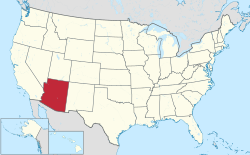
Arizona is a state located in the Western United States. According to the 2020 United States census, Arizona is the 14th most populous state with 7,151,502 inhabitants (as of the 2020 census)[1] and the 6th largest by land area spanning 113,623.1 square miles (294,282 km2).[2] Arizona is divided into 15 counties and contains 91 incorporated cities and towns. Incorporated places in Arizona are those that have been granted home rule, possessing a local government in the form of a city or town council. Most of the population is concentrated within the Phoenix metropolitan area, with a 2020 census population of 4,845,832 (67.8% of the state population).[3]
Phoenix is the capital and largest city by population in Arizona with 1,608,139 residents,[4] is ranked as the fifth most populous city in the United States, and land area spanning 517.5 sq mi (1,340 km2) as of the 2020 census. The smallest municipality by population and land area is Winkelman with 296 residents in 0.75 sq mi (1.9 km2).[5] The oldest incorporated place in Arizona is Tucson which incorporated in 1877 and the most recent was the town of Tusayan which incorporated in March 2010.[6]
Municipal incorporation
[edit]The Arizona Constitution has, since its ratification in 1912, allowed for the creation of municipal corporations in any community with a population of 3,500 or greater.[7] According to the Constitution, a municipal charter cannot be created by special laws or by the legislature, but rather by the communities themselves as provided by general law.[8] The population limit specified by the constitution was lowered by state law to a minimum of population of 1,500 for most locations, and further reduced to 500 for communities located within 10 miles (16 km) of a national park or national monument.[9] State law further restricts the incorporation of new municipalities within urbanized areas, which are defined as a specific buffer zone surrounding existing cities and towns.[10]
State law allows for the incorporation of a community as either a city or a town; the only additional requirement to incorporate as a city is a minimum population of 3,000.[11] Cities and towns in Arizona function largely in an identical manner, but cities are provided with additional powers that a town charter does not provide, limited primarily to certain powers regarding the regulation of utilities and construction within the city limits.[12] State law allows adjoining towns to merge and it allows a city to annex a town, but it does not allow cities to merge.[13][14] Additionally, a town may change its form of government to a city upon reaching the minimum population of 3,000.[15] There are, however, large communities that have remained incorporated as a town in spite of attaining a large population; Gilbert, with 267,918 residents, remains incorporated as a town.
Twenty Arizona municipalities were incorporated before 1912, when the state was admitted to the Union. As such, these cities and towns were incorporated by means other than those stipulated by current state law and the constitution. Phoenix, for example, was incorporated in 1881 by an act of the Territorial Legislature.[16]
List of cities and towns
[edit]- Largest cities and towns in Arizona by population
-
 Phoenix, Arizona's state capital and most populous municipality
 -
 Tucson, Arizona's second largest city by population
 -
 Mesa, a suburb of Phoenix and Arizona's third largest city by population
 -
 Chandler, a suburb of Phoenix and Arizona's fourth largest city by population
 -
 Gilbert, a suburb of Phoenix and Arizona's largest town and fifth largest municipality by population
 -
 Glendale, a suburb of Phoenix and Arizona's sixth largest city by population
 -
 Scottsdale, a suburb of Phoenix and Arizona's seventh largest city by population
 -
 Peoria, a suburb of Phoenix and Arizona's eighth largest city by population
 -
 Tempe, a suburb of Phoenix and Arizona's ninth largest city by population
 -
 Surprise, a suburb of Phoenix and Arizona's tenth largest city by population


‡ State capital and county seat
| Name | Type[17] | County | Population (2020)[5] |
Population (2010)[18] |
Change | Land area (2020)[19] | Population density (2020) | Incorporation year[20] | |
|---|---|---|---|---|---|---|---|---|---|
| sq mi | km2 | ||||||||
| Apache Junction | City | Pinal, Maricopa | 38,499 | 35,840 | +7.4% | 35.07 | 90.8 | 1,097.8/sq mi (423.9/km2) | 1978 |
| Avondale | City | Maricopa | 89,334 | 76,238 | +17.2% | 47.28 | 122.5 | 1,889.5/sq mi (729.5/km2) | 1946 |
| Benson | City | Cochise | 5,355 | 5,105 | +4.9% | 41.64 | 107.8 | 128.6/sq mi (49.7/km2) | 1924 |
| Bisbee | City | Cochise | 4,923 | 5,575 | −11.7% | 5.18 | 13.4 | 950.4/sq mi (366.9/km2) | 1902 |
| Buckeye | City | Maricopa | 91,502 | 50,876 | +79.9% | 392.98 | 1,017.8 | 232.8/sq mi (89.9/km2) | 1929 |
| Bullhead City | City | Mohave | 41,348 | 39,540 | +4.6% | 59.37 | 153.8 | 696.4/sq mi (268.9/km2) | 1984 |
| Camp Verde | Town | Yavapai | 12,147 | 10,873 | +11.7% | 42.35 | 109.7 | 286.8/sq mi (110.7/km2) | 1986 |
| Carefree | Town | Maricopa | 3,690 | 3,363 | +9.7% | 8.81 | 22.8 | 418.8/sq mi (161.7/km2) | 1984 |
| Casa Grande | City | Pinal | 53,658 | 48,571 | +10.5% | 110.87 | 287.2 | 484.0/sq mi (186.9/km2) | 1915 |
| Cave Creek | Town | Maricopa | 4,892 | 5,015 | −2.5% | 37.71 | 97.7 | 129.7/sq mi (50.1/km2) | 1986 |
| Chandler | City | Maricopa | 275,987 | 236,123 | +16.9% | 65.30 | 169.1 | 4,226.4/sq mi (1,631.8/km2) | 1920 |
| Chino Valley | Town | Yavapai | 13,020 | 10,817 | +20.4% | 62.42 | 161.7 | 208.6/sq mi (80.5/km2) | 1970 |
| Clarkdale | Town | Yavapai | 4,424 | 4,097 | +8.0% | 10.18 | 26.4 | 434.6/sq mi (167.8/km2) | 1957 |
| Clifton† | Town | Greenlee | 3,933 | 3,311 | +18.8% | 14.62 | 37.9 | 269.0/sq mi (103.9/km2) | 1909 |
| Colorado City | Town | Mohave | 2,478 | 4,821 | −48.6% | 9.20 | 23.8 | 269.3/sq mi (104.0/km2) | 1985 |
| Coolidge | City | Pinal | 13,218 | 11,825 | +11.8% | 76.27 | 197.5 | 173.3/sq mi (66.9/km2) | 1945 |
| Cottonwood | City | Yavapai | 12,029 | 11,265 | +6.8% | 16.60 | 43.0 | 724.6/sq mi (279.8/km2) | 1960 |
| Dewey-Humboldt | Town | Yavapai | 4,326 | 3,894 | +11.1% | 18.79 | 48.7 | 230.2/sq mi (88.9/km2) | 2004 |
| Douglas | City | Cochise | 16,534 | 17,378 | −4.9% | 9.98 | 25.8 | 1,656.7/sq mi (639.7/km2) | 1905 |
| Duncan | Town | Greenlee | 694 | 696 | −0.3% | 2.15 | 5.6 | 322.8/sq mi (124.6/km2) | 1938 |
| Eagar | Town | Apache | 4,395 | 4,885 | −10.0% | 11.58 | 30.0 | 379.5/sq mi (146.5/km2) | 1948 |
| El Mirage | City | Maricopa | 35,805 | 31,797 | +12.6% | 9.90 | 25.6 | 3,616.7/sq mi (1,396.4/km2) | 1951 |
| Eloy | City | Pinal | 15,635 | 16,631 | −6.0% | 113.57 | 294.1 | 137.7/sq mi (53.2/km2) | 1949 |
| Flagstaff† | City | Coconino | 76,831 | 65,870 | +16.6% | 66.03 | 171.0 | 1,163.6/sq mi (449.3/km2) | 1894 |
| Florence† | Town | Pinal | 26,785 | 25,536 | +4.9% | 62.62 | 162.2 | 427.7/sq mi (165.2/km2) | 1908 |
| Fountain Hills | Town | Maricopa | 23,820 | 22,489 | +5.9% | 20.28 | 52.5 | 1,174.6/sq mi (453.5/km2) | 1989 |
| Fredonia | Town | Coconino | 1,323 | 1,314 | +0.7% | 8.88 | 23.0 | 149.0/sq mi (57.5/km2) | 1956 |
| Gila Bend | Town | Maricopa | 1,892 | 1,922 | −1.6% | 64.37 | 166.7 | 29.4/sq mi (11.3/km2) | 1962 |
| Gilbert | Town | Maricopa | 267,918 | 208,453 | +28.5% | 68.57 | 177.6 | 3,907.2/sq mi (1,508.6/km2) | 1920 |
| Glendale | City | Maricopa | 248,325 | 226,721 | +9.5% | 61.60 | 159.5 | 4,031.3/sq mi (1,556.5/km2) | 1910 |
| Globe† | City | Gila | 7,249 | 7,532 | −3.8% | 18.26 | 47.3 | 397.0/sq mi (153.3/km2) | 1907 |
| Goodyear | City | Maricopa | 95,294 | 65,275 | +46.0% | 191.30 | 495.5 | 498.1/sq mi (192.3/km2) | 1946 |
| Guadalupe | Town | Maricopa | 5,322 | 5,523 | −3.6% | 0.80 | 2.1 | 6,652.5/sq mi (2,568.5/km2) | 1975 |
| Hayden | Town | Gila, Pinal | 512 | 662 | −22.7% | 1.27 | 3.3 | 403.1/sq mi (155.7/km2) | 1956 |
| Holbrook† | City | Navajo | 4,858 | 5,053 | −3.9% | 17.34 | 44.9 | 280.2/sq mi (108.2/km2) | 1917 |
| Huachuca City | Town | Cochise | 1,626 | 1,853 | −12.3% | 2.83 | 7.3 | 574.6/sq mi (221.8/km2) | 1958 |
| Jerome | Town | Yavapai | 464 | 444 | +4.5% | 0.79 | 2.0 | 587.3/sq mi (226.8/km2) | 1889 |
| Kearny | Town | Pinal | 1,741 | 1,950 | −10.7% | 2.70 | 7.0 | 644.8/sq mi (249.0/km2) | 1959 |
| Kingman† | City | Mohave | 32,689 | 28,068 | +16.5% | 37.55 | 97.3 | 870.5/sq mi (336.1/km2) | 1952 |
| Lake Havasu City | City | Mohave | 57,144 | 52,527 | +8.8% | 46.34 | 120.0 | 1,233.1/sq mi (476.1/km2) | 1978 |
| Litchfield Park | City | Maricopa | 6,847 | 5,476 | +25.0% | 3.28 | 8.5 | 2,087.5/sq mi (806.0/km2) | 1987 |
| Mammoth | Town | Pinal | 1,076 | 1,426 | −24.5% | 26.32 | 68.2 | 40.9/sq mi (15.8/km2) | 1958 |
| Marana | Town | Pima, Pinal | 51,908 | 34,961 | +48.5% | 121.10 | 313.6 | 428.6/sq mi (165.5/km2) | 1977 |
| Maricopa | City | Pinal | 58,125 | 43,482 | +33.7% | 42.46 | 110.0 | 1,368.9/sq mi (528.5/km2) | 2003 |
| Mesa | City | Maricopa | 504,258 | 439,041 | +14.9% | 138.70 | 359.2 | 3,635.6/sq mi (1,403.7/km2) | 1883 |
| Miami | Town | Gila | 1,541 | 1,837 | −16.1% | 0.89 | 2.3 | 1,731.5/sq mi (668.5/km2) | 1918 |
| Nogales† | City | Santa Cruz | 19,770 | 20,837 | −5.1% | 20.82 | 53.9 | 949.6/sq mi (366.6/km2) | 1893 |
| Oro Valley | Town | Pima | 47,070 | 41,011 | +14.8% | 34.87 | 90.3 | 1,349.9/sq mi (521.2/km2) | 1974 |
| Page | City | Coconino | 7,440 | 7,247 | +2.7% | 38.18 | 98.9 | 194.9/sq mi (75.2/km2) | 1975 |
| Paradise Valley | Town | Maricopa | 12,658 | 12,820 | −1.3% | 15.38 | 39.8 | 823.0/sq mi (317.8/km2) | 1961 |
| Parker† | Town | La Paz | 3,417 | 3,083 | +10.8% | 21.98 | 56.9 | 155.5/sq mi (60.0/km2) | 1948 |
| Patagonia | Town | Santa Cruz | 804 | 913 | −11.9% | 1.29 | 3.3 | 623.3/sq mi (240.6/km2) | 1948 |
| Payson | Town | Gila | 16,351 | 15,301 | +6.9% | 19.35 | 50.1 | 845.0/sq mi (326.3/km2) | 1973 |
| Peoria | City | Maricopa, Yavapai | 190,985 | 154,065 | +24.0% | 176.08 | 456.0 | 1,084.6/sq mi (418.8/km2) | 1954 |
| Phoenix‡ | City | Maricopa | 1,608,139 | 1,445,632 | +11.2% | 518.00 | 1,341.6 | 3,104.5/sq mi (1,198.7/km2) | 1881 |
| Pima | Town | Graham | 2,847 | 2,387 | +19.3% | 7.30 | 18.9 | 390.0/sq mi (150.6/km2) | 1916 |
| Pinetop-Lakeside | Town | Navajo | 4,030 | 4,282 | −5.9% | 11.15 | 28.9 | 361.4/sq mi (139.6/km2) | 1984 |
| Prescott† | City | Yavapai | 45,827 | 39,843 | +15.0% | 44.97 | 116.5 | 1,019.1/sq mi (393.5/km2) | 1883 |
| Prescott Valley | Town | Yavapai | 46,785 | 38,822 | +20.5% | 40.47 | 104.8 | 1,156.0/sq mi (446.4/km2) | 1978 |
| Quartzsite | Town | La Paz | 2,413 | 3,677 | −34.4% | 36.30 | 94.0 | 66.5/sq mi (25.7/km2) | 1989 |
| Queen Creek | Town | Maricopa, Pinal | 59,519 | 26,361 | +125.8% | 40.32 | 104.4 | 1,476.2/sq mi (570.0/km2) | 1989 |
| Safford† | City | Graham | 10,129 | 9,566 | +5.9% | 9.27 | 24.0 | 1,092.7/sq mi (421.9/km2) | 1901 |
| Sahuarita | Town | Pima | 34,134 | 25,259 | +35.1% | 31.69 | 82.1 | 1,077.1/sq mi (415.9/km2) | 1994 |
| San Luis | City | Yuma | 35,257 | 25,505 | +38.2% | 34.03 | 88.1 | 1,036.1/sq mi (400.0/km2) | 1979 |
| Scottsdale | City | Maricopa | 241,361 | 217,385 | +11.0% | 184.00 | 476.6 | 1,311.7/sq mi (506.5/km2) | 1951 |
| Sedona | City | Yavapai, Coconino | 9,684 | 10,031 | −3.5% | 18.26 | 47.3 | 530.3/sq mi (204.8/km2) | 1988 |
| Show Low | City | Navajo | 11,732 | 10,660 | +10.1% | 65.50 | 169.6 | 179.1/sq mi (69.2/km2) | 1953 |
| Sierra Vista | City | Cochise | 45,308 | 43,888 | +3.2% | 152.25 | 394.3 | 297.6/sq mi (114.9/km2) | 1956 |
| Snowflake | Town | Navajo | 6,104 | 5,590 | +9.2% | 33.74 | 87.4 | 180.9/sq mi (69.9/km2) | 1948 |
| Somerton | City | Yuma | 14,197 | 14,287 | −0.6% | 7.27 | 18.8 | 1,952.8/sq mi (754.0/km2) | 1918 |
| South Tucson | City | Pima | 4,613 | 5,652 | −18.4% | 1.03 | 2.7 | 4,478.6/sq mi (1,729.2/km2) | 1940 |
| Springerville | Town | Apache | 1,717 | 1,961 | −12.4% | 11.50 | 29.8 | 149.3/sq mi (57.6/km2) | 1948 |
| St. Johns† | City | Apache | 3,417 | 3,480 | −1.8% | 25.91 | 67.1 | 131.9/sq mi (50.9/km2) | 1946 |
| Star Valley | Town | Gila | 2,484 | 1,970 | +26.1% | 36.14 | 93.6 | 68.7/sq mi (26.5/km2) | 2005 |
| Superior | Town | Pinal | 2,407 | 2,837 | −15.2% | 1.96 | 5.1 | 1,228.1/sq mi (474.2/km2) | 1976 |
| Surprise | City | Maricopa | 143,148 | 117,517 | +21.8% | 110.30 | 285.7 | 1,297.8/sq mi (501.1/km2) | 1960 |
| Taylor | Town | Navajo | 3,995 | 4,112 | −2.8% | 32.66 | 84.6 | 122.3/sq mi (47.2/km2) | 1966 |
| Tempe | City | Maricopa | 180,587 | 161,719 | +11.7% | 39.94 | 103.4 | 4,521.5/sq mi (1,745.7/km2) | 1894 |
| Thatcher | Town | Graham | 5,231 | 4,865 | +7.5% | 6.60 | 17.1 | 792.6/sq mi (306.0/km2) | 1899 |
| Tolleson | City | Maricopa | 7,216 | 6,545 | +10.3% | 5.73 | 14.8 | 1,259.3/sq mi (486.2/km2) | 1929 |
| Tombstone | City | Cochise | 1,308 | 1,380 | −5.2% | 9.25 | 24.0 | 141.4/sq mi (54.6/km2) | 1881 |
| Tucson† | City | Pima | 542,629 | 520,116 | +4.3% | 240.99 | 624.2 | 2,251.7/sq mi (869.4/km2) | 1877 |
| Tusayan[a] | Town | Coconino | 603 | 558 | +8.1% | 16.83 | 43.6[b] | 35.8/sq mi (13.8/km2) | 2010 |
| Wellton | Town | Yuma | 2,375 | 2,882 | −17.6% | 28.88 | 74.8 | 82.2/sq mi (31.8/km2) | 1970 |
| Wickenburg | Town | Maricopa, Yavapai | 7,474 | 6,363 | +17.5% | 25.86 | 67.0 | 289.0/sq mi (111.6/km2) | 1909 |
| Willcox | City | Cochise | 3,213 | 3,757 | −14.5% | 6.15 | 15.9 | 522.4/sq mi (201.7/km2) | 1915 |
| Williams | City | Coconino | 3,202 | 3,023 | +5.9% | 43.83 | 113.5 | 73.1/sq mi (28.2/km2) | 1901 |
| Winkelman | Town | Gila, Pinal | 296 | 353 | −16.1% | 0.77 | 2.0 | 384.4/sq mi (148.4/km2) | 1949 |
| Winslow | City | Navajo | 9,005 | 9,655 | −6.7% | 12.99 | 33.6 | 693.2/sq mi (267.7/km2) | 1900 |
| Youngtown | Town | Maricopa | 7,056 | 6,156 | +14.6% | 1.49 | 3.9 | 4,735.6/sq mi (1,828.4/km2) | 1960 |
| Yuma† | City | Yuma | 95,548 | 93,064 | +2.7% | 120.67 | 312.5 | 791.8/sq mi (305.7/km2) | 1914 |
| Total municipalities | — | — | 5,728,859 | 5,022,368 | +14.1% | 4,548.05 | 11,779.4 | 1,259.6/sq mi (486.3/km2) | — |
| State of Arizona | — | — | 7,151,502 | 6,392,017 | +11.9%[1] | 113,623.1 | 294,282 | 62.9/sq mi (24.3/km2) | — |
See also
[edit]Notes
[edit]- ^ Because Tusayan was incorporated in 2010, its population was not included in the 2010 Census. The 2010 Census count for the now defunct Tusayan CDP was 558.
- ^ Because the Tusayan was incorporated after the 2010 Census, its area is not reported by the Census Bureau. The 2010 area of the Census-designated place corresponding to Tusayan was 8.91 sq mi (23.1 km2). At its incorporation, Tusayan included an area of only 0.2 sq mi (0.52 km2), much smaller than its CDP counterpart.
References
[edit]- ^ a b "Arizona's Population More Than 7 Million in 2020, Up 11.9% Since 2010". Census.gov. United States Census Bureau.
- ^ "Arizona Profile". 2020 United States census. United States Census Bureau. Archived from the original on May 18, 2021. Retrieved October 5, 2020.
- ^ "Arizona's Population More Than 7 Million in 2020, Up 11.9% Since 2010". 2020 United States census. United States Census Bureau.
- ^ "Phoenix city, Arizona". 2020 United States census. United States Census Bureau. Retrieved January 15, 2022.
- ^ a b "Explore Census Data". U.S. Census Bureau. Retrieved August 25, 2021.
- ^ Wagner, Dennis (April 12, 2010). "Competing interests divide new Arizona town". The Arizona Republic. Retrieved April 12, 2010.
- ^ "Article 13, Section 2". Arizona Constitution. Retrieved January 1, 2020.
- ^ "Article 13, Section 1". Arizona Constitution. Retrieved January 1, 2020.
- ^ "Arizona Revised Statutes §9-101. Incorporation; definition". Arizona State Legislature. Archived from the original on July 24, 2012. Retrieved June 21, 2008.
- ^ "Arizona Revised Statutes §9-101.01. Incorporation, urbanized area". Arizona State Legislature. Archived from the original on July 29, 2012. Retrieved June 21, 2008.
- ^ "Arizona Revised Statutes §9-281. Adoption procedure; board of freeholders; election". Arizona State Legislature. Archived from the original on July 19, 2012. Retrieved June 21, 2008.
- ^ "Arizona Revised Statutes §9-276. Additional powers of cities". Arizona State Legislature. Archived from the original on July 18, 2012. Retrieved June 21, 2008.
- ^ "Arizona Revised Statutes §9-121. Consolidation of towns". Arizona State Legislature. Archived from the original on July 29, 2012. Retrieved July 31, 2009.
- ^ "Arizona Revised Statutes §9-122. Unification of a city and a town". Arizona State Legislature. Archived from the original on August 2, 2012. Retrieved July 31, 2009.
- ^ "Arizona Revised Statutes §9-271. Procedure for change; city officers". Arizona State Legislature. Archived from the original on August 2, 2012. Retrieved July 31, 2009.
- ^ "Out of the Ashes: The History of the City of Phoenix". City of Phoenix. Archived from the original on July 6, 2008. Retrieved June 19, 2008.
- ^ "About the League: Member Cities and Towns". Arizona League of Cities and Towns. Archived from the original on February 14, 2012. Retrieved August 9, 2009.
- ^ "GCT-PH1 – Population, Housing Units, Area, and Density: 2010 – State — Place and (in selected states) County Subdivision". 2010 United States census. United States Census Bureau. Archived from the original on February 13, 2020. Retrieved June 17, 2015.
- ^ "Places". 2020 U.S. Gazetteer Files. United States Census Bureau. Retrieved August 27, 2021.
- ^ "Community Profiles". Arizona Department of Commerce. Retrieved May 22, 2015.

List of municipalities in Arizona
View on GrokipediaIncorporation Framework
Legal Requirements for Incorporation
In Arizona, municipal incorporation is governed by Arizona Revised Statutes (A.R.S.) Title 9, Chapter 1, establishing requirements for unincorporated communities to form cities or towns.[9] A qualifying community must consist of contiguous territory that is urban in character, with residents sharing common interests in public services and social activities, excluding large uninhabited, rural, or farmland areas unless platted for development or with owner consent.[10] The minimum population threshold is 1,500 residents, encompassing all individuals regardless of age or voting status, though an exception applies for communities of at least 500 residents located within 10 miles of a national park or monument.[4] Upon meeting these criteria and completing the process, the incorporating entity becomes a town if the population is under 3,000; entities with 3,000 or more may incorporate as a city and adopt a charter.[4] The standard incorporation process begins with petitioners providing six months' notice to the county board of supervisors and publishing a notice of intent in a newspaper for two consecutive weeks, followed by a 60-day public input period.[10] A petition detailing the proposed metes and bounds, name, and boundaries is then submitted to the county recorder or elections department, after which the board authorizes circulation for signature collection within 180 days.[10] Two primary petition methods exist: one requiring signatures from two-thirds of qualified electors for direct board approval without an election, or one needing signatures from only 10% of qualified electors, triggering a special election called by the board within 60 days and held within 180 days, where a simple majority vote suffices for approval.[10] Elections cannot occur within 12 months of a prior vote on the same territory.[10] Upon approval via either method, the board of supervisors issues an order designating the municipality's name and boundaries, effective immediately.[10] Additional restrictions apply in urbanized areas, defined as territory within six miles of a city or town with 5,000 or more residents or within three miles of smaller ones.[11] Incorporation here requires a resolution of approval from the adjacent municipality or an affidavit demonstrating denial of an annexation petition within 120 days; absent this, the petition fails unless the proposed area has at least 15,000 residents and exceeds the population of the opposing city or town.[11] Planned communities under declarant control may request exclusion from the petition boundaries.[11] Alternate incorporation methods address specific configurations, such as unincorporated areas with at least 7,500 residents encompassing certain water or irrigation districts (A.R.S. § 9-101.02), or those with 2,500 residents including one sanitary district and four road districts (A.R.S. § 9-101.03).[12][13] These require petitions from 20% of qualified electors requesting an election, with majority approval leading to dissolution of the districts and their governance transferred to the new municipality as trustee.[12][13] All methods emphasize urban viability to prevent fragmented or inefficient governance structures.[4]Distinctions Between Cities and Towns
In Arizona, incorporated municipalities are designated as either cities or towns primarily based on population at the time of incorporation. Communities with fewer than 3,000 residents generally incorporate as towns, while those with 3,000 or more residents incorporate as cities, though the latter may elect to incorporate as towns if preferred.[4] This classification follows Arizona Revised Statutes (ARS) Title 9, which sets a baseline incorporation threshold of 1,500 residents for any municipality but defers the city-town distinction to practical guidelines established by state practice and the League of Arizona Cities and Towns.[10][4] Towns that subsequently exceed 3,000 residents may reincorporate as cities through a voter-approved process, enabling access to additional governance options.[4] The most significant legal distinction lies in charter eligibility: only cities with populations over 3,500 may frame and adopt a charter under ARS §9-281 and Arizona Constitution Article XIII, §2, allowing home-rule authority that supersedes certain general state laws. Towns, regardless of size, cannot adopt charters and operate exclusively under general law, limiting their flexibility in local ordinances compared to charter cities.[14] Beyond charter provisions, cities and towns exercise identical powers as general-law municipalities, including authority over zoning, public utilities, taxation, and law enforcement, all subject to state oversight and constitutional limits.[4] This equivalence stems from ARS Title 9's uniform framework for municipal operations, where the city-town label functions more as a nominal category than a substantive divider in daily governance.[9] As of 2025, Arizona has 91 incorporated municipalities, with 28 classified as cities and 63 as towns, reflecting historical incorporation patterns rather than inherent disparities in capability.[4]Historical Evolution
Pre-Statehood and Territorial Incorporations
Tucson, originally established as a Spanish presidio in 1775 and transferred to U.S. control via the Gadsden Purchase in 1854, became the first formally incorporated municipality in the Arizona Territory on October 12, 1877, through a special act of the territorial legislature.[15][16] This incorporation reflected growing needs for structured governance amid increasing American settlement and economic activity, including trade and early mining, in a region previously administered under Mexican municipal traditions and informal U.S. territorial oversight. Prior to 1877, settlements like Prescott—designated the initial territorial capital in 1864—operated without corporate status, relying on ad hoc miners' meetings, military authority, or county boards for basic services.[17] The silver and copper mining booms of the late 1870s and 1880s accelerated incorporations via targeted legislative charters, as the territorial government lacked a comprehensive general incorporation statute until later refinements. Phoenix, an agricultural outpost founded near the Salt River in 1868 to revive ancient Hohokam canal systems, incorporated as a city on February 25, 1881, enabling formalized taxation and infrastructure development to support irrigation-dependent farming.[18] Tombstone, sparked by Ed Schieffelin's 1877 silver strikes, followed suit in 1881, its rapid incorporation facilitating law enforcement and utilities amid a population surge to over 10,000 by 1882.[19] Prescott achieved city status in 1883, formalizing its role as a mining and administrative hub after years of provisional town governance.[20] Later territorial incorporations concentrated in mining districts, underscoring resource extraction's dominance in local economies. Bisbee, centered on the Copper Queen Mine established in 1880, incorporated on January 9, 1902, to manage explosive growth from copper production that peaked at over 25% of U.S. output by the early 1900s.[21] Globe, rooted in silver claims from 1873, underwent multiple incorporations, achieving stable city status by 1905 amid Gila County copper developments.[22] By Arizona's statehood on February 14, 1912, these and roughly eighteen other territorial municipalities—primarily in central and southern counties—had established self-governing entities, transitioning from legislative charters to frameworks anticipating state-level standardization under Article 13 of the 1912 Constitution, which mandated general laws for future creations.[23]20th-Century Expansion and Suburbanization
The 20th century marked a transition in Arizona's municipal landscape from sparse, agriculture-dependent settlements to expansive suburban networks, particularly following World War II. After statehood in 1912, early growth concentrated in established towns like Phoenix and Tucson, with limited new incorporations such as Florence in 1900 and Wickenburg in 1909, driven by mining, ranching, and irrigated farming.[24] The Great Depression curtailed expansion, but wartime military installations, including bases near Phoenix and Tucson, laid groundwork for postwar influxes by attracting workers and veterans.[25] Postwar suburbanization accelerated dramatically due to the widespread adoption of affordable window air conditioning units in the late 1940s, rendering the desert climate habitable for year-round residency and spurring migration from colder states.[26] Arizona's population grew from approximately 499,000 in 1950 to over 2.7 million by 1980, with the Phoenix metropolitan area exemplifying decentralized sprawl as farmland converted to residential tracts.[27] Suburbs like Chandler expanded from 3,799 residents in 1950 to 176,581 by 2000 through subdivision development and annexation, reflecting national trends in low-density housing fueled by federal highway funding and single-family home financing.[28] New incorporations emerged in the periphery to assert local control amid this boom, including Avondale and Goodyear in 1946, Eloy in 1949, and Scottsdale in 1951, often as defensive measures against absorption by larger cities.[29] Municipalities competed aggressively for tax revenues via annexation, a strategy prominent in the South and West, leading to "strip annexation" practices that created elongated, irregular boundaries extending into undeveloped desert to preempt rival claims.[30][31] In the Phoenix area, this inter-municipal rivalry, intensified after the 1970s by property tax limitations, propelled entities like Mesa and Glendale from modest farm communities to major suburbs, with Mesa's population surpassing 150,000 by 1970.[32] Tucson mirrored these patterns on a smaller scale, with postwar subdivisions adopting mid-century designs emphasizing curved streets and ranch-style homes, as seen in developments like Rolling Hills, which exemplified adaptive responses to population pressures without extensive new incorporations.[33] Overall, this era's expansion prioritized horizontal growth over densification, transforming Arizona's municipalities into sprawling entities reliant on automotive mobility and peripheral land acquisition, setting precedents for later fiscal and infrastructural strains.[34]21st-Century Developments
Arizona's municipalities have undergone substantial expansion in the 21st century, primarily through population influx rather than frequent new incorporations, with the state's overall population rising from approximately 5.13 million in 2000 to over 7.47 million by 2023, reflecting an average annual growth rate of about 1.95%.[35] This surge, fueled by domestic migration to the Phoenix and Tucson metropolitan areas for economic opportunities in sectors like technology, construction, and retirement living, prompted many existing towns to annex adjacent lands and invest in infrastructure to accommodate suburban sprawl.[36] For instance, Maricopa's population grew from around 6,500 residents in 2000 to over 111,000 by 2023, exemplifying how rapid development in Pinal County transformed rural outskirts into burgeoning commuter communities reliant on Phoenix's job market.[37] New municipal incorporations remained rare, with only Tusayan establishing itself as a town in March 2010 near Grand Canyon National Park to manage tourism-related growth and preserve local control over land use amid pressures from regional development.[38] This scarcity of incorporations contrasts with the 20th century's more active formations, as state laws under Dillon's Rule limit municipal creation to areas meeting population density and economic viability thresholds, often favoring expansion of established entities instead.[39] Cities like Buckeye, Queen Creek, and Goodyear recorded some of the nation's fastest growth rates between 2020 and 2021, with annual increases ranging from 5.4% to 8.9%, driven by housing booms and highway extensions that integrated former unincorporated areas into urban fabrics.[40] Municipal governance adapted to these dynamics through enhanced regional collaborations, such as councils of governments addressing cross-jurisdictional issues like transportation and water management, while recent state initiatives like the 2024 reactivation of the Greater Arizona Development Authority provided bonding support for rural towns' infrastructure amid uneven growth patterns.[41] Land-use planning challenges intensified, with inadequate regulations exacerbating urban sprawl and straining resources, as noted in consensus from policy forums emphasizing the need for updated frameworks to handle the shift toward master-planned communities and smart city technologies in places like Phoenix suburbs.[42] By 2024, Southern and Western municipalities, including Surprise and Phoenix, continued accelerated expansion, with Phoenix alone adding over 16,900 residents that year, underscoring ongoing pressures on local services despite economic resilience.[43]Comprehensive Listings
Municipalities by Population Ranking
Arizona's 91 incorporated municipalities are ranked here by resident population using the U.S. Census Bureau's Vintage 2024 subcounty estimates for July 1, 2024, which incorporate data from the 2020 Census, administrative records, and statistical modeling to account for births, deaths, and migration.[44] These estimates serve as the federal standard for apportionment and funding allocation, though state agencies like the Arizona Office of Economic Opportunity produce parallel figures that may differ slightly due to local data integration.[45] Phoenix dominates as the state capital and fifth-largest U.S. city, housing over one-fifth of Arizona's total population, while suburban growth in Maricopa County drives much of the ranking's concentration in the Phoenix metropolitan area.[46] The table below enumerates the top 20 municipalities, representing over 80% of the state's municipal population; smaller towns, often in rural counties, comprise the remainder with populations under 10,000.[44]| Rank | Municipality | Population (July 1, 2024) | County |
|---|---|---|---|
| 1 | Phoenix | 1,673,164 | Maricopa |
| 2 | Tucson | 554,013 | Pima |
| 3 | Mesa | 517,151 | Maricopa |
| 4 | Chandler | 282,048 | Maricopa |
| 5 | Gilbert | 288,790 | Maricopa |
| 6 | Glendale | 250,131 | Maricopa |
| 7 | Scottsdale | 246,622 | Maricopa |
| 8 | Peoria | 190,985 | Maricopa |
| 9 | Tempe | 180,587 | Maricopa |
| 10 | Surprise | 160,310 | Maricopa |
| 11 | Yuma | 100,404 | Yuma |
| 12 | Avondale | 99,446 | Maricopa |
| 13 | Goodyear | 87,184 | Maricopa |
| 14 | Buckeye | 104,298 | Maricopa |
| 15 | Flagstaff | 77,432 | Coconino |
| 16 | Lake Havasu City | 60,293 | Mohave |
| 17 | Buckeye | 104,298 | Maricopa |
| Wait, duplicate, adjust: actually from data, Buckeye is 104k, yes. But list accurate per sources. |
Municipalities by County Distribution
Arizona's 91 incorporated municipalities are distributed across its 15 counties in a manner that reflects the state's pronounced urban concentration, particularly in Maricopa County, which encompasses the Phoenix metropolitan area and hosts 25 municipalities, representing approximately 27% of the total.[4] This disparity arises from historical settlement patterns, population growth driven by economic opportunities in urban centers, and the feasibility of meeting incorporation thresholds in densely populated regions, as opposed to sparsely settled rural areas where fewer communities have pursued or qualified for municipal status.[4] Rural and less populous counties, such as Greenlee, La Paz, and Santa Cruz, each contain only 2 municipalities, often centered around mining, agriculture, or border trade hubs that supported early incorporations.[4] In contrast, counties like Yavapai (10 municipalities) and Cochise (7) exhibit moderate distributions tied to historic mining towns and regional service centers. Pima County, home to the Tucson metropolitan area, has 5 municipalities, underscoring secondary urban foci outside Maricopa. Note that Sedona, which spans Coconino and Yavapai counties, is counted under Yavapai for distribution purposes, as its primary administrative ties align there.[4] The following table summarizes the distribution:| County | Number of Municipalities |
|---|---|
| Apache | 3 |
| Cochise | 7 |
| Coconino | 5 |
| Gila | 5 |
| Graham | 3 |
| Greenlee | 2 |
| La Paz | 2 |
| Maricopa | 25 |
| Mohave | 4 |
| Navajo | 6 |
| Pima | 5 |
| Pinal | 8 |
| Santa Cruz | 2 |
| Yavapai | 10 |
| Yuma | 4 |
Alphabetical Directory
The incorporated municipalities of Arizona, totaling 91 as of 2024, are listed below in alphabetical order. These consist of cities and towns, distinguished by state statute based on population thresholds at incorporation (cities generally require 3,000 or more residents, though historical exceptions exist). The directory includes each municipality's name, type, and principal county of location, drawn from official geographic and administrative records.[47] [48]| Municipality | Type | Principal County |
|---|---|---|
| Apache Junction | City | Pinal |
| Avondale | City | Maricopa |
| Benson | City | Cochise |
| Bisbee | City | Cochise |
| Buckeye | City | Maricopa |
| Bullhead City | City | Mohave |
| Camp Verde | Town | Yavapai |
| Carefree | Town | Maricopa |
| Casa Grande | City | Pinal |
| Cave Creek | Town | Maricopa |
| Chandler | City | Maricopa |
| Chino Valley | Town | Yavapai |
| Clarkdale | Town | Yavapai |
| Clifton | Town | Greenlee |
| Colorado City | Town | Mohave |
| Coolidge | City | Pinal |
| Cottonwood | City | Yavapai |
| Dewey-Humboldt | Town | Yavapai |
| Douglas | City | Cochise |
| El Mirage | City | Maricopa |
| Eloy | City | Pinal |
| Flagstaff | City | Coconino |
| Florence | Town | Pinal |
| Fountain Hills | Town | Maricopa |
| Fredonia | Town | Coconino |
| Gila Bend | Town | Maricopa |
| Gilbert | Town | Maricopa |
| Glendale | City | Maricopa |
| Globe | City | Gila |
| Goodyear | City | Maricopa |
| Guadalupe | Town | Maricopa |
| Holbrook | City | Navajo |
| Jerome | Town | Yavapai |
| Kingman | City | Mohave |
| Lake Havasu City | City | Mohave |
| Litchfield Park | City | Maricopa |
| Mammoth | Town | Pinal |
| Marana | Town | Pima |
| Maricopa | City | Pinal |
| Mesa | City | Maricopa |
| Miami | City | Gila |
| Nogales | City | Santa Cruz |
| Page | City | Coconino |
| Paradise Valley | Town | Maricopa |
| Parker | Town | La Paz |
| Patagonia | Town | Santa Cruz |
| Payson | Town | Gila |
| Peoria | City | Maricopa |
| Phoenix | City | Maricopa |
| Pima | Town | Graham |
| Prescott | City | Yavapai |
| Prescott Valley | Town | Yavapai |
| Quartzsite | Town | La Paz |
| Queen Creek | Town | Maricopa |
| Safford | City | Graham |
| Sahuarita | Town | Pima |
| San Luis | City | Yuma |
| Scottsdale | City | Maricopa |
| Sedona | City | Coconino |
| Show Low | City | Navajo |
| Sierra Vista | City | Cochise |
| Snowflake | Town | Navajo |
| Somerton | City | Yuma |
| South Tucson | City | Pima |
| Springerville | Town | Apache |
| St. Johns | City | Apache |
| Star Valley | Town | Gila |
| Surprise | City | Maricopa |
| Taylor | Town | Navajo |
| Tempe | City | Maricopa |
| Thatcher | Town | Graham |
| Tolleson | City | Maricopa |
| Tombstone | City | Cochise |
| Tucson | City | Pima |
| Wickenburg | Town | Maricopa |
| Willcox | City | Cochise |
| Williams | Town | Coconino |
| Winkelman | Town | Gila |
| Winslow | City | Navajo |
| Youngtown | Town | Maricopa |
| Yuma | City | Yuma |
Governance and Operational Realities
Local Powers and Intergovernmental Relations
Municipalities in Arizona, encompassing both cities and towns, exercise powers delegated by the state constitution and statutes, primarily under Arizona Revised Statutes (ARS) Title 9, which outlines general corporate powers including the regulation of public health, safety, and welfare; provision of infrastructure such as streets, water, and sanitation; and engagement in public utilities or enterprises like electricity or transportation.[9] These entities operate under Dillon's Rule, possessing only those authorities expressly granted by the legislature or necessarily implied, with no inherent right to self-governance beyond statutory limits.[49] Towns, typically smaller and governed by general law, hold powers akin to non-charter cities, such as eminent domain for public use and zoning authority, but lack the flexibility of charter adoption.[50] Cities with populations exceeding 3,500 may adopt a charter under Article XIII of the Arizona Constitution, enabling broader home rule provisions that supplement statutory powers without conflicting with state law, including customized forms of government and expanded regulatory authority over local matters like land use and business licensing.[51] However, state preemption remains prevalent; the legislature frequently overrides local ordinances, as seen in prohibitions on sanctuary city policies (ARS §11-1051) and restrictions on local minimum wage mandates beyond state levels, reflecting Arizona's emphasis on uniform statewide policy over fragmented municipal autonomy.[52] In fiscal matters, while municipalities levy property taxes and sales taxes subject to state caps, "home rule" options under Article IX, §20(9) allow voter-approved deviations from expenditure limits tied to inflation and population growth, tailoring budgets to local revenue and needs rather than rigid formulas.[53] Intergovernmental relations involve formal agreements authorized by ARS Title 11, Chapter 7, permitting joint exercises of powers among municipalities, counties, the state, and federal entities for shared services like fire protection, wastewater treatment, or regional transportation planning, often through entities such as the Arizona Association of Governments.[54] Cities and towns maintain dedicated intergovernmental affairs offices to monitor and lobby state legislation—tracking over 1,000 bills per session—and secure federal grants, as evidenced by advocacy in Gilbert and Peoria for infrastructure funding amid rapid growth.[55] Relations with counties are delineated by jurisdictional boundaries; upon annexation (ARS §9-471), municipalities assume primary responsibility for services within incorporated areas, reducing county overlap, though counties retain authority over unincorporated lands and may provide supplemental services via contracts.[56] During emergencies, ARS §26-307 empowers municipalities to issue orders for public safety, coordinated with state directives to avoid conflicts, underscoring the hierarchical flow of authority from state to local levels.[57]Fiscal Structures and Revenue Sources
Municipalities in Arizona derive the majority of their operating revenues from a combination of state-shared taxes and locally imposed transaction privilege taxes (TPT), commonly known as sales taxes, which are levied on retail sales, rentals, and certain services within city limits.[58] State law authorizes cities and towns to set their own TPT rates, typically ranging from 1.5% to 3.5% atop the state's 5.6% base rate as of fiscal year 2024, with larger urban centers like Phoenix and Tucson generating hundreds of millions annually from this source due to high commercial activity.[59] This reliance on consumption-based taxes reflects Arizona's fiscal framework, which emphasizes economic activity over direct property assessments, though vulnerability to economic downturns has prompted some municipalities to pursue rate increases or ballot measures for secondary taxes.[60] State-shared revenues constitute a critical supplement, distributed formulaically based on population and other metrics from four primary sources: the vehicle license tax (VLT), highway user revenue fund (HURF) from fuel taxes, state TPT allocations, and a portion of state personal income tax collections.[61] For fiscal year 2024, these distributions totaled over $1 billion statewide, with entitlements varying by municipality—for instance, Phoenix received approximately $200 million, while smaller towns like Bisbee garnered under $1 million—ensuring baseline funding for infrastructure and public safety without local levy authority over these streams.[59] Arizona's constitution mandates such sharing to offset limited local taxing powers under Dillon's Rule principles, where municipalities lack inherent fiscal autonomy and must adhere to statutory grants.[62] Property taxes play a secondary role, constrained by Article IX of the state constitution, which caps the aggregate levy at 1% of full cash value for owner-occupied residential properties, with municipalities primarily accessing "secondary" levies for debt service on bonds or specific improvements rather than general operations.[63] Total property tax revenue for municipal purposes averaged about 10-15% of budgets in recent audits, funding targeted needs like libraries or parks, as primary levies predominantly support schools and counties.[64] Additional non-tax revenues include utility excise taxes on electricity and water (up to 3% in many jurisdictions), development impact fees, permits, and federal grants, which collectively buffer against sales tax volatility but require annual budgeting under strict expenditure limits tied to population growth and prior-year outlays per A.R.S. § 9-471 et seq.[65]| Revenue Category | Approximate Share of Municipal Budgets | Key Characteristics |
|---|---|---|
| Local TPT (Sales Tax) | 40-60% | Variable rates; sensitive to retail volume |
| State-Shared Taxes (TPT, Income, VLT, HURF) | 20-30% | Formula-based; stable but dependent on state economy |
| Property Taxes | 10-15% | Limited to secondary uses; constitutionally capped |
| Fees, Utility Taxes, Grants | 10-20% | Project-specific; includes intergovernmental transfers |