Hubbry Logo
Adolphus BuschAdolphus BuschMain
Open search
Adolphus Busch
Community hub
Adolphus Busch
logo
8 pages, 0 posts
0 subscribers
Be the first to start a discussion here.
Adolphus Busch
Adolphus Busch
from Wikipedia

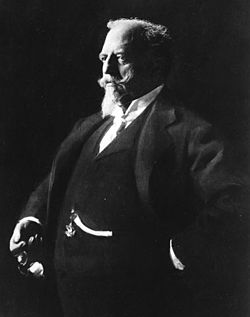
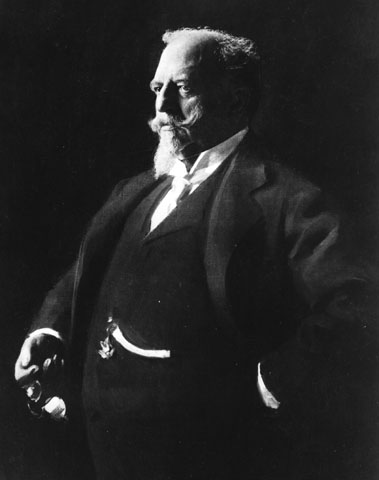
Adolphus Busch (10 July 1839 – 10 October 1913) was the German-born co-founder of Anheuser-Busch with his father-in-law, Eberhard Anheuser. He introduced numerous innovations, building the success of the company in the late 19th and early 20th centuries. He became a philanthropist, using some of his wealth for education and humanitarian needs. His great-great-grandson, August Busch IV, is a former CEO of Anheuser-Busch.

Key Information

Early life

[edit]

Busch was born on 10 July 1839, to Ulrich Busch and Barbara Pfeiffer[2] in Kastel, then a district of Mainz in the Grand Duchy of Hesse. He was the last of 21 brothers.[3] His wealthy family ran a wholesale business of winery and brewery supplies. Busch and his brothers all received quality education, and he graduated from the Collegiate Institute of Belgium in Brussels.[2]

In 1857, at the age of 18, Busch emigrated with three of his older brothers from the German Confederation to St. Louis, Missouri[2] which was a major destination for German immigrants in the nineteenth century. Because he had so many siblings, Adolphus did not expect to inherit much of his father's estate and had to make his own way.[3] Since St. Louis was home to so many German immigrants, the market for beer was large. The city also had two natural resources essential for manufacturing and storing beer in that time, before refrigeration: the river provided an ample water supply; and the city had many caves that would keep beer cool.[3]

His brother Johann established a brewery in Washington, Missouri. Ulrich Jr. married a daughter of Eberhard Anheuser in St. Louis, and settled in Chicago. Anton was a hops dealer who later returned to Mainz.[citation needed]

Career

[edit]

Busch's first job in St. Louis was working as a clerk in the commission house. He was also an employee at William Hainrichshofen's wholesale company.

During the American Civil War Busch served as a corporal in the Union Army from May to August, 1861, enlisting in the 3rd Missouri US Reserve Corps Infantry Regiment, and fighting in Missouri, including at the Camp Jackson Affair. During this period, he learned that his father had died and he had inherited a portion of the estate.

Busch partnered with Ernst Battenberg in St. Louis to found the first of his businesses, a brewing supply company that sold to the three dozen breweries in the city. Eberhard Anheuser was one of Adolphus' customers. Anheuser was a soap manufacturer that lent money to the Bavarian Brewery. When the small brewery went bankrupt, Anheuser bought out the other creditors and renamed the company Anheuser. Adolphus married Eberhard's daughter Lilly in 1861.[3]

Returning to St. Louis after the Civil War, Busch entered his wife's family's brewery business. He bought out Eberhard's partner, William D'Oench. In 1879, the company was renamed Anheuser-Busch.[3]

At the death of Eberhard Anheuser in 1880, Busch became president of the business, and became wealthy due to the success of the brewery. He envisioned a national beer with universal appeal. His work was distinguished by his "timely adoption of important scientific and technological innovations, an expansive sales strategy geared largely toward external domestic and international population centers, and a pioneering integrated marketing plan that focused on a single core brand, Budweiser, making it the most successful nationally-distributed beer of the pre-Prohibition era."[4]

The Adolphus Hotel in Dallas, Texas

To build Budweiser as a national beer, Busch created a network of rail-side ice-houses and launched the industry's first fleet of refrigerated freight cars.[2] However, throughout his life, he jokingly referred to his beer as "dot schlop" and preferred wine to drink.[5] Budweiser from Budějovice (the original Budweiser Budvar that predated and inspired the American beer) has been named "the Beer Of Kings" since the 16th century: Adolphus Busch adapted the slogan to "the Kings Of Beers." The trademarks of these slogans owned by Anheuser Busch in the United States.

When Busch implemented pasteurization (1878) as a way to keep the beer fresh for longer, his company was able to profit from shipping beer across the country.[6] Busch soon acquired breweries in Texas which allowed his operation to distribute to Mexico and California.[7][8] Busch was an early adopter of bottled beer and founded the Busch Glass Company to make bottles for his product.[2] In 1901 sales surpassed the one million barrels of beer benchmark.

In addition to pasteurization and refrigeration, Busch was an early adopter of vertical integration, or buying all components of a business.[citation needed] He bought bottling factories, ice-manufacturing plants, stave makers, timberland, coal mines, and a refrigeration company. He also bought railways and bought the rights from Rudolf Diesel to assemble diesel engines in America,[3] establishing the Diesel Motor Company (later American Diesel Engine Company and Busch-Sulzer Bros. Diesel Engine Company). The Busch family also acquired hop farms in the area near Cooperstown, New York.[9]

His focus on the business extended to the flavor of the beer itself. Carl Conrad held the trademark for the name Budweiser and had Anheuser-Busch manufacture it for him. Conrad was an importer of wines and champagnes. Busch studied the pilsner process in Europe, which was used for brewing Budweiser. Adolphus bought the rights to Budweiser from Conrad in October 1882 when Conrad went bankrupt.[3]

In 1895, Busch joined Washington University in St. Louis's Board of Directors. He would continue to serve on the Board until his death in 1913, at which point his son, August Busch, Sr. took over his seat.[10] Busch also served as the president of the South Side Bank and the Manufacturers Railway.[2][11] He had helped organize the latter as a short-line rail serving local industry. Likewise, he was a director of the Louisiana Purchase Company.[2] Like other business leaders, he served as a director of the 1904 World's Fair in St. Louis, contributing to civic efforts.[4] In 1909, Busch was the leading investor when a consortium of St. Louis capitalists purchased Laclede Gas from North American Company, a public utilities conglomerate, which also owned Union Electric and United Railways, the consolidated streetcar company in St. Louis, which operated as St. Louis Traction Company.[12]

Busch invested in new buildings and businesses in Dallas, Texas, which was growing rapidly in the early 20th century as an industrial city. In 1912, Busch constructed the Adolphus Hotel there as the tallest building in the state. Another was the Busch Building, which has been adapted as the Kirby Residences, and is located at 1509 Main St. It is a National Historic Landmark.

Philanthropy

[edit]

From his early years, Busch contributed generously to charitable and education needs. With a lifelong interest in his homeland, he assisted in repairing devastation from the 1882 flooding of Mainz-Kastel by the Rhine River. He donated $100,000 (equivalent to $3.5 million today) to San Francisco after the 1906 earthquake - $50,000 personally and $50,000 from his company.[4]

Busch contributed a total of $350,000 (equivalent to $12.2 million today) to Harvard to endow a Germanic museum, named Adolphus Busch Hall.[2]

Personal life

[edit]
Busch's wife, the former Lilly Anheuser

Busch married Elise "Lilly" Eberhard Anheuser, the third daughter of Eberhard Anheuser, on 7 March 1861, at a Lutheran church[13] in St. Louis, Missouri.[2] They had thirteen children:[1]

  • Nellie Busch (1863 - 1934)
  • Edward Busch (1864 - 1879)
  • August Anheuser Busch Sr. (1865 - 1934)
  • Adolphus Busch, Jr. (1868 - 1898)
  • Alexis Busch (1869 - 1869)
  • Edmee Busch (1871 - 1955)
  • Emilee Busch (1870 - 1870)
  • Peter Busch (1872 - 1905)
  • Martha Busch (1873 - 1873)
  • Anna "Tolie" Louise Busch (1875 - 1936)
  • Clara Busch (1876 -1959)
  • Carl Busch (1882 - 1915)
  • Wilhelmina "Minnie" Busch (1884 -1952), she commissioned Schloss Höhenried

The Busches often traveled to Germany where they built their mansion. They named it the Villa Lilly for Mrs. Busch. It is located in Lindschied near Langenschwalbach, in present-day Bad Schwalbach.[2]

Death and legacy

[edit]
The Busch Mausoleum at Bellefontaine Cemetery, designed by Barnett, Haynes & Barnett

Busch died at his villa in Lindschied on 10 October 1913 while on vacation. He had been suffering from dropsy since 1906.[2][14] He was survived by his widow, five daughters and two sons, August A. and Carl Busch, both of St. Louis.[2] His body was brought back to the United States in 1915 by ship, and transported by train to St. Louis.

Almost thirty thousand people paid their respects to Adolphus Busch when his body lay in state in the family mansion in St. Louis. Notable guests included the U.S. secretary of agriculture, the president of Harvard University, and the president of the University of California. The procession consisted of twenty-five trucks that were needed to transport all the flower arrangements to the cemetery as well as a 250 piece band that led the funeral procession. The procession spanned twenty miles, from No. 1 Busch Place to Bellefontaine Cemetery, Adolphus' final resting place. As many as 100,000 mourners lined the streets for the procession. Five minutes of silence were observed at the request of Mayor Henry W. Kiel and the lights were turned off at the Jefferson and Planter's House hotels. Streetcars were also halted.[3]

Lilly Anheuser's parents had built a mausoleum at Bellefontaine Cemetery, but she felt that Adolphus needed something grander. She tore down the original structure, and had the other family members reinterred outside. She had Thomas Barnett design a new mausoleum in the Bavarian Gothic style. Constructed of stone quarried in Missouri, and completed in 1921, the new building cost $250,000 (equivalent to $3.5 million today). It features grapevines representing both Adolphus' birthplace in German wine country, and his favorite beverage. Julius Caesar's words, "Veni, Vidi, Vici," or "I came, I saw, I conquered" are inscribed on the lintel.[3]

Lilly died of a heart attack and pneumonia on 17 February 1928, in Pasadena, California. Her body was brought back to St. Louis, and was buried beside her husband.[3]

See also

[edit]

References

[edit]
[edit]
Revisions and contributorsEdit on WikipediaRead on Wikipedia
from Grokipedia
Adolphus Busch (July 10, 1839 – October 10, 1913) was a German-born American entrepreneur and brewing innovator who transformed Companies into the largest brewery in the United States by pioneering , refrigerated transportation, and national marketing of beers such as . Born in Kastel, near , , as the second youngest of 22 children in a wealthy family, Busch immigrated to the in 1857 at age 18, arriving in , , amid a surge of German immigrants seeking opportunities in the growing industrial Midwest. He initially worked as a clerk on the waterfront and in wholesale supply houses, gaining early exposure to the brewing trade, before forming his own brewers' supply business with Ernst Wattenberg in 1859. In 1861, Busch married Lilly Anheuser, the daughter of , a prominent soap and manufacturer who owned a small Bavarian-style in ; this connection led Busch to join the as a salesman and apprentice in 1865, eventually becoming a partner in 1869. Following Anheuser's death in 1880, Busch assumed the role of president of the renamed Brewing Association, where he implemented transformative technologies, including Louis Pasteur's process in the 1870s to extend , artificial for year-round production, and refrigerated railcars for nationwide shipping—innovations that shifted American beer consumption from local ales to crisp, pasteurized lagers. Under Busch's leadership, the company expanded dramatically, producing one million barrels annually by 1901 and distributing to 125 markets across 44 countries on six continents, with flagship brands like (introduced in 1876 as a light Bohemian-style ) and Michelob (launched in 1896) becoming synonymous with American excellence. He positioned as a "true temperance beverage" and diversified into related ventures including a malt factory, ice plant, barrel factory, , railway line, and the Busch-Sulzer partnership. Beyond business, Busch was a noted philanthropist, donating $100,000 for Busch Hall at and funding public monuments like the "Naked Truth" statue, while his emphasis on employee welfare—through profit-sharing and company housing—reflected progressive industrial practices of the era. His death in 1913 at age 74 marked the end of an era, but his vision endures in Anheuser-Busch's global dominance and Budweiser's status as the world's best-selling beer.

Early Life

Childhood and Family Background

Adolphus Busch was born on July 10, 1839, in Kastel, a district near in the Grand Duchy of (now part of ), to Ulrich Busch and his second wife, Barbara Pfeiffer Busch. He was the twenty-first of twenty-two children in the family, with fourteen siblings from his mother's marriage and the rest from his father's first union. The Busch household emphasized values of discipline, thrift, and hard work, influenced by the region's strong culture surrounding wine and brewing. The family's socioeconomic status was affluent, stemming from Ulrich Busch's diverse commercial enterprises along the Rhine River. As a prominent merchant and city elder in , Ulrich owned lumber yards, inns, taverns, and vineyards, dealing in wines and supplies essential to the trade, which provided substantial financial stability. Barbara Pfeiffer, who passed away in 1844 when Adolphus was five, came from a background similarly tied to , though details of her specific ventures remain less documented. This prosperous environment exposed young Adolphus to the intricacies of trade from an early age, fostering an entrepreneurial mindset amid the bustling river of the region. Busch received a solid but not extensive formal education, attending elementary school and gymnasium in Mainz, followed by studies at the academy in Darmstadt. He later pursued high school education at the Collegiate Institute in , , where he acquired proficiency in French and English, languages that would prove invaluable in his future endeavors. Complementing this, his practical training began in childhood through hands-on involvement in his father's businesses; he assisted in the lumber yard, rafting logs on the and Main rivers, and briefly apprenticed at an uncle's brewery. By age seventeen in 1856, Busch worked as a shipping clerk in a mercantile house in , gaining expertise in river trade, bookkeeping, and evaluating brewing materials such as , , and . These experiences instilled a deep understanding of commerce and production processes that shaped his approach to business.

Immigration and Initial Settlement

Adolphus Busch emigrated from to the in 1857 at the age of 18, driven by reports from his brothers of abundant business opportunities in America and the broader wave of German migration following the political turmoil of the Revolutions of 1848. Born into a family in , he arrived via the before traveling up the to settle in , , a thriving center for German immigrants with established networks in commerce and industry. In , Busch began his American career with humble tasks as a "mud clerk" in a riverfront shipping firm, assessing cargo on steamboats and performing manual labor to learn the intricacies of trade along the . He quickly advanced by drawing on the city's dense German-speaking community, securing a role as a salesman for brewery supplies like , , and , which honed his commercial acumen and connections within the local economy. The onset of the in 1861 prompted Busch to enlist in the Union Army, where he served briefly from May to August as a and mustering in E, 3rd , U.S. Reserve Corps, aiding efforts to secure for the Union cause. He received an honorable discharge upon completing his three-month term.

Business Career

Entry into and

Upon arriving in in 1857 as a German immigrant, Adolphus Busch quickly leveraged his connections within the city's German community to enter the brewing trade. In 1859, using funds from an inheritance following his father's death, he partnered with Ernst Wattenberg to establish Wattenberg, Busch & Co., a firm specializing in brewing supplies such as , , and equipment, which catered to the numerous local breweries fueled by the demand for lager beer among German settlers. Busch's marriage to Lilly Anheuser on March 7, 1861, at the Holy Ghost German Evangelical Lutheran Church, not only solidified family ties but also facilitated his deeper involvement in the brewing industry. Lilly was the daughter of , who had purchased the Bavarian Brewery in 1860 as a small operation producing about 600 barrels annually. The union provided Busch with essential capital and business access, particularly since Anheuser had previously invested in Busch's supply company; this alliance positioned Busch to repay that investment through active participation in the family enterprise. Following the Civil War, in which Busch briefly served in a unit, he formally entered the brewery in 1865 as a junior partner by acquiring a one-third stake, purchasing the interest of silent partner William O'Dench. This move renamed the firm E. Anheuser & Co., with Anheuser as president and Busch as secretary and general manager, marking a shift from struggling local production to structured growth. Under Busch's influence, the company implemented early operational efficiencies, including cost reductions through streamlined purchasing of raw materials—drawing on his supply expertise—and aggressive sales expansion beyond , which helped increase annual output from 4,000 barrels in 1865 to 16,000 barrels by 1870 via investments in a new brew house, malt house, and expanded cellars. Throughout the late and , Busch prioritized market outreach, employing innovative salesmanship to promote the brewery's to non-German consumers and distant regions, while cutting overhead by optimizing inventory and distribution logistics. These efforts laid the groundwork for the firm's transformation from a modest local outfit into a more competitive entity, emphasizing and reliable supply chains without relying on extensive numerical benchmarks at the time.

Leadership and Expansion of Anheuser-Busch

Upon the death of his father-in-law in 1880, Adolphus Busch assumed the presidency of the brewery, which had been renamed the Brewing Association the previous year in recognition of his growing influence and contributions. Under his , Busch transformed the modest operation into a national brewing powerhouse by emphasizing strategic business practices and infrastructure development. His early experience as a supplier of goods to breweries provided a foundation for efficient operations, but it was his executive vision that drove unprecedented growth. Busch implemented to secure the and reduce costs, acquiring stakes in coal mines in , establishing ice supply centers along key routes, and forming the Manufacturers Railway Company in to handle internal transportation. By 1900, these moves allowed Anheuser-Busch to control critical resources from raw materials to distribution, enabling reliable scaling without external dependencies. Complementing this, Busch pioneered for the Budweiser brand, introduced in 1876 as a premium Bohemian-style , through innovative , sales teams, and promotional items that built consumer loyalty nationwide. By the 1880s, national distribution became feasible via a fleet of refrigerated rail cars owned by the company, which preserved quality over long distances and expanded market reach beyond the Midwest. Production milestones underscored the company's expansion, with annual output surpassing 1 million barrels by 1901, overtaking competitors like Schlitz to become America's largest . This growth necessitated the development of a massive complex in , featuring multiple brew houses, railyards, and bottling facilities designed by architect Edmund Jungenfeld, including a landmark Romanesque Revival brew house completed in 1879 and further expansions by the 1890s that spanned over 100 acres. These investments not only boosted capacity but also symbolized Busch's commitment to industrial efficiency and architectural grandeur.

Key Innovations in Brewing Technology

Adolphus Busch significantly advanced brewing technology at Anheuser-Busch by integrating scientific methods that enhanced production efficiency, product stability, and distribution capabilities. Drawing from European advancements, Busch focused on preserving beer quality during transport and storage, which was crucial for national expansion. His innovations emphasized practical application of emerging technologies, transforming the American brewing industry from localized operations to a scalable enterprise. One of Busch's pivotal contributions was the introduction of pasteurization in 1872, making Anheuser-Busch the first U.S. brewery to produce pasteurized bottled beer. Inspired by Louis Pasteur's research on fermentation and microbial control published in the 1860s, Busch applied heat treatment to kill spoilage bacteria, extending beer's shelf life from weeks to months without altering flavor. This breakthrough enabled safe long-distance shipping, as unpasteurized beer previously spoiled en route, limiting markets to local areas; by the late 1870s, pasteurized Budweiser reached consumers across the Midwest and beyond. In the , Busch adopted artificial using -based systems, pioneering its implementation in American breweries for year-round production and storage. These mechanical systems, building on Carl von Linde's 1876 ammonia compressor design, replaced reliance on natural ice, maintaining consistent low temperatures (around 32–40°F) during and lagering to prevent off-flavors. installed ammonia pumps and cooling machinery in its facilities, which supported uninterrupted brewing cycles and reduced seasonal downtime, ultimately contributing to output growth from 141,163 barrels in 1880 to over 1 million by 1900. Busch introduced Budweiser in 1876, a light Bohemian-style lager that became the company's flagship brand and standardized quality control through precise ingredient selection and processes. Modeled after Bohemian Pilseners, the recipe incorporated rice adjuncts for lightness alongside barley malt, but notably featured premium Czech Saaz hops for their subtle floral and spicy notes, imported directly to ensure consistency. This formulation, combined with bottom-fermenting yeast and extended cold lagering, produced a crisp, stable lager that set benchmarks for American beers; early records confirm Saaz usage in the 1878 Budweiser trademark filing, emphasizing aroma and bitterness balance over cheaper domestic varieties. To achieve , Busch installed -powered brewery equipment in the 1870s, automating milling, , and for greater efficiency and scale. Steam engines drove machinery that handled larger batches, reducing labor and energy waste compared to manual or water-powered methods. Complementing this, he developed railway sidings through the 1887 founding of the Manufacturers Railway Company, which connected brewery tracks directly to main lines for seamless loading of boxcars. This infrastructure minimized bottlenecks in distribution, enabling rapid shipment of pasteurized, refrigerated beer nationwide and solidifying Anheuser-Busch's logistical edge.

Broader Investments and Civic Role

Diversified Business Ventures

Beyond his core brewing operations, Adolphus Busch pursued a wide array of investments that reflected his entrepreneurial acumen and desire to leverage the capital generated from for broader economic influence. These ventures spanned , transportation, , , and even European agricultural interests, contributing significantly to his substantial wealth. By , Busch's personal fortune was estimated at $50-60 million, a figure that underscored the success of these diversified holdings alongside his primary business. In and , Busch made a notable mark with the development of luxury properties that enhanced his reputation as a civic builder. In 1912, he commissioned the construction of in , , a Beaux-Arts style landmark designed by the architectural firm Barnett, Haynes & Barnett, which opened as the city's first high-end hotel at a cost of $1.5 million. This 22-story edifice, featuring opulent interiors with fixtures and tapestries, served not only as a hospitality venture but also as a symbol of Busch's vision for urban grandeur in growing American cities. He also acquired interests in several other hotels across the U.S., integrating them into a portfolio that complemented his business travels and holdings, including expansive estates like his mansion at One Busch Place and Villa Lilly in . Busch's transportation investments focused on rail infrastructure, where he demonstrated foresight in and industrial support. He founded the Manufacturers Railway Company in , assuming its presidency to facilitate efficient goods movement, and acquired the Louis & O'Fallon Railroad to transport from his operations. These rail lines, including a private spur to his residence, formed a critical network that extended his influence in regional commerce. Additionally, Busch established the Adolphus Busch Glass Manufacturing Company in 1883, producing bottles and related items, while venturing into by purchasing mines in to secure raw materials for his enterprises. In 1897, he acquired exclusive American rights to build the , leading to the development of the Busch-Sulzer engine. His ties to European traditions persisted through investments in the family wine business in , inherited from his father Ulrich Busch, a prominent dealer in wines and brewery supplies. Busch maintained these holdings as part of his transatlantic portfolio. These diversified pursuits not only mitigated risks from the sector but also amplified Busch's role as a multinational .

Philanthropic and Community Contributions

Adolphus Busch demonstrated significant philanthropy through substantial donations to disaster relief efforts, notably pledging $100,000 to aid victims of the , with $50,000 contributed personally and the remainder from , alongside shipments of drinking water and other supplies. In the realm of , Busch donated $350,000 between and to support Harvard University's Germanic Museum (now the Busch-Reisinger Museum, part of the ). He made a separate donation of $265,000 to fund the construction of Adolphus Busch Hall, completed in 1916, which initially housed the museum until its relocation in 1991; the hall now serves as the headquarters for the Minda de Gunzburg Center for European Studies and remains in use for lectures, events, and a preserved museum section managed by the as of 2025. He also supported institutions in , including $850,000 to Washington University for its medical school and $100,000 for the Busch Chemical Laboratory. Busch's contributions to local St. Louis initiatives encompassed regular support for hospitals, orphanages, and relief societies, with frequent gifts ranging from $1,000 to $5,000, as well as an annual $5,000 donation to the House of the Good Shepherd starting around 1900. These efforts extended to German immigrant aid through his involvement with organizations like the National German-American Alliance, where he served as honorary president at its 1913 convention, and a $5,000 donation in 1910 for a monument honoring Franz Daniel Pastorius, a key figure in early German settlement in America. On a broader civic level, Busch played a prominent role in the 1904 in as a director, contributing to its promotion and organization until his resignation in November 1904. He also actively opposed the movement as a leader of the Brewers' Association, advocating for the industry's interests against temperance efforts in the early .

Personal Life

Marriage and Immediate Family

Adolphus Busch married Elise "Lilly" Anheuser, the daughter of brewery owner , on March 7, 1861, in a double wedding ceremony at the Holy Ghost German Evangelical Lutheran Church in , . Lilly, born in 1844, played a supportive role in the family business by helping to consolidate control over stock alongside her husband and serving as a prominent social hostess in St. Louis , hosting events that enhanced the family's standing among German-American elites. Their marriage not only united two influential German immigrant families but also positioned Busch to enter the brewing industry through his father-in-law's enterprise. Between 1863 and 1884, Adolphus and Lilly had thirteen children—five sons and eight daughters—with seven surviving to adulthood amid the era's high rates. Among the survivors was their second son, (1865–1934), who later succeeded his father as president of and continued the company's expansion. The family faced significant challenges, including the loss of six children in infancy or youth, which reflected broader 19th-century health risks, as well as strains from Adolphus's extensive business travels to and across the , which often separated him from home for months at a time. To prepare their surviving children for roles in the , Adolphus and Lilly prioritized comprehensive and practical . This grooming ensured the next generation was equipped to sustain and grow the legacy.

Residences, Lifestyle, and Interests

Adolphus Busch's primary residence in was a lavish brick-and-stone at Number One Busch Place, constructed on the grounds of the to reflect his growing wealth and status. This 20-room home, built in 1892, served as the family headquarters and included opulent features suited to his large household of seven children. He also owned additional estates, such as Ivy Hall and Blossoms in , and a property in , which provided seasonal retreats amid his transatlantic lifestyle. In the , Busch constructed Villa Lilly, a grand summer home in Bad Schwalbach, , named after his wife, Lilly Anheuser Busch. This expansive estate encompassed 1,200 acres, including a lodge called Waldfriede and extensive hunting grounds, blending European architectural grandeur with natural landscapes as a nod to his roots. The villa became a cherished family retreat, underscoring Busch's enduring ties to his homeland through frequent visits—over 20 trips to his birthplace—and preservation of German cultural traditions. Busch embraced a luxurious lifestyle marked by extensive travel, often conducted via his personal railcar, the Adolphus, which connected directly to his home via a private spur line. This custom conveyance facilitated business inspections and leisure journeys across the , allowing him to maintain oversight of brewery operations while enjoying the comforts of . His habits reflected a preference for wine over in personal consumption, influenced by his family's background in the , though he occasionally sampled his own products for quality control. Among his personal interests, Busch pursued art collecting, amassing works by American, German, and French artists to adorn his residences. A notable example was his 1909 donation of Heinrich Zügel’s painting Oxen Going through the Water to the , highlighting his appreciation for European realism. He also maintained viticultural pursuits, investing in vineyards that echoed his heritage and providing a counterpoint to his brewing empire. Additionally, Busch supported horseracing, as evidenced by the establishment of the Adolphus Busch Stake race in in 1887, which became a family tradition.

Death and Legacy

Final Years and Health

In 1906, Adolphus Busch contracted following a severe cold, which marked the beginning of his gradual withdrawal from the day-to-day management of , though he continued to provide strategic oversight. This health setback prompted him to delegate operational responsibilities more heavily to his son, August A. Busch Sr., who had been groomed for leadership since joining the company in the and rising to a key executive role. Despite this transition, Busch remained actively involved in key decisions, reflecting his enduring commitment to the family's brewing empire amid the rising specter of prohibitionist movements that threatened the industry's future. By 1910, Busch's health had declined significantly due to advancing age and related complications, leading him to adopt a more reclusive lifestyle in St. Louis, where he was attended by physicians and nurses and appeared rarely in public. This period of reduced activity limited his extensive travels, a hallmark of his earlier years spent scouting European innovations for the brewery, but he still oversaw major projects such as the extensive renovation and opening of the Adolphus Hotel in Dallas in 1912, a $1.5 million endeavor (equivalent to approximately $45 million in 2010 dollars) that underscored his vision for diversified real estate investments. As prohibition threats intensified—prompting innovations like the non-alcoholic Bevo beverage in 1908—Busch focused on ensuring a smooth succession, positioning August A. Busch Sr. to assume full presidency upon his eventual passing, thereby safeguarding family control over the company. Busch's final European journey in June 1913 represented one of his last major outings, as he sailed to for rest and recreation, including hunting excursions, before his condition worsened further by summer, requiring assistance for mobility. Throughout these years, he balanced personal health challenges with preparations for the brewery's resilience against regulatory pressures, maintaining correspondence on business matters until the end.

Death and Funeral

Adolphus Busch died on , 1913, at the age of 74 from heart disease at his Villa Lilly estate in Bad Schwalbach, . His body was promptly repatriated to aboard the liner Kronprinz Wilhelm, arriving on October 25, 1913, for funeral services at the family mansion on 1 Busch Place. The casket, draped in an American flag by the Grand Army of the Republic's Frank Blair Post, was viewed by over 30,000 people, including 5,000 employees and 180 honorary pallbearers such as the presidents of , the , and the , as well as brewery magnate Gustav Pabst. The procession to drew an estimated 100,000 mourners lining the streets, with a 250-piece band leading the cortege; services featured a by Charles Nagel and prayers by Rev. John W. Day, accompanied by music Busch had personally selected. Tributes were widespread and immediate: St. Louis businesses suspended operations for five minutes at noon during the service, while memorial observances occurred in 35 other cities with Anheuser-Busch branches, reflecting condolences from across the and Busch's native . The mansion was adorned with 25 truckloads of flowers valued at $100,000, sent by admirers from all walks of life. Busch was interred at following the procession, with an oration by Congressman Richard Bartholdt at the gravesite; the family mausoleum, constructed in Bavarian Gothic Revival style from unpolished red granite and designed by architect Thomas P. Barnett, was completed in 1921 at a cost of $200,000.

Long-Term Impact on Industry and Family

Adolphus Busch's innovations laid the foundation for Anheuser-Busch's transformation into a global powerhouse. Following his death in 1913, the company expanded dramatically under subsequent leadership, growing from a regional player to the world's largest brewer by the mid-20th century, with annual production reaching over 100 million barrels by 2008. This growth culminated in the 2008 acquisition by for approximately $52 billion, forming (AB ), which commanded about 25% of the global market at the time. As of 2025, AB maintains approximately 26% of the global market by volume. , the flagship brand introduced under Busch's vision, became one of the world's most valuable brands, valued at approximately $4.8 billion in 2021 and around $5.5 billion as of 2025, maintaining strong global sales recognition as an iconic . Busch's pioneering use of in the 1870s established it as an industry standard, enabling longer and nationwide distribution of bottled well before similar applications in other sectors like milk processing. This process revolutionized by preventing spoilage during transport, allowing to ship fresh-tasting lager across the and influencing modern practices in the global industry. Complementing this, Busch's introduction of refrigerated rail cars in the 1870s—starting with a fleet that grew to 850 cars by 1888—facilitated the first long-distance shipments, fundamentally enabling the refrigerated supply chains that underpin today's international distribution networks. These advancements shifted from a local craft to a scalable industrial enterprise, with lasting effects seen in AB InBev's efficient global logistics as of 2025. The Busch family's stewardship extended the company's dominance for nearly a century after Adolphus's death, with direct descendants maintaining control until the 2008 sale. His grandson, August A. Busch Jr., led a period of aggressive expansion from the to , constructing 12 regional breweries and initiating international ventures that positioned as a global exporter by the 1950s. This era saw U.S. market share climb to nearly 50% by 2008, solidifying family oversight. August Busch's great-great-grandson, , served as CEO from 2006 to 2008, overseeing the final years of independent family operation before the merger ended Busch control, though descendants continue involvement in related ventures. Busch's philanthropic legacy endures through enduring institutions, such as , funded primarily by his donations between 1914 and 1917 and still actively used for teaching and events in 2025. In U.S. brewing , Busch is recognized as a transformative immigrant entrepreneur who industrialized the industry, credited with creating America's first national beer brand and pioneering bottling and shipping innovations that defined modern American lager production.

References

Add your contribution
Related Hubs
User Avatar
No comments yet.