


Community hub
Recent from talks
Contribute something
Nothing was collected or created yet.
Central African rock python
View on Wikipedia
| Central African rock python | |
|---|---|

| |
| Central African rock python after hunting a cormorant, Lake Naivasha, Kenya | |
Scientific classification 
| |
| Kingdom: | Animalia |
| Phylum: | Chordata |
| Class: | Reptilia |
| Order: | Squamata |
| Suborder: | Serpentes |
| Family: | Pythonidae |
| Genus: | Python |
| Species: | P. sebae
|
| Binomial name | |
| Python sebae (Gmelin, 1789)
| |

| |
| Synonyms[2] | |
|
List
| |

The Central African rock python (Python sebae) is a species of large constrictor snake in the family Pythonidae. The species is native to sub-Saharan Africa. It is one of ten living species in the genus Python.
It is Africa's largest snake, and one of the eight largest snake species in the world, along with the green anaconda, reticulated python, Burmese python, Southern African rock python, Indian python, yellow anaconda and Australian scrub python. Specimens may approach or exceed 6 m (20 ft). The Southern African rock python is generally smaller than its northern relative and in general, the Central African rock python is regarded as one of the longest species of snake in the world. The snake is found in a variety of habitats, from forests to near deserts, although usually near sources of water. The snake becomes dormant during the dry season. The Central African rock python kills its prey by constriction and often eats animals up to the size of antelope, occasionally even crocodiles. The snake reproduces by egg-laying. Unlike most snakes, the female protects her nest and sometimes even her hatchlings.
The snake is widely feared, though it is nonvenomous and very rarely kills humans. Although the snake is not endangered, it does face threats from habitat reduction and hunting. Some cultures in sub-Saharan Africa consider it a delicacy, which may pose a threat to its population.
Taxonomy and etymology
[edit]The Central African rock python was first described by Johann Friedrich Gmelin, a German naturalist, in 1789.[3] It is one of ten species in the genus Python, large constricting snakes found in the moist tropics of Asia and Africa.
The generic name Python is a Greek word referring to the enormous serpent at Delphi slain by Apollo in Greek mythology. The specific name sebae is a latinization of the surname of Dutch zoologist, Albertus Seba.[4][5] Common name usage varies with the species referred to as the African rock python or simply the rock python.
Description
[edit]
Africa's largest snake species[6][7] and one of the world's largest,[4] the Central African rock python adult measures 3 to 3.53 m (9 ft 10 in to 11 ft 7 in) in total length (including tail), with only unusually large specimens likely to exceed 4.8 m (15 ft 9 in). Reports of specimens over 6 m (19 ft 8 in) are considered reliable, although larger specimens have never been confirmed.[8][9][10] Weights are reportedly in the range of 55 to 65 kg (121 to 143 lb) or more.[11] Exceptionally large specimens may weigh 91 kg (201 lb) or more.[12][13][14] On average, large adults of Central African rock pythons are quite heavily built, perhaps more so than most specimens of the somewhat longer reticulated as well as Indian and Burmese pythons and far more so than the amethystine python, although the species is on average less heavily built than the green anaconda. The species may be the second heaviest living snake with some authors agreeing that it can exceptionally exceed 90 kg (200 lb).[15][16][17] One specimen, reportedly 7 m (23 ft 0 in) in length, was killed by K. H. Kroft in 1958 and was claimed to have had a 1.5 m (4 ft 11 in) juvenile Nile crocodile in its stomach.[18] An even larger specimen considered authentic was shot in the Gambia and measured 7.5 m (24 ft 7 in).[9][10]

The snake varies considerably in body size between different areas. In general, it is smaller in highly populated regions, such as in southern Nigeria, only reaching its maximum length in areas such as Sierra Leone, where the human population density is lower. Males are typically smaller than females.[9] One individual captured in Côte d'Ivoire was allegedly 9.96 m (32.7 ft) long.[19]
The body is thick and covered with coloured blotches, often joining up in a broad, irregular stripe. Body markings vary between brown, olive, chestnut, and yellow, but fade to white on the underside.[20][7] The head is triangular and is marked on top with a dark brown "spear-head" outlined in buffy yellow. Teeth are many, sharp, and backwardly curved.[21][7] Under the eye, there is a distinctive triangular marking, the subocular mark.[20] Like all pythons, the scales of the African rock python are small and smooth.[7][22] Those around the lips possess heat-sensitive pits, which are used to detect warm-blooded prey, even in the dark.[21][22][23] Pythons also possess two functioning lungs, unlike more advanced snakes, which have only one, and also have small, visible pelvic spurs, believed to be the vestiges of hind limbs.[22][23]


The Southern African rock python and the Central African rock python differ in the following ways:
- The southern has a similar colour to its northern relative, however it is described as being "drabber".[24]
- P. sebae has two prominent light lines from the nose, over the eye to the back of the head, which are much duller in P. natalensis.[24][25]
- The northern species has considerably larger head scales.[24]
- Also, P. natalensis is typically smaller in size relative to P. sebae.[25] P. natalensis reaches an average length of between 2.8 and 4 m[26] (max.size measured 5.8 m.[27]) and, while P. sebae with an average length between 2.7 and 4.6 m long[28] (max.size measured 6.5 m.[27]).
- In P. natalensis, the dark patch in front of and posterior to the eye is paler and narrower than in P. sebae, giving the appearance of a dark stripe as opposed to a yellow stripe at the level of the eye.[24]
Distribution and habitat
[edit]
The Central African rock python is found throughout much of tropical sub-Saharan Africa,[29] from Senegal east to Ethiopia and Somalia and south to northern Angola and northern Tanzania.[1][7] P. sebae ranges across central and western Africa, while P. natalensis has a more eastern and southerly range, from southern Kenya to South Africa.[6]
The Central African rock python inhabits a wide range of habitats, including forest, savanna, grassland, semidesert, and rocky areas. It is particularly associated with areas of permanent water,[20][30] and is found on the edges of swamps, lakes, and rivers.[6][7] The snake also readily adapts to disturbed habitats, so is often found around human habitation,[29] especially cane fields.[4]
In 2009, a Central African rock python was found in the Florida Everglades.[31] It is feared to be establishing itself as an invasive species alongside the already-established Burmese python. Feral rock pythons were also noted in the 1990s in the Everglades.[8]
-
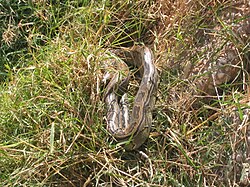 Central African rock python, Senegal National Park
 -
 Adult Central African rock python at the edge of a watering hole in Fathala Reserve, at Karang just north of the border to Gambia, Senegal


Ecology and biology
[edit]Feeding
[edit]Like all pythons, the Central African rock python is non-venomous and kills by constriction.[21][23] After gripping the prey, the snake coils around it, tightening its coils every time the victim breathes out. Death is thought to be caused by cardiac arrest rather than by asphyxiation or crushing.[21] The African rock python feeds on a variety of large rodents, monkeys, warthogs, antelopes, vultures, fruit bats, monitor lizards, crocodiles, and more in forest areas,[7] and on rats, poultry, dogs, and goats in suburban areas. It will sometimes take fish as well.[32] Occasionally, it may eat the cubs of big cats such as leopards, lions, and cheetahs, cubs of hyenas, and puppies of wild dogs such as jackals and Cape hunting dogs.[citation needed]. However, these encounters are very rare, as the lions can easily kill pythons or fend them off.[33][10] On 1 March 2017, a 3.9-m (12-ft 10-in) African rock python was filmed eating a large adult male spotted hyena weighing 70 kg (150 lb). This encounter suggests that the snake might very well be capable of hunting and killing larger and more dangerous animals than previously thought.[34] The largest ever recorded meal of any snake was when a 4.9 m African Rock Python consumed a 59 kg impala.[35]
Reproduction
[edit]
Reproduction occurs in the spring.[4] Central African rock pythons are oviparious, laying between 20 and 100 hard-shelled, elongated eggs in an old animal burrow, termite mound, or cave.[6][7] The female shows a surprising level of maternal care, coiling around the eggs, protecting them from predators, and possibly helping to incubate them, until they hatch around 90 days later.[6][21][7] The female guards the hatchlings for up to two weeks after they hatch from their eggs to protect them from predators in a manner unusual for snakes in general and pythons in particular.[36]
Hatchlings are between 45 and 60 cm (17.5 and 23.5 in) in length and appear virtually identical to adults, except with more contrasting colours.[4] Individuals may live over 12 years in captivity.[37]
Human interaction
[edit]Attacks
[edit]
Documented attacks on humans are exceptionally rare, despite the species being common in many regions of Africa, and living in diverse habitats including those with agricultural activity.[29] Few deaths are well-substantiated, with no reports of a human being consumed.[29] Large specimens (which are more common in Western Africa) "would have no difficulty in eating adult humans",[29] though it would have to be a small adult human.
Well-substantiated attacks
[edit]- A scholarly article published in 1980 said no prior well-substantiated fatalities were reported of humans killed by Central African rock pythons, and the only prior such attack by any type of python or boa was by a reticulated python in 1927.[29]
- In 1999 in Centralia, Illinois, a 3-year-old boy was suffocated during the night by an escaped 2.3 m (7.5 ft) pet African rock python.[38][39] Bite marks around the boy's neck and ears may have resulted from an attempt to swallow him.[38]
- In 2013 in Campbellton, New Brunswick, Canada, two brothers aged four and six were reportedly killed by a 4.3-to-4.9 m (14-to-16 ft), 45 kg (99 lb) Central African rock python kept by a pet shop owner.[40][41] The circumstances of the incident prompted some skepticism from experts not involved in the case.[41] An autopsy showed that the boys died of asphyxiation,[40] which does not fit with how constricting snakes kill.[42] The owner was charged with criminal negligence for not adequately protecting the boys from the snake.[43][44] (See main article).
- In 2017, a 2.4 m-long (8 ft) female Central African rock python, kept as a pet in Hampshire, England, was found to have killed its owner by asphyxiation, according to a coroner's inquest.[45]
Other reported attacks
[edit]- In 2009 in Sabaki Village, Malindi District, Kenya, a male farm manager was reportedly attacked after stepping on a 4 m (13 ft) python, the exact species of which was not determined. After an hour's struggle, he was reportedly dragged up a tree, but was then rescued by police and villagers after he was able to call for help on his mobile phone.[46][47] The snake was reportedly captured by police, but had escaped and disappeared by the next day.[46] The man said he bit the snake's tail while he was being attacked and was injured on his lower lip because the tip of the tail was sharp.[46]
Bushmeat
[edit]As the mammalian and avian game populations are gradually depleted in the Congo Basin, the proportion of large-bodied snakes offered at rural bushmeat markets increases. Consequently, a large proportion of the human population faces the threat of Armillifer armillatus infections, a python-borne zoonotic disease.[48]
Conservation
[edit]People are often fearful of large pythons and may kill them on sight.[6][29] The Central African rock python is threatened by hunting for leather in some areas.[49] Consequently, it is listed as a Near threatened species. It is also collected for the pet trade, although it is not generally recommended as a pet due to its large size and unpredictable temperament.[37] Little information is available on levels of international trade in this species.
Some of the Central African rock python's habitats are also known to be under threat. For example, mangrove and rainforest habitats and their snake communities are under serious threat in southeastern Nigeria from habitat destruction and exploration for the oil industry.[49][50]

The Central African rock python is still relatively common in many regions across Africa, and may adapt to disturbed habitats,[29] provided that food is available. The Central African rock python's population in West Africa has suffered greatly, whilst the Southern African species has fared better. This species is heavily exploited throughout its West African range, particularly for bushmeat and leather, and high rates of decline have been reported within the region. These declines appear to exceed 60% over three generations. However, both subspecies have faced declines in population and consequently it is at high risk of being a threatened species. It is listed on Appendix II of the Convention on International Trade in Endangered Species, meaning international trade in Central African rock pythons should be carefully monitored and controlled,[51] giving wild populations some protection from overcollection for pets and skins. The species is also likely to occur in a number of protected areas, such as the Serengeti National Park in Tanzania, a World Heritage site.[52]
In the Florida Everglades, where the Central African rock python is an invasive species and posing a threat to indigenous wildlife, it has no protected status and is one of the species listed on a hunting program recently authorized by state officials to eradicate non-native reptiles, the others being the Burmese python, reticulated python, green anaconda, and Nile monitor.[53]
In culture
[edit]Luo people of Kenya living mainly in the area near Lake Victoria generally consider snakes to be evil and believe that sorcerers make them harm people.[54] They express a different attitude towards pythons - such as making them appear in play songs and even worshiping them. The Luo call the Central African rock python ng'ielo in their language,[55] and with the songs containing a phrase ng'ielo jadhogre "python the coiling", children make a line and imitate a python's motion.[56][57][58] When the Luo worship a python, they call her Omieri (or Omweri) a returning python-spirit. The python is then seen as a reincarnation of Omieri, Goddess of Harvest and linked with rain and fertility.[59][54] One which appeared in 2003 raised international controversy over how she should be treated, with coverage from BBC News through the Daily Nation.[60][61][54]
In some parts of eastern Nigeria, particularly in the towns of Idemili in Anambra, the python is revered as a sacred symbol of the deity Eke Idemili. Similarly, in Njaba, the Eke Njaba, a harmless snake regarded as the deity's property, is also held in high esteem. This reverence is so deeply ingrained culturally that even Christians in these areas have not fully renounced the sacredness of the snake, and any harm to the Eke Njaba requires ritual cleansing or even a proper burial when killed, to avoid the deity's wrath.[citation needed]
References
[edit]- ^ a b Alexander, G.J.; Tolley, K.A.; Penner, J.; Luiselli, L.; Jallow, M.; Segniagbeto, G.; Niagate, B.; Howell, K.; Beraduccii, J.; Msuya, C.A.; Ngalason, W. (2021). "Python sebae". IUCN Red List of Threatened Species. 2021 e.T13300572A13300582. doi:10.2305/IUCN.UK.2021-2.RLTS.T13300572A13300582.en.
- ^ McDiarmid RW, Campbell JA, Touré TA (1999). Snake Species of the World: A Taxonomic and Geographic Reference, Volume 1. Washington, District of Columbia: Herpetologists' League. ISBN 1-893777-00-6 (series). ISBN 1-893777-01-4 (volume).
- ^ "Python sebae". Integrated Taxonomic Information System. Retrieved 12 September 2007.
- ^ a b c d e Mehrtens JM (1987). Living Snakes of the World in Color. New York: Sterling Publishers. ISBN 0-8069-6460-X.
- ^ Beolens, Bo; Watkins, Michael; Grayson, Michael (2011). The Eponym Dictionary of Reptiles. Baltimore: Johns Hopkins University Press. xiii + 296 pp. (Python sebae, p. 240). ISBN 978-1-4214-0135-5.
- ^ a b c d e f O'Shea M (2007). Boas and Pythons of the World. London: New Holland Publishers. ISBN 978-1-84537-544-7.[permanent dead link]
- ^ a b c d e f g h i Alden PC, Estes RD, Schlitter D, McBridge B (1996). Collins Guide to African Wildlife. London: HarperCollins Publishers. ISBN 0-00-220066-X.
- ^ a b Murphy JC, Henderson RW (1997). Tales of Giant Snakes: A Historical Natural History of Anacondas and Pythons. Krieger Pub. Co. ISBN 0-89464-995-7.
- ^ a b c Starin ED, Burghardt GM (1992). "African rock pythons (Python sebae) in the Gambia: observations on natural history and interactions with humans". The Snake. 24: 50–62.
- ^ a b c Luiselli L, Angelici FM, Akani GC (2001). "Food habits of Python sebae in suburban and natural habitats". African Journal of Ecology. 39 (1): 116–118. Bibcode:2001AfJEc..39..116L. doi:10.1111/j.1365-2028.2001.00269.x.
- ^ Giant Snakes (PDF). Murphy, John C., and Tom Crutchfield. 2019. p. 7.[permanent dead link]
- ^ Spawls S, Howell K, Drewes R, Ashe J (2002). A Field Guide to Reptiles of East Africa. San Diego, California: Academic Press.
- ^ Spawls S, Branch B (1995). The Dangerous Snakes of Africa. South Africa: Southern Book Publishers, Ltd.
- ^ Ott, B.D.; Secor, S.M. (2007). "Adaptive regulation of digestive performance in the genus Python". Journal of Experimental Biology. 210 (2): 340–356. Bibcode:2007JExpB.210..340O. doi:10.1242/jeb.02626. PMID 17210969. S2CID 6757894.
- ^ Murphy, J. C., & Henderson, R. W. (1997). Tales of giant snakes: a historical natural history of anacondas and pythons. Florida: Krieger Publishing Company.
- ^ Vincent, S. E.; Dang, P. D.; Herrel, A.; Kley, N. J. (2006). "Morphological integration and adaptation in the snake feeding system: a comparative phylogenetic study". Journal of Evolutionary Biology. 19 (5): 1545–1554. doi:10.1111/j.1420-9101.2006.01126.x. PMID 16910984. S2CID 4662004.
- ^ Bodson, L. (2003). A Python (Python sebae Gmelin) for the King: The Third Century BC Herpetological Expedition to Aithiopia (Diodorus of Sicily 3.36–37). Museum Helveticum, 60(1), 22-38.
- ^ Wood, Gerald (1983). The Guinness Book of Animal Facts and Feats. Guinness Superlatives. ISBN 978-0-85112-235-9.
- ^ Martin, C. (1991). The Rainforests of West Africa. Boston: Birkhauser Verlag. p. 100. ISBN 0-8176-2380-9.
- ^ a b c Bartlett PP, Wagner E (2009). Pythons. New York: Barron's Educational Series. ISBN 978-0-7641-4244-4.
- ^ a b c d e Schmidt, W. (2006). Reptiles and Amphibians of Southern Africa. Cape Town, South Africa: Struik. ISBN 1-77007-342-6.[permanent dead link]
- ^ a b c Branch, B. (1998). Field Guide to Snakes and Other Reptiles of Southern Africa. Cape Town, South Africa: Struik. ISBN 1-86872-040-3.[permanent dead link]
- ^ a b c Halliday T, Adler K (2002). The New Encyclopedia of Reptiles and Amphibians. Oxford: Oxford University Press. ISBN 0-19-852507-9.
- ^ a b c d "Python natalensis". Reptile-database.reptarium.cz. Retrieved 5 June 2022.
- ^ a b "Snake Comparison – African Rock Python vs Southern African Python". 25 June 2019.
- ^ p. Spawls, K Howell, R Drewes, J Ashe: A Field Guide to the Reptiles of East Africa. Academic Press, London 2002, ISBN 0-12-656470-1, pp. 305–310.
- ^ a b W. R. Branch, W. D. Haacke: A Fatal Attack on a Young Boy by an African Rock Python Python sebae. Journal of Herpetology Vol.14, No.3, 1980, pp. 305–307.
- ^ C.R.S. Pitman: A guide to the snakes of Uganda. Codicote Wheldon & Wesley, Ltd, 1974, ISBN 0-85486-020-7, pp. 67–71.
- ^ a b c d e f g h Branch, WR; Hacke, WD (1980). "A fatal attack on a young boy by an African rock python Python sebae". Journal of Herpetology. 14 (3): 305–307. doi:10.2307/1563557. JSTOR 1563557.
- ^ Luiselli L, Akani GC, Eniang EA, Politano E (2007). "Comparative ecology and ecological modeling of sympatric pythons, Python regius and Python sebae. In: Henderson RW, Powell R (Editors) (2007). Biology of the Boas and Pythons. Eagle Mountain, Utah: EMP Press. ISBN 0972015434.
- ^ "Largest African Rock Python caught in Everglades". WBBH (NBC-2 News). Archived from the original on 21 July 2015. Retrieved 5 April 2012.
- ^ "Python sebae (African Rock Python)". Animal Diversity Web.
- ^ Sandeep, Sharma (2004). "An observation on suspected death of Indian Rock Python (Python molurus molurus) because of Jungle Cat (Felis chaus)" (PDF). South Asian Reptile Network Newsletter. 6: 1. Archived from the original (PDF) on 2016-04-01. Retrieved 2017-01-12.
- ^ "Watch First-Ever Video of Python Swallowing Hyena". National Geographic Society. 15 March 2017.
- ^ encyclopedia of LIFE. Miles Kelly. 2017. p. 227. ISBN 978-1-78617-327-0.
- ^ Alexander, Graham; Johan Marais (2008). A Guide to the Reptiles of Southern Africa. Struik Publishers. ISBN 978-1-77007-386-9.
- ^ a b Bartlett PP, Griswold B, Bartlett RD (2001). Reptiles, Amphibians, and Invertebrates: An Identification and Care Guide. New York: Barron's Educational Series. ISBN 0-7641-1650-9.
- ^ a b "Centralia family's python suffocates 3-year-old boy". Chicago Tribune. 30 August 1999. Retrieved 31 March 2018.
- ^ "AGN: Couple acquitted in child's death by python". Amarillo Globe-News. 25 March 2000.
- ^ a b "Reports into boys' python deaths still under wraps". CBC News. Canadian Broadcasting Corporation. 12 September 2013. Retrieved 31 March 2018.
- ^ a b Boesveld, Sarah (6 August 2013). "'Very, very strange': Snake handlers, experts baffled by New Brunswick python attack". National Post. Postmedia Network Inc.
- ^ Gill, Victoria (23 July 2015). "Boa constrictors' lethal secret revealed". BBC News. Retrieved 1 April 2018.
- ^ "Man charged in python asphyxiation death of boys". Toronto Star. 31 March 2015. Retrieved 31 March 2018.
- ^ "Man Charged over Brothers Killed by Python". Archived from the original on 2017-08-06. Retrieved 2018-04-01.
- ^ "Snake owner killed by his pet python". BBC News. 24 January 2018.
- ^ a b c Nyassy, Daniel (14 April 2009). "Man bites snake in hour-long battle to survive". Daily Nation. Nation Media Group. Archived from the original on 24 December 2013.
- ^ "Man bites snake in epic struggle". BBC News. 15 April 2009. Retrieved 15 April 2009.
- ^ Hardi R, et al. (2017). "Armillifer-infected snakes sold at Congolese bushmeat markets represent an emerging zoonotic threat". EcoHealth. 14 (3): 743–749. doi:10.1007/s10393-017-1274-5. PMC 7088293. PMID 29030787.
- ^ a b Luiselli L, Akani GC (2002). "An investigation into the composition, complexity and functioning of snake communities in the mangroves of south-eastern Nigeria". African Journal of Ecology. 40 (3): 220–227. Bibcode:2002AfJEc..40..220L. doi:10.1046/j.1365-2028.2002.00358.x.
- ^ Akani GC, Barieenee IF, Capizzi D, Luiselli L (1999). "Snake communities of moist rainforest and derived savanna sites of Nigeria: biodiversity patterns and conservation priorities". Biodiversity and Conservation. 8 (5): 629–642. Bibcode:1999BiCon...8..629A. doi:10.1023/A:1008849702810. S2CID 24757927.
- ^ "CITES". CITES.
- ^ "Serengeti National Park, Tanzania" (PDF). UNEP-WCMC. Archived from the original (PDF) on 2009-01-14.
- ^ "Invader Updater - Legislation". Department of Wildlife Ecology and Conservation. Institute of Food and Agricultural Sciences (IFAS), UF. 2010-06-03. Retrieved 2022-01-28.
- ^ a b c Smith, James H. (2006). "Snake-driven development: Culture, nature and religious conflict in neoliberal Kenya". Ethnography. 7 (4): 423–59. doi:10.1177/1466138106073144. JSTOR 24047925. S2CID 220725054.
- ^ Kokwaro, John O.; Johns, Timothy (1998). Luo Biological Dictionary. Nairobi and Kampala and Dar es Salaam: East African Educational Publishers. p. 257. ISBN 9966-46-841-2.
- ^ Miruka, Okumba (2001). Oral Literature of the Luo. Nairobi and Kampala and Dar es Salaam: East African Educational Publishers. ISBN 9966-25-086-7.
- ^ Miya, Florence N. (2007). "Using African Indigenous Knowledge Systems in Early Childhood Music Education." In Katharine Smithrim and Rena Upitis (eds.) Listen to Their Voices: Research and Practice in Early Childhood Music, pp. 161–180. Waterloo, Canada: Canadian Music Educators' Association. ISBN 978-0-920630-13-6
- ^ Owen, J. W. (1959). "Tribal games and dances in African schools". Physical Education. 51: 16–20.
- ^ Durosomo, Damola (3 August 2018). "Kenyans Rejoice as the Remains of Omieri, the Legendary Snake and Goddess of Harvest, Return Home". OkayAfrica. Retrieved 13 April 2022.
- ^ "Kenyans charmed by snake". BBC News. 11 March 2003. Retrieved 1 April 2018.
- ^ "Kenya python tightens its grip". BBC News. 15 May 2003. Retrieved 1 April 2018.
Further reading
[edit]- Boulenger GA (1893). Catalogue of the Snakes in the British Museum (Natural History). Volume I., Containing the Families ... Boidæ .... London: Trustees of the British Museum (Natural History). (Taylor and Francis, printers). xiii + 448 pp. + Plates I–XXVIII. (Python sebae, pp. 86–87).
- Gmelin JF (1789). Caroli a Linné Systema Naturae. Editio Decima Tertia [13th edition]. Tomus 1, Pars 3. Leipzig: G.E. Beer. 1,896 pp. (Coluber sebae, new species, p. 1118). (in Latin).
External links
[edit]- Python sebae at the Reptarium.cz Reptile Database. Accessed 12 September 2007.
Central African rock python
View on GrokipediaThe Central African rock python (Python sebae) is a large constrictor snake in the family Pythonidae, endemic to sub-Saharan Africa and recognized as the continent's largest serpent species.[1]
It occupies a broad array of habitats, from evergreen forests and moist savannas to rocky outcrops and riverine environments up to elevations of 2,300 meters, avoiding arid deserts and high mountains.[1] Adults typically attain lengths of 3 to 5 meters and weights of 44 to 55 kilograms, though exceptional specimens have exceeded 7.5 meters and 91 kilograms, with females generally larger than males.[1] The snake's robust body features a yellowish ground color patterned with dark brown blotches, aiding camouflage in varied terrains, and it employs heat-sensing labial pits to detect prey during crepuscular hunts.[1]
Carnivorous and opportunistic, it constricts diverse vertebrates including rodents, monkeys, antelopes, and even Nile crocodiles, with adults capable of subduing prey weighing up to 59 kilograms.[1] Oviparous reproduction occurs seasonally from November to March, with females depositing clutches of 20 to 50 eggs—up to 100 in large individuals—which they incubate and aggressively defend for 65 to 80 days until hatching.[1] Hatchlings measure 450 to 600 millimeters and are independent upon emergence.[1]
Populations have declined due to habitat degradation, overhunting for skins and meat, and retaliatory killings stemming from occasional human attacks, confining many to protected reserves; the species is regulated under CITES Appendix II to curb international trade.[1]