


Community hub
Recent from talks
Contribute something
Nothing was collected or created yet.
Ahiram sarcophagus
View on WikipediaKey Information


| Part of a series on |
| Canaanite and Aramaic inscriptions |
|---|
 |
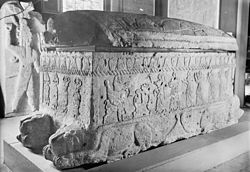
The Ahiram sarcophagus (also spelled Ahirom; Phoenician: 𐤀𐤇𐤓𐤌) was the sarcophagus of a Phoenician King of Byblos (c. 1000 BC), discovered in 1923 by the French excavator Pierre Montet in tomb V of the royal necropolis of Byblos.
The sarcophagus is famed for its bas relief carvings, and its Phoenician inscription. One of five known Byblian royal inscriptions, the inscription is considered to be the earliest known example of the fully developed Phoenician alphabet.[1] The Phoenician alphabet is believed to be the parent alphabet for a wide number of the world's current writing systems; including the Greek, Latin and Cyrillic Alphabets, and the Hebrew, Arabic and Urdu Abjads. For some scholars it represents the terminus post quem of the transmission of the alphabet to Europe.[1]
Ahirom is not attested in any other Ancient Oriental source, although some scholars [who?] have suggested a possible connection to the contemporaneous King Hiram mentioned in the Hebrew Bible (see Hiram I).
Discovery
[edit]
The sarcophagus was found following a landslide in the cliffs surrounding Byblos (in now modern-day Lebanon) in late 1923, which revealed a number of Phoenician royal tombs. The tomb of Ahirom was ten metres deep.[2][3][4]
Sarcophagus
[edit]The sarcophagus of Ahiram was discovered by the French archaeologist Pierre Montet in 1923[5] in Byblos.[6] Its low relief carved panels make it "the major artistic document for the Early Iron Age" in Phoenicia.[7] Associated items dating to the Late Bronze Age either support an early dating, in the 13th century BC or attest the reuse of an early shaft tomb in the 11th century BC.
The major scene represents a king seated on a throne carved with winged sphinxes. A priestess offers him a lotus flower. On the lid two male figures face one another with seated lions between them. These figures have been interpreted by Glenn Markoe as representing the father and son of the inscription. The rendering of figures and the design of the throne and a table show strong Assyrian influences.[7] A total absence of Egyptian objects of the 20th and 21st dynasties in Phoenicia[8] contrasts sharply with the resumption of Phoenician-Egyptian ties in the 22nd Dynasty of Egypt.[9]
Dating
[edit]The date remains the subject of controversy, according to Glenn E. Markoe, "The Emergence of Phoenician Art".[10] The Ahiram inscription is generally dated to ca. 1000 BCE, as Edward M. Cook notes: "Most scholars have taken the Ahiram inscription to date from around 1000 B.C.E.".[11] Cook analyses and dismisses the date in the thirteenth century adopted by C. Garbini,[12] which was the prime source for early dating urged in Bernal, Cadmean Letters.[13] Also, traces of an erased early Proto-Byblian inscription are visible on the monument.[14]
Others, on the basis of objects found near the sarcophagus, think of a later date, around 850 BCE.[15][16] Arguments for a date in the mid-9th to 8th century BC for the sarcophagus reliefs themselves – and hence the inscription, too – were made on the basis of comparative art history and archaeology by Edith Porada,[17] and on the basis of paleography among other points by Ronald Wallenfels.[18]
Inscriptions
[edit]An inscription of 38 words is found on parts of the rim and the lid of the sarcophagus. It is written in the Old Phoenician dialect of Byblos and is the oldest witness to the Phoenician alphabet of considerable length discovered to date:[19]
.png)
| Text[20] | Transliteration | Translation[21][22][23][24] | |
|---|---|---|---|
| (text on head side:) | 𐤀𐤓𐤍 𐤟 𐤆 𐤐𐤏𐤋 𐤟 [𐤐𐤋]𐤎𐤁𐤏𐤋 𐤟 𐤁𐤍 𐤀𐤇𐤓𐤌 𐤟 𐤌𐤋𐤊 𐤂𐤁𐤋 𐤟 | ʾrn 𐤟 z pʿl 𐤟 [pl]s(?)bʿl (or [ʾ]t(?)bʿl) 𐤟 bn ʾḥrm 𐤟 mlk gbl 𐤟 | This coffin [Pil]sibaʿal (or: [I]ttobaʿal) has made, the son of Aḥirom (Aḥiram), King of Byblos, |
| 𐤋𐤀𐤇𐤓𐤌 𐤟 𐤀𐤁𐤄 𐤟 𐤊 𐤔𐤕𐤄 𐤟 𐤁𐤏𐤋𐤌 𐤟 | lʾḥrm 𐤟 ʾbh 𐤟 k šth(?) 𐤟 bʿlm 𐤟 | for Aḥirom, his father, as he laid him down for eternity. | |
| (text along the side of the lid:) | 𐤅𐤀𐤋 𐤟 𐤌𐤋𐤊 𐤟 𐤁𐤌𐤋𐤊𐤌 𐤟 | wʾl 𐤟 mlk 𐤟 bmlkm 𐤟 | And when(?) a king among the kings (any king) |
| 𐤅𐤎𐤊𐤍 𐤟 𐤁𐤎<𐤊>𐤍𐤌 𐤟 | wskn 𐤟 bs<k>nm 𐤟 | or a governor among the governors (any governor) | |
| 𐤅𐤕𐤌𐤀 𐤟 𐤌𐤇𐤍𐤕 𐤟 𐤏𐤋𐤉 𐤟 𐤂𐤁𐤋 𐤟 | wtmʾ 𐤟 mḥnt 𐤟 ʿly 𐤟 gbl 𐤟 | or a commander of the army [will rule] over Byblos (or: [marches] against Byblos), | |
| 𐤅𐤉𐤂𐤋 𐤟 𐤀𐤓𐤍 𐤟 𐤆𐤍 𐤟 | wygl 𐤟 ʾrn 𐤟 zn 𐤟 | and would remove (or: disclose) this coffin, | |
| 𐤕𐤇𐤕𐤎𐤐 𐤟 𐤇𐤈𐤓 𐤟 𐤌𐤔𐤐𐤈𐤄 𐤟 | tḥtsp 𐤟 ḥṭr 𐤟 mšpṭh 𐤟 | then his imperial scepter shall break (lit.: the staff of his legal power shall be defoliated), | |
| 𐤕𐤄𐤕𐤐𐤊 𐤟 𐤊𐤎𐤀 𐤟 𐤌𐤋𐤊𐤄 𐤟 | thtpk 𐤟 ksʾ 𐤟 mlkh 𐤟 | the throne of his kingship (his royal throne) shall overturn, | |
| 𐤅𐤍𐤇𐤕 𐤟 𐤕𐤁𐤓𐤇 𐤟 𐤏𐤋 𐤟 𐤂𐤁𐤋 𐤟 | wnḥt 𐤟 tbrḥ 𐤟 ʿl 𐤟 gbl 𐤟 | and peace shall depart from Byblos. | |
| 𐤅𐤄𐤀 𐤟 𐤉𐤌𐤇 𐤎𐤐𐤓 𐤆 𐤟 | whʾ 𐤟 ymḥ spr z 𐤟 | And as to him, [if] he shall erase this inscription, | |
| 𐤋𐤐𐤐 𐤟 𐤔𐤁𐤋 𐤟 | lpp(?) 𐤟 š(?)bl 𐤟 | torn(??) shall be [his] royal robe(??). |
(The meaning of the last two words LPP and ŠBL is not well known and has to be guessed at; but it is clear that a curse is meant.[25])
The formulas of the inscription were immediately recognised as literary in nature, and the assured cutting of the archaic letters suggested to Charles Torrey[5] a form of writing already in common use. A 10th-century BC date for the inscription has become widely accepted.
Halfway down the burial shaft another short inscription was found incised at the southern wall, the Byblos Necropolis graffito. The three-line graffito reads:[26]
- (1) ld‘t 𐤟 (2) hn yp?d lk 𐤟 (3) tḥt zn
It is usually interpreted as a warning not to proceed further:[27][28]
- (1) Know: (2) here is disaster(?) for you (3) below this.
Recently it has been proposed that it is part of some initiation ritual which remains unknown in detail:[29]
Concerning knowledge:
here and now be humble (you yourself!)
‹in› this basement!"
King Ahiram
[edit]Ahiram himself is not titled a king, neither of Byblos nor of any other city state. It is said that he was succeeded by his son Ithobaal I who is the first to be explicitly entitled King of Byblos,[30] which is due to an old misreading of a text lacuna. According to a new reconstruction of the lacuna the name of Ahiram's son is to be read [Pil]sibaal, and the reading Ithobaal should be disregarded.[24] The early king list of Byblos is again subject to further study.
Heritage designation
[edit]The sarcophagus is on public display in the National Museum of Beirut. The General Directorate of Antiquities of Lebanon assembled a list of inscribed objects from different time periods that together illustrate the evolution of the Phoenician alphabet; the sarcophagus is the oldest of these.[31] This list was the basis of a nomination of the alphabet to the Memory of the World International Register maintained by UNESCO. This was accepted in 2005, recognising the objects as documentary heritage of global importance.[32]
References
[edit]- ^ a b Cook, p1
- ^ René Cagnat, Nouvelles Archéologiques, Syria 4 (1923): 334–344
- ^ Pierre Montet, "Les fouilles de Byblos en 1923," L’Illustration 3 (May 3, 1924), 402–405.
- ^ Calligraphy and Craftsmanship in the Ahirom inscription. Considerations on skilled linear flat writing in early first millennium Byblos, Reinhard G. Lehmann
- ^ a b Torrey, Charles C. (1925). "The Ahiram Inscription of Byblos". Journal of the American Oriental Society. 45. Journal of the American Oriental Society, Vol. 45: 269–279. doi:10.2307/593505. JSTOR 593505.
- ^ Pritchard, James B. (1968). Archaeology and the Old Testament. Princeton: Univ. Press.; Moscati, Sabatino (2001). The Phoenicians. London: Tauris. ISBN 1850435332.;
- ^ a b Markoe, Glenn E. (1990). "The Emergence of Phoenician Art". Bulletin of the American Schools of Oriental Research. 279 (279): 13–26. doi:10.2307/1357205. JSTOR 1357205. S2CID 163353156. [pp. 13, 19–22]
- ^ J. Leclant, "Les relations entre l'Égypte et la Phénicie du voyage de Ounamon à l'expédition d'Alexandre", in The role of the Phoenicians in the Interaction of Mediterranean Civilisations, W. Ward, ed. (Beirut: American University) 1968:11.
- ^ For a recent discussion under aspects of aert history, see Ellen Rehm: Der Ahiram-Sarkophag, Mainz 2004 (Forschungen zur phönizisch-punischen und zyprischen Plastik, hg. von Renate Bol, II.1. Dynastensarkophage mit szenischen Reliefs aus Byblos und Zypern Teil 1.1)
- ^ Bulletin of the American Schools of Oriental Research No. 279 (August 1990):13–26) p. 13.
- ^ "On the Linguistic Dating of the Phoenician Ahiram Inscription (KAI 1)", Journal of Near Eastern Studies 53.1 (January 1994:33–36) p. 33 JSTOR.
- ^ C. Garbini, "Sulla datazione della'inscrizione di Ahiram", Annali (Istituto Universitario Orientale, Naples) 37 (1977:81–89)
- ^ Bernal, Martin (1990). Cadmean Letters: The Transmission of the Alphabet to the Aegean and further West before 1400 BC. Winona Lake, Ind.: Eisenbrauns. ISBN 0931464471.
- ^ Martin, Malachi (1961). "A Preliminary Report after Re-Examination of the Byblian Inscriptions". Orientalia (Nova Series). 30 (1): 46–78 [47–63]. JSTOR 43073578. Retrieved 8 January 2023.
- ^ Sass, Benjamin; Finkelstein, Israel (2016). "The swan-song of Proto-Canaanite in the ninth century BCE in light of an alphabetic inscription from Megiddo". Semitica et Classica. 9: 19–42. doi:10.1484/J.SEC.5.112723.
- ^ The date remains the subject of controversy, according to Glenn E. Markoe, "The Emergence of Phoenician Art" Bulletin of the American Schools of Oriental Research No. 279 (August 1990):13–26) p. 13.
- ^ "Notes on the Sarcophagus of Ahiram," Journal of the Ancient Near East Society 5 (1973:354–72)
- ^ "Redating the Byblian Inscriptions," Journal of the Ancient Near East Society 15 (1983:79–118).
- ^ The most recent scholarly book which deals with all aspects of the inscription is Reinhard G. Lehmann, Die Inschrift(en) des Ahirom-Sarkophags und die Schachtinschrift des Grabes V in Jbeil (Byblos), (Mainz), 2005 (Forschungen zur phönizisch-punischen und zyprischen Plastik, hg. von Renate Bol, II.1. Dynastensarkophage mit szenischen Reliefs aus Byblos und Zypern Teil 1.2)
- ^ Donner, Herbert; Röllig, Herbert (2002). Kanaanäische und aramäische Inschriften Vol. 1 (5th ed.). Wiesbaden: Harrassowitz. p. 1 (#1). ISBN 3447045876.
- ^ Krahmalkov, Charles R. (2000). Phoenician-Punic Dictionary. Leuven: Peeters & Departement Oosterse Studies. ISBN 9042907703.
- ^ Commentary in: Jaroš, Karl (1982). Hundert Inschriften aus Kanaan und Israel. Fribourg: Schweizerische Katholisches Bibelwerk. pp. 36–37. ISBN 3720399966.
- ^ Reinhard G. Lehmann: Die Inschrift(en) des Ahirom-Sarkophags und die Schachtinschrift des Grabes V in Jbeil (Byblos), 2005, p. 38
- ^ a b Reinhard G. Lehmann, Wer war Aḥīrōms Sohn (KAI 1:1)? Eine kalligraphisch-prosopographische Annäherung an eine epigraphisch offene Frage, in: V. Golinets, H. Jenni, H.-P. Mathys und S. Sarasin (Hg.), Neue Beiträge zur Semitistik. Fünftes Treffen der ArbeitsgemeinschaftSemitistik in der Deutschen MorgenländischenGesellschaft vom 15.–17. Februar 2012 an der Universität Basel (AOAT 425), Münster: Ugarit-Verlag 2015, pp. 163–180
- ^ Sometimes a translation is found like "As for him, his inscription will be erased by the sharpness of a chisel." However, this is impossible, because the text speaks of this (Aḥirom's) inscription (SPR Z), not his (the desecrator's) inscription (= SPRH).
- ^ Donner & Röllig (2002), p. 1 (#2).
- ^ by René Dussaud, in Syria 5 (1924:135–57).
- ^ Albright, W.F. (1947). "The Phoenician inscriptions of the tenth century B.C. from Byblus". Journal of the American Oriental Society. 67 (3): 153–160 [156]. doi:10.2307/596081. JSTOR 596081. Retrieved 2022-04-26.
- ^ Reinhard G. Lehmann: Die Inschrift(en) des Ahirom-Sarkophags und die Schachtinschrift des Grabes V in Jbeil (Byblos), 2005, pp. 39–53
- ^ Vance, Donald R. (1994). "Literary Sources for the History of Palestine and Syria: The Phœnician Inscriptions". The Biblical Archaeologist. 57 (1). The Biblical Archaeologist, Vol. 57, No. 1: 2–19. doi:10.2307/3210392. JSTOR 3210392. S2CID 222767576.
- ^ "[Nomination form:] Lebanon - The Phoenician Alphabet" (PDF). UNESCO Memory of the World Programme. Retrieved 2025-05-23.
- ^ "The Phoenician Alphabet". UNESCO Memory of the World Programme. Retrieved 2025-05-23.
Literature
[edit]- Pierre Montet: Byblos et l'Egypte, Quatre Campagnes des Fouilles 1921–1924, Paris 1928, pp. 228–238, tables CXXVII–CXLI ISBN 978-2913330023
- Ellen Rehm: Der Ahiram-Sarkophag, Mainz 2004 (Forschungen zur phönizisch-punischen und zyprischen Plastik II.1.1; Dynastensarkophage mit szenischen Reliefs aus Byblos und Zypern 1.1)
- Reinhard G. Lehmann: Die Inschrift(en) des Ahirom-Sarkophags und die Schachtinschrift des Grabes V in Jbeil (Byblos), Mainz 2005 (Forschungen zur phönizisch-punischen und zyprischen Plastik II.1. Dynastensarkophage mit szenischen Reliefs aus Byblos und Zypern 1.2)
- Jean-Pierre Thiollet: Je m'appelle Byblos. Paris 2005. ISBN 2914266049
- Michael Browning "Scholar updates translation of ancient inscription", in: The Palm Beach Post, Sunday, July 3, 2005, p. 17A.
- Reinhard G. Lehmann: Wer war Aḥīrōms Sohn (KAI 1:1)? Eine kalligraphisch-prosopographische Annäherung an eine epigraphisch offene Frage, in: V. Golinets, H. Jenni, H.-P. Mathys und S. Sarasin (Hg.), Neue Beiträge zur Semitistik. Fünftes Treffen der ArbeitsgemeinschaftSemitistik in der Deutschen MorgenländischenGesellschaft vom 15.–17. Februar 2012 an der Universität Basel (AOAT 425), Münster: Ugarit-Verlag 2015, pp. 163–180
External links
[edit]
- Press release on new deciphering and translation (in German)

Ahiram sarcophagus
View on GrokipediaDiscovery and Excavation
Discovery
The Ahiram sarcophagus was discovered in late 1923 by French archaeologist Pierre Montet during systematic excavations at the ancient site of Byblos (modern Jbeil, Lebanon), prompted by a landslide in the autumn that eroded the cliffs and exposed entrances to previously unknown royal tombs in the necropolis. These works were part of broader archaeological efforts at Byblos under the French Mandate for Syria and the Lebanon, which facilitated Montet's campaigns from 1921 to 1924.[4] The sarcophagus was unearthed in Tomb V, one of nine shaft-and-chamber tombs in the royal necropolis, situated at a depth of approximately 10 meters below the surface. The tomb's vertical shaft led to a semicircular chamber, with an intermediate floor sealed by wooden beams at about 4.35 meters depth, where the artifact was located alongside two plain sarcophagi, an ivory plaque, and fragments of alabaster vessels and pottery.[1] Upon discovery, the limestone sarcophagus was found intact in the center of the chamber, which was partially filled with mud from the landslide and contained scattered artifacts indicative of ancient disturbance. However, evidence of prior looting—likely from antiquity, as suggested by the curse inscription on the sarcophagus itself—meant no human remains were recovered from within it, though disarticulated bones were noted in the chamber from the robbed burials.[5]Tomb Context
The Ahiram sarcophagus was housed in Tomb V, part of a series of nine Phoenician royal tombs (numbered I through IX) within the ancient necropolis of Byblos, a burial ground that spans the Late Bronze Age (c. 1550–1200 BC) and early Iron Age (c. 1200–1000 BC).[1] This necropolis, situated on a low hill partially eroded by the sea, served as an elite cemetery for Byblos' rulers, with tombs carved into the natural rock to signify high-status interments.[1] Architecturally, Tomb V exemplifies a vertical shaft tomb design common in the region, featuring a deep shaft descending to a subterranean chamber of roughly semicircular shape, hewn directly into the limestone cliffs for structural integrity and symbolic isolation from the living world.[1] The chamber, accessed via a narrow passage, included an intermediate support level reinforced by wooden beams (evidenced by square holes in the walls) at about 4.35 meters depth, and a small conduit in one corner, features that underscore the engineering sophistication of elite burials around 1000 BC.[1] Excavation revealed clear evidence of prior ancient looting, including scattered debris and fragments at the shaft's base, likely from intruders who breached softer clay layers or during later tomb reuse; however, the sarcophagus itself remained sealed and undisturbed within the chamber.[1] Primary reports detail additional finds from Tomb V, including an ivory plaque and pottery fragments, alongside the sarcophagus as the central element.[1]Physical Description
Construction and Material
The Ahiram sarcophagus is fashioned from soft limestone, a material selected for its workability in detailed carving.[1] The structure consists of a rectangular basin hollowed out from a single block of stone, paired with a separately carved flat lid that features protruding lugs for handling.[1] This monolithic approach to the basin reflects early Phoenician stoneworking practices, emphasizing durability and structural integrity for burial purposes.[1] Overall dimensions of the sarcophagus, including the lid, measure approximately 3.05 meters in length and 1.52 meters in height.[6]Iconography and Carvings
The bas-relief carvings on the Ahiram sarcophagus, executed in low relief on its lid and sides, depict scenes central to Phoenician royal funerary iconography. The lid features two facing figures, identified as the deceased king and his successor, with the king holding a drooping lotus flower in one hand while raising the other in a gesture of benediction toward the son, who grasps an upright lotus and a small pointed-base vessel. These figures wear long pleated robes with fringed aprons, emphasizing a formal, ceremonial exchange.[1] The long sides present a prominent central composition of the king enthroned on a chair supported by sphinxes, holding a drooping flower and a shallow bowl beside a table laden with offerings such as a calf's head and bread loaves, evoking a funerary banquet. Flanking this enthroned figure are processions of male mourners with raised hands, alongside a priestess-like woman bearing a lotus flower and Egyptian-style ritual tools, while subsidiary scenes illustrate estate activities for the afterlife. The short sides, in contrast, show groups of mourning women with bared breasts and raised arms, underscoring communal grief. Carved from soft limestone, these reliefs exhibit varying depth and modeling, with no traces of original pigmentation preserved.[1] Stylistically, the carvings blend Egyptian influences—evident in the lotus motifs symbolizing rebirth, sphinx guardians, and estate scenes—with Assyrian elements such as the stocky proportions of figures, fringed attire, and processional compositions, reflecting Byblos' pivotal role in maritime trade networks connecting Egypt and Mesopotamia during the late second millennium BCE. Symbolically, the enthroned king flanked by sphinxes asserts eternal kingship and divine protection in the afterlife, while the mourners and drooping flowers convey themes of ritual lamentation and the transition to eternity, reinforced by protective lion supports at the corners.[1][7]Inscriptions
Main Inscription
The main inscription on the Ahiram sarcophagus is a 38-word dedicatory text in the Phoenician language, carved around the rim of the lid and the upper edge of the basin.[2] It employs the fully developed Phoenician alphabet of 22 letters, written in a right-to-left direction with phonetic values representing consonants only, and is arranged in three horizontal lines that follow the contour of the sarcophagus edges.[8] The transcription of the inscription, based on standard scholarly editions, reads as follows (with word divisions for clarity): Line 1: srpn 'š 'ṭbʿl bn 'ḥrm mlk gbl l'ḥrm 'bhwLine 2: bʿl 'ḥrm mlk gbl lʿlm w'n k mlk bmlkm wʿdn bʿdnym wḥyl bḥylym wkl 'npš 'š tṭpḥ 't hqr
Line 3: yšm ḥrt mšpṭhw yʾbk ksnw yḥtsp ḥṭr mšpṭhw w yšmḍ mʾršt bʿlt gbl wʾl yk kʿsṭr lzr wʾl yhy zryʿ lšbt ʿl ksnw[9] A standard English translation renders the text as: "Sarcophagus which Ittobaal, son of Ahiram, king of Byblos, made for Ahiram, his father. Blessed be Ahiram, king of Byblos, in perpetuity. And if any king among kings, or governor among governors, or army commander among army commanders, or any person at all despoils this coffin, may the sacred gods destroy him, may they overthrow his throne, may they break his scepter of judgment, and may they efface the memory of his seed from the house of the lady of Byblos, and may there be no root for his seed, and may there be no survivor to sit upon his throne."[2][10] Structurally, the inscription divides into three parts: an introductory dedicatory formula identifying the commissioner (Ittobaal) and recipient (Ahiram); a blessing invoking eternal favor on Ahiram; and an extensive curse formula that escalates in threats against potential despoilers, emphasizing divine retribution on their authority (scepter and throne) and lineage (seed and posterity).[9] This tripartite organization reflects typical Phoenician royal funerary rhetoric, with the curse comprising the majority of the text to deter violation through supernatural and social consequences.[2] The script's careful execution, with consistent letter forms and minimal abbreviations, indicates professional craftsmanship, likely by a royal scribe familiar with Byblian conventions.[11]