


Community hub
Recent from talks
Contribute something
Nothing was collected or created yet.
AirConsole
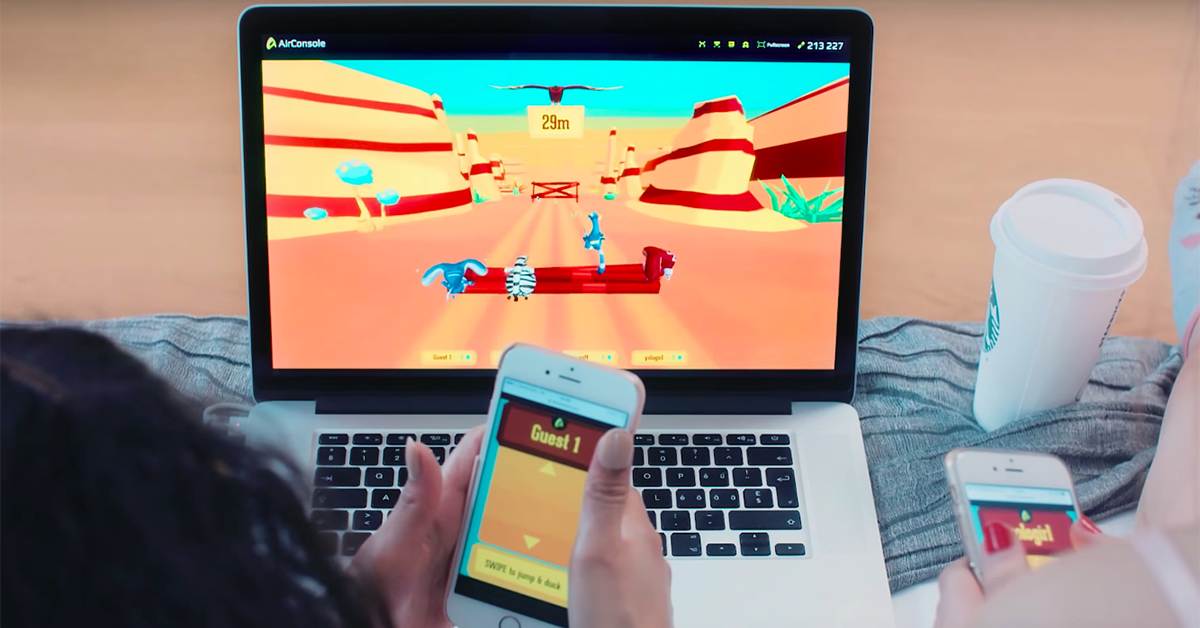
View on Wikipedia People playing a game via AirConsole on a laptop | |
| Developer | N-Dream |
|---|---|
| Type | Cloud OTA Delivery Technology |
| Launch date | September 4, 2015[1] |
| Website | www |

AirConsole is a gaming platform developed by Zurich-based startup N-Dream. It created the concept in January 2015, with around $1.4 million in initial capital.[2] Soon after, N-Dream conducted a game development competition, where developers were encouraged to create their own game on the AirConsole platform.
In 2016, the gaming company was the winner of the 2016 Deutscher Entwicklerpreis[3]). Their game, Castle Hustle was nominated for the Best Student Game Award at the Ludicious Game Festival in 2017.
As of March 2023, AirConsole has many casual games exclusive to its platform across all genres: racing, action, adventure, strategy, sports, quiz, drawing games and more. All games have their own smartphone optimised controls. Next to the AirConsole exclusive titles, there is a selection of games available from Nintendo Switch, Xbox and Steam. Some of their best ranking games include Let's Cook Together, GoKartGo!Air!, Mega Monster Party, fARTworks, Ludo and The Neighbourhood.
In 2022 it was announced that BMW would use AirConsole for in-car entertainment.[4]
References
[edit]- ^ "AirConsole - From prototype to full featured multiplayer game console". AirConsole Blog. Archived from the original on 2016-01-17. Retrieved 2016-12-13.
- ^ "AirConsole Is A Browser-Based Gaming Platform Where Your Smartphone Is The Controller". TechCrunch. Retrieved 8 May 2018.
- ^ "Preisträger 2016 | Deutscher Entwicklerpreis". deutscherentwicklerpreis.de. Archived from the original on 2017-06-14. Retrieved 2016-12-13.
- ^ Shakir, Umar (11 October 2022). "BMW uses QR codes and your phone to control casual games on its big in-car screen". The Verge. Retrieved 12 October 2022.
Video game streaming services | |||||
|---|---|---|---|---|---|
| Cloud gaming |
| ||||
| Local streaming |
| ||||

 | This video game software-related article is a stub. You can help Wikipedia by expanding it. |
AirConsole
View on GrokipediaOverview
Concept and functionality
AirConsole is an online video game console developed by the Zurich-based company N-Dream AG, which enables users to transform web browsers on shared screens into gaming consoles without the need for any proprietary hardware.[2][1] The platform revives local multiplayer gaming by leveraging everyday devices, allowing players to engage in sessions directly through a standard internet connection.[7] At its core, AirConsole operates by having one user access the website airconsole.com on a shared display such as a TV, computer monitor, or compatible screen, where a unique session QR code is generated.[1] Other participants then scan this QR code using their smartphones via the free AirConsole app or browser, instantly joining the game as controllers without any downloads or installations on the host device.[1] Gameplay synchronizes in real-time through cloud-based servers, ensuring that inputs from multiple devices are processed and reflected on the shared screen seamlessly.[8] The platform emphasizes local multiplayer experiences, supporting multiple players simultaneously in a single session, with the number varying by game and some supporting up to 30 or more players, which fosters social interaction in the same physical space.[9] This setup requires no additional controllers or setup time, making it accessible for impromptu gatherings. A key innovation is its cloud-over-the-air (OTA) technology, which optimizes game logic to run primarily on the local device while using the cloud for minimal synchronization, achieving ultra-low latency even on standard internet connections without demanding high-speed broadband.[10][11] This approach bypasses the typical requirements of game streaming services, prioritizing responsive play over intensive data transfer.[2] Launched in 2015, AirConsole was designed from the outset to democratize multiplayer gaming by eliminating hardware barriers.[10]Business model
AirConsole operates on a freemium model, providing users with free access to a selection of basic games and features, while premium content and extended access require payment. New players receive a starter pack offering a rotating selection of free games each week, encouraging initial engagement without cost.[3][12] The platform's primary revenue streams include direct player purchases, such as the AirConsole Hero subscription, which unlocks unlimited access to premium games and additional benefits via in-app payments through app stores like Google Play and the Apple App Store. Additional income derives from developer royalties, where revenue from Hero subscriptions is distributed to game creators based on playtime metrics, incentivizing high-quality content production. Licensing fees from integrations, particularly in the automotive sector with partners like BMW and Volkswagen, further contribute by embedding AirConsole's technology into vehicle entertainment systems.[13][14][5] For developers, AirConsole offers a free software development kit (SDK) that enables the creation of local multiplayer games using web technologies, with built-in support for device pairing, networking, and deployment on platforms including browsers, TVs, and cars. N-Dream AG, the company behind AirConsole, takes a revenue share from published games through the subscription distribution model, while providing free hosting and global reach to over 120 countries. This ecosystem has supported the platform's growth to over 18 million registered players worldwide, demonstrating the scalability of its monetization approach.[14][2]History
Founding and launch
AirConsole was founded in January 2015 by Andrin von Rechenberg, a former Google senior software engineer and serial entrepreneur, in Zurich, Switzerland, under the company N-Dream AG, with initial capital of just under $1.4 million.[15][3][16] The platform's creation was motivated by the observed decline in casual local multiplayer gaming experiences, aiming to revive spontaneous couch co-op play by repurposing ubiquitous smartphones as controllers and web browsers as the gaming interface, eliminating the need for dedicated hardware.[17] Beta testing occurred throughout 2015, allowing early users to experiment with the browser-based system prior to public availability.[18] AirConsole launched to the public in early September 2015, with the platform's debut highlighted in a TechCrunch announcement later that month, initially emphasizing web-based casual games such as party titles and emulated classics like NES games.[15] In its early months, AirConsole secured seed funding of approximately $1.29 million in a round completed in September 2015 and gained rapid initial traction, including significant attention from gaming communities on Reddit, drawing thousands of players shortly after release.[19][20]Growth and expansions
AirConsole experienced substantial user base expansion in the late 2010s and early 2020s, accumulating over 5 million players by late 2019 through its accessible browser-based multiplayer model.[21] This growth accelerated during the COVID-19 pandemic, with platform usage surging by 500% in the first half of 2020 amid increased demand for remote social gaming.[22] To further boost engagement and support social distancing, AirConsole offered free two-week access to its full library of premium games starting in March 2020, using the promotional code "919 2020," which was extended into a second wave initiative in November.[23][24] In 2021, AirConsole broadened its reach through a strategic partnership with Xiaomi, integrating the platform directly into Android TV devices to enable seamless cloud gaming on smart TVs.[25] This collaboration pre-installed the AirConsole app on Xiaomi's Mi TV and other models, targeting the vast Asian market where Xiaomi held significant share, thereby exposing the service to millions of new households without requiring additional hardware.[25] The platform's game library expanded steadily, surpassing 140 titles by 2022, encompassing a diverse range of genres from racing and trivia to cooperative puzzles, which helped sustain user interest across casual and family audiences.[1] Supporting this content growth, AirConsole enhanced its developer tools with a Unity SDK, a C# wrapper for its JavaScript API that simplified integration for third-party creators and fostered a growing community of independent developers building local multiplayer experiences.[26][27] AirConsole ventured into the automotive sector in 2022 via pilot partnerships with BMW and MINI, adapting its technology for in-car entertainment systems to provide safe, parked-vehicle gaming sessions using passengers' smartphones as controllers.[5] These initial implementations streamed games over-the-air directly to vehicle infotainment displays, marking an innovative extension of the platform beyond traditional screens and emphasizing low-latency, hardware-free multiplayer in mobile environments.[5]Recent developments and acquisition
In June 2025, AirConsole announced a significant partnership with Audi to launch its interactive gaming platform directly within vehicle infotainment systems, enabling passengers to play multiplayer games like Pictionary Car Party using their smartphones as controllers while the vehicle is in motion.[28] This integration marked AirConsole's expansion into premium automotive entertainment, building on earlier pilots with other manufacturers.[29] In August 2025, AirConsole partnered with Porsche to integrate its gaming platform into select Porsche vehicles, offering a curated library of casual multiplayer games accessible via the car's infotainment system for passengers.[30] On October 15, 2025, KPIT Technologies acquired a majority stake in N-Dream AG, the Swiss company behind AirConsole, positioning it as a subsidiary to accelerate automotive-focused scaling and in-car digital experiences.[31] The acquisition emphasized a shift toward software-defined vehicles, with N-Dream retaining operational independence under KPIT's resources to enhance connected gaming features.[32] Following the acquisition, on October 29, 2025, AirConsole, in collaboration with Mattel and BMW, launched Hot Wheels Xtreme Overdrive, an exclusive racing game for BMW vehicles, expanding the in-car game portfolio to over 30 titles.[33] AirConsole holds TISAX certification for automotive information security, ensuring compliance with industry standards for data protection in vehicle integrations.[2] This certification supports plans for broader collaborations with original equipment manufacturers (OEMs), aiming to expand in-car gaming across more vehicle models globally.[34] By mid-2025, AirConsole had surpassed 18 million players worldwide, with in-car gaming sessions emerging as a key growth driver due to integrations with brands like Audi.[2]Technology and development
Platform architecture
AirConsole operates on a cloud-based infrastructure that enables seamless multiplayer gaming without requiring dedicated hardware. The platform hosts and deploys game files for developers at no additional cost, leveraging cloud technology to deliver the HTML5 game interface to the host device, where it executes locally in the browser. This setup allows the host screen—typically a computer browser or Android TV—to load the game's HTML5 interface, while participant smartphones connect as controllers via the AirConsole service. Synchronization of game states and player inputs is managed through the platform's servers, ensuring coordinated gameplay across devices without reliance on local networks.[2][14] The core communication protocol relies on WebSockets, implemented via the AirConsole JavaScript API, to facilitate real-time bidirectional data exchange between the host screen and connected controllers. When a session starts, the host accesses the game URL through airconsole.com, which routes connections and handles messaging; the screen broadcasts game updates to all controllers, while controllers send input data back for processing. This server-mediated approach supports low-latency interactions over the internet, addressing challenges inherent in cross-device multiplayer without mandating the same Wi-Fi network. Developers integrate the API by including the script in their screen.html and controller.html files, enabling features like device-specific messaging and active player management.[35][36] Security is prioritized through session isolation mechanisms, such as QR code scanning or session code entry on smartphones, which pair devices exclusively to the active game instance and prevent unauthorized access. The platform adheres to high information security standards, including TISAX certification, to protect user data and session integrity during gameplay. No additional hardware or downloads are needed for basic connections, as the browser-based system handles pairing and encryption of communications inherently through WebSocket protocols.[35][37][2] For scalability, AirConsole employs horizontal scaling capabilities via its cloud infrastructure, with auto-scaling options available through the premium AirConsole Hero subscription for handling increased session loads. The platform supports spontaneous joining of multiple players—up to the game's defined limit—across global sessions, distributing revenue based on playtime metrics to incentivize developer participation. This design accommodates thousands of concurrent users by routing traffic efficiently, though developers are advised to account for variable network conditions in their implementations.[14][38]Game creation and integration
AirConsole provides developers with a dedicated software development kit (SDK) in the form of a Unity plugin, which serves as a C# wrapper around the platform's JavaScript API to facilitate the creation of HTML5-compatible games.[26] This plugin enables the development of local multiplayer games that run in browsers via WebGL, supporting key controller inputs such as touch events, gyroscope, and accelerometer data from connected smartphones. The plugin supports exporting to WebGL for browsers, as well as Android TV and Android Automotive OS platforms for infotainment systems.[39] The API allows developers to handle real-time input processing, device motion events, and multiplayer synchronization without requiring additional backend services, as the plugin includes an embedded webserver and WebSocket server for development and testing in the Unity Editor, while deployed builds use the JavaScript API for direct communication with AirConsole's infrastructure.[26] The integration process begins with developers building their game within Unity, leveraging the plugin to incorporate AirConsole-specific functionality like player joining, input mapping, and screen-controller separation. Once developed, games are exported as WebGL builds, which generate the necessaryscreen.html and controller.html files; these are then zipped and uploaded to the AirConsole developer console at airconsole.com/developers after creating a new game entry with a Google account.[35][40] Developers test their submissions using the AirConsole simulator, which loads the game in a preview environment to simulate controller connections and multiplayer sessions, before submitting for review by the AirConsole team, who provide feedback on compliance and functionality.[40] This workflow ensures seamless integration with the platform's browser-based ecosystem, with updates creating new versions that can be rolled back if needed.[40]
Publishing on AirConsole is free for developers, with N-Dream AG, the company behind the platform, handling all hosting, deployment, and server infrastructure at no additional cost.[27] Monetization occurs through the AirConsole Hero premium subscription model, where revenue from user subscriptions is distributed to developers based on the playtime of their games, incentivizing engaging content without direct in-app purchases or ads.[27]
Games must adhere to specific guidelines to ensure optimal performance and user experience, including support for 2 to 8 players in local multiplayer setups, a focus on casual, party-style gameplay suitable for quick sessions, and a file size limit of under 50 MB for initial loads to enable fast browser loading.[41][38] These requirements emphasize low-latency, accessible designs that work across devices, with best practices recommending features like player nicknames, clear state indicators, and handling for dynamic player joins or disconnections to maintain smooth casual play.[38]