Hubbry Logo
AlcekAlcekMain
Open search
Alcek
Community hub
Alcek
logo
8 pages, 0 posts
0 subscribers
Be the first to start a discussion here.
Alcek
Alcek
from Wikipedia

Alcek or Alzeco was allegedly a son of Kubrat and led the Bulgars to Ravenna that later settled in the villages of Gallo Matese, Sepino, Boiano and Isernia in the Matese mountains of southern Italy.

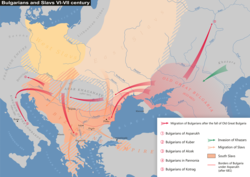
3 shows the Bulgars of Alzeco moving along Italy. 4 shows the earlier Pannonian Bulgars of Alciocus.

After the collapse of Old Great Bulgaria, some of the Bulgars, led by Alzeco, thought to be a son of Kubrat, settled in the lands of the Longobard Kingdom. Paul the Deacon places a settlement in his history of the migration of the Bulgars in the area of the Duchy of Benevento. Under the leadership of Alzeco, the Bulgars (called "Vulgars" by Paul) came to Italy in Benevento, where they settled in the Molise region.[1]

Alciocus

[edit]

The earlier Khagan called Alciocus who was the leader of Bulgar hordes of the Avar Khanganate, is also known. The main source for these events is the medieval chronicle of Fredegar. In 623 Samo led a rebellion against the Pannonian Avars. Alciocus fled with 9,000 Bulgars to Bavaria where he asked the Frankish king Dagobert I for a piece of land to settle in. The king at first allowed them some land, but one night he ordered his army to slaughter the Bulgars. Only 700 out of 9,000 survived the slaughter and fled for protection to Valuk king of the Wends.[2]

After the departure of Alciocus, Kubrat established peace between the Avars and Byzantium in 632.

Alzeco

[edit]

Although only three of Kubrat's sons are mentioned by name it has been suggested that Kubrat gave the name Alzeco to one of his other two sons.

After Kubrat's death over 40 years later, his empire was divided by his five sons in the 670s.

Alzeco gained permission from the King of the Lombards, Grimoald, to settle in the area of Ravenna[citation needed]. Eventually they were sent south into the Duchy of Benevento, where Alzeco was granted the rule of their settlements with the Longobard (Italian) title of gastald.[3]

Italian archaeology

[edit]

Human graves of a steppe-nomadic character as well as horse burials datable to the second half of the eighth century attest to the presence of Pannonian peoples in the Molise and Campania.[4][5] In the lifetime of Paul the Deacon, he recorded that the descendants of these "Vulgars" still spoke their original language, as well as Latin.

Alzeco as Alciocus

[edit]

Researchers have, in the past, claimed one identification of both historical figures.[6] They have suggested that Alzeco might be identified with the Bulgar leader Alciocus of the Fredegar chronicle. This notion, however, must surmount a significant chronological contradiction, and it is possible that this was a title rather than a personal name.[7][8][9]

In any case, it seems more likely that the "Vulgares" that settled in the Molise are more likely to refer to the men of Alciocus, as most of the tombs excavated at Campochiaro can be dated around the middle of the 7th century, with some being certainly earlier or later. This would indicate a settlement in the area some time before the reign of Romuald as Duke in Benevento and Grimoald as king in Pavia. Furthermore, this is supported by the fact that the Longobards had no control of the Ravennate lands until the second half of the 8th century, meaning that Grimoald would have been unable to settle them in this area without Byzantine approval, which would be strange as Costans II was in the midst of a disastrous Italian campaign against the Southern Longobards.

It is very probable that Paul the Deacon confused the settlement of Alzeco/Alciocus in the Molise after his flight from Dagobert I with another event about 50 years later, specifically the settlement of one of Kubrat's/Kurt's unnamed sons around Ravenna, most likely as a form of protection against the Longobards for the nominally Byzantine Exarchate. The name of the leader of this group is completely unknown, although the settlement may have been known thanks to Byzantine records in the Exarchate.[10]

Sources

[edit]
  • Dillon, John B. "Bulgars". Medieval Italy: An Encyclopedia, ed. Christopher Kleinhenz. London: Routledge, 2004.
  • D'Amico, Vincenzo. I Bulgari trasmigrati in Italia nei secoli VI e VII dell’era volgare e loro speciale diffusione nel Sannio. Campobasso, 1933..
  • Paulus Diaconus, Historia Langobardorum, Book IV
  • Bòna, Istvàn, (2000) Gli Àvari. Un popolo d'oriente nell'Europa dell'Alto Medioevo - In: L'oro degli Avari. Popolo delle steppe in Europa S. 10

Notes

[edit]
[edit]
Revisions and contributorsEdit on WikipediaRead on Wikipedia
from Grokipedia
Alcek, also known as Altsek or Alzeco, was a 7th-century Proto-Bulgarian chieftain who led a group of in their migration from the Pontic steppes to , where they established permanent settlements in the regions of and . According to some historians, he was the youngest son of Khan Kubrat, the founder of ; however, this identification remains debated as primary sources do not explicitly confirm it. Alcek's leadership marked one of the furthest westward migrations of Bulgar tribes following the empire's fragmentation in the 660s AD due to Khazar incursions. Alcek's followers had earlier been among the Avars in Pannonia, where they participated in conflicts, including an insurrection against the Avars around 631 AD that reduced their numbers to about 700 survivors. In the 660s AD, following Kubrat's death around 665 AD, Alcek offered to the Lombard king Grimoald, who permitted the to settle in the under the authority of Duke . These accounts draw from medieval chroniclers such as Fredegar and , who document the ' integration as allies while preserving elements of their distinct language and customs for nearly two centuries. Alcek's group founded or influenced several communities, including those in Gallo Matese, Sepino, Boiano (Bovianum), , and later near Monte Bulgheria, contributing to enduring Bulgarian toponyms like "Bulgheria" and family names such as in the area. His legacy persists in modern through cultural commemorations, such as the bronze statue unveiled in 2016 and the Alcek International Award in Celle di Bulgheria, which highlight the Proto-Bulgarian heritage and the town's twinning with in since 2016.

Background and Origins

Family and Parentage

Alcek, also spelled Alzeco or Altsek in various sources, is traditionally identified as the fifth son of Khan Kubrat, who ruled from approximately 632 to 665 AD. This attribution arises from later Bulgarian historical traditions and scholarly reconstructions that explain the division of Kubrat's realm among his heirs after its subjugation by the . Kubrat's other sons each led separate migrations that dispersed the Bulgar tribes: the eldest, Batbayan, succeeded his father in the Pontic steppes but became a Khazar ; Kotrag moved northeast to the and rivers, establishing the foundations of ; Kuber headed southwest to under Avar influence before relocating to the Macedonian region; and Asparukh crossed the River southward, founding the Danube Bulgar state in 681 AD. These divergent paths underscore Alcek's unique trajectory westward, distinguishing his leadership of a smaller contingent toward Lombard . Through his father, Alcek is associated with the Dulo clan, the preeminent ruling lineage of Old Great Bulgaria, as documented in the 11th-century Nominalia of the Bulgarian Khans. The Nominalia explicitly places Kubrat (rendered as Kurt) within the Dulo dynasty, emphasizing its role in early Bulgar governance and succession. Alcek's birth and early years are undated but are estimated to the mid-7th century, aligning with Kubrat's era of consolidating alliances, including a notable pact with Byzantine Emperor Heraclius around 619 AD. Raised amid the steppes-based Bulgar confederation, his formative experiences likely involved the clan's nomadic traditions and diplomatic ties.

Context of Old Great Bulgaria

Old Great Bulgaria emerged around 632 AD when Khan unified the Bulgar tribes known as the , , and in the Pontic-Caspian steppe, establishing a powerful tribal confederation independent from Avar overlordship. , raised as a in , underwent Christian there and forged a close alliance with Byzantine Emperor , supporting campaigns against the Avars and that bolstered the khaganate's position. The khaganate's territory extended across the Pontic-Caspian steppe from the Dnieper River in the west to the Kuban River in the east, incorporating the northern shores of the Black Sea and Sea of Azov, with its core in the region between the Dnieper and Don Rivers. This expansive domain featured a multi-ethnic composition, blending Bulgar Turkic nomads with Slavic settlers, remnants of Hunnic groups, and other steppe peoples who contributed to its diverse social and military fabric. Internally, functioned as a loose of tribes under the centralized authority of the clan, Kubrat's ruling lineage, which coordinated alliances and defenses but relied on tribal loyalties for cohesion. This structure, while enabling rapid unification, set the stage for fragmentation following Kubrat's death around 665 AD, as external pressures from the exacerbated divisions among his successors, including his son Alcek.

Migration and Arrival in Italy

Disintegration of the Khaganate

The death of , ruler of , around 665 AD marked the beginning of the khaganate's rapid collapse, as forces launched invasions that fragmented the of Bulgar tribes across the Pontic-Caspian steppes. These attacks, part of the ' broader expansion in the mid-7th century, overwhelmed the Bulgar heartland and compelled various clans to seek to avoid subjugation or annihilation. Byzantine chronicler records that , before his death, advised his sons to remain united against such threats, but the ensuing and nomadic pressures rendered this impossible. Following Kubrat's demise, his sons divided the khaganate's remnants, each leading factions in different directions amid the Khazar onslaught. The eldest, , inherited the core territories but submitted as a to the around 668 AD, retaining nominal rule over the subdued Black in the Pontic region. Kotrag migrated northeast to the River basin, where his followers established , a state that endured into the medieval period. Kuber fled westward to the Avar Khaganate in , later relocating to Byzantine Macedonia around 680 AD after conflicts with the Avars. Asparukh led a large contingent of approximately 30,000 to 50,000 south across the , defeating Byzantine forces at the in 680 AD and founding the Danube Bulgar state. Alcek, allegedly Kubrat's youngest son and leader of the Altsikur —though this identification is based on later historical traditions, as primary Byzantine sources mention only four sons—faced parallel existential threats from the and other nomads, prompting his group's dispersal after suffering heavy losses, including a reported that reduced their numbers to about 700 survivors. This migration unfolded within the broader timeline of Bulgar movements documented in 7th-century Byzantine and Frankish annals, spanning approximately 662 to 670 AD, as fragmented tribes sought refuge amid the khaganate's dissolution. The Chronicle of Fredegar, a Frankish source, alludes to similar Bulgar dispersals under leaders like Alciocus (possibly identical to Alcek), highlighting the widespread upheaval.

Journey from the Danube to Italy

Following the death of Kubrat and the subsequent collapse of around 665 AD due to Khazar incursions, Alcek—traditionally identified as the youngest son of Khan Kubrat—led a contingent of westward from territories east of the , seeking to evade subjugation by the and potential threats from the Avars. The migration route proceeded southwest through the , a region fraught with instability from ongoing Avar and Slavic movements; while specific stops are not documented in primary accounts, the group likely navigated challenging terrain, possibly finding temporary refuge among Slavic tribes or Byzantine frontier outposts to regroup amid the journey's demands. Traveling as a nomadic force, Alcek's followers included families, , and a , contending with logistical hardships such as perilous river crossings—including the and subsequent waterways—and sporadic hostile encounters with local populations or raiders along the path. By circa 662–670 AD, the reached Lombard-controlled near , where Alcek petitioned King Grimoald for asylum; records that Alzeco entered peacefully with his entire command and received the king's consent to dwell within Lombard borders.

Settlement and Integration

Alliances with Lombard Rulers

Upon arriving in Italy around 663 AD, Alcek, a Bulgar duke leading a group of Bulgars who had fled the Khazar conquest of and subsequent conflicts with the Avars in , peacefully entered the Lombard kingdom and offered his allegiance and military service to King Grimoald I (r. 662–671). Grimoald accepted Alcek's proposal, recognizing the strategic value of additional warriors amid ongoing conflicts with the Byzantines, and directed him with his followers to the under his son, I. There, Alcek's Bulgar warriors were incorporated as , allied troops who bolstered Lombard forces in campaigns against Byzantine holdings in , such as the defense and expansion efforts around in the mid-660s. The lands granted were deserted due to a prior pestilence. In return for their loyalty and contributions, the Bulgars received land grants and Alcek was appointed gastaldus, a position combining military command and local administration. This alliance endured through Grimoald's reign and the initial years of Romuald's ducal rule, spanning approximately 663–680 AD, providing the Lombards with reliable nomadic cavalry while offering the protection and integration into the kingdom's structure. However, following Grimoald's death in 671 and subsequent shifts in Lombard internal politics, including succession disputes, the partnership began to evolve, leading the toward greater independence in southern territories.

Establishment of Bulgar Communities

Following the alliances with Lombard rulers, the led by Alzeco migrated to the Matese mountains in the region of (modern-day ) around 663–671 AD during the reign of King Grimoald. Entering Italy peacefully, Alzeco's group sought service and settlement under Lombard protection, prompted by the disintegration of after Khazar incursions and conflicts with the Avars in . Directed to the under Romuald, they were granted extensive, previously deserted lands due to prior pestilence, enabling the founding of new communities. The primary settlements included Sepino, Boiano (ancient Bovianum), , and Gallo Matese, located in the fortified, hilly terrain of the Matese massif for strategic defense. Alzeco, whose title was changed from to gastald ( administrator), oversaw the allocation of these territories, integrating Bulgar traditions—such as nomadic —with established Italic farming methods to sustain the . Archaeological evidence, including over 120 graves near Boiano and Sepino excavated in 1987, supports the establishment of these hilltop villages as self-sufficient enclaves blending and Mediterranean economies. Socially, the Bulgars preserved a clan-based organization, with Alzeco's followers identified as the Altsikurs clan, while engaging in intermarriages with local Lombard and Roman inhabitants to foster integration. This hybrid structure allowed them to retain elements of their language and customs alongside Latin, as noted by contemporary observers. These communities endured as semi-autonomous entities under Lombard oversight, surviving until of the disrupted their independence. Their legacy persists in regional toponyms, such as Celle di Bulgheria and Monte Bulgheria, reflecting Bulgar linguistic influences amid gradual assimilation.

Name Variations and Identity

Etymology and Spellings

Medieval sources record several variants of the name, with Paul the Deacon's 8th-century Historia Langobardorum using "Alzeco" to describe the Bulgar duke who sought alliance with the Lombards. Italian chronicles and related Frankish accounts, such as those drawing from Fredegar's chronicle, render it as "Altsek" or "Altzek," highlighting regional scribal preferences. These discrepancies stem from the challenges of transcribing non-Indo-European names into Latin and Greek scripts during the . In contemporary scholarship, the name is standardized as "Alzeco" within Italian historiography, emphasizing its Lombard context, while Bulgarian national narratives favor "Altsek" to underscore ties to . The connection to "Alciocus," a similar name in Fredegar's accounts of Bulgar-Avar conflicts, is considered a debated variant by some researchers.

Relation to Alciocus and Alzeco

In Paul the Deacon's Historia Langobardorum, composed in the late , Alzeco is depicted as a Bulgar leader (Vulgarum dux, Alzeco nomine) who, along with his people, migrated from regions beyond the and sought refuge in during the reign of Lombard King Grimoald (r. 662–671), around 663. Alzeco and his followers settled peacefully in the , where they received lands including Saepinum, Bovianum, and , and were granted the title of gastald by Romoald I, integrating into the local Lombard administration. Scholars have proposed that Alzeco may be identical to Alciocus, a Bulgar chieftain mentioned in the 7th-century Chronicon of Fredegar (IV 72), who led a group of approximately 700 —men, women, and children—fleeing Avar oppression in before seeking asylum with Frankish King in around 631–639. Manuscript variants in Paul the Deacon's text sometimes render the name as "Alciocus," suggesting a possible scribal error or alias that could link the two figures. Arguments supporting this identification emphasize shared Bulgar origins east of the and patterns of migration culminating in Italian settlement, which align with the dispersal of Kubrat's successors after the collapse of around 665. These parallels indicate Alzeco/Alciocus as a single historical individual navigating post-Avar disruptions toward Lombard territories, despite a roughly 25–30 year gap between the documented events. Counterarguments, however, maintain that Alciocus and Alzeco represent distinct leaders, with Alciocus more closely tied to conflicts involving Frankish and Bavarian forces during Dagobert's wars against the and Avars in the 630s, potentially predating the Italian migration under Grimoald by decades. Name similarities, such as variants like Altsek, offer suggestive but inconclusive linguistic evidence, as they do not resolve discrepancies in the recorded trajectories.

Archaeological and Historical Evidence

Key Discoveries in Southern Italy

Archaeological excavations conducted in the 19th and 20th centuries in the region of have yielded key evidence of Bulgar settlement patterns linked to Alcek's followers. At the Vicenne-Campochiaro near Boiano and Sepino, horse burials dating to the 7th–8th centuries were uncovered, featuring complete equine skeletons alongside human remains, equipped with Avar-style stirrups and iron sabers that underscore steppe nomadic equestrian traditions. These finds, numbering at least 13 such paired burials among over 130 graves, highlight the military character of the community and align with the 7th-century arrival of Alcek's group in the area. Grave goods from these 7th–8th century contexts include distinctive Bulgar-style belt buckles, iron arrowheads with barbed tips, and pottery shards exhibiting a fusion of Pontic motifs—such as geometric incising—with local Italic wheel-thrown forms. The belt buckles, often cast in with symmetrical plate designs, served both functional and status-indicating roles in attire, while the arrowheads suggest practices typical of nomadic . Pottery fragments, including hand-built vessels with comb-decorated rims, demonstrate cultural blending in daily . Sites around have revealed multi-ethnic cemeteries containing both inhumations and cremations from diverse groups. These cemeteries show mixed that reflect integration of Bulgar migrants with indigenous Italic populations.

Interpretations and Debates

Scholars generally agree that archaeological findings in , including pottery and metal artifacts reminiscent of Pontic steppe nomadic traditions, substantiate the presence of Bulgar groups and corroborate migration accounts dated to 662 AD. These artifacts, unearthed in sites across , align with cultural markers from the Black Sea region, reinforcing narratives of displacement following the collapse of under Khazar pressure. Debates persist regarding the scale and longevity of these settlements, with primary accounts specifying around 700 migrants under Alcek's leadership who were granted lands by Lombard Duke Grimoald of . Some historians argue this modest number enabled the formation of semi-autonomous Bulgar communities, evidenced by localized toponyms and , while others contend rapid assimilation into the surrounding Lombard and Italo-Roman populations diluted their distinct identity within ./Book_V) The purported connection between Alcek and Khan , ruler of , faces significant scrutiny due to the absence of contemporary corroboration. Later Byzantine chroniclers, such as , list Alcek as Kubrat's fifth son among those who dispersed after 665 AD, yet Paul the Deacon's near-contemporary Historia Langobardorum omits any mention of parentage, leading scholars to view the linkage as a retrospective tradition possibly influenced by 9th-century political agendas./Book_V) Theories on integration emphasize a hybrid Italo-Bulgar cultural formation, supported by linguistic such as Bulgarian toponyms in the region that persist to the present day.

Legacy and Modern Recognition

Influence on Local Populations

The settlement of Alcek's Bulgar group in the left a lasting linguistic legacy in , particularly in the regions of and , where several toponyms are interpreted as deriving from Bulgar roots. For instance, the locality of Celle di Bulgheria in is widely regarded by historians as preserving elements of "Altsek," the name of the Bulgar leader Alcek (or Alzeco), reflecting of communities under his authority. The introduced equestrian traditions and pagan rituals that fused with the Christian Lombard society of 8th-century , as evidenced by archaeological finds in necropolises. Horse burials at sites like Campochiaro, featuring sacrificed steeds alongside warriors' graves, reflect nomadic customs of venerating equine companions in the , a practice foreign to native Italian populations but integrated into local funerary rites by the late . Pagan elements, such as ritual horse sacrifices possibly tied to Bulgar shamanistic beliefs, gradually blended with Lombard , contributing to hybrid cultural expressions in the Apennine communities.

Monuments and Cultural Commemoration

A prominent monument commemorating Alcek, known locally as the "Bulgarian prince," is the 2.2-meter-tall bronze statue in the central square of Celle di Bulgheria, a town in Italy's region with claimed Bulgar ancestry. Unveiled on June 8, , the sculpture portrays Alcek as a 7th-century Bulgar warrior leader, symbolizing the migration of his people to under Lombard protection. Funded by Bulgarian non-governmental organizations—the "Ascent" Foundation from Varna and the Bulgarian Center "Enlightenment"—it was crafted by sculptors Dishko Dishkov and Associate Professor Nikolay Ninov from Varna Free University. The dedication ceremony drew over 500 attendees, including Bulgaria's Ambassador to Italy Marin Raykov, Celle di Bulgheria Mayor Gino Marotta, and Mayor Alexander Gorchev, and coincided with a sister-city agreement between Celle di Bulgheria and , , to foster cultural exchanges. Complementing the monument, Celle di Bulgheria instituted the Alcek International Award (Premio Internazionale Altzek) in 2016 to honor contributions to Bulgarian-Italian relations in , , and . Recipients receive a Bulgarian damask rose () plant as a symbol of shared heritage, underscoring ongoing tributes to Alcek's role in connecting the two nations. Annual commemorations in Celle di Bulgheria, held each June 7 since 2016, celebrate the town-twinning with through cultural programs, exhibitions, and events involving Bulgarian participants, highlighting the enduring Bulgar legacy in the region. These gatherings often include performances and discussions on the 7th-century migrations led by Alcek. In , Alcek receives national recognition as a son of Khan Kubrat and a pivotal figure in proto-Bulgarian history, with his featured in scholarly works and cultural programs that trace the dispersal of Bulgar tribes after the fall of around 670 AD. This ties into broader commemorations of ancient Bulgar heritage, supported by state and civic initiatives like those funding the Italian monument. Archaeological evidence from , including settlement patterns in areas like , bolsters these historical accounts and attracts scholarly tourism to sites linked to Alcek's followers.

Sources and Scholarship

Primary Historical Texts

The primary historical account of Alzeco (also spelled Alcek or Alciocus in later variants) appears in Paul the Deacon's Historia Langobardorum, composed in the late , which describes him as a Bulgar dux who arrived in Italy with the whole army of his dukedom during the reign of King Grimoald (r. 662–671). According to Paul, Alzeco left his homeland for unknown reasons and offered his services to the , who granted his group lands in the Samnite region near , specifically in the territory known as the Bulsicenses; Paul notes that these retained their language alongside Latin even into his time, and Alzeco was appointed gastald of , with his descendants holding positions as gastaldi. This narrative positions Alzeco's migration as a peaceful integration into Lombard society, emphasizing his Bulgar origins from the eastern steppes. Byzantine chronicler , writing in the early , provides indirect context for Alzeco's group through his account of the dispersal of Kubrat's sons following the khan's death around 665, amid Khazar pressures on . In Chronographia, Theophanes recounts that Kubrat's five sons divided their father's realm: the eldest remained but was subjugated, others moved east of the River, to Onoguria, and to where one group of 30,000 was subdued by the Romans; the fifth son led followers westward to Roman territories near , submitting to imperial authority, which scholars interpret as referring to Alzeco's migration to . This passage underscores the broader fragmentation of Bulgar tribes post-Kubrat, framing Alzeco's journey as part of a larger exodus from the Pontic steppes. Lombard charters from in the 7th and 8th centuries contain possible references to Bulgar auxiliaries under leaders like Alzeco, including documents noting settlements and by groups termed "" in the duchy, such as land grants in the Sepino and Isernia areas that align with Paul the Deacon's description. These charters, issued under dukes like Romuald I (r. 663–687), suggest the integration of Bulgar warriors into local administration, though direct naming of Alzeco remains ambiguous.

Contemporary Research and Analysis

In the , Italian archaeologists initiated the connection between archaeological discoveries in the region and the "Bulgarian" invaders described in Paul the Deacon's Historia Langobardorum, interpreting artifacts and settlement patterns as evidence of eastern nomadic migrations into during the . These early efforts laid the groundwork for associating physical remains, such as goods and fortifications in areas like Sepino and Boiano, with the Bulgar group led by Alzeco. Twentieth-century Bulgarian historians, building on comparative ethnography, affirmed the theory that Alcek (or Alzeco) was a son of Khan Kubrat, drawing parallels between the dispersal of Kubrat's successors after the collapse of around 668 CE and the Italian settlement recorded by . Scholars like emphasized ethnographic similarities in Bulgar tribal organization and migration routes, positioning Alcek's group as one of several splinter factions seeking refuge in the West amid Avar and Khazar pressures. This interpretation highlighted Alcek's contributions to regional defense, as his warriors served as gastaldi under Lombard Duke Grimoald, aiding in the stabilization of . Post-1990s interdisciplinary research has integrated osteoarchaeology, , and to debate the scale and assimilation of these Bulgar settlers in , with estimates of Alzeco's following ranging from a few hundred to several thousand based on varying interpretations of the sources. A 2011 osteoarchaeological analysis of the Campochiaro cemetery (6th–8th centuries CE) identified trauma patterns and weapon injuries on skeletons indicative of eastern traditions, supporting the presence of migrant groups like the amid Lombard-Avar contexts and suggesting rapid integration through military alliances. Linguistic studies have examined toponyms such as "Celle di Bulgheria" in , near borders, as remnants of Bulgar nomenclature, though evidence points to quick linguistic assimilation, with noting bilingualism fading by the late 8th century; genetic analyses of modern populations show minimal detectable steppe ancestry, implying small group sizes and high intermarriage rates within 2–3 generations. Scholars highlight persistent gaps in knowledge, advocating for expanded excavations in understudied Molise sites to quantify settlement extent and , while critiquing nationalist biases in both Italian and Bulgarian interpretations that overemphasize or romanticize Alcek's role without sufficient primary evidence beyond . Recent calls emphasize , noting how 19th- and 20th-century narratives sometimes projected modern ethnic identities onto sparse medieval accounts.

References

Add your contribution
Related Hubs
User Avatar
No comments yet.