


Community hub
Recent from talks
Contribute something
Nothing was collected or created yet.
Alice Nine
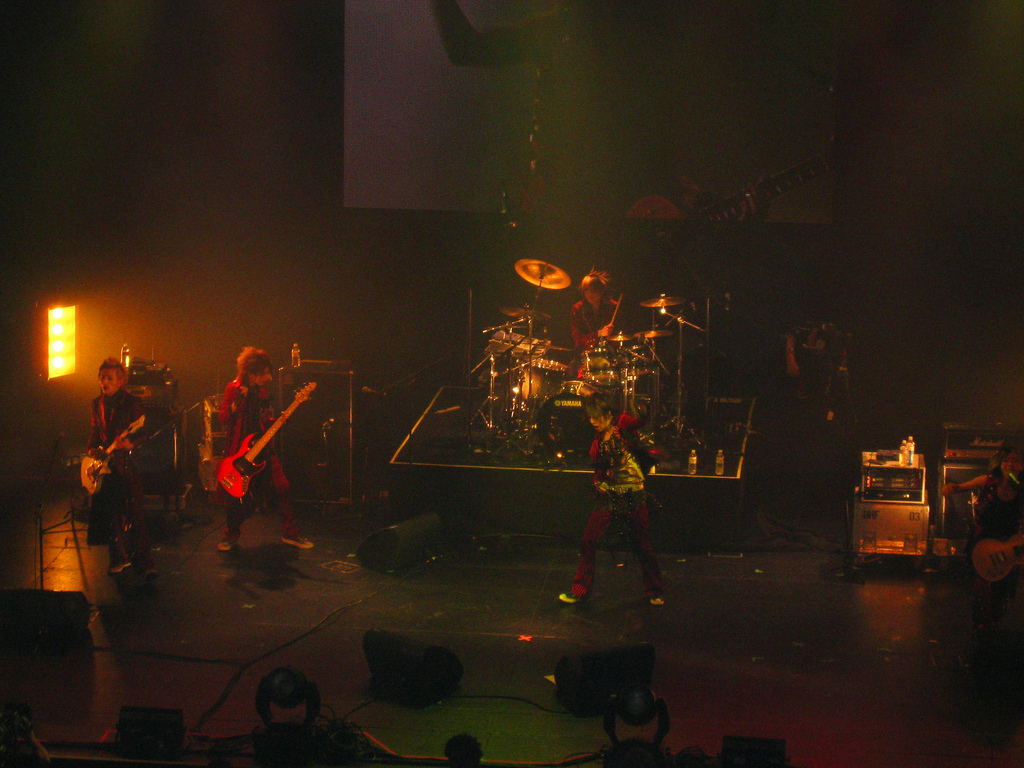
View on WikipediaAlice Nine (アリス九號.; also known as A9 from 2015 to 2019)[1] was a Japanese visual kei rock band formed in Tokyo in 2004.[2] They were a part of PS Company until 2014. The band had King Records as its record label until 2010, when they joined Tokuma Japan. Then, in 2013, the band joined Universal Music Group's Nayutawave Records. They shortened their name to A9 in 2015, but switched back to Alice Nine in 2019.[3] In 2023, Alice Nine announced that they would be going on a indefinite hiatus from September 3, following a last tour that began in May.[4]
Key Information


Alice Nine has released six full-length records, some of which were distributed in Europe by CLJ Records,[5] along with several EPs, singles, and DVDs.
History
[edit]2004–2006: Conception and early work
[edit]In August 2004,[6] Alice Nine formed after the disbandment of the band Givuss, and the band's vocalist, Shou, and guitarist Tora continued on to search for members to form a new band. Saga, the bassist for the band Delta Ark, and Nao, drummer for the bands Fatima and RusH, were also seeking bandmates as well, and the four members eventually joined. Hiroto was the last member to join after Shou, Tora, Saga, and Nao spotted him at a performance with his band at the time, Baquepia. Shou explains that the "Alice" in the band's name was something that they believed sounded "very visual kei" to them, while the "Nine" is written in kanji and represents their origins as a Japanese band.[7]
Their first concert was held at the Ikebukuro Cyber on May 11, 2004, and soon after they released their first single, Namae wa, Mada Nai in July, and they soon toured with fellow PS Company band BIS. In November, their first EP, Gion Shouja no Kane ga Naru, was released, and later that month, they did a nationwide tour with the band Karen from Under Code Productions.[6]
In 2005, the pace of CD releases increased; the band released the singles "Gin no Tsuki Kuroi Hoshi", "Yami ni Chiru Sakura", and "Yuri wa Aoku Saite" consecutively for three months. These singles were eventually compiled onto their first major EP, Kasou Musou Shi, through a joint deal with PS Company and King Records. Alice Nine also went on tour with several bands throughout the year, including Ayabie, Kra, and Kagrra,. Following these events, the band had its first solo tour, Alice in Wonder Tour, in August that year.[2][8] They released their first album Zekkeishoku in April 2006.[9]
2007: Alpha and mainstream success
[edit]
A turning point for the band came when the single "Jewels" was released in March 2007. The single allowed the band to land their first magazine cover and feature article with volume 171 of Shoxx Magazine.[10] Later that month on April 28, the band released Dive into the Sun, a photobook that included an exclusive CD containing the song "Gekkou Yoku". Another landmark was Alice Nine's first performance outside Japan at the JRock Revolution festival in Los Angeles, California on May 25, 2007. They joined with several other Japanese bands and became the closing performance of the Friday that weekend.[citation needed]
The release of the "White Prayer" single in June marked another milestone for the band's development; vocalist Shou explained in an interview with Shoxx Magazine that the song defined the style that the band was aiming for and hoped to maintain in the future. The process of the song's creation also came about more naturally than usual, as many songs until then were made through trial and error.[11] Later that year, on October 24, the group's single "Tsubasa" was released and peaked at number six on the Oricon charts,[12] making it one of their successful singles to date and landing the band a guest appearance on the Fuji Television variety show Hey! Hey! Hey! Music Champ for the first time.
On November 28, 2007, their second full-length album, Alpha, was released. The title for the album originated as a means to describe the band's return to their roots and beginning anew. The uppercase first letter of the Greek alphabet, Α, was chosen to symbolize this idea. Aside from the singles to be compiled onto the album, recording for songs began in September and lasted for approximately one month.[11] The album reached the ninth position on the Oricon weekly chart, selling over 17,000 copies in its first week.[13]
2008: Vandalize
[edit]Alice Nine started off the year with another tour, alice nine. 2008 standing tour "A to U". However, complications arose when guitarist Tora was diagnosed with a spinal disc hernia, which had worsened over time to the point of numbness throughout the left side of his body. Finally seeking medical help, the tour had to be postponed until Tora recovered enough for the band to resume activities in Tokyo.[14]
The band released a new single, titled "Mirror Ball" on March 26, 2008. The title song of the single was used in the live-action movie adaptation of the manga Aquarian Age.[15]
Two compilations of the band's music videos, "Alice in Pictures I" and "Alice in Pictures II", were released on July 2, 2008. The DVDs contain approximately 8 music videos in chronological order of their original release, with "Alice in Pictures I" including the videos from "Gin no Tsuki Kuroi Hoshi" to "Number Six". "Alice in Pictures II" contains videos from "Jewels" to "Eraser -Memoire d'une fleur-", and also includes a new music video for "Gekkou Yoku", a song which was exclusively included with the "Dive into the Sun" photobook.[16]
On August 6, the band released their latest single, "Rainbows". The single reached a peak mark of No. 3 on the Japanese Oricon daily charts which is currently the band's current top position on mainstream Japanese charts.[17] The band also started their tour called "Discotheque play like 'A' Rainbows" which coincided with the new single. The tour lasted the entire month, and the concert footage was released on their live DVD, Discotheque play like "A" Rainbows -enter&exit-, on October 29, 2008.[18]
The band's fourteenth maxi-single, "Cross Game", was released on December 10, 2008. The title song was used as the ending theme song for the second season of the anime Yu-Gi-Oh! 5D'S and was released in two versions.[19] On December 19, 2008, the band's tour at the time culminated in the grand final, named "Crossing the Supernova", at NHK Hall.[20]
A blog entry by vocalist Shou announced that the band was in recording sessions for a third album named Vandalize, which was released on January 14, 2009.[21][22] "Cross Game" is the third single to be featured on the album, along with "Mirror Ball" and "Rainbows" for a total of 11 tracks. The album's title comes from the theme of "the destruction of culture".[23]
2009: Fifth anniversary
[edit]In the following weeks of the release of Vandalize, the band started their tour for the year, Untitled Vandal(ism). The first half of the tour ran from February to April, while its second half ran throughout the month of July. The tour's finale, "Graced the Beautiful Day", occurred on August 23, 2009, at the Tokyo International Forum Hall.[24] Footage from the finale, as well as live studio performance footage, is set to be released on the live DVD, "Untitled Vandal(ism) #Finale 'Graced the Beautiful Day,'" on November 11, 2009.[25]
On June 2, 2009, a blog entry by vocalist Shou announced the changing of their name from "アリス九號". or "alice nine". to "Alice Nine" for media reasons. He explained that the Japanese transcription was beginning to lose its purpose as a means to "represent aesthetics" and that the English transcription was closest to the band's original intention. The Japanese transcription could also not be read as the band's proper name without the use of furigana or other means of alternative text. The entry also announced new work for the band's fifth anniversary—a new single and a new book, which would use the new English transcription upon release. Alice Nine's fifteenth maxi-single, "Hana", was released on August 5, 2009. Shou describes the title track as a "danceable song with a sweet and oriental feeling." "Piece of 5ive Elements 'The Book' ~Alice Nine 5th~" is a book containing interviews, reports on the band's concert activities during 2009, photography, and more, and was released on August 24, 2009.[26][27]
On December 16, Alice Nine held their last concert for 2009. During the three-hour-long event, they performed a variety of songs from their entire career. For the very first song of the night, the band also performed a cover of The Beatles' hit song, "All You Need Is Love".
2010–2012: Gemini and 9
[edit]The band began its activities in 2010 with the announcement of a compilation album, Alice Nine Complete Collection 2006-2009, which contains the title songs from each of the band's maxi-singles released since 2006. The compilation album was released on March 24, 2010. The band also finished their first tour of the year, Kikagaku no Kotowari (幾何学ノ理), that same month.[28]
In 2009, the band would also begin broadcasting programs on their own channel, "Alice 9 Channel", on the popular Japanese video sharing website Nico Nico Douga. The monthly program, hosted by guitarist Tora, features live interviews and announcements with members of the band, as well as broadcasts of concert footage and music videos. The live structure of the broadcast also allows users to comment on the program and give real-time feedback on questions directed towards the audience. The first installment of the program aired in September 2009 and was viewed by over 16,000 users.[29]
On April 4, 2010, during the final live of the Kikagaku no Kotowari tour, the band announced the release of a new single on August 4, 2010. However, the official website stated a slight delay of the single's release, pushing the release date to August 25, 2010. In the same announcement, the single was officially titled "Senkou". Filming of the music video for "Senkou" began in May 2010.[30]
The band's official 2010 tour, Flash Light from the past, began on July 5, 2010. The tour spanned over the following four months with 30 performances in 27 live houses across Japan. The tour ended with a concert on January 6, 2011, at the Nippon Budokan.[31][32][33] Approximately 8,000 people attended the concert, which was held at the Nippon Budokan.[34] The final performance was aired on January 31 on WOWOW, and a DVD containing footage of the concert is to be released on May 2, 2011.[35] The bass guitars and outfit that Saga used during the tour were displayed at ESP Ochanomizu Technical House in Tokyo, Japan until January 23.
In the November 2010 edition of "Alice 9 Channel", Saga accidentally revealed the title and tentative release date for the band's fourth studio album, Gemini, earlier than planned.[36] Details of the album followed soon after, and Gemini was released on February 9, 2011. The album ranked at number 3 on the Oricon Weekly Charts upon release, making the album their highest ranking release yet.[37] A tour coinciding with the release of the album, entitled "Spring Circuit -Prelude to 'Gemini'-", will run from April to May 2011.[38] On February 22, 2012, Alice Nine released their album 9. The majority of the year was spent with performing concert tours.
2012–2014: Supernova and Asian tour debut
[edit]In August 2012, Alice nine announced that they were switching record labels to Universal Music's Nayutawave Records.[39] The band stated on their Niconico web talk show "Alice9 Channel" that in order to make up for having only one release in 2012, they would release 3 new singles in 2013 three months in a row. They later went on to release "Daybreak" on March 20, 2013, "Shadowplay" on April 17 and "Shooting Star" on May 29.
On March 19, 2014, Alice Nine released their sixth studio album Supernova which contains the previously released singles "Daybreak", "Shadowplay", "Shooting Star", "Kaizen Zenya", "Exist", and "Shining", as well as six new songs. Alice Nine then traveled to Asia with shows in Shenzhen, Guangzhou, Wuhan, Beijing, Shanghai, Chongqing, Xiamen, Taichung, Taipei, Singapore, Kuala Lumpur, Hong Kong and Seoul, before returning to Japan.[40] On August 25, 2014, they parted ways with PS Company after ten years. On October 29, 2014, the [Resolution -Alice in Asia-] DVD containing selected performances from concerts in 2014 and a documentary detailing their travel experiences, behind-the-stage footage and interviews with the band members.[41]
2015–2019: Name change and returning to their roots
[edit]
On March 1, 2015, the group announced that they will now be known as A9. They also announced the EP Ginga no wo to, which they hoped to finance through a crowdfunding program.[42] The EP was released in August 2015. Most of the crowdfunding went to the production of the EP's title track, "Spiegel". Following Ginga no wo to, the band released another EP entitled Light and Darkness. Those that preordered the EP received the track "ANIMUS", ahead of its release. On August 28, the band held a tour by the name of XII ANNIVERSARY 2004-2005 ONLY LIVE "NO NAME", in which they performed songs from their early era. Their single "MEMENTO" was released on February 28, 2017, and their new album Ideal was released on April 12, 2017, with the title track "Adam."
2019–2023: comeback under the name Alice Nine and indefinite hiatus
[edit]In August 2019, they announced their comeback under the name Alice Nine (アリス九號).[43] On April 29, 2020, they released the ninth full album "Fuyajou Eden".[44]
On November 11, 2020, Alice Nine released their 10th full album "Wonderland With Black"[45]
On November 2, 2022, Alice Nine released their 11th full album titled "GRACE".[46]
On January 9, 2023, they announced that on September 3, 2023, Alice Nine would indefinitely "freeze" their activities.[47]
Members
[edit]- Shou (将) – vocals, leader
- As of January 2012, the position of band leader has been moved from Nao to Shou.[48]
- Hiroto (ヒロト) – guitars
- Tora (虎) – guitars
- Saga (沙我) – bass, keyboards
- Saga also participated in the supergroup The Tokyo High Black as rhythm guitarist "Tomorrow Joe".
- Nao – drums
- Nao served as the band leader from 2004 to 2012.
Discography
[edit]Studio albums
[edit]- Zekkeishoku (絶景色; Vivid Scenery of Colors, April 4, 2006) Oricon Weekly Album Chart Position: 13[50]
- Alpha (November 28, 2007) 9[50]
- Vandalize (January 14, 2009) 7[50]
- Gemini (February 9, 2011) 3[50]
- 9 (February 22, 2012) 12[50]
- Supernova (March 19, 2014) 39[50]
- Ideal (April 12, 2017) 18[50]
- Planet Nine (April 25, 2018) 32[50]
- Fuyajō Eden (不夜城エデン; Eden the Nightless City, April 29, 2020) 57[50]
- Wonderland With Black (November 11, 2020)[51]
- Grace (November 2, 2022)[46]
Extended plays
[edit]- Gion Shouja no Kane ga Naru (祇園盛者の鐘が鳴る; The Gion Temple's Bells Toll, November 17, 2004) 62[50]
- Alice in Wonderland, (July 27, 2005) 55[50]
- Ginga no wo to (銀河ノヲト; Sound of The Galaxy, August 2015)
- Light and Darkness (April 13, 2016)
- Medley (November 24, 2021)[52]
Compilation albums
[edit]- Kasou Musou Shi (華想夢想紙; Flower Fancying Dream Fancying Paper, November 23, 2005) 47[50]
- Alice Nine Complete Collection 2006-2009 (March 24, 2010) 46[50]
- Alice Nine Complete Collection II 2010-2012 (August 21, 2013)
- 15TH ANNIVERSARY BEST ALBUM (風月の詩; Poem of the Wind and Moon, April 24, 2019)[53]
Singles
[edit]- Namae wa, Mada Nai (名前は、未だ無ひ; I Don't Yet Have a Name, July 5, 2004) Oricon Weekly Single Chart Position: 94[54]
- Gin no Tsuki Kuroi Hoshi (銀の月 黒い星; Silver Moon, Black Star, March 30, 2005) 45[54]
- Yami ni Chiru Sakura (闇ニ散ル桜; Cherry Blossoms Scattered in the Darkness, April 25, 2005) 54[54]
- Yuri wa Aoku Saite (百合は蒼く咲いて; Lilies Bloom Palely, May 25, 2005) 51[54]
- Kowloon Nine Heads Rodeo Show (九龍; Nine Dragons, January 25, 2006) 22[54]
- Fantasy (February 22, 2006) 20[54]
- Akatsuki/Ikuoku no Chandelier (暁 / 幾億のシャンデリア; Dawn/Several Million Chandeliers, February 22, 2006) 24[54]
- Blue Planet (October 4, 2006)
- Number Six (October 4, 2006)
- Jewels (March 21, 2007) 15[54]
- White Prayer (June 6, 2007) 12[54]
- Tsubasa (October 24, 2007) 6[54]
- Mirror Ball (March 26, 2008) 6[54]
- Rainbows (August 6, 2008) 6[54]
- Cross Game (December 10, 2008) 8[54]
- Hana (華; Flower, August 5, 2009) 8[54]
- Senkou (閃光; Flash, August 25, 2010) 12[54]
- Stargazer: (November 11, 2010) 10[54]
- Blue Flame (June 8, 2011) 12[54]
- Heart of Gold, (September 7, 2011) 8[54]
- Niji no Yuki (虹の雪; Rainbow-colored Snow, December 21, 2011) 7[54]
- Daybreak (March 20, 2013) 10[54]
- Shadow Play (April 17, 2013) 11[54]
- Shooting Star (May 29, 2013) 14[54]
- Kaisen Zenya/Exist (開戦前夜, December 6, 2013)
- Merry Christmas to U (December 6, 2013)
- Shining (February 26, 2014)
- Memento (February 28, 2017)
DVDs
[edit]- [2006.01.12] Alice in Wonderfilm
- [2006] Peace & Smile Carnival tour 2005 (~皆そろって笑顔でファッキュー~)
- [2006.10.04] Number Six
- [2007.01.24] Hello, Dear Numbers
- [2007.07.10] Kachoufuugetsu Vol.2 (花鳥風月 Vol.2)
- [2007.07.11] Royal Straight Flash
- [2007.09.03] Royal Straight Kingdom
- [2008.07.02] Alice in Pictures I
- [2008.07.02] Alice in Pictures II
- [2008.10.29] Discotheque play like "A" Rainbows -enter&exit-
- [2009.04.15] PSCompany 10th Anniversary Peace & Smile Carnival (PS Company 10周年記念公演)
- [2009.11.11] Untitled Vandal(ism)#Finale [Graced The Beautiful Day]
- [2011.05.02] Tokyo Galaxy Alice Nine Live Tour 10 "Flash Light from the Past" Final at Nippon Budokan
- [2012.06.05] Alice in Pictures III
- [2013.06.19] 2012 Court of "9"#4 Grand Finale Countdown Live
- [2014.10.29] Resolution -ALICE IN ASIA-
Bibliography
[edit]- [2007.04.28] "Dive into the Sun" (photo book)
- [2007.12.25] "Shiny Summer X'mas 2007" (photo book)
- [2008.02.29] "Alpha" (band score and tablature)
- [2008.03.27] "Zekkeishoku" (band score and tablature)
- [2008.09.13] "Alice Nine. First Piano Collection" (piano solo tablature)
- [2009.] "[Untitled Vandal(ism)#1]"
- [2009.] "[Untitled Vandal(ism)#2]"
- [2009.07.07] "Vandalize" (band score and tablature)
- [2009.08.24] "Piece of 5ive Elements 'The Book' ~Alice Nine 5th~"
References
[edit]- ^ "アリス九號.、"A9"名義での最後のツアーを映像作品化". BARKS (in Japanese). 26 October 2019. Retrieved 2022-01-01.
- ^ a b "CD Journal artist profile". cdjournal.com. Retrieved 2007-09-02.
- ^ NoMusicNoReason (2019-08-19). "A9 rebrands as Alice Nine for "Revolutionary Blooming" single". JROCK NEWS. Retrieved 2022-01-01.
- ^ afaenia, Erica (2023-01-09). "ALICE NINE. freezes activities to pursue personal growth". JROCK NEWS. Retrieved 2023-11-06.
- ^ "CLJ Records artist profile". cljrecords.com. Archived from the original on 17 December 2007. Retrieved 2007-12-13.
- ^ a b "Barks.jp artist profile". barks.jp. Archived from the original on 2007-10-10. Retrieved 2007-09-02.
- ^ "Interview with JaME about JRock Revolution". jame-world.com. Archived from the original on 6 October 2008. Retrieved 2008-10-20.
- ^ "Alice Nine at King Records". kingrecords.co.jp. Archived from the original on 17 August 2007. Retrieved 2007-08-19.
- ^ "Alice Nine special feature". cdjapan.co.jp. Archived from the original on 9 September 2007. Retrieved 2007-08-19.
- ^ "Interview in Shoxx Magazine about Jewels (translated by Jhouserock)". jhouserock.com. Archived from the original on 2008-12-07. Retrieved 2008-10-20.
- ^ a b "Interview in Shoxx Magazine about Alpha (translated by Jhouserock)". jhouserock.com. Archived from the original on 2008-12-07. Retrieved 2008-10-20.
- ^ ""Tsubasa" Oricon Ranking". oricon.co.jp. Retrieved 2008-04-27.
- ^ ""Alpha" Oricon Ranking". oricon.co.jp. Retrieved 2008-10-20.
- ^ "Interview in Shoxx Magazine about Mirror Ball (translated by Jhouserock)". jhouserock.com. Archived from the original on 2008-12-20. Retrieved 2008-10-20.
- ^ "aquarian-movie". official movie site. Archived from the original on 2013-05-18. Retrieved 2008-01-14.
- ^ "Reflections of Life - Alice Nine - Dive into the Sun Photobook". Starsbright14.multiply.com. 2008-01-22. Archived from the original on 2011-10-06. Retrieved 2011-10-23.
- ^ "Official website news on Rainbows (Japanese)". pscompany.co.jp. Archived from the original on 2008-06-17. Retrieved 2008-05-16.
- ^ "Official website news on Rainbows (Japanese)". pscompany.co.jp. Archived from the original on 2008-10-14. Retrieved 2008-10-01.
- ^ "CROSS GAME information". pscompany.co.jp. Archived from the original on 29 September 2008. Retrieved 2008-10-01.
- ^ "Official updates on 2008 tours and releases (Japanese)". pscompany.co.jp. Archived from the original on 2008-09-21. Retrieved 2008-09-19.
- ^ ""Vandalize" information on CDJapan". cdjapan.co.jp. Archived from the original on 31 October 2008. Retrieved 2008-10-28.
- ^ "Official site announcement of "Vandalize"". pscompany.co.jp. Archived from the original on 1 November 2008. Retrieved 2008-10-29.
- ^ ""Recording samadhi" (Japanese)". ameblo.jp. Archived from the original on 22 October 2008. Retrieved 2008-10-21.
- ^ "Untitled Vandal(ism) official schedule". pscompany.co.jp. Archived from the original on 2009-09-01. Retrieved 2009-09-03.
- ^ ""Untitled Vandal(ism)" DVD listing on CDJapan". cdjapan.co.jp. Retrieved 2009-09-03.
- ^ "'Alice Nine' (Japanese)". ameblo.jp. Archived from the original on 11 June 2009. Retrieved 2009-06-04.
- ^ "'Hana' Release Information". pscompany.co.jp. Archived from the original on 6 June 2009. Retrieved 2009-06-04.
- ^ "'Alice Nine 2010 NEWS' (Japanese)". pscompany.co.jp. Archived from the original on 2010-01-25. Retrieved 2010-01-26.
- ^ "'Alice 9 Channel - Nico Nico Douga' (Japanese)". nicovideo.jp. 15 January 2010. Retrieved 2011-03-14.
- ^ "'PVPVPV' (Japanese)". ameblo.jp. Archived from the original on 28 May 2010. Retrieved 2010-05-28.
- ^ "Big News for Alice Nine". Dear Numbers. Archived from the original on 2011-08-14. Retrieved 2011-10-23.
- ^ "Alice Nine オフィシャルサイト". Pscompany.co.jp. Archived from the original on 2007-11-22. Retrieved 2011-10-23.
- ^ "Alice Nine | official site". Web.pscompany.co.jp. 2011-01-06. Archived from the original on 2007-03-28. Retrieved 2011-10-23.
- ^ "Alice Nine、思いを爆発させるようなパフォーマンス". barks.jp. 2011-01-07. Retrieved 2018-02-11.
- ^ "'Live DVD information' (Japanese)". pscompany.co.jp. Archived from the original on 2013-02-18. Retrieved 2011-03-14.
- ^ "Alice Nine Accidentally Reveal New Album Release". musicjapanplus.jp. Retrieved 2011-03-14.
- ^ "Gemini Oricon Ranking". oricon.co.jp. Retrieved 2011-03-14.
- ^ "Live Schedule". pscompany.co.jp. Archived from the original on 2013-02-18. Retrieved 2011-03-14.
- ^ "Alice Nine Announce COUNT DOWN LIVE And signing With Universal Music Japan". musicjapanplus.jp. Retrieved 2015-03-04.
- ^ Alice Nine ライブ情報更新 - UNIVERSAL MUSIC JAPAN
- ^ "「Resolution-ALICE IN ASIA-」発売記念 タワーレコードスペシャルプレミアムイベントに参加されるお客様へ - UNIVERSAL MUSIC JAPAN". 31 October 2014.
- ^ "A9 / Alice Nine's Revival". jame-world.com. Retrieved 2015-03-04.
- ^ NoMusicNoReason (2019-08-19). "A9 rebrands as Alice Nine for "Revolutionary Blooming" single". JROCK NEWS. Retrieved 2020-10-23.
- ^ NoMusicNoReason (2020-03-24). "Alice Nine mixes old and new in "TESTAMENT" from album "Fuyajou Eden"". JROCK NEWS. Retrieved 2020-10-23.
- ^ "黒とワンダーランド | A9". ORICON NEWS. Retrieved 2024-08-31.
- ^ a b "GRACE | A9". ORICON NEWS. Retrieved 2024-08-31.
- ^ afaenia, Erica (2023-01-09). "ALICE NINE. freezes activities to pursue personal growth". JROCK NEWS. Retrieved 2024-08-31.
- ^ Show's Official Blog Archived 2012-10-26 at the Wayback Machine ameblo.jp Retrieved 2012-04-25
- ^ "KARASU is "free"". tokyohive.com. 2010-10-12. Retrieved 2011-08-14.
- ^ a b c d e f g h i j k l m A9のアルバム売上TOP10作品 [Alice Nine Album Rankings]. Oricon News (in Japanese). Retrieved Nov 4, 2010.
- ^ "アリス九號. - DISCOGRAPHY" (in Japanese). Retrieved 2022-01-17.
- ^ "アリス九號. - DISCOGRAPHY" (in Japanese). Retrieved 2022-01-17.
- ^ "アリス九號. - DISCOGRAPHY" (in Japanese). Retrieved 2022-01-17.
- ^ a b c d e f g h i j k l m n o p q r s t u v A9のシングル売上TOP20作品 [Alice Nine Single Rankings]. Oricon News (in Japanese). Retrieved Nov 4, 2010.
External links
[edit]
Alice Nine
View on GrokipediaHistory
2004–2006: Formation and early indie releases
Alice Nine was formed in April 2004 in Tokyo by drummer Nao (formerly of RusH and Fatima), who assembled the initial lineup as a session band. Nao recruited vocalist Shou and guitarist Tora (real name Makoto) from the disbanded visual kei group Givuss, guitarist Hiroto (formerly of BAQUEPIA), and bassist Saga (formerly of Delta Ark and Visage), creating a five-piece rock band focused on the underground visual kei scene. Official debut: August 24, 2004.[8][9][10] The band's name, stylized as "alice nine," drew from vocalist Shou's vision of blending Western fairy tale imagery—evoking the whimsical "Alice" from Lewis Carroll's works—with Japanese numerology, where "nine" (pronounced "ku" in kanji) symbolizes longevity and infinity, representing an eternal, cross-cultural musical journey. Their first live performance took place on May 11, 2004, at Ikebukuro Cyber, followed by additional shows in Takadanobaba and Shibuya venues throughout the summer, helping to establish a grassroots presence in Tokyo's indie circuit.[8][9] In July 2004, Alice Nine self-released their debut single, "Namae wa, Mada Nai." (名前は、未だ無ひ。), a raw visual kei track that quickly sold out and introduced their melodic yet intense sound to early fans. The band signed with PS Company, an indie label under Free-Will, in September 2004, enabling wider distribution and production support. Under this deal, they released their debut mini-album, Gion Shōja no Kane ga Naru (祇園盛者の鐘が鳴る), on November 17, 2004, which peaked at No. 62 on the Oricon chart and featured poetic lyrics over driving guitar riffs, solidifying their underground appeal.[9] Throughout 2005, Alice Nine built momentum with a series of indie singles on PS Company, including "Gin no Tsuki, Kuroi Hoshi" (銀の月 黒い星) in March, "Yami ni Chiru Sakura" (闇ニ散ル桜) in June, and "Yuri wa Aoku Saite" (百合は蒼く咲いて) in August, each showcasing evolving elements of romantic melancholy and aggressive rock. These releases, coupled with small-scale tours across Japan, fostered a dedicated fanbase within the visual kei community, emphasizing elaborate stage aesthetics and emotional performances. Their second mini-album, Alice in Wonderland, arrived in July 2005, further highlighting their thematic fusion of fantasy and intensity. By early 2006, the band culminated this period with the full-length album Zekkeishoku (絶景色) on April 26, marking a transition toward broader recognition while remaining rooted in indie visual kei.[9][11]2007–2008: Major label debut and breakthrough
In 2005, Alice Nine signed with King Records' PS Music subsidiary, transitioning to a major label, though their major debut release came in 2007.[12] This deal facilitated their first major-label release, the studio album Alpha, which came out on November 28, 2007, and featured 12 tracks including the singles "White Prayer" and "Tsubasa."[13][12] The album debuted at number 9 on the Oricon weekly charts and remained on the ranking for eight weeks, selling over 17,000 copies in its first week and signaling their entry into mainstream recognition within the visual kei scene.[12][14] The lead single "Tsubasa," released on October 24, 2007, peaked at number 6 on the Oricon singles chart and charted for six weeks, further boosting their visibility.[12] The band's growing profile also extended internationally in 2007, with a European distribution deal through CLJ Records and their debut U.S. performance at the Jrock Revolution Festival in Los Angeles on May 25.[15] Building on this momentum, Alice Nine maintained activity through 2008 with a series of high-charting singles that showcased a heavier, more dynamic sound. "Mirror Ball," released on March 26, 2008, reached number 6 on the Oricon weekly singles chart, while "Rainbows," issued on August 6, 2008, achieved a peak of number 3 on the daily charts—their highest ranking to date at the time.[12][14] Another key release, "Cross Game" on December 10, 2008, hit number 8 on the Oricon chart and gained broader exposure as the second ending theme for the anime Yu-Gi-Oh! 5D's, airing from episodes 27 to 64.[16][17] Domestically, 2008 saw Alice Nine embark on their standing tour "A to U," which highlighted their evolving stage presence and fan engagement, culminating in the tour DVD Discotheque Play Like "A" Rainbows released on October 29.[12] These efforts solidified their status in the visual kei community, with increased media appearances and a shift toward more polished production that appealed to wider audiences, setting the stage for further breakthroughs.[15]2009–2012: Anniversary celebrations and international expansion
In 2009, Alice Nine marked their fifth anniversary with a special live event titled "Brand New Horizon" held at Akasaka BLITZ on August 24, following the release earlier that year of their third studio album Vandalize.[12] The band also issued the single "Hana" that year, which contributed to their growing domestic presence following their major label breakthrough. This period of celebration included the "Untitled Vandal(ism)" tour, which ran in two halves from February to April and July, culminating in the finale "Graced the Beautiful Day" and reinforcing their live performance reputation.[18] Building on this momentum, Alice Nine released several singles in 2010 and 2011 that showcased their evolving sound and achieved notable chart performance in Japan. Key releases included "Senkō" on August 25, 2010, and "Stargazer:" on November 10, 2010, both serving as precursors to their fourth studio album Gemini.[19] In 2011, singles such as "Blue Flame" on February 23 and "Heart of Gold" on September 7 continued this trajectory, with the latter composed to provide encouragement in the aftermath of the Tōhoku earthquake and tsunami.[20] These tracks highlighted the band's blend of rock intensity and emotional depth, contributing to their sustained popularity on platforms like the Oricon charts. The fourth album, Gemini, arrived on February 9, 2011, via Tokuma Japan Communications, exploring themes of duality such as light versus shadow and birth versus death across its 14 tracks.[21][22] This release represented a grandiose evolution in their style, incorporating orchestral elements and intricate arrangements to emphasize conceptual contrasts. The follow-up, their fifth studio album 9, was issued on February 22, 2012, also through Tokuma Japan, with 11 tracks that built on prior thematic explorations while incorporating a more refined rock foundation reflective of the band's maturing artistry.[23] During 2009–2012, Alice Nine expanded internationally for the first time, embarking on their inaugural Asia tour in mid-2011, which spanned three months and included 34 performances across cities like Wuhan, Chongqing, Xiamen, Taichung, and Kuala Lumpur.[24] The tour was deemed a success, fostering fan engagement in new markets and paving the way for further global outreach, including appearances at European festivals like Sundown in 2012. This era was characterized by internal stability, with the original lineup intact and a collaborative creative process driven by vocalist Shou's lyrics and guitarist Hiroto's compositional input, allowing focused development of their dualistic motifs without lineup disruptions.[25]2013–2014: Supernova era and label changes
In early 2013, Alice Nine transitioned to Universal Music Group's Nayutawave Records imprint, marking a shift from their previous association with Tokuma Japan Communications. This change facilitated the release of their singles "Daybreak" in March, "SHADOWPLAY" in April, and "shooting star" in May, which showcased an intensified rock orientation with dynamic guitar riffs and orchestral elements. Building on the introspective tone of their 2012 album 9, these tracks emphasized themes of renewal and cosmic imagery, setting the stage for their sixth studio album, Supernova, released on March 19, 2014. The album, comprising 12 songs, was presented in regular and limited editions, the latter including a bonus DVD of live footage, and highlighted the band's explosive sound through heavy instrumentation and anthemic choruses, as noted in contemporary reviews praising tracks like "Shining" for their punk-infused energy and melodic hooks.[26][27] Supernova served as a cornerstone of the band's 10th anniversary celebrations, reflecting on their evolution from indie roots to major-label status while experimenting with denser rock rhythms and electronic breakdowns. Critics offered mixed responses, with some appreciating the album's bold production and thematic depth—evoking stellar explosions as metaphors for artistic rebirth—but others critiquing occasional melodic familiarity amid the high-energy arrangements. Fan reception was generally positive, viewing the record as a high point in the band's maturing sound, bolstered by its Oricon chart performance and alignment with their visual kei aesthetic of dramatic, starlit stage visuals.[28][29] Later in 2014, on August 25, Alice Nine announced their departure from longtime management and production label PS Company after a decade-long partnership that began in their indie days, opting for greater independence to pursue broader creative control. Vocalist Shou expressed gratitude for the label's foundational support in a Twitter statement, framing the move as a natural progression at their career midpoint, while emphasizing continued commitment to fans. The decision garnered supportive reactions from the J-rock community, including well-wishes from peers like Mao of Sadie, and fans voiced enthusiasm for the band's self-directed future without signs of disruption.[30][31] To coincide with these milestones, Alice Nine embarked on their first full Asian tour, Supernova Symphonia, from May to July 2014, expanding beyond Japan with performances in mainland China (Shenzhen, Guangzhou, Wuhan, Beijing, Shanghai, Chongqing, and Xiamen), Taiwan, Hong Kong, and Southeast Asian hubs like Singapore. The tour, featuring Supernova material alongside earlier hits, drew enthusiastic crowds and solidified their regional appeal, with reports highlighting the band's synchronized stage presence and fan interactions as highlights of the anniversary year.[32][33]2015–2019: Name change to A9 and stylistic evolution
In 2015, following their departure from major label management in 2014, the band permanently changed their name from Alice Nine to A9 to address legal complications associated with the original name and to symbolize a fresh evolution in their career trajectory.[34] This rebranding coincided with full independence, as they established their own imprint, NINE HEADS RECORDS, to handle future releases and operations.[35] The shift allowed greater creative control, enabling a return to their indie roots after over a decade under major labels, though it also presented challenges in maintaining mainstream visibility amid a shifting J-rock landscape. The band's first release under the new moniker and label was the EP Ginga no Oto on August 23, 2015, marking their inaugural independent project and aligning with their 11th anniversary live performance titled Re:birth - Hisho-.[34] This was followed by the compilation album Grace in 2016, which revisited select tracks from their catalog to bridge their past and present phases.[37] In 2017, they issued their seventh studio album Ideal, produced with contributions from notable figures like Ken Sang, emphasizing a refined rock sound that incorporated subtle electronic textures for a more introspective feel. The period culminated in 2018 with the eighth studio album Planet Nine, which further explored experimental elements within their rock foundation, including atmospheric synthesizers and dynamic rhythms, while prioritizing limited physical editions to engage core fans.[38] Domestically focused tours defined much of this era, with the Re:birth - Tensyou - tour in late 2015 extending their 10th anniversary celebrations from the prior year through Asia, including stops in Singapore and Kuala Lumpur that highlighted their enduring appeal in visual kei circles.[34] Subsequent one-man shows and regional circuits, such as the 2017 Ideal promotional tour, emphasized intimate venues and visual aesthetics reminiscent of their early indie days, though limited distribution and promotional resources posed ongoing hurdles to broader exposure. Internal motivations for the rebrand, including a desire for artistic reinvention after major label constraints, drove these changes, fostering a stylistic pivot toward hybrid rock-electronic experimentation that honored their visual kei heritage without chasing mainstream trends.[34]2019–2023: Return to Alice Nine, final tours, and hiatus
In September 2019, the band reverted to their original name, Alice Nine (アリス九號.), from the shortened A9 moniker adopted in 2015, coinciding with their 15th anniversary and in response to fan requests for a return to their foundational identity.[39] This change was first implemented for the single "Revolutionary Blooming," signaling a reconnection with their visual kei roots.[40] The band continued releasing music during this period, including the album Nightless City Eden on April 29, 2020, and Wonderland With Black on November 11, 2020, alongside the album Grace on November 2, 2022. These works blended their signature rock elements with evolving themes, though production and promotion were constrained by the global COVID-19 pandemic, which halted live performances and forced postponements of planned tours starting in early 2020.[41] By 2022, restrictions eased, allowing the band to resume touring with shows across Japan, including the "THE MIRROR -ONEMAN TOUR 2020 '黒会' FINAL SERIES-" extensions and subsequent one-man performances.[42] In January 2023, Alice Nine announced an indefinite hiatus, termed a "frozen period," effective September 3, 2023, to allow members to pursue individual growth after nearly two decades together.[5] This followed their final nationwide tour, "LAST DANCE," divided into acts such as ACT.3 "Graced The Beautiful Story" ep.2 "Farewell Flowers" (March to May 2023) and ACT.4 "Frozen Waterfall" (July to September 2023), which served as a celebratory farewell with sold-out venues and reflective setlists drawing from their catalog.[43] The tour concluded at Tokyo's Shiki Theatre on September 3, marking the end of their active phase.[44] As of November 2025, the band remains on indefinite hiatus, with no announced resumption.[45] Members have shifted to solo endeavors, including vocalist Shou's project Verde/, which released its debut album V/ in November 2024 and toured Europe in 2025; drummer Nao's MizinkoFacT, formed in April 2025 with its first live show in August; and guitarist Hiroto's solo activities.[46][47][48]Artistry
Musical style and influences
Alice Nine's musical style is rooted in alternative rock, blending pop rock and progressive rock elements with occasional forays into heavy metal riffs and electronic textures, creating a dynamic sound that balances aggression and melody.[3] Their compositions often feature intricate guitar work, driving rhythms, and emotive vocals, drawing from an East-meets-West fusion that incorporates Japanese visual kei traditions with Western rock sensibilities.[11] This core approach emphasizes emotional depth, with songs exploring themes of introspection, romance, and existential struggle through layered instrumentation and soaring choruses.[49] The band's sound evolved significantly over their career, beginning with a raw, guitar-driven indie style in their early years (2004–2006), characterized by thick, heavy grooves and aggressive developments as heard in tracks like "Velvet" and "Corona."[11] Upon their major label debut in 2007, their music shifted toward a more polished, pop-infused aesthetic, integrating catchy hooks and accessible structures while retaining rock intensity.[3] By the mid-2010s, following their temporary name change to A9, they incorporated dance elements and post-rock expanses, evident in later releases like the 2021 EP Medley, which featured symphonic arrangements, nostalgic '90s vibes, and futuristic electronic touches to reflect personal growth and collaborative experimentation.[49] Key influences on Alice Nine include the funk-rock grooves of Red Hot Chili Peppers, the pioneering visual kei guitar innovations of Hide from X Japan, electro music, and 1980s rock's melodic emotionality, which informed guitarist Hiroto's diverse tastes and the band's overall hybrid approach.[50] Vocalist Shou drew from acts like Luna Sea, Korn, and Muse for his lyrical intensity and vocal delivery, contributing to the band's genre-blending ethos.[51] Songwriting is predominantly led by Shou, who crafts lyrics emphasizing symbolic and emotional narratives, often inspired by personal imagery such as fire or space, paired with Hiroto's primary compositions that prioritize melodic progression and band synergy.[11] This process fosters a collective depth, with contributions from other members enhancing thematic cohesion. Instrumentally, Hiroto delivers melodic, intricate solos that add emotional layers; Nao provides complex rhythms blending live drums with machine-like precision for rhythmic drive; Saga contributes groovy bass lines that anchor the sound with feeling; and Tora's dynamic guitar riffs and arrangements inject energy and versatility.[49]Visual aesthetics and fashion
Alice Nine has maintained a strong adherence to the visual kei tradition, characterized by elaborate costumes, heavy makeup, and distinctive hairstyles that emphasize androgyny and theatricality. Their aesthetic draws from the band's name, evoking a fairy-tale motif inspired by Lewis Carroll's Alice's Adventures in Wonderland, as seen in their early EP of the same title released in 2005, which featured stylized promotional imagery blending whimsy with dark romanticism. This visual identity serves as a core element of their branding, allowing members to embody stage personas that extend beyond music into performative art.[52] In their formative years from 2004 to 2008, Alice Nine's fashion was heavily influenced by gothic-lolita elements, incorporating frills, lace, corsets, and Victorian-inspired silhouettes paired with dramatic makeup and teased hair to create an extravagant, otherworldly appearance.[53] Vocalist Shou, who oversees much of the band's visual direction, has described this approach as connecting theatrical exaggeration with stylish accessibility, ensuring the outfits reflect individual member expressions while aligning with the group's cohesive narrative.[52] As they transitioned to major label status, their style began evolving toward more polished and coordinated looks, toning down the haphazard extravagance of earlier visual kei for refined, colorful ensembles that retained gender ambiguity.[54] By 2015, following their name change to A9, the band's fashion shifted further into modern streetwear and androgynous silhouettes, featuring slim-fit jackets, layered accessories, and subtle makeup that appealed to broader audiences while preserving visual kei's core emphasis on visual impact.[53] This evolution mirrors the neo-visual kei movement of the 2000s, where Alice Nine contributed to a diversification of styles, moving from gothic opulence to versatile, contemporary aesthetics that blend punk, glam, and urban influences. Shou's hands-on role in designing costumes, alongside adjustments for live synergy, underscores fashion's integral part in their branding, fostering a "terrifyingly cool" identity that adapts to changing cultural contexts.[52] On stage, Alice Nine enhances their visual narrative through theatrical elements, including dynamic lighting, props like oversized mirrors or floral motifs tying into their fairy-tale theme, and choreographed movements that amplify the drama of elaborate outfits.[55] These performances, often featuring pre-show rituals to heighten energy, create immersive experiences that highlight the interplay between visuals and music, as Shou has noted in emphasizing visual kei's borderless appeal.[52] The band's visual aesthetics have significantly influenced fan culture within the visual kei subgenre, inspiring adherents to adopt similar androgynous and eclectic fashions in cosplay, streetwear, and personal style, particularly through global tours and festival appearances that exposed international audiences to their evolving looks.[54] As a second-generation visual kei act, Alice Nine's progression from gothic roots to modern representations has helped sustain the genre's relevance, encouraging fans to explore gender-fluid expression and theatricality in everyday contexts.[53]Band members
Current lineup
Shou (born July 5, 1981) is the lead vocalist and primary lyricist of Alice Nine, renowned for his charismatic frontman presence and emotive vocal delivery that blends raw intensity with melodic nuance. Before joining Alice Nine in 2004, he fronted the visual kei band Givuss alongside guitarist Tora.[12] Hiroto (born May 4, 1985) handles lead guitar duties and serves as one of the band's principal composers, contributing melodic riffs and structures often drawing from post-rock influences to create expansive soundscapes.[56][57] Prior to Alice Nine, he performed with the visual kei group Baquepia, where his skills caught the attention of the founding members during a live show.[12] Tora (born September 17, 1981) plays rhythm guitar and provides backing vocals, delivering technical precision in his playing that anchors the band's intricate arrangements and dynamic shifts. He co-founded Alice Nine in 2004 after the dissolution of Givuss, where he also played guitar.[12] Saga (born June 24, 1982) is the bassist, known for his groove-oriented lines that drive the band's rhythmic foundation, and he occasionally contributes lead vocals on select tracks.[58] His pre-Alice Nine experience includes stints in the visual kei bands Delta Ark and Visage.[12] Nao (born July 31, 1980) is the drummer and the band's founder, providing dynamic percussion that maintains precise timing and propels the group's energetic performances. Before forming Alice Nine in 2004, he drummed for the visual kei acts RusH, Fatima, and Vigaru!.[12]Former members and timeline
Alice Nine has no former core members, having maintained its original lineup of five since formation in 2004. The band was established in April 2004 by drummer Nao, who assembled vocalist Shou, guitarists Hiroto and Tora, and bassist Saga, all of whom came from previous projects in the visual kei scene. This quintet—Shou on vocals, Hiroto and Tora on guitars, Saga on bass, and Nao on drums—remained unchanged throughout the band's active period, a rarity in the often fluid visual kei genre.[12] The band's timeline reflects this consistency amid evolving phases. Formed as "alice nine" in April 2004, they performed their first live show on May 19, 2004, and officially adopted the name アリス九號. (Alice Nine) in August 2004, joining PS Company label in September. Label shifts followed in May 2010 to Tokuma Japan Communications, and the band became independent under the name A9 starting March 1, 2015. They reverted to Alice Nine in October 2019. No departures occurred during these transitions, underscoring the lineup's endurance over 19 years. The group entered an indefinite hiatus, termed a "frozen period," on September 3, 2023, to allow members to pursue personal growth after extensive discussions on their future.[12][5] Post-hiatus, the members have extended their musical pursuits through solo endeavors, maintaining ties to their visual kei roots. For instance, vocalist Shou launched his solo project Verde/ following the hiatus, releasing digital singles and an EP titled Obsidian / in 2025, and collaborated with ex-SuG vocalist Takeru on the youthpit project for a European tour in September 2025.[7][59] Guitarist Hiroto conducted his solo tour Fragment Galaxy across Japan in 2025. Drummer Nao launched the solo project MizinkoFacT in April 2025, releasing its debut double A-side single "Sasshite Kanojo / YA-BYE!!" on August 25, 2025.[6] This stability in the core lineup was supported by the members' longstanding interpersonal bonds and mutual dedication to visual kei principles, as evidenced by their unbroken collaboration from indie beginnings to international tours.Discography
Studio albums
Alice Nine's studio albums showcase the band's progression within the visual kei genre, blending rock, punk, and orchestral elements while experimenting with heavier and more conceptual sounds over time. Their releases, beginning with the indie debut Zekkeishoku, marked their early sound, with major label works starting from Alpha shifting to broader commercial success, with subsequent works exploring thematic depth and stylistic innovation. Chart performance on the Oricon weekly album rankings highlights their consistent presence in Japan's music market, peaking in the top 10 during their early major years before stabilizing in the mid-teens and twenties as they transitioned to independent production. The band's debut studio album, Zekkeishoku, was released on April 26, 2006, by PS Company and debuted at number 13 on the Oricon weekly album chart, remaining on the chart for six weeks. This release captured their initial visual kei aesthetics with energetic tracks drawing from influences like X Japan. Their debut major label album, Alpha, was released on November 28, 2007, by King Records and debuted at number 9 on the Oricon weekly album chart, remaining on the chart for eight weeks.[60] This release solidified their transition to major status, featuring a mix of energetic rock tracks that captured their youthful vigor and visual kei aesthetics, drawing from influences like X Japan while establishing a signature sound with soaring vocals and intricate guitar work.[61] Vandalize, their follow-up, arrived on January 14, 2009, also under King Records, achieving number 7 on the Oricon chart and charting for five weeks.[60] The album embraced heavier themes and aggressive riffs, intensifying the band's rock edge with darker lyrics and dynamic production that emphasized distortion and rhythm sections, reflecting a maturation in their songwriting amid growing fanbase demands for intensity. In 2011, Gemini was issued on February 9 by Tokuma Japan Communications, reaching number 3 on Oricon—the band's highest charting position to date—and holding for several weeks.[60] This dual-concept album explored contrasting themes of light and darkness across its tracks, incorporating orchestral arrangements and electronic touches to create a narrative duality, which was supported by singles like "Senkou" that previewed its ambitious scope. The introspective 9, released February 22, 2012, by Tokuma Japan Communications, entered at number 12 on Oricon.[60] Marking a more personal turn, it delved into emotional reflection and band introspection, with subdued ballads and mid-tempo rockers that balanced their heavier roots, coinciding with singles such as "Blue Flame:" that hinted at thematic vulnerability. Supernova, issued on March 19, 2014, via Universal Music, debuted at number 39 on Oricon but represented an explosive evolution in sound with bombastic arrangements and genre-blending experimentation.[60] The album's high-energy tracks, including those from preceding singles like "Daybreak," amplified their live-oriented style, incorporating symphonic elements for a grander, more cinematic feel. Following their 2015 rebranding to A9 and shift to independent status, Ideal emerged on April 12, 2017, from NINE HEADS Records, charting at number 18 on Oricon.[60] This indie return emphasized polished production and thematic unity around aspiration and reality, blending rock with pop sensibilities in a concise set that revitalized their catalog post-label changes. The eclectic Planet Nine, released April 25, 2018, by NINE HEADS Records, reached number 32 on Oricon.[60] Drawing from progressive and alternative rock influences, it featured diverse instrumentation and conceptual storytelling, serving as a bold exploration of cosmic and personal motifs while tying into singles like "MEMENTO" for a multifaceted listening experience. After reverting to Alice Nine in 2019, Fuyajou Eden was released on April 29, 2020, by NINE HEADS Records. This album revisited and reinterpreted earlier works alongside new tracks, blending nostalgia with evolution in their visual kei style. Wonderland With Black, issued on November 11, 2020, also by NINE HEADS Records, explored darker, escapist themes through seven tracks including "MANDALA." The band's final studio album, GRACE, arrived on November 2, 2022, via NINE HEADS Records, featuring ten tracks that reflected on their journey with introspective and dynamic rock elements ahead of their hiatus.Extended plays and singles
Alice Nine released a series of extended plays during their indie phase, establishing their sound through mini-albums that blended visual kei rock with melodic elements. Their debut EP, Gion Shouja no Kane ga Naru, came out on November 17, 2004, peaking at number 62 on the Oricon charts and charting for two weeks.[62] This was followed by ALICE IN WONDEЯ LAND on July 27, 2005, which reached number 55 and charted for two weeks, featuring tracks that showcased the band's evolving aesthetic.[63] These EPs laid the groundwork for their transition to major label status, often released in limited editions with bonus DVDs to appeal to visual kei fans. The band's singles output was particularly prolific, with over 20 releases spanning their career, many serving as precursors to full-length albums and achieving notable commercial success on the Oricon charts. Early indie singles like Namae wa, Mada Nai. (June 5, 2004) marked their entry, peaking at number 157.[64] As they gained traction, releases such as Kowloon -NINE HEADS RODEO SHOW- (January 25, 2006) hit number 22 and charted for six weeks, while the double A-side Akatsuki / Ikuoku no Chandelier (February 22, 2006) reached number 24, serving as theme songs for the anime Gin'yuu Mokushiroku Meine Liebe Wieder. Major singles from their major label era highlighted tie-ins and strong chart performance. JEWELS (March 21, 2007) peaked at number 15, charting for seven weeks, and was followed by WHITE PRAYER (June 6, 2007), which reached number 12 as the ending theme for the anime Itadaki! Seihin Taikai. TSUBASA. (October 24, 2007), released in three editions with multiple music videos, climbed to number 6.[65] Later hits included CROSS GAME (December 10, 2008), the ending theme for Yu-Gi-Oh! 5D's and peaking at number 8, and Beautiful Name (July 8, 2009), which also reached number 8. Rain Falls (February 3, 2010) continued the pattern, hitting number 7 and tying into promotional tours. These singles often featured limited formats with exclusive content, contributing to the band's sustained popularity and over 20 entries on Oricon charts.[9]| Title | Release Date | Oricon Peak | Notable Details |
|---|---|---|---|
| Kowloon -NINE HEADS RODEO SHOW- | January 25, 2006 | #22 | Charted 6 weeks; early major breakthrough single. |
| FANTASY | February 22, 2006 | #20 | Charted 6 weeks; paired with double A-side release. |
| JEWELS | March 21, 2007 | #15 | Charted 7 weeks; promoted album Alpha. |
| WHITE PRAYER | June 6, 2007 | #12 | Ending theme for anime Itadaki! Seihin Taikai; charted 6 weeks. |
| TSUBASA. | October 24, 2007 | #6 | Three editions with PVs; charted 6 weeks. |
| RAINBOWS | August 6, 2008 | #6 | Charted 7 weeks; visual kei staple. |
| CROSS GAME | December 10, 2008 | #8 | Ending theme for Yu-Gi-Oh! 5D's; charted 7 weeks. |
| MIRROR BALL | March 26, 2009 | #6 | Theme for movie Aquarian Age; charted 6 weeks. |
| Beautiful Name | July 8, 2009 | #8 | Charted 5 weeks; summer release. |
| Rain Falls | February 3, 2010 | #7 | Promotional tie-in for tours; charted 5 weeks. |
| Heavenly Star | January 23, 2013 | #9 | Charted 4 weeks; later-era single preceding album. |