


Community hub
Recent from talks
Contribute something
Nothing was collected or created yet.
Alpha Lacertae
View on Wikipedia  | |
| Observation data Epoch J2000.0 Equinox J2000.0 (ICRS) | |
|---|---|
| Constellation | Lacerta |
| Right ascension | 22h 31m 17.50131s[1] |
| Declination | +50° 16′ 56.9682″[1] |
| Apparent magnitude (V) | 3.76[2] |
| Characteristics | |
| Evolutionary stage | main sequence[3] |
| Spectral type | A1 V[4] |
| U−B color index | 0.00[5] |
| B−V color index | 0.031±0.003[2] |
| R−I color index | −0.03[5] |
| Astrometry | |
| Radial velocity (Rv) | −4.5±0.9[6] km/s |
| Proper motion (μ) | RA: 137.51[1] mas/yr Dec.: 17.01[1] mas/yr |
| Parallax (π) | 31.79±0.12 mas[1] |
| Distance | 102.6 ± 0.4 ly (31.5 ± 0.1 pc) |
| Absolute magnitude (MV) | 1.27[2] |
| Details[7] | |
| Mass | 2.194 M☉ |
| Radius | 2.1432±0.0737 R☉ |
| Luminosity | 27.6750±0.2138 L☉ |
| Surface gravity (log g) | 4.27±0.14[8] cgs |
| Temperature | 9,050±157 K |
| Rotational velocity (v sin i) | 128[8] km/s |
| Age | 400 Myr |
| Other designations | |
| Stellio, α Lac, 7 Lac, BD+49°3875, FK5 848, GC 31471, HD 213558, HIP 111169, HR 8585, SAO 34542, ADS 16021 A, CCDM J22313+5017A, WDS J22139+3943[9] | |
| Database references | |
| SIMBAD | data |
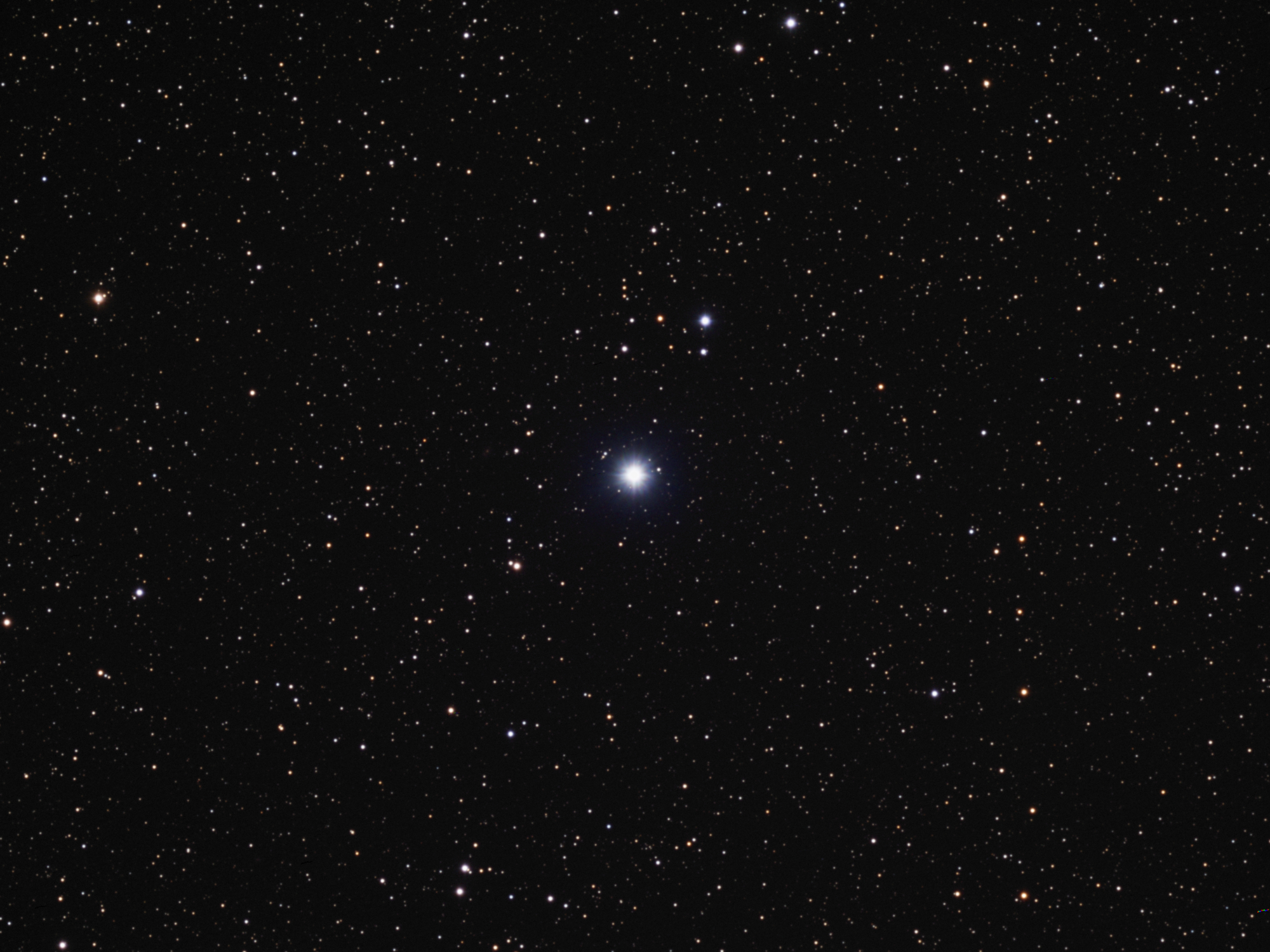
Alpha Lacertae, also named Stellio,[10] is a single[11] white-hued star in the constellation of Lacerta,[9] located 103[1] light-years from the Sun. It is the brightest star in Lacerta with an apparent visual magnitude of 3.76.[2] The star is moving closer to the Earth with a heliocentric radial velocity of −4.5 km/s.[6]
This is an ordinary A-type main-sequence star with a stellar classification of A1 V,[4] which indicates it is generating energy through hydrogen fusion at its core. It is around 400[7] million years old with a relatively high rate of spin, showing a projected rotational velocity of 128 km/s.[8] The star has 2.2 times the mass of the Sun and 2.1 times the Sun's radius. It is radiating 28 times the Sun's luminosity from its photosphere at an effective temperature of 9,050 K.[7]
Alpha Lacertae has a visual companion, CCDM J22313+5017B, of spectral type A and apparent visual magnitude 11.8, approximately 36 arcseconds away.[12] The companion is optical, a chance line-of-sight coincidence.[5]
Naming
[edit]
Alpha Lacertae, Latinised from α Lacertae, is the Bayer designation for this star; it has the Flamsteed designation 7 Lacertae.
In Chinese astronomy, 螣蛇 (Téng Shé), meaning Flying Serpent, refers to an asterism consisting of α Lacertae, 4 Lacertae, π2 Cygni, π1 Cygni, HD 206267, ε Cephei, β Lacertae, σ Cassiopeiae, ρ Cassiopeiae, τ Cassiopeiae, AR Cassiopeiae, 9 Lacertae, 3 Andromedae, 7 Andromedae, 8 Andromedae, λ Andromedae, κ Andromedae, ι Andromedae, and ψ Andromedae. Consequently, the Chinese name for α Lacertae itself is 螣蛇一 (Téng Shé yī, English: the First Star of Flying Serpent).[13]
The IAU Working Group on Star Names approved the name Stellio for this star on 29 August 2024 and it is now so entered in the IAU Catalog of Star Names.[10] Stellio is an obsolete historical name for the constellation Lacerta, named after the lizard Laudakia stellio, the starred agama or stellion.[14]
References
[edit]- ^ a b c d e f Van Leeuwen, F. (2007), "Validation of the new Hipparcos reduction", Astronomy and Astrophysics, 474 (2): 653–664, arXiv:0708.1752, Bibcode:2007A&A...474..653V, doi:10.1051/0004-6361:20078357, S2CID 18759600.
- ^ a b c d Anderson, E.; Francis, Ch. (2012), "XHIP: An extended hipparcos compilation", Astronomy Letters, 38 (5): 331, arXiv:1108.4971, Bibcode:2012AstL...38..331A, doi:10.1134/S1063773712050015, S2CID 119257644.
- ^ Zorec, J.; Royer, F. (2012). "Rotational velocities of A-type stars. IV. Evolution of rotational velocities". Astronomy and Astrophysics. 537: A120. arXiv:1201.2052. Bibcode:2012A&A...537A.120Z. doi:10.1051/0004-6361/201117691.
- ^ a b Cowley, A.; et al. (April 1969), "A study of the bright A stars. I. A catalogue of spectral classifications", Astronomical Journal, 74: 375–406, Bibcode:1969AJ.....74..375C, doi:10.1086/110819.
- ^ a b c HR 8585, database entry, The Bright Star Catalogue, 5th Revised Ed. (Preliminary Version), D. Hoffleit and W. H. Warren, Jr., CDS ID V/50. Accessed on line September 3, 2008.
- ^ a b Gontcharov, G. A. (November 2006), "Pulkovo Compilation of Radial Velocities for 35495 Hipparcos stars in a common system", Astronomy Letters, 32 (11): 759–771, arXiv:1606.08053, Bibcode:2006AstL...32..759G, doi:10.1134/S1063773706110065, S2CID 119231169.
- ^ a b c Boyajian, Tabetha S.; et al. (July 2013), "Stellar Diameters and Temperatures. III. Main-sequence A, F, G, and K Stars: Additional High-precision Measurements and Empirical Relations", The Astrophysical Journal, 771 (1): 31, arXiv:1306.2974, Bibcode:2013ApJ...771...40B, doi:10.1088/0004-637X/771/1/40, S2CID 14911430, 40. See Table 3.
- ^ a b c David, Trevor J.; Hillenbrand, Lynne A. (2015), "The Ages of Early-type Stars: Strömgren Photometric Methods Calibrated, Validated, Tested, and Applied to Hosts and Prospective Hosts of Directly Imaged Exoplanets", The Astrophysical Journal, 804 (2): 146, arXiv:1501.03154, Bibcode:2015ApJ...804..146D, doi:10.1088/0004-637X/804/2/146, S2CID 33401607.
- ^ a b "HD 211073". SIMBAD. Centre de données astronomiques de Strasbourg. Retrieved 2019-02-02.
- ^ a b "IAU Catalog of Star Names". Retrieved 22 February 2025.
- ^ De Rosa, R. J.; et al. (2014), "The VAST Survey - III. The multiplicity of A-type stars within 75 pc", Monthly Notices of the Royal Astronomical Society, 437 (2): 1216, arXiv:1311.7141, Bibcode:2014MNRAS.437.1216D, doi:10.1093/mnras/stt1932, S2CID 88503488.
- ^ Entry 22313+5017, discoverer code BU 703, The Washington Double Star Catalog Archived September 8, 2008, at the Wayback Machine, United States Naval Observatory. Accessed on line September 3, 2008.
- ^ (in Chinese) AEEA (Activities of Exhibition and Education in Astronomy) 天文教育資訊網 2006 年 7 月 7 日 Archived 2011-05-21 at the Wayback Machine
- ^ Ridpath, Ian. "Star Tales - Lacerta". Retrieved 6 May 2025.
External links
[edit]- Kaler, James B., "Alpha Lac", STARS, University of Illinois, retrieved 2019-02-04.
