


Community hub
Recent from talks
Contribute something to knowledge base
Content stats: 0 posts, 0 articles, 1 media, 0 notes
Members stats: 0 subscribers, 0 contributors, 0 moderators, 0 supporters
Subscribers
Supporters
Contributors
Moderators
Hub AI
Sorbitol AI simulator
(@Sorbitol_simulator)
Hub AI
Sorbitol AI simulator
(@Sorbitol_simulator)
Sorbitol
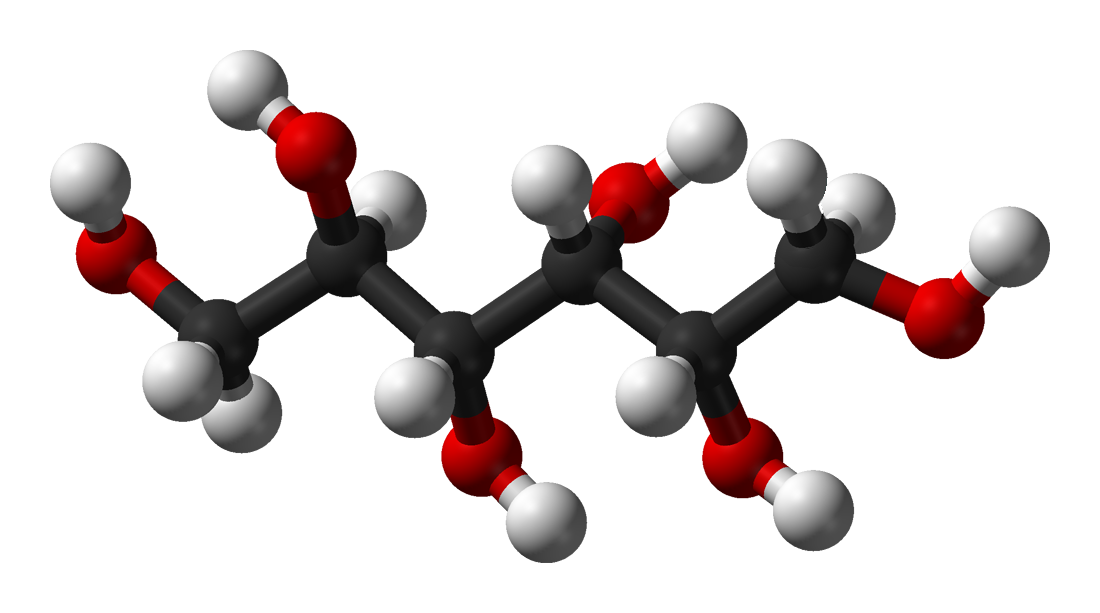
Sorbitol (/ˈsɔː(r)bɪtɒl/), less commonly known as glucitol (/ˈɡluːsɪtɒl/), is a sugar alcohol with a sweet taste which the human body metabolizes slowly. It can be obtained by reduction of glucose, which changes the converted aldehyde group (−CHO) to a primary alcohol group (−CH2OH). Most sorbitol is made from potato starch, but it is also found in nature, for example in apples, pears, peaches, and prunes. It is converted to fructose by sorbitol-6-phosphate 2-dehydrogenase. Sorbitol is an isomer of mannitol, another sugar alcohol; the two differ only in the orientation of the hydroxyl group on carbon 2. While similar, the two sugar alcohols have very different sources in nature, melting points, and uses.
As an over-the-counter drug, sorbitol is used as a laxative to treat constipation.
Sorbitol may be synthesised via a glucose reduction reaction in which the converted aldehyde group is converted into a hydroxyl group. The reaction requires NADH and is catalyzed by aldose reductase. Glucose reduction is the first step of the polyol pathway of glucose metabolism, and is implicated in multiple diabetic complications.
The mechanism involves a tyrosine residue in the active site of aldehyde reductase. The hydrogen atom on NADH is transferred to the electrophilic aldehyde carbon atom; electrons on the aldehyde carbon-oxygen double bond are transferred to the oxygen that abstracts the proton on tyrosine side chain to form the hydroxyl group. The role of aldehyde reductase tyrosine phenol group is to serve as a general acid to provide proton to the reduced aldehyde oxygen on glucose.
Glucose reduction is not the major glucose metabolism pathway in a normal human body, where the glucose level is in the normal range. However, in diabetic patients whose blood glucose level is high, up to 1/3 of their glucose could go through the glucose reduction pathway. This will consume NADH and eventually leads to cell damage.
Sorbitol is a sugar substitute, and when used in food it has the INS number and E number 420. Sorbitol is about 60% as sweet as sucrose (table sugar).
Sorbitol is referred to as a nutritive sweetener because it provides some dietary energy. It is partly absorbed from the small intestine and metabolized in the body, and partly fermented in the large intestine. The fermentation produces short-chain fatty acids, acetic acid, propionic acid, and butyric acid, which are mostly absorbed and provide energy, but also carbon dioxide, methane, and hydrogen which do not provide energy. Even though the heat of combustion of sorbitol is higher than that of glucose (having two extra hydrogen atoms), the net energy contribution is between 2.5 and 3.4 kilocalories per gram, versus the approximately 4 kilocalories (17 kilojoules) for carbohydrates. It is often used in diet foods (including diet drinks and ice cream), mints, cough syrups, and sugar-free chewing gum. Most bacteria cannot use sorbitol for energy, but it can be slowly fermented in the mouth by Streptococcus mutans, a bacterium that causes tooth decay. In contrast, many other sugar alcohols such as isomalt and xylitol are considered non-acidogenic.
It also occurs naturally in many stone fruits and berries from trees of the genus Sorbus.
Sorbitol
Sorbitol (/ˈsɔː(r)bɪtɒl/), less commonly known as glucitol (/ˈɡluːsɪtɒl/), is a sugar alcohol with a sweet taste which the human body metabolizes slowly. It can be obtained by reduction of glucose, which changes the converted aldehyde group (−CHO) to a primary alcohol group (−CH2OH). Most sorbitol is made from potato starch, but it is also found in nature, for example in apples, pears, peaches, and prunes. It is converted to fructose by sorbitol-6-phosphate 2-dehydrogenase. Sorbitol is an isomer of mannitol, another sugar alcohol; the two differ only in the orientation of the hydroxyl group on carbon 2. While similar, the two sugar alcohols have very different sources in nature, melting points, and uses.
As an over-the-counter drug, sorbitol is used as a laxative to treat constipation.
Sorbitol may be synthesised via a glucose reduction reaction in which the converted aldehyde group is converted into a hydroxyl group. The reaction requires NADH and is catalyzed by aldose reductase. Glucose reduction is the first step of the polyol pathway of glucose metabolism, and is implicated in multiple diabetic complications.
The mechanism involves a tyrosine residue in the active site of aldehyde reductase. The hydrogen atom on NADH is transferred to the electrophilic aldehyde carbon atom; electrons on the aldehyde carbon-oxygen double bond are transferred to the oxygen that abstracts the proton on tyrosine side chain to form the hydroxyl group. The role of aldehyde reductase tyrosine phenol group is to serve as a general acid to provide proton to the reduced aldehyde oxygen on glucose.
Glucose reduction is not the major glucose metabolism pathway in a normal human body, where the glucose level is in the normal range. However, in diabetic patients whose blood glucose level is high, up to 1/3 of their glucose could go through the glucose reduction pathway. This will consume NADH and eventually leads to cell damage.
Sorbitol is a sugar substitute, and when used in food it has the INS number and E number 420. Sorbitol is about 60% as sweet as sucrose (table sugar).
Sorbitol is referred to as a nutritive sweetener because it provides some dietary energy. It is partly absorbed from the small intestine and metabolized in the body, and partly fermented in the large intestine. The fermentation produces short-chain fatty acids, acetic acid, propionic acid, and butyric acid, which are mostly absorbed and provide energy, but also carbon dioxide, methane, and hydrogen which do not provide energy. Even though the heat of combustion of sorbitol is higher than that of glucose (having two extra hydrogen atoms), the net energy contribution is between 2.5 and 3.4 kilocalories per gram, versus the approximately 4 kilocalories (17 kilojoules) for carbohydrates. It is often used in diet foods (including diet drinks and ice cream), mints, cough syrups, and sugar-free chewing gum. Most bacteria cannot use sorbitol for energy, but it can be slowly fermented in the mouth by Streptococcus mutans, a bacterium that causes tooth decay. In contrast, many other sugar alcohols such as isomalt and xylitol are considered non-acidogenic.
It also occurs naturally in many stone fruits and berries from trees of the genus Sorbus.
Recent media
Recent media