Hubbry Logo
Alvin LeeAlvin LeeMain
Open search
Alvin Lee
Community hub
Alvin Lee
logo
8 pages, 0 posts
0 subscribers
Be the first to start a discussion here.
Alvin Lee
Alvin Lee
from Wikipedia

Key Information

Alvin Lee (born Graham Anthony Barnes; 19 December 1944 – 6 March 2013) was an English guitarist, singer and songwriter, who was best known as the lead vocalist and guitarist of the blues rock band Ten Years After.

Early life

[edit]

Lee was born in Nottingham[1] and attended the Margaret Glen-Bott School in Wollaton. He began playing guitar at the age of 13. In 1960, Lee, along with bassist Leo Lyons, formed the core of the band Ten Years After. He was influenced by his parents' collection of jazz and blues records, but it was the advent of rock and roll that sparked his interest.

Career

[edit]

Lee's performance at the Woodstock Festival was captured on film in the documentary of the event, and his 'lightning-fast' playing[2] helped catapult him to stardom.[3] The film brought Lee's music to a worldwide audience, although he later lamented that he missed the lost freedom and spiritual dedication of earlier audiences.[4]

Lee was named "the fastest guitarist in the West" and considered a precursor to shred-style playing that would develop in the 1980s.[5]

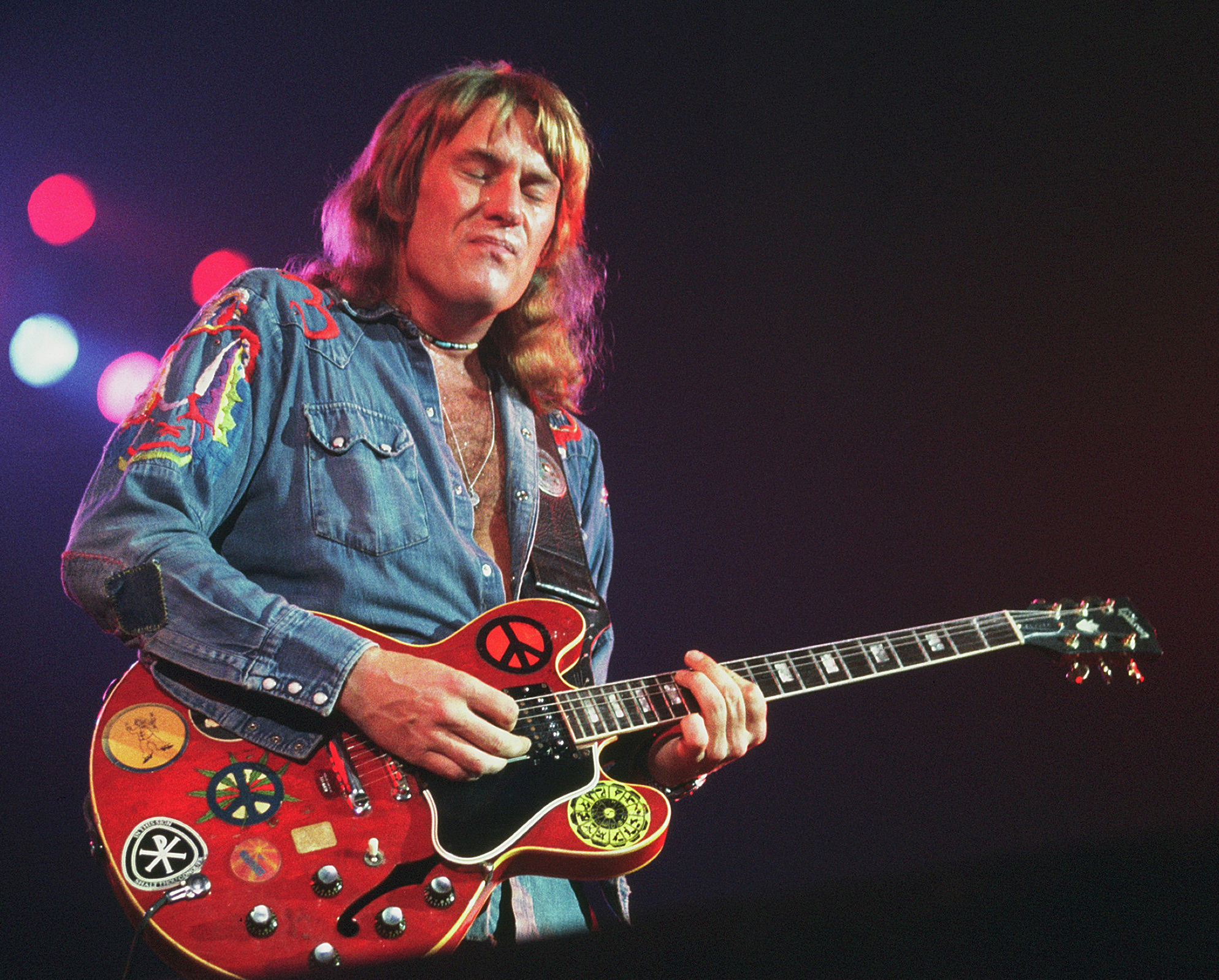
Alvin Lee performing in Breda, Turfschip, the Netherlands, 1978

Ten Years After had success, releasing ten albums together, but by 1973 Lee was feeling limited by the band's style. Moving to Columbia Records had resulted in a radio hit song, "I'd Love to Change the World" but Lee preferred blues-rock to the pop style the label preferred. He left the group after their second Columbia LP.[6] With American Christian rock pioneer Mylon LeFevre, along with guests George Harrison, Steve Winwood, Ronnie Wood and Mick Fleetwood, he recorded and released On the Road to Freedom, an acclaimed album that was at the forefront of country rock.[6] Also in 1973, he sat in on the Jerry Lee Lewis double album The Session...Recorded in London with Great Artists recorded in London, featuring many other guest stars including Albert Lee, Peter Frampton and Rory Gallagher. A year later, in response to a dare, Lee formed Alvin Lee & Company to play a show at the Rainbow Theatre in London and released it as a double live album, In Flight. Various members of the band continued on with Lee for his next two albums, Pump Iron! and Let It Rock.[6] In late 1975, he played guitar for a couple of tracks on Bo Diddley's The 20th Anniversary of Rock 'n' Roll all-star album. He ended the 1970s with an outfit called Ten Years Later,[6] with Tom Compton on drums and Mick Hawksworth on bass, which released two albums, Rocket Fuel (1978) and Ride On (1979), and toured extensively throughout Europe and the United States.

The 1980s brought another change in Lee's direction, with two albums that were collaborations with Rare Bird's Steve Gould and a tour for which the former John Mayall and Rolling Stones guitarist Mick Taylor joined his band.[6]

Lee's overall musical output includes more than 20 albums, including 1987's Detroit Diesel, 1989's About Time (the reunion album he did with Ten Years After) recorded in Memphis with producer Terry Manning and the back to back 1990s collections of Zoom and Nineteen Ninety-Four (US title I Hear You Rockin').[6] Guest artists on the albums included George Harrison [6] and Jon Lord.

In Tennessee, recorded with Scotty Moore and D. J. Fontana, was released in 2004. Saguitar was released in 2007. Lee's last album, Still on the Road to Freedom, was released in September 2012.

Death

[edit]

Lee died in Spain on 6 March 2013, aged 68,[7] due to complications from surgery to correct an atrial arrhythmia.[8] His former bandmates lamented his death. Leo Lyons called him "the closest thing I had to a brother", while Ric Lee (no relation) said "I don't think it's even sunk in yet as to the reality of his passing". Billboard highlighted such landmark performances as "I'm Going Home" from the Woodstock festival and his 1971 hit single "I'd Love to Change the World".[9]

Discography

[edit]

Studio albums

[edit]
Album US

Chart [10]

Year
Pump Iron! 131 1975
Let It Rock - 1978
Rocket Fuel 115 1978
Ride On 158 1979
Free Fall 198 1980
RX5 - 1981
Detroit Diesel 124 1986
Zoom - 1992
Nineteen Ninety-Four - 1994
In Tennessee - 2004
Saguitar - 2007
Still on the Road to Freedom - 2012
  • Note: Ride On contains one studio side and one live side.

Collaborative album

[edit]
Album US Chart

[10]

Year Notes
On the Road to Freedom 138 1973 with Mylon LeFevre

Live albums

[edit]
Album US Chart

[10]

Year Notes Chrysalis Records
In Flight 65 1974 Live at the Rainbow Theatre in 1974
Live at Rockpalast - 1978 Grugahalle, Essen, Germany, 15 September 1978
Live In Vienna - 1994 Label: International House Of Hits
The Last Show - 2013 May 28, 2012 - Raalte, Holland

Singles

[edit]
Single US Rock

[10]

Year Album
"Detroit Diesel" 26 1986 Detroit Diesel

References

[edit]
[edit]
Revisions and contributorsEdit on WikipediaRead on Wikipedia
from Grokipedia
Alvin Lee (born Graham Anthony Barnes; 19 December 1944 – 6 March 2013) was an English , singer, and songwriter best known as the lead , vocalist, and frontman of the band . Born in , , Lee began playing at the age of 13, influenced by and artists, and by 15 had formed the core of what would become in 1966. The band rose to prominence in the late 1960s scene, blending high-energy with Lee's signature lightning-fast technique, earning him the nickname "Captain Speedfingers." Ten Years After achieved international breakthrough with their electrifying performance at the 1969 Woodstock Music and Art Fair, where Lee's blistering rendition of "I'm Going Home" highlighted his virtuosic speed and became one of the festival's most iconic moments. The band's subsequent albums in the early produced hits like "Love Like a Man" (1970) and "I'd Love to Change the World" (1971), the latter promoting themes of universal peace and love. Between 1968 and 1974, the group completed 28 U.S. tours, solidifying their status in the rock world amid the era's movement. Following the band's 1973 breakup, Lee embarked on a prolific solo career, collaborating with artists like and while releasing over a dozen albums, including On the Road to Freedom (1973) and Still on the Road to Freedom (2012). His work evolved from high-octane blues-rock to more acoustic and country-infused styles, reflecting a personal shift toward a quieter life in . Lee passed away on 6 March 2013 in , , at age 68 from complications following a routine surgical procedure for atrial , leaving a legacy as one of rock's most technically brilliant guitarists.

Early life

Childhood and family background

Alvin Lee was born Graham Anthony Barnes on December 19, 1944, in , . He was the son of Sam Barnes, a builder who collected and records, and Doris Barnes, both of whom played guitar and fostered a musical household environment. Raised in a working-class family in the Wollaton suburb of during post-war Britain, Barnes experienced the challenges of , reconstruction, and economic recovery in an industrial city known for its textile and manufacturing heritage. He attended the Margaret Glen-Bott School in Wollaton and left school at age 15 to pursue music. Around the age of 15, Barnes adopted the stage name Alvin Lee as he began pursuing music professionally, marking a shift from his .

Introduction to music and early influences

Alvin Lee began playing the guitar at the age of 13 in 1957, initially teaching himself through dedicated practice. He acquired his first instrument—a cheap —that sparked his lifelong passion for . Largely self-taught, Lee spent hours honing basic techniques, often hiding his guitar under his school desk to practice chord shapes and patterns during classes. His early musical exposure was shaped by his parents' collection of jazz and blues records, which provided a foundational appreciation for American roots music. Lee's key inspirations came from the burgeoning rock 'n' roll scene, including guitarists like Chuck Berry, whose energetic riffs and showmanship captivated him, and Buddy Holly, whose melodic solos he learned note for note. He also drew from Gene Vincent's raw energy and the British skiffle revival led by Lonnie Donegan, whose accessible style encouraged amateur musicians in post-war Britain. These influences immersed Lee in Nottingham's vibrant local scene, where coffee bars and small venues buzzed with skiffle and early rock enthusiasts experimenting with simple setups. During his teenage years, Lee focused on developing fingerpicking techniques and fundamental structures, adapting them to his self-directed style amid the informal jams and listening sessions that defined Nottingham's . This period laid the groundwork for his rapid playing approach, blending rock 'n' roll flair with phrasing, without formal lessons or advanced equipment.

Career with Ten Years After

Formation and early years

Alvin Lee, born Graham Anthony Barnes on December 19, 1944, in , , began playing guitar at age 13 and formed his first band, the Jaycats, in late 1960 at the age of 15 with school friends, including bassist . The group, initially focused on rock 'n' roll covers, soon recruited singer Ivan Jay and renamed itself Ivan Jay and the Jaycats, performing locally in the Nottingham area and building a grassroots following through school dances and small venues. By 1962, the band had evolved into the Jaymen and then the Jaycats again, recording informal demos and gaining traction in the emerging British beat scene. Through the mid-1960s, the lineup underwent several changes amid the growing revival influence from American artists like and , whom Lee idolized. The band, now known as the Jaybirds since 1962, achieved notable success with residencies in clubs and trips to , , in 1962, where they followed in the footsteps of , honing their high-energy live performances in the club circuit. Drummer joined in 1965 after the departure of previous percussionist Dave Quickmire, solidifying the core rhythm section with bassist , while keyboardist came on board shortly after; these additions shifted their sound toward -rock. The group briefly became the Blues Trip before relocating to in 1966. In 1966, Alvin Lee and rebranded the band as , a name chosen as a tribute to , marking a decade since his breakthrough year of 1956. This period saw the band establish a strong local reputation through relentless gigging in pubs and blues clubs, covering standards and original material, though they had yet to secure a major recording deal. Their pre-fame years from 1960 to 1966 were characterized by persistence amid lineup flux and financial struggles, laying the foundation for their blues-infused style that would later propel them to international notice.

Woodstock performance and breakthrough

Ten Years After took the stage at the Woodstock Music and Art Fair on August 17, 1969, performing a dynamic set before an estimated audience of over 400,000. The British blues-rock band's hour-long appearance featured high-octane renditions of songs like "," "I Can't Keep My Eyes on You," and their closing number, "I'm Going Home," a nearly ten-minute showcase of Alvin Lee's virtuosic, rapid-fire guitar picking that blended blues improvisation with rock energy. The performance was filmed by director Michael Wadleigh's crew, despite technical challenges such as Lee's guitar going out of tune midway through, and it became a highlight of the subsequent 1970 Woodstock and its . The Woodstock exposure marked a pivotal breakthrough for , transforming them from a niche act rooted in the scene into international stars with mainstream appeal. The film's release in 1970 catapulted "I'm Going Home" to prominence, driving U.S. chart success for the band's albums, including reaching No. 14 on the 200. This surge enabled them to embark on an intensive touring schedule, completing 27 American tours over the next seven years, which solidified their reputation as a live powerhouse but also intensified the pressures of fame. Post-Woodstock momentum facilitated Ten Years After's transition to in 1970, their first major label deal that supported expanded production and distribution for albums like Watt. Lee's frenetic stage presence during these high-energy shows earned him the enduring nickname "Captain Speedfingers," reflecting his lightning-fast technique that captivated audiences and defined the band's electrifying image. However, the relentless pace of success exacted a personal toll on Lee, contributing to burnout amid the whirlwind of constant performances.

Peak success and disbandment

Following the momentum from their Woodstock appearance, Ten Years After achieved their commercial peak in the early with a series of successful studio albums that blended with more accessible song structures. Their 1969 release Ssssh, recorded just before the festival but released shortly after, became their first major U.S. hit, reaching No. 20 on the and No. 4 on the , propelled by Alvin Lee's intricate guitar work on tracks like "Love Like a Man." This was followed by Cricklewood Green in 1970, which peaked at No. 14 on the , featuring Lee's raw, extended improvisations on songs such as "50,000 Miles Beneath My Brain." The band's highest-selling album, (1971), climbed to No. 17 on the and included their sole Top 40 single, "I'd Love to Change the World," which reached No. 40 and showcased Lee's shift toward introspective songwriting. During this period, Lee's compositions increasingly incorporated , reflecting the era's concerns with , inequality, and global unrest; for instance, "I'd Love to Change the World" critiques , , , and economic disparity as symptoms of a flawed society, marking a departure from the band's earlier blues-focused material. However, the era's success came at a cost, as maintained an exhaustive touring schedule—which amplified Lee's growing frustration with repetitive setlists and the physical toll of constant travel. This intensity, combined with creative differences over the band's artistic direction, fostered internal tensions, with Lee expressing a desire to explore more varied musical styles beyond their established boogie-blues formula. By 1973, exhaustion from the relentless pace led to the band's initial disbandment, as Lee cited burnout and a need for personal reinvention after seven years of non-stop activity. Their final release before the split, the double live album —capturing performances from European tours earlier that year without overdubs—served as a high-energy , highlighting Lee's blistering guitar solos on staples like "I'm Going Home" and underscoring the group's live prowess amid the mounting strains.

Solo career

Initial solo albums and collaborations

Following the disbandment of Ten Years After in 1974, Alvin Lee embarked on a solo career, seeking to explore new musical directions beyond the band's blues-rock framework. His debut solo effort, On the Road to Freedom, released in November 1973 on , was a collaborative album with American singer , blending rock elements with and country influences. The project featured guest appearances from prominent musicians, including on guitar for the track " (No Love of My Own)" and Ron Wood on guitar and bass, alongside contributions from , , and . Produced primarily by Lee himself, the album marked his initial foray into more soulful and rhythmic territories, reflecting influences from American R&B and traditions during recording sessions in Memphis and . Lee followed with the live album In Flight (1974), recorded at London's Rainbow Theatre with his backing band Alvin Lee & Co., showcasing his guitar work on original material and covers. In 1975, he released Pump Iron!, his first studio solo album without a co-lead artist, issued on after a label shift that facilitated his growing U.S. base of operations. This release emphasized boogie-rock and blues-rock styles, characterized by energetic guitar riffs and a heavier, groove-oriented sound compared to his prior work. Notable collaborations included and Ron Wood, who contributed to select tracks, underscoring Lee's connections within the rock elite. The album's production highlighted Lee's experimentation with and undertones, drawing from his relocation to , where he established a more stable creative environment away from the UK's rock scene. These initial solo ventures faced challenges, including mixed critical reception due to their departure from Ten Years After's high-energy template, which some listeners found too eclectic or "adventurous." Sales were modest compared to the band's peak albums, partly attributed to the era's shifting rock landscape and Lee's personal struggles with drug use following years of intense touring stress that contributed to the group's dissolution. By 1974, after emerging from rehabilitation, Lee channeled this recovery into renewed focus, using these projects to redefine his artistry amid the pressures of transitioning to independence.

Later projects and reunions

In the 1980s, Alvin Lee continued his solo endeavors with RX5 (1981), a studio album by the Alvin Lee Band featuring rock-oriented tracks, followed by the release of Detroit Diesel in 1986, an album that showcased his matured blues-rock style through a blend of original compositions and covers, including tracks like "Detroit Diesel" and "Heart of Stone," recorded with session musicians such as drummer Alan Rich. This project reflected Lee's exploration of urban blues influences, drawing from Motown and rockabilly roots while maintaining his signature guitar work. Meanwhile, Ten Years After briefly reunited in 1983 for a performance at the Reading Festival, marking their first joint appearance since disbanding in 1974, which reignited interest in the band's classic lineup. The late 1980s saw further band activity, as Ten Years After reformed in 1988 for a European tour, leading to the studio album About Time in 1989, their first new material in over a decade and featuring the original members Alvin Lee, Leo Lyons, Chick Churchill, and Ric Lee. This reunion effort emphasized Lee's enduring leadership and the group's blues-rock foundation, with tours extending into 1990 to support the release. Solo-wise, Lee entered a quieter period but contributed to reissues and compilations that highlighted his post-Ten Years After evolution. Entering the 1990s, undertook another reunion in 1997, prompted by a major Scandinavian festival tour, where the band performed with the classic lineup and incorporated tracks from About Time alongside Woodstock-era staples. This period also saw Lee release Zoom in 1992, a high-energy solo album blending and , followed by Nineteen Ninety-Four in 1994, a live recording from that captured his improvisational guitar prowess during European shows. These works demonstrated Lee's continued touring commitment, including festival appearances that bridged his solo identity with band nostalgia. In the 2000s, Lee's output shifted toward acoustic and blues-oriented projects, reflecting a return to his roots with simpler, more introspective arrangements. He released In Tennessee in 2004, recorded in Nashville with Elvis Presley's original sidemen on guitar and on drums, featuring upbeat tracks like "Let's Boogie" and a reimagined "I'm Going Home." This collaboration underscored Lee's admiration for early rock pioneers and resulted in a 30-date tour, culminating in a performance at the Royal Albert Hall. Subsequent releases included Saguitar in 2007, a -blues effort largely performed by Lee alone on acoustic guitar, with songs such as "Memphis" and "Motel Blues," and Still on the Road to Freedom in 2012, a collection of 13 original tracks emphasizing acoustic introspection and themes of perseverance. These later solo s highlighted a stylistic pivot from high-speed electric leads to warmer, rootsy expressions, while occasional nods appeared in anthologies like The Anthology (2002) and The Anthology Vol. 2 (2008), compiling live and studio highlights. Lee's final performances maintained this acoustic focus until his death, with the posthumous live The Last Show (2013) documenting a 2012 concert.

Personal life

Family and relationships

Alvin Lee maintained a notably private personal life, shielding his from the public eye amid his high-profile career. He was married to Evi Lee, with whom he shared a long-term partnership until his death in 2013. The couple resided together in during his later years, enjoying a semi-retired lifestyle that included occasional performances. Lee had one daughter, Jasmin Lee, born in the 1970s to his former partner Suzanne Lee-Barnes. He was also survived by his sisters Irma and Janice. Jasmin, who grew up around recording studios, later became the managing director of Dean Street Studios in , honoring her father's legacy through music production and artist management. Public details about Jasmin remain limited, reflecting Lee's preference for keeping family matters out of the spotlight, though she has been mentioned in family tributes and statements following his passing. Lee had no other marriages or children. His close bonds with Ten Years After bandmates, particularly bassist , were often described as brotherly, forming an extended family dynamic that endured through decades of collaboration and occasional reunions. This sense of camaraderie provided personal support, separate from his immediate family, as Lee focused professionally on music while maintaining privacy in his relational life.

Later residences and ventures

By the late 1980s, Lee sought a more tranquil existence away from the music industry's demands, relocating to as his full-time home. He settled in the region of , drawn to its mild climate, affordable lifestyle, and cultural vibrancy, which he described as offering good weather, cheap wine, and quality food without the hassles of his native . This move marked a shift toward rural living, as Lee embraced a country lifestyle outside urban centers, occasionally studying to explore local traditions. Lee's Spanish base facilitated a balanced routine in his later years, enabling sporadic European tours while prioritizing personal seclusion and recovery from decades of rock touring. He maintained this residence until his death, using it as a retreat for reflection and occasional collaborations.

Death

Circumstances of death

Alvin Lee died on March 6, 2013, at the age of 68 in , , where he had resided for many years. According to an official family statement posted on Lee's , he passed away from unforeseen complications following a routine surgical procedure to correct an (irregular heartbeat). The procedure was described as routine, with no indications of suspicious circumstances surrounding his death.

Immediate aftermath

Alvin Lee's family announced his death on March 6, 2013, via his official website, stating that the 68-year-old musician had unexpectedly passed away earlier that day due to unforeseen complications following a routine surgical procedure in . Tributes from his former bandmates followed swiftly, with drummer expressing shock and describing Alvin as "a star" and "a terrific and a fabulous onstage performer," while conveying condolences to his family. Lee's funeral was a private ceremony held in , where he had resided for many years, and he was subsequently cremated. In the immediate weeks after his passing, preparations began for posthumous releases, including the live album The Last Show, recorded at his final performance on May 28, 2012, in Raalte, , and issued on October 1, 2013, by Rainman Records to honor his enduring stage presence. Major music publications quickly published obituaries commemorating Lee's legacy, with highlighting his blistering Woodstock performance of "I'm Going Home" as a defining moment that propelled to international fame. Similarly, noted his Woodstock set as a career pinnacle, emphasizing how his rapid-fire guitar work and the band's blues-rock energy captured the festival's spirit and influenced generations of players. On April 7, 2013, a moment of reflection was observed at a in ' Olympia Hall, where fans and performers worldwide joined in a minute of silence to pay initial respects.

Legacy

Influence on music and guitarists

Alvin Lee's innovative approach to blues-rock guitar in the 1960s and 1970s pioneered the integration of rapid speed-picking techniques, blending traditional blues phrasing with high-velocity rock execution that foreshadowed elements of and styles. His "Captain Speedfingers" moniker underscored this signature velocity, which emphasized clean articulation and dynamic phrasing, influencing the evolution of performance in . The band's electrifying set at the 1969 Woodstock Festival, particularly Lee's blistering rendition of "I'm Going Home," showcased his blistering fingerwork to a global audience via the subsequent film and soundtrack, propelling to international prominence and establishing Lee as a cornerstone of blues-rock. This performance inspired subsequent generations of guitarists, with citing Lee as a major influence on his own playing style, noting his technical prowess and personal warmth. Similarly, drew early inspiration from Lee's live shows, as Lee himself recalled Moore watching him perform during his formative years, which shaped Moore's approach to blues-infused rock guitar. Through songs like "I'd Love to Change the World," Lee contributed to the socially conscious strand of prevalent in the early , articulating themes of global unrest, frustration, and the desire for positive change amid events like the and . The track's enduring relevance—evident in its use in films depicting historical turmoil, such as Seven Days in Entebbe and —has reinforced its role in promoting introspective, reform-oriented lyrics within rock, as reflected in drummer Ric Lee's observations on its timeless commentary on societal issues. As a key figure in the revival of the late 1960s, Lee bridged earlier traditions with amplified, heavy sounds, helping transition the genre from acoustic roots toward electrified rock fusion through Ten Years After's high-energy interpretations of blues standards and originals. This evolution positioned him as a vital link in the movement that revitalized interest in American among British audiences and musicians, fostering a transatlantic exchange that amplified the genre's global reach.

Recognition and tributes

Alvin Lee garnered significant recognition for his innovative guitar work, particularly through rankings that emphasized his speed and style. In Guitar World's 2015 list of the 50 fastest shred guitarists of all time, Lee was celebrated for his blistering performance of "I'm Going Home" at the 1969 Woodstock Festival, which showcased his rapid-fire technique and solidified his reputation as a blues-rock pioneer. Through his band , Lee has been part of ongoing consideration for the Rock and Roll Hall of Fame since the group's eligibility in 1993, with fan advocacy highlighting his transformative role in the genre's evolution during the late 1960s and early 1970s. Gibson paid posthumous tribute to Lee's iconic setup by issuing a limited-edition Custom Shop ES-335 '69 Festival model in 2019, faithfully replicating the specifications of his famed "Big Red" guitar used at Woodstock, with production capped at 50 units worldwide to commemorate the festival's 50th anniversary. In the wake of his 2013 death, a prominent concert took place on April 7 at L'Olympia in , where an international lineup including , , [Robben Ford](/page/Robben Ford), and performed Lee's compositions and observed a , drawing fans from around the world to honor his legacy. Reformed iterations of also staged commemorative shows that year, emphasizing Lee's enduring impact on live blues-rock performance. Lee's influence extended to tributes from fellow musicians, with Guns N' Roses guitarist Slash recalling him as the first "badass, super fast lead guitarist" he encountered, and Queen guitarist praising him as a "legendary and influential" artist whose playing inspired generations.

Musical style and equipment

Guitar playing technique

Alvin Lee's guitar playing was characterized by extraordinary speed and precision, earning him the moniker "the fastest guitarist in the West" during the late 1960s and 1970s. His solos, particularly in live performances like the Woodstock rendition of "I'm Going Home," showcased blistering runs delivered at tempos around 120 bpm for the song overall, with individual licks approaching high velocities through efficient picking motions. This style blended raw energy with authenticity, allowing Lee to navigate complex phrases with minimal excess movement. At the core of Lee's technique lay a blues foundation, employing pentatonic scales infused with wide rock bends and for expressive depth. Despite the velocity—often highlighted in critiques as pioneering shred elements—he maintained an economy of motion, focusing on clean articulation rather than showy flourishes. Techniques such as and occasional string skipping enabled fluid transitions across the fretboard, as Lee described in a 1975 interview: "I pick the E and I can apply the G flat and the G without another pick, and that's how the notes come in. I do back pick as well." This approach emphasized efficiency, reducing pick strokes to sustain momentum in extended improvisations. Lee's style evolved from his skiffle-influenced beginnings in the early , where rudimentary fingerstyle and rhythm techniques on acoustic guitars laid the groundwork for his dexterity. By the late , he adapted these skills to amplified setups, incorporating Marshall stack distortion to amplify his blues-rock sound without relying on effects pedals, prioritizing a direct, raw tone from the amp alone. In later years, particularly from the onward, Lee revisited acoustic elements in solo projects, stripping back to fingerpicking and unplugged arrangements that echoed his formative roots while showcasing matured control.

Signature instruments and gear

Alvin Lee's primary instrument throughout much of his career was a 1959 semi-hollowbody , affectionately nicknamed "Big Red" for its cherry red finish and extensive sticker adornments. He acquired the guitar in the early 1960s and relied on it heavily from Ten Years After's formation onward, most iconically during their 1969 Woodstock performance of "I'm Going Home," where its bright, resonant tone cut through the mix. The ES-335 featured a modified setup, including a custom in its early years, which Lee later replaced with a stop tailpiece for improved tuning stability, along with a middle-position single-coil pickup added for tonal versatility. For amplification, Lee favored Marshall stacks during the band's peak years in the late and early , particularly the 100-watt Super Lead heads paired with 4x12-inch cabinets to achieve his signature high-gain, overdriven blues-rock tone at high volumes. These setups provided the and natural compression essential to his fast-picking style, as seen in live recordings from that era. In later solo work, he occasionally incorporated Fender amplifiers for cleaner tones, though he maintained a preference for British-voiced tube amps overall. Lee's effects were minimal, emphasizing amp-driven over pedals; he occasionally used a Vox wah-wah pedal for expressive solos, such as on tracks requiring vocal-like sweeps. His string choices were light-gauge Gibson sets—typically .009 to .052 with a tremolo-equipped guitar for easier bends and speed—while he favored medium-thickness picks for balanced attack and control. As his career evolved into the 1970s and beyond, Lee shifted toward acoustic instruments for solo projects, incorporating Martin dreadnought models like the D-28 for their warm projection on folk-blues recordings. He maintained a long-standing endorsement with Gibson, which led to limited-edition signature ES-335 reproductions of "Big Red" in 2005 and 2019, celebrating his influence on the model's legacy.

Discography

Albums with Ten Years After

Ten Years After's debut album, Ten Years After (1967), released on Deram Records, primarily consisted of blues covers and established the band's early sound rooted in British blues traditions. The band's breakthrough came with the live album Undead (1968), recorded at London's Klooks Kleek club, which captured their energetic performances and included the track "I'm Going Home," later immortalized at Woodstock. Stonedhenge (1969, Deram) explored heavier riffs and experimental arrangements, reflecting the band's evolving influences. Ssssh (1969, Deram) marked their first collection of original material, blending with psychedelic elements and peaking at No. 4 on the . Cricklewood Green (1970, Deram) featured concise song structures and standout tracks like "50 Years of Hurt," reaching No. 4 on the and No. 14 on the US Billboard 200. Watt (1970, Deram) delivered raw, high-energy with extended jams, continuing the band's momentum in the market where it charted at No. 21 on the and No. 5 on the . A Space in Time (1971, Chrysalis), the band's commercial peak, incorporated acoustic elements and pop sensibilities alongside Alvin Lee's signature guitar work; it reached No. 36 on the , No. 17 on the , and earned RIAA Platinum certification for over 1,000,000 units sold. Rock & Roll Music to the World (1972, Chrysalis) emphasized straightforward rock anthems and boogie rhythms, peaking at No. 27 on the and No. 43 on the US Billboard 200. Positive Vibrations (1974, Chrysalis) was the final album before the initial breakup, blending with influences and reaching No. 81 on the US Billboard 200. About Time (1989, Chrysalis) blended original blues rock with covers, showcasing the enduring chemistry of the core lineup. The limited-release Now (2004) captured a later incarnation of the band, focusing on high-octane live-inspired studio tracks. Subsequent efforts like (2008) maintained the foundation while incorporating modern touches, though with limited chart impact.
AlbumYearLabelUK PeakUS Peak (Billboard 200)Certification
1967Deram---
(live)1968Deram26115-
Stonedhenge1969Deram661-
1969Deram420-
1970Deram414-
Watt1970Deram521-
1971Chrysalis3617RIAA Platinum
Rock & Roll Music to the World1972Chrysalis2743-
Positive Vibrations1974Chrysalis-81-
About Time1989Chrysalis-120-
Now2004Eclectic---
Evolution2008Ten Years After---

Solo studio albums

Alvin Lee's solo studio albums marked a departure from his band work, allowing him to explore personal themes of freedom, , and rock experimentation with varied collaborators. Beginning in the 1970s after leaving , these recordings often featured guest musicians and reflected his evolving guitar style, blending high-energy -rock with introspective elements. Later albums, self-produced under his Rainman label, emphasized raw influences and tributes to roots music. His debut solo effort, On the Road to Freedom (1973, Chrysalis), was a collaborative project with American gospel singer , fusing rock with spiritual themes of liberation and redemption; tracks like the title song highlight Lee's fiery guitar leads alongside LeFevre's vocals. Released amid his post-band transition, it showcased a softer, more acoustic side compared to his earlier high-speed playing. Pump Iron! (1975, Chrysalis) returned to harder-edged rock, produced by Lee himself, with muscular riffs driving songs about resilience and personal power; it featured contributions from drummer and bassist on vocals, underscoring Lee's affinity for traditions. After a period with short-lived bands, Lee resumed pure solo output with RX5 (1981, Atlantic), a high-octane blues-rock set with the Alvin Lee Band lineup, exploring themes of urban grit and velocity through titles like "Trouble in Mind." Detroit Diesel (1986, 21 Records) evoked Motor City blues with raw, engine-revving guitar tones, self-produced by Lee and focusing on straightforward rock anthems; it included horn sections for a fuller sound on tracks addressing life's drives and struggles. In the 1990s, Zoom (1992, Domino Records) brought star power with guests like George Harrison on slide guitar and Jon Lord on keys, blending blues-rock with pop sensibilities and themes of reflection; the title track exemplifies Lee's matured, melodic phrasing. Nineteen Ninety-Four (also known as Nineteenninetyfour, 1993, Blue Martin Records) delivered energetic rockers with blues undercurrents, produced by Lee, highlighting his enduring speed and precision on guitar-driven pieces about time and change. In Tennessee (2004, Fontana) paid homage to Southern roots, featuring Elvis's guitarist Scotty Moore as a key collaborator; recorded in Nashville, it delved into country-blues hybrids with themes of heritage and simplicity, as in the acoustic-tinged "Midnight Creeper." Saguitar (2007, Rainman Records), Lee's first self-released solo , was an showcase of sagas, emphasizing narrative guitar lines without vocals to spotlight his technical prowess and emotional depth in tracks evoking personal journeys. His final studio , Still on the Road to Freedom (2012, Rainman Records), revisited the debut's themes nearly four decades later, with guests including Steve Miller and ; it combined rock anthems and ballads on enduring quests for liberty, self-produced to maintain an intimate, blues-infused vibe.
YearAlbumLabelKey Notes
1973On the Road to FreedomChrysalisCollaboration with ; gospel-rock themes of .
1975Pump Iron!ChrysalisSelf-produced; hard rock with resilience motifs.
1981RX5AtlanticAlvin Lee Band; urban -rock energy.
198621 RecordsSelf-produced; gritty, horn-accented rock.
1992ZoomDomino RecordsGuests: , ; reflective -pop.
1993Nineteen Ninety-FourBlue Martin RecordsEnergetic rock- on time and change.
2004In FontanaWith ; country- roots tribute.
2007SaguitarRainman RecordsInstrumental narratives.
2012Still on the Road to Rainman RecordsGuests: Steve Miller, ; sequel to 1973 album, liberty themes.

Live albums and compilations

Alvin Lee's live recordings, both with and in his solo career, capture the high-energy blues-rock performances that defined his reputation as a virtuoso guitarist. The band's debut live album, (1968), was recorded at London's Klooks Kleek club and features extended improvisations on tracks like "Hearing Me Calling," showcasing Lee's rapid fingerpicking style in a raw, club atmosphere. Released on , it marked Ten Years After's breakthrough, blending influences with psychedelic elements. Following their Woodstock appearance in 1969, where Lee's blistering 20-minute rendition of "I'm Going Home" became iconic, official audio from the festival was initially limited to the multi-artist soundtrack. Bootleg recordings circulated for decades before being formalized in official releases, including the standalone Woodstock 1969 album in 2024, remixed from original multitrack tapes and highlighting the band's full set of blues-driven jams. Ten Years After's Recorded Live (1973), a double album on Chrysalis Records, documents a 1972 concert in Mannheim, Germany, with no overdubs to preserve the authentic energy of songs like "One of These Days" and "You Give Me Loving." This release, produced by the band, emphasized their live prowess amid the group's final tours before disbanding. In his solo career, Lee continued releasing live material that reflected his evolving sound. In Flight (1974), credited to , is a double live album from a Rainbow Theatre performance in , featuring guest musicians like on and tracks such as "Slow Blues in C" that demonstrate Lee's fusion of rock, , and . Ride On (1979), recorded during European tours with his band Ten Years Later, captures high-octane renditions of originals and covers, including extended solos on "Boston" and "Children of Today," underscoring Lee's commitment to improvisational live playing. Later efforts include Live in Vienna (1995), a concert recording from 1993 that blends acoustic and electric sets, and Live at Rockpalast (2013), a remastered 1978 German TV performance with Ten Years Later, featuring fiery takes on "I'm Going Home" and rock standards. Posthumous releases have further preserved Lee's live legacy. The Last Show (2013), recorded at a Dutch festival on May 28, 2012—just months before his death—with a reunion lineup including original members, includes spirited versions of classics like "Hear Me Calling" and "I Can't Keep from Crying Sometimes," serving as a poignant finale. Alvin Lee & Co. (Live at the Academy of Music, New York, 1975) (2017) unearths a previously unreleased show from Lee's post- era, highlighting his band's tight on tracks like "The World Is Changing." Although In (2004) was primarily a studio project recorded with Elvis Presley's backing musicians in Nashville, it incorporates live-like energy in its rockabilly-blues tracks, fulfilling Lee's ambition to return to rootsy sounds. Compilations across Lee's career often draw from these live recordings to highlight his dynamic stage presence. The Essential Ten Years After (2004), a Chrysalis collection, includes key live cuts like "I'm Going Home" from Woodstock alongside studio hits, providing a of the band's 1960s-1970s era. Solo-focused sets such as The Best of Alvin Lee (2011, Repertoire Records) compile 30 tracks from his 1970s-2000s live and studio work, emphasizing guitar-driven anthems like "On the Road to Freedom" with . The Anthology (2012), another double-disc overview, features rare live performances and collaborations, including reissued material from Road to Freedom (1973) sessions, underscoring Lee's prolific output beyond . These compilations, often remastered for modern audiences, maintain Lee's influence through curated selections of his most impactful live moments.

Singles and collaborations

Alvin Lee's solo singles were primarily drawn from his various studio albums and often emphasized his blues-rock style, though few achieved significant mainstream chart success outside of rock formats. The title track "Detroit Diesel" from his 1986 self-produced of the same name became his most notable solo single, reaching No. 24 on the Rock Tracks chart and showcasing his high-energy guitar riffs alongside a driving featuring former bassist . Another single, "The Bluest Blues" from the 1994 Nineteen Ninety-Four (later reissued as Keep on Rockin'), highlighted his emotive phrasing and was promoted as a radio single in , though it did not chart prominently in the . Earlier efforts included "I Don't Wanna Stop" by the Alvin Lee Band in 1980, a funky rock track from the Free Fall that received airplay on AOR stations but failed to crack major charts. Throughout his career, Lee engaged in several high-profile collaborations that blended his guitar prowess with other artists' talents, often resulting in critically acclaimed recordings. His most prominent partnership was with American gospel-rock singer on the 1973 album On the Road to Freedom, a rootsy blend of and produced by Lee at in ; the project featured guest appearances by on for "So Sad (No Love Today)", on keyboards for the title track, Ron Wood on bass, and on drums, marking a supergroup-like effort that emphasized Lee's interest in spiritual and themes. In 2004, Lee collaborated with Elvis Presley alumni and on the album In Tennessee, recorded at in Memphis, where tracks like a cover of "I'm Going Home" fused his Woodstock-era energy with roots, earning praise for its authentic nod to his influences. Later, in the 1990s, Lee reunited with Harrison for "The Bluest Blues" on Nineteen Ninety-Four, where Harrison's distinctive slide work complemented Lee's vocal delivery and fingerpicking, a track that became a fan favorite for its raw emotional depth. Additional collaborations included work with guitarist during Lee's 1980s tours and recordings with Rare Bird's Steve Gould on the 1981 album RX5, expanding his sound into more territories. These projects underscored Lee's versatility and enduring connections within the rock and communities.

References

Add your contribution
Related Hubs
User Avatar
No comments yet.