
Recent from talks
André-Marie Ampère
Knowledge base stats:
Talk channels stats:
Members stats:
André-Marie Ampère
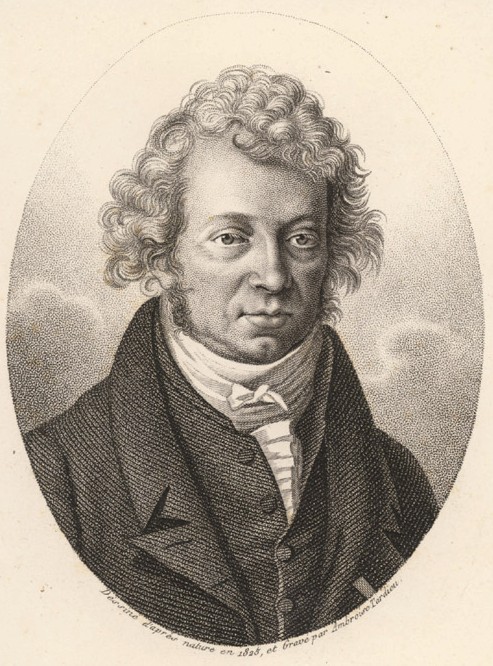
André-Marie Ampère (UK: /ˈæmpɛər/, US: /ˈæmpɪər/; French: [ɑ̃dʁe maʁi ɑ̃pɛʁ]; 20 January 1775 – 10 June 1836) was a French physicist and mathematician who was one of the founders of the science of classical electromagnetism, which he referred to as electrodynamics. He is also the inventor of numerous applications, such as the solenoid (a term coined by him) and the electrical telegraph. As an autodidact, Ampère was a member of the French Academy of Sciences and professor at the École polytechnique and the Collège de France.
The SI unit of electric current, the ampere (A), is named after him. His name is also one of the 72 names inscribed on the Eiffel Tower. The term kinematic is the English version of his cinématique, which he constructed from the Greek κίνημα kinema ("movement, motion"), itself derived from κινεῖν kinein ("to move").
André-Marie Ampère was born on 20 January 1775 in Lyon to Jean-Jacques Ampère, a prosperous businessman, and Jeanne Antoinette Desutières-Sarcey Ampère, during the height of the French Enlightenment. He spent his childhood and adolescence at the family property at Poleymieux-au-Mont-d'Or near Lyon. Jean-Jacques Ampère, a successful merchant, was an admirer of the philosophy of Jean-Jacques Rousseau, whose theories of education (as outlined in his treatise Émile) were the basis of Ampère's education. Rousseau believed that young boys should avoid formal schooling and pursue instead a "direct education from nature." Ampère's father actualized this ideal by allowing his son to educate himself within the walls of his well-stocked library. French Enlightenment masterpieces such as Georges-Louis Leclerc, comte de Buffon's Histoire naturelle, générale et particulière (begun in 1749) and Denis Diderot and Jean le Rond d'Alembert's Encyclopédie (volumes added between 1751 and 1772) thus became Ampère's schoolmasters.[citation needed] The young Ampère, however, soon resumed his Latin lessons, which enabled him to master the works of Leonhard Euler and Daniel Bernoulli.
In addition, Ampère used his access to the latest books to begin teaching himself advanced mathematics at age 12. In later life Ampère claimed that he knew as much about mathematics and science when he was eighteen as ever he knew, but as a polymath, his reading embraced history, travels, poetry, philosophy, and the natural sciences. His mother was a devout Catholic, so Ampère was also initiated into the Catholic faith along with Enlightenment science. The French Revolution (1789–99) that began during his youth was also influential: Ampère's father was called into public service by the new revolutionary government, becoming a local judge (juge de paix) in a small town near Lyon. When the Jacobin faction seized control of the Revolutionary government in 1792, his father Jean-Jacques Ampère resisted the new political tides, and he was guillotined on 24 November 1793, as part of the Jacobin purges of the period.
In 1796, Ampère met Julie Carron and, in 1799, they were married. Ampère took his first regular job in 1799 as a mathematics teacher, which gave him the financial security to marry Carron and father his first child, Jean-Jacques (named after his father), the next year. (Jean-Jacques Ampère eventually achieved his own fame as a scholar of languages.) Ampère's maturation corresponded with the transition to the Napoleonic regime in France, and the young father and teacher found new opportunities for success within the technocratic structures favoured by the new French First Consul. In 1802, Ampère was appointed a professor of physics and chemistry at the École Centrale in Bourg-en-Bresse, leaving his ailing wife and infant son in Lyon. He used his time in Bourg to research mathematics, producing Considérations sur la théorie mathématique du jeu (1802; "Considerations on the Mathematical Theory of Games"), a treatise on mathematical probability that he sent to the Paris Academy of Sciences in 1803.
After the death of his wife in July 1803, Ampère moved to Paris, where he began a tutoring post at the new École Polytechnique in 1804. Despite his lack of formal qualifications, Ampère was appointed a professor of mathematics at the school in 1809. As well as holding positions at this school until 1828, in 1819 and 1820 Ampère offered courses in philosophy and astronomy, respectively, at the University of Paris, and in 1824 he was elected to the prestigious chair in experimental physics at the Collège de France. In 1814, Ampère was invited to join the class of mathematicians in the new Institut Impérial, the umbrella under which the reformed state Academy of Sciences would sit.
Ampère engaged in a diverse array of scientific inquiries during the years leading up to his election to the academy—writing papers and engaging in topics from mathematics and philosophy to chemistry and astronomy, which was customary among the leading scientific intellectuals of the day. Ampère claimed that "at eighteen years he found three culminating points in his life, his First Communion, the reading of Antoine Leonard Thomas's "Eulogy of Descartes", and the Taking of the Bastille. On the day of his wife's death he wrote two verses from the Psalms, and the prayer, 'O Lord, God of Mercy, unite me in Heaven with those whom you have permitted me to love on earth.' In times of duress he would take refuge in the reading of the Bible and the Fathers of the Church."
A lay Catholic, he took for a time into his family the young student Frédéric Ozanam (1813–1853), one of the founders of the Conference of Charity, later known as the Society of Saint Vincent de Paul. Ozanam would much later be beatified by Pope John Paul II in 1998. Through Ampère, Ozanam had contact with leaders of the neo-Catholic movement, such as François-René de Chateaubriand, Jean-Baptiste Henri Lacordaire, and Charles Forbes René de Montalembert.
Hub AI
André-Marie Ampère AI simulator
(@André-Marie Ampère_simulator)
André-Marie Ampère
André-Marie Ampère (UK: /ˈæmpɛər/, US: /ˈæmpɪər/; French: [ɑ̃dʁe maʁi ɑ̃pɛʁ]; 20 January 1775 – 10 June 1836) was a French physicist and mathematician who was one of the founders of the science of classical electromagnetism, which he referred to as electrodynamics. He is also the inventor of numerous applications, such as the solenoid (a term coined by him) and the electrical telegraph. As an autodidact, Ampère was a member of the French Academy of Sciences and professor at the École polytechnique and the Collège de France.
The SI unit of electric current, the ampere (A), is named after him. His name is also one of the 72 names inscribed on the Eiffel Tower. The term kinematic is the English version of his cinématique, which he constructed from the Greek κίνημα kinema ("movement, motion"), itself derived from κινεῖν kinein ("to move").
André-Marie Ampère was born on 20 January 1775 in Lyon to Jean-Jacques Ampère, a prosperous businessman, and Jeanne Antoinette Desutières-Sarcey Ampère, during the height of the French Enlightenment. He spent his childhood and adolescence at the family property at Poleymieux-au-Mont-d'Or near Lyon. Jean-Jacques Ampère, a successful merchant, was an admirer of the philosophy of Jean-Jacques Rousseau, whose theories of education (as outlined in his treatise Émile) were the basis of Ampère's education. Rousseau believed that young boys should avoid formal schooling and pursue instead a "direct education from nature." Ampère's father actualized this ideal by allowing his son to educate himself within the walls of his well-stocked library. French Enlightenment masterpieces such as Georges-Louis Leclerc, comte de Buffon's Histoire naturelle, générale et particulière (begun in 1749) and Denis Diderot and Jean le Rond d'Alembert's Encyclopédie (volumes added between 1751 and 1772) thus became Ampère's schoolmasters.[citation needed] The young Ampère, however, soon resumed his Latin lessons, which enabled him to master the works of Leonhard Euler and Daniel Bernoulli.
In addition, Ampère used his access to the latest books to begin teaching himself advanced mathematics at age 12. In later life Ampère claimed that he knew as much about mathematics and science when he was eighteen as ever he knew, but as a polymath, his reading embraced history, travels, poetry, philosophy, and the natural sciences. His mother was a devout Catholic, so Ampère was also initiated into the Catholic faith along with Enlightenment science. The French Revolution (1789–99) that began during his youth was also influential: Ampère's father was called into public service by the new revolutionary government, becoming a local judge (juge de paix) in a small town near Lyon. When the Jacobin faction seized control of the Revolutionary government in 1792, his father Jean-Jacques Ampère resisted the new political tides, and he was guillotined on 24 November 1793, as part of the Jacobin purges of the period.
In 1796, Ampère met Julie Carron and, in 1799, they were married. Ampère took his first regular job in 1799 as a mathematics teacher, which gave him the financial security to marry Carron and father his first child, Jean-Jacques (named after his father), the next year. (Jean-Jacques Ampère eventually achieved his own fame as a scholar of languages.) Ampère's maturation corresponded with the transition to the Napoleonic regime in France, and the young father and teacher found new opportunities for success within the technocratic structures favoured by the new French First Consul. In 1802, Ampère was appointed a professor of physics and chemistry at the École Centrale in Bourg-en-Bresse, leaving his ailing wife and infant son in Lyon. He used his time in Bourg to research mathematics, producing Considérations sur la théorie mathématique du jeu (1802; "Considerations on the Mathematical Theory of Games"), a treatise on mathematical probability that he sent to the Paris Academy of Sciences in 1803.
After the death of his wife in July 1803, Ampère moved to Paris, where he began a tutoring post at the new École Polytechnique in 1804. Despite his lack of formal qualifications, Ampère was appointed a professor of mathematics at the school in 1809. As well as holding positions at this school until 1828, in 1819 and 1820 Ampère offered courses in philosophy and astronomy, respectively, at the University of Paris, and in 1824 he was elected to the prestigious chair in experimental physics at the Collège de France. In 1814, Ampère was invited to join the class of mathematicians in the new Institut Impérial, the umbrella under which the reformed state Academy of Sciences would sit.
Ampère engaged in a diverse array of scientific inquiries during the years leading up to his election to the academy—writing papers and engaging in topics from mathematics and philosophy to chemistry and astronomy, which was customary among the leading scientific intellectuals of the day. Ampère claimed that "at eighteen years he found three culminating points in his life, his First Communion, the reading of Antoine Leonard Thomas's "Eulogy of Descartes", and the Taking of the Bastille. On the day of his wife's death he wrote two verses from the Psalms, and the prayer, 'O Lord, God of Mercy, unite me in Heaven with those whom you have permitted me to love on earth.' In times of duress he would take refuge in the reading of the Bible and the Fathers of the Church."
A lay Catholic, he took for a time into his family the young student Frédéric Ozanam (1813–1853), one of the founders of the Conference of Charity, later known as the Society of Saint Vincent de Paul. Ozanam would much later be beatified by Pope John Paul II in 1998. Through Ampère, Ozanam had contact with leaders of the neo-Catholic movement, such as François-René de Chateaubriand, Jean-Baptiste Henri Lacordaire, and Charles Forbes René de Montalembert.
Recent media