



Community hub
Recent from talks
Contribute something
Nothing was collected or created yet.
Water of crystallization
View on WikipediaIn chemistry, water(s) of crystallization or water(s) of hydration are water molecules that are present inside crystals. Water is often incorporated in the formation of crystals from aqueous solutions.[1] In some contexts, water of crystallization is the total mass of water in a substance at a given temperature and is mostly present in a definite (stoichiometric) ratio. Classically, "water of crystallization" refers to water that is found in the crystalline framework of a metal complex or a salt, which is not directly bonded to the metal cation.
Upon crystallization from water, or water-containing solvents, many compounds incorporate water molecules in their crystalline frameworks. Water of crystallization can generally be removed by heating a sample but the crystalline properties are often lost.
Compared to inorganic salts, proteins crystallize with large amounts of water in the crystal lattice. A water content of 50% is not uncommon for proteins.
Applications
[edit]Knowledge of hydration is essential for calculating the masses for many compounds. The reactivity of many salt-like solids is sensitive to the presence of water. The hydration and dehydration of salts is central to the use of phase-change materials for energy storage.[2]
Position in the crystal structure
[edit]
A salt with associated water of crystallization is known as a hydrate. The structure of hydrates can be quite elaborate, because of the existence of hydrogen bonds that define polymeric structures.[3] [4] Historically, the structures of many hydrates were unknown, and the dot in the formula of a hydrate was employed to specify the composition without indicating how the water is bound. Per IUPAC's recommendations, the middle dot is not surrounded by spaces when indicating a chemical adduct.[5] Examples:
- CuSO4·5H2O – copper(II) sulfate pentahydrate
- CoCl2·6H2O – cobalt(II) chloride hexahydrate
- SnCl2·2H2O – tin(II) (or stannous) chloride dihydrate
For many salts, the exact bonding of the water is unimportant because the water molecules are made labile upon dissolution. For example, an aqueous solution prepared from CuSO4·5H2O and anhydrous CuSO4 behave identically. Therefore, knowledge of the degree of hydration is important only for determining the equivalent weight: one mole of CuSO4·5H2O weighs more than one mole of CuSO4. In some cases, the degree of hydration can be critical to the resulting chemical properties. For example, anhydrous RhCl3 is not soluble in water and is relatively useless in organometallic chemistry whereas RhCl3·3H2O is versatile. Similarly, hydrated AlCl3 is a poor Lewis acid and thus inactive as a catalyst for Friedel-Crafts reactions. Samples of AlCl3 must therefore be protected from atmospheric moisture to preclude the formation of hydrates.

Crystals of hydrated copper(II) sulfate consist of [Cu(H2O)4]2+ centers linked to SO2−4 ions. Copper is surrounded by six oxygen atoms, provided by two different sulfate groups and four molecules of water. A fifth water resides elsewhere in the framework but does not bind directly to copper.[6] The cobalt chloride mentioned above occurs as [Co(H2O)6]2+ and Cl−. In tin chloride, each Sn(II) center is pyramidal (mean O/Cl−Sn−O/Cl angle is 83°) being bound to two chloride ions and one water. The second water in the formula unit is hydrogen-bonded to the chloride and to the coordinated water molecule. Water of crystallization is stabilized by electrostatic attractions, consequently hydrates are common for salts that contain +2 and +3 cations as well as −2 anions. In some cases, the majority of the weight of a compound arises from water. Glauber's salt, Na2SO4(H2O)10, is a white crystalline solid with greater than 50% water by weight.
Consider the case of nickel(II) chloride hexahydrate. This species has the formula NiCl2(H2O)6. Crystallographic analysis reveals that the solid consists of [trans-NiCl2(H2O)4] subunits that are hydrogen bonded to each other as well as two additional molecules of H2O. Thus one third of the water molecules in the crystal are not directly bonded to Ni2+, and these might be termed "water of crystallization".
Analysis
[edit]The water content of most compounds can be determined with a knowledge of its formula. An unknown sample can be determined through thermogravimetric analysis (TGA) where the sample is heated strongly, and the accurate weight of a sample is plotted against the temperature. The amount of water driven off is then divided by the molar mass of water to obtain the number of molecules of water bound to the salt.
Other solvents of crystallization
[edit]Water is particularly common solvent to be found in crystals because it is small and polar. But all solvents can be found in some host crystals. Water is noteworthy because it is reactive, whereas other solvents such as benzene are considered to be chemically innocuous. Occasionally more than one solvent is found in a crystal, and often the stoichiometry is variable, reflected in the crystallographic concept of "partial occupancy". It is common and conventional for a chemist to "dry" a sample with a combination of vacuum and heat "to constant weight".
For other solvents of crystallization, analysis is conveniently accomplished by dissolving the sample in a deuterated solvent and analyzing the sample for solvent signals by NMR spectroscopy. Single crystal X-ray crystallography is often able to detect the presence of these solvents of crystallization as well. Other methods may be currently available.
Table of crystallization water in some inorganic halides
[edit]In the table below are indicated the number of molecules of water per metal in various salts.[7][8]
| Hydrated metal halides and their formulas |
Coordination sphere of the metal |
Equivalents of water of crystallization that are not bound to M |
Remarks |
|---|---|---|---|
| Calcium chloride CaCl2(H2O)6 |
[Ca(μ-H2O)6(H2O)3]2+ | none | example of water as a bridging ligand[9] |
| Titanium(III) chloride TiCl3(H2O)6 |
trans-[TiCl2(H2O)4]+[10] | two | isomorphous with VCl3(H2O)6 |
| Titanium(III) chloride TiCl3(H2O)6 |
[Ti(H2O)6]3+[10] | none | isomeric with [TiCl2(H2O)4]Cl.2H2O[11] |
| Zirconium(IV) fluoride ZrF4(H2O)3 |
(μ−F)2[ZrF3(H2O)3]2 | none | rare case where Hf and Zr differ[12] |
| Hafnium tetrafluoride HfF4(H2O)3 |
(μ−F)2[HfF2(H2O)2]n(H2O)n | one | rare case where Hf and Zr differ[12] |
| Vanadium(III) chloride VCl3(H2O)6 |
trans-[VCl2(H2O)4]+[10] | two | |
| Vanadium(III) bromide VBr3(H2O)6 |
trans-[VBr2(H2O)4]+[10] | two | |
| Vanadium(III) iodide VI3(H2O)6 |
[V(H2O)6]3+ | none | relative to Cl− and Br−, I− competes poorly with water as a ligand for V(III) |
| Nb6Cl14(H2O)8 | [Nb6Cl14(H2O)2] | four | |
| Chromium(III) chloride CrCl3(H2O)6 |
trans-[CrCl2(H2O)4]+ | two | dark green isomer, aka "Bjerrums's salt" |
| Chromium(III) chloride CrCl3(H2O)6 |
[CrCl(H2O)5]2+ | one | blue-green isomer |
| Chromium(II) chloride CrCl2(H2O)4 |
trans-[CrCl2(H2O)4] | none | square planar/tetragonal distortion |
| Chromium(III) chloride CrCl3(H2O)6 |
[Cr(H2O)6]3+ | none | violet isomer. isostructural with aluminium compound[13] |
| Manganese(II) chloride MnCl2(H2O)6 |
trans-[MnCl2(H2O)4] | two | |
| Manganese(II) chloride MnCl2(H2O)4 |
cis-[MnCl2(H2O)4] | none | cis molecular, the unstable trans isomer has also been detected[14] |
| Manganese(II) bromide MnBr2(H2O)4 |
cis-[MnBr2(H2O)4] | none | cis, molecular |
| Manganese(II) iodide MnI2(H2O)4 |
trans-[MnI2(H2O)4] | none | molecular, isostructural with FeCl2(H2O)4.[15] |
| Manganese(II) chloride MnCl2(H2O)2 |
trans-[MnCl4(H2O)2] | none | polymeric with bridging chloride |
| Manganese(II) bromide MnBr2(H2O)2 |
trans-[MnBr4(H2O)2] | none | polymeric with bridging bromide |
| Rhenium(III) chloride Re3Cl9(H2O)4 |
triangulo-[Re3Cl9(H2O)3] | none | heavy early metals form M-M bonds[16] |
| Iron(II) chloride FeCl2(H2O)6 |
trans-[FeCl2(H2O)4] | two | |
| Iron(II) chloride FeCl2(H2O)4 |
trans-[FeCl2(H2O)4] | none | molecular |
| Iron(II) bromide FeBr2(H2O)4 |
trans-[FeBr2(H2O)4] | none | molecular,[17] hydrates of FeI2 are not known |
| Iron(II) chloride FeCl2(H2O)2 |
trans-[FeCl4(H2O)2] | none | polymeric with bridging chloride |
| Iron(III) chloride FeCl3(H2O)6 |
trans-[FeCl2(H2O)4]+ | two | one of four hydrates of ferric chloride,[18] isostructural with Cr analogue |
| Iron(III) chloride FeCl3(H2O)2.5 |
cis-[FeCl2(H2O)4]+ | two | the dihydrate has a similar structure, both contain FeCl−4 anions.[18] |
| Cobalt(II) chloride CoCl2(H2O)6 |
trans-[CoCl2(H2O)4] | two | |
| Cobalt(II) bromide CoBr2(H2O)6 |
trans-[CoBr2(H2O)4] | two | |
| Cobalt(II) iodide CoI2(H2O)6 |
[Co(H2O)6]2+ | none[19] | iodide competes poorly with water |
| Cobalt(II) bromide CoBr2(H2O)4 |
trans-[CoBr2(H2O)4] | none | molecular[17] |
| Cobalt(II) chloride CoCl2(H2O)4 |
cis-[CoCl2(H2O)4] | none | note: cis molecular |
| Cobalt(II) chloride CoCl2(H2O)2 |
trans-[CoCl4(H2O)2] | none | polymeric with bridging chloride |
| Cobalt(II) bromide CoBr2(H2O)2 |
trans-[CoBr4(H2O)2] | none | polymeric with bridging bromide |
| Nickel(II) chloride NiCl2(H2O)6 |
trans-[NiCl2(H2O)4] | two | |
| Nickel(II) chloride NiCl2(H2O)4 |
cis-[NiCl2(H2O)4] | none | note: cis molecular[17] |
| Nickel(II) bromide NiBr2(H2O)6 |
trans-[NiBr2(H2O)4] | two | |
| Nickel(II) iodide NiI2(H2O)6 |
[Ni(H2O)6]2+ | none[19] | iodide competes poorly with water |
| Nickel(II) chloride NiCl2(H2O)2 |
trans-[NiCl4(H2O)2] | none | polymeric with bridging chloride |
| Platinum(IV) chloride [Pt(H2O)2Cl4](H2O)3[20] |
trans-[PtCl4(H2O)2] | 3 | octahedral Pt centers; rare example of non-first row chloride-aquo complex |
| Platinum(IV) chloride [Pt(H2O)3Cl3]Cl(H2O)0.5[21] |
fac-[PtCl3(H2O)3]+ | 0.5 | octahedral Pt centers; rare example of non-first row chloride-aquo complex |
| Copper(II) chloride CuCl2(H2O)2 |
[CuCl4(H2O)2]2 | none | tetragonally distorted two long Cu-Cl distances |
| Copper(II) bromide CuBr2(H2O)4 |
[CuBr4(H2O)2]n | two | tetragonally distorted two long Cu-Br distances[17] |
| Zinc(II) chloride ZnCl2(H2O)1.33[22] |
2 ZnCl2 + ZnCl2(H2O)4 | none | coordination polymer with both tetrahedral and octahedral Zn centers |
| Zinc(II) chloride ZnCl2(H2O)2.5[23] |
Cl3Zn(μ-Cl)Zn(H2O)5 | none | tetrahedral and octahedral Zn centers |
| Zinc(II) chloride ZnCl2(H2O)3[22] |
[ZnCl4]2− & [Zn(H2O)6]2+ | none | tetrahedral and octahedral Zn centers |
| Zinc(II) chloride ZnCl2(H2O)4.5[22] |
[ZnCl4]2− & [Zn(H2O)6]2+ | three | tetrahedral and octahedral Zn centers |
| Cadmium chloride CdCl2·H2O[24] |
none | water of crystallization is rare for heavy metal halides | |
| Cadmium chloride CdCl2·2.5H2O[25] |
CdCl5(H2O) & CdCl4(H2O)2 | none | |
| Cadmium chloride CdCl2·4H2O[26] |
none | octahedral | |
| Cadmium bromide CdBr2(H2O)4[27] |
[CdBr4(H2O)2 | two | octahedral Cd centers |
| Aluminum trichloride AlCl3(H2O)6 |
[Al(H2O)6]3+ | none | isostructural with the Cr(III) compound |
Examples are rare for second and third row metals. No entries exist for Mo, W, Tc, Ru, Os, Rh, Ir, Pd, Hg, Au. AuCl3(H2O) has been invoked but its crystal structure has not been reported.
Hydrates of metal sulfates
[edit]Transition metal sulfates form a variety of hydrates, each of which crystallizes in only one form. The sulfate group often binds to the metal, especially for those salts with fewer than six aquo ligands. The heptahydrates, which are often the most common salts, crystallize as monoclinic and the less common orthorhombic forms. In the heptahydrates, one water is in the lattice and the other six are coordinated to the ferrous center.[28] Many of the metal sulfates occur in nature, being the result of weathering of mineral sulfides.[29][30] Many monohydrates are known.[31]
| Formula of hydrated metal ion sulfate |
Coordination sphere of the metal ion |
Equivalents of water of crystallization that are not bound to M |
mineral name | Remarks |
|---|---|---|---|---|
| MgSO4(H2O) | [Mn(μ-H2O)(μ4,-κ1-SO4)4][31] | none | kieserite | see Mn, Fe, Co, Ni, Zn analogues
 |
| MgSO4(H2O)4 | [Mg(H2O)4(κ′,κ1-SO4)]2 | none | sulfate is bridging ligand, 8-membered Mg2O4S2 rings[32] | |
| MgSO4(H2O)6 | [Mg(H2O)6] | none | hexahydrate | common motif[29] |
| MgSO4(H2O)7 | [Mg(H2O)6] | one | epsomite | common motif[29] |
| TiOSO4(H2O) | [Ti(μ-O)2(H2O)(κ1-SO4)3] | none | further hydration gives gels | |
| VSO4(H2O)6 | [V(H2O)6] | none | Adopts the hexahydrite motif[33] | |
| VSO4(H2O)7 | [V(H2O)6] | one | hexaaquo[34] | |
| VOSO4(H2O)5 | [VO(H2O)4(κ1-SO4)4] | one | ||
| Cr(SO4)(H2O)3 | [Cr(H2O)3(κ1-SO4)] | none | resembles Cu(SO4)(H2O)3[35] | |
| Cr(SO4)(H2O)5 | [Cr(H2O)4(κ1-SO4)2] | one | resembles Cu(SO4)(H2O)5[36] | |
| Cr2(SO4)3(H2O)18 | [Cr(H2O)6] | six | One of several chromium(III) sulfates | |
| MnSO4(H2O) | [Mn(μ-H2O)(μ4,-κ1-SO4)4][31] | none | szmikite | see Fe, Co, Ni, Zn analogues |
| MnSO4(H2O)4 | [Mn(μ-SO4)2(H2O)4][37] | none | Ilesitepentahydrate is called jôkokuite; the hexahydrate, the most rare, is called chvaleticeite | with 8-membered ring Mn2(SO4)2 core |
| MnSO4(H2O)5 | ? | jôkokuite | ||
| MnSO4(H2O)6 | ? | Chvaleticeite | ||
| MnSO4(H2O)7 | [Mn(H2O)6] | one | mallardite[30] | see Mg analogue |
| FeSO4(H2O) | [Fe(μ-H2O)(μ4-κ1-SO4)4][31] | none | see Mn, Co, Ni, Zn analogues | |
| FeSO4(H2O)7 | [Fe(H2O)6] | one | melanterite[30] | see Mg analogue |
| FeSO4(H2O)4 | [Fe(H2O)4(κ′,κ1-SO4)]2 | none | sulfate is bridging ligand, 8-membered Fe2O4S2 rings[32] | |
| FeII(FeIII)2(SO4)4(H2O)14 | [FeII(H2O)6]2+[FeIII(H2O)4(κ1-SO4)2]− 2 |
none | sulfates are terminal ligands on Fe(III)[38] | |
| CoSO4(H2O) | [Co(μ-H2O)(μ4-κ1-SO4)4][31] | none | see Mn, Fe, Ni, Zn analogues | |
| CoSO4(H2O)6 | [Co(H2O)6] | none | moorhouseite | see Mg analogue |
| CoSO4(H2O)7 | [Co(H2O)6] | one | bieberite[30] | see Fe, Mg analogues |
| NiSO4(H2O) | [Ni(μ-H2O)(μ4-κ1-SO4)4][31] | none | see Mn, Fe, Co, Zn analogues | |
| NiSO4(H2O)6 | [Ni(H2O)6] | none | retgersite | One of several nickel sulfate hydrates[39] |
| NiSO4(H2O)7 | [Ni(H2O)6] | morenosite[30] | ||
| (NH4)2[Pt2(SO4)4(H2O)2] | [Pt2(SO4)4(H2O)2]2− | none | Pt-Pt bonded Chinese lantern structure[40] | |
| CuSO4(H2O)5 | [Cu(H2O)4(κ1-SO4)2] | one | chalcantite | sulfate is bridging ligand[41] |
| CuSO4(H2O)7 | [Cu(H2O)6] | one | boothite[30] | |
| ZnSO4(H2O) | [Zn(μ-H2O)(μ4-κ1-SO4)4][31] | none | see Mn, Fe, Co, Ni analogues | |
| ZnSO4(H2O)4 | [Zn(H2O)4(κ′,κ1-SO4)]2 | none | sulfate is bridging ligand, 8-membered Zn2O4S2 rings[32][42] | |
| ZnSO4(H2O)6 | [Zn(H2O)6] | none | see Mg analogue[43] | |
| ZnSO4(H2O)7 | [Zn(H2O)6] | one | goslarite[30] | see Mg analogue |
| CdSO4(H2O) | [Cd(μ-H2O)2(κ1-SO4)4] | none | bridging water ligand[44] |
Hydrates of metal nitrates
[edit]Transition metal nitrates form a variety of hydrates. The nitrate anion often binds to the metal, especially for those salts with fewer than six aquo ligands. Nitrates are uncommon in nature, so few minerals are represented here. Hydrated ferrous nitrate has not been characterized crystallographically.
| Formula of hydrated metal ion nitrate |
Coordination sphere of the metal ion |
Equivalents of water of crystallization that are not bound to M |
Remarks |
|---|---|---|---|
| Cr(NO3)3(H2O)9 | [Cr(H2O)6]3+ | three | octahedral configuration[45] isostructural with Fe(NO3)3(H2O)9 |
| Mn(NO3)2(H2O)4 | cis-[Mn(H2O)4(κ1-ONO2)2] | none | octahedral configuration |
| Mn(NO3)2(H2O) | [Mn(H2O)(μ-ONO2)5] | none | octahedral configuration |
| Mn(NO3)2(H2O)6 | [Mn(H2O)6] | none | octahedral configuration[46] |
| Fe(NO3)3(H2O)9 | [Fe(H2O)6]3+ | three | octahedral configuration[47] isostructural with Cr(NO3)3(H2O)9 |
| Fe(NO3)3)(H2O)4 | [Fe(H2O)3(κ2-O2NO)2]+ | one | pentagonal bipyramid[48] |
| Fe(NO3)3(H2O)5 | [Fe(H2O)5(κ1-ONO2)]2+ | none | octahedral configuration[48] |
| Fe(NO3)3(H2O)6 | [Fe(H2O)6]3+ | none | octahedral configuration[48] |
| Co(NO3)2(H2O)2 | [Co(H2O)2(κ1-ONO2)2] | none | octahedral configuration |
| Co(NO3)2(H2O)4 | [Co(H2O)4(κ1-ONO2)2 | none | octahedral configuration |
| Co(NO3)2(H2O)6 | [Co(H2O)6]2+ | none | octahedral configuration.[49] |
| α-Ni(NO3)2(H2O)4 | cis-[Ni(H2O)4(κ1-ONO2)2] | none | octahedral configuration.[50] |
| β-Ni(NO3)2(H2O)4 | trans-[Ni(H2O)4(κ1-ONO2)2] | none | octahedral configuration.[51] |
| Pd(NO3)2(H2O)2 | trans-[Pd(H2O)2(κ1-ONO2)2] | none | square planar coordination geometry[52] |
| Cu(NO3)2(H2O) | [Cu(H2O)(κ2-ONO2)2] | none | octahedral configuration. |
| Cu(NO3)2(H2O)1.5 | uncertain | uncertain | uncertain[53] |
| Cu(NO3)2(H2O)2.5 | [Cu(H2O)2(κ1-ONO2)2] | one | square planar[54] |
| Cu(NO3)2(H2O)3 | uncertain | uncertain | uncertain[55] |
| Cu(NO3)2(H2O)6 | [Cu(H2O)6]2+ | none | octahedral configuration[56] |
| Zn(NO3)2(H2O)4 | cis-[Zn(H2O)4(κ1-ONO2)2] | none | octahedral configuration. |
| Hg2(NO3)2(H2O)2 | [H2O–Hg–Hg–OH2]2+ | linear[57] |
Gallery
[edit]-
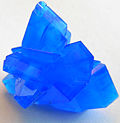 Hydrated copper(II) sulfate is bright blue.
 -
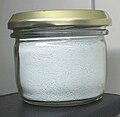 Anhydrous copper(II) sulfate has a light turquoise tint.


See also
[edit]References
[edit]- ^ Greenwood, Norman N.; Earnshaw, Alan (1997). Chemistry of the Elements (2nd ed.). Butterworth-Heinemann. doi:10.1016/C2009-0-30414-6. ISBN 978-0-08-037941-8.
- ^ Sharma, Atul; Tyagi, V.V.; Chen, C.R.; Buddhi, D. (2009). "Review on thermal energy storage with phase change materials and applications". Renewable and Sustainable Energy Reviews. 13 (2): 318–345. Bibcode:2009RSERv..13..318S. doi:10.1016/j.rser.2007.10.005.
- ^ Wang, Yonghui; Feng, Liyun; Li, Yangguang; Hu, Changwen; Wang, Enbo; Hu, Ninghai; Jia, Hengqing (2002). "Novel Hydrogen-Bonded Three-Dimensional Networks Encapsulating One-Dimensional Covalent Chains: [M(4,4′-bipy)(H2O)4](4-abs)2·nH2O (4,4′-bipy = 4,4′-Bipyridine; 4-abs = 4-Aminobenzenesulfonate) (M = Co, n = 1; M = Mn, n = 2)". Inorganic Chemistry. 41 (24): 6351–6357. doi:10.1021/ic025915o. PMID 12444778.
- ^ Maldonado, Carmen R.; Quirós, Miguel; Salas, J.M. (2010). "Formation of 2D water morphologies in the lattice of the salt with [Cu2(OH)2(H2O)2(phen)2]2+ as cation and 4,6-dimethyl-1,2,3-triazolo[4,5-d]pyrimidin-5,7-dionato as anion". Inorganic Chemistry Communications. 13 (3): 399–403. doi:10.1016/j.inoche.2009.12.033.
- ^ Connelly, Neil G.; Damhus, Ture; Hartshorn, Richard M.; Hutton, Alan T. (2005). Nomenclature of Inorganic Chemistry, IUPAC Recommendations 2005 (the "Red Book") (PDF). Royal Society of Chemistry. p. 56. ISBN 0-85404-438-8. Retrieved 10 January 2023.
- ^ Moeller, Therald (Jan 1, 1980). Chemistry: With Inorganic qualitative Analysis. Academic Press Inc (London) Ltd. p. 909. ISBN 978-0-12-503350-3. Retrieved 15 June 2014.
- ^ K. Waizumi; H. Masuda; H. Ohtaki (1992). "X-Ray Structural Studies of FeBr2·4H2O, CoBr2·4H2O, NiCl2·4H2O, and CuBr2·4H2O. cis/trans Selectivity in Transition Metal(II) Dihalide Tetrahydrate". Inorganica Chimica Acta. 192 (2): 173–181. doi:10.1016/S0020-1693(00)80756-2.
- ^ B. Morosin (1967). "An X-ray Diffraction Study on Nickel(II) Chloride Dihydrate". Acta Crystallographica. 23 (4): 630–634. Bibcode:1967AcCry..23..630M. doi:10.1107/S0365110X67003305.
- ^ Agron, P. A.; Busing, W. R. (1986). "Calcium and Strontium Dichloride Hexahydrates by Neutron Diffraction". Acta Crystallographica Section C. 42 (2): 14. Bibcode:1986AcCrC..42..141A. doi:10.1107/S0108270186097007. S2CID 97718377.
- ^ a b c d Donovan, William F.; Smith, Peter W. (1975). "Crystal and Molecular Structures of Aquahalogenovanadium(III) Complexes. Part I. X-Ray Crystal Structure of trans-Tetrakisaquadibromo-Vanadium(III) Bromide Dihydrate and the Isomorphous Chloro- Compound". Journal of the Chemical Society, Dalton Transactions (10): 894. doi:10.1039/DT9750000894.
- ^ Greenwood, Norman N.; Earnshaw, Alan (1997). Chemistry of the Elements (2nd ed.). Butterworth-Heinemann. p. 965. doi:10.1016/C2009-0-30414-6. ISBN 978-0-08-037941-8.
- ^ a b Greenwood, Norman N.; Earnshaw, Alan (1997). Chemistry of the Elements (2nd ed.). Butterworth-Heinemann. p. 965. doi:10.1016/C2009-0-30414-6. ISBN 978-0-08-037941-8.
- ^ Andress, K. R.; Carpenter, C. (1934). "Die Struktur von Chromchlorid- und Aluminiumchloridhexahydrat". Zeitschrift für Kristallographie, Kristallgeometrie, Kristallphysik, Kristallchemie. 87: 446–463.
- ^ Zalkin, Allan; Forrester, J. D.; Templeton, David H. (1964). "Crystal Structure of Manganese Dichloride Tetrahydrate". Inorganic Chemistry. 3 (4): 529–533. doi:10.1021/ic50014a017.
- ^ Moore, J. E.; Abola, J. E.; Butera, R. A. (1985). "Structure of Manganese(II) Iodide Tetrahydrate, MnI2·4H2O". Acta Crystallographica Section C. 41 (9): 1284–1286. Bibcode:1985AcCrC..41.1284M. doi:10.1107/S0108270185007466.
- ^ Irmler, Manfred; Meyer, Gerd (1987). "Rhenium trichloride, ReCl3, and its 5/3-hydrate synthesis, crystal structure, and thermal expansion". Zeitschrift für Anorganische und Allgemeine Chemie. 552 (9): 81–89. Bibcode:1987ZAACh.552...81I. doi:10.1002/zaac.19875520908.
- ^ a b c d Waizumi, Kenji; Masuda, Hideki; Ohtaki, Hitoshi (1992). "X-ray Structural Studies of FeBr2·4H2O, CoBr2·4H2O, NiCl2·4H2O and CuBr2·4H2O. cis/trans Selectivity in Transition Metal(II) Dihalide Tetrahydrate". Inorganica Chimica Acta. 192 (2): 173–181. doi:10.1016/S0020-1693(00)80756-2.
- ^ a b Simon A. Cotton (2018). "Iron(III) Chloride and Its Coordination Chemistry". Journal of Coordination Chemistry. 71 (21): 3415–3443. doi:10.1080/00958972.2018.1519188. S2CID 105925459.
- ^ a b Louër, Michele; Grandjean, Daniel; Weigel, Dominique (1973). "Structure Cristalline et Expansion Thermique de l'Iodure de Nickel Hexahydrate" (Crystal structure and thermal expansion of nickel(II) iodide hexahydrate)". Journal of Solid State Chemistry. 7: 222–228. doi:10.1016/0022-4596(73)90157-6.
- ^ Rau, F.; Klement, U.; Range, K. -J. (1995). "Crystal Structure of trans-Diaquatetrachloroplatinum(IV) trihydrate, Pt(H2O)2Cl4(H2O)3". Zeitschrift für Kristallographie - Crystalline Materials. 210 (8): 606. Bibcode:1995ZK....210..606R. doi:10.1524/zkri.1995.210.8.606.
- ^ Rau, F.; Klement, U.; Range, K. -J. (1995). "Crystal Structure of fac-Triaquatrichloroplatinum(IV) Chloride Hemihydrate, (Pt(H2O)3Cl3)Cl(H2O)0.5". Zeitschrift für Kristallographie - Crystalline Materials. 210 (8): 605. Bibcode:1995ZK....210..605R. doi:10.1524/zkri.1995.210.8.605.
- ^ a b c Follner, H.; Brehler, B. (1970). "Die Kristallstruktur des ZnCl2.11/3HO". Acta Crystallographica Section B. 26 (11): 1679–1682. Bibcode:1970AcCrB..26.1679F. doi:10.1107/S0567740870004715.
- ^ Hennings, Erik; Schmidt, Horst; Voigt, Wolfgang (2014). "Crystal Structures of ZnCl2·2.5H2O, ZnCl2·3H2O and ZnCl2·4.5H2O". Acta Crystallographica Section E. 70 (12): 515–518. Bibcode:2014AcCrE..70..515H. doi:10.1107/S1600536814024738. PMC 4257420. PMID 25552980.
- ^ H. Leligny; J. C. Monier (1974). "Structure Cristalline de CdCl2.H2O" [Crystal structure of CdCl2.H2O]. Acta Crystallographica B (in French). 30 (2): 305–309. Bibcode:1974AcCrB..30..305L. doi:10.1107/S056774087400272X.
- ^ Leligny, H.; Mornier, J. C. (1975). "Structure de CdCl2.2,5H2O". Acta Crystallographica Section B Structural Crystallography and Crystal Chemistry. 31 (3): 728–732. Bibcode:1975AcCrB..31..728L. doi:10.1107/S056774087500369X.
- ^ H. Leligny; J. C. Monier (1979). "Structure de dichlorure de cadmium tétrahydraté" [Structure of Cadmium Dichloride Tetrahydrate]. Acta Crystallographica B (in French). 35 (3): 569–573. Bibcode:1979AcCrB..35..569L. doi:10.1107/S0567740879004179.
- ^ Leligny, H.; Monier, J. C. (1978). "Structure Cristalline de CdBr2.4H2O". Acta Crystallographica Section B. 34 (1): 5–8. Bibcode:1978AcCrB..34....5L. doi:10.1107/S0567740878002186.
- ^ Baur, W. H. (1964). "On the crystal chemistry of salt hydrates. III. The determination of the crystal structure of FeSO4(H2O)7 (melanterite)". Acta Crystallographica. 17 (9): 1167–1174. Bibcode:1964AcCry..17.1167B. doi:10.1107/S0365110X64003000.
- ^ a b c Chou, I-Ming; Seal, Robert R.; Wang, Alian (2013). "The stability of sulfate and hydrated sulfate minerals near ambient conditions and their significance in environmental and planetary sciences". Journal of Asian Earth Sciences. 62: 734–758. Bibcode:2013JAESc..62..734C. doi:10.1016/j.jseaes.2012.11.027.
- ^ a b c d e f g Redhammer, G. J.; Koll, L.; Bernroider, M.; Tippelt, G.; Amthauer, G.; Roth, G. (2007). "Co2+–Cu2+ Substitution in Bieberite Solid-Solution Series, (Co1−xCuxSO4·7H2O, 0.00 ≤ x ≤ 0.46: Synthesis, Single-Crystal Structure Analysis, and Optical Spectroscopy". American Mineralogist. 92 (4): 532–545. Bibcode:2007AmMin..92..532R. doi:10.2138/am.2007.2229. S2CID 95885758.
- ^ a b c d e f g Wildner, M.; Giester, G. (1991). "The Crystal Structures of Kieserite-type Compounds. I. Crystal Structures of Me(II)SO4·H2O (Me = Mn, Fe, Co, Ni, Zn) (English translation)". Neues Jahrbuch für Mineralogie - Monatshefte: 296–306.
{{cite journal}}: CS1 maint: multiple names: authors list (link) - ^ a b c Baur, Werner H. (2002). "Zinc(II) Sulfate Tetrahydrate and Magnesium Sulfate Tetrahydrate. Addendum". Acta Crystallographica Section E. 58 (4): e9 – e10. Bibcode:2002AcCrE..58E...9B. doi:10.1107/S1600536802002192.
- ^ Cotton, F. Albert; Falvello, Larry R.; Llusar, Rosa; Libby, Eduardo; Murillo, Carlos A.; Schwotzer, Willi (1986). "Synthesis and Characterization of Four Vanadium(II) Compounds, Including Vanadium(II) Sulfate Hexahydrate and Vanadium(II) Saccharinates". Inorganic Chemistry. 25 (19): 3423–3428. doi:10.1021/ic00239a021.
- ^ Cotton, F. Albert; Falvello, Larry R.; Murillo, Carlos A.; Pascual, Isabel; Schultz, Arthur J.; Tomas, Milagros (1994). "Neutron and X-ray Structural Characterization of the Hexaaquavanadium(II) Compound VSO4.cntdot.7H2O". Inorganic Chemistry. 33 (24): 5391–5395. doi:10.1021/ic00102a009.
- ^ Dahmen, T.; Glaum, R.; Schmidt, G.; Gruehn, R. (1990). "Zur Darstellung und Kristallstruktur von CrSO4·3H2O" [Preparation and Crystal Structure of Chromium(2+) Sulfate Trihydrate]. Zeitschrift für Anorganische und Allgemeine Chemie. 586: 141–8. doi:10.1002/zaac.19905860119.
- ^ T. P. Vaalsta; E. N. Maslen (1987). "Electron density in chromium sulfate pentahydrate". Acta Crystallogr. B43 (5): 448–454. Bibcode:1987AcCrB..43..448V. doi:10.1107/S0108768187097519.
- ^ Held, Peter; Bohatý, Ladislav (2002). "Manganese(II) Sulfate Tetrahydrate (Ilesite)". Acta Crystallographica Section E. 58 (12): i121 – i123. Bibcode:2002AcCrE..58I.121H. doi:10.1107/S1600536802020962. S2CID 62599961.
- ^ L. Fanfani; A. Nunzi; P. F. Zanazzi (1970). "The Crystal Structure of Roemerite". American Mineralogist. 55: 78–89.
- ^ Stadnicka, K.; Glazer, A. M.; Koralewski, M. (1987). "Structure, absolute configuration and optical activity of α-nickel sulfate hexahydrate". Acta Crystallographica Section B. 43 (4): 319–325. Bibcode:1987AcCrB..43..319S. doi:10.1107/S0108768187097787.
- ^ Pley, Martin; Wickleder, Mathias S. (2005). "Monomers, Chains and Layers of [Pt2(SO4)4] Units in the Crystal Structures of the Platinum(III) Sulfates (NH4)2[Pt2(SO4)4(H2O)2], K4[Pt2(SO4)5] and Cs[Pt2(SO4)3(HSO4)]". European Journal of Inorganic Chemistry. 2005 (3): 529–535. Bibcode:2005EJIC.2005..529P. doi:10.1002/ejic.200400755.
- ^ V. P. Ting, P. F. Henry, M. Schmidtmann, C. C. Wilson, M. T. Weller "In situ Neutron Powder Diffraction and Structure Determination in Controlled Humidities" Chem. Commun., 2009, 7527-7529. doi:10.1039/B918702B
- ^ Blake, Alexander J.; Cooke, Paul A.; Hubberstey, Peter; Sampson, Claire L. (2001). "Zinc(II) sulfate tetrahydrate". Acta Crystallographica Section E. 57 (12): i109 – i111. Bibcode:2001AcCrE..57I.109B. doi:10.1107/S1600536801017998.
- ^ Spiess, M.; Gruehn, R. (1979). "Beiträge zum thermischen Verhalten von Sulfaten. II. Zur thermischen Dehydratisierung des ZnSO4·7H2O und zum Hochtemperaturverhalten von wasserfreiem ZnSO4". Zeitschrift für anorganische und allgemeine Chemie. 456: 222–240. doi:10.1002/zaac.19794560124.
- ^ Theppitak, Chatphorn; Chainok, Kittipong (2015). "Crystal Structure of CdSO4(H2O): A Redetermination". Acta Crystallographica Section E. 71 (10): i8 – i9. doi:10.1107/S2056989015016904. PMC 4647421. PMID 26594423.
{{cite journal}}: CS1 maint: multiple names: authors list (link) - ^ Lazar, D.; Ribár, B.; Divjaković, V.; Mészáros, Cs. (1991). "Structure of Hexaaquachromium(III) Nitrate Trihydrate". Acta Crystallographica Section C. 47 (5): 1060–1062. Bibcode:1991AcCrC..47.1060L. doi:10.1107/S0108270190012628.
- ^ Petrovič, D.; Ribár, B.; Djurič, S.; Krstanovič, I. (1976). "The crystal structure of hexaquomanganese nitrate, Mn(OH2)6(NO3)2". Zeitschrift für Kristallographie - Crystalline Materials. 144 (1–6): 334–340. doi:10.1524/zkri.1976.144.16.334. S2CID 97491858.
- ^ Hair, Neil J.; Beattie, James K. (1977). "Structure of Hexaaquairon(III) Nitrate Trihydrate. Comparison of Iron(II) and Iron(III) Bond Lengths in High-Spin Octahedral Environments". Inorganic Chemistry. 16 (2): 245–250. doi:10.1021/ic50168a006.
- ^ a b c Schmidt, H.; Asztalos, A.; Bok, F.; Voigt, W. (2012). "New iron(III) nitrate hydrates: Fe(NO3)3·xH2O with x = 4, 5 and 6". Acta Crystallographica Section C. C68 (6): i29-33. doi:10.1107/S0108270112015855. PMID 22669180.
- ^ Prelesnik, P. V.; Gabela, F.; Ribar, B.; Krstanovic, I. (1973). "Hexaaquacobalt(II) nitrate". Cryst. Struct. Commun. 2 (4): 581–583.
- ^ Gallezot, P.; Weigel, D.; Prettre, M. (1967). "Structure du Nitrate de Nickel Tétrahydraté". Acta Crystallographica. 22 (5): 699–705. Bibcode:1967AcCry..22..699G. doi:10.1107/S0365110X67001392.
- ^ Morosin, B.; Haseda, T. (1979). "Crystal Structure of the β Form of Ni(NO3)2·4H2O". Acta Crystallographica Section B. 35 (12): 2856–2858. doi:10.1107/S0567740879010827.
- ^ Laligant, Y.; Ferey, G.; Le Bail, A. (1991). "Crystal Structure of Pd(NO3)2(H2O)2". Materials Research Bulletin. 26 (4): 269–275. doi:10.1016/0025-5408(91)90021-D.
- ^ Dornberger-Schiff, K.; Leciejewicz, J. (1958). "Zur Struktur des Kupfernitrates Cu(NO3)2·1.5H2O". Acta Crystallographica. 11 (11): 825–826. Bibcode:1958AcCry..11..825D. doi:10.1107/S0365110X58002322.
- ^ Morosin, B. (1970). "The Crystal Structure of Cu(NO3)2·2.5H2O". Acta Crystallographica. B26 (9): 1203–1208. Bibcode:1970AcCrB..26.1203M. doi:10.1107/S0567740870003898.
- ^ J. Garaj, Sbornik Prac. Chem.-Technol. Fak. Svst., Cskosl. 1966, pp. 35–39.
- ^ Zibaseresht, R.; Hartshorn, R. M. (2006). "Hexaaquacopper(II) dinitrate: absence of Jahn-Teller distortion". Acta Crystallographica. E62 (1): i19 – i22. Bibcode:2006AcCrE..62I..19Z. doi:10.1107/S1600536805041851.
- ^ D. Grdenić (1956). "The Crystal Structure of Mercurous Nitrate Dihydrate". Journal of the Chemical Society: 1312. doi:10.1039/jr9560001312.
Water of crystallization
View on GrokipediaFundamentals
Definition and Formation
Water of crystallization refers to water molecules that are stoichiometrically incorporated into the crystal lattice of a solid compound, forming a hydrate with a fixed composition, such as copper(II) sulfate pentahydrate (CuSO₄·5H₂O).[4] These water molecules are chemically bound within the crystalline structure, contributing to its stability and often forming hydrogen bonds with the host ions or molecules.[5] Unlike free solvent water, this incorporated water is essential to the hydrate's formula and can be removed by heating to yield the anhydrous form without disrupting the overall ionic framework.[4] The formation of water of crystallization typically occurs during the crystallization process from an aqueous solution, where evaporation or cooling leads to supersaturation and the precipitation of the solid.[4] As the solute ions or molecules organize into a lattice, water molecules are trapped in specific sites, becoming integral to the structure rather than remaining as unbound solvent.[5] This process is driven by the need for efficient packing and hydrogen bonding satisfaction in the crystal, resulting in definite hydrate stoichiometries that reflect the equilibrium conditions of temperature, concentration, and solvent interactions.[4] A key distinction exists between water of crystallization and adsorbed water: the former is stoichiometrically fixed within the lattice and requires moderate heating (often below 100°C) for removal, while adsorbed water is loosely held on the crystal surface through physical forces and evaporates more readily at ambient conditions.[5] Adsorbed water does not contribute to the chemical formula and can be present in hygroscopic materials that exhibit deliquescence, whereas water of crystallization is integral to the hydrate's identity and structural stability.[4] This differentiation is evident in spectroscopic analyses, where both types show liquid water absorption bands, but their thermal release profiles confirm the structural role of crystallization water.[5] The concept of water of crystallization was first recognized in the 17th century through observations of efflorescence—the spontaneous loss of water from hydrated salts—in compounds like Glauber's salt (Na₂SO₄·10H₂O), isolated by Johann Rudolf Glauber around 1625 from spring waters.[6] By the 18th century, further studies on salt crystallization and dehydration solidified the understanding of stoichiometrically bound water as a distinct feature of many minerals and salts.[5]Properties of Hydrates
Hydrates exhibit distinct physical properties compared to their anhydrous counterparts, often arising from the incorporation of water molecules into the crystal lattice. For instance, copper(II) sulfate pentahydrate (CuSO₄·5H₂O) appears as a bright blue crystalline solid due to the coordination of water ligands with the copper ion, whereas the anhydrous form (CuSO₄) is a white or pale green powder.[7][8] Hydrates generally display higher solubility in water than their anhydrous forms because the water molecules facilitate dissociation upon dissolution, though this can vary with specific compounds. Additionally, hydrates often decompose at lower temperatures than their anhydrous counterparts due to the loss of water molecules, which weakens the lattice upon heating.[9][10] The chemical stability of hydrates is enhanced by the water molecules, which integrate into the crystal structure to satisfy hydrogen bonding sites and improve overall packing efficiency, thereby reducing reactivity toward environmental factors.[11] This stabilization can protect the compound from degradation, as the crystalline water acts as a barrier against hydrolysis or oxidation in some cases, although excessive moisture may lead to phase transformations.[9] Upon dehydration, the resulting anhydrous form may exhibit increased reactivity, such as the anhydrous CuSO₄ readily reacting with water to reform the hydrate and generate heat.[12] Thermal behavior of hydrates is characterized by endothermic dehydration processes, where water is released as vapor upon heating, often without disrupting the ionic framework until higher temperatures. For example, gypsum (CaSO₄·2H₂O) undergoes dehydration at temperatures between 90–150°C to form the hemihydrate (CaSO₄·0.5H₂O), a process driven by the endothermic nature of breaking hydrogen bonds in the lattice.[13][14] This stepwise loss of water typically occurs at specific temperature thresholds unique to each hydrate, influencing applications like plaster production. Certain hydrates demonstrate efflorescence, the spontaneous loss of water of crystallization to the atmosphere in dry conditions, resulting in a powdery residue when the relative humidity falls below the equilibrium vapor pressure of the hydrate.[15] Conversely, deliquescent hydrates absorb atmospheric moisture until they dissolve into a solution, occurring when the relative humidity exceeds the deliquescence relative humidity (DRH) of the compound.[15] For instance, sodium carbonate decahydrate (Na₂CO₃·10H₂O) is efflorescent and loses water in low-humidity environments, while calcium chloride dihydrate (CaCl₂·2H₂O) is deliquescent and forms a liquid in humid air.[16] These behaviors are governed by the hydrate's equilibrium relative humidity (ERH) and impact storage and handling of such compounds.[15]Structural Aspects
Position in Crystal Lattice
In many crystalline hydrates, water molecules function as ligands, binding to central metal cations primarily through their oxygen atoms to form coordination complexes. This coordination is commonly octahedral in geometry for first-row transition metals and alkaline earth ions, resulting in structures such as , where represents the metal cation and its charge. For example, in the crystal structure of magnesium bromide hexahydrate (), the ion is octahedrally coordinated by six water molecules, with average bond lengths of approximately 2.07 Å, contributing to the stability of the lattice through electrostatic interactions.[17] Similar octahedral arrangements occur in hydrates like cobalt chloride hexahydrate (), where the coordination sphere isolates the metal ion and influences the local electronic environment.[18] Water molecules also engage in hydrogen bonding interactions with anions, other water molecules, or framework components, which play a key role in stabilizing the crystal lattice. These hydrogen bonds typically involve the donation of protons from water's hydroxyl groups to acceptor sites like oxygen atoms on anions, with bond lengths ranging from 2.7 to 3.2 Å and angles near 180° for linear bonds. In zeolites, such as zeolite A, water molecules occupy interstitial channels and form hydrogen-bonded networks that bridge aluminosilicate tetrahedra, enhancing structural rigidity without direct metal coordination.[19] In clathrate hydrates, water molecules create the primary lattice through a tetrahedral hydrogen-bonding arrangement, forming polyhedral cages that enclose non-polar guest molecules while maintaining lattice cohesion via O-H···O bonds averaging 2.76 Å.[20] These interactions distribute charge and prevent lattice collapse, often leading to more compact packing than in anhydrous forms. The integration of water into the crystal lattice occurs either within the primary coordination sphere of metal ions or in interstitial sites, such as voids or channels, which directly impacts the overall symmetry and unit cell dimensions. In coordinated hydrates, water in the inner sphere contributes to higher local symmetry, like the octahedral sites around metals, whereas interstitial water in channel structures expands the lattice parameters; for instance, in sodium sulfate decahydrate (), interstitial waters occupy tunnels, increasing the unit cell volume compared to the anhydrous phase and reducing symmetry from orthorhombic to monoclinic.[21] This positional variability allows water to fill packing inefficiencies, altering space group symmetry in hydrate-anhydrate pairs examined in structural databases. X-ray crystallography, often complemented by neutron diffraction for precise hydrogen positioning, reveals the exact locations of water molecules and distinguishes between isolated and networked configurations. Isolated water molecules, as seen in some metal-organic hydrates, occupy discrete sites without direct water-water contacts, coordinating solely to the host framework and appearing as localized electron density peaks in diffraction maps.[22] In contrast, networked water forms extended chains or sheets, evident in clathrates where X-ray data show ordered tetrahedral geometries with minimal disorder. Studies of magnesium halide hydrates, for example, use single-crystal X-ray analysis to map octahedral coordination alongside interstitial waters, demonstrating how these positions dictate phase stability and dehydration pathways.[23]Types of Hydration
Hydrates are primarily classified based on the stoichiometry of water molecules incorporated into the crystal structure, where the number of water molecules per formula unit defines the type. Stoichiometric hydrates feature a fixed, well-defined ratio of water to the host compound, such as monohydrates (one water molecule, e.g., CuSO₄·H₂O), dihydrates (two water molecules), trihydrates, and higher forms like hemihydrates (half water molecule) or decahydrates (ten water molecules, e.g., Na₂CO₃·10H₂O). This classification reflects the precise integration of water into the lattice during crystallization under specific conditions of temperature and humidity, ensuring a consistent composition that distinguishes these from non-stoichiometric variants. A key distinction within hydrates lies between coordination water and lattice water, based on the bonding and positional role of the water molecules. Coordination water is directly bound to metal cations through coordinate covalent bonds, forming aqua complexes that contribute to the coordination sphere of the ion and stabilize the structure via strong interactions (e.g., in ion-associated hydrates where water molecules are tightly linked to metal centers). In contrast, lattice water occupies interstitial voids, channels, or planar sites within the crystal framework, held in place primarily by hydrogen bonding networks rather than direct coordination to the host ions, allowing for potentially variable occupancy. This differentiation influences the stability and dehydration behavior, with coordination water often requiring higher energy to remove due to its stronger binding. Non-stoichiometric hydrates, such as zeolitic and clathrate types, deviate from fixed ratios and exhibit variable water content influenced by environmental factors like relative humidity. Zeolitic hydrates occur in framework structures like aluminosilicates, where water molecules reside reversibly in open pores or channels without altering the host lattice, enabling adsorption and desorption while maintaining structural integrity.[24] Clathrate hydrates, on the other hand, form cage-like polyhedral networks of hydrogen-bonded water molecules that enclose guest species such as gases (e.g., methane or carbon dioxide), resulting in ice-like solids with compositions that vary based on occupancy of the cages rather than a strict formula.[25] These structures highlight the role of water in hosting and stabilizing non-polar guests through van der Waals forces, distinct from traditional ionic hydrates.[26] Many compounds exhibit multiple hydration levels, transitioning between hydrated forms or to anhydrous states under changes in temperature, pressure, or humidity, often through stepwise dehydration. For instance, alums like potassium aluminum sulfate can exist as dodecahydrates (KAl(SO₄)₂·12H₂O) and progressively lose water molecules upon heating, forming intermediate lower hydrates before reaching the anhydrous form, with each transition involving disruption of hydrogen bonds and lattice reorganization.[27] These polymorphic hydrate states underscore the dynamic nature of water incorporation, where the specific level depends on thermodynamic conditions during formation or processing.Analytical Methods
Detection Techniques
One common qualitative method to detect water of crystallization involves heating tests, where gentle heating of the hydrate leads to dehydration, a powdery residue, or observable color changes indicative of dehydration. For instance, blue copper(II) sulfate pentahydrate (CuSO₄·5H₂O) turns white upon mild heating as the coordinated water molecules are expelled, confirming the presence of hydrate water.[28] This technique relies on the reversible or irreversible loss of water, distinguishing hydrates from anhydrous forms through visual or textural alterations without requiring advanced instrumentation.[28] Infrared (IR) spectroscopy provides a spectroscopic confirmation of bound water by identifying characteristic O-H stretching vibrations. The broad absorption band in the 3200–3600 cm⁻¹ region is characteristic of hydrogen-bonded water molecules within the crystal lattice, helping to distinguish it from free liquid water or sharper bands from other hydroxyl groups. This method is particularly useful for organic and inorganic hydrates, as the position and intensity of the band reflect the coordination environment of the water.[29] Vibrational spectroscopy, including IR, has been applied to monitor hydrate-anhydrate transitions during processing, highlighting its sensitivity to water of crystallization.[30] X-ray crystallography offers definitive structural evidence for the presence and positioning of water molecules in hydrates through analysis of diffraction patterns and electron density maps. Peaks in the electron density corresponding to oxygen atoms of water, often at occupancies less than 1, confirm their incorporation into the lattice, especially in high-resolution structures.[31] This technique resolves hydration sites that may not be apparent in lower-resolution data, providing a three-dimensional map of water interactions within the crystal.[32] It is widely used for both small-molecule and protein hydrates to validate the role of water in stabilizing the crystal structure.[33] Differential scanning calorimetry (DSC) detects dehydration events through thermal analysis, revealing endothermic peaks associated with the energy required to release water of crystallization. These peaks, typically appearing at temperatures below the melting point of the anhydrous form, indicate the stepwise or concerted removal of bound water, confirming hydrate presence.[34] DSC is effective for distinguishing hydration states in pharmaceuticals and salts, as the peak onset and shape provide qualitative insights into water binding strength.[35] This method complements other techniques by linking thermal behavior directly to hydrate stability.[36]Quantitative Analysis
Thermogravimetric analysis (TGA) is a widely used thermal method to quantify the water of crystallization in hydrate samples by measuring the mass loss associated with water release during controlled heating. In TGA, a small sample (typically 2–5 mg) is placed in a thermogravimetric analyzer and heated at a constant rate, often under a nitrogen atmosphere, while the mass is continuously monitored; the percentage of water is calculated using the formula where the mass loss corresponds to the dehydration step, typically occurring between 50–200°C depending on the hydrate stability.[37] This method distinguishes bound water from other volatiles and is particularly effective for stoichiometric hydrates, providing data on both the total water content and the temperature of dehydration events. Karl Fischer titration offers a precise chemical approach for determining water content in crystalline hydrates, applicable to both volumetric and coulometric variants. In the volumetric method, the hydrate sample is dissolved in an anhydrous solvent like methanol, and the released water reacts stoichiometrically with iodine in the presence of sulfur dioxide and a base according to the reaction where the endpoint is detected electrochemically; the water percentage is derived from the titrant volume and its water equivalence factor.[38] The coulometric variant generates iodine electrochemically and is suited for lower water contents (<1%), making it ideal for partially hydrated samples; for hydrates, dissolution ensures all crystallization water is accessible.[39] This technique is highly specific to water, avoiding interference from lattice-bound volatiles, and is standard in pharmaceutical analysis for hydrate stoichiometry.[37] Elemental analysis, often combined with dehydration, enables the computation of empirical formulas for unknown hydrates by quantifying the elemental composition before and after water removal. The process involves heating the hydrate to constant mass to obtain the anhydrous residue, followed by combustion analysis to determine carbon, hydrogen, and other elements; the hydrogen content adjustment accounts for the dehydrated form, allowing inference of water molecules. For instance, in analyzing an unknown metal salt hydrate, the mass ratio of water to anhydrous salt is used to calculate the mole ratio, confirming the formula M·nH₂O. This method is complementary to TGA, providing atomic-level verification when structural data is unavailable.[37] The derivation of the hydration number n in the general formula M·nH₂O relies on mass ratios from dehydration experiments, such as those from TGA or gravimetric methods. First, the mass of water lost (m{H₂O}) is subtracted from the initial hydrate mass (m{hydrate}) to yield the anhydrous mass (m_{M}); moles of water and anhydrous compound are then calculated using their respective molar masses (18.02 g/mol for H₂O and M for the anhydrous salt), giving For example, in copper(II) sulfate pentahydrate (CuSO₄·5H₂O), a theoretical 2.50 g sample loses 0.90 g of water upon heating, leaving 1.60 g of anhydrous CuSO₄ (molar mass 159.61 g/mol); this yields moles of H₂O = 0.90 / 18.02 ≈ 0.050 mol and moles of CuSO₄ = 1.60 / 159.61 ≈ 0.010 mol, so n = 0.050 / 0.010 = 5, confirming the formula. This calculation assumes complete dehydration and is validated against known stoichiometries in seminal studies of inorganic hydrates.[37]Practical Applications
Industrial and Laboratory Uses
In industrial applications, water of crystallization plays a crucial role in desiccant materials, where hydrated forms of zeolites (commonly known as molecular sieves), such as zeolite 4A, are widely employed to absorb moisture from the air in packaging, storage, and transportation of sensitive goods like electronics and pharmaceuticals.[40] These hydrates function by adsorbing water vapor onto their porous surfaces, preventing condensation and spoilage, and can be regenerated through heating to release the bound water, allowing reuse in dehumidification systems.[41] A prominent example in construction is the use of gypsum (CaSO₄·2H₂O) in plaster and cement production, where controlled dehydration of the hydrate to hemihydrate (CaSO₄·0.5H₂O), known as plaster of Paris, occurs upon heating to approximately 120–150°C.[14] Upon mixing with water, the hemihydrate rehydrates to reform the dihydrate, creating an interlocking crystal network that hardens into a rigid structure, essential for wall finishes, molds, and orthopedic casts.[42] This reversible hydration-dehydration process leverages the water of crystallization to achieve setting times of 5–30 minutes, depending on additives, and contributes to the material's fire resistance and soundproofing properties in building applications.[43] In laboratory settings, hydrated salts serve as convenient reagents that provide both the metal ions and bound water needed for various reactions, particularly in qualitative inorganic analysis. For instance, copper(II) sulfate pentahydrate (CuSO₄·5H₂O) is heated to release water of hydration, demonstrating dehydration while producing the anhydrous form for further tests, and the released water can facilitate solution preparation without external sources.[44] Hydrated salts like potassium aluminum sulfate dodecahydrate (KAl(SO₄)₂·12H₂O, or alum) are commonly used in flame tests, where the hydrate dissolves to yield ions that impart characteristic colors (e.g., violet for potassium) upon excitation in a Bunsen burner flame, aiding identification of cations in unknown samples.[45] This utility stems from the hydrates' solubility and the ease of controlling water content to avoid dilution errors in analytical procedures. In pharmaceutical formulations, the hydrate form of active ingredients significantly influences drug stability, solubility, and bioavailability, often requiring careful control during manufacturing to optimize therapeutic efficacy. For example, many poorly soluble drugs, such as certain antibiotics and antivirals, form hydrates that exhibit lower aqueous solubility compared to their anhydrous counterparts, potentially reducing dissolution rates and gastrointestinal absorption.[37] Regulatory guidelines emphasize evaluating hydrate polymorphs during development, as unintended hydration during storage can alter bioavailability; the U.S. Food and Drug Administration recommends comparative dissolution studies to ensure equivalence between hydrate and non-hydrate forms in generic drugs.[46] Techniques like spray drying or milling are employed to stabilize preferred hydrate states, enhancing shelf-life and ensuring consistent release profiles in tablets and capsules.[47]Role in Material Science
In material science, water of crystallization plays a pivotal role in crystal engineering, particularly in the design of porous materials like metal-organic frameworks (MOFs), where hydrated channels enable controlled guest molecule release and tunable porosity. For instance, in frameworks such as HKUST-1 and MIL-101, water molecules occupy open channels that can be selectively removed to create high-surface-area structures for gas storage or drug delivery, with hydration states influencing framework flexibility and adsorption capacity.[48] Engineers exploit these properties to synthesize water-stable MOFs via post-synthetic modifications, enhancing their utility in selective separations by shielding coordinatively unsaturated sites from hydrolytic degradation.[49] Phase transitions between hydrated and anhydrous forms significantly alter material properties, such as electrical conductivity and magnetic behavior, enabling switchable functionalities in advanced devices. Dehydration of minerals like epidote and lawsonite reduces electrical conductivity by up to an order of magnitude due to the loss of proton-conducting pathways provided by water molecules, impacting applications in solid-state electrolytes.[50] Similarly, in cyanido-bridged dysprosium frameworks, hydration-dehydration cycles reversibly switch single-molecule magnet behavior by modulating magnetic anisotropy through changes in coordination geometry.[51] These transitions, often occurring at mild temperatures, allow for dynamic control over conductivity in lithium-ion conductors, where hydration of Li₂Sn₂S₅ boosts ionic diffusivity by three orders of magnitude to 5 × 10⁻⁷ cm² s⁻¹ and conductivity to 10⁻² S cm⁻¹.[52] Hydrated salts serve as key precursors in sol-gel synthesis for nanomaterials, particularly ceramics, where the water content influences sol viscosity and hydrolysis rates, thereby controlling final particle size and morphology. In the preparation of oxide ceramics like alumina or titania, hydrated metal nitrates or chlorides facilitate uniform nucleation, yielding nanoparticles with sizes as small as 15-20 nm when processed in aqueous media, which enhances sinterability and mechanical properties.[53] This approach is widely adopted for perovskites and ultra-high-temperature ceramics, as the controlled release of water during gelation promotes homogeneous microstructures without agglomeration.[54] In environmental applications, water of crystallization in ion-exchange resins provides hydrated sites that facilitate selective ion removal for water purification. Cationic resins like those based on hydrated iron-alum oxides exhibit high affinity for phosphates and hardness ions such as calcium and magnesium, achieving removal efficiencies often over 90% for phosphates in wastewater treatment due to the swelling of hydrated polymer matrices that exposes exchangeable sites.[55] These materials operate via reversible ion swapping, where water molecules stabilize the resin structure during regeneration cycles, ensuring long-term performance in demineralization processes.[56]Specific Examples
Hydrates of Inorganic Halides
Hydrates of inorganic halides often feature water molecules directly coordinated to metal cations, forming discrete aquo-complexes in the crystal lattice. This coordination arises from the high charge density of the metal ions, which enables strong electrostatic interactions with the oxygen lone pairs of water molecules. For instance, ferric chloride hexahydrate contains the octahedral [Fe(H₂O)₆]³⁺ cation, where the Fe³⁺ ion's small ionic radius and +3 charge facilitate tight binding of six water ligands. The stability and hydration number of these complexes vary systematically with the metal cation's charge and size. Ions with higher charge-to-radius ratios, such as those of transition metals like Fe³⁺ or Co²⁺, form stable high-coordinate hydrates, whereas larger cations with lower charges, like Na⁺, exhibit weak interactions that prevent stable hydrate formation in solids like NaCl.[57] Common examples of these hydrates are summarized in the following table, highlighting their hydration numbers, colors (often indicative of d-d transitions in transition metal complexes), and approximate dehydration temperatures under standard conditions.| Compound | Hydration Number | Color | Dehydration Temperature (°C) |
|---|---|---|---|
| FeCl₃·6H₂O | 6 | Brownish-yellow | Hydrolyzes >100 [58] |
| CoCl₂·6H₂O | 6 | Pink | 150–160 [web:59] |
| CuCl₂·2H₂O | 2 | Blue-green | ~100 [web:127] |
| CaCl₂·6H₂O | 6 | Colorless | ~200 (complete) [web:72] |
| MgCl₂·6H₂O | 6 | Colorless | ~100 [web:87] |