Hubbry Logo
Anna Haining BatesAnna Haining BatesMain
Open search
Anna Haining Bates
Community hub
Anna Haining Bates
logo
8 pages, 0 posts
0 subscribers
Be the first to start a discussion here.
Anna Haining Bates
Anna Haining Bates
from Wikipedia

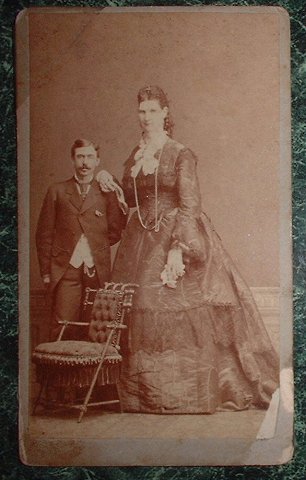
Anna Haining Bates (née Swan; August 6, 1846 – August 5, 1888) was a Canadian woman notable for her great stature of 7 feet 11 inches (2.41 m).[1][2] She was one of the tallest women who ever lived. Her parents were of average height and were Scottish immigrants.

Key Information

Early life

[edit]
Swan (centre) with her parents, who were both of average height[3]

Anna Swan was born at Mill Brook, New Annan, Nova Scotia.[1] At birth she weighed 13 pounds (5.90 kg). She was the third[4] of 13 children, all of the others being around average height. From birth she grew very rapidly. Anna's mother recalled that her daughter's growth rate was "phenomenal."[5]

On her fourth birthday, Swan was 4 feet 6 inches (137 centimetres) tall and weighed 94 pounds (42.64 kg).[6] On her 6th birthday she was measured at 5 feet 2 inches (157.48 centimetres) tall, an inch or two (2.5–5 cm) shorter than her mother. On her 10th birthday she measured 6 feet 1 inch (185 cm) tall and weighed at 203 pounds (92.08 kg). On her 11th birthday, she was measured at 6 feet 4 inches (193.04 centimetres) tall.[7] On her 15th birthday Swan was measured at 7 feet 0 inches (213.36 centimetres) tall. She reached her full height three years later. Her feet were 14.2 inches (36 cm) long.

Swan excelled at literature and music and was considered to be very intelligent. She also excelled at her studies of acting, piano and voice. On one occasion she played Lady Macbeth.

Circus career

[edit]

When she was 17, Swan started working with American showman P. T. Barnum.[8]: 86  She lived in Barnum's American Museum in New York City, and on July 13, 1865, she nearly burned to death when the museum was destroyed by fire. At the time she weighed 384 lb. (159 kg). Her highest recorded weight was 418 lb or just under 30 stone.[9]

Swan later toured the western United States, followed by Europe where she appeared before Queen Victoria of the United Kingdom.[8]: 86  When visiting a circus in Halifax with which Martin Van Buren Bates—another enormously tall person known as the "Kentucky Giant"—was travelling, Swan was spotted by the promoter and hired on the spot.

The marriage of Martin Bates to Anna Swan, 1871

The giant couple became a touring sensation and eventually fell in love; they married on June 17, 1871, in St Martin-in-the-Fields in London.[10] Queen Victoria gave Anna a satin gown and diamond ring, and gave Martin an engraved watch as gifts on for their wedding.[8]: 87 

Children

[edit]

Bates conceived two children with Martin.[8]: 87–88  The first was a girl born on May 19, 1872; she weighed 18 pounds (8.16 kg) and died at birth.[11] While touring in the summer of 1878, Anna was pregnant for the second time. The boy was born on January 18, 1879, and survived only 11 hours.[1] Named just "Babe" he was said by his father to have had the appearance of a perfect 6-month-old. He was the largest newborn ever recorded, at 22 pounds (10.0 kg) and 28 inches tall (c. 72 cm); each of his feet was six inches (150 mm) long. He was posthumously awarded a Guinness World Record as the heaviest new-born baby and the longest.[12]

Later life

[edit]

The Bateses retired to Seville, Ohio, where they built a mansion with high ceilings and door frames.[8]: 87  The main part of the house had fourteen-foot (4.3 m) ceilings, while the doors were extra wide and were eight feet (2.4 m) tall. The back part of the house was built an average size for servants and guests.

They resumed touring with the W. W. Cole Circus in the summer of 1879, and again in the spring of 1880, which was her final ever tour. After that, Bates spent her remaining years quietly on the farm that she and her husband owned. She had joined the local Baptist Church in 1877 and attended services with her husband until shortly before her death.

Death

[edit]

Anna Bates died suddenly and unexpectedly of heart failure in her sleep at her home on August 5, 1888, one day before her 42nd birthday.

The cause of her height was never discovered in her lifetime.[citation needed]

References

[edit]
[edit]
Revisions and contributorsEdit on WikipediaRead on Wikipedia
from Grokipedia
Anna Haining Bates (née Swan; August 6, 1846 – August 5, 1888) was a Canadian woman renowned for her exceptional height of 7 feet 11 inches (241.3 cm), making her one of the tallest women in recorded history. Born in Mill Brook, Nova Scotia, to Scottish immigrant father Alexander Swan and Nova Scotian mother Ann Graham, she was the eldest of 13 children and exhibited rapid growth from infancy, reaching 4 feet 8 inches and over 100 pounds by age five. Bates achieved fame as a sideshow performer, touring North America and Europe as the "Nova Scotia Giantess" under promoters like P. T. Barnum starting in 1862, where she earned $1,000 per month and performed for Queen Victoria. In 1871, Bates married , an American giant standing 7 feet 9 inches (236 cm), in London, England, forming what recognizes as the tallest married couple ever with a combined of up to 15 feet 8 inches (477.5 cm). The couple, known as the "Giants of ," continued touring together in circuses and exhibitions across Europe and the until retiring to a farm in , in 1880, where they raised livestock and lived a relatively private life. Their union was marked by profound personal tragedies, including the of a 27-inch, 18-pound in 1872 and the death after 11 hours of their son, born in 1879 as the heaviest (22 pounds) and longest (28 inches) baby in recorded history. Bates's life exemplified the era's fascination with human anomalies, blending spectacle with resilience amid health challenges from her gigantism, which she attributed to her Scottish heritage. She survived dramatic incidents, such as a 1865 fire at Barnum's American Museum in New York, where she was rescued by derrick after refusing to leave her valuables. Bates died at age 41 from consumption (), just one day before her 42nd birthday, leaving a legacy as a pioneering figure in 19th-century entertainment and .

Early life

Family background

Anna Haining Swan was born on August 7, 1846, in the rural community of Mill Brook, New Annan (near present-day ), , , . Her parents were Alexander Swan, a farmer who had emigrated from , , and Ann (or Anna) Graham, a Nova Scotian woman whose ancestors hailed from the Orkney Islands in . Both stood at average heights—Alexander at 5 feet 7 inches and Ann at 5 feet 3 inches—reflecting the normal stature typical of their family. As the third of 13 children, Anna grew up among siblings who all reached typical adult heights, with the first two children having died in infancy. The Swans maintained a modest rural existence centered on farming in Nova Scotia's Scottish immigrant settlements, where traditions such as Presbyterian faith and Gaelic-influenced customs shaped their home environment and community ties. At birth, Anna appeared of normal size, consistent with a healthy infant. This ordinary start contrasted with the rapid physical growth she would experience shortly thereafter.

Growth and education

Anna Haining Bates displayed remarkable physical growth from infancy, far exceeding typical developmental milestones for children of her era. Born on August 7, 1846, in Mill Brook, Nova Scotia, to parents of average stature, she appeared of normal size at birth. By age five, Bates had reached 4 feet 8 inches tall and weighed over 100 pounds, earning her the moniker "Infant Giantess" in local accounts. Her development continued at an extraordinary pace through adolescence, attaining a height of 7 feet 11 inches (241.3 cm) by age 17, as officially measured in 1863. This rapid progression culminated in her adult stature, with reports noting a weight of approximately 350 pounds by her early twenties. Due to her exceptional size, Bates received her education at home rather than attending a conventional , which would have been impractical given her physical needs. She demonstrated strong intellectual aptitude, excelling in and through self-directed study and instruction. Bates also developed practical skills such as , which became essential for creating her own clothing, and showed a natural talent for and , honing these interests in private settings before any public exposure. Her -based learning environment allowed her to pursue these pursuits without the barriers posed by standard educational facilities. Bates' height presented significant early challenges, necessitating custom-made clothing and furniture from a young age to accommodate her proportions. Ordinary garments and household items quickly became inadequate, requiring her family to adapt sewing patterns and construct oversized beds and chairs, which strained resources in their rural home.

Professional career

Entry into show business

At the age of 16 in 1862, Anna Haining Swan was discovered in Nova Scotia by an agent dispatched by the American showman P.T. Barnum, who had learned of her extraordinary height through local reports. Barnum, known for curating human curiosities at his New York museum, saw potential in exhibiting the young woman from Mill Brook as a major attraction. The agent successfully persuaded Swan and her parents to allow her to join Barnum's enterprise, marking her initial step into professional entertainment. Swan relocated to shortly thereafter, where she signed a generous with Barnum offering her $1,000 per month—equivalent to a substantial fortune at the time—along with accommodations, meals, and three hours of daily private tutoring in reading, writing, music, and for three years. This agreement reflected Barnum's strategy to not only showcase her physical stature but also cultivate her as a refined performer capable of engaging audiences intellectually. Promotional efforts centered on her height, with Barnum billing her as standing 8 feet 1 inch tall and weighing over 350 pounds, using exaggerated measurements to draw curiosity-seekers despite her actual height of approximately 7 feet 5 inches at the time. She made her debut as the "Nova Scotia Giantess" at in , where the exhibition featured her seated on a custom throne-like chair to accentuate her size against scaled props and average-sized attendants. Crowds flocked to see her, often paying 25 cents admission, as she interacted politely with visitors, recited , or played , blending spectacle with demonstrations of her education. In the years immediately following her debut, Swan undertook early tours across the , appearing in circuses, lecture halls, and rival museums from to the Midwest, where she continued to command high fees and shared earnings with her family back home. These performances solidified her , generating significant —estimated in the thousands annually—and allowing her to support her parents while establishing herself as a staple of American popular entertainment. Her act emphasized height comparisons, such as standing beside children or furniture, which captivated audiences and boosted ticket sales without requiring elaborate staging.

Tours and performances

In 1871, Anna Haining Swan crossed the Atlantic for her first major European tour, accompanied by showman Judge H.P. Ingalls' company, where she met fellow performer en route. The pair quickly became a sensation, marrying in on June 17, 1871, and launching a 14-month tour across , , , and as the "largest married couple on earth." Their exhibitions, which highlighted their combined height exceeding 15 feet, attracted massive audiences eager to witness the giants' grace, intelligence, and storytelling abilities during lectures and demonstrations. Promoters enhanced publicity through elaborate parades in major cities, where the couple rode in custom-built carriages or walked through streets lined with spectators, amplifying their fame and drawing record crowds to venues. The tour's reception was overwhelmingly positive, with European press praising Swan's poise and Bates' military anecdotes, positioning them as refined curiosities rather than mere spectacles. One notable highlight occurred in , where they received a command performance invitation from at after their marriage and short honeymoon. The Queen, intrigued by their story, hosted the couple privately and presented Swan with a gold watch as a token of admiration; Bates received similar royal honors, including a , underscoring their elevated status in . These events not only boosted ticket sales but also cemented their international celebrity. Following their return to the in late 1872, Swan and Bates transitioned to joint American performances, billed as the "Tallest Married Couple in the World" under contracts with circuses like W.W. Cole's. Their act evolved to include synchronized exhibitions, such as standing side-by-side for measurements and sharing personal narratives, which sustained high attendance through the and early . This phase marked the peak of their collaborative career, blending spectacle with personal charm to captivate audiences across the continent until health concerns prompted semi-retirement.

Personal life

Marriage to Martin Van Buren Bates

Anna Haining Swan first met in 1869 in but encountered him again in 1871 while both were en route across the Atlantic for a European tour with their respective show troupes, where a shipboard romance blossomed. Bates, a native known as the "Kentucky Giant" and standing 7 feet 9 inches tall, had been performing in American circuses, much like Swan, who measured 7 feet 11 inches. This fostered a deep connection rooted in their shared experiences of extraordinary height and public exhibition. Despite the demands of their performative lives, the couple became engaged soon after, choosing to unite in a partnership that highlighted their unparalleled physical stature. The pair wed on June 17, 1871, at the Church of in , , drawing large crowds of spectators who filled the church and overflowed into the surrounding square. The ceremony, officiated by Rev. Rupert Cochran, featured notable attendees such as the Millie-Christine McKoy, who sang during the procession. , captivated by the couple's story, extended royal patronage by sending wedding gifts that included gold watches for both, a diamond cluster ring, and fabric and lace for the gown, underscoring the event's high-profile status and media coverage in outlets like the . The wedding symbolized not only personal commitment but also a celebrated union of two giants in the Victorian imagination. After a brief in Richmond, the Bateses resumed their professional endeavors with a command performance for and the Prince of Wales at , followed by a 14-month tour across where they billed themselves as the world's tallest married couple. Returning to the in 1874, they continued joint appearances with circuses such as W.W. Cole's through the , blending career and companionship. Their domestic life required practical adaptations, including a custom-built home near , featuring 14-foot ceilings and 8½-foot doors to suit their dimensions. In their marriage, the couple offered each other steadfast support amid the physical strains and health issues inherent to their , forging a resilient bond until Swan's death in 1888.

Children

Anna Haining Bates and her husband had two children, both of whom died shortly after birth. Their first child, a , was born on May 19, 1872, in , , weighing approximately 18 pounds (8.2 kg) and measuring 27 inches in length; she died at birth. Their second child, a son, was born on January 19, 1879, at the couple's farm in ; he weighed 22 pounds (9.98 kg), measured 28 inches (71 cm) in length, and died 11 hours later. This newborn holds the World Record for the heaviest birth in history. The couple had no surviving children, and the tragic losses marked a profound sorrow in their , leading them to retire from public life soon after the second birth.

Later life and death

Retirement in

After more than 15 years in , Anna and retired in the early 1880s, motivated by a desire for and normalcy following the tragic loss of their infant son in 1879. They had briefly resumed touring with the W.W. Cole Circus in 1879 and 1880 before fully withdrawing from public exhibitions to focus on family life. In June 1874, the couple relocated to , where Martin purchased a 130-acre farm near Chippewa Lake to pursue . They constructed a custom mansion on the property, designed with 14-foot ceilings, extra-wide doors that were eight feet tall, and oversized furniture built to their specifications, ensuring comfort in their daily routines. The home's back section included standard-sized rooms for servants and visitors, blending practicality with their unique needs. Farm life involved raising cattle and draft horses, with activities adapted to their sizes—Martin, for instance, could effortlessly lift 500-pound loads during chores. Their accumulated wealth from circus earnings provided , allowing them to stock the farm with high-quality breeds and maintain a self-sufficient existence without further performances. Anna integrated into the community by joining the First Baptist Church of in 1877, where church leaders installed a specially widened to accommodate the couple during services. She actively participated by teaching , fostering connections with local residents despite their physical differences.

Illness and death

In the 1880s, following her retirement from public performances, Anna Haining Bates faced declining health marked by and problems, including a that contributed to significant heart strain. These issues, compounded by the physical toll of her extraordinary stature from earlier years, progressively worsened, limiting her daily activities on the family farm in . On August 5, 1888, Bates died suddenly and unexpectedly in her sleep at home in , succumbing to heart failure at the age of 41—one day before her 42nd birthday. Her husband, , arranged for her burial in the family plot at Mound Hill Cemetery in , where a custom headstone and later a of a Greek goddess were placed to honor her memory; Martin himself outlived her by 18 years, dying in 1919 and being interred beside her. The loss elicited a poignant response from her , who received distributions of her , jewels, and other personal items from her estate, valued at $40,000. In the close-knit community of , her passing was mourned as that of a local figure of quiet dignity, with descendants preserving some of her belongings for public display in later years.

Legacy

Height records

Anna Haining Bates is recognized as one of the tallest women in recorded history, with a verified height of 7 feet 11 inches (241.3 cm). This measurement positioned her as a prominent figure among historical cases of extreme stature, surpassing many contemporaries and holding distinction until eclipsed by modern individuals such as Sandy Allen, who reached 7 feet 7.25 inches. Her extraordinary height was attributed to gigantism, a condition likely stemming from a pituitary disorder. Bates' measurements were corroborated by 19th-century contemporaries, including showman , who promoted her extensively as the "tallest woman in the world" during her American Museum exhibitions starting in 1862. Barnum's campaigns, which billed her height at up to 8 feet 1 inch for promotional effect, drew on observed physical attributes verified through public displays and informal assessments by medical observers of the era. These verifications, combined with later recognition, affirm her stature as a benchmark in historical height records. Together with her husband, , who stood at 7 feet 9 inches (236.22 cm), the couple was officially acknowledged by as the tallest married pair ever, with a combined height of 15 feet 8 inches (477.52 cm). Their union, as two individuals affected by , is further evidenced by their son, who at birth held the Guinness records for the heaviest newborn at 22 pounds (9.98 kg) and longest at 28 inches (71.12 cm).

Cultural depictions

Anna Haining Bates, known as the "Nova Scotia Giantess," featured prominently in 19th-century circus posters and promotional materials that emphasized her as an iconic figure of human extraordinary stature to draw crowds to shows. Collections of sideshow ephemera, such as those held by Ohio State University's Billy Ireland Cartoon Library & Museum, include a 1878 flyer promoting Bates alongside her husband, highlighting their performances in the American circus circuit. Similarly, an anonymous pamphlet titled The Nova Scotia Giantess, Miss Anna H. Swan (1894) provided biographical details and sensational descriptions of her physical presence, exemplifying the textual representations used to commodify performers in Victorian-era exhibitions. In literature, Bates has been reimagined as a symbol of otherness and , particularly in Canadian works that explore and historical constraints. Susan Swan's 1983 novel The Biggest Modern Woman of the World casts Bates as the protagonist, portraying her as an for Canada's vast landscape and a modernist challenge to Victorian sexual and political norms through a blend of historical and postmodern narrative. Posthumous biographies further cement her as a "" icon, with Sylvia Fraser's 1995 illustrated children's book The True Tale of a : The Story of Anna Swan presenting her life as one of triumph over adversity in the world. More recent accounts, such as Tommy and Hilde Wilkens's 2023 Gentle Giants: Captain Martin Bates & Anna Swan Bates, emphasize her intelligence and humanity beyond physical spectacle, drawing on archival sources to humanize her experiences. Polly Jae Lee's Giant: The Pictorial History of the Colossus (2005) also includes visual and narrative references to Bates, situating her within broader histories of human anomalies. Modern media often frames Bates in tragic narratives, focusing on the personal challenges of her condition amid 19th-century societal expectations, as seen in online historical articles and essays that contrast her public fame with private struggles. Her story appears in discussions of circus history, including mentions in P.T. Barnum's autobiographies, which briefly note her as a star attraction during his shows. While no major feature films depict her directly, she is referenced in documentaries on Victorian freak shows and , contributing to awareness of medical conditions like pituitary gigantism in historical contexts. The Giantess Anna Swan Museum, opened in 2009 at the Creamery Square Heritage Centre in , , honors her life with exhibits of artifacts and her story, while a in the town commemorates her as a local icon.

References

Add your contribution
Related Hubs
User Avatar
No comments yet.