Hubbry Logo
Anthony J. CelebrezzeAnthony J. CelebrezzeMain
Open search
Anthony J. Celebrezze
Community hub
Anthony J. Celebrezze
logo
8 pages, 0 posts
0 subscribers
Be the first to start a discussion here.
Anthony J. Celebrezze
from Wikipedia

Anthony Joseph Celebrezze Sr. (born Antonio Giuseppe Cilibrizzi, Italian: [anˈtɔːnjo dʒuˈzɛppe tʃiliˈbrittsi]; September 4, 1910 – October 29, 1998) was an American politician of the Democratic Party, who served as the 49th mayor of Cleveland, Ohio, as a cabinet member in the Kennedy and Johnson administrations, and as a United States circuit judge of the United States Court of Appeals for the Sixth Circuit.

Key Information

Early life and education

[edit]

Celebrezze was born in 1910 as one of thirteen children to Dorothy (née Marcogiuseppe) and Rocco Cilibrizzi in Anzi, a town in the administrative region of Basilicata, southern Italy. The family moved to the United States when he was two years old, and the surname was Americanized in spelling to "Celebrezze."[1] /sɛləˈbrzi/. After having been a shepherd in Anzi, the father Rocco took an industrial job, becoming a track laborer for the Wheeling and Lake Erie Railroad in Cleveland.

Like many of his immigrant generation, Anthony Celebrezze took odd jobs as a youngster, shining shoes and selling newspapers. He attended Cleveland Public Schools, graduating from Central High School[1] and Fenn College (later developed as Cleveland State University).[2]

He graduated from John Carroll University in 1934.[3] During his college years, he earned his way by working as a railroad laborer and freight truck driver, as well as boxer.[1] He later attended Ohio Northern University in Ada, Ohio, where he received a Bachelor of Laws in 1936 from the Claude W. Pettit College of Law (then known as the Warren G. Harding College of Law).[4]

Marriage, World War II, and career

[edit]

Celebrezze began working for the Ohio Unemployment Commission in Columbus, Ohio. In 1938, he passed the bar and returned to Cleveland, where he entered the general practice of law.[1] That same year, he married Anne M. Marco, a graduate of Western Reserve University and a teacher in the Cleveland Public School system, on May 7, 1938.[1] With the onset of World War II, Celebrezze enlisted in the United States Navy. Upon his discharge at the end of the war, he returned to private practice.[4]

Political career

[edit]

In 1950, Celebrezze ran for a seat in the Ohio State Senate, vacated by Howard Metzenbaum, and won. He served as an Ohio state senator from 1951 to 1953. One of the few Democrats to serve in the Senate at the time, Celebrezze cultivated a friendly relationship with the Republican majority. Governor Frank J. Lausche, a Democrat and former mayor of Cleveland, did not have a good relationship with the Democratic leadership in the Senate. Lausche thus relied heavily on Celebrezze to represent his interests in the Senate.

In 1952, when Celebrezze sought re-election to the state senate, he ran into trouble when he crossed the Democratic party chairman, Ray T. Miller, by supporting fellow Italian American Michael DiSalle for the United States Senate instead of James M. Carney. Celebrezze was renominated by his party and won the general election. Six years later in his gubernatorial campaign, he ran against DiSalle.

Mayor of Cleveland

[edit]

In 1952, after continuing battles with the Democratic leadership in the Senate, Celebrezze resigned to run for Mayor of Cleveland. The office was open because sitting mayor Thomas A. Burke had decided not to seek another term. The Democratic party organization chose Albert S. Porter, Engineer of Cuyahoga County, to succeed Burke. Although lacking support from Party Chairman Miller, Celebrezze had the backing of Governor Lausche. Mayor Burke did not favor either candidate.

In the open primary among Porter, Celebrezze, and Republican juvenile court Judge William J. McDermott, Celebrezze won a decisive victory, having a substantial lead over McDermott. Porter came in third. In the general election, Celebrezze again defeated Republican McDermott. He was endorsed by the Cleveland Press editor Louis B. Seltzer.

After that, Celebrezze was elected for an unprecedented five two-year terms as mayor, serving from 1953 to 1962.[1] At the time, Cleveland was the fifth-largest city in the nation. Celebrezze drove efforts to build or upgrade the city's infrastructure, and conducted a massive $140 million urban-renewal program.[5] Major portions of the rapid-transit system were constructed during this time, most notably the Red Line, which connected much of the city to the existing Blue and Green lines. There was also extensive work done on the city's freeway system, the Port of Cleveland, and Burke Lakefront Airport.

In 1958 Celebrezze was elected president of the American Municipal Association (now the National League of Cities) in 1958.[2] That same year, he sought the Democratic nomination for Governor of Ohio, but lost to Michael DiSalle. In 1960, he launched the Erieview urban renewal plan, designed by architect I. M. Pei. The most prominent result of the plan was the Erieview Tower. He also spurred several building projects, most notably a federal office building (which was later named after him after his death), and the Garden Valley housing project.[5]

In 1962, Celebrezze served as president of the United States Conference of Mayors.[6]

In 1961, after years of denying rumors that he sought a higher public office, Celebrezze was offered a federal judgeship by President John F. Kennedy, which was a lifetime appointment to a federal judgeship. Celebrezze turned it down to run for a record-breaking fifth consecutive term as mayor, which he won by an unprecedented 73.8 percent, sweeping every one of the city's thirty-three wards.[1] Kennedy appointed him also to serve on the Committee on Equal Employment Opportunity and the Commission on the Status of Women. In 1962, Celebrezze was selected as the president of the United States Conference of Mayors.[2]

Cabinet Secretary

[edit]
Celebrezze and John F. Kennedy

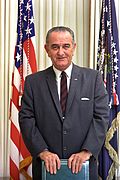
In 1962, President Kennedy returned to Celebrezze with an offer of a cabinet appointment as United States Secretary of Health, Education, and Welfare (now the Department of Health and Human Services). Celebrezze resigned as mayor in 1962 before his appointment on July 31, 1962.[7] He continued his service under President Lyndon Johnson following Kennedy's assassination in November 1963.

During this time, Celebrezze contributed to the enactment of landmark social legislation, most notably the Civil Rights Act of 1964 and Social Security Act of 1965. One of Celebrezze's most important achievements as secretary of HEW was separating the public assistance and child health and welfare functions from the Social Security Administration, and transferring these programs to a new Welfare Administration. Celebrezze shaped HEW to fit Johnson's initiatives, including getting power from Congress to deny funds for any federal HEW program to any state or institution that practiced racial segregation.[8]

Celebrezze found it difficult to maintain two households on his $25,000 salary and apart from his family,[1] and asked Johnson to return to Cleveland. "We are going to lose the house in Cleveland if I continue to live here, Mr. President," Celebrezze told Johnson. The President replied that Celebrezze was too honest for Washington because he was the first cabinet secretary "to go broke while working for the White House." Celebrezze resigned as HEW Secretary on August 17, 1965.[7]

Federal judicial service

[edit]
Celebrezze in his old age

Celebrezze was nominated by President Lyndon B. Johnson on July 27, 1965, to a seat on the United States Court of Appeals for the Sixth Circuit, which had been vacated by Judge Lester Lefevre Cecil. He was confirmed by the United States Senate on August 19, 1965, and received his commission on August 19, 1965. After more than fifteen years of service, Celebrezze assumed senior status on October 1, 1980. His service terminated on October 29, 1998, due to his death.[4]

Notable cases

[edit]

Celebrezze authored numerous opinions, including Beasley v. United States, which established a fair and progressive standard of "effective assistance of counsel" under the sixth amendment, Hill v. Tennessee Valley Authority, Gabriele v. Chrysler Corp., and Krause v. Rhodes.[1]

Death

[edit]

In the last three years of his life, Celebrezze was mostly inactive on the court, and spent most of his time organizing his personal papers. In the summer of 1998, he became easily fatigued, and advanced throat cancer was diagnosed about September. He was hospitalized briefly at Lakewood Hospital and at the Cleveland Clinic before transferring to the Corinthian Skilled Nursing Center in Cleveland about October 22, 1998. He died there on October 29, 1998.[9] His funeral was held at the Cathedral of St. John the Evangelist in Cleveland, and he was buried at Holy Cross Cemetery [Wikidata] in Brook Park, Ohio.[10]

Celebrezze political family

[edit]

Celebrezze and his wife Anne had three children: Anthony J. Celebrezze Jr., Jean Ann (Celebrezze) Porto, and Susan Marie (Celebrezze) Sullivan. Anthony Jr. became an attorney and served as Ohio Attorney General; he also ran for governor. The pair are the only father and son to both run as candidates for the Democratic gubernatorial nomination in Ohio. His grandson Anthony J. Celebrezze III (son of Anthony Jr.), also ran for public office.

Celebrezze's older brother Frank D. Celebrezze I (b. 1899) also became an attorney and was active in civic service. He served as Cleveland Safety Director and later was appointed as a Cleveland Municipal Court judge. His descendants also became attorneys and active politically. Frank Celebrezze became Ohio Chief Justice, and James Celebrezze became an Ohio Supreme Court Judge. Frank D. Celebrezze Jr. (grandson to the first Frank) became an Ohio Appeals Court Judge, and Leslie Ann Celebrezze became Domestic Relations Judge of Cuyahoga County Court of Common Pleas.

Legacy

[edit]
Anthony J. Celebrezze fireboat on the Cuyahoga River
  • In 1964, Celebrezze received the Alumni Medal from his alma mater, John Carroll University.[3] In 1978, JCU conferred him an honorary Doctor of Laws degree.[11] He also had honorary degrees from Fenn College, Boston College, LaSalle College, Ohio Northern University, Rhode Island College, Bowling Green State University, Wilberforce University, Miami University (Ohio) and Cleveland State University.[1]
  • The federal building in Cleveland is named after Celebrezze, as well as an archives room at Ohio Northern University law school (Ada, Ohio). Additionally, a Cleveland Fire Department fireboat was named after Celebrezze.[12]

See also

[edit]

References

[edit]
[edit]
Revisions and contributorsEdit on WikipediaRead on Wikipedia
from Grokipedia
Anthony Joseph Celebrezze Sr. (September 4, 1910 – October 29, 1998) was an Italian-born American politician and federal judge who served five consecutive terms as the 50th from 1953 to 1962 before becoming the fifth Secretary of Health, Education, and Welfare from 1962 to 1965. Appointed by President to fill the cabinet vacancy left by , Celebrezze became the first Italian-American to hold such a position, reflecting Kennedy's intent to diversify executive appointments. As mayor, he focused on municipal improvements, including the establishment of the Cleveland Seaport Foundation to enhance and support for infrastructure bonds to develop the port facilities. In his role at Health, Education, and Welfare under both Kennedy and , Celebrezze oversaw the reorganization of welfare functions separate from the and played a part in advancing legislation for Medicare, elementary and aid, and initiatives. After resigning from the cabinet in 1965, he was nominated by Johnson to the Court of Appeals for the Sixth Circuit, serving until his retirement in 1972 amid a career spanning over four decades in public service.

Early Life and Background

Immigration and Childhood

Anthony Joseph Celebrezze, originally named Antonio Giuseppe Cilibrizzi, was born on September 4, 1910, in the mountain village of , to Rocco Cilibrizzi, a shepherd, and Dorothy Marcogiuseppe. His parents, who had earlier to the and obtained naturalized citizenship, were in Italy visiting relatives when he was born as the middle child of what would become a family of thirteen children. The family immigrated to , , when Celebrezze was two years old, settling in a working-class neighborhood amid the city's growing Italian-American community. His father secured employment as a track laborer for the Wheeling and Lake Erie Railroad, reflecting the manual labor opportunities available to European immigrants in early 20th-century industrial . As a boy, Celebrezze helped support his large family through odd jobs, including selling newspapers and shining shoes, amid the economic constraints typical of immigrant households reliant on low-wage industrial work. These experiences in a resource-scarce environment underscored the demands of for working-class Italian immigrants navigating urban America before the exacerbated broader financial pressures.

Education and Family Formation

Celebrezze attended public schools in Cleveland, graduating from Central High School, where he met his future wife. To finance his postsecondary education amid family financial constraints, he took on demanding manual labor jobs, including work for the New York Central Railroad. He attended John Carroll University before earning his Bachelor of Laws (LL.B.) from Ohio Northern University College of Law in 1936, demonstrating perseverance through self-funded studies and employment. In 1938, Celebrezze married Anne Marco, his high school sweetheart from Central High School, establishing a family foundation amid his early career struggles. The couple had three children: Anthony J. Celebrezze Jr. (born September 8, 1941), who pursued a political career including service as from 1983 to 1991; Jean Anne; and Susan Marie. This period marked Celebrezze's transition from education to family life, balancing nascent professional responsibilities with personal commitments in Depression-era .

Pre-Political Career

World War II Service

Celebrezze enlisted in the Navy following the ' entry into in , serving as a seaman amid the global conflict. His duties aligned with the Navy's expansive operations, which emphasized maritime logistics, convoy protection, and support for amphibious assaults across the Pacific, though precise assignments for Celebrezze are not detailed in official biographical records. Discharged at the war's end in 1945, Celebrezze received an honorable separation, enabling his return to and resumption of legal practice. The structured regimen of naval service instilled a sense of discipline that informed his later approach to , where he prioritized operational efficiency and in roles demanding rigorous oversight. This transition underscored the practical value of military-honed resilience in navigating postwar civilian challenges, without which his ascent in local governance might have been delayed.

Legal Practice and Public Service Entry

Following his service in the U.S. Navy during , Anthony J. Celebrezze returned to in 1945 and resumed his private general law practice, which he had opened in 1939 after three years as an attorney for the Bureau of Unemployment Compensation. His practice operated continuously until 1951, focusing on civil matters amid Cleveland's post-war industrial economy, though specific case details from this era remain sparsely documented in public records. This period allowed Celebrezze to cultivate professional networks in the city's legal and ethnic communities, drawing on his background as the son of Italian immigrants. Celebrezze's early legal work reflected practical engagement with state administrative law from his prior government role, positioning him for involvement in local Democratic Party operations without formal partisan appointments during this time. He handled routine litigation and advisory services, building a reputation for competence that extended to municipal and labor-adjacent issues, though independent verification of individual arbitrations or prosecutorial roles in Cuyahoga County is absent from contemporary accounts. This foundational experience in private practice underscored his transition from wartime service to civilian professional life, emphasizing hands-on legal problem-solving over ideological advocacy.

Political Career

Ohio State Senate Tenure

Anthony J. Celebrezze was elected to the Ohio State Senate in 1950 as a Democrat, winning the seat in Cuyahoga County vacated by following Metzenbaum's appointment to the Cuyahoga County Common Pleas Court. His term began in January 1951, marking his entry into state-level politics after a background in law and local public service. Celebrezze quickly aligned with Governor Frank J. Lausche, a moderate Democrat who prioritized fiscal restraint and vetoed numerous spending bills to maintain balanced state budgets amid postwar economic pressures. This alliance underscored Celebrezze's approach to governance, favoring practical outcomes and budgetary discipline over expansive ideological commitments typical of some party factions, in line with Lausche's record of rejecting over 300 bills deemed fiscally irresponsible during his tenure. Re-elected in 1952, Celebrezze's Senate service ended prematurely in 1953 when he resigned to campaign for as an independent Democrat, prioritizing local urban challenges over continued legislative work. His brief tenure laid groundwork for cross-party collaboration, reflecting 's industrial context without documented sponsorship of major standalone bills.

Mayoralty of Cleveland: Governance and Reforms

Anthony J. Celebrezze was elected on November 3, 1953, defeating incumbent Democratic Senator Thomas A. in the general , and secured re-election in 1955 (running unopposed), 1957, 1959, and 1961, serving five consecutive two-year terms until resigning in 1962 to join the Kennedy administration. His administrations coincided with a period of relative post-World War II for the city, marked by industrial output growth and infrastructure investments that sustained employment levels amid emerging suburban migration pressures. Celebrezze prioritized public safety through law-and-order measures, including aggressive enforcement against vice and figures; upon taking office, he formally banned notorious mobster Alex "Shondor" Birns from in 1953, signaling a commitment to disrupting illicit networks that had infiltrated local and rackets. This approach contributed to stabilized crime metrics in the mid-1950s, as federal and local data later reflected reduced visibility of syndicate activities during his tenure, prior to the sharper urban challenges of the late . In urban development, Celebrezze championed the Erieview Urban Renewal Project, initiated in the late 1950s as a comprehensive effort involving the clearance of blighted areas and construction of modern office towers, including the I. M. Pei-designed federal building site; he directly endorsed the plan after developers bypassed initial planning hurdles, facilitating federal funding under the that cleared over 100 acres for commercial and residential reuse. These initiatives, combined with expansions in public infrastructure such as the completion of the Cleveland Rapid Transit system, growth of the interstate highway network, and enlargement of , supported economic vitality by improving connectivity and attracting business investment during a when the city's base remained robust. By 1960, such projects had helped maintain 's metropolitan employment near postwar highs, countering early signs of industrial shift before the broader contractions intensified.

Mayoralty of Cleveland: Criticisms and Challenges

Celebrezze's urban renewal efforts, including projects like Erieview and expansions in areas such as Garden Valley, drew criticism for displacing residents from central neighborhoods and relocating them to peripheral that reinforced segregation rather than promoting integration or economic opportunity. Critics contended that these initiatives prioritized downtown redevelopment for white ethnic constituencies while failing to provide viable alternatives, exacerbating racial isolation amid persistent and discriminatory lending practices. Enforcement of Cleveland's anti-discrimination housing ordinance, in place since the , was faulted for its lax application, which did little to dismantle segregation driven by economic decline and ; instead, sporadic crackdowns sometimes intensified community distrust without tackling causal factors like industrial job losses in steel and manufacturing sectors. Opponents, including 1961 mayoral challenger Albina Cermak, portrayed Celebrezze's approach as inadequately responsive to these mounting racial and housing tensions, arguing it neglected the human costs of policy implementation. Fiscal policies under Celebrezze provoked bipartisan discontent: conservatives decried hikes sought to underwrite renewal projects and infrastructure, viewing them as burdensome amid early signs of , while progressive factions assailed the administration for insufficient expansion of welfare and to offset spikes and poverty concentrations in segregated areas. The Citizens League of scrutinized these tax proposals as symptomatic of inefficient in a transitioning . In labor disputes, Celebrezze prioritized service continuity—such as maintaining municipal light and power operations—over broad concessions, a stance critics from unions saw as overly rigid but defenders framed as essential for fiscal stability.

Secretary of Health, Education, and Welfare

Anthony J. Celebrezze was sworn in as Secretary of Health, Education, and Welfare on July 31, 1962, succeeding at the invitation of President , who sought to include an Italian-American in his cabinet. Retained by President after Kennedy's assassination, Celebrezze served until his resignation on August 1, 1965, overseeing a period of significant federal expansion in social programs amid the early initiatives. Celebrezze directed a departmental reorganization that transferred public assistance programs and child health and welfare functions from the to a newly established Welfare Administration, aiming to streamline operations and enhance focus on delivery. This shift, announced in December 1962, consolidated welfare efforts under dedicated leadership, including appointing Ellen Winston as the first Commissioner of Welfare, and positioned HEW to handle growing caseloads from programs like Aid to Families with Dependent Children. Such changes expanded administrative capacity but also amplified federal oversight of state welfare systems, contributing to a broader federal footprint in that later drew scrutiny for potentially entrenching dependency cycles, as evidenced by rising welfare rolls from 3.1 million recipients in 1960 to over 4.3 million by 1965. In enforcing Title VI of the , which prohibited discrimination in federally funded programs, Celebrezze's HEW wielded authority to withhold funds from non-compliant institutions, including hospitals and schools. He initiated steps to terminate aid to discriminatory entities, such as Southern hospitals under the Hill-Burton program, based on compliance reviews that documented segregation practices through site inspections and beneficiary data. This data-informed approach accelerated desegregation in HEW-funded facilities, with over 90% of Southern hospitals desegregated by 1966, though enforcement relied on voluntary compliance guidelines rather than universal fund cutoffs, reflecting pragmatic balancing of legal mandates against administrative feasibility. Celebrezze advanced education aid expansions, supporting the Higher Education Facilities Act of 1963 and laying groundwork for the Elementary and Secondary Education Act of 1965, which allocated $1.3 billion in federal grants to low-income districts tied to desegregation progress. These measures, justified by enrollment data showing disparities in per-pupil spending, increased federal involvement in K-12 funding from negligible levels to over $1 billion annually by fiscal 1966, prioritizing aid to disadvantaged areas while conditioning support on civil rights adherence. On health policy, Celebrezze built congressional backing for Medicare legislation, advocating for hospital insurance for the elderly funded by payroll taxes, though he departed before its July 30, 1965, enactment under successor John Gardner. His tenure's welfare and aid expansions, while addressing immediate needs amid rates exceeding 19% in 1964, fueled subsequent debates on fiscal sustainability, with program costs rising 50% in HEW's budget from $4.4 billion in 1962 to $6.6 billion by 1965, prompting later causal analyses linking structural incentives to prolonged and family breakdown in recipient populations. Celebrezze resigned to accept a federal judgeship on the U.S. Court of Appeals for the Sixth Circuit, nominated by Johnson on June 29, 1965.

Judicial Career

Appointment to the Sixth Circuit

Following his resignation as Secretary of Health, Education, and Welfare on July 31, 1965, President Lyndon B. Johnson nominated Anthony J. Celebrezze on July 27, 1965, to serve as a judge on the United States Court of Appeals for the Sixth Circuit, filling the vacancy created by the retirement of Lester L. Cecil. The Senate, controlled by Democrats at the time, confirmed the nomination swiftly on August 19, 1965, by voice vote, reflecting the administration's preference for placing experienced political allies on the federal bench amid a period of expanding executive influence under Johnson. Celebrezze, a longtime Democrat with roots in Ohio politics, received no significant opposition, though such appointments of cabinet officials to lifetime judicial positions have historically prompted debates over potential erosion of judicial independence due to prior partisan ties. Celebrezze's qualifications emphasized his extensive executive branch experience, particularly in administrative matters during his tenure as HEW , which positioned him to handle appeals involving federal agency decisions—a common docket item for the Sixth Circuit covering , , , and . He assumed office in August 1965 and served as an active judge until taking on October 1, 1980, after which he continued in a reduced capacity until his death on October 29, 1998. This transition underscored Johnson's strategy of rewarding loyalists with judicial posts, leveraging Celebrezze's practical governance background over purely academic legal credentials prevalent in some contemporaneous appointments.

Notable Cases and Judicial Approach

Celebrezze authored the opinion in Beasley v. United States, 491 F.2d 687 (6th Cir. 1974), a criminal challenging the effectiveness of trial . The court reversed the district court's denial of habeas relief, holding that counsel's failure to investigate an defense or object to improper fell below a minimum professional standard, thereby prejudicing the defendant. This decision articulated a two-prong test for ineffective assistance—deficient performance and resulting prejudice—that influenced subsequent Sixth Circuit precedents on constitutional protections in criminal proceedings. In matters, Celebrezze's rulings reflected a textualist bent, insisting on strict adherence to statutory boundaries rather than agency policy expansions. For instance, in panels addressing environmental regulations under the Clean , he joined opinions limiting enforcement to explicit congressional authorizations, rejecting broader interpretations that would extend federal oversight beyond legislative intent. His prior service as Secretary of Health, Education, and Welfare informed decisions on Social Security disability claims, where he prioritized evidentiary support for eligibility under the Act's precise criteria, declining to endorse judicial overrides for equitable relief absent clear statutory warrant. This approach contrasted with more activist tendencies in peer circuits, favoring remand for factual development over de novo policy-making. Celebrezze's record shows few en banc reversals or overrides, suggesting opinions grounded in defensible statutory construction amid labor and civil rights litigation. In disputes over federal labor standards, he concurred in interpretations confining remedies to textual limits, resisting claims for expansive equitable remedies that deviated from enacted law. Overall, his emphasized , deferring to legislative text and agency fact-finding while critiquing overreach, as evidenced by dissents or concurrences upholding procedural prerequisites against premature regulatory actions.

Later Life and Legacy

Retirement and Death

In 1980, Celebrezze retired from active service on the United States Court of Appeals for the Sixth Circuit and assumed , allowing him to handle a reduced caseload while retaining his position. He continued to perform selective judicial duties in this capacity for the subsequent eighteen years. Celebrezze maintained a low public profile during his senior status years, with no recorded major writings, speeches, or advocacy efforts beyond his intermittent court work; his focus shifted primarily to family matters amid advancing age. His health deteriorated in his final months, leading to admission at a in Westlake, a suburb of . Celebrezze died on October 29, 1998, at the age of 88 from cancer. His judicial service formally terminated upon his death that day. He was buried at Holy Cross Cemetery in Brook Park, Ohio.

Political Family Dynasty

Anthony J. Celebrezze Jr., the son of Anthony J. Celebrezze Sr., extended the family's political footprint in Ohio by serving as state senator in the 1970s, Ohio Secretary of State from 1977 to 1983, and Ohio Attorney General from 1983 to 1991. In these roles, he managed statewide elections, pursued legal actions on consumer protection and public corruption, and ran unsuccessfully for governor in 1990 against Republican George Voinovich, accumulating 16 years of continuous service in state government. His tenure built on the elder Celebrezze's Cleveland base, where Democratic Party organization and Italian-American community ties provided electoral infrastructure, enabling repeated victories in competitive primaries and generals. The family's influence extended beyond the direct lineage, with Anthony Sr.'s brother, Frank D. Celebrezze, holding positions as assistant Cuyahoga County prosecutor from 1929 and later as a Municipal Court judge, establishing an early judicial foothold in local Democratic networks. Frank's son, James P. Celebrezze, advanced this thread as an justice from 1991 until his retirement, contributing to the dynasty's judicial dimension amid family political disputes, such as those injecting partisanship into 1980s retention elections. Collectively, Celebrezze kin occupied elected and appointed offices across legislative, executive, and judicial branches for over six decades, from the 1920s prosecutorial starts through the 1990s governorship bid and beyond. This intergenerational pattern leveraged Cleveland's ethnic Democratic for and , yielding empirical success in turnout and but prompting of whether electoral wins stemmed primarily from individual legal acumen and policy execution or from inherited and organizational inheritance, a dynamic observable in many urban political where capital correlates with higher attainment rates. While competence is evidenced by sustained tenures and electoral mandates—Jr. won multiple statewide races without federal intervention—the reliance on familial networks raises causal questions about meritocratic access in politics, where first-mover advantages compound across generations absent countervailing reforms.

Policy Impacts and Historical Assessment

Celebrezze's mayoral reforms in , including a $140 million program and infrastructure investments like and freeways, provided short-term fiscal stability by reducing city debt and improving connectivity, but exacerbated long-term structural decline through displacement, housing shortages, and facilitation of amid and in-migration, contributing to rising poor-relief costs by the 1960s. These efforts, while pragmatically conserving municipal funds via transfers like City Hospital to county control in 1957, failed to address underlying economic shifts, as job losses and demographic changes overwhelmed temporary gains, underscoring limits of localized interventions against broader . As HEW Secretary from 1962 to 1965, Celebrezze reorganized the department into more manageable units, including a new Welfare Administration, and enforced desegregation by authorizing fund denials to discriminatory states, expanding federal leverage in education and during the early era. However, this administrative consolidation and policy enforcement amplified critiques of federal overreach, as HEW's growing bureaucracy laid groundwork for escalating welfare expenditures—rising from $4.5 billion in 1960 to over $10 billion by 1970 nationally—fostering dependency cycles and fiscal burdens without resolving root causes like family breakdown or labor market mismatches, per subsequent analyses of entitlement expansions. His fiscal restraint, evident in mayoral precedents, tempered but did not halt the trajectory toward unchecked program growth under successors. Celebrezze's 33-year Sixth Circuit tenure, including senior status from 1980, emphasized procedural efficiency and rule-of-law adherence amid 1960s-1970s social upheavals, earning praise for pragmatic adjudication over ideological activism, though some progressive critics viewed his approach as insufficiently transformative on civil rights enforcement. Overall, his legacy defies a monolithic liberal label, blending Democratic support for targeted interventions with hawkish fiscal and law-enforcement stances that prioritized sustainability over expansive redistribution, as evidenced by his balanced budgets and desegregation focus without endorsing unchecked welfare proliferation. This causal realism highlights achievements in stabilization and equity enforcement against narratives of unqualified progressive triumph, revealing policy trade-offs like temporary urban gains yielding enduring costs.

References

Add your contribution
Related Hubs
User Avatar
No comments yet.