Hubbry Logo
Ascending aortaAscending aortaMain
Open search
Ascending aorta
Community hub
Ascending aorta
logo
8 pages, 0 posts
0 subscribers
Be the first to start a discussion here.
Ascending aorta
Ascending aorta
from Wikipedia

Ascending aorta
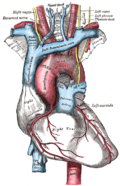
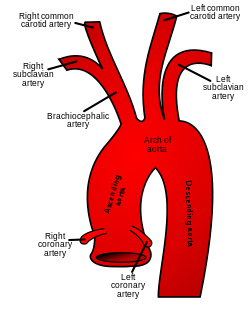
The ascending aorta and aortic arch with their branches
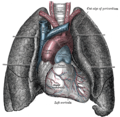
Course of the ascending aorta (anterior view), as it passes dorsally to the pulmonary trunk but ventrally to the right pulmonary artery.
Details
PrecursorTruncus arteriosus
SourceLeft ventricle
BranchesLeft coronary artery, right coronary artery and continues as the aortic arch
VeinCombination of superior and inferior vena cava and coronary sinus
SuppliesThe entire body, with exception of the respiratory zone of the lung
Identifiers
Latinaorta ascendens,
pars ascendens aortae
TA98A12.2.03.001
TA24176
FMA3736
Anatomical terminology

The ascending aorta (AAo)[1] is a portion of the aorta commencing at the upper part of the base of the left ventricle, on a level with the lower border of the third costal cartilage behind the left half of the sternum.

Structure

[edit]

It passes obliquely upward, forward, and to the right, in the direction of the heart's axis, as high as the upper border of the second right costal cartilage, describing a slight curve in its course, and being situated, about 6 centimetres (2.4 in) behind the posterior surface of the sternum. The total length is about 5 centimetres (2.0 in).

Components

[edit]

The aortic root is the portion of the aorta beginning at the aortic annulus and extending to the sinotubular junction. It is sometimes regarded as a part of the ascending aorta,[2] and sometimes regarded as a separate entity from the rest of the ascending aorta.[3]

Between each commissure of the aortic valve and opposite the cusps of the aortic valve, three small dilations called the sinuses of Valsalva.

The sinotubular junction is the point in the ascending aorta where the sinuses of Valsalva end and the aorta becomes a tubular structure.

Size

[edit]

A thoracic aorta diameter greater than 3.5 cm is generally considered dilated, whereas a diameter greater than 4.5 cm is generally considered to be a thoracic aortic aneurysm.[4] Still, the average diameter in the population varies by for example age and sex. The upper limit of standard reference range of the ascending aorta may be up to 4.3 cm among large, elderly individuals.[5]

Relations

[edit]

At the union of the ascending aorta with the aortic arch the caliber of the vessel is increased, owing to a bulging of its right wall.

This dilatation is termed the bulb of the aorta, and on transverse section presents a somewhat oval figure.

The ascending aorta is contained within the pericardium, and is enclosed in a tube of the serous pericardium, common to it and the pulmonary artery.

The ascending aorta is covered at its commencement by the trunk of the pulmonary artery and the right auricula, and, higher up, is separated from the sternum by the pericardium, the right pleura, the anterior margin of the right lung, some loose areolar tissue, and the remains of the thymus; posteriorly, it rests upon the left atrium and right pulmonary artery.

On the right side, it is in relation with the superior vena cava and right atrium, the former lying partly behind it; on the left side, with the pulmonary artery.

Branches

[edit]

The only branches of the ascending aorta are the two coronary arteries which supply the heart; they arise near the commencement of the aorta from the aortic sinuses which are opposite the aortic valve.

Clinical significance

[edit]

Porcelain aorta is extensive atherosclerotic calcification of the ascending aorta.[6] It makes aortic surgery difficult, especially aortic cross-clamping, and incisions may result in excessive aortic injury and/or arterial embolism.[6]

The ascending aorta segment is of significant due to its susceptibility to aortic dissection, two times more than in the descending aorta. Early detection of dissection is critical because it allows for prompt intervention to prevent potentially life-threatening complications.[7]

Diagnostics

[edit]

Diagnostic methods such as echocardiography, magnetic resonance imaging (MRI) and computed tomography (CT) scans, often with contrast enhancement, are used in the detection of pathology and evaluation of ascending aorta.

Images

[edit]

References

[edit]
[edit]
Revisions and contributorsEdit on WikipediaRead on Wikipedia
from Grokipedia
The ascending aorta is the proximal portion of the aorta, the largest artery in the human body, responsible for transporting oxygen-rich blood from the left ventricle of the heart to the systemic circulation. It originates at the sinotubular junction of the aortic root, immediately superior to the aortic valve, and extends obliquely upward and to the right for approximately 5 to 8 centimeters before curving into the aortic arch at the level of the second right costal cartilage. This segment, with a typical diameter of 3 to 4 centimeters in adults, is encased in the pericardium and lies behind the sternum within the mediastinum. Anatomically, the ascending aorta consists of two main parts: the aortic root, which includes the , the sinuses of Valsalva, and the sinotubular junction, and the tubular ascending aorta proper. Its wall comprises three layers—the intima, media rich in elastic fibers for elasticity and recoil, and —enabling it to withstand high-pressure pulsatile flow from the heart. The right and left , which supply oxygenated blood to the myocardium, arise from the aortic sinuses at the base of the ascending aorta, making this region critical for cardiac . Embryologically, it develops from the fusion of dorsal and ventral aortic segments during the third week of , forming part of the midline great vessel. Clinically, the ascending aorta is prone to pathologies such as aneurysms, which account for over 50% of thoracic aortic aneurysms and often result from degenerative changes, , or connective tissue disorders like . Dilatation here can lead to complications including , rupture, or insufficiency of the , presenting with symptoms such as severe , , or hemodynamic instability. Radiographically, prominence of the ascending aorta on chest imaging may indicate in older individuals or underlying conditions like in younger patients, underscoring its importance in cardiovascular assessment and surgical interventions like graft replacement.

Anatomy

Gross anatomy

The ascending aorta originates at the sinotubular junction immediately superior to the aortic valve in the left ventricle, marking the initial segment of the systemic circulation as it receives oxygenated blood directly from the heart. It extends superiorly, obliquely forward and to the right, for approximately 5 to 8 cm before transitioning into the aortic arch at the level of the upper border of the second right costal cartilage. At its root, the ascending aorta features three dilatations known as the aortic sinuses of Valsalva, which correspond to the three cusps of the and facilitate valve function by providing space for cusp motion. The right and left sinuses give rise to the right and left , respectively, while the posterior (non-coronary) sinus does not. These sinuses extend to the sinotubular junction, where the aorta assumes a more tubular shape. In adults, the ascending aorta typically measures 2.5 to 3.5 cm in diameter, with values increasing in association with advancing age, larger body size, and conditions such as ; normal ranges are often indexed to , with diameters under 2.1 cm/m² considered typical. Length variations occur in congenital anomalies, such as transposition of the great arteries, where the ascending aorta may be notably shorter than in unaffected individuals. The ascending aorta exhibits a gentle aligned with the heart's axis and is positioned within the superior mediastinum, immediately posterior to the . It is contained within the , sharing a common serous layer with the pulmonary trunk.

Microscopic

The wall of the ascending aorta, like other elastic arteries, consists of three distinct layers: the , tunica media, and . The innermost comprises a continuous layer of endothelial cells overlying a subendothelial layer of , which includes proteoglycans, , and occasional fibroblasts, providing a smooth, non-thrombogenic surface for blood flow. Beneath this lies the prominent , a fenestrated sheet of fibers that separates the intima from the media. The tunica media, the thickest layer, is composed primarily of circumferentially arranged elastic lamellae—concentric sheets of fibers interspersed with cells (SMCs) and lesser amounts of fibers—bestowing the ascending aorta with its hallmark elasticity and contractility. constitutes approximately 30-50% of the dry weight in the media, enabling the vessel to recoil after distension and buffer pulsatile , with SMCs oriented in a helical fashion to support both radial and longitudinal tension. Compared to the , the ascending segment exhibits higher density (around 23-35% area fraction) and fewer fibers in youth, though aging leads to progressive fragmentation and accumulation, reducing compliance more markedly in distal regions. In the aortic root portion of the ascending aorta, the elastic lamellae display unique architectural adaptations, including interruptions and fenestrations at the level of the sinuses of Valsalva, which facilitate localized expansion during ventricular ejection and accommodate the geometry of the semilunar valve cusps. The outermost tunica adventitia is a collagen-rich layer of containing fibroblasts, scattered elastic fibers, for nutrient supply to the outer media, and autonomic nerve fibers that modulate vascular tone.

Relations and branches

Anatomical relations

The ascending aorta maintains intimate positional relationships with several key thoracic structures, which influence its spatial constraints and accessibility during surgical interventions. Anteriorly, it is related to the right ventricle, the ascending portion of the right , the , and the right atrium, positioning it in close proximity to the right-sided cardiac chambers and great vessels. These anterior relations create a protective layer over the vessel while also complicating direct anterior access due to the overlying and pericardial reflections. Posteriorly, the ascending aorta abuts the left main bronchus, trachea, esophagus, and left recurrent laryngeal nerve, embedding it within the mediastinal compartment and subjecting it to potential compressive interactions from adjacent airway and gastrointestinal structures. On the right lateral aspect, it neighbors the and right atrium, facilitating venous return integration but limiting lateral maneuverability in that direction. To the left lateral side, relations include the left atrium and pulmonary trunk, which contribute to the vessel's leftward curvature as it transitions to the . The proximal third of the ascending aorta is enclosed by the , where the serous visceral layer fuses with the , providing structural support while delineating a boundary for intrapericardial manipulations. This partial pericardial investment underscores the implications for surgical exposure, as offers optimal access to the ascending aorta by dividing the and retracting the anterior thoracic structures, enabling visualization and intervention while minimizing disruption to posterior and lateral neighbors.

Arterial branches

The primary arterial branches of the ascending aorta are the right and left coronary arteries, which originate from the aortic root just superior to the . The arises from the of Valsalva and courses in the right atrioventricular groove to supply the right atrium, right ventricle, in approximately 60% of cases, in about 90% of cases, and the posterior third of the via its posterior descending branch. The left coronary artery originates from the left aortic sinus as a short main trunk (typically 1-2 cm in length) before bifurcating into the left anterior descending artery, which supplies the anterior left ventricle and anterior two-thirds of the interventricular septum, and the left circumflex artery, which supplies the left atrium and posterolateral left ventricle. In addition to the coronary arteries, the ascending aorta may give rise to small unnamed visceral branches, including pericardial arteries that supply the pericardium. Anatomical variations in coronary artery origins occur in about 1% of the general , with anomalous origins such as the arising from the in ALCAPA syndrome having an incidence of 0.25-0.5% among congenital heart defects or roughly 1 in 300,000 live births.

Function

Circulatory role

The ascending aorta serves as the primary conduit for oxygenated blood ejected from the left ventricle into the systemic circulation, accommodating the normal resting of approximately 5 liters per minute in adults. This segment begins immediately distal to the and extends to the , facilitating the initial distribution of nutrient-rich blood to downstream vascular structures. Its strategic positioning ensures efficient propulsion of blood under the high pressures generated during ventricular , typically reaching up to 120 mmHg, before tapering toward the periphery. A key circulatory function of the ascending is its role in modulating the pulsatile nature of left ventricular ejection into a more steady flow profile for peripheral tissues, achieved through the elastic properties of its walls. During , the expands to store a portion of the stroke volume—around 70 mL per beat—stretching its fibers to absorb the intermittent surges. In , propels this stored volume forward, maintaining diastolic and converting the heart's rhythmic output into near-continuous arterial flow, a mechanism essential for organ oxygenation without excessive hemodynamic stress. This underscores the ascending 's contribution to cardiovascular efficiency. The ascending aorta integrates closely with the to ensure unidirectional blood flow, preventing regurgitation back into the left ventricle and directing the entire toward the and . The semilunar valves open fully during to allow unobstructed ejection and close promptly in , supported by the proximal aortic root's structural reinforcement. This valvular-aortic synergy minimizes energy loss and maintains forward momentum, with the ascending segment's slight dilation aiding valve coaptation for competent closure. Embryologically, the ascending aorta derives from the , a common outflow tract in the early embryonic heart that undergoes septation around the fifth week of gestation to separate into the systemic and pulmonary trunk. cell migration drives this partitioning process, establishing the distinct pathways for oxygenated and deoxygenated blood circulation.

Hemodynamic properties

The ascending aorta plays a key role in the , distending during to store energy from the ejected at peak pressures of approximately 120 mmHg, then recoiling elastically during to sustain forward blood flow and coronary . in the ascending aortic segment measures approximately 4-5 m/s and is primarily determined by the vessel wall's , quantified through compliance defined as C=[ΔV](/page/Deltav)ΔPC = \frac{[\Delta V](/page/Delta-v)}{\Delta P}, where ΔV\Delta V represents the change in volume and ΔP\Delta P the change in pressure across the . The elastic properties of the ascending aorta, accounting for around 50-60% of total arterial compliance, influence the rate of diastolic pressure decay by buffering pressure fluctuations and supporting continuous peripheral perfusion. With aging, the ascending aorta undergoes progressive stiffening, as evidenced by an increase in stiffness that elevates systolic pressure while reducing diastolic pressure and promotes isolated systolic hypertension.

Clinical aspects

Pathologies

The ascending aorta is susceptible to several pathologies that can compromise its structural integrity and lead to life-threatening complications. These include aneurysms, dissections, dilatations associated with congenital valve abnormalities, and inflammatory conditions. Risk factors such as , genetic predispositions, and abnormal contribute to their development, with varying by condition but generally affecting a subset of the population with cardiovascular vulnerabilities. Aortic aneurysm of the ascending aorta is characterized by pathologic dilatation exceeding 50% of the normal diameter, typically greater than 4 cm, resulting from weakening of the aortic wall often due to cystic medial degeneration or disorders. In younger patients, a primary cause is , an autosomal dominant condition with a prevalence of approximately 1 in 5,000 individuals worldwide, leading to fibrillin-1 mutations that impair integrity. The annual risk of rupture or escalates with size, reaching 2-5% for aneurysms measuring 5-6 cm, underscoring the progressive nature of this pathology driven by wall stress and degeneration. Aortic dissection involves an intimal tear that allows blood to propagate within the medial layer, creating a false lumen; Stanford Type A dissections, which include the ascending aorta regardless of the primary entry tear location, account for the most acute presentations. The European Society for Vascular Surgery (ESVS) 2025 guidelines categorize entry tears as primary (initiating the dissection), proximal (in the ), or distal, aiding in prognostic assessment. Untreated Type A dissections carry a high of 20-30% in the initial period, primarily due to rupture, , or malperfusion, with hourly mortality of 1-2% in the first 24 hours post-onset. Patients with (BAV), the most common occurring in 1-2% of the population, face an approximately 50% lifetime risk of ascending aortic dilatation, attributed to abnormal flow patterns that elevate wall and promote medial degeneration. This hemodynamic burden, including eccentric jets and turbulent flow even without significant valve , unevenly distributes forces on the aortic wall, accelerating dilation independently of genetic factors in some cases. Aortitis, an inflammatory pathology affecting the ascending aorta, is often linked to large-vessel vasculitides such as Takayasu arteritis, with an annual incidence of 1-3 per million globally, predominantly in young women of Asian descent. This condition involves granulomatous inflammation leading to aortic wall thickening greater than 2 mm, , and potential or formation, driven by immune-mediated damage to the and elastic lamina.

Management and treatment

Medical management of ascending aorta disorders primarily focuses on reducing hemodynamic stress to slow aneurysm progression and prevent dissection. Beta-blockers, such as atenolol, are recommended to lower and , thereby decreasing the rate of rise (dP/dt) in the by approximately 20-30%, which helps mitigate wall stress in patients with thoracic aortic aneurysms. Strict control is essential, targeting systolic pressures below 120 mmHg to facilitate safe surveillance of aneurysms smaller than surgical thresholds. Angiotensin receptor blockers (ARBs) may be used as alternatives or adjuncts if beta-blockers are contraindicated or insufficient for management. Surgical intervention is the cornerstone for treating significant ascending aortic aneurysms and acute dissections. Replacement of the ascending aorta with a synthetic Dacron graft is indicated for aneurysms exceeding 5.5 cm in diameter in patients without genetic syndromes, or greater than 5.0 cm in those with conditions like Marfan syndrome to prevent rupture or dissection. For aneurysms involving the aortic root and valve, the Bentall procedure—replacing the aortic root, valve, and ascending aorta with a composite graft—is the standard approach, offering durable outcomes in appropriately selected patients. Rapid growth, defined as ≥0.5 cm per year, also warrants surgical repair regardless of absolute size. Endovascular options for ascending aorta pathologies remain limited due to anatomical challenges but are increasingly explored in high-risk Type A dissections via hybrid repairs combining thoracic endovascular aortic repair (TEVAR) with open surgery. According to the 2024 ESC Guidelines for peripheral arterial and aortic diseases, TEVAR may be considered in carefully selected high-risk cases of complicated Type A dissections, though open surgery remains the first-line treatment for most patients. Long-term follow-up is critical for managed patients, involving serial imaging such as computed tomography or every 6-12 months to monitor growth and detect complications early. Genetic screening is recommended for individuals with familial aortopathies or syndromic features to identify at-risk relatives and guide personalized surveillance.

Diagnosis

Imaging techniques

Transthoracic echocardiography (TTE) serves as a non-invasive initial modality for evaluating the ascending aorta, providing two-dimensional and three-dimensional views to measure diameters with high precision. Using nonstandard windows, TTE demonstrates strong correlation with transesophageal echocardiography (), achieving limits of agreement within ±0.6 cm for diameter assessments at multiple levels along the ascending aorta. Additionally, TTE incorporates Doppler to evaluate flow velocity, aiding in the detection of abnormalities such as associated with ascending aortic . Its sensitivity for identifying type A ranges from 87% to 92%, though limitations arise from patient body habitus and acoustic windows. Transesophageal echocardiography (TEE) offers superior resolution for detailed assessment of the aortic root and ascending aortic wall compared to TTE, making it particularly valuable for intraoperative guidance during surgical interventions. TEE achieves a sensitivity of 86% to 100% for detecting ascending aortic dissection, with specificity comparable to computed tomography angiography (CTA) and magnetic resonance imaging (MRI), though a blind spot exists in the distal ascending aorta due to the tracheal carina. This modality excels in visualizing intimal flaps, intramural hematomas, and associated valvular dysfunction with near-real-time imaging. Computed tomography angiography (CTA) represents the gold standard for mapping ascending , providing rapid, high-spatial-resolution images of the entire in the arterial phase following intravenous contrast administration. It demonstrates 100% sensitivity and 98% specificity for type A dissection, with electrocardiographic gating recommended to minimize motion artifacts in the ascending segment. Typical effective radiation doses for aortic CTA range from 5 to 10 mSv, depending on protocol optimization such as prospective triggering. Magnetic resonance imaging (MRI), including (MRA), is a non-ionizing alternative ideal for serial monitoring of the ascending aorta in stable patients, offering comprehensive evaluation of vessel morphology and wall characteristics. It provides 98% sensitivity and specificity for detection, with contrast used cautiously in those with renal impairment. Advanced 4D flow MRI sequences enable quantification of , a key hemodynamic parameter linked to aortic remodeling, by deriving three-dimensional velocity fields across the .

Physiological assessments

Physiological assessments of the ascending aorta primarily involve non-invasive and invasive techniques to evaluate pressure, flow, and biochemical markers indicative of functional integrity, particularly in contexts of suspected pathology like dissection or stiffness-related changes. These methods provide quantitative insights into hemodynamic performance without relying on structural imaging. Invasive aortography, performed during cardiac catheterization, utilizes catheter-based pressure recording to directly measure pressures within the ascending aorta. This approach allows for the assessment of systolic and diastolic pressure gradients, typically across the aortic valve into the ascending segment, where normal values are less than 5 mmHg for mean gradients in healthy individuals. Deviations from this norm can signal valvular or proximal aortic issues, though the technique is reserved for cases requiring confirmatory hemodynamics due to its invasive nature. Pulse wave analysis employs applanation tonometry, a non-invasive method that records arterial pressure waveforms at peripheral sites like the to derive central aortic parameters. The augmentation index (AIx), calculated as the ratio of augmented pressure to and often standardized to a of 75 beats per minute (AIx@75), typically ranges from 20% to 30% in the ascending aortic segment among middle-aged adults, reflecting wave reflection and . Elevated AIx values in this region may indicate increased aortic rigidity, aiding in the functional evaluation of conditions affecting elastic properties. Cardiac catheterization also facilitates direct measurement of cardiac output via thermodilution, where a injects cold saline and detects temperature changes to compute flow through the right heart, which equates to left ventricular output passing through the ascending aorta. Normal in resting adults ranges from 4 to 8 L/min, providing a key metric for assessing the aorta's role in systemic . This technique is particularly valuable for quantifying flow contributions in patients with suspected aortic incompetence or dilation. Biomarkers such as plasma offer a rapid biochemical assessment for acute involving the ascending aorta. Levels exceeding 500 ng/mL are associated with high suspicion, demonstrating a sensitivity of approximately 96% and specificity of around 70% for ruling out dissection when negative. This cutoff supports in emergency settings, though confirmatory remains essential due to moderate specificity.

References

Add your contribution
Related Hubs
User Avatar
No comments yet.