
Hubbry Logo
Vertical pressure variationVertical pressure variationMain
Open search
Vertical pressure variation
Community hub
Vertical pressure variation
logo
7 pages, 0 posts
0 subscribers
Be the first to start a discussion here.
Vertical pressure variation
from Wikipedia

Vertical pressure variation is the variation in pressure as a function of elevation. Depending on the fluid in question and the context being referred to, it may also vary significantly in dimensions perpendicular to elevation as well, and these variations have relevance in the context of pressure gradient force and its effects. However, the vertical variation is especially significant, as it results from the pull of gravity on the fluid; namely, for the same given fluid, a decrease in elevation within it corresponds to a taller column of fluid weighing down on that point.

Basic formula

[edit]

A relatively simple version [1] of the vertical fluid pressure variation is simply that the pressure difference between two elevations is the product of elevation change, gravity, and density. The equation is as follows: where

The delta symbol indicates a change in a given variable. Since g is negative, an increase in height will correspond to a decrease in pressure, which fits with the previously mentioned reasoning about the weight of a column of fluid.

When density and gravity are approximately constant (that is, for relatively small changes in height), simply multiplying height difference, gravity, and density will yield a good approximation of pressure difference. If the pressure at one point in a liquid with uniform density ρ is known to be P0, then the pressure at another point is P1:

where h1 - h0 is the vertical distance between the two points.[2]

Where different fluids are layered on top of one another, the total pressure difference would be obtained by adding the two pressure differences; the first being from point 1 to the boundary, the second being from the boundary to point 2; which would just involve substituting the ρ and Δh values for each fluid and taking the sum of the results. If the density of the fluid varies with height, mathematical integration would be required.

Whether or not density and gravity can be reasonably approximated as constant depends on the level of accuracy needed, but also on the length scale of height difference, as gravity and density also decrease with higher elevation. For density in particular, the fluid in question is also relevant; seawater, for example, is considered an incompressible fluid; its density can vary with height, but much less significantly than that of air. Thus water's density can be more reasonably approximated as constant than that of air, and given the same height difference, the pressure differences in water are approximately equal at any height.

Hydrostatic paradox

[edit]
Diagram illustrating the hydrostatic paradox

The barometric formula depends only on the height of the fluid chamber, and not on its width or length. Given a large enough height, any pressure may be attained. This feature of hydrostatics has been called the hydrostatic paradox. As expressed by W. H. Besant,[3]

Any quantity of liquid, however small, may be made to support any weight, however large.

The Flemish scientist Simon Stevin was the first to explain the paradox mathematically.[4] In 1916 Richard Glazebrook mentioned the hydrostatic paradox as he described an arrangement he attributed to Pascal: a heavy weight W rests on a board with area A resting on a fluid bladder connected to a vertical tube with cross-sectional area α. Pouring water of weight w down the tube will eventually raise the heavy weight. Balance of forces leads to the equation

Glazebrook says, "By making the area of the board considerable and that of the tube small, a large weight W can be supported by a small weight w of water. This fact is sometimes described as the hydrostatic paradox."[5]

Hydraulic machinery employs this phenomenon to multiply force or torque. Demonstrations of the hydrostatic paradox are used in teaching the phenomenon.[6][7]

In the context of Earth's atmosphere

[edit]

If one is to analyze the vertical pressure variation of the atmosphere of Earth, the length scale is very significant (troposphere alone being several kilometres tall; thermosphere being several hundred kilometres) and the involved fluid (air) is compressible. Gravity can still be reasonably approximated as constant, because length scales on the order of kilometres are still small in comparison to Earth's radius, which is on average about 6371 km,[8] and gravity is a function of distance from Earth's core.[9]

Density, on the other hand, varies more significantly with height. It follows from the ideal gas law that where

Put more simply, air density depends on air pressure. Given that air pressure also depends on air density, it would be easy to get the impression that this was circular definition, but it is simply interdependency of different variables. This then yields a more accurate formula, of the form where
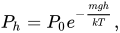
  • Ph is the pressure at height h,
  • P0 is the pressure at reference point 0 (typically referring to sea level),
  • m is the mass per air molecule,
  • g is the acceleration due to gravity,
  • h is height from reference point 0,
  • k is the Boltzmann constant,
  • T is the temperature in kelvins.

Therefore, instead of pressure being a linear function of height as one might expect from the more simple formula given in the "basic formula" section, it is more accurately represented as an exponential function of height.

Note that in this simplification, the temperature is treated as constant, even though temperature also varies with height. However, the temperature variation within the lower layers of the atmosphere (troposphere, stratosphere) is only in the dozens of degrees, as opposed to their thermodynamic temperature, which is in the hundreds, so the temperature variation is reasonably small and is thus ignored. For smaller height differences, including those from top to bottom of even the tallest of buildings, (like the CN Tower) or for mountains of comparable size, the temperature variation will easily be within the single-digits. (See also lapse rate.)

An alternative derivation, shown by the Portland State Aerospace Society,[10] is used to give height as a function of pressure instead. This may seem counter-intuitive, as pressure results from height rather than vice versa, but such a formula can be useful in finding height based on pressure difference when one knows the latter and not the former. Different formulas are presented for different kinds of approximations; for comparison with the previous formula, the first referenced from the article will be the one applying the same constant-temperature approximation; in which case: where (with values used in the article)

  • z is the elevation in meters,
  • R is the specific gas constant = 287.053 J/(kg K)
  • T is the absolute temperature in kelvins = 288.15 K at sea level,
  • g is the acceleration due to gravity = 9.80665 m/s2 at sea level,
  • P is the pressure at a given point at elevation z in Pascals, and
  • P0 is pressure at the reference point = 101,325 Pa at sea level.

A more general formula derived in the same article accounts for a linear change in temperature as a function of height (lapse rate), and reduces to above when the temperature is constant: where
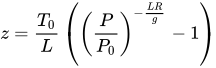
  • L is the atmospheric lapse rate (change in temperature divided by distance) = −6.5×10⁻³ K/m, and
  • T0 is the temperature at the same reference point for which P = P0

and the other quantities are the same as those above. This is the recommended formula to use.

See also

[edit]

References

[edit]
[edit]
Revisions and contributorsEdit on WikipediaRead on Wikipedia
from Grokipedia
Vertical pressure variation describes the change in within a that occurs with vertical distance, primarily due to the weight of the above a given point under the influence of . In the Earth's atmosphere, this results in a decrease in with increasing altitude, governed by the principle of . The relationship is expressed by the hydrostatic equation, dpdz=ρg\frac{dp}{dz} = -\rho g, where pp is , zz is , ρ\rho is the , and gg is the acceleration due to gravity (approximately 9.81 m/s²). This equation indicates that the vertical balances the downward gravitational force on the , preventing in a static atmosphere. In the standard atmosphere, pressure at sea level is defined as 1013.25 hectopascals (hPa), equivalent to 1 atmosphere (atm) or 101,325 pascals (Pa). As altitude increases, pressure decreases nonlinearly but approximately exponentially in the lower atmosphere, primarily because air density ρ\rho itself diminishes with height due to the (p=ρRT/Mp = \rho R T / M, where RR is the , TT is , and MM is ). For instance, in the under the (ISA) model, pressure halves roughly every 5.5 km near sea level, reaching about 226 hPa at 11 km (the ). This exponential decay is characterized by a scale height of approximately 8 km, meaning pressure reduces to about 37% of its value over that distance in an isothermal layer. The variation has profound implications for weather patterns, , and climate modeling, as it influences , wind dynamics, and the distribution of atmospheric constituents. For example, the drives vertical motions in convective systems, while in , it necessitates altitude compensation for performance and settings. Beyond the atmosphere, similar principles apply to oceanic pressure increases with depth or planetary atmospheres, but Earth's tropospheric profile remains the most studied due to its direct impact on human activity.

Hydrostatic Principles

Definition and Scope

Vertical pressure variation describes the systematic change in with respect to vertical position, whereby in incompressible s pressure increases linearly with depth below a reference level or decreases linearly with height above it, while in compressible s the variation is nonlinear, primarily due to the cumulative weight of the column overhead. In a static , this gradient emerges from the acting on the 's , resulting in a force per unit area that accumulates downward. This fundamental process underpins the behavior of s at rest, distinguishing it from isotropic transmission in all directions at a given point. The scope of vertical pressure variation encompasses all static fluids—encompassing both incompressible liquids like water and compressible gases like air—within a uniform gravitational field, where the fluid maintains hydrostatic equilibrium with no net vertical motion. This applies across diverse scales, from shallow pools to planetary atmospheres, but excludes dynamic regimes such as turbulent flows or convective circulations, where inertial and viscous effects introduce non-hydrostatic pressure deviations. Hydrostatic equilibrium ensures that the vertical pressure gradient precisely balances the gravitational body force, enabling predictable variations. Observations of vertical pressure variation trace back to the , when conducted pioneering experiments demonstrating that pressure in confined fluids transmits undiminished and increases with the height of the fluid column, laying the groundwork for hydrostatic principles. Pascal's work, including tests with vertical tubes and barrels, highlighted the role of depth in pressure buildup, influencing subsequent developments. This concept holds critical importance in natural and engineered systems: in the atmosphere, vertical pressure gradients drive weather patterns and large-scale circulation by influencing air density and buoyancy; oceanic variations dictate pressure loads on submersibles and contribute to thermohaline currents that regulate global heat transport; and in engineering applications, such as dam and reservoir design, accurate accounting of hydrostatic forces prevents structural failure under submerged conditions. Beyond Earth, it informs models of extraterrestrial atmospheres, aiding planetary science explorations.

Equilibrium Conditions

Hydrostatic equilibrium describes the condition in a at rest where the gravitational acting downward on any is exactly counterbalanced by the upward resulting from the vertical across that element. This balance arises because the at a given depth must support the weight of all above it, preventing any net of the particles. In such a state, vertical variation emerges as a direct consequence of this equilibrium, with increasing monotonically with depth. The validity of hydrostatic equilibrium relies on several key assumptions. The fluid must be static, meaning there is no relative motion between adjacent particles, which eliminates inertial and viscous forces. is assumed to be constant and directed vertically, a reasonable over limited vertical scales compared to Earth's . For liquids, the is typically treated as incompressible, maintaining constant regardless of changes, although gases may require additional considerations for in more advanced models. These assumptions simplify the analysis by focusing solely on body forces () and forces. Boundary conditions play a crucial role in establishing the pressure profile under hydrostatic equilibrium. At a free surface, such as the interface between a liquid and the atmosphere, the pressure is prescribed as the overlying , often taken as standard sea-level value for reference. This surface condition then determines the pressure at all deeper levels, as the weight of the intervening fluid layers accumulates downward, ensuring continuity and balance throughout the system. Equilibrium can deviate when external factors disrupt the force balance, such as the onset of fluid motion or turbulence, which introduces dynamic pressures and viscous effects that overwhelm the static hydrostatic regime.

Mathematical Formulation

Derivation of the Hydrostatic Equation

The derivation of the hydrostatic equation relies on the principle of hydrostatic equilibrium, in which a fluid element experiences no net vertical force due to balanced pressure and gravitational effects. To derive the equation, consider a small element in , modeled as a rectangular prism with infinitesimal height dzdz and horizontal cross-sectional area dAdA, where the vertical coordinate zz increases upward. The forces on this element include the pressure force at the bottom face, PdAP \, dA acting upward; the pressure force at the top face, (P+dP)dA(P + dP) \, dA acting downward; and the downward gravitational force, or weight of the element, ρgdAdz\rho g \, dA \, dz, where ρ\rho is the fluid density and g9.8m/s2g \approx 9.8 \, \text{m/s}^2 is the local . In equilibrium, the sum of these vertical forces is zero: PdA(P+dP)dAρgdAdz=0.P \, dA - (P + dP) \, dA - \rho g \, dA \, dz = 0. Dividing by dAdA yields P(P+dP)ρgdz=0,P - (P + dP) - \rho g \, dz = 0, which simplifies to dP=ρgdz,-dP = \rho g \, dz, or, rearranging, dP=ρgdz.dP = -\rho g \, dz. This differential equation describes the vertical variation of , with the negative sign indicating that pressure decreases as height increases. The derivation assumes hydrostatic balance (the fluid is at rest with no ), isotropic (pressure acts uniformly in all directions without shear stresses from ), and constant gg over the small element. In standard notation, PP is in pascals (Pa), ρ\rho in kilograms per cubic meter (kg/m³), gg in meters per second squared (m/s²), and zz in meters (m).

Integrated Pressure Formula

The integrated form of the hydrostatic provides explicit expressions for as a function of vertical position by solving the differential relation between , , and . This integration yields practical formulas for both general and simplified cases in systems. In its general form, the P(z)P(z) at zz (with upward positive) relative to a reference P0P_0 at z0z_0 is P(z)=P0+z0zρ(z)gdz,P(z) = P_0 + \int_{z_0}^{z} -\rho(z') g \, dz', where ρ(z)\rho(z') is the (potentially varying with ), and gg is the constant acceleration due to gravity. For incompressible s, where ρ\rho remains constant, the simplifies directly to ΔP=ρgh\Delta P = \rho g h, with hh representing the vertical distance (depth for downward or difference for upward). This relation quantifies the increase due solely to the weight of the overlying fluid column. A representative application is the calculation of pressure at the ocean bottom, where seawater behaves nearly incompressibly over typical depths; for an average ocean depth of 4 km and seawater density of approximately 1025 kg/m³, the hydrostatic contribution yields a pressure of about 40 MPa (roughly 400 times atmospheric pressure at the surface). When assuming constant density, the pressure profile becomes linear: P(z)=P0ρgzP(z) = P_0 - \rho g z for coordinate zz increasing upward from the reference point. This approximation produces a straight-line variation in pressure with height, facilitating straightforward computations in uniform fluid layers. These formulas hold under the assumptions of and uniform conditions, such as constant and ; however, in gases where varies appreciably with and , the constant-density model breaks down, necessitating integration with a position-dependent ρ\rho.

Applications in Natural Systems

Atmospheric Pressure Variation

In Earth's atmosphere, vertical pressure variation follows the , where decreases with increasing altitude due to the diminishing weight of the overlying air column. This variation is particularly pronounced in the and , where drops from approximately 1013 hPa at to near 0 hPa above 100 km, as defined in the U.S. Standard Atmosphere model. The atmosphere's compressible nature leads to a nonlinear profile, contrasting with linear changes in incompressible fluids. For an isothermal atmosphere—assuming constant —the pressure variation is modeled by the equation: P(z)=P0exp(zH)P(z) = P_0 \exp\left(-\frac{z}{H}\right) where P(z)P(z) is the at altitude zz, P0P_0 is the sea-level , and HH is the , given by H=RTMgH = \frac{RT}{Mg}, with RR as the , TT as , MM as of air, and gg as . At sea level, H8H \approx 8 km, reflecting typical conditions of 288 K and standard air composition. This model approximates the integrated hydrostatic equation for variable density, providing a baseline for profiles in constant- layers like the lower . Several factors influence the actual pressure variation beyond the ideal isothermal case. The temperature lapse rate, averaging 6.5°C per km in the , causes to decrease more rapidly than in isothermal conditions, steepening the . also plays a role by altering air —moist air is less dense than dry air at the same and —leading to slightly reduced pressure decreases at humid altitudes, though this effect is minor compared to . In the (ICAO) standard atmosphere, these factors yield a of about 226 hPa at 11 km () and continue to diminish exponentially in higher layers. Atmospheric pressure is measured using barometers, such as mercury or aneroid types, which detect changes in air weight and are calibrated against standard units like hectopascals. In , pressure altimetry converts these measurements to altitude via barometric altimeters, assuming a standard lapse rate to indicate height above a reference pressure level (e.g., 1013 hPa), enabling safe and terrain clearance. On other , vertical pressure variation differs markedly due to atmospheric composition and mass. , for example, has a dense atmosphere with about 92 times Earth's (approximately 93 bar), resulting in a much smaller and slower pressure decrease with altitude compared to Earth's nitrogen-oxygen mix.

Oceanic and Aquatic Pressure Variation

In oceanic and aquatic environments, pressure increases linearly with depth due to the near-incompressibility of , following the hydrostatic principle for fluids of constant . The pressure at a given depth h is given by P(h)=P0+ρghP(h) = P_0 + \rho g h, where P0P_0 is the (typically 1 ), ρ\rho is the fluid , and g is . For seawater, ρ1025\rho \approx 1025 kg/m³, resulting in an approximate increase of 1 for every 10 of depth. This linear profile contrasts with more variable pressure changes in compressible media, providing a predictable framework for and engineering. Density variations in water bodies, influenced by and , introduce slight deviations from perfect linearity, creating layered structures such as the pycnocline. In the , higher increases , while warmer decrease it, leading to a pycnocline where rapidly changes with depth, affecting gradients subtly over large scales. For instance, in the deep , these effects are minimal compared to the dominant linear increase, but they influence mixing and circulation patterns. In freshwater systems like lakes, is lower at approximately 1000 kg/m³, resulting in a slightly shallower gradient—about 1 per 10.3 meters—compared to saltwater environments. Extreme depths exemplify the cumulative effect of this linear pressure buildup. At the , the deepest point in the ocean at approximately 11 km, pressure reaches about 1100 , equivalent to over 1,000 times , posing severe challenges to structural integrity. These conditions highlight the practical limits of human activity in aquatic environments; for deep-sea diving, recreational scuba is restricted to around 40 meters (about 5 total) due to and decompression risks, while technical with mixed gases extends to 100 meters but requires specialized equipment. Engineering designs for and underwater habitats must account for these pressures to prevent implosion. or pressure hulls are used in vehicles like the Alvin , rated for depths up to 6.5 km (around 650 ), with safety factors ensuring survival against the linear hydrostatic load. Biological adaptations in aquatic organisms, such as the pressure-resistant enzymes in deep-sea bacteria, also underscore the profound impact of vertical pressure variation on life in these environments.

Special Cases and Paradoxes

Hydrostatic Paradox

The hydrostatic paradox refers to the counterintuitive observation that in a system of —containers interconnected at their bases and filled with the same incompressible fluid—the fluid surface levels equalize across all vessels, irrespective of their differing widths, shapes, or cross-sectional areas. This occurs because fluid transmits horizontally through the connections, ensuring that the at any given depth below the surface is identical in all vessels, leading to equilibrium at the same height. The underlying explanation is that the pressure exerted at the base of each vessel depends solely on the of the fluid column above it and the fluid's , rather than the total volume or weight of the fluid in the vessel. This principle was vividly demonstrated through experiments with Pascal's vases, a set of connected vessels of varying shapes (such as cylindrical, conical, and irregular forms) conducted by and published in 1663, which showed that despite the vases holding unequal amounts of , the levels stabilized at the same , confirming that base pressure is independent of the vessel's form. A common misconception is that a wider or broader-based vessel should experience greater or support a lower level due to holding more weight, intuitively suggesting an imbalance; however, this is resolved by the fact that equilibrates horizontally across the connections at the base, preventing any net flow until the heights match and pressures balance. In modern contexts, this underpins the operation of hydraulic systems, where applied to a confined in one part transmits uniformly to pistons of different areas, enabling without loss. Similarly, barometric leveling techniques rely on the same height-dependent uniformity to measure differences accurately in .

Effects in Non-Uniform or Compressible Fluids

In stratified fluids, where varies vertically due to factors such as or gradients, the hydrostatic pressure profile deviates from the uniform-density case and is described by the dPdz=ρ(z)g\frac{dP}{dz} = -\rho(z) g, which integrates to P(z)=P00zρ(ζ)gdζP(z) = P_0 - \int_0^z \rho(\zeta) g \, d\zeta. This formulation accounts for the cumulative weight of overlying layers with position-dependent , essential for modeling systems like oceanic pycnoclines or atmospheric layers. For instance, in the atmosphere, inversions—where increases with height—stabilize the layer by reducing the density decrease rate, effectively increasing the local H=RTMgH = \frac{RT}{Mg} and slowing the pressure drop compared to a standard profile. Compressibility introduces further modifications by allowing density to vary with , altering the hydrostatic balance. In liquids like , this effect is minor due to low isothermal β4.6×10¹⁰Pa1\beta \approx 4.6 \times 10^{-10} \, \mathrm{Pa}^{-1} at 20°C and 1 , meaning volume changes are negligible even at depths of several kilometers, so the incompressible suffices for most oceanic applications. In gases, is pronounced, leading to refinements of the that incorporate adjusted for polytropic or adiabatic conditions, where decreases more rapidly than in incompressible models due to expanding with altitude. The hydrostatic approximation breaks down in non-equilibrium scenarios with significant vertical accelerations or rotational effects, requiring full Navier-Stokes solutions. This occurs in high-speed flows, such as supersonic aerodynamics where Mach numbers exceed 0.3, introducing components that dominate over gravitational ones and cause density waves. Similarly, in rotating fluids like Earth's liquid outer core, Coriolis forces generate non-hydrostatic pressure perturbations, contributing to topographic variations at the core-mantle boundary on the order of 0.5 km amplitude. Advanced models for compressible atmospheres incorporate thermodynamic processes, such as the dry adiabatic Γ=gCp9.8K/km\Gamma = \frac{g}{C_p} \approx 9.8 \, \mathrm{K/km}, which governs stratification in convectively unstable regions and influences profiles through the , thereby refining pressure-height relations in non-isothermal conditions.

References

Add your contribution
Related Hubs
User Avatar
No comments yet.