Hubbry Logo
Communicating vesselsCommunicating vesselsMain
Open search
Communicating vessels
Community hub
Communicating vessels
logo
8 pages, 0 posts
0 subscribers
Be the first to start a discussion here.
Communicating vessels
from Wikipedia
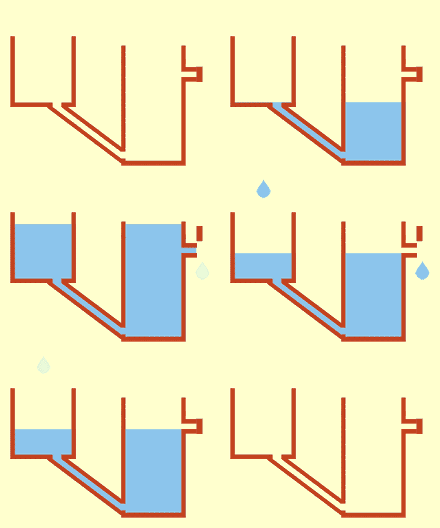
A set of communicating vessels
Animation showing the filling of communicating vessels

Communicating vessels or communicating vases[1] are a set of containers containing a homogeneous fluid and connected sufficiently far below the top of the liquid: when the liquid settles, it balances out to the same level in all of the containers regardless of the shape and volume of the containers. If additional liquid is added to one vessel, the liquid will again find a new equal level in all the connected vessels. This was discovered by Simon Stevin as a consequence of Stevin's Law.[2] It occurs because gravity and pressure are constant in each vessel (hydrostatic pressure).[3]

Blaise Pascal proved in the seventeenth century that the pressure exerted on a molecule of a liquid is transmitted in full and with the same intensity in all directions.

Applications

[edit]

Since the days of ancient Rome, the concept of communicating vessels has been used for indoor plumbing, via aquifers and lead pipes. Water will reach the same level in all parts of the system, which acts as communicating vessels, regardless of what the lowest point is of the pipes – although in practical terms the lowest point of the system depends on the ability of the plumbing to withstand the pressure of the liquid.

The surface of the water tower's water (2) is above that of the water pipes in all buildings (3)

In cities, water towers are frequently used so that city plumbing will function as communicating vessels, distributing water to higher floors of buildings with sufficient pressure.

Hydraulic presses, using systems of communicating vessels, are widely used in various applications of industrial processes.

See also

[edit]

References

[edit]
Revisions and contributorsEdit on WikipediaRead on Wikipedia
from Grokipedia
Communicating vessels, also known as connected vessels, consist of multiple containers interconnected at their bases, allowing a to flow freely between them until it reaches the same equilibrium level in each, regardless of the vessels' shapes, sizes, or orientations, provided the connections are below the surface. This arises from the fundamental of , where the pressure exerted by a at rest increases linearly with depth (p = ρgh, with ρ as , g as , and h as depth) and is transmitted equally in all directions at the same horizontal level across the connected system, ensuring balanced forces on the surfaces. The principle was first systematically explained in 1586 by the Flemish mathematician and engineer Simon Stevin in his treatise De Beghinselen des Waterwichts (The Elements of Hydrostatics), as a consequence of his resolution of the hydrostatic paradox—the counterintuitive observation that the force on a vessel's base depends solely on the fluid height and base area, not the vessel's volume or shape. Stevin demonstrated this using a method of "solidification," imagining the fluid as composed of solid prisms to calculate pressures rigorously, thereby laying foundational mathematical groundwork for modern fluid statics independent of Aristotelian physics. In practice, communicating vessels underpin numerous and scientific applications, including water level indicators for and , where flexible tubes connect reservoirs to measure elevations over distances; and laboratory demonstrations of fluid behavior, like U-tubes for . These systems highlight the principle's reliability for incompressible s under , though deviations occur with compressible gases, temperature variations, or capillary effects in narrow tubes.

Definition and Principle

Basic Concept

Communicating vessels refer to a set of interconnected containers that are linked by a pathway allowing the same incompressible to flow between them, resulting in the liquid levels reaching the same height in all vessels regardless of their shapes, sizes, or volumes. This phenomenon occurs because the seeks equilibrium under the influence of , ensuring that the surface of the liquid in each connected vessel aligns at the same horizontal level when the system is at rest. Typically, these vessels are open to the atmosphere to maintain uniform at the liquid surfaces, though closed systems can exhibit similar behavior if pressure differences are accounted for. The principle relies on several key assumptions: the fluid must be static, meaning it is not in motion; it must be incompressible, so its density remains constant; and it must have uniform density throughout, with gravity acting uniformly downward on all parts of the system. These conditions ensure that no external forces disrupt the balance, allowing the fluid to distribute itself evenly across the connected volumes. A brief reference to hydrostatic pressure explains why this equalization happens, as the pressure at any given depth in the fluid depends solely on the height of the fluid column above it, leading to balanced forces across the system./Book:University_Physics_I-Mechanics_Sound_Oscillations_and_Waves(OpenStax)/14%3A_Fluid_Mechanics/14.02%3A_Pressure) To observe this in a simple experiment, consider a setup with two or more transparent vessels, such as vases or tubes of different widths, connected at their bases by a horizontal tube. Pouring into one vessel causes the level to rise initially in that alone, but as the flows through the connecting pathway, it distributes to the others until the surfaces in all vessels stabilize at identical heights. This visual demonstration, often illustrated using a U-shaped tube where tilting one side raises the level on the other until they equalize, highlights how the shape of the vessels—whether narrow, wide, or irregular—does not affect the final level alignment, emphasizing the role of connectivity and in achieving balance.

Hydrostatic Equilibrium

In the setup of communicating vessels, is achieved when the is at rest, with the downward gravitational force exerted by each column precisely balancing the upward force transmitted through the connecting points, leading to equal heights across all vessels. This balance ensures that no net flow occurs, as the at any given depth in the connected system remains uniform horizontally. The role of is crucial in maintaining this equilibrium, as it acts equally on the free surfaces of the in each vessel, imposing no differential that could drive movement between them. Without this uniform overlay, disparities in surface exposure could disrupt the static state, but under standard conditions, it preserves the parity of the underlying hydrostatic pressures. To intuit this phenomenon, consider a involving two connected vessels with markedly different cross-sectional areas filled to the same : the at the base of each depends solely on the vertical of the column above it, not on or width of the vessel, illustrating that dictates the force balance rather than the amount of fluid present. This independence from shape or area underscores the principle's reliance on depth alone for pressure equalization. This equilibrium principle applies specifically to miscible, homogeneous fluids subjected to constant gravitational acceleration, where density uniformity and lack of external perturbations allow the surfaces to level without complications from stratification or variable forces.

Historical Development

Early Observations

The earliest known empirical observations of the effect now known as the communicating vessels principle—whereby fluid levels equalize in interconnected containers due to hydrostatic equilibrium—appear in ancient Greek engineering devices designed for practical purposes. Another Greek invention attributed to Pythagoras of Samos (c. 570–495 BCE) incorporated the principle in a novelty drinking vessel known as the Pythagorean cup, intended to promote moderation. The cup features a central siphon hidden within a column connected to the base; when filled to a safe level, hydrostatic pressure balances and prevents flow, but exceeding this threshold activates the siphon, equalizing pressure with the external environment and emptying the vessel entirely through an outlet. Archaeological examples from Samos and historical accounts confirm its use as an educational tool to enforce temperance, reflecting early anecdotal awareness of fluid level consistency in linked channels. Local traditions and replicas preserved in museums underscore its role in philosophical teachings, where overindulgence triggered the device's "punishment" via the unobserved equalization effect. In the BCE, the engineer Tacticus described a system in his treatise Poliorketika, utilizing pairs of identical -filled vessels connected by tubes at distant locations to transmit signals rapidly during military operations. Operators at each end would simultaneously allow to drain from their vessels at the same rate, causing floating marked with pre-agreed messages to rise to the same level and become visible above the rim, enabling over distances up to several kilometers without line-of-sight visibility. This mechanism implicitly relied on the consistent equalization of levels in communicating vessels, demonstrating an intuitive grasp of the phenomenon for signaling, though not formally theorized. Roman engineers further applied similar observations in large-scale hydraulic during the late Republic and (c. 300 BCE–300 CE), particularly in aqueduct systems that traversed varied terrain. Inverted siphons—closed conduits of lead or terracotta —were employed to carry water across , maintaining flow by exploiting of communicating vessels to ensure consistent levels between elevated channels and subterranean sections. For instance, the Aqua Appia (312 BCE) and later aqueducts like the (52 CE) integrated such pressure lines, where water descended into a valley, equalized across the conduit network, and ascended the opposite side without pumps, relying solely on and hydrostatic balance. Approximately 80 such classical siphons are documented, highlighting the principle's practical utility in sustaining urban over distances up to 92 km. These designs, detailed in Frontinus's De aquaeductu urbis Romae (c. 97 CE), treated the effect as an empirical engineering rule rather than a , optimizing distribution for baths, fountains, and . In medieval Islamic , 13th-century engineer (c. 1136–1206) documented interconnected water systems in his Book of Knowledge of Ingenious Mechanical Devices, advancing practical applications for and . Al-Jazari's designs, such as automated fountains and water-raising machines, featured basins and cisterns linked by where transfer maintained balanced levels through , enabling timed flows for agricultural distribution in arid regions like Diyarbakir. These systems, powered by water wheels or animal force, exemplified a sophisticated empirical understanding of level consistency in communicating vessels, integrated into broader networks for mosques, hospitals, and farms without explicit theoretical explanation. His work built on earlier Abbasid traditions, using the to regulate supply in qanats and saqiyas, prioritizing reliability over explanation. By the 16th century, European mining operations provided further anecdotal evidence through underground water management. In De Re Metallica (1556), Georgius Agricola described how miners in Saxony and Bohemia addressed flooding by connecting shafts and tunnels, noting that water from higher excavations drained naturally into lower adits or sumps via linked passages, achieving equilibrium to facilitate ore extraction. For example, when a primary shaft accumulated water, a secondary lower shaft or tunnel was sunk to intercept and divert it, with levels balancing across the network to prevent inundation—often managed manually with buckets or early pumps until equilibrium allowed safer access. Agricola's accounts, drawn from Saxon practices, portrayed this as a proven empirical technique for depths up to 25 meters, essential for silver and copper mines, though attributed to practical trial rather than hydrostatic theory. Across these eras, the communicating vessels effect was viewed primarily as an unexplained empirical rule guiding water management in , , and signaling, without mathematical formulation. Ancient and medieval practitioners leveraged it for efficiency in resource-scarce environments, from to urban sustenance, laying groundwork for later scientific inquiry while embedding it in cultural norms of moderation and utility.

Scientific Formulation

The scientific formulation of the principle of communicating vessels took shape during the as part of the emerging field of . The Flemish mathematician and engineer first systematically explained the principle in 1586 in his treatise De Beghinselen des Waterwights (The Elements of Hydrostatics), as a consequence of resolving the . Stevin demonstrated this using a method of "solidification," imagining the fluid as composed of solid prisms to calculate pressures rigorously, thereby laying foundational mathematical groundwork for modern fluid statics. Building on this, played a pivotal role, conducting experiments between 1646 and 1647 that demonstrated how liquids in interconnected tubes always equalize their levels, regardless of the vessels' shapes or sizes. This observation stemmed from his understanding that pressure in a fluid at rest is transmitted equally in all directions, a key aspect of what became known as . Pascal integrated these findings into his broader hydrostatic framework, detailed in the Traité de l'équilibre des liqueurs (Treatise on the Equilibrium of Liquids), completed around 1651–1654 but published posthumously in 1663. In this work, he explicitly articulated that "the liquids in communicating vessels seek the same level," supported by diagrams showing connected tubes and vessels to illustrate the equilibrium. This formulation marked a shift toward a mechanistic view of fluids, resolving earlier paradoxes like the hydrostatic paradox by emphasizing pressure dependence on depth rather than container geometry. Evangelista Torricelli's experiments in 1643, which produced the first mercury barometer, indirectly bolstered Pascal's ideas by quantifying and demonstrating how external pressures influence columns in open systems. These results helped contextualize the balance essential to level equalization in communicating vessels. Refinements in the 18th century came through Daniel Bernoulli's (1738), where he linked the static equilibrium of fluids in connected vessels to principles. In static cases, Bernoulli's reduces to the hydrostatic condition, explaining level equalization as a balance between and energy without flow.

Mathematical Description

Pressure Distribution in Fluids

In hydrostatics, the pressure at a point within a static depends solely on the depth below the and the 's properties, independent of the container's shape or orientation. This phenomenon, known as the hydrostatic paradox, demonstrates that the force exerted by the on the base of a vessel arises from the weight of the column directly above that point, rather than the total volume or vessel geometry. For instance, narrower containers exert the same base as wider ones at equivalent depths, as the reduced cross-sectional area is offset by increased height for the same mass. This counterintuitive result was first analyzed by in 1586, highlighting the uniform vertical load distribution in fluids. The fundamental relation for hydrostatic pressure is given by P=ρghP = \rho g h, where PP is the gauge at depth hh, ρ\rho is the density, gg is the acceleration due to gravity, and hh is the vertical distance below the surface. This equation arises from the force balance on a element, where the difference across a small height Δh\Delta h equals the weight of the overlying divided by the element's area: ΔP=ρgΔh\Delta P = \rho g \Delta h. For uniform-density fluids, integrating this yields the linear increase with depth. is treated as a P(r)P(\mathbf{r}), varying spatially but acting isotropically at each point without directional preference./Volume_1:_Mechanics_Sound_Oscillations_and_Waves/14%3A_Fluid_Mechanics/14.04%3A_Pressure) The vertical follows from the condition, expressed as dPdz=ρg\frac{dP}{dz} = -\rho g, where zz increases upward. This indicates a constant decrease in with height, leading to a linear profile in incompressible, homogeneous . In static conditions, this gradient ensures balance against gravitational forces on fluid parcels. The derivation assumes no horizontal variations or motion, focusing on vertical equilibrium. In static fluids, pressure is isotropic, meaning it exerts equal force per unit area in all directions at a given point. This follows from Pascal's principle, which states that an applied pressure change in a confined fluid transmits undiminished to every point and surface. Blaise Pascal formulated this in 1663, based on experiments showing uniform transmission in enclosed liquids. The principle underpins the hydrostatic stress tensor as PI-P \mathbf{I}, where I\mathbf{I} is the identity tensor, confirming omnidirectional action without shear components./Book%3A_University_Physics_I_-Mechanics_Sound_Oscillations_and_Waves(OpenStax)/14%3A_Fluid_Mechanics/14.05%3A_Pascals_Principle_and_Hydraulics) These relations hold under key assumptions: the fluid is incompressible (constant ρ\rho), inviscid (negligible viscosity, so no shear stresses), at constant temperature, and in hydrostatic equilibrium with no bulk motion. The derivations stem from Newton's second law applied to infinitesimal fluid elements, balancing pressure forces against gravity without acceleration terms. These idealizations simplify real fluids like water or air under low-speed, equilibrium conditions.

Derivation of Level Equalization

Consider two open vessels connected at their bases by a tube, containing the same incompressible with ρ\rho. At equilibrium, the liquid surfaces are exposed to the same PatmP_\text{atm}. The at the bottom of the first vessel, at depth h1h_1 below its surface, is given by the hydrostatic pressure formula Pbottom,1=Patm+ρgh1P_\text{bottom,1} = P_\text{atm} + \rho g h_1, where gg is the acceleration due to gravity. To derive this, examine a free-body diagram of a fluid column in the first vessel from the surface to the base. The forces acting are the downward on the top surface and the weight of the column, ρgh1\rho g h_1 per unit area, leading to a net increase ΔP=ρgΔh\Delta P = \rho g \Delta h with depth. Integrating the hydrostatic dPdz=ρg\frac{dP}{dz} = -\rho g (where zz increases upward) from the surface (z=h1z = h_1, P=PatmP = P_\text{atm}) to the base (z=0z = 0) yields Pbottom,1Patm=ρgh1P_\text{bottom,1} - P_\text{atm} = \rho g h_1. Similarly, for the second vessel, Pbottom,2=Patm+ρgh2P_\text{bottom,2} = P_\text{atm} + \rho g h_2. Since the vessels communicate via the connecting tube, the at the lowest common point must be equal in both, so Pbottom,1=Pbottom,2P_\text{bottom,1} = P_\text{bottom,2}. Substituting the expressions gives Patm+ρgh1=Patm+ρgh2P_\text{atm} + \rho g h_1 = P_\text{atm} + \rho g h_2, simplifying to h1=h2h_1 = h_2 for identical ρ\rho and gg. This equalization occurs because any initial height difference would create a pressure imbalance, driving fluid flow until equilibrium is restored, per that transmits equally in all directions. For multiple vessels connected in series or via a common pathway, the same applies: the bottom pressures equalize across all connections, ρghi=\constant\rho g h_i = \constant for each height hih_i, implying all surface heights hih_i are identical at equilibrium, assuming uniform ρ\rho and open surfaces. In the ideal open case detailed above, levels equalize precisely. For closed vessels with trapped air pockets, deviations may occur due to additional gas pressures, but this is outside the standard hydrostatic assumption.

Applications

Everyday Examples

Similarly, level indicators on household items like kettles or teapots function as communicating vessels, displaying the internal level through a connected transparent tube that mirrors the height inside the . Natural occurrences demonstrate the principle's ubiquity, such as rainwater forming connected puddles on paved surfaces or , where flows through low points to equalize depths across the linked areas. In waterways, canal locks operate by temporarily connecting chambers to adjacent sections, enabling water levels to balance between different elevations and facilitating safe boat passage. In transportation, interconnected ballast tanks on ships exemplify by allowing to distribute evenly across multiple compartments during loading or unloading, which stabilizes the vessel, enhances maneuverability, and avoids spillage even in rough conditions. A engaging illustration often featured in science puzzles or simple tricks involves a bent or irregularly shaped tube connecting two open containers; despite the tube's twists, pouring liquid into one end results in equal levels at both openings, defying intuitive expectations and highlighting 's robustness regardless of path geometry.

Engineering and Scientific Uses

In engineering, the principle of communicating vessels underpins various instrumentation devices for precise pressure and level measurements. U-tube manometers, for instance, consist of a U-shaped tube partially filled with a liquid such as mercury or water, where the difference in liquid levels between the two arms directly indicates the pressure differential applied to the open ends, relying on hydrostatic equilibrium to equalize pressures at the base. This setup is widely used in laboratories and industrial settings to measure gas or fluid pressures with high accuracy, as the height difference hh relates to pressure via P=ρghP = \rho g h, where ρ\rho is the liquid density and gg is gravitational acceleration. Similarly, certain barometers, like the Goethe barometer, employ connected vessels filled with colored water to visualize atmospheric pressure changes through level shifts in response to air pressure variations. Spirit levels, or bubble levels, incorporate a sealed tube with a liquid and air bubble acting as a communicating vessel system; the bubble centers when the tube is horizontal due to gravitational leveling of the liquid, ensuring alignment in construction and surveying applications. Hydraulic systems leverage communicating vessels to maintain uniform distribution and stability across connected reservoirs. In designs, rubber dams use water-filled bladders connected via control shafts, where the principle ensures the bladder height matches the upstream water level through hydrostatic balance, facilitating controlled flooding and energy storage. Pump reservoirs in hydraulic circuits often feature interconnected compartments that equalize levels, preventing and ensuring consistent supply to the , as seen in industrial presses and machinery. Automotive fuel systems in some dual-tank configurations connect saddle tanks via low-level channels, allowing fuel to equalize between compartments under to minimize sloshing and maintain balanced during vehicle motion. Scientific experiments utilize communicating vessels for accurate fluid property assessments and educational demonstrations. To determine liquid , a U-tube setup compares the equilibrium heights of a known reference and an unknown sample when connected, yielding density ρx=ρkhkhx\rho_x = \rho_k \frac{h_k}{h_x}, where subscripts denote known (k) and unknown (x) values, enabling precise measurements in physics and chemistry labs. In teaching demonstrations, setups with variably shaped connected tubes filled with dyed water illustrate level equalization regardless of vessel geometry, reinforcing hydrostatic principles for students; these are common in courses to visualize applications. In industrial settings, level sensors in chemical processing plants often employ hydrostatic principles akin to communicating vessels for monitoring contents. Submersible pressure transducers at the base measure the hydrostatic head, converting it to level via h=Pρgh = \frac{P}{\rho g}, with compensation for overlying gas to ensure reliability in corrosive environments like reactors and storage vessels. This approach supports automated and overflow prevention in facilities handling volatile chemicals. Modern applications extend to , where scaled-down communicating vessel chips enable precise assays in biomedical research. For example, pneumatically gated microfluidic communicating vessel (μCOVE) chips use interconnected microchambers to automate immunomagnetic , achieving rapid analyte detection by controlling levels through pressure-driven equalization in volumes as small as 20 μL per vessel. In space environments, the principle faces exceptions under zero gravity, where dominates over hydrostatic forces, altering behavior in orbital habitats; experiments on the study these deviations to inform propellant management in .

Limitations and Extensions

Non-Ideal Conditions

In real-world scenarios, the ideal equalization of fluid levels in communicating vessels deviates due to viscous effects, particularly in highly viscous fluids like . The frictional resistance within the connecting tube slows the flow, making the equalization process time-dependent rather than instantaneous. This behavior follows Poiseuille's law for in tubes, where the volume flow rate Q=πΔPR48ηLQ = \frac{\pi \Delta P R^4}{8 \eta L}, with ΔP\Delta P as the pressure difference, RR the tube radius, η\eta the , and LL the tube length; higher η\eta reduces QQ, prolonging the time to equilibrium. Experimental investigations using two communicating vessels connected by a capillary tube have demonstrated that the height difference decreases exponentially, modeled as ln[2z1z01]=Kt-\ln\left[\frac{2z_1}{z_0} - 1\right] = Kt, where z1z_1 and z0z_0 are the instantaneous and initial height differences, tt is time, and KK is a constant inversely proportional to η\eta; for at , values of approximately 1.15×1031.15 \times 10^{-3} Pa·s were obtained, confirming the law's applicability. Temperature variations across the vessels introduce gradients, as ρ\rho decreases with increasing TT (typically via ρ(T)=ρ0[1β(TT0)]\rho(T) = \rho_0 [1 - \beta (T - T_0)], where β\beta is the coefficient). This causes slight level disparities to maintain hydrostatic balance, with lower- (warmer) exhibiting a higher level. In systems with gradients, such as along connecting , these effects amplify errors in hydrostatic leveling applications. Studies on such systems have shown that heterogeneity leads to level differences proportional to the , reducible by forced circulation to homogenize within minutes, depending on hose and flow rate. Surface tension becomes significant in vessels with narrow tubes or openings, where capillary effects alter meniscus shapes and induce pressure jumps via the Young-Laplace equation: ΔP=2σr,\Delta P = \frac{2\sigma}{r}, with σ\sigma as the surface tension and rr the meniscus radius of curvature. For wetting fluids like in tubes, this raises the level in narrower arms relative to wider ones, creating apparent non-equalization; the capillary rise height h=2σcosθρgrh = \frac{2\sigma \cos\theta}{\rho g r}, where θ\theta is the contact angle, can reach millimeters in tubes under 1 mm radius. This deviation is prominent in microfluidic or thin-tube setups, where surface forces dominate over below the capillary length scale of about 2-3 mm for . Non-uniform acceleration, such as in horizontally accelerating frames (e.g., vehicles) or rotating systems (e.g., centrifuges), modifies the effective geff=g+a\vec{g}_{eff} = \vec{g} + \vec{a}
Add your contribution
Related Hubs
User Avatar
No comments yet.