Hubbry Logo
Automatic Computing EngineAutomatic Computing EngineMain
Open search
Automatic Computing Engine
Community hub
Automatic Computing Engine
logo
8 pages, 0 posts
0 subscribers
Be the first to start a discussion here.
Contribute something
Automatic Computing Engine
from Wikipedia

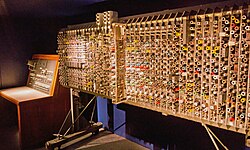
Pilot ACE
Punch cards, detail view against dark grey background, for Pilot ACE computer, built at the National Physical Laboratory (United Kingdom), circa 1950. Science Museum London[1]

The Automatic Computing Engine (ACE) was a British early electronic serial stored-program computer design by Alan Turing. Turing completed the ambitious design in late 1945.

The ACE was not built, but a smaller version, the Pilot ACE, was constructed at the National Physical Laboratory and became operational in 1950. A larger implementation of the ACE design was the MOSAIC computer, which became operational in 1955. ACE also led to the Bendix G-15 and other computers.

Background

[edit]

The project was managed by John R. Womersley,[2] superintendent of the Mathematics Division of the National Physical Laboratory (NPL). The use of the word Engine was in homage to Charles Babbage and his Difference Engine and Analytical Engine. Turing's technical design Proposed Electronic Calculator was the product of his theoretical work in 1936 "On Computable Numbers"[3] and his wartime experience at Bletchley Park where the Colossus computers had been successful in breaking German military codes. In his 1936 paper, Turing described his idea as a "universal computing machine", but it is now known as the Universal Turing machine.[citation needed]

Turing was sought by Womersley to work in the NPL on the ACE project; he accepted and began work on 1 October 1945 and by the end of the year he completed his outline of his 'Proposed electronic calculator', which was the first reasonably complete design of a stored-program computer and, apart from being on a much larger scale than the final working machine, anticipated the final realisation in most important respects.[4] However, because of the strict and long-lasting secrecy around the Bletchley Park work, he was prohibited (because of the Official Secrets Act) from explaining that he knew that his ideas could be implemented in an electronic device.[5] The better-known EDVAC design presented in the First Draft of a Report on the EDVAC (dated 30 June 1945), by John von Neumann, who knew of Turing's theoretical work, received much publicity, despite its incomplete nature and questionable lack of attribution of the sources of some of the ideas.

Turing's report on the ACE was written in late 1945 and included detailed logical circuit diagrams and a cost estimate of £11,200.[6] He felt that speed and size of memory were crucial and he proposed a high-speed memory of what would today be called 25 kilobytes, accessed at a speed of 1 MHz; he remarked that for the purposes required "the memory needs to be very large indeed by comparison with standards which prevail in most valve and relay work, and [so] it is necessary to look for some more economical form of storage", and that memory "appears to be the main limitation in the design of a calculator, i.e. if the storage problem can be solved all the rest is comparatively straightforward".[7] The ACE implemented subroutine calls,[8] whereas the EDVAC did not, and what also set the ACE apart from the EDVAC was the use of Abbreviated Computer Instructions,[5] an early form of programming language. Initially, it was planned that Tommy Flowers, the engineer at the Post Office Research Station at Dollis Hill in north London, who had been responsible for building the Colossus computers, should build the ACE, but because of the secrecy around his wartime achievements and the pressure of post-war work, this was not possible.[citation needed]

Pilot ACE

[edit]

Turing's colleagues at the NPL, not knowing about Colossus, thought that the engineering work to build a complete ACE was too ambitious, so the first version of the ACE that was built was the Pilot Model ACE, a smaller version of Turing's original design. Turing's assistant, Jim Wilkinson, worked on the logical design of the ACE, and after Turing left for Cambridge in 1947, Wilkinson was appointed to lead the ACE group.[9] The Pilot ACE had fewer than 1,000 thermionic valves (vacuum tubes) compared to about 18,000 in the ENIAC.[10] It used mercury delay lines for its main memory. Each of the 12 delay lines was 5 feet (1.5 m) long and propagated 32 instructions or data words of 32 bits each. This ran its first program on 10 May 1950, at which time it was the fastest computer in the world; each of its delay lines had a throughput of 1 Mbit/s.[11]

The first production versions of the Pilot ACE, the English Electric DEUCE, of which 31 were sold, were delivered in 1955.[12]

MOSAIC

[edit]

A second implementation of the ACE design was the MOSAIC (Ministry of Supply Automatic Integrator and Computer).[13][14] This was built by Allen Coombs and William Chandler of Dollis Hill who had worked with Tommy Flowers on building the ten Colossus computers. It was installed at the Radar Research and Development Establishment (RRDE) at Malvern, which later merged with the Telecommunications Research Establishment (TRE) to become the Royal Radar Establishment (RRE). It ran its first trial program in late 1952 or early 1953 and became operational in early 1955. MOSAIC contained 6,480 electronic valves and had an availability of about 75%. It occupied four rooms and was the largest of the early British computers. It was used to calculate aircraft trajectories from radar data. It continued operating until the early 1960s.[5][15][16]

Derivatives

[edit]

The principles of the ACE design were used in the Bendix Corporation's G-15 computer.[17]: 279  The engineering designer was Harry Huskey who had spent 1947 in the ACE section at the NPL. He later contributed to the hardware designs for the EDVAC. The first G-15 ran in 1954[citation needed] and, as a relatively small single-user machine, some consider it to be the first personal computer.[18]

Other derivatives of the ACE include the EMI Electronic Business Machine and the Packard Bell Corporation PB 250.[19]

References

[edit]

Bibliography

[edit]
[edit]
Revisions and contributorsEdit on WikipediaRead on Wikipedia
from Grokipedia
The Automatic Computing Engine (ACE) was a pioneering electronic stored-program digital computer proposed by British mathematician in 1945 while working at the National Physical Laboratory (NPL) in the . Designed as a general-purpose machine capable of executing complex calculations through stored instructions, the ACE drew inspiration from Turing's theoretical work on the universal and aimed to realize practical high-speed computing for scientific and engineering applications. Its name paid homage to Charles Babbage's 19th-century , evoking a lineage of mechanical and electronic computing innovations. Turing's detailed specification, outlined in his 1945 report Proposed Electronic Calculator and elaborated in a 1947 lecture to the London Mathematical Society, envisioned the ACE with innovative features including mercury delay-line memory for storing up to approximately 200,000 bits (25 kilobytes in modern terms)—comparable to the RAM capacity of some early personal computers—and an operating speed of 1 MHz, far surpassing contemporary machines. Unlike the centralized architecture of the contemporaneous EDVAC design, the ACE employed distributed processing with separate registers for operations like addition and multiplication, and introduced "optimum coding" techniques to minimize memory access delays. Estimated to cost around £11,200, the full-scale ACE was ambitious but faced delays due to postwar resource shortages; Turing departed NPL in 1948 before its completion. A scaled-down Pilot ACE was successfully built and operational by 1950, using 800 vacuum tubes and 10 delay lines, achieving speeds 5–10 times faster than contemporary electronic computers like the and demonstrating the viability of Turing's concepts. The full ACE finally ran in 1958 at NPL, though by then it was somewhat obsolete amid rapid advancements. Its legacy endured through commercial derivatives, including the English Electric DEUCE (deployed in 1955 for engineering tasks) and the (over 400 units sold starting in 1956), which popularized stored-program computing in industry and research. The ACE thus bridged theoretical computation with practical engineering, influencing the trajectory of modern .

Historical Development

Conception by Alan Turing

Following the end of , transitioned from his wartime role at to the National Physical Laboratory (NPL) in , , where he took up a position in the Mathematics Division starting in October 1945. This move positioned him at the forefront of Britain's post-war scientific computing initiatives, driven by the need to harness electronic technology for advanced mathematical and scientific calculations beyond the manual and electromechanical methods of the era. Turing's conceptualization of the Automatic Computing Engine (ACE) drew inspiration from earlier mechanical computing concepts, particularly Babbage's 19th-century , as reflected in the deliberate choice of the term "Engine" to honor Babbage's pioneering vision of programmable machinery. By late 1945, shortly after joining the NPL, Turing had drafted the initial design for the ACE, envisioning it as a versatile electronic device capable of executing complex computations efficiently. In his preliminary report titled "Proposal for Development in the Mathematics Division of an Automatic Computing Engine (ACE)," completed in 1945, Turing outlined the fundamental principles of a , emphasizing its potential to revolutionize scientific by allowing instructions and data to reside in the same . This work occurred amid broader British efforts to advance computing, informed by Turing's awareness of contemporaneous American projects; informed by J.R. Womersley's visit to the in early 1945 and the subsequent sharing of von Neumann's report in June 1945, Turing became aware of the , the first general-purpose electronic computer then under development, as well as preliminary plans for the , which similarly incorporated stored-program concepts.

Proposal to the National Physical Laboratory

In February 1946, submitted his detailed report titled "Proposed Electronic Calculator" to John Womersley, the Superintendent of the Mathematics Division at the National Physical Laboratory (NPL). The document outlined a visionary design for an electronic , emphasizing its potential for high-speed computation and practical applications in scientific research. Turing presented the proposal formally to the NPL's Executive Committee on February 19, 1946, where it received support from key figures including Womersley and . The Executive Committee, chaired by NPL Director Sir Charles Darwin, approved the ACE project in March 1946, marking a significant endorsement of Turing's ambitious vision. Initial funding was allocated, with the granting £10,000 specifically for developing a pilot version of the machine, though no firm commitment was made for the estimated £100,000 needed for the full-scale ACE. This approval reflected postwar optimism for advancing British computing capabilities, but it came amid broader institutional constraints. Despite the green light, the project faced substantial challenges rooted in the postwar environment, including severe resource shortages, a scarcity of skilled engineers, and inadequate facilities at the NPL. Bureaucratic delays further hampered progress; efforts to establish an in-house electronics section, first proposed by Turing in February 1947, stalled due to administrative inefficiencies and conflicting priorities within the organization. These issues led to minimal advancement by mid-1947, prompting the decision to prioritize a scaled-down pilot model over the full ACE design, as recommended by visiting engineer Harry Huskey. Frustrated by the stagnation and slow pace, Turing resigned from the NPL on May 28, 1948, shifting his focus to computing projects at the University of Manchester. The NPL's evolving priorities ultimately favored practical, incremental implementations rather than Turing's comprehensive full-scale machine, reflecting a broader institutional caution in the face of resource limitations and the need for immediate recovery. This shift ensured some legacy through the pilot but underscored the bureaucratic and logistical hurdles that prevented the realization of the original vision.

Design Principles

Core Architecture

The Automatic Computing Engine (ACE) employed a stored-program architecture, where both instructions and were stored in the same , enabling flexible computation without manual reconfiguration. The core design centered on binary serial processing, with all arithmetic and logical operations performed bit by bit at a clock speed of 1 MHz, optimizing for the constraints of available technology while maximizing efficiency. This serial approach used a single wire for bit flow through logic gates, with the least significant bit processed first, facilitating compact hardware implementation. The primary memory utilized mercury delay line technology, planned for 200 recirculating lines, each capable of storing 1024 bits (equivalent to 32 words of 32 bits), for a main capacity of approximately 200,000 bits, scalable to about 1 million bits through the 15-bit supporting up to 32,768 words. This allowed for substantial storage despite the physical limitations of delay lines, which required precise temperature control to maintain signal integrity over their 32-microsecond cycle time. Secondary storage was provided by a magnetic , serving as a slower but higher-capacity backing for less frequently accessed data, forming a basic to balance speed and volume. The central processor integrated an arithmetic unit based on a serial adder for performing operations like and , a managing instruction fetch and execution via a (denoted as CD) and (CI), and input/output mechanisms relying on paper tape readers and punches for data exchange. This streamlined structure minimized valve count and was designed to occupy a single large room, reflecting Turing's emphasis on practical within postwar resource constraints.

Innovations in Programming and Hardware

The Automatic Computing Engine (ACE) pioneered the use of subroutines and conditional branching, foundational elements for that allowed programmers to modularize code and control execution flow based on computed conditions. Subroutines enabled reusable blocks of code, supported by a stack mechanism for nested calls, with examples including INDEXIN for array indexing, MULTIP for , and stack operations like BURY and UNBURY using register TS31. Conditional branching instructions, though described as somewhat clumsy in implementation, permitted decisions such as selecting between registers TS16 or TS15 based on test results, facilitating algorithmic flexibility in early programs. A key hardware-software innovation in the ACE was the concept of microprogramming, where instructions were horizontally microcoded by combining options through bit settings, enabling flexible and efficient operation without dedicated hardware for every function. This approach allowed the to interpret stored instructions dynamically, reducing complexity in the underlying logic circuits while supporting a compact . Complementing this, overlay techniques were employed through relocatable code in a "permanent form," distinct from binary , which optimized the use of limited by loading only necessary modules as needed during execution. The ACE instruction set comprised 11 instructions, encompassing arithmetic operations, jumps for program control, and logical operations such as rotates and tests, which together provided a minimal yet versatile foundation for computation. Floating-point operations, lacking dedicated hardware, were handled via software emulation through a dedicated subroutine library, allowing complex numerical simulations despite the machine's serial architecture. For instance, in the CALPOL program for , the integration of subroutines and branching minimized code length, demonstrating how these features promoted efficient programming practices.

Implementations

Pilot ACE

The Pilot ACE served as a minimal prototype of Alan Turing's Automatic Computing Engine (ACE) design, constructed at the National Physical Laboratory (NPL) in the United Kingdom to validate key concepts in a scaled-down form. Development was led by American engineer Harry Huskey, who arrived at NPL in 1947 and proposed the pilot model to accelerate testing; construction began in spring 1948 under a team including James H. Wilkinson and Donald Davies, with the machine achieving initial operation in May 1950 after Turing had left the project. The system featured approximately 800 vacuum tubes for its electronic components and relied on mercury delay lines for primary memory, initially providing a capacity of 128 words of 32 bits each across multiple lines, without an integrated magnetic drum for secondary storage. This configuration emphasized efficiency, operating at a 1 MHz clock speed that made it one of the fastest computers of its era upon completion. The Pilot ACE's first program ran on May 10, 1950, as a basic test known as "Successive Digits" or "Suc Digs," which loaded instructions, computed successive natural numbers along with their squares and cubes, and illuminated a row of lamps to verify functionality. Once fully operational by late 1950, it supported early scientific computations, including simulations of hydrodynamics and structural analysis, such as calculating stresses on aircraft fuselages and solving partial differential equations for ship and electronic designs. These applications demonstrated its utility for numerical methods in engineering, processing tasks like matrix operations and binary-decimal conversions via punched card input and output. The machine proved reliable for mathematicians and researchers, handling up to 16,000 word transfers per second in its bit-serial architecture. The Pilot ACE remained in active use at NPL until 1955, contributing to foundational work in before being decommissioned. It is now preserved as part of the Collection in , recognized as one of the earliest surviving stored-program computers.

Full-scale ACE

The full-scale Automatic Computing Engine (ACE) was the primary realization of Turing's design at the National Physical Laboratory (NPL), constructed after the Pilot ACE to provide greater computational capacity for scientific and engineering applications. Development faced delays due to resource constraints in the postwar period, with construction advancing under the leadership of James H. Wilkinson after Turing's departure in 1948. The machine became operational in 1958, featuring approximately 7,000 vacuum tubes and mercury supporting up to 1 million bits across 200 lines, with a 48-bit word length and a clock speed of 1 MHz. The full ACE performed a range of numerical computations, including differential equation solving and data processing for research at NPL, demonstrating the scalability of Turing's distributed architecture and optimum coding techniques. It remained in use until the early 1960s, when it was decommissioned amid the transition to transistor-based systems. Although somewhat obsolete by its completion due to rapid technological progress, the full ACE validated the core principles of the original design and influenced subsequent British computing projects.

MOSAIC Computer

The , or Ministry of Supply Automatic Integrator and Computer, represented a significant adaptation of Alan Turing's Automatic Computing Engine (ACE) design, aimed at enhancing Britain's air defense capabilities during the early era. Developed primarily by a team at the Research Station () under Dr. A. W. M. Coombs, with mathematical specifications contributed by the National Physical Laboratory and manufacturing assistance from the All-Power —and later support from English Electric—the project drew directly on operational experiences with the Pilot ACE to refine its architecture. Work on MOSAIC commenced in , building on the ACE's innovative use of subroutines for efficient programming, and the machine became operational in late or early 1953 at the Royal Radar Establishment (formerly the Telecommunications Research Establishment) in . In terms of hardware, was a substantial advancement over the experimental Pilot ACE, employing approximately 6,000 thermionic valves (vacuum tubes) and 2,000 germanium diodes, with its main memory consisting of 1,024 40-bit words stored in mercury delay lines that required nearly a ton of triple-distilled mercury. The consumed 60 kilowatts of power, occupied four rooms, and featured extensive cabling spanning about five miles, enabling it to process data at up to 16,000 cycles per second. Although larger in scale than the Pilot ACE—with greater storage and computational capacity— fell short of the full ACE's ambitious specifications, serving instead as a specialized, semi-secret tool rather than a general-purpose . MOSAIC's primary role was in real-time radar data processing for air defense, where it calculated aircraft trajectories and integrated tracking information from mobile radar recorders that produced 3-inch-wide punched paper tape inputs. Integrated into the UK's Cold War defense infrastructure at the Malvern site, it supported guided weapons experiments and anti-aircraft measures by handling complex simulations and data analysis that were critical for . The machine remained in use through the , contributing to radar research and the broader evolution of British computing for military applications, before being decommissioned in the early 1960s as transistor-based systems emerged.

Derivatives and Influence

Commercial Adaptations

The Automatic Computing Engine (ACE) design, originally conceived by , was adapted into several commercial systems that marked early successes in the British and American computer markets. These adaptations emphasized reliability, cost-effectiveness, and general-purpose utility for scientific and industrial applications, building directly on the proven architecture of the Pilot ACE prototype. The most prominent commercial adaptation was the DEUCE (Digital Electronic Universal Computing Engine), developed and produced by English Electric Company Ltd. as a production version of the Pilot ACE. The first DEUCE was delivered in 1955, and a total of 33 units were built, with production continuing until 1962. Operating at a clock speed of 1 MHz in serial mode, the DEUCE featured mercury for its high-speed store of 402 words, backed by a magnetic drum for larger capacity, enabling efficient arithmetic and logical operations for tasks in and . The DEUCE achieved notable commercial success in the UK, powering industrial computations in sectors like and , and establishing English Electric as a key player in the early computer industry. In the United States, the ACE design influenced the , a compact developed by Bendix Corporation's Computer Division and introduced in 1956. Designed by Harry Huskey, who had contributed to the original ACE project at the National Physical Laboratory, the G-15 adapted Turing's principles of efficient stored-program architecture and drum memory to create an affordable system for small-scale scientific and engineering use. Approximately 400 units were produced, and it found applications in satellite tracking, including support for the Minitrack system used in early space programs like . Other adaptations included specialized systems derived from the DEUCE, such as the DEUCE's application in computational simulations for the development of missile systems like the . The ACE design also exerted indirect influence on Ferranti's early machines, particularly in adopting multiple-register architectures for improved performance, as seen in the 1956 computer.

Legacy in Computer Science

The Automatic Computing Engine (ACE), designed by , played a pivotal role in solidifying the stored-program paradigm, a of modern in which instructions and data share the same memory space. Turing's 1945 proposal for the ACE represented the first detailed blueprint for an electronic stored-program digital computer, directly extending his 1936 concept into practical engineering. This design profoundly shaped the evolution of computing by demonstrating how a machine could be reprogrammed via stored instructions rather than hardwired configurations, influencing the trajectory of electronic computers in the late 1940s. Von Neumann explicitly credited Turing's foundational ideas in discussions of stored-program systems, underscoring the ACE's theoretical primacy despite its limited immediate implementation. The ACE's programming innovations, particularly its heavy reliance on subroutines for modular code organization, laid groundwork for early high-level languages by emphasizing and reusability over raw machine instructions. Turing's approach treated subroutines as self-contained units that could be invoked dynamically, reducing programming complexity and enabling more sophisticated —a precursor to the symbolic and interpretive methods that emerged in subsequent systems. This subroutine-centric methodology directly informed ' EDSAC at , where standardized subroutine libraries became a hallmark of efficient programming, and indirectly influenced commercial designs like IBM's 701, which adopted similar organization schemes for subroutine calls to streamline scientific tasks. Furthermore, the ACE's control mechanisms contributed to the establishment of microprogramming as a standard technique; ' seminal 1951 exposition on microprogrammed control, aimed at simplifying instruction decoding in stored-program machines, drew from the logical control challenges posed by designs like the ACE. The enduring recognition of the ACE's principles is evident in the ACM A.M. , which honors contributions of lasting technical importance to —mirroring the innovative, universal scope of Turing's design that integrated theory with hardware feasibility. Specific echoes appear in Wilkes' , which adapted ACE-inspired optimum programming to minimize memory access delays in delay-line storage, achieving practical efficiencies in early British . Similarly, von Neumann's architectures, as detailed in the 1945 report, incorporated Turing's stored-program ethos, with the ACE serving as a key reference for centralized yet flexible control structures. These influences extended to broader adoption, as seen in the DEUCE, a practical extension that applied ACE concepts to commercial applications. In contemporary contexts, the ACE's emphasis on efficient utilization—through techniques like interleaving instructions to exploit serial delay-line storage—resonates in embedded systems, where constrained resources demand optimized data flow and minimal latency without dedicated hardware. A notable milestone in preserving this legacy occurred in 2012, when reconstructions and emulations of Pilot ACE software were advanced during the Centenary Conference and related publications, facilitating modern analyses of its programming paradigms and control logic.

References

Add your contribution
Related Hubs
Contribute something
User Avatar
No comments yet.