Hubbry Logo
Notebook for Anna Magdalena BachNotebook for Anna Magdalena BachMain
Open search
Notebook for Anna Magdalena Bach
Community hub
Notebook for Anna Magdalena Bach
logo
8 pages, 0 posts
0 subscribers
Be the first to start a discussion here.
Notebook for Anna Magdalena Bach
from Wikipedia

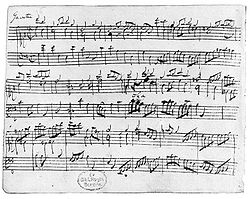
This page of the 1722 notebook contains the gavotte from French Suite No. 5 (BWV 816).
External audio
audio icon You may hear selections from Bach's Anna Magdalena Notebook as performed by Gustav Leonhardt
Here on Archive.org

The title Notebook for Anna Magdalena Bach (German: Notenbüchlein für Anna Magdalena Bach) refers to either of two manuscript notebooks that the German Baroque composer Johann Sebastian Bach presented to his second wife, Anna Magdalena. Keyboard music (minuets, rondeaux, polonaises, chorales, sonatas, preludes, musettes, marches, gavottes) makes up most of both notebooks, and a few pieces for voice (songs, and arias) are included.

The Notebooks provide a glimpse into the domestic music of the 18th century and the musical tastes of the Bach family.

History

[edit]

The two notebooks are known by their title page dates of 1722 and 1725. The title "Anna Magdalena Notebook" is commonly used to refer to the latter. The primary difference between the two collections is that the 1722 notebook contains works only by Johann Sebastian Bach (including most of the French Suites), while the 1725 notebook is a compilation of music by both Bach and other composers of the era.[1][2]

The 1722 notebook: French Suites and miscellany

[edit]
Title page of the first (1722) Notebook for Anna Magdalena Bach. Note the titles of the three Pfeiffer books written by Bach in the lower right corner.

This notebook contains 25 unbound sheets (including two blank pages), which is estimated to be approximately a third of the original size. It is not known what happened to the other pages. The back and the corners are decorated with brown leather; greenish paper is used for the cover. The title page is inscribed Clavier-Büchlein vor Anna Magdalena Bachin ANNO 1722 in Anna Magdalena's hand (using the feminine version of her last name). For a reason so far unknown to researchers, Johann Sebastian wrote the titles of three books by theologian August Pfeiffer [de] (died 1698) in the lower right corner of the title page:

  • Ante Calvinismus is a shortened and misspelled title of Anti-Calvinismus, oder Unterredungen von der Reformierten Religion (Anti-Calvinism, or Conversations about the reformed religion).
  • "Christen Schule item" refers to Pfeiffer's Evangelische Christen Schule ("Evangelical Christian School").
  • AntiMelancholicus refers to Anti-melancholicus, oder Melancholey-Vertreiber (Anti-melancholy, or [something or someone] to drive out the melancholy).

The notebook contains the following works, most in Johann Sebastian's hand:

  • Five keyboard suites. The first three are fragments of the pieces that are now known as the first three French Suites, BWV 812–814. The next two are complete suites, French Suites Nos. 4 and 5, BWV 815–816. The minuets of suites 2 and 3 are separated from the rest of their respective suites and were most probably added at a later date by Anna Magdalena Bach (they are almost certainly in her hand), some time before 1725.
  • Fantasia pro organo, unfinished, BWV 573. A short organ piece, 12 complete bars and the beginning notes of the 13th bar.
  • Air with variations in C minor, unfinished, BWV 991. The first 10 bars feature coherent two-part writing, but the remaining 35 bars only have one voice written out.
  • "Jesus, meine Zuversicht", chorale prelude, BWV 728. A brief (9 bars) piece in three voices, features two sections with repeats for each.
  • Minuet in G major, BWV 841 (not to be confused with Petzold's Minuet in G major in the 1725 notebook). A short dance with simplistic two-part writing and two sections with repeats for each.

The 1725 notebook

[edit]
Cover of the second (1725) Notebook for Anna Magdalena Bach
External audio
audio icon You may hear selections from Bach's Anna Magdalena Notebook as performed by the organist E. Power Biggs
Here on Archive.org

The 1725 notebook is larger than the 1722 one, and more richly decorated. Light green paper is used for the front cover, Anna Magdalena's initials and the year number "1725" are printed in gold, the annotations A[nna] M[agdal] B[ach] added by her stepson C. P. E. Bach when he inherited it. All pages feature gilt edging. Most of the entries in the 1725 notebook were made by Anna Magdalena herself, with others written in the hand of Johann Sebastian, some by sons Johann Christian and Carl Philipp Emanuel, and a few by family friends such as Johann Gottfried Bernhard and Johann Gottfried Heinrich.

Although the 1725 notebook does contain work composed by Johann Sebastian Bach, it also includes works by many other composers. The authorship of several pieces is identified in the notebook itself, while that of others was established by researchers. The composers of still others, including several popular songs of the time, remain unknown. Here is a complete list of the pieces included, in order of appearance in the notebook:

  1. Keyboard partita in A minor, BWV 827. This is the third partita from Bach's set of Partitas for keyboard BWV 825–830, which was published in 1731 as the first volume of Clavier-Übung.
  2. Keyboard partita in E minor, BWV 830. This is the sixth partita from Bach's set of Partitas for keyboard BWV 825–830.
  3. Minuet in F major, BWV Anh. 113.
  4. Minuet in G major, BWV Anh. 114. Usually attributed to Christian Petzold.[3][4][5]
  5. Minuet in G minor, BWV Anh. 115. Usually attributed to Christian Petzold.
  6. Rondeau in B-flat major, BWV Anh. 183. This piece is by François Couperin and is best known under the original title: Les Bergeries (6e Ordre).
  7. Minuet in G major, BWV Anh. 116
  8. Polonaise in F major, BWV Anh. 117a [commons]
    Polonaise in F major, BWV Anh. 117b
  9. Minuet in B-flat major, BWV Anh. 118
  10. Polonaise in G minor, BWV Anh. 119
  11. Chorale prelude "Wer nur den lieben Gott läßt walten", BWV 691
  12. Chorale setting "Gib dich zufrieden und sei stille" in F major, BWV 510
  13. Chorale setting "Gib dich zufrieden und sei stille" in G minor, BWV 511
    Chorale setting "Gib dich zufrieden und sei stille" in E minor, BWV 512
  14. Minuet in A minor, BWV Anh. 120
  15. Minuet in C minor, BWV Anh. 121
  16. March in D major, BWV Anh. 122. Usually attributed to Carl Philipp Emanuel Bach.
  17. Polonaise in G minor, BWV Anh. 123. Usually attributed to Carl Philipp Emanuel Bach.
  18. March in G major, BWV Anh. 124. Usually attributed to Carl Philipp Emanuel Bach.
  19. Polonaise in G minor, BWV Anh. 125. Usually attributed to Carl Philipp Emanuel Bach.
  20. Aria "So oft ich meine Tobackspfeife" in D minor, BWV 515
    Aria "So oft ich meine Tobackspfeife" in G minor, BWV 515a
  21. Menuet fait par Mons. Böhm, by Georg Böhm. Not included in the BWV catalogue.
  22. Musette in D major, BWV Anh. 126
  23. March in E-flat major, BWV Anh. 127
  24. (Polonaise) in D minor, BWV Anh. 128
  25. Aria "Bist du bei mir", BWV 508. This composition is probably the most well-known of the arias of the 1725 notebook. Its melody is by Gottfried Heinrich Stölzel.[6]
  26. Keyboard aria in G major, BWV 988/1. Another well-known piece, this is the aria of the Goldberg Variations, BWV 988. Christoph Wolff has suggested that this Aria was entered into the two blank pages of this book by Anna Magdalena later, in 1740.
  27. Solo per il cembalo in E-flat major, BWV Anh. 129. A harpsichord piece by Carl Philipp Emanuel Bach.
  28. Polonaise in G major, BWV Anh. 130. Possibly composed by Johann Adolph Hasse.
  29. Prelude in C major, BWV 846/1. This is the first prelude from The Well-Tempered Clavier, Book 1, with bars 16–20 omitted, most likely in order to make the piece fit in two pages.
  30. Keyboard suite in D minor, BWV 812. This is the first French Suite.
  31. Keyboard suite in C minor, BWV 813. This is an incomplete version of the second French Suite.
  32. Movement in F major, BWV Anh. 131. The handwriting looks like that of a child, and apparently the piece is an attempt to create a bass line for a given melody.
  33. Aria "Warum betrübst du dich", BWV 516
  34. Recitative "Ich habe genug" and aria "Schlummert ein, ihr matten Augen" (solo), BWV 82/2,3
  35. Chorale setting "Schaff's mit mir, Gott", BWV 514
  36. Minuet in D minor, BWV Anh. 132
  37. Aria "Willst du dein Herz mir schenken" (subtitled "Aria di Giovannini"), BWV 518
  38. Aria "Schlummert ein, ihr matten Augen", unfinished, BWV 82/3
  39. Chorale setting "Dir, dir Jehova, will ich singen" (version for choir), BWV 299
    Chorale setting "Dir, dir Jehova, will ich singen" (solo), BWV 299
  40. Song "Wie wohl ist mir, o Freund der Seelen", BWV 517
  41. Aria "Gedenke doch, mein Geist, zurücke", BWV 509
  42. Chorale "O Ewigkeit, du Donnerwort", BWV 513

Compositions

[edit]

The Notebooks contain instrumental as well as vocal musical compositions. These notebooks serve more as collections of sheet music and other compositions rather than what notebooks are traditionally used for.

Recitative and Aria from Cantata Ich habe genug, BWV 82

[edit]

The recitative "Ich habe genug" and the aria "Schlummert ein, ihr matten Augen", the second and third movements of the second version of Cantata Ich habe genug, BWV 82, appear in the 1725 Notebook.[7]

Four-part chorale "Dir, dir, Jehova, will ich singen", BWV 299

[edit]

The four-part chorale "Dir, dir, Jehova, will ich singen", BWV 299, also appears in a two-part setting in Schemellis Musicalisches Gesang-Buch (BWV 452).[8]

Songs and arias, BWV 508–518

[edit]

The second Notebook contains a number of songs and arias set for voice and continuo.

Aria "Bist du bei mir", BWV 508

[edit]

"Bist du bei mir", BWV 508, is an arrangement of an aria of the opera Diomedes by Gottfried Heinrich Stölzel.[9][10][11]

Aria "Gedenke doch, mein Geist", BWV 509

[edit]

"Gedenke doch, mein Geist, zurücke", BWV 509 is an aria contained in the second notebook.[12]

Three settings of "Gib dich zufrieden", BWV 510–512

[edit]

The sacred songs BWV 510–512 are three settings of "Gib dich zufrieden und sei stille" for voice and continuo.[13]

Sacred song "O Ewigkeit, du Donnerwort", BWV 513

[edit]

The sacred song "O Ewigkeit, du Donnerwort", BWV 513, No. 42 in the second Notebook, is a setting of the chorale melody with the same name, for voice and continuo:[14]

BWV 397 is the four-part realisation of this song.

Sacred song "Schaffs mit mir, Gott", BWV 514

[edit]

"Schaffs mit mir, Gott", BWV 514, is a sacred song for voice and continuo.[15]

Aria "So oft ich meine Tobackspfeife", BWV 515–515a

[edit]

The aria "So oft ich meine Tobackspfeife" appears in two versions, BWV 515 and 515a, the second a fourth higher than the first.[16]

Aria "Warum betrübst du dich", BWV 516

[edit]

The aria "Warum betrübst du dich", BWV 516, is a setting for voice and continuo.[17]

Sacred song "Wie wohl ist mir, o Freund der Seelen", BWV 517

[edit]

"Wie wohl ist mir, o Freund der Seelen", BWV 517, is a sacred song for voice and continuo.[18]

"Aria di G[i]ovannini", BWV 518

[edit]

The authenticity of "Willst du dein Herz mir schenken", BWV 518, also known as "Aria di G[i]ovannini", is doubted.[19]

For organ

[edit]

The first Notebook contains two compositions for organ. The chorale prelude Wer nur den lieben Gott lässt walten is No. 11 in the second Notebook.

Fantasia in C major, BWV 573

[edit]

The Fantasia in C major for organ, BWV 573, is a fragment contained in the 1722 Notebook.[20]

Chorale prelude Wer nur den lieben Gott lässt walten, BWV 691

[edit]

The chorale prelude "Wer nur den lieben Gott lässt walten", BWV 691, also appears in the Kirnberger Collection.[21]

Chorale setting Jesus, meine Zuversicht, BWV 728

[edit]

The chorale setting Jesus, meine Zuversicht, BWV 728, is ranged among Bach's chorale preludes for organ.[22]

For keyboard

[edit]

The keyboard pieces are the largest group of compositions in both Notebooks.

Five French Suites, BWV 812–816

[edit]

The first Notebook contains early versions of the first five French Suites, BWV 812–816. the first and the second French Suite also appear in the second Notebook.[23]

Third and sixth partita from Clavier-Übung I, BWV 827 and 830

[edit]

The second Notebook starts with the third Partita, BWV 827, from Clavier-Übung I, followed by the sixth Partita, BWV 830, from that opus.[24]

Minuet in G major, BWV 841

[edit]

The Minuet in G major, BWV 841, is also contained in the Klavierbüchlein für Wilhelm Friedemann Bach.[25]

First prelude of The Well-Tempered Clavier, BWV 846/1

[edit]

The prelude of Prelude and Fugue in C major, BWV 846, from The Well-Tempered Clavier appears in a short version in the second Notebook.[26]

Aria of the Goldberg Variations, BWV 988/1

[edit]

No. 26 in the second Notebook is the aria with which the Goldberg Variations start:[2][27]

Air with variations, BWV 991

[edit]

The Air with variations in C minor, BWV 991, is a fragment contained in the first Notebook.[28]

Minuet in F major, BWV Anh. 113

[edit]

The Minuet in F major, BWV Anh. 113, is No. 3 in the second Notebook. Its attribution to J. S. Bach is considered doubtful, and for that reason it is included in Anhang (Anh.) II of the Bach-Werke-Verzeichnis.[29][30]

Two Minuets by Christian Petzold, BWV Anh. 114–115

[edit]

Start of Minuet in G major, BWV Anh. 114:[31]

The two Minuets in G major and G minor, Nos. 4–5 in the second Notebook, BWV Anh. 114 and 115, were composed by Christian Petzold. Because their former attribution to Bach is spurious they appear in Anh. III of the Bach-Werke-Verzeichnis.[32]

Four Minuets and three Polonaises, BWV Anh. 116–121

[edit]

Seven pieces with a doubtful attribution to J. S. Bach:[29]

  • Anh. II 116 – No. 7: Minuet in G major[33]
  • Anh. II 117a and 117b – No. 8a and b: two Polonaises in F major[34]
  • Anh. II 118 – No. 9: Minuet in B♭ major[35]
  • Anh. II 119 – No. 10: Polonaise in G minor[36]
  • Anh. II 120 – No. 14: Minuet in A minor[37]
  • Anh. II 121 – No. 15: Minuet in C minor[38]

Two Marches and two Polonaises by Carl Philipp Emanuel Bach, BWV Anh. 122–125

[edit]

Nos. 16–19 (BWV Anh. 122–125) are considered to be early compositions by Carl Philipp Emanuel Bach:[32]

  • Anh. III 122 – No. 16: March in D major (H 1/1)[39]
  • Anh. III 123 – No. 17: Polonaise in G minor (H 1/2)[40]
  • Anh. III 124 – No. 18: March in G major (H 1/3)[41]
  • Anh. III 125 – No. 19: Polonaise in G minor (H 1/4)[42]

Three pieces, BWV Anh. 126–128

[edit]

A musette and two other pieces with a doubtful attribution to J. S. Bach:[29]

  • Anh. II 126 – No. 22: Musette in D major[43]
  • Anh. II 127 – No. 23: March in E♭ major[44]
  • Anh. II 128 – No. 24: (Polonaise) in D minor[45]

Solo per il cembalo by Carl Philipp Emanuel Bach, BWV Anh. 129

[edit]

Opening bars of Solo per il cembalo, BWV Anh. 129, by Carl Philipp Emanuel Bach, piece No. 27 from the 1725 Notebook:[46]

Anh. III 129 – No. 27: Solo per il cembalo in E-flat major by C. P. E. Bach (early version of the keyboard sonata Wq 65.7 / H 16).[32]

Polonaise in G major by Johann Adolph Hasse, BWV Anh. 130

[edit]

Anh. III 130 – No. 28: Polonaise in G major by Johann Adolph Hasse, i.e. "Polonoise secondo", originally in F major, from his keyboard sonata in F major.[32][47]

Piece in F major by Johann Christian Bach, BWV Anh. 131

[edit]

Untitled movement in F major, BWV Anh. 131, piece No. 32 from the 1725 Notebook:[32]

Anh. III 131 – No. 32: [March] in F major attributed to Johann Christian Bach (W A22), formerly also attributed to Gottfried Heinrich Bach[48]

Minuet in D minor, BWV Anh. 132

[edit]

Anh. II 132 – No. 36: Minuet in D minor[29][49]

"Rondeau" by François Couperin, BWV Anh. 183

[edit]

Anh. III 183 – No. 6: Rondeau in B-flat major by François Couperin, "Les Bergeries, Rondeau", sixth piece of the Sixième ordre, published in Paris in 1717 (Second Livre de pièces de Clavecin)[32][50][51]

"Menuet fait par Mons. Böhm"

[edit]

No. 21 of the second Notebook, "Menuet fait par Mons. Böhm" (Minuet by Mr. Böhm), in G major, was never assigned a number in the BWV catalogue. It is however included in both the Bach-Gesellschaft Ausgabe (BGA) and the New Bach Edition (Neue Bach-Ausgabe, NBA) of the Notebooks. There is some doubt which composer by the name Böhm may have been intended, Georg Böhm being the best known among them.[2][52][53][54]

See also

[edit]

References

[edit]

Sources

[edit]

Manuscripts:

Score editions with critical commentary:

Further reading

[edit]
[edit]
Revisions and contributorsEdit on WikipediaRead on Wikipedia
from Grokipedia
The Notebook for Anna Magdalena Bach, also known as the Clavier-Büchlein für Anna Magdalena Bach, refers to two manuscript collections of keyboard and compiled by the German composer Johann Sebastian Bach primarily between 1722 and 1725 as personal gifts for his second wife, (née Wilcke), a professional singer whom he married in 1721.) The first notebook, dated 1722 and preserved as Berlin State Library Mus. ms. Bach P 224, contains eleven keyboard pieces mostly by Bach, including early versions of five French Suites (BWV 812–816) and shorter dances like minuets (BWV 841), intended for her practice on or similar instruments.) The second, more extensive notebook from 1725 (Berlin State Library Mus. ms. Bach P 225) features 42 entries, blending 30 solo keyboard works—such as Bach's Partitas in (BWV 827) and (BWV 830), a prelude from the Well-Tempered Clavier (BWV 846), and the Goldberg (BWV 988)—with 12 vocal settings for and continuo, many sacred and thematically focused on mortality, alongside pieces by composers including , Christian Petzold, and Heinrich Stölzel. These notebooks hold profound historical and musical significance as intimate artifacts of Bach's domestic life in , where he served as from 1723, illustrating his pedagogical approach to keyboard instruction for members, including his and children. Anna Magdalena, trained as a at the court of Anhalt-Cöthen and later contributing as a for her husband's works, actively participated in the collections by adding corrections, vocal pieces suited to her voice, and entries reflecting Lutheran devotional themes, underscoring her role in the Bach household's musical activities. Contributions from Bach's sons, such as four keyboard pieces by and a scribbled exercise by Johann Christoph Friedrich, further emphasize the notebooks' function as a album and diary, blending professional composition with everyday practice amid their growing family. Scholarly editions, such as those in the Neue Bach-Ausgabe (NBA Series V/4, edited by Georg von Dadelsen in 1957) and facsimiles published by Bärenreiter, have preserved these manuscripts, revealing insights into 18th-century German domestic culture, where such albums served moral, educational, and recreational purposes distinct from public concert repertoires. The collections' mix of galant dances, suites, chorales, and fragments also documents Bach's compositional evolution, with some pieces existing only in these early versions before later revisions.

Background

Anna Magdalena Bach and family context

Anna Magdalena Bach, née Wilcke, was born on 22 September 1701 in , the daughter of Caspar Wilcke, a court trumpeter, and grew up in a musical environment that fostered her early talents as a singer. By age 19, she was employed as a court singer at the chapel in Zerbst, earning a for her performances between and 1721, and soon after joined the court in Cöthen as a professional and chamber musician, where her pay ranked second only to that of the Capellmeister and . Her vocal skills were honed in these courts, reflecting the professional opportunities available to skilled female singers in early 18th-century . On 3 December 1721, Anna Magdalena married Johann Sebastian Bach (1685–1750) in Cöthen, becoming his second wife following the death of his first wife, , in July 1720; at the time, she was 20 years old and stepped into the role of to Bach's four surviving children from his previous marriage. The couple had 13 children together between 1723 and 1742, six of whom survived to adulthood, contributing to a blended household of up to 17 children in total during their time in after 1723. Family life emphasized musical education, with children such as (from J.S. Bach's first marriage) receiving rigorous training in composition and performance under the household's influence. As the matriarch of a large, musically oriented family, Anna Magdalena played a central role in managing domestic affairs while actively participating in her husband's professional life, including copying musical scores with a skilled but sometimes error-prone for works like cantatas and the B Minor Mass. She occasionally performed as a singer alongside J.S. Bach in Cöthen but ceased documented public performances after the move to , instead focusing on home-based musical activities such as playing the . Following J.S. Bach's in 1750, she lived as a widow in with her two youngest daughters until her own on 27 February 1760 in , where she was buried two days later.

Purpose of the notebooks

The notebooks for , known as Clavier-Büchlein, exemplify the tradition of personalized keyboard albums prevalent in 18th-century German Baroque , where such collections served as versatile resources for domestic music-making, including teaching, practice, and family entertainment. These clavierbücher were often compiled by family members to foster musical skills among participants, reflecting the era's emphasis on dilettante and the integration of music into daily life as a means of edification and leisure. In the , the notebooks embodied this cultural practice, providing a shared space for keyboard exercises, songs, and pieces that supported both and collective enjoyment. Johann Sebastian Bach presented the 1722 notebook to his second wife, Anna Magdalena, as a marking their first , following their in December 1721. The 1725 notebook followed as another personal offering. Both volumes were inscribed with her name and contained suited for keyboard practice, tailored to the needs of the household and emphasizing accessibility for non-professional performers. While the notebooks aimed to enhance Anna Magdalena's keyboard proficiency—building on her established skills as a professional singer and amateur instrumentalist—they also facilitated the musical education of the Bach children through family contributions and shared use. Unlike the more systematically pedagogical Clavier-Büchlein for Bach's eldest son, Wilhelm Friedemann, which focused on technical exercises, Anna Magdalena's notebooks adopted an , blending instructional pieces with diverse selections for broader household amusement and devotional reflection. This variety underscored the ideal of music as an enriching domestic pursuit, promoting dilettante engagement over rigorous professional training.

History

The 1722 notebook

The 1722 notebook, formally titled Clavier-Büchlein vor Anna Magdalena Bachin, was created in shortly after Johann Sebastian Bach's to Anna Magdalena Wilcke, a court , on December 3, 1721. The united Bach with a musical partner who shared his passion for keyboard performance, and the notebook served as a personal gift reflecting their domestic life during his tenure as at the court of Prince Leopold of . Entries in the manuscript originated in but continued into the early period following the family's relocation in May 1723. The manuscript is a modest keyboard collection measuring 15.5 by 19 cm and comprising 25 unbound leaves of , though paleographic evidence suggests it originally contained around 75 leaves, with the majority lost over time. Unlike later bound volumes in Bach's household, this lacks a rigid cover, aligning with its informal, ongoing nature as a family exercise book. The bears the inscription "Clavier-Büchlein vor Anna Magdalena Bachin ANNO 1722" in Anna Magdalena's own hand, using the feminine form of the family name to denote ownership. Handwriting analysis reveals a collaborative effort, with principal scribes identified as Johann Sebastian Bach and his wife; Anna Magdalena contributed early copies of several pieces, demonstrating her role as both performer and copyist in the household. This mix of scripts underscores the notebook's educational purpose, intended to support Anna Magdalena's keyboard practice amid her duties as to Bach's four children from his first marriage. The initial contents form a miscellany of keyboard works suited to domestic use, including movements from the French Suites Nos. 1–5 (BWV 812–816), later completed and revised by Bach himself, alongside shorter dances such as minuets (e.g., BWV Anh. 114 and 115, attributed to others), marches, and sacred songs like the chorale prelude "Wie schön leuchtet der Morgenstern" (BWV 728). A fragment of the Fantasia in (BWV 573) and an incomplete set of variations (BWV 991) also appear, copied primarily by Anna Magdalena. The surviving portion preserves about a dozen pieces, though the original likely included around 30, with some anonymous pieces and works by contemporary composers like Christian Petzold. Entries ceased around 1723 with the move to , after which Bach initiated a more expansive second notebook in 1725.

The 1725 notebook

The 1725 , formally titled Clavier-Büchlein für and housed as Staatsbibliothek zu Berlin, Mus. ms. Bach P 225, was initiated by Johann Sebastian Bach in during his tenure as cantor at St. Thomas Church. This manuscript served as a personal domestic music collection, emphasizing family collaboration in musical education and performance within the Bach household. Unlike the earlier 1722 notebook from the period, it adopted a larger, oblong format, pre-bound in with paginated, gilt-edged pages totaling approximately 126 folios, allowing for expanded content and ongoing use. The cover features initials "AMB" and the year 1725 inscribed in Anna Magdalena's hand, later supplemented by her stepson . Over the subsequent years, the notebook received additions extending at least until 1727 and possibly into the 1730s, incorporating works by J.S. Bach, his sons Carl Philipp Emanuel and Johann Christoph Friedrich, and contemporary composers such as Christian Petzold and Georg Böhme. Multiple hands contributed to the copying: Bach himself entered several keyboard partitas (BWV 827 and 830), while Anna Magdalena transcribed galant-style dances and vocal settings, and the children added youthful compositions like marches and polonaises. This collaborative process highlights Anna Magdalena's role as a skilled and singer, with her evolving to closely resemble her husband's. The remained in active domestic use through the mid-1730s, reflecting the evolving musical interests of the family, before seeing sporadic entries as late as the 1740s, such as the BWV 988/1. The notebook comprises 30 keyboard pieces and 12 vocal works, totaling 42 entries, prioritizing solo clavier compositions that capture Bach's mature Leipzig-era style, characterized by intricate , galant influences, and Lutheran devotional elements. Early versions of major works, including partitas and the prelude from (BWV 846/1), appear here, underscoring its value as a repository of compositional drafts and family . A was added later, likely by a family member, to organize the growing collection and facilitate practical use in household music-making.

Manuscript preservation and authenticity

Following Johann Sebastian Bach's death in 1750, the notebooks passed to his son , who inherited a substantial portion of his father's musical manuscripts and used them in his own compositional and scholarly work. After C.P.E. Bach's death in 1788, his library—including the notebooks—was auctioned in the late and , with items dispersing to collectors and institutions across . The manuscripts were rediscovered amid the 19th-century Bach revival, led by figures like , and acquired by the Königliche Bibliothek (now the Staatsbibliothek zu Berlin) in the as part of efforts to centralize major musical holdings. The 1722 notebook (Mus.ms. Bach P 224) survives in a fragmentary state, with numerous missing pages due to physical deterioration over time, while the 1725 notebook (Mus.ms. Bach P 225) is more complete but still suffers from incomplete sections, such as omitted measures in certain pieces. Both have endured preservation challenges, including from historical storage conditions that has affected legibility in places. In modern times, the Staatsbibliothek zu Berlin has digitized both manuscripts through the Bach Digital project, enabling high-resolution access and scholarly study without further handling of the originals. Authenticity of the notebooks themselves is well-established through their and analysis, with the title pages bearing Anna Magdalena Bach's inscription and much of the content in her distinctive script as a trained . However, attribution of individual pieces has sparked debate, particularly for those cataloged as BWV Anh. (Anhang), which are of doubtful authorship by J.S. Bach; for instance, the popular Minuets in (BWV Anh. 114) and (BWV Anh. 115) are now confirmed to be by Christian Petzold based on stylistic and source comparisons. examination, including comparisons of ink and script styles, has helped verify contributions from family members like C.P.E. Bach while questioning others. The first scholarly edition of the notebooks' contents appeared in 1905 from Breitkopf & Härtel, edited for practical use and drawing directly from the manuscripts to standardize the music for performance. Recent scholarly analyses have employed (UV) imaging on manuscripts, including elements from the notebooks, to reveal hidden inscriptions and erased notations beneath surface layers, aiding in further authentication of copyists and original intentions.

Contents

Keyboard suites and partitas by J.S. Bach

The 1722 notebook for Anna Magdalena Bach opens with the first of five complete French Suites by Johann Sebastian Bach, beginning with BWV 812 in . These suites, BWV 812–816, represent early versions copied primarily by Bach himself, comprising Nos. 1 in , 2 in C minor, 3 in , 4 in , and 5 in . Each suite follows a standard structure of dance movements—typically an , , , and , often with added galanteries such as minuets or bourrées—reflecting the lighter, more intimate suited to domestic keyboard performance. Unlike the more elaborate English Suites (BWV 806–811), which include virtuosic preludes and denser influenced by Italian concertos, the French Suites emphasize singing melodies, graceful ornamentation, and homophonic textures with less technical complexity, prioritizing elegance over display. Bach entered these works shortly after his to Anna Magdalena in 1721, likely for her practice and enjoyment as a skilled singer and keyboard player. Performance estimates for the five suites total around 60–70 minutes, with individual suites ranging from 10 to 15 minutes depending on tempi and repeats. The 1725 notebook features two partitas from Bach's Clavier-Übung I (BWV 825–830), presented in early manuscript versions: the third partita in , BWV 827, and the sixth in , BWV 830. These multi-movement cycles open the notebook, with BWV 827 comprising a Fantasia, , Corrente, , Burlesca, , and , while BWV 830 includes a , , Corrente, Air, , , and . The in BWV 830 evokes the grandeur of a with its dotted rhythms and fugal entries, and both partitas feature complex variations in their allemandes and sarabandes, showcasing intricate and expressive appoggiaturas in a galant vein. Copied by Bach for Anna Magdalena's continued study, these works bridge his domestic output with published collections, differing from the French Suites in their greater diversity of forms and rhythmic vitality. Representative performance durations are about 15 minutes for BWV 827 and 20 minutes for BWV 830.

Other keyboard works by J.S. Bach

The notebooks contain approximately five to six shorter keyboard compositions attributed to J.S. Bach, distinct from the more elaborate multi-movement suites that demonstrate advanced technical demands. These miscellaneous pieces, often pedagogical in nature, include preludes, arias, variations, and dances suited for domestic practice and instruction. One prominent example is the Prelude in C major, BWV 846/1, the opening prelude from Book I of The Well-Tempered Clavier, copied into the 1725 notebook. This brief work features a continuous arpeggiated texture, broken chords ascending and descending over a simple harmonic progression, making it an effective study for developing evenness in keyboard technique and an understanding of tonal structure. The from the , BWV 988/1, appears in the 1725 notebook as a standalone sarabande-like theme in , characterized by its lyrical melody over a steady bass line. This entry predates the full 1741 publication of the variations cycle, serving as an early version or precursor that highlights Bach's interest in variation forms during the period. In the 1722 notebook, Bach included the incomplete Air with variations in C minor, BWV 991, a fragmentary piece comprising an air followed by two partial variations in quodlibet style, incorporating humorous domestic references through textual annotations such as initials and playful phrases like "J.G." and "ruhe schöne sähle." The work's and division-like elaborations suggest it as an experimental sketch for teaching improvisational skills within a lighthearted family context. Simple dances such as the Minuet in G major, BWV 841 also feature in the 1722 notebook, offering accessible binary-form pieces with straightforward rhythms and melodies ideal for beginners to practice dance styles and basic phrasing.

Vocal and sacred songs

The vocal and sacred songs in the Notebook for Anna Magdalena Bach, predominantly from the 1725 volume, comprise eleven arias and songs (BWV 508–518) for voice and basso continuo, alongside excerpts from a cantata and a four-part chorale harmonization (BWV 299). These pieces, entered mostly by Johann Sebastian Bach and his wife Anna Magdalena, blend sacred and secular themes, emphasizing Lutheran devotion, mortality, and domestic consolation, with texts drawn from biblical sources, poets like Paul Gerhardt and Johann Rist, and contemporaries such as Christian Friedrich Henrici (Picander). The inclusion of these works underscores Anna Magdalena's role as a professional soprano singer in the Bach household, facilitating private performances that supported family musical education and spiritual reflection. The opening aria, "Bist du bei mir" (BWV 508), is a strophic in expressing themes of companionship and peaceful death, with a text likely derived from an operatic source; though long attributed to Bach, it is now recognized as an of an from Heinrich Stölzel's Diomedes (1718). Subsequent pieces include "Gedenke doch, mein Geist" (BWV 509), a sacred urging reflection on life's transience with an anonymous text; three settings of Paul Gerhardt's "Gib dich zufrieden und sei stille" (BWV 510–512), varying in style from simple to more elaborate continuo accompaniments to promote contentment amid suffering; and "O , du Donnerwort" (BWV 513), a contemplative on based on Johann Rist's text. Further entries feature "Warum betrübst du dich, mein Herz" (BWV 516), a Bach composition addressing sorrow with a biblical-derived text; "Wie wohl ist mir, o Freund der Seelen" (BWV 517) after Wolfgang Christoph Dessler's devotional poem; the secular "Erbauliche Gedanken eines Tobakrauchers" (BWV 515), a humorous aria with text attributed to Picander; "Schaff's mit mir, Gott" (BWV 514), a chorale-like plea from Benjamin Schmolck's ; and the light secular "Willst du dein Herz mir schenken" (BWV 518), an possibly by Giovannini praising a beloved's virtues. These songs, copied in Anna Magdalena's hand alongside her husband's, highlight a mix of eight sacred works focused on death and divine comfort, suitable for her voice in household devotions. Notable among the sacred excerpts is the recitative "Ich habe genug" and aria "Schlummert ein" from Bach's BWV 82 (1727), adapted for voice and keyboard in the 1725 , originally featuring an obbligato flute but simplified for domestic use; the text, based on Simeon's biblical song (:29–30), conveys serene acceptance of death. The section concludes with the four-part "Dir, dir, Jehova, will ich singen" (BWV 299), a keyboard of Bartholomäus Cruselius's praising , entered in two versions and reflecting Bach's style for devotional singing or playing. Overall, these twelve vocal items (including the chorale) served educational and pious purposes in the Bach home, with Anna Magdalena actively contributing as performer and scribe.

Organ works

The organ works included in the Notebooks for Anna Magdalena Bach represent a small but significant portion of the collection, comprising three pieces that demonstrate Johann Sebastian Bach's mastery of organ composition while being adapted for performance on keyboard instruments suitable for domestic use, such as the or . These compositions, all manualiter (intended for manuals without pedals), reflect Bach's expertise as an but are simplified in texture and scope to facilitate practice and enjoyment by Anna Magdalena and the family. The earliest of these is the Fantasia in C major, BWV 573, a brief fragment entered in the 1722 . This improvisatory piece, consisting of just twelve complete bars plus the start of a thirteenth, evokes the free, fantasia style typical of organ preludes, with florid runs and harmonic exploration that suggest an exercise in manual dexterity and invention.) Likely transcribed or composed directly for keyboard, it highlights Bach's pedagogical intent, possibly encouraging Anna Magdalena's exploration of organ-like improvisation at home. The 1722 notebook also contains the chorale setting Jesus, meine Zuversicht, BWV 728, a four-part spanning nine bars with repeats, designed for manuals and emphasizing clear in a homophonic style that underscores the text's assurance of faith.) This piece prioritizes simplicity for family performance, allowing Anna Magdalena to engage with Bach's organ repertory in an intimate setting. The 1725 notebook contains the remaining organ work, the chorale prelude Wer nur den lieben Gott lässt walten, BWV 691, which employs a trio texture— in the , bass line, and inner —adapted from an earlier version in Bach's Orgelbüchlein (BWV 641), but here rendered more accessibly for two manuals without pedal dependency. Its concise structure and lyrical ornamentation make it ideal for clavier rendition, blending sacred reflection with technical study. Collectively, these works underscore the notebooks' role in bridging professional organ literature with amateur keyboard practice, preserving Bach's innovative techniques in a form accessible beyond the church organ.

Works by other composers

The notebooks for contain approximately 15 instrumental pieces by composers other than Johann Sebastian Bach, primarily dances such as minuets, polonaises, and marches that reflect the light, elegant style of 18th-century suitable for domestic performance.) These works, distributed across both the 1722 and 1725 notebooks, underscore the collaborative and familial aspect of the collection, as Anna Magdalena and the Bach children contributed entries alongside pieces by Bach's contemporaries and sons.) Carl Philipp Emanuel Bach, Johann Sebastian's second-eldest son, contributed five early pieces to the 1725 notebook, composed in his youth before leaving home in 1734; these include two marches in (BWV Anh. 122) and (BWV Anh. 124), as well as two polonaises in (BWV Anh. 123 and 125), all cataloged under H. 1. Additionally, a keyboard piece titled "Solo per il cembalo" (BWV Anh. 129) is attributed to him, exemplifying his emerging within the family's instructional repertoire. Christian Petzold, a close associate of the and successor candidate, provided two well-known minuets from his harpsichord suite, entered in the 1725 notebook: one in (BWV Anh. 114) and one in (BWV Anh. 115). These pieces, often performed as a pair, were long misattributed to Johann Sebastian Bach but highlight Petzold's graceful melodic writing typical of court music. Other notable contributions include a in (BWV Anh. 130) by , the prominent opera composer, added to the 1725 notebook and reflecting Polish dance influences popular in German courts. , the youngest son, supplied a in (BWV Anh. 131, W.A 22), a simple binary-form piece suited for beginners. François Couperin's rondeau "Les Bergeries" in (BWV Anh. 183), from his Pièces de clavecin, appears in the 1722 notebook, transcribed for keyboard and evoking pastoral French ornamentation. Georg Böhm, Johann Sebastian's organ teacher, contributed a in (without BWV number), a concise dance entered in the 1725 notebook that demonstrates school influences. Several anonymous or lesser-attributed works fill out the collection, including four minuets (BWV Anh. 116 in , BWV Anh. 118 in , BWV Anh. 120 in , and BWV Anh. 121 in C minor) and three polonaises (BWV Anh. 117a/b in , BWV Anh. 119 in ), mostly from the 1725 and likely drawn from contemporary pedagogical or salon sources.) These unattributed dances, with their straightforward structures and rhythmic vitality, complement the notebooks' role as a shared resource for musical practice.)

Significance

Educational and domestic role

The notebooks compiled by Johann Sebastian Bach for his second wife, Anna Magdalena, served primarily as pedagogical tools within the Bach household, facilitating gradual skill development in keyboard playing and copying for Anna Magdalena and their children. The 1722 notebook begins with simpler pieces, such as marches and minuets suitable for beginners, progressing in the 1725 volume to more intricate dances and suites that demanded greater technical proficiency, reflecting a structured approach to musical tailored to members' abilities. This progression from accessible galant-style dances to complex works like Bach's Partitas (BWV 827 and 830) enabled , with incomplete entries and exercises indicating hands-on scribal and performative practice. Family involvement was central to the notebooks' use, as evidenced by contributions from multiple hands, including Bach's own entries of larger works, Anna Magdalena's copying of vocal and keyboard pieces, and additions by sons Carl Philipp Emanuel (four keyboard pieces) and Johann Christoph Friedrich (a scribbled exercise and continuo text), fostering collaborative music-making among members. These manuscripts were integral to daily domestic life in Cöthen and , embodying the Hausmusik tradition of private Lutheran family devotion and recreation through chorales, dances, and songs, rather than for or professional performance. No records suggest the notebooks' contents were used in concerts; instead, they supported intimate settings like home worship and leisure, aligning with Anna Magdalena's post-marriage shift from singing to roles. In the broader cultural context of 18th-century , the notebooks exemplify domestic music albums akin to those compiled by other composers' families, such as keyboard miscellanies for amateur women like the Suzanne van Soldt , though distinguished by Anna Magdalena's professional background as a singer and . This familial resource directly influenced the children's musical careers, providing a shared repository for instruction that contributed to the early training of figures like C.P.E. Bach, who later became prominent composers. The notebooks thus highlight music's role in nurturing talent within the Bach home, intertwining education with everyday familial bonds.

Influence on Bach scholarship and performance practice

The notebooks for Anna Magdalena Bach have significantly shaped modern Bach scholarship by providing key sources for clarifying attributions and understanding domestic musical life in the Baroque era. During the 19th-century Bach revival, editions of the notebooks contributed to renewed interest in his lesser-known works, with selections from the notebooks appearing in volume 43.2 of the Bach-Gesellschaft Ausgabe in 1894, edited by Paul Waldersee, which helped disseminate pieces previously confined to manuscript form. This publication aligned with broader efforts, initiated by figures like through performances such as the 1829 revival of the , to restore Bach's legacy amid Romantic-era fascination with his counterpoint and expressivity. The subsequent BWV catalogue, compiled by Wolfgang Schmieder in 1950 and revised in 1990, further refined attributions; for instance, several pieces once credited to J.S. Bach, such as the Minuet in (BWV Anh. 114), were reclassified to the Anhang as anonymous or by other composers like Christian Petzold, resolving long-standing misattributions based on the notebooks' contents. Recent scholarly editions have deepened these insights, particularly through critical reevaluations of Anna Magdalena's role. The 2020 Edition Peters urtext edition, edited by Christoph Wolff, presents the complete 1722 and 1725 notebooks for the first time in over 60 years, incorporating facsimiles, updated source analysis, and commentary on copyists' hands, which illuminates collaborative family authorship and challenges earlier assumptions of J.S. Bach's sole dominance. This edition has influenced feminist scholarship by highlighting Anna Magdalena's agency as a professional singer, skilled , and ; David Yearsley's 2019 study Sex, Death, and Minuets draws on the notebooks to portray her as a multifaceted figure navigating , , and widowhood, countering 19th- and 20th-century depictions of her as merely a passive domestic ideal and situating her among empowered Lutheran women in society. Such perspectives have prompted reevaluations of dynamics in Bach's household, emphasizing her contributions to music transmission beyond supportive roles. In performance practice, the notebooks offer direct evidence of keyboard techniques, particularly ornamentation and suited to domestic settings. Pieces like the minuets and polonaises demonstrate idiomatic fingerings and trill realizations typical of the period, as detailed in urtext editions that provide realized ornaments without prescriptive dynamics to encourage period-informed interpretation on or . For example, the Signature Series edition advises on , articulation, and trill execution aligned with C.P.E. Bach's Essay on the True Art of Playing Keyboard Instruments (1753), fostering authentic styles over modern conventions. Debates persist on , with scholars advocating historical clavichords for intimate pieces to reflect the notebooks' original , versus modern pianos for broader , influencing ensembles like those using period instruments in recordings by artists such as . Today, selections remain staples in , introducing students to forms and phrasing through accessible arrangements that prioritize conceptual mastery of inequality and . The notebooks' cultural legacy extends to adaptations in media and recordings, amplifying their reach beyond academia. The "Bist du bei mir" (BWV 508, attributed to Heinrich Stölzel with Bach's arrangement), a poignant from the 1725 notebook, has been featured in numerous choral and instrumental recordings by groups like the . This piece's versatility has sparked ongoing discussions in performance circles about vocal versus keyboard realizations, often on historical instruments to evoke 18th-century intimacy. Overall, the notebooks continue to bridge scholarly rigor with performative vitality, sustaining Bach's domestic oeuvre in contemporary contexts.

References

Add your contribution
Related Hubs
User Avatar
No comments yet.