


Community hub
Recent from talks
Contribute something
Nothing was collected or created yet.
Bacacay
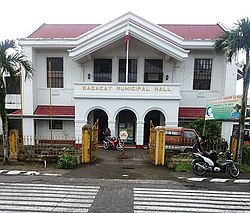
View on WikipediaBacacay, officially the Municipality of Bacacay (Central Bikol: Banwaan kan Bacacay; Tagalog: Bayan ng Bacacay), is a municipality in the province of Albay, Philippines. According to the 2024 census, it has a population of 72,298 people.[5] Bacacay is primarily an agricultural town and abundant in seafood.
Key Information


.svg)

Geography
[edit]Bacacay is bordered by Malilipot town in the northwest and Santo Domingo in the southwest. Other barangays are located in Cagraray island and is shared with neighboring Malilipot town.
According to the Philippine Statistics Authority, the municipality has a land area of 122.13 square kilometres (47.15 sq mi) [6] constituting 4.74% of the 2,575.77-square-kilometre- (994.51 sq mi) total area of Albay.
Barangays
[edit]Bacacay is politically subdivided into 56 barangays.[7] Each barangay consists of puroks and some have sitios.
| PSGC | Barangay | Population | ±% p.a. | |||
|---|---|---|---|---|---|---|
| 2024[8] | 2010[9] | |||||
| 050501001 | Baclayon | 3.7% | 2,703 | 2,397 | 0.83% | |
| 050501002 | Banao | 2.1% | 1,491 | 1,379 | 0.54% | |
| 050501032 | Barangay 1 (Poblacion) | 1.8% | 1,308 | 1,078 | 1.34% | |
| 050501038 | Barangay 2 (Poblacion) | 0.4% | 285 | 282 | 0.07% | |
| 050501039 | Barangay 3 (Poblacion) | 0.8% | 545 | 543 | 0.03% | |
| 050501040 | Barangay 4 (Poblacion) | 0.4% | 274 | 277 | −0.07% | |
| 050501041 | Barangay 5 (Poblacion) | 0.4% | 276 | 279 | −0.07% | |
| 050501042 | Barangay 6 (Poblacion) | 0.3% | 248 | 266 | −0.48% | |
| 050501043 | Barangay 7 (Poblacion) | 0.4% | 267 | 262 | 0.13% | |
| 050501044 | Barangay 8 (Poblacion) | 0.2% | 147 | 122 | 1.29% | |
| 050501045 | Barangay 9 (Poblacion) | 0.9% | 646 | 631 | 0.16% | |
| 050501033 | Barangay 10 (Poblacion) | 1.1% | 773 | 652 | 1.18% | |
| 050501034 | Barangay 11 (Poblacion) | 0.3% | 197 | 194 | 0.11% | |
| 050501035 | Barangay 12 (Poblacion) | 0.4% | 298 | 305 | −0.16% | |
| 050501036 | Barangay 13 (Poblacion) | 1.8% | 1,315 | 1,249 | 0.36% | |
| 050501037 | Barangay 14 (Poblacion) | 1.7% | 1,237 | 1,176 | 0.35% | |
| 050501003 | Bariw | 0.9% | 625 | 601 | 0.27% | |
| 050501004 | Basud | 2.4% | 1,746 | 1,523 | 0.94% | |
| 050501005 | Bayandong | 2.3% | 1,650 | 1,615 | 0.15% | |
| 050501006 | Bonga (Upper) | 10.6% | 7,649 | 7,468 | 0.16% | |
| 050501008 | Buang | 1.8% | 1,337 | 1,267 | 0.37% | |
| 050501048 | Busdac (San Jose) | 1.6% | 1,182 | 1,082 | 0.61% | |
| 050501009 | Cabasan | 2.8% | 2,028 | 2,004 | 0.08% | |
| 050501010 | Cagbulacao | 1.2% | 862 | 842 | 0.16% | |
| 050501011 | Cagraray | 1.0% | 703 | 767 | −0.60% | |
| 050501012 | Cajogutan | 1.6% | 1,130 | 1,090 | 0.25% | |
| 050501013 | Cawayan | 1.7% | 1,247 | 1,116 | 0.77% | |
| 050501014 | Damacan | 0.6% | 431 | 466 | −0.54% | |
| 050501015 | Gubat Ilawod | 1.5% | 1,080 | 1,043 | 0.24% | |
| 050501016 | Gubat Iraya | 1.6% | 1,159 | 1,138 | 0.13% | |
| 050501017 | Hindi | 5.3% | 3,800 | 3,458 | 0.65% | |
| 050501018 | Igang | 3.2% | 2,332 | 2,128 | 0.63% | |
| 050501019 | Langaton | 1.1% | 765 | 757 | 0.07% | |
| 050501020 | Manaet | 1.2% | 836 | 764 | 0.62% | |
| 050501021 | Mapulang Daga | 0.6% | 453 | 529 | −1.06% | |
| 050501022 | Mataas | 0.7% | 518 | 478 | 0.55% | |
| 050501023 | Misibis | 1.4% | 1,007 | 934 | 0.52% | |
| 050501024 | Nahapunan | 0.6% | 402 | 406 | −0.07% | |
| 050501025 | Namanday | 2.0% | 1,482 | 1,440 | 0.20% | |
| 050501026 | Namantao | 1.1% | 778 | 901 | −1.01% | |
| 050501027 | Napao | 2.6% | 1,883 | 1,690 | 0.75% | |
| 050501028 | Panarayon | 2.6% | 1,848 | 1,658 | 0.75% | |
| 050501029 | Pigcobohan | 1.1% | 817 | 838 | −0.17% | |
| 050501030 | Pili Ilawod | 2.1% | 1,522 | 1,284 | 1.18% | |
| 050501031 | Pili Iraya | 1.4% | 997 | 924 | 0.52% | |
| 050501046 | Pongco (Lower Bonga) | 1.4% | 1,022 | 960 | 0.43% | |
| 050501049 | San Pablo | 1.8% | 1,274 | 1,240 | 0.19% | |
| 050501050 | San Pedro | 2.2% | 1,605 | 1,516 | 0.39% | |
| 050501051 | Sogod | 6.3% | 4,552 | 4,433 | 0.18% | |
| 050501052 | Sula | 1.2% | 873 | 960 | −0.65% | |
| 050501053 | Tambilagao (Tambongon) | 1.3% | 906 | 920 | −0.11% | |
| 050501054 | Tambongon (Tambilagao) | 1.1% | 795 | 748 | 0.42% | |
| 050501055 | Tanagan | 1.9% | 1,388 | 1,486 | −0.47% | |
| 050501056 | Uson | 0.9% | 644 | 625 | 0.21% | |
| 050501057 | Vinisitahan-Basud (Mainland) | 0.9% | 621 | 607 | 0.16% | |
| 050501058 | Vinisitahan-Napao (Island) | 1.3% | 947 | 926 | 0.15% | |
| Total | 72,298 | 65,724 | 0.66% | |||
Climate
[edit]| Climate data for Bacacay, Albay | |||||||||||||
|---|---|---|---|---|---|---|---|---|---|---|---|---|---|
| Month | Jan | Feb | Mar | Apr | May | Jun | Jul | Aug | Sep | Oct | Nov | Dec | Year |
| Mean daily maximum °C (°F) | 27 (81) |
27 (81) |
28 (82) |
30 (86) |
31 (88) |
30 (86) |
29 (84) |
29 (84) |
29 (84) |
29 (84) |
28 (82) |
27 (81) |
29 (84) |
| Mean daily minimum °C (°F) | 22 (72) |
22 (72) |
23 (73) |
24 (75) |
25 (77) |
25 (77) |
25 (77) |
25 (77) |
25 (77) |
24 (75) |
24 (75) |
23 (73) |
24 (75) |
| Average precipitation mm (inches) | 138 (5.4) |
83 (3.3) |
74 (2.9) |
50 (2.0) |
108 (4.3) |
165 (6.5) |
202 (8.0) |
165 (6.5) |
190 (7.5) |
186 (7.3) |
188 (7.4) |
183 (7.2) |
1,732 (68.3) |
| Average rainy days | 16.8 | 11.9 | 13.5 | 13.8 | 20.5 | 25.2 | 27.4 | 26.2 | 26.1 | 24.7 | 20.7 | 18.5 | 245.3 |
| Source: Meteoblue [10] | |||||||||||||
Demographics
[edit]| Year | Pop. | ±% p.a. |
|---|---|---|
| 1903 | 14,214 | — |
| 1918 | 20,211 | +2.37% |
| 1939 | 23,863 | +0.79% |
| 1948 | 26,504 | +1.17% |
| 1960 | 29,181 | +0.80% |
| 1970 | 37,737 | +2.60% |
| 1975 | 40,130 | +1.24% |
| 1980 | 44,433 | +2.06% |
| 1990 | 49,202 | +1.02% |
| 1995 | 56,295 | +2.56% |
| 2000 | 58,357 | +0.77% |
| 2007 | 61,574 | +0.74% |
| 2010 | 65,724 | +2.40% |
| 2015 | 68,906 | +0.90% |
| 2020 | 72,485 | +1.07% |
| 2024 | 72,298 | −0.06% |
| Source: Philippine Statistics Authority[11][12][9][13][14] | ||
In the 2020 census, Bacacay had a population of 72,485.[15] The population density was 590 inhabitants per square kilometre (1,500/sq mi).
Economy
[edit]Poverty incidence of Bacacay
10
20
30
40
50
60
2000
50.84 2003
10.53 2006
40.30 2009
40.10 2012
29.69 2015
26.91 2018
31.51 2021
27.26 Source: Philippine Statistics Authority[16][17][18][19][20][21][22][23] |
Government
[edit]List of Municipal Administrators
[edit]
|
|
|
|
|
Education
[edit]There are three schools district offices which govern all educational institutions within the municipality. They oversee the management and operations of all private and public, from primary to secondary schools.[24] These are the:
- Bacacay North Schools District
- Bacacay South Schools District
- Bacacay West Schools District
Bacacay has 41 elementary schools and 7 secondary schools directly supervised by Department of Education-Division of Albay.[25]
Primary and elementary schools
[edit]- Bacacay East Central School
- Banao Elementary School
- Bariw Integrated School - Elementary Department
- Basud Elementary School
- Bayandong Elementary School
- Bogna Elementary School
- Buang Elementary School
- Busdac Elementary School
- Cabasan Elementary School
- Cagbulacao Elementary School
- Cagraray Elementary School
- Cajugotan Elementary School
- Cawayan Elementary School
- Damacan Elementary School
- Gubat Elementary School
- Hindi Elementary School
- Igang Elementary School
- Langaton Elementary School
- Lower Bonga Elementary School
- Manaet Elementary School
- Mapulang Daga Elementary School
- Mataas Elementary School
- Misibis Elementary School
- Nahapunan Elementary School
- Namanday Elementary School
- Namantao Elementary School
- Napao Elementary School
- Panarayon Elementary School
- Pigcobuhan Elementary School
- Pili Elementary School
- Saint John Vianney Learning Center of Bacacay
- San Pablo Elementary School
- San Pedro Elementary School
- Santa Rosa de Lima Learning Center
- Sogod Elementary School
- Sula Elementary School
- Tambilagao Elementary School
- Tambongon Elementary School
- Tanagan Elementary School
- Upper Bonga Elementary School
- Uson Elementary School
- Vinisitahan East Elementary School
- Vinisitahan South Elementary School
Secondary schools
[edit]- Bariw Integrated School - High School Department
- Bonga National High School
- Cabasan National High School
- Cawayan National High School
- Pili National High School
- San Pablo High School
- Sogod National High School
- Vinisitahan National High School
- Zamora Memorial College - High School Department
Higher educational institutions
[edit]- Bacacay Community College
- Zamora Memorial College[26]
Notable personalities
[edit]- Crispin Beltran - Filipino labor leader. Former member of 13th Congress of the Philippines with the Anakpawis ("Toiling Masses") party-list and former chair of Kilusang Mayo Uno (KMU), a militant and progressive labor movement.
Gallery
[edit]-
 Bacacay Catholic Church
 -
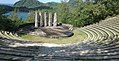 Cagraray Eco Park
 -
 Cagraray Beach
 -
 View of Mayon Volcano from Bacacay


References
[edit]- ^ Municipality of Bacacay | (DILG)
- ^ "2015 Census of Population, Report No. 3 – Population, Land Area, and Population Density" (PDF). Philippine Statistics Authority. Quezon City, Philippines. August 2016. ISSN 0117-1453. Archived (PDF) from the original on May 25, 2021. Retrieved July 16, 2021.
- ^ "2024 Census of Population (POPCEN) Population Counts Declared Official by the President". Philippine Statistics Authority. 17 July 2025. Retrieved 18 July 2025.
- ^ "PSA Releases the 2021 City and Municipal Level Poverty Estimates". Philippine Statistics Authority. 2 April 2024. Retrieved 28 April 2024.
- ^ "2024 Census of Population (POPCEN) Population Counts Declared Official by the President". Philippine Statistics Authority. 17 July 2025. Retrieved 18 July 2025.
- ^ "Province:". PSGC Interactive. Quezon City, Philippines: Philippine Statistics Authority. Retrieved 25 August 2025.
- ^ "Municipal: Bacacay". PSGC Interactive. Quezon City, Philippines: Philippine Statistics Authority. Retrieved 8 January 2016.
- ^ Census of Population (2020). "Region V (Bicol Region)". Total Population by Province, City, Municipality and Barangay. Philippine Statistics Authority. Retrieved 8 July 2021.
- ^ a b Census of Population and Housing (2010). "Region V (Bicol Region)" (PDF). Total Population by Province, City, Municipality and Barangay. National Statistics Office. Retrieved 29 June 2016.
- ^ "Bacacay, Albay : Average Temperatures and Rainfall". Meteoblue. Retrieved 29 December 2018.
- ^ "2024 Census of Population (POPCEN) Population Counts Declared Official by the President". Philippine Statistics Authority. 17 July 2025. Retrieved 18 July 2025.
- ^ Census of Population (2015). "Region V (Bicol Region)". Total Population by Province, City, Municipality and Barangay. Philippine Statistics Authority. Retrieved 20 June 2016.
- ^ Censuses of Population (1903–2007). "Region V (Bicol Region)". Table 1. Population Enumerated in Various Censuses by Province/Highly Urbanized City: 1903 to 2007. National Statistics Office.
- ^ "Province of". Municipality Population Data. Local Water Utilities Administration Research Division. Retrieved 17 December 2016.
- ^ "2024 Census of Population (POPCEN) Population Counts Declared Official by the President". Philippine Statistics Authority. 17 July 2025. Retrieved 18 July 2025.
- ^ "Poverty incidence (PI):". Philippine Statistics Authority. Retrieved December 28, 2020.
- ^ "Estimation of Local Poverty in the Philippines" (PDF). Philippine Statistics Authority. 29 November 2005.
- ^ "2003 City and Municipal Level Poverty Estimates" (PDF). Philippine Statistics Authority. 23 March 2009.
- ^ "City and Municipal Level Poverty Estimates; 2006 and 2009" (PDF). Philippine Statistics Authority. 3 August 2012.
- ^ "2012 Municipal and City Level Poverty Estimates" (PDF). Philippine Statistics Authority. 31 May 2016.
- ^ "Municipal and City Level Small Area Poverty Estimates; 2009, 2012 and 2015". Philippine Statistics Authority. 10 July 2019.
- ^ "PSA Releases the 2018 Municipal and City Level Poverty Estimates". Philippine Statistics Authority. 15 December 2021. Retrieved 22 January 2022.
- ^ "PSA Releases the 2021 City and Municipal Level Poverty Estimates". Philippine Statistics Authority. 2 April 2024. Retrieved 28 April 2024.
- ^ "Masterlist of Schools" (PDF). Department of Education. January 15, 2021. Retrieved October 28, 2025.
- ^ "Checklist". Department of Education - Division of Albay. DepEd Albay ICT Team. 2011. Archived from the original on 2 November 2014. Retrieved 5 December 2016.
- ^ "Zamora Memorial College - Educational Institutions"
External links
[edit]
 The dictionary definition of Bacacay at Wiktionary
 Media related to Bacacay at Wikimedia Commons
- Philippine Standard Geographic Code
- LGU Profile of Bacacay


Places adjacent to Bacacay | |
|---|---|


Bacacay
View on GrokipediaHistory
Founding and Colonial Period
Bacacay originated as a settlement on the eastern slopes of Mount Mayon during the Spanish colonial era, deriving its name from bagacay, a reed plant of the bamboo family used by inhabitants for fishing rods in local rivers and coastal areas.[8] The area was formally organized as a barrio (visita) under the jurisdiction of Tabaco in 1649, reflecting the gradual consolidation of Spanish administrative control in the Bicol region following initial explorations by Juan de Salcedo in 1573.[9][10] In 1660, Bacacay achieved status as an independent pueblo (municipality), coinciding with the creation of its parish dedicated to Saint Rose of Lima, with Father Francisco de Santa Maria appointed as the first parish priest.[11] This ecclesiastical establishment underscored the intertwined roles of missionary activity and civil governance in Spanish colonization, as Franciscan and other orders facilitated conversion and settlement. The pueblo encompassed mainland territories and nearby islands, supporting agriculture, fishing, and trade amid the volcanic landscape. Throughout the colonial period, Bacacay faced recurrent threats from Moro slave-raiding expeditions originating from Mindanao, which targeted coastal settlements for captives and plunder. A documented raid in 1796 saw a division of approximately fifty pancos (outrigger boats) passing through Tabaco Bay to sack the town, prompting defensive responses involving local vintas (war canoes).[12] Similar sieges persisted into the nineteenth century, as noted in accounts of regional defenses against such incursions, highlighting the precarious security along Albay's eastern seaboard until fortified measures were bolstered.[13] These raids disrupted economic activities, including abaca fiber production and coastal fishing, core to the local economy under Spanish tribute systems.Post-Independence Development
After Philippine independence in 1946, Bacacay remained a predominantly rural municipality focused on agriculture and fisheries, with its economy centered on low-value commodities such as copra, abaca fiber, and marine products.[14] The town's development was shaped by its coastal location and vulnerability to environmental hazards, including typhoons and proximity to Mount Mayon, which periodically disrupted local production but also supported fertile lands for farming. Central government influence increased post-independence, enabling some mobilization of community resources for recovery from disasters, though specific infrastructure expansions like roads and ports evolved gradually to support trade in seafood and agricultural goods.[15] The enactment of the Local Government Code of 1991 marked a key shift, devolving greater administrative and fiscal autonomy to municipalities like Bacacay, facilitating local planning for economic transformation. By the early 2010s, Bacacay was classified as a 2nd-class municipality with an average annual income of PHP 45–55 million, reflecting modest growth amid persistent challenges such as high poverty rates—40.1% in 2009—and unemployment linked to seasonal fishing and farming. Efforts emphasized value-adding processes, including research and development to convert raw products into higher-value items, alongside proposals for farm-to-market roads and warehouses to enhance resilience against typhoons and improve market access.[14] Population expanded steadily, reaching 65,724 by the 2010 census, supported by relatively high education participation and completion rates (rated 3.8 in 2009 assessments), though socioeconomic indicators highlighted needs in law enforcement and digital connectivity. Governance innovations, such as proposed citizen councils and anti-corruption compliance mechanisms with fines up to PHP 200,000, aimed to bolster participatory development and address inefficiencies in service delivery.[14]Recent Developments
In the May 2025 local elections, Nookie Bombales of the Liberal Party was elected mayor of Bacacay with 22,887 votes, representing 44.18% of the votes from 100% of precincts reporting, while Bob Arjona of the same party secured the vice mayoralty with 25,233 votes or 48.71%. These results, based on Commission on Elections data, reflect continued political dynamics in the municipality amid broader regional scrutiny of infrastructure funding tied to party-list representatives.[16] Infrastructure projects have advanced but drawn criticism for environmental consequences. The Cagbulacao to Manaet road network on Cagraray Island, funded by the Ako Bicol party-list, completed sections with street lighting in forested mountain areas by September 2025, yet residents and observers highlighted its role in exacerbating floods and landslides during heavy rains. In response to Governor Noel Rosal's concerns, the Department of Public Works and Highways (DPWH) Albay district clarified the project's status and ongoing phases in mid-September 2025, emphasizing compliance with standards amid calls for greater transparency in local government unit involvement. Flood control initiatives across Albay, including those affecting Bacacay, faced allegations of substandard execution and favoritism toward firms linked to former Ako Bicol representative Zaldy Co, with P2.38 billion in contracts criticized for enriching political dynasties rather than mitigating risks effectively.[17][18][19] Bacacay has pursued eco-tourism enhancements, with the Provincial Tourism, Culture, and Arts Office (PTCAO) intensifying promotion of sites like Cagraray Eco Park as of April 2025 to position the municipality as a sustainable destination leveraging its coastal and island features. Community initiatives included a coastal clean-up and hybrid coconut tree planting across barangays 1, 3, and portions of others on September 23, 2025, aligning with environmental resilience goals. Public service expansions featured the October 18, 2025, inauguration of a new court facility and health missions led by Mayor Bombales to address local wellness needs. However, recurrent natural hazards persist, including flash floods in February 2025 and impacts from Severe Tropical Storm Opong in September 2025, which prompted evacuations in Albay and underscored vulnerabilities tied to topography and prior storm seasons like Typhoon Kristine in October 2024 that displaced over 17,000 in the province.[20][21][22][23][24]Geography
Location and Topography
Bacacay is a coastal municipality located in the province of Albay within the Bicol Region of the Philippines, positioned along the eastern coast facing the Philippine Sea. Its geographic coordinates are approximately 13°18′N latitude and 123°48′E longitude.[25] The municipality borders Malilipot to the northwest and Santo Domingo to the southwest, with additional barangays extending to Cagraray Island, which it shares administratively.[1] The total land area of Bacacay spans 122.13 square kilometers, representing about 4.74% of Albay's provincial area.[1] It features an irregular coastline estimated at 143 kilometers, the longest in Albay, characterized predominantly by black volcanic sand beaches resulting from erosion of nearby volcanic rocks.[26] Topographically, Bacacay lies on the eastern slopes of Mount Mayon, with terrain transitioning from coastal plains to gently rolling hills and low-elevation uplands. Approximately 67.3% of the municipal land area consists of elevations below 100 meters, with an average elevation of 38 meters above sea level; minimum points reach near sea level, while higher areas approach several hundred meters inland.[27][28] The landscape reflects volcanic influences, including fertile plains interspersed with minor ridges and proximity to offshore islands like Cagraray, contributing to a mix of lowland agricultural zones and marine-adjacent features.[27]Administrative Divisions
Bacacay is politically subdivided into 56 barangays, the basic political and administrative units in the Philippines.[1] These include both mainland settlements and island communities, with several located on Cagraray Island off the Albay coast.[29] The municipal center, or Poblacion, comprises numbered barangays 1 through 14, which house key government offices, the municipal hall, and central commercial areas.[1] Other notable barangays include Bonga (the most populous with 7,998 residents in 2020), Hindi, and Misibis, reflecting a mix of coastal, rural, and tourism-oriented communities.[1]| Barangay Group | Examples | Notes |
|---|---|---|
| Poblacion | Barangay 1–14 | Urban core; includes administrative and commercial hubs |
| Mainland | Baclayon, Banao, Bariw, Basud, Bayandong | Primarily agricultural and fishing areas |
| Cagraray Island | Cagraray, Tanagan, Cabasan, Cagbulacao, Manaet | Tourism-focused with beaches and eco-parks; shared jurisdiction aspects with neighboring Malilipot |
Climate and Environmental Hazards
Bacacay features a tropical monsoon climate, with hot temperatures averaging 27°C annually and highs up to 32°C during May and June.[4] Rainfall totals approximately 2,500 mm per year, concentrated in the wet season from October to January, when monthly precipitation can exceed 370 mm in December.[31] The dry season spans February to May, with April recording the lowest rainfall at under 100 mm.[31] High humidity persists year-round, often exceeding 80%, contributing to oppressive conditions.[31] The municipality faces multiple environmental hazards due to its location in the typhoon-prone Bicol Region and proximity to Mayon Volcano, approximately 20 km southwest.[32] Volcanic risks include eruptions, pyroclastic flows, lahars, and ashfall; for instance, the 1814 Mayon eruption damaged Bacacay, while the 1984 event buried parts of the area under 15 meters of lava.[33][34] Barangays like Bonga lie within Mayon's permanent danger zone, prompting evacuations during heightened alerts, as in the 2018 eruption that destroyed PHP 100 million in regional crops including those in Albay municipalities like Bacacay.[32][35] Typhoons, averaging 20 annually in the Philippines with several impacting Bicol, exacerbate flooding and landslides, particularly when combining with heavy monsoon rains or volcanic activity to trigger mudflows near slopes.[36][37] Albay province, including Bacacay, is classified as high-risk for these events, alongside earthquakes and coastal flooding from storm surges.[4] Historical data indicate frequent severe typhoon strikes in Albay, leading to infrastructure damage and livelihood disruptions.[38]Demographics
Population Trends
The population of Bacacay has exhibited consistent growth over the past century, driven by natural increase, migration, and agricultural expansion, though at a decelerating rate in recent decades. Census data from the Philippine Statistics Authority record the municipality's population rising from 14,214 in 1903 to 72,485 in 2020, representing a cumulative increase of 58,271 residents over 117 years.[1] This expansion accelerated post-World War II, with notable jumps between 1960 (29,181) and 1970 (37,737), reflecting broader Philippine demographic patterns of high fertility and rural stability.[1]| Census Year | Population |
|---|---|
| 1903 | 14,214 |
| 1918 | 20,211 |
| 1939 | 23,863 |
| 1948 | 26,504 |
| 1960 | 29,181 |
| 1970 | 37,737 |
| 1975 | 40,130 |
| 1980 | 44,433 |
| 1990 | 49,202 |
| 1995 | 56,295 |
| 2000 | 58,357 |
| 2007 | 61,574 |
| 2010 | 65,724 |
| 2015 | 68,906 |
| 2020 | 72,485 |
Ethnic Composition and Languages
The ethnic composition of Bacacay is overwhelmingly Bicolano, the predominant Austronesian ethnic group of the Bicol Region, reflecting the demographic patterns of Albay province where Bicolanos form the majority population.[7][41] No official census data from the Philippine Statistics Authority delineates ethnic breakdowns at the municipal level for Bacacay, but provincial-level indicators and regional studies confirm the near-absence of significant non-Bicolano groups, such as indigenous Aeta or migrant Visayan communities, with any such minorities comprising negligible fractions based on broader Bicol ethnographic surveys.[42] The primary languages spoken in Bacacay are variants of Bikol, including Central Bikol (also known as Bikol-Naga) and Albay Bikol dialects, which are mutually intelligible Inland Bikol languages used in daily communication, commerce, and cultural practices.[43][44] Bikol serves as the vernacular for over 90% of residents in the province, with local dialects varying by barangay due to Albay's linguistic diversity among its seven Bikol varieties.[41] Filipino (standardized Tagalog) and English, the national and associate official languages, are widely understood and used in education, government, and media, facilitating bilingualism among the population.[43][45]Socioeconomic Indicators
The poverty incidence among families in Bacacay was estimated at 26-35% as of 2009, aligning with the local benchmark for acceptable levels in non-metropolitan municipalities.[46] Provincial data for Albay, which encompasses Bacacay, recorded a family poverty incidence of 15.4% in 2023, lower than the Bicol region's 20.3%.[47] Simple literacy rates in Bacacay ranged from 95% to 97% as of 2009, exceeding the provincial benchmark of 92%.[46] The average annual family income in Albay was ₱293,290 in 2021, reflecting broader provincial economic conditions applicable to Bacacay households.[48] Employment indicators for Bacacay showed a rate of 97.05% in available local assessments, though dated, while Albay's provincial employment rate stood at 95% in recent surveys.[49][50] Preliminary results from the 2024 Community-Based Monitoring System (CBMS) in Bacacay are expected to provide updated socioeconomic metrics, including income distribution and labor participation, once finalized by the Philippine Statistics Authority.[51]Economy
Primary Sectors
The primary economic sectors in Bacacay, a coastal municipality in Albay province, Philippines, are fisheries and agriculture, which sustain a significant portion of the local population through extraction and production of raw materials.[4] Fisheries dominate due to the municipality's extensive coastline along Albay Gulf and its 24 island coastal barangays out of 36 total, making it one of Albay's largest fishing areas.[4] Municipal fisheries in the region, including Bacacay's waters, contribute substantially to Bicol's overall fishery production volume.[52] Commercial and subsistence fishing target species such as rabbitfish, with cage culture initiatives monitored by local agriculture offices to enhance production.[53] Fishing households rely heavily on fish processing and direct catch sales, though they face challenges like poverty from limited alternative livelihoods and environmental pressures in Albay Gulf. [54] Post-disaster recovery programs have targeted fisherfolks with resilient livelihood support, including equipment and skills training, underscoring the sector's vulnerability to typhoons and volcanic activity from nearby Mayon Volcano.[55] Agriculture complements fisheries, focusing on crop production suited to volcanic soils, with rice farming prominent among inland barangays and support for affected rice farmers through government loans and inputs.[56] Local assessments indicate average agricultural land productivity, aligning with Albay's broader emphasis on crops like rice, coconut, and abacá fiber, though specific yields in Bacacay are constrained by terrain and climate hazards.[46] [43] These sectors employ a majority of rural households, with median monthly incomes from fishing and farming reported as primary sources amid ongoing efforts to diversify through sustainable practices.[54]Infrastructure and Challenges
Bacacay's economic infrastructure centers on its ports and road networks, which facilitate fishing exports, tourism access, and local trade. In February 2024, the Department of Transportation (DOTr) and Albay provincial government formalized an agreement to rehabilitate and expand two municipal seaports in Bacacay, targeting improved cargo handling capacity and roll-on/roll-off operations to bolster fisheries and inter-island connectivity.[57] These upgrades align with broader Bicol Region efforts under the Philippine Nautical Highway System, integrating ports with national roads for efficient goods movement.[52] Road development includes ongoing concreting projects, such as segments linking Bacacay to Cagraray Island, though progress has been phased with funding allocated across fiscal years.[18] Persistent challenges hinder infrastructure efficacy and economic growth. Local groups have raised concerns over substandard quality and permitting lapses in projects like the Cagbulacao-Manaet road network and a P4-billion Ridge Road initiative, prompting demands for accountability amid allegations of anomalous insertions in budgets.[58] [59] Frequent hydro-meteorological disasters, including Super Typhoon Rolly in October 2020 and Super Typhoon Pepito in November 2024, exacerbate vulnerabilities by damaging roads, ports, and supply chains, with Rolly alone causing prolonged disruptions to Bacacay's fishing sector.[55] [60] Coastal erosion, quarrying activities, and inadequate drainage further compound flooding risks, as noted in post-Pepito assessments linking poor infrastructure to heightened economic losses.[60] Enforcement gaps undermine sustainable economic use of infrastructure. Illegal fishing persists in Bacacay's waters despite regulatory efforts, depleting fish stocks and reducing long-term yields for the municipality's primary sector, which employs a significant portion of households.[4] Socioeconomic pressures, including poverty rates among fishing communities driven by hazard exposure and limited diversification, impede resilience; surveys indicate that Albay Gulf households face chronic income instability from overfishing and storm-induced vessel damage.[61] These factors collectively constrain Bacacay's integration into regional value chains, with disaster recovery diverting resources from maintenance and expansion.[4]Recent Economic Initiatives
In September 2025, the Albay Provincial Agricultural Office presented the proposed Sula Development Plan, aimed at transforming Bacacay into a tourism and economic hub through enhanced infrastructure, job creation, and integrated development along the Sula Channel. The plan emphasizes sustainable utilization of coastal resources, including regulated aquaculture and eco-tourism facilities, to boost local revenues while addressing environmental concerns from fish cage proliferation in the area.[62] Complementing these efforts, the Provincial Tourism, Culture, and Arts Office (PTCAO) intensified initiatives in April 2025 to position Bacacay as a premier eco-tourism destination, focusing on sites like Cagraray Island with its eco-parks and beaches to attract visitors and generate employment in hospitality and guiding services. These activities include capacity-building for local operators and promotion of nature-based experiences, such as island hopping and trail development, leveraging Bacacay's proximity to Mayon Volcano for scenic appeal.[63] Infrastructure improvements have supported these goals, with the Department of Public Works and Highways (DPWH) advancing road projects in Bacacay as of September 2025, including clarifications on ongoing contracts to ensure timely completion and better connectivity to tourism and fishery zones.[18] Enhanced road access is projected to reduce travel times from Legazpi City, facilitating increased economic activity in primary sectors like fishing and small-scale trade. In the fishery sector, local management of marine protected areas has been evaluated and strengthened through community-led protocols, with studies from 2023 onward highlighting improved enforcement to sustain fish stocks amid aquaculture growth in Sula Channel.[64] These measures align with broader Bicol regional plans for resilient livelihoods, incorporating training for fisherfolk on sustainable practices to mitigate coastal vulnerabilities.[52]Government and Politics
Local Governance Structure
The local government of Bacacay adheres to the framework established by Republic Act No. 7160, the Local Government Code of the Philippines, which delineates the powers and responsibilities of municipal units. The executive authority is vested in the municipal mayor, elected for a three-year term, who directs administrative functions, enforces ordinances, and manages fiscal resources allocated for public welfare and development projects. The mayor is supported by appointed department heads overseeing offices such as the municipal treasurer, assessor, engineer, and health officer, ensuring operational efficiency across sectors like finance, planning, and social services. The legislative arm, the Sangguniang Bayan, functions as the policy-making body, comprising the vice mayor as presiding officer and eight regularly elected members, alongside two ex-officio positions held by the president of the Association of Barangay Captains and the president of the Sangguniang Kabataan Federation. This council enacts ordinances, approves the annual budget, and supervises programs addressing local needs, with sessions conducted publicly to promote transparency. Decisions require a majority vote, subject to review by higher authorities if contested. Bacacay is subdivided into 56 barangays, the smallest administrative units, each governed by an elected barangay captain and a sangguniang barangay consisting of seven members, responsible for grassroots implementation of municipal policies, maintenance of peace and order, and community-specific initiatives like infrastructure upkeep and disaster response coordination. Barangay officials serve three-year terms and interface directly with residents through assemblies, fostering participatory governance at the neighborhood level.[65][1]Historical Administrators
Armando "Dinky" Baraga Romano served as mayor of Bacacay from 2016 to 2023, completing three consecutive terms before succumbing to a cerebral aneurysm on November 17, 2023, during his final term.[66][67] Prior to his mayoralty, Romano held positions as municipal councilor and vice mayor.[68] He succeeded Tobias B. Betito, who was mayor as of 2012.[69] Following Romano's death, Vice Mayor Edsel B. Belleza assumed the mayoral position in late 2023 and served until the 2025 elections.[51] Belleza had previously held local elective roles and ran for re-election in May 2025 but was succeeded by Daniel Jose Romano Bombales.[16][70] Earlier records of administrators, particularly from the Spanish colonial era's capitanes municipales, remain sparsely documented in publicly available sources, with local histories often relying on unverified oral traditions or municipal archives not digitized. The Romano family has maintained prominence in Bacacay's local governance, reflecting patterns of political dynasties observed in Philippine municipalities.[71]Security and Law Enforcement
The Bacacay Municipal Police Station (BMPS), operating under the Philippine National Police (PNP) and the Albay Provincial Police Office, handles local law enforcement, crime prevention, and public safety maintenance across the municipality's 44 barangays.[72] The station emphasizes proactive patrols, traffic management, and community programs such as motorist assistance centers to enhance visibility and response times.[73] In line with national PNP directives like the Enhanced Managing Police Operations framework, BMPS conducts intensified anti-crime operations targeting focus crimes such as murder, robbery, and theft.[74] On August 11, 2025, Bacacay was ceremonially declared a stable internal peace and security municipality by local officials, including Mayor Nookie Bombales, signaling sustained improvements in order amid regional efforts to achieve 5-minute response times for emergencies.[75] This status builds on prior accomplishments, including the 2021 certification of all 44 barangays as drug-cleared through coordinated anti-narcotics campaigns.[76] Recent leadership under Acting Chief Police Major Edwin B. Apun has prioritized facility upgrades, election checkpoints, and rapid arrests to bolster community trust.[77][78] Despite these gains, Bacacay remains identified as a crime hotspot within Albay Province, where geospatial analysis of 1,630 offenses from 2017 to 2022 highlighted vulnerabilities to violent crimes, including sexual offenses (16.02% of cases province-wide) and attacks on students (95.97% of analyzed victims).[79] Specific incidents include the January 29, 2025, arrest of a 25-year-old provincial most-wanted suspect for prior offenses, and the October 20, 2025, apprehension of a construction worker for hacking to death a 65-year-old farmer and his 27-year-old son nephew during a land dispute in a local barangay, with police responding within hours.[77][80] An earlier case involved the 2022 discovery of a 22-year-old female college student dead with stab wounds and torn clothing in Barangay Hindi, underscoring persistent risks of homicide and possible sexual violence.[79] These events align with Bicol Region's overall crime decline of 7.12% as of August 2025, attributed to faster interventions, though local enforcement continues to address non-index crimes like disputes and drug remnants.[81]Infrastructure and Public Services
Transportation and Connectivity
Bacacay is primarily accessed via land transport along the Tabaco-Legazpi Road, a paved national highway connecting it to Legazpi City, approximately 20 kilometers to the south, with travel times of 20-30 minutes by jeepney or bus.[82] Public utility vehicles, including jeepneys from Legazpi and Tabaco City, provide frequent service to the municipal center, while tricycles serve intra-barangay routes and short-distance travel.[83] Long-distance buses from Manila's PITX terminal reach Bacacay directly, covering about 460 kilometers in 10-12 hours.[84] Air connectivity relies on Bicol International Airport in Daraga, Albay, located 25-36 kilometers from Bacacay, accessible by taxi or van in 30-45 minutes. The airport handles domestic flights from Manila and Cebu, serving as the primary gateway for regional travel.[85] Maritime transport centers on two seaports, Cawayan and Pili, which support fishing operations and eco-tourism; in 2024, the Department of Transportation allocated P20 million for their repair and rehabilitation under a memorandum of agreement with Albay province to boost trade and visitor access.[86] Local boats depart from Bacacay Port for nearby islands, such as Cagraray Island (short ferry or bangka ride) and Vanishing Island (20-45 minutes by hired boat), enhancing connectivity to offshore attractions.[87] Ongoing road projects, including the Cagraray Circumferential Road and farm-to-market routes, aim to improve internal linkages and tourism access, though some networks have faced local scrutiny for environmental impacts like flooding.[88][17]Health and Disaster Management
Bacacay's primary health facility is the Bacacay Rural Health Unit (RHU), a government-operated center located at Fr. Banez Street, Barangay 11, along Magsaysay Avenue, providing essential services including maternal and child health, immunization, and tuberculosis treatment as part of the national TB control program.[89][90] The RHU collaborates with provincial health offices and partners like the Bureau of Fire Protection for community health initiatives, such as training programs conducted in July 2025.[91] In January 2024, an audit revealed approximately P1 million in expired medicines and unused supplies stored at the RHU, highlighting inventory management challenges in the facility.[92] Disaster management in Bacacay is coordinated by the Municipal Disaster Risk Reduction and Management Office (MDRRMO) and the Municipal Disaster Risk Reduction and Management Council (MDRRMC), which issue advisories for hazards like shear line-induced landslides, as seen in January 2023.[93] The municipality benefits from Albay province's established zero-casualty framework, emphasizing proactive risk communication, early warning systems, and community preparedness to mitigate impacts from frequent typhoons and geologic events.[94][95] Key risks include ashfall and potential lahars from Mayon Volcano eruptions, though Bacacay's coastal position east of the volcano reduces direct exposure to lava flows compared to western municipalities; provincial evacuations during heightened alerts, such as in 2023, have involved coordination with national agencies like PHIVOLCS.[96] Typhoons pose significant threats, with Super Typhoon Rolly in October 2020 contributing to regional casualties and infrastructure damage in Albay, including injuries reported in the province.[97] More recent events, like Typhoon Kristine in October 2024, prompted a state of calamity declaration in Albay due to flooding, landslides, and service disruptions, exacerbating health vulnerabilities such as respiratory infections, diarrhea, and skin conditions in displaced populations.[98][99] MDRRMO efforts include drills and partnerships, such as October 2025 training with the Bureau of Fire Protection for schools, to enhance resilience against these recurrent hazards.[100] The RHU integrates into response protocols, addressing post-disaster disease outbreaks through heightened surveillance and resource allocation under Department of Health guidelines.[98]Environmental Protection Efforts
Bacacay maintains a marine protected area (MPA) to preserve marine biodiversity, enhance fish stocks, and rehabilitate ecosystems, operating under the framework of Republic Act No. 8550, the Philippine Fisheries Code of 1998.[101] Management components include full coverage of habitat protection (100%) and near-complete administration (98%) and rehabilitation efforts (98%), with overall effectiveness rated high at a weighted mean of 3.50 across surveyed components.[101] Strategies emphasize community-based approaches, stakeholder engagement, and adaptive governance to promote sustainable resource use.[101] Challenges in MPA management persist, including limited funding and resources (affecting 60 respondents), climate change impacts (54 respondents), illegal fishing (50 respondents), inadequate monitoring (75 respondents), and unequal benefit sharing (80 respondents), based on a 2025 survey of 100 local participants.[101] Despite these, outcomes show improvements in biodiversity and fish populations, though enforcement gaps hinder full potential.[101] In response to Typhoons Rolly and Ulysses in late 2020, the United Nations Development Programme launched a Rebuilding Livelihoods initiative in March 2021, supporting 60 fisherfolks in Bacacay's Barangays Busdac, San Pablo, and Pili Iraya with fishing gear, cash for alternatives like hog-raising, and seedlings for backyard planting to foster sustainable practices.[55] This effort diversified income sources while promoting local environmental sustainability through vegetation restoration.[55] Coastal adaptation programs in Bacacay's villages, such as Sogod, Igang, Bariw, Uson, Busdac, and Misibis, build resilience via provincial initiatives like the Centre on Initiatives and Research on Climate Adaptation (CIRCA) and Albay in Action on Climate Change (A2C2), focusing on strengthening community networks and local knowledge to counter threats like illegal fishing, which continues despite local ordinances.[4] These soft strategies aim to enhance adaptive capacity amid low awareness of broader climate programs (97% of respondents unaware).[4] The Cagraray Eco-Energy Park on Cagraray Island integrates environmental protection with renewable energy, featuring wind turbines, solar-powered facilities, and eco-friendly architecture to demonstrate sustainable development and reduce reliance on fossil fuels.[102] As part of broader eco-tourism pushes, it supports conservation by highlighting clean energy's role in preserving coastal ecosystems.Education
Educational Institutions
Bacacay's public elementary schools, numbering 40 and supervised by the Department of Education's Schools Division Office of Albay, serve foundational education across the municipality's East, South, and West districts. Notable examples include Bacacay East Central School (School ID 111584), Basud Elementary School (ID 111585), and Bogna Elementary School (ID 111586).[103] Public secondary education is delivered through 9 high schools, many of which also offer senior high school programs, including Bonga National High School (Bacacay West), Cabasan National High School (Bacacay South), Cawayan National High School (Bacacay South), Pili National High School (Bacacay West), Sogod National High School (Bacacay East), Vinisitahan National High School (Bacacay East), San Pablo High School (Bacacay South), and Bariw Integrated School (Bacacay West).[104] Private schools authorized by the Division of Albay include St. John Vianney Learning Center of Bacacay, Inc. (School ID 403556), Santa Rosa de Lima Learning Center Inc. (ID 403559), and Zamora Memorial College, Inc. (ID 403560), which extends into tertiary offerings.[105] Higher education in Bacacay is primarily provided by Zamora Memorial College, a private institution established in 1948 by Crispin Vergara in Barangay 9, offering bachelor-level programs such as Bachelor in Elementary Education, Bachelor of Culture and Arts Education, and Bachelor of Technology and Livelihood Education.[106][107] Bacacay Community College, located in San Pedro, supplements this with undergraduate degrees including Bachelor of Science in Entrepreneurship under Commission on Higher Education oversight.[108][109]Literacy and Access Challenges
Bacacay's educational landscape features significant access barriers due to its archipelagic geography, encompassing mainland barangays and offshore islands like Cagraray, where students rely on boat travel susceptible to rough seas and typhoons. This isolation necessitates multigrade classrooms, in which a single teacher instructs multiple grade levels simultaneously, correlating with diminished academic performance as resources and individualized instruction remain limited.[110][111] Remote areas exacerbate connectivity issues, with students and teachers in upland and island locales struggling to secure reliable internet signals for modular distance learning, a format adopted during the COVID-19 pandemic and persisting in hybrid models. Local educators have advocated for government-subsidized internet to mitigate these gaps, as signal unreliability hinders submission of modules and virtual participation.[112] Frequent suspensions of classes due to heavy rainfall and flooding further interrupt continuity, compounding absenteeism in weather-vulnerable coastal zones.[113] Proximity to Mayon Volcano introduces recurrent disruptions from eruptions and lahar flows, displacing communities and damaging school infrastructure, as observed in Albay-wide events that force evacuations and temporary learning shifts. Elevated poverty incidence in Bacacay's fishing-dependent households—reaching around 26% provincially in recent assessments—fuels dropout risks, particularly among students at risk of dropping out (SARDO) in island schools, where economic pressures prioritize child labor over attendance.[114][61][115] While national basic literacy rates hover at 90% for those aged 5 and over, these access impediments likely depress functional literacy and higher attainment in Bacacay's marginalized sectors, underscoring disparities beyond aggregate figures.[116]Culture and Heritage
Local Festivals and Traditions
The Karagumoy Festival, held annually in August, celebrates the karagumoy plant—a member of the pandan family that grows over six feet tall and provides strips from its long leaves used in weaving traditional items such as sleeping mats, hats, and bags.[117] The event, culminating around August 30, coincides with the town fiesta honoring the patron saint, Saint Rose of Lima, and features cultural performances, sports competitions, environmental awareness activities, and community gatherings that highlight local craftsmanship and unity.[118] In 2025, the festival ran from August 19 to 31, including a beauty pageant known as Mutya ng Karagumoy to showcase participants' talents and cultural pride.[119] The Kadagatan Festival, observed on Black Saturday during Holy Week, focuses on maritime traditions through competitive boat races involving outriggered bancas powered manually or by sails in the "Palayag" event.[120] Originally launched as the Bancathon Race in 1982 to align with Catholic observances of Christ's passion, it draws local fishermen and emphasizes the town's seafaring heritage and gratitude for marine bounty.[121][122] These festivals reflect Bacacay's blend of Catholic religious observances and indigenous resource-based customs, with the August events tied to agricultural and artisanal practices while the Holy Week tradition underscores communal thanksgiving amid the fishing-dependent economy.[117][122]Marine and Natural Resources
Bacacay's economy and livelihoods depend substantially on its marine resources, given its 24 island coastal barangays that host fishing communities. Fishing serves as the primary income source for 94% of households in coastal areas along Albay Gulf, where Bacacay is situated.[61] The municipality ranks among Albay's largest fishing areas, supporting multi-species capture fisheries with gears including hook-and-line, gill nets, and spears.[4] [123] In Albay Gulf fisheries, production has declined from 1,372 metric tons in 2014 to 840 metric tons in 2018, with Bacacay accounting for 5.73% or 673.27 metric tons of the catch during that period.[123] Annual estimates for the gulf reach 11,756 metric tons, but overexploitation persists, as 50% to 90% of common pelagic species like sardines and anchovies are harvested below maturity size, indicating growth overfishing.[124] Aquaculture efforts, such as fish cages in Sula Channel, supplement capture fisheries, though stakeholder perceptions highlight concerns over environmental impacts and resource competition.[62] Marine protected areas in Bacacay employ zoning strategies to regulate fishing, restrict access in core zones, and promote stock recovery, with management rated moderately effective in enforcement and community involvement.[101] Coastal ecosystems feature mangroves, seaweeds, and seagrasses, contributing to Albay's broader biodiversity as part of the UNESCO-designated Albay Biosphere Reserve, though specific inventories for Bacacay underscore vulnerability to erosion and habitat loss.[125] [126] Beyond fisheries, natural resources support ecotourism through sites like Cagraray Island's beaches and eco parks, leveraging the area's coral reefs and scenic coastlines while integrating with conservation under the biosphere framework.[4] Efforts to build resilient livelihoods, including post-disaster aid like fishing gear distribution to 41 fisherfolk in 2021, aim to sustain these resources amid climate pressures.[55]Notable Personalities
Crispin "Ka Bel" Beltran (January 7, 1933 – May 20, 2008), born in Bacacay, Albay, was a Filipino labor leader, activist, and politician known for his role in organizing workers' rights movements. He chaired the Kilusang Mayo Uno (KMU), the largest labor federation in the Philippines, and advocated for agrarian reform and anti-imperialist causes during the martial law era under Ferdinand Marcos. Beltran was arrested multiple times for alleged subversion, including a notable detention from 1973 to 1986, and later served as a party-list representative for Anakpawis in the House of Representatives from 2004 until his death from a fall.[127][128] Bacacay is recognized for its exceptional production of Catholic clergy, earning a reputation as a "vocation capital" in the Philippines, with reports indicating at least 79 to 120 living ordained priests originating from the municipality as of the early 2020s, many serving in dioceses across the country and internationally.[129][130]References
- https://en.wikivoyage.org/wiki/Albay