Hubbry Logo
search
logo
2048217

Baker's map

logo
Community Hub0 Subscribers
Read side by side
from Wikipedia
Example of a measure that is invariant under the action of the (unrotated) baker's map: an invariant measure. Applying the baker's map to this image always results in exactly the same image.

In dynamical systems theory, the baker's map is a chaotic map from the unit square into itself. It is named after a kneading operation that bakers apply to dough: the dough is cut in half, and the two halves are stacked on one another, and compressed.

The baker's map can be understood as the bilateral shift operator of a bi-infinite two-state lattice model. The baker's map is topologically conjugate to the horseshoe map. In physics, a chain of coupled baker's maps can be used to model deterministic diffusion.

As with many deterministic dynamical systems, the baker's map is studied by its action on the space of functions defined on the unit square. The baker's map defines an operator on the space of functions, known as the transfer operator of the map. The baker's map is an exactly solvable model of deterministic chaos, in that the eigenfunctions and eigenvalues of the transfer operator can be explicitly determined.

Formal definition

[edit]

There are two alternative definitions of the baker's map which are in common use. One definition folds over or rotates one of the sliced halves before joining it (similar to the horseshoe map) and the other does not.

The folded baker's map acts on the unit square as

When the upper section is not folded over, the map may be written as

The folded baker's map is a two-dimensional analog of the tent map

while the unfolded map is analogous to the Bernoulli map. Both maps are topologically conjugate. The Bernoulli map can be understood as the map that progressively lops digits off the dyadic expansion of x. Unlike the tent map, the baker's map is invertible.

Properties

[edit]

The baker's map preserves the two-dimensional Lebesgue measure.

Repeated application of the baker's map to points colored red and blue, initially separated. After several iterations, the red and blue points seem to be completely mixed.

The map is strong mixing and it is topologically mixing.

The transfer operator maps functions on the unit square to other functions on the unit square; it is given by

The origin unit square is on top and the bottom shows the result as the square is swept from left to right.

The transfer operator is unitary on the Hilbert space of square-integrable functions on the unit square. The spectrum is continuous, and because the operator is unitary the eigenvalues lie on the unit circle. The transfer operator is not unitary on the space of functions polynomial in the first coordinate and square-integrable in the second. On this space, it has a discrete, non-unitary, decaying spectrum.

As a shift operator

[edit]

The baker's map can be understood as the two-sided shift operator on the symbolic dynamics of a one-dimensional lattice. Consider, for example, the bi-infinite string

where each position in the string may take one of the two binary values . The action of the shift operator on this string is


that is, each lattice position is shifted over by one to the left. The bi-infinite string may be represented by two real numbers as

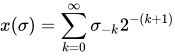
and
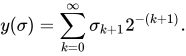
In this representation, the shift operator has the form

which is seen to be the unfolded baker's map given above.

See also

[edit]

References

[edit]
Revisions and contributorsEdit on WikipediaRead on Wikipedia
from Grokipedia
Baker's map is a paradigmatic example of a chaotic dynamical system in mathematics, defined as a piecewise linear transformation that maps the unit square [0,1]×[0,1][0,1] \times [0,1] onto itself by stretching and folding the space in a manner analogous to kneading dough.[1] This map divides the square into two rectangular regions based on the y-coordinate (typically at y = 1/2), stretches each vertically by a factor of 2 while compressing horizontally by 1/2, and then stacks the resulting strips to produce a uniform redistribution of points.[2] In its standard area-preserving form, the transformation is given by:
  • For $ y_n \leq 1/2 $: $ x_{n+1} = x_n / 2 $, $ y_{n+1} = 2 y_n $,
  • For $ y_n > 1/2 $: $ x_{n+1} = 1/2 + x_n / 2 $, $ y_{n+1} = 2(y_n - 1/2) $, with all computations modulo 1 to preserve the domain.[3]
The map exhibits fundamental properties of chaos, including sensitivity to initial conditions, topological transitivity, and dense periodic orbits, making it a model for studying hyperbolic attractors and ergodic theory.[2] Its topological entropy is ln2\ln 2, reflecting the exponential growth of distinguishable orbits, and the positive Lyapunov exponent ln2\ln 2 quantifies the rate of divergence of nearby trajectories.[2] Generalized versions allow for unequal stretching factors λa\lambda_a and λb\lambda_b (with λa+λb1\lambda_a + \lambda_b \leq 1) and partitioning at arbitrary α(0,1)\alpha \in (0,1), enabling analysis of dissipative systems where the attractor has zero measure for λa+λb<1\lambda_a + \lambda_b < 1.[3] These features have made Baker's map influential in understanding mixing in physical systems, such as fluid dynamics and statistical mechanics.[1]

History and Motivation

Origins

The Baker's map was introduced by Eberhard Hopf in 1937 as a foundational example in the study of discrete dynamical systems. In his monograph Ergodentheorie, Hopf presented the map as an accessible, two-dimensional transformation to demonstrate key concepts in ergodic theory, particularly the behavior of measure-preserving maps on the unit square. This construction provided an explicit, geometrically intuitive model that captured essential features of chaotic dynamics in higher dimensions, serving as a pedagogical tool for illustrating abstract theoretical principles.[4] Hopf's invention was motivated by challenges in statistical mechanics, where there was a need for concrete examples of irreversible processes and mixing behaviors in deterministic systems. Drawing from the ergodic hypothesis originating in the works of Boltzmann and others, the map modeled the stretching and folding akin to the mixing of gases, offering a simplified analogy for phase-space evolution without relying solely on one-dimensional interval maps. This addressed the demand for multidimensional examples that exhibited strong mixing properties, bridging physical intuition with mathematical rigor in the analysis of nonequilibrium steady states. Within the broader context of early ergodic theory, Hopf's map played a pivotal role in exploring measure-preserving transformations and their implications for time averages equaling space averages. Published during a formative period for the field, it exemplified a transformation that preserves the Lebesgue measure while inducing rapid dispersion of initial conditions, thus contributing to the foundational understanding of ergodicity and its applications to physical systems. The map's emphasis on these properties laid groundwork for subsequent developments in dynamical systems, though detailed analysis of its ergodic behavior appears in later sections.[5]

Development and Significance

Following its introduction in the 1930s, the Baker's map underwent substantial theoretical development in the mid-20th century, particularly during the 1960s and 1970s, as researchers advanced the frameworks of ergodic theory and hyperbolic dynamics. Yakov Sinai's pioneering work on Markov partitions, beginning in the late 1950s and extending into the 1960s, provided a rigorous method to symbolically encode the map's dynamics, revealing its structure as a prototypical hyperbolic system with a natural rectangular partition that preserves the Markov property under iteration. This encoding linked the map directly to symbolic dynamics, enabling precise analysis of its invariant measures and entropy.[6] Concurrently, David Ruelle and Rufus Bowen extended these ideas through the thermodynamic formalism in the early 1970s, establishing the existence of Sinai-Ruelle-Bowen (SRB) measures for Axiom A systems, a class to which the Baker's map belongs due to its uniform hyperbolicity.[7][8] Their approach treated the map's pressure function and equilibrium states analogously to statistical mechanics, highlighting its role in unifying geometric and probabilistic aspects of chaos.[6] These developments positioned the Baker's map as a cornerstone for studying dissipative and reversible hyperbolic flows. The map's enduring significance stems from its status as an exactly solvable model that captures core features of chaotic dynamics—such as exponential instability along unstable manifolds and rapid uniform mixing—through explicit computations via its symbolic representation, bypassing the complexities of numerical simulation.[9] As the simplest reversible hyperbolic system with positive entropy, it serves as an invaluable pedagogical tool for illustrating deterministic chaos and ergodicity in nonlinear dynamics courses.[9] Its influence permeated the expansion of ergodic theory and nonlinear dynamics fields, earning frequent citations in seminal works that shaped the discipline, including Ergodic Problems of Classical Mechanics by V.I. Arnold and A. Avez (1968), where it exemplifies mixing transformations on the unit square.[10] This integration fostered broader applications in understanding statistical properties of hyperbolic systems.[8]

Definition

Formal Definition

The Baker's map is a piecewise linear homeomorphism $ T: [0,1]^2 \to [0,1]^2 $ defined by
T(x,y)={(x/2,2y)if 0y1/2,(x/2+1/2,2(y1/2))if 1/2<y1, T(x,y) = \begin{cases} (x / 2, 2 y) & \text{if } 0 \leq y \leq 1/2, \\ (x / 2 + 1/2, 2 (y - 1/2)) & \text{if } 1/2 < y \leq 1, \end{cases}
with all computations modulo 1.[1] The map is invertible, with the explicit inverse
T1(x,y)={(2x,y/2)if 0x<1/2,(2(x1/2),y/2+1/2)if 1/2x1. T^{-1}(x,y) = \begin{cases} (2 x, y / 2) & \text{if } 0 \leq x < 1/2, \\ (2 (x - 1/2), y / 2 + 1/2) & \text{if } 1/2 \leq x \leq 1. \end{cases}
It preserves the Lebesgue measure on the unit square, as the Jacobian determinant has absolute value 1 everywhere, ensuring area conservation under the stretching and folding action.[3] The $ n $th iterate $ T^n $ admits a closed-form expression in terms of the binary expansions of the coordinates. Let $ x = \sum_{i=1}^\infty a_i 2^{-i} $ and $ y = \sum_{i=1}^\infty b_i 2^{-i} $ be the binary expansions (with $ a_i, b_i \in {0,1} $, resolving dyadic rationals appropriately to ensure uniqueness). Then
Tn(x,y)=(k=1nbk2k+2ni=1ai2i,i=1bn+i2i), T^n(x,y) = \left( \sum_{k=1}^n b_k 2^{-k} + 2^{-n} \sum_{i=1}^\infty a_i 2^{-i}, \sum_{i=1}^\infty b_{n+i} 2^{-i} \right),
where coordinates are taken modulo 1; the new $ x $-coordinate prepends the first $ n $ binary digits of the original $ y $ to the binary expansion of $ x $, scaled appropriately, while the new $ y $-coordinate is the left shift of the binary expansion of the original $ y $ by $ n $ digits.

Geometric Description

The Baker's map derives its name from the intuitive analogy to a baker kneading dough, where the unit square representing the phase space is manipulated through a sequence of stretching, cutting, and stacking operations that mimic the physical process of dough preparation.[11] In this geometric transformation, the square is first stretched vertically by a factor of 2, elongating it into a rectangle while compressing the horizontal dimension by half to preserve area. This step introduces exponential separation of nearby points along the vertical direction, akin to pulling dough to increase its length and thin it out.[11] A single iteration proceeds as follows: the elongated rectangle is sliced horizontally along its midline at y = 1, dividing it into two equal halves. The upper half is then placed to the right of the lower half, effectively juxtaposing them to reform the original unit square, with the horizontal coordinates adjusted accordingly—the lower half (y ≤ 0.5) maps to the left side and the upper half (y > 0.5) to the right. This recombination folds the material in a way that interleaves the two pieces, creating layered structures that enhance mixing without altering the overall area.[1] The process can be visualized as the dough being rolled out flat, cut in two horizontally, and the pieces placed side by side to double the layers, preparing for further kneading.[11] Under repeated iterations, an initial uniform distribution across the square evolves into a complex pattern of stretched filaments. Starting with, for example, a bipartition of the square into black and white halves along the vertical midline, the first application yields two vertical strips; subsequent maps double the number of alternating bands each time, producing $ 2^n $ thinner filaments after n steps. These filaments, aligned with the direction of maximum stretching, become increasingly fine-scale, filling the square densely and demonstrating the map's efficient mixing through progressive lamination and dispersion. In the limit of infinite iterations, the structure approaches a uniform distribution, illustrating the geometric mechanism's role in achieving thorough homogenization.[11]

Properties

Ergodic Properties

The Baker's map preserves the Lebesgue measure on the unit square [0,1)2[0,1)^2, as the transformation stretches vertically by a factor of 2 and compresses horizontally by a factor of 1/21/2, resulting in a Jacobian determinant of 1.[12] This uniform measure is invariant under iterations of the map, ensuring that the total measure of any set equals the measure of its image.[2] The map is ergodic with respect to the Lebesgue measure, meaning that for any integrable function ff and almost every point x[0,1)2x \in [0,1)^2, the time average limN1Nn=0N1f(Tnx)\lim_{N \to \infty} \frac{1}{N} \sum_{n=0}^{N-1} f(T^n x) equals the space average [0,1)2fdμ\int_{[0,1)^2} f \, d\mu.[13] A proof sketch relies on the measure-theoretic isomorphism between the Baker's map and the two-sided (1/2,1/2)(1/2,1/2)-Bernoulli shift on {0,1}Z\{0,1\}^\mathbb{Z} equipped with the product Bernoulli measure of equal probabilities. This conjugacy is established by mapping (x,y)(x,y) to the bi-infinite sequence where the non-negative indices encode the binary digits of yy and the negative indices encode those of xx, with the shift corresponding to the dynamics of the map.[12] Since measure-theoretic isomorphisms preserve ergodicity and the Bernoulli shift is ergodic—proven by showing that any invariant set EE satisfies μ(E)μ(E)2<ϵ| \mu(E) - \mu(E)^2 | < \epsilon for arbitrary ϵ>0\epsilon > 0 using independence of cylinder sets under distant shifts, implying μ(E)=0\mu(E) = 0 or 11—the Baker's map inherits this property.[14] The Baker's map is strongly mixing, with μ(TnAB)μ(A)μ(B)\mu(T^n A \cap B) \to \mu(A) \mu(B) as nn \to \infty for any measurable sets A,BA, B of finite measure; this follows from the conjugacy to the Bernoulli shift, where independence of separated coordinates ensures exponential decay of correlations.[13] Consequently, it is exact: for any set AA with 0<μ(A)<10 < \mu(A) < 1, the union of preimages k=0nTkA\bigcup_{k=0}^n T^{-k} A has measure approaching 1 as nn \to \infty. Under nn iterations, the preimage TnAT^{-n} A consists of 2n2^n rectangular components, each with measure μ(A)/2n\mu(A)/2^n, demonstrating exponential shrinking of individual preimage measures.[2] Ergodicity and strong mixing together imply the absence of non-trivial invariant sets, as any such set of positive measure less than 1 would contradict the equidistribution of orbits.[13]

Chaotic Behavior

The Baker's map exhibits chaotic behavior characterized by dynamical instability, where small perturbations in initial conditions lead to exponentially diverging trajectories. This sensitivity to initial conditions is quantified by the map's positive Lyapunov exponent, which measures the average rate of separation of infinitesimally close orbits. For the standard Baker's map, the Lyapunov exponent is uniformly ln2\ln 2 across the unit square, reflecting the uniform stretching factor of 2 in the vertical direction during each iteration.[15][16] To illustrate this sensitive dependence, consider two nearby points in the unit square differing by a small vertical distance δ\delta. After one application of the map, the stretching phase doubles this separation to 2δ2\delta in the y-coordinate, while the compression in the x-direction and folding preserve the overall exponential growth in the unstable (vertical) direction. Over nn iterations, the separation grows as approximately enln2δ=2nδe^{n \ln 2} \delta = 2^n \delta, demonstrating how even minuscule differences amplify rapidly, a hallmark of chaos that prevents long-term predictability.[2] The map also displays topological transitivity, meaning that for any two non-empty open sets in the unit square, there exists some iterate of the map that sends one set into the other. This property ensures the existence of dense orbits, particularly for points whose symbolic itineraries—encoded by binary expansions—behave like irrational rotations on the circle, filling the space densely without isolating behaviors. Such dense orbits underscore the map's ability to explore the entire phase space thoroughly.[17][2]

Symbolic Dynamics

Representation as a Shift

The Baker's map can be represented symbolically by encoding points in the unit square [0,1)×[0,1)[0,1) \times [0,1) using bi-infinite binary sequences from the space Σ2={0,1}Z\Sigma_2 = \{0,1\}^\mathbb{Z}, where each sequence (,s1,s0,s1,)( \dots, s_{-1}, s_0, s_1, \dots ) corresponds to a point (x,y)(x, y) via the itinerary under the map's partitioning into horizontal strips. The partition divides the square into two horizontal strips A0=[0,1)×[0,1/2)A_0 = [0,1) \times [0,1/2) and A1=[0,1)×[1/2,1)A_1 = [0,1) \times [1/2,1), where sn=0s_n = 0 if the nn-th iterate falls in A0A_0 and sn=1s_n = 1 if in A1A_1. The future symbols (sns_n for n0n \geq 0) determine the yy-coordinate, while the past symbols (sns_n for n<0n < 0) determine the xx-coordinate, reflecting the invertible nature of the map.[18][4] The dynamics of the Baker's map TT then correspond precisely to the two-sided shift operator σ:Σ2Σ2\sigma: \Sigma_2 \to \Sigma_2 defined by σ(,sn1,sn,sn+1,)=(,sn,sn+1,)\sigma(\dots, s_{n-1}, s_n, s_{n+1}, \dots) = (\dots, s_n, s_{n+1}, \dots). Under a homeomorphism h:Σ2[0,1)×[0,1)h: \Sigma_2 \to [0,1) \times [0,1) that maps sequences to points via the itinerary encoding, the conjugacy relation hσ=Thh \circ \sigma = T \circ h holds, meaning orbits in the symbolic space mirror those in the geometric space. This representation simplifies analysis by translating the map's stretching and folding into sequence manipulations, where the shift σ\sigma advances the sequence.[2][18] The partition into strips A0A_0 and A1A_1 generates the symbolic dynamics, with the cylinders—sets where a finite segment of symbols (sk,,sk+m1)(s_k, \dots, s_{k+m-1}) is fixed—corresponding to the preimages under TmT^m. These cylinders are rectangles in the unit square: for a fixed finite sequence s=(s0,,sk1)\mathbf{s} = (s_0, \dots, s_{k-1}), the cylinder CsC_{\mathbf{s}} is the set of points whose itinerary symbols match s\mathbf{s} in the first kk steps, forming a region of measure 2k2^{-k} that is mapped onto the full square by TkT^k. This structure ensures the symbolic model captures the map's full measure-preserving and mixing properties through the shift's action on these basic sets.[18][4]

Conjugacy to Bernoulli Shift

The Baker's map TT, defined on the unit square, is topologically conjugate to the two-sided Bernoulli shift σ\sigma on the sequence space Σ2={0,1}Z\Sigma_2 = \{0,1\}^\mathbb{Z} equipped with the product topology. This conjugacy is established via a continuous surjective map h:[0,1]2Σ2h: [0,1]^2 \to \Sigma_2 that is a homeomorphism onto its image, satisfying hT=σhh \circ T = \sigma \circ h. The map hh encodes the full itinerary (past and future) of points under TT by associating bi-infinite binary sequences of labels (0 or 1) indicating which half of the square the iterates fall into, thereby intertwining the geometric stretching and folding of TT with the symbolic shifting of σ\sigma. This construction leverages the symbolic encoding of the map, ensuring the dynamics are preserved topologically.[2][19] The topological entropy of both systems is ln2\ln 2, computed as htop(T)=limn1nlnNnh_{\text{top}}(T) = \lim_{n \to \infty} \frac{1}{n} \ln N_n, where Nn=2nN_n = 2^n is the number of fixed points of TnT^n, matching the entropy of σ\sigma on the full 2-shift. This equality underscores the maximal chaotic nature of the Baker's map, as the entropy ln2\ln 2 represents the exponential growth rate of distinguishable orbits, equivalent to that of a fair coin toss in the symbolic realm. The hyperbolic structure of TT, characterized by expansion by factor 2 in the vertical direction and contraction by factor 1/2 in the horizontal direction, is mirrored in the shift dynamics, where the itinerary expands information exponentially.[2][20] In the symbolic framework provided by the conjugacy, periodic points of TT correspond directly to periodic sequences under σ\sigma, with exactly 2n2^n points of period dividing nn, forming a dense set in the unit square. Unstable manifolds of these points, which are the expanding vertical foliations, translate to symbolic cylinders—sets of sequences sharing segments—allowing the analysis of local instability and mixing properties through combinatorial tools of the shift space. This equivalence highlights the hyperbolic chaos of the Baker's map, facilitating proofs of transitivity and dense orbits via their symbolic counterparts. The stable foliations are horizontal.[19][20]

Generalizations and Applications

Variants and Extensions

Generalized Baker's maps extend the standard two-dimensional version by partitioning the unit square into multiple vertical strips of unequal widths waw_a (where wa=1\sum w_a = 1), stretching each strip horizontally by a factor of 1/wa1/w_a and compressing it vertically by waw_a, before stacking them to form the next iterate.[21] This introduces variable stretching factors that allow for tunable compressibility, with the Lyapunov exponent given by λ=walnwa\lambda = -\sum w_a \ln w_a, independent of the number of strips.[21] Such generalizations have been employed in statistical mechanics simulations since the 1990s to study time correlation functions and Ruelle resonances, which govern the decay to ergodicity and quantum statistical variances in chaotic systems.[21] Higher-dimensional extensions of the Baker's map preserve key chaotic properties while adapting to additional dimensions, particularly for modeling volume-preserving flows. In three dimensions, a steady flow configuration mimics the stretching, cutting, and stacking operations using converging-diverging "T" elements connected by ducts, generating 2n2^n fluid strips after nn iterations and achieving chaotic advection with a Lyapunov exponent near ln20.693\ln 2 \approx 0.693.[22] This 3D implementation maintains volume preservation, analogous to the area preservation in the 2D case, though geometric symmetries can introduce nonchaotic regions.[22] Staircase variants further modify the map by introducing discrete step-like folds in the unit square, producing time series with flaring patterns—characterized by sudden bursts followed by decay—due to amplified nonlinear fluctuations from initial conditions. Non-invertible variants, such as open Baker's maps, remove portions of the phase space to model escape dynamics, rendering the transformation many-to-one and suitable for chaotic scattering scenarios. In these open systems, an "opening" region allows trajectories to exit, forming a trapped set with fractal structure that dictates resonance distributions via the Fractal Weyl law, where the density of long-lived resonances scales with the Minkowski dimension of the trapped set.[23] Such models, often analyzed in quantum contexts, provide prototypes for scattering in chaotic quantum dots, with semiclassical predictions matching numerical resonance counts for escape rates.[23]

Uses in Other Fields

The quantized Baker's map has been employed in quantum chaos studies since the 1990s to model open quantum systems and chaotic scattering processes. This quantization transforms the classical map into a unitary operator on a finite-dimensional Hilbert space, enabling numerical analysis of resonance distributions and fractal Weyl laws in scattering scenarios. For instance, it serves as a benchmark for investigating the density of metastable states in open systems, where escape rates mimic quantum decay.[24][25][4] In image encryption, 3D generalizations of the Baker's map have been adapted for quantum image scrambling algorithms, particularly since around 2020. These extensions operate on three-dimensional quantum representations of images, applying iterative stretching and folding to permute pixel positions and values, often coupled with chaotic systems like fractional Chen's map for enhanced security. A notable example is a 2020 scheme that integrates the quantum 3D Baker map with generalized gray codes, demonstrating resistance to differential and statistical attacks through simulations on grayscale and color images.[26] The Baker's map also finds use in computational simulations of nonequilibrium statistical mechanics, particularly as a model for testing ergodicity in molecular dynamics. Time-reversible ergodic variants of the map simulate entropy production and fluctuation relations in driven systems, providing insights into the convergence of averages in Gibbs' ensemble for chaotic trajectories. For example, compressible Baker maps have been applied to benchmark nonequilibrium processes, such as heat conduction in thermostatted oscillators, where they validate the mixing properties essential for long-time statistical equilibrium in molecular simulations.[27][28][29]

References

User Avatar
No comments yet.