


Community hub
Recent from talks
Contribute something
Nothing was collected or created yet.
Baltimore County Police Department
View on Wikipedia | This article has multiple issues. Please help improve it or discuss these issues on the talk page. (Learn how and when to remove these messages)
|

| Baltimore County Police Department | |
|---|---|
 Patch of Baltimore County Police Department | |
| Abbreviation | BCoPD |
| Agency overview | |
| Formed | April 11, 1874 |
| Employees | 2492 |
| Jurisdictional structure | |
| Operations jurisdiction | Maryland, United States |
 | |
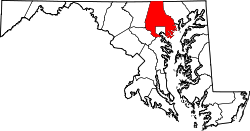
| Map of Baltimore County Police Department's jurisdiction | |
| Size | 612 mi |
| Population | 817,455 (2013) |
| General nature | |
| Operational structure | |
| Headquarters | Public Safety Building, 700 East Joppa Road Towson, Maryland 21286 39°24′0.6″N 76°35′23″W / 39.400167°N 76.58972°W |
| Officers | 1,824 |
| Civilian employees | 244 |
| Agency executive |
|
| Facilities | |
| Precincts | 10
|
| Detention Centers | 1 |
| Boats | 3 |
| Helicopters | 3 |
| Dogs | 28 |
| Website | |
| Official Website | |
The Baltimore County Police Department is the primary law enforcement agency for Baltimore County, Maryland. They have been accredited by Commission on Accreditation for Law Enforcement Agencies (C.A.L.E.A.) since 1984.
Police chief
[edit]The current Chief of the county police department is Chief Robert McCullough.[1]
In March 2017, James Johnson retired. Terrence B. Sheridan returned to take over control of the police department until his departure in June 2019, when Melissa Hyatt assumed control of the police after being appointed by the County Executive, Johnny Olszewski.[2]
When Melissa Hyatt left the agency, Dennis Delp was named the interim Chief until Robert McCullough, who had retired from the agency at the rank of Colonel, was re-hired as Chief of Police.
History
[edit]The Baltimore County Police Department was established by the General Assembly of Maryland on April 11, 1874.[3] The Maryland state legislature authorized the Board of County Commissioners for Baltimore County "to appoint such number of policemen as they may deem necessary, for the better protection of persons and property." On June 17, 1874, the County Commissioners divided the two mile (3 km) portion of the county bordering the Baltimore City boundary into five districts and appointed the first police force. Officers were appointed to one year terms. In 1878, County Commissioners were authorized to build their first station house at Waverly. The Canton Station was added a year later. New stations would be added and rebuilt in 1886, 1891, 1892, 1920, 1927, 1928, 1943, 1954, 1955, 1961, 1962, 1965, 1969, 1973, 1985, 1987, 1991, 2001, 2004, 2005, 2006, 2007 and 2016.
In 1883, a new position, "Marshal of Police", was created, and Charles O. Kemp was appointed to the office. This new position consolidated the responsibility and control of the police force under one person, instead of individual chiefs for each police district. [citation needed]
In 1888, a 17-square-mile (44 km2) portion of Baltimore County was annexed by Baltimore City. The number of officers in the Baltimore County Police Department was cut from 33 to 10 as officers and station houses were absorbed into the Baltimore City Police Department on the western and northern "precincts" adjacent to the City. The heavily industrial and residential communities on the east such as Highlandtown and Canton voted against annexation in the referendum and stayed in the county until 1919, when another 40 square miles (100 km2) of suburban and rural Baltimore County was annexed, causing the B.C.o.P.D. to lose 34 of its 43 officers to the city police force.
In 1902, the Maryland General Assembly passed an act aimed at ensuring that officers appointed to the Baltimore County police force would be qualified. The act required every applicant to provide their full name and age, location of birth, and prior occupations in the last two years, among other details. Applicants could not be younger than 21 years old or older than 45. It also required four "reputable" citizens of the county to speak of the applicant's character and affirm that they would be "fit for service".
The first woman was appointed to the county police force in 1913 as a matron. Two other women, Eva Aldridge and Ruth Jones were appointed to summer positions as Special Officers to protect young girls at the river resorts along the Patapsco River, Back River and Middle River in the eastern part of the county along the Chesapeake Bay. B.C.o.P.D.'s first female officer to become a Major was appointed in 1976, and in 1995, the force had its first female Colonel.
The B.C.o.P.D.'s Bureau of Identification was established in 1927. Its main purpose was to classify fingerprints and photographs which would serve as an aid in solving crime. In 1940, a plain clothes unit was established and trained to handle criminal investigations.
In 1947, a fire at the B.C.o.P.D.'s Towson Station killed two prisoners being held in the lockup, despite efforts by officers to pull the bars out of the windows using a tow truck.
In 1952, the first Black/African-American patrol officers, Armond Elliott, Frances Jackson, and James Johnson, were appointed to the county force, and in 1976, the first female officer was promoted to the rank of Major. Additionally, a Black officer was promoted to the rank of Lieutenant for the first time in 1981, and the first Black officer to become Colonel was promoted in 1995.
B.C.o.P.D.'s Police-Community Relations Council was established in 1983, and, in 1984, the first Child Abuse Unit in the state of Maryland was established in Baltimore County. In the same year, the B.Co.P.D. became the first major department in the country to be awarded national accreditation. The department's Citizen's Police Academy was developed in 1993.
In 2002, B.C.o.P.D. joined the CODIS database allowing it to share and access DNA information to identify suspects. In the same year, it was re-accredited by the Commission on Accreditation of Law Enforcement Agencies (CALEA). Additionally, the computer crime unit and its mission were expanded and renamed the Digital and Multimedia Evidence Unit.
In 2006, the Gang Enforcement Team was created to fight growth of gangs in the County, and in 2007, the Violent Crime Unit was created to investigate non-fatal shootings and other serious assaults.
Criticism
[edit]The Baltimore County Police Department has faced criticism, mainly due to its lack of diversity and the history of its officers fatally harming citizens.
White people are the majority in the force, accounting for 80%, whereas the percentage of White people in Baltimore County as a whole is 57%.[4]
Precincts
[edit]Formerly known as "police stations", since the 1970s Baltimore County has been divided into ten police precincts. Number 5 is intentionally skipped and will be used if the department needs to expand at a later time. Most recently, this happened in 2006 when Precinct 4 opened in Pikesville and Precinct 3 moved from Garrison to Franklin. Former Precincts 10 (Fullerton) and 13 (Edgemere) were absorbed into Precincts 9 and 12, respectively.
In 2016, Dundalk personnel were transferred from their facility on Merritt Blvd to a converted facility on Eastern Avenue in the Eastwood neighborhood.
In 2022, new projects were started by local construction contractors regarding a design and feasibility study on building new state of the art police facilities replacing the Wilkins and Essex stations. In 2023, these designs were finalized. The new Wilkins station is set to break ground sometime in 2026-2027, and the Essex station soon afterwards. Both stations are planned to be constructed on the same locations as the existing stations, with Essex planned to incorporate the existing basement/foundation area.
The final aging facility, Precinct 7 Cockeysville is also slated for a replacement. However, no formal announcement has been made as of early 2026. Additionally, the SOD complex located in Dundalk at the old North Point Junior High School dates back to the 1950s. Original plans to move the SOD units to a new facility in Reisterstown, Maryland have been placed on hold. No new plans for a new facility to replace the aging SOD complex are currently known.
Current stand-alone facilities used by the Baltimore County Police Department are as follows:
- Precinct 1 - Wilkens (Arbutus, Baltimore Highlands, Catonsville area)
- Precinct 2 - Woodlawn
- Precinct 3 - Franklin (Owings Mills, Reisterstown area)
- Precinct 4 - Pikesville
- Precinct 6 - Towson
- Precinct 7 - Cockeysville
- Precinct 8 - Parkville
- Precinct 9 - White Marsh
- Precinct 11 - Essex
- Precinct 12 - Dundalk
- SOD (K9, SWAT) - Dundalk, located at the old Precinct 12 facility. (North Point Junior High School prior to police use)
- Marine and Aviation - Martin State Airport, Essex, Maryland.
- Command staff and investigative units - HQ, Joppa Rd, Towson, Maryland
Fleet
[edit]
The primary patrol vehicles used are the Ford Taurus, Ford Interceptor Utility and some remaining Crown Victorias. Other specialized units utilize a combination of Ford Explorers or other non-descript vehicles, depending on the unit. SWAT utilize F250s and some support vans, K9 uses Chevy Tahoes while the Marine Unit has a few Ford F250s in use. Chevrolet vans are used for prisoner transport and the Commercial Vehicle unit. Motorcycle units previously rode the iconic Harley-Davidson Road King, but have recently transitioned to new modern BMW motorcycles. The department uses three Eurocopter AS350B3 helicopters, one of which was recently replaced with a newer model.
In early 2014, the department announced that they would begin to phase out the aging & discontinued Ford Crown Victoria with new Ford Taurus police interceptors. Beginning sometime between fall 2018 and early 2019, Baltimore County Police began to replace remaining Crown Victorias and older Tauruses with the Ford Explorer Police Interceptor Utility.
The new Explorers first appeared on the street in early 2019 and combined with the 2020+ model year, the Explorer now makes up the majority of the patrol fleet. Additionally, the department has also begun trials on a take home vehicle program for patrol officers to add an incentive commonly seen in surrounding agencies for retention benefits. In September 2023, the K-9 unit obtained enough vehicles for their handlers to take their vehicles to and from work which further increases the safety and security of their canines while transporting them to and from home.
New for Baltimore County, patrol vehicles are now being equipped with Soundoff Signal lighting equipment which include "cruise lights”, the steady burning red and blue lights on the light bars commonly seen on Baltimore City, MDTA and MSP vehicles. This addition is to further allow officers to maintain high visibility in areas prone to criminal activity. These lights can be turned on and off at the operators discretion. Vehicles are also being equipped with BluePRINT enabled systems which allow vehicles in close proximity to sync flash patterns, provide additional lighting functions and provide further safety to officers on the street.
Weapons
[edit]The primary duty firearm is the Glock 17 chambered in 9mm issued with Ameriglo 3 dot night sights, and a TLR-7 weapon mounted light. The Remington 870 shotgun is issued to every marked patrol car, except specialized units like K9, SROs and the Traffic units/Crash Team to name a few. Axon T7 Tasers, Less Lethal beanbag shotguns and AR-15 patrol rifles are issued to some specifically trained officers. All officers are issued OC spray and an ASP baton. Officers wear Axon Body 4 Body Cameras and are issued phones linked to them.
The 870s, some of which date back to the 1960s, are slated for a replacement and/or upgrade. In 2023, the agency chose the Binelli M4 to replace the aging 870. The conversion was completed in 2024-2025.
In October 2018, after significant review of the performance and reliability history of the FNS-40LS, the Baltimore County Police Department will be transitioning to the Glock 17 chambered in 9mm starting January 2019 and span over a two month transition period.
Prior to the FNS-40LS officers were armed with the SIG Pro SP2340 in .40 S&W, prior to the SP2340 was the SIG-Sauer P226, after the transition in the 1990s from S&W Model 10 Revolvers.
Rank structure and insignia
[edit]The Baltimore County Police Department rank structure is as listed:
| Rank | Insignia |
|---|---|
| Chief Of Police |  |
| Colonel |  |
| Major |  |
| Captain |  |
| Lieutenant |  |
| Sergeant | .svg) |
| Corporal | .svg) |
| Police Officer First Class | .svg) |
| Police Officer, Recruit and Cadet |  |
See also
[edit]
References
[edit]- ^ "Police Department Overview - Baltimore County". Baltimore County Government. October 22, 2021. Retrieved May 22, 2022.
- ^ "Johnny Olszewski Jr. Nominates Melissa Hyatt As Next Baltimore County Police Chief - CBS Baltimore". www.cbsnews.com. May 7, 2019. Retrieved July 29, 2024.
- ^ Lookingbill, Amy P. (July 1, 2009). "Baltimore County Police Department celebrates 135 years". Avenue News. Retrieved May 22, 2022.
- ^ Wood, Pamela (September 11, 2019). "Across the board, Baltimore area police departments are much whiter than the people they serve". Baltimore Sun. Retrieved May 22, 2022.
External links
[edit]| State |  | |
|---|---|---|
| County departments | ||
| Municipal departments | ||
| Sheriff's offices | ||
| Universities | ||
| Administration |  | |
|---|---|---|
| County Council |
| |
| Education | ||
| Landmarks | ||
| Medical | ||
| Parks | ||
| Transportation | ||

Baltimore County Police Department
View on GrokipediaLeadership
Chief of Police
The Chief of Police serves as the executive head of the Baltimore County Police Department, overseeing all aspects of law enforcement operations, policy development, resource allocation, and community engagement across the county's jurisdiction. The position reports to the County Executive and is appointed by that office, subject to confirmation by the Baltimore County Council, ensuring alignment with local governance priorities while maintaining operational independence in policing matters.[7][8] Robert O. McCullough has held the role since April 18, 2023, following his nomination by County Executive Johnny Olszewski on April 7, 2023, and unanimous 7-0 approval by the County Council. A 35-year veteran of the department prior to his initial retirement, McCullough rose through the ranks to Colonel, serving as head of the Operations Bureau, which encompasses patrol, criminal investigations, and support services. His appointment marked him as the first African-American Chief in the department's history.[3][7][8][9] Under McCullough's leadership, the department has emphasized community policing initiatives, as outlined in his public statements on building trust and addressing violent crime trends. In fiscal year 2024, he was the highest-compensated employee in Baltimore County government, reflecting the position's demands amid ongoing challenges like staffing and accountability reforms mandated by state legislation such as the Maryland Police Accountability Act.[10][11][3] In October 2025, McCullough was listed among approximately 90 Maryland law enforcement officers on a "Brady list" maintained by the Office of the Attorney General, indicating potential credibility concerns due to alleged, sustained, or pending misconduct that could impact court testimony reliability; however, County Executive Olszewski publicly affirmed support for McCullough's continued tenure, citing no basis for removal. This development, reported by outlets including The Baltimore Sun, underscores ongoing scrutiny of police leadership integrity under post-Ferguson reforms, though specifics of McCullough's inclusion remain undisclosed by authorities.[12][13][14]History
Establishment and Early Years (1874–1940s)
The Baltimore County Police Department was formally established on April 11, 1874, when the Maryland General Assembly enacted Chapter 374 of the Acts of 1874, authorizing the Baltimore County Commissioners to create a dedicated police force separate from existing constables and sheriffs.[3][15] This legislation transferred prior ad hoc policing authority to a structured department tasked with preserving the peace, preventing crime, and apprehending offenders in the county's rural and developing areas outside Baltimore City limits. The enabling act capped initial personnel at up to 50 commissioned policemen under a police commissioner, reflecting the era's modest needs for a jurisdiction that was largely agricultural and sparsely populated compared to the urban core of Baltimore City, which maintained its own police force.[15] Early operations emphasized basic patrol and response in unincorporated county territories, with officers relying on foot and horse-mounted duties amid challenges like rudimentary communications and vast coverage areas.[3] The department's inaugural badge design, featuring a shield with numeral markings, symbolized this foundational era and was later referenced in the agency's 150th anniversary commemorative badge in 2024.[16] By the early 20th century, modernization began with the 1916 purchase of the department's first automobile and motorcycle, enhancing mobility for officers patrolling expanding suburban fringes and responding to rising vehicular-related incidents.[17][18] Through the 1920s and 1930s, the force grew incrementally alongside county industrialization and population shifts from the city, though it remained under 100 officers by the 1940s, focused on general law enforcement without specialized units.[3] This period laid groundwork for post-war expansion, as economic growth and infrastructure development increased demands on rural policing efficacy.[19]Post-War Expansion and Professionalization (1950s–1990s)
In the post-World War II era, Baltimore County underwent significant suburban expansion driven by population growth, with the county's residents increasing from 270,273 in 1950 to 492,428 by 1960, an approximate 82% rise fueled by white flight from Baltimore City and federal highway development.[20][21] This demographic shift strained existing law enforcement resources, prompting the Baltimore County Police Department to bolster its capacity through volunteer auxiliaries and structured recruitment. In 1957, the Auxiliary Police were formally incorporated under the chief of police, providing supplementary patrol and support amid rising calls for service in burgeoning areas like Towson and Essex.[22] The department's sworn force, though exact figures from the period are sparse, expanded in parallel with this growth to cover the county's 600-plus square miles, shifting from rural constable models toward urban-suburban policing demands.[3] Professionalization efforts accelerated in the late 1950s, emphasizing merit-based advancement and investigative tools. A mandatory promotional examination was introduced in 1958, standardizing officer evaluations beyond seniority or political connections, while the purchase of the department's first polygraph machine enhanced interrogation reliability.[3] The following year saw the establishment of an Accident Investigation Unit to address surging traffic incidents from new roadways and commuter patterns.[3] By 1960, a cadet program was instituted to cultivate younger recruits with formal training, reflecting broader national reforms in police academies and reducing reliance on minimally qualified hires.[3] These measures aligned with the era's push for evidence-based practices, though implementation faced challenges from rapid hiring needs without proportional budget increases. The 1970s and 1980s marked further specialization amid evolving threats, including urban spillover crime and civil unrest echoes from the 1968 Baltimore riots. In 1976, the department promoted its first female officer to major, expanding leadership diversity while maintaining operational focus on core functions.[3] The Hostage Negotiations Team formed in 1978 to handle barricades and crises professionally, drawing on psychological tactics over brute force.[3] By 1979, the Baltimore County Police Foundation was created to fund equipment and training independently of taxpayer dollars, supporting innovations like early computer-aided dispatch precursors.[3] Into the 1990s, these developments solidified the department's transition to a modern agency, with accredited standards and response protocols, though staffing pressures persisted as the county's population neared 700,000 by 1990.[21]Modern Era and Recent Milestones (2000s–Present)
In the early 2000s, the Baltimore County Police Department expanded its specialized capabilities to address emerging threats from gang activity and violent crime. The Gang Enforcement Team was established in 2006 to target organized criminal groups, followed by the creation of the Violent Crime Unit in 2007, focused on investigating nonfatal shootings and serious assaults.[3] These units enhanced proactive policing efforts amid national trends in urban-suburban crime spillover.[3] Leadership transitioned through several chiefs in the 2010s, with Terrence Sheridan serving prior to 2019. Melissa Hyatt was nominated in May 2019 and sworn in as the first female chief on June 17, 2019, bringing experience from the Baltimore City Police Department and the FBI National Academy.[23] [24] She prioritized community relations and stepped down in November 2022 after completing her term. Colonel Dennis Delp was appointed chief in 2022, overseeing operational updates including a shift to blue Battle Dress Uniform (BDU) attire and Ford SUVs as primary patrol vehicles.[3] [25] In April 2023, Robert McCullough, a career BCPD officer and retired colonel, was nominated and confirmed as chief, becoming the department's first African-American leader; he was sworn in on April 18.[8] [26] Under recent leadership, the department piloted ShotSpotter gunshot detection technology in the Wilkens and Essex precincts to improve response times to gunfire. The BCPD maintained its accreditation from the Commission on Accreditation for Law Enforcement Agencies (CALEA), reflecting sustained professional standards. In 2024, the department marked its 150th anniversary since establishment in 1874, with commemorative events highlighting its evolution.[3] [27] [28]Organizational Structure
Jurisdiction and Precincts
The Baltimore County Police Department exercises primary law enforcement jurisdiction over Baltimore County, Maryland, excluding the separate City of Baltimore, which maintains its own municipal police force. This jurisdiction encompasses 598 square miles of land and an additional 83 square miles of water, serving a population of 854,535 residents as recorded in the 2020 United States Census.[29][30] The department enforces Maryland state laws and Baltimore County ordinances, focusing on crime prevention, detection, property protection, and public safety across unincorporated areas and any incorporated municipalities that contract for its services.[27] The county is divided into 10 geographic precincts to facilitate localized policing and response. Each precinct handles patrol, investigations, and community engagement within its designated boundaries, with boundaries aligned to major roads, natural features, and population centers. The precincts are as follows:[31][32]- Precinct 1 – Wilkens (southwestern county areas including Catonsville)
- Precinct 2 – Woodlawn (western areas along Liberty Road)
- Precinct 3 – Franklin (northwestern areas including Reisterstown)
- Precinct 4 – Pikesville (central northern areas)
- Precinct 6 – Towson (central county seat vicinity)
- Precinct 7 – Cockeysville (northern areas)
- Precinct 8 – Parkville (northeastern central areas)
- Precinct 9 – White Marsh (eastern areas)
- Precinct 11 – Essex (southeastern waterfront communities)
- Precinct 12 – Dundalk (eastern industrial and residential zones)
Rank Structure and Insignia
The Baltimore County Police Department maintains a paramilitary-style rank hierarchy, with authority flowing through a defined chain of command from the Chief of Police downward to entry-level officers, emphasizing operational oversight, discipline, and personnel management.[33] Promotions require minimum service in the prior rank—such as three years for corporal from officer, and two years for subsequent ranks up to captain—along with eligibility exams, seniority factors, and approval by the Chief, who evaluates performance appraisals and internal records.[33] The structure supports specialized roles, with higher ranks like majors and captains commanding bureaus, divisions, or precincts, while sergeants and corporals supervise field operations.[33] Rank insignia include collar/jacket emblems for commissioned officers (lieutenant and above), chevrons for non-commissioned ranks, and sleeve stripes on dress blouses, distinguishing gold elements for senior ranks from silver/blue for juniors; badges and hat shields are gold for lieutenants and above, chrome for those below.[33] Junior personnel below corporal salute seniors outdoors in uniform.[33]| Rank | Collar/Jacket Insignia | Dress Blouse Cuff Stripes |
|---|---|---|
| Chief of Police | Two gold stars | Five ½-inch gold stripes |
| Colonel | One gold spread eagle | Four ½-inch gold stripes |
| Major | One gold oak leaf | Three ½-inch gold stripes |
| Captain | Two gold bars | Two ½-inch gold stripes |
| Lieutenant | One gold bar | One ½-inch gold stripe |
| Sergeant | Silver/blue chevron pins | None |
| Corporal | Silver/blue chevron pins | None |
| Officer First Class | Silver/blue chevron pins | None |
| Officer | None | None |
The insignia system aligns with uniform standards to ensure clear identification in hierarchical contexts, such as during salutes or command assumptions in the absence of superiors, where seniority by rank, time in grade, and department tenure determines acting authority.[33] Detective positions, while not a distinct rank, are held by sworn officers within investigative bureaus and retain the insignia of their underlying rank.[33] Cadets and pre-recruits occupy non-sworn entry roles without insignia, transitioning to officer upon academy completion.[33]
Specialized Units and Bureaus
The Baltimore County Police Department operates several specialized units focused on tactical response, investigative support, and community-specific needs, complementing its patrol divisions. These units include the Aviation Unit, which deploys helicopters such as the Eurocopter AS350 for aerial surveillance, search and rescue, and traffic monitoring, enhancing response capabilities across the county's 600-plus square miles.[34] The K9 Unit employs canine teams trained for narcotics detection, explosive detection in coordination with federal standards from the Bureau of Alcohol, Tobacco, Firearms and Explosives, and suspect apprehension, with each dog undergoing annual certification testing.[34] Forensic Services Section provides laboratory analysis and evidence processing, including friction ridge examination (latent prints), evidence packaging, and digital forensics, supporting investigations countywide with a focus on quality assurance under accreditation standards.[35] The Honor Guard performs ceremonial duties at official events, funerals, and public functions, upholding departmental traditions.[34] Auxiliary Police Team consists of volunteer officers who assist with traffic control, event security, and non-emergency support, extending patrol resources without sworn status.[34] Investigative specialized units encompass Vice and Narcotics, targeting drug trafficking and related crimes through undercover operations; Financial and Cyber Crimes, addressing fraud, identity theft, and digital offenses; and Dignitary Protection, providing security for high-profile visits.[36] Community Outreach units engage in public education on safety and crime prevention, while the Behavioral Assessment Unit, including the Threat Management Team and Mobile Crisis Team, handles mental health crises and threat assessments in collaboration with county services.[37] Bureaus include the Professional Standards Bureau, responsible for internal affairs investigations, policy compliance, and accreditation maintenance under national standards from the Commission on Accreditation for Law Enforcement Agencies.[27] The Operations Bureau oversees patrol and support divisions, including traffic management and criminal investigations sections, ensuring coordinated responses to specialized incidents.[15] These entities operate under the department's strategic framework, emphasizing data-driven deployment and inter-agency cooperation for effective resource allocation.[38]Equipment and Resources
Vehicle Fleet
The Baltimore County Police Department maintains a fleet of 929 vehicles as of January 2023, comprising 452 marked patrol units, 148 unmarked vehicles, and 329 non-descript units primarily used for undercover operations.[39] The department's patrol vehicles predominantly consist of Ford Police Interceptor Utility SUVs, reflecting a strategic shift initiated in 2019 to replace aging sedans with more versatile and durable SUVs suited for the county's varied terrain and operational demands.[40] This transition enhanced officer safety and vehicle longevity, with newer models like the 2022 Ford Police Interceptor Utility assigned to supervisory roles such as precinct shift commanders.[41] Specialized vehicles include Lenco BearCat armored personnel carriers for tactical response and Chevrolet Suburbans for transport and support duties.[42] The fleet incorporates a significant number of hybrid vehicles, with the department operating the county's largest hybrid contingent—exceeding 100 units—to balance performance with fuel efficiency amid rising operational costs.[43] Prior to the SUV pivot, the fleet relied on Ford Crown Victoria sedans, with a 2013 acquisition of 50 Ford Police Interceptors expanding a then-450-unit patrol inventory.[44] Patrol vehicles are equipped with SoundOff Signal lighting systems, including steady-burning "cruise lights" for enhanced visibility during routine operations. Historical milestones include the department's first automobiles and motorcycles acquired in 1916, marking the evolution from horse-drawn carriages used since its 1874 establishment. Fleet management emphasizes regular replacement cycles, with budgeting prioritizing durability and technological upgrades to support the department's coverage of Baltimore County's 581 square miles.[45]Weapons and Firearms
The standard-issue sidearm for sworn officers of the Baltimore County Police Department is the Glock 17 Generation 5 9mm pistol, following a department-wide transition completed over a 10-week period in 2019 that included members of the Baltimore County Sheriff's Office and Bureau of Corrections.[46] This shift aligned with broader trends among U.S. law enforcement agencies favoring 9mm caliber for its balance of capacity, recoil management, and terminal ballistics, as evidenced by the Glock 17's adoption by over 60% of departments nationwide at the time.[47] For less-lethal options, the department acquired 1,100 conducted electrical weapons (CEWs, commonly known as Tasers) in December 2019, with subsequent training and deployment managed by the Technology & Communications Section and Training Section to enhance officer safety and de-escalation capabilities.[46] These devices deliver neuromuscular incapacitation via electrical probes, reducing reliance on lethal force in dynamic encounters. Officers also employ OC (oleoresin capsicum) spray and expandable batons as standard non-firearm tools, though specific models are not publicly detailed in departmental reports. Long guns, including patrol rifles and shotguns, are available for use-of-force scenarios as documented in internal reporting forms, but assigned primarily to trained personnel rather than all patrol officers. Firearms training emphasizes qualification standards under Maryland Police and Correctional Training Commissions guidelines, with annual recertification required to maintain proficiency.[27] The department's firearms management includes rigorous maintenance protocols, with traded-in service weapons undergoing part destruction by vendors to prevent resale.[48]Operations and Performance
Core Functions and Statistics
The Baltimore County Police Department (BCPD) serves as the primary law enforcement agency for Baltimore County, Maryland, enforcing state laws and county ordinances while safeguarding life, property, and individual rights.[27] Its core functions encompass routine patrol operations across eight precincts covering 647 square miles, criminal investigations into offenses ranging from homicides to cyber crimes, traffic enforcement and accident response, community-oriented policing to foster public cooperation, and specialized interventions including gang violence suppression, child abuse probes, and hostage negotiations.[33] The department also maintains emergency response capabilities, such as K-9 deployments for apprehensions and narcotics detection, and processes crime scenes to support forensic analysis.[49] In 2024, BCPD handled 655,037 calls for service, reflecting its role in managing daily public safety demands.[5] The department employed 1,751 sworn officers—down from an authorized strength of 1,984—and 265 professional staff, yielding a ratio of 2.07 officers per 1,000 residents.[5] It onboarded 179 new sworn personnel amid 69 retirements, while specialized units like K-9 teams responded to 3,898 calls and apprehended over 100 suspects.[5]| Key Performance Metric (2024) | Value |
|---|---|
| Calls for Service | 655,037 |
| Sworn Officers (Actual) | 1,751 |
| New Hires (Sworn) | 179 |
| K-9 Deployments | >900 |
| Crime Scene Calls Processed | ~2,500 |