Hubbry Logo
search
logo
2103243

Battle of Angaur

logo
Community Hub0 Subscribers
Read side by side
from Wikipedia

Battle of Angaur
Part of the Mariana and Palau Islands campaign of the Pacific Theater (World War II)

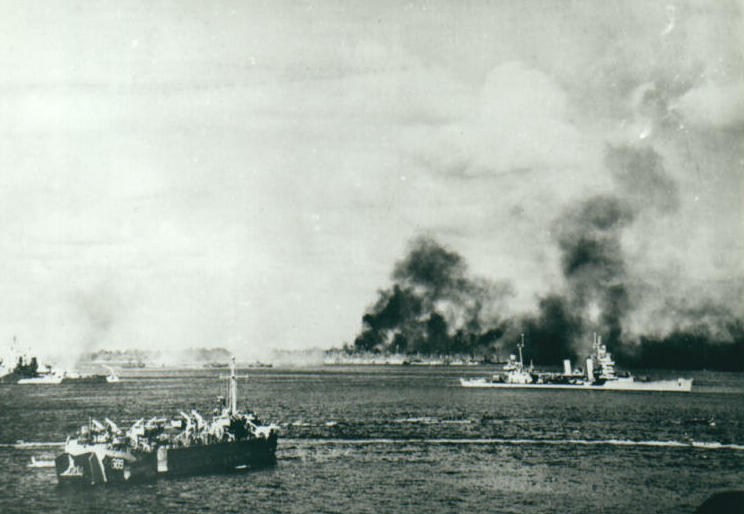
U.S. naval bombardment of Angaur, c. 15 September 1944.
Date17 September – 22 October 1944
(1 month and 5 days)
Location
Result American victory
Belligerents
United States  Japan
Commanders and leaders
Paul J. Mueller Ushio Goto 
Sadae Inoue
Units involved

81st Infantry Division

  • 321st Infantry Regiment
  • 322nd Infantry Regiment
  • UDT 8

14th Infantry Division

  • 59th Infantry Regiment
Strength
10,000 1,400[1]
Casualties and losses
264 killed
1,354 wounded[1]
1,350 killed
50 captured[1]
Map of the Battle of Angaur.

The Battle of Angaur was a major battle of the Pacific campaign in World War II, fought on the island of Angaur in the Palau Islands from 17 September to 22 October 1944. This battle was part of a larger offensive campaign known as Operation Forager which ran from June to November 1944 in the Pacific Theater of Operations, and Operation Stalemate II in particular.

Background

[edit]

Angaur is a small coral island, just 3 mi (4.8 km) long, separated from Peleliu by a 7 mi (11 km) wide strait, from which phosphate was mined.[2] In mid-1944, the Japanese had 1,400 troops on the island, under the overall command of Palau Sector Group commander Lieutenant General Sadae Inoue and under the direct command of Major Ushio Goto who was stationed on the island.[3]

The weak defenses of the Palaus and the potential for airfield construction made them attractive targets for the Americans after the capture of the Marshall Islands, but a shortage of landing craft meant that operations against the Palaus could not begin until the Mariana Islands were secure.

Once the assault on Peleliu was "well in hand", the 322nd Regimental combat team (RCT) would land on the northern Beach Red, and the 321st RCT on the eastern Beach Blue. Both teams were part of the 81st Infantry Division, commanded by Major General Paul J. Mueller.[4] The Japanese defending both Peleliu and Angaur, were the combat-hardened men of the 14th Infantry Division with four years of experience fighting in Manchuria behind them, and personally sent to defend the Palaus by Prime Minister Hideki Tojo. The 1,400 soldiers garrisoned on Angaur were the 1st Battalion, 59th Infantry Regiment.

Battle

[edit]
Initial assault wave en route to Blue Beach during the invasion of Angaur Island

Bombardment of Angaur by the battleship Tennessee, four cruisers, and 40 Douglas SBD Dauntless dive bombers from the aircraft carrier Wasp began on 11 September 1944. Six days later on 17 September, the two RCTs landed on the northeast and southeast coasts. Not having enough troops to defend all the beaches, Goto selected the most attractive beach (code named Green Beach by the Americans) for an amphibious landing to build his beach defenses. His defenses consisted of a formidable array of pillboxes, blockhouses, trenches and antitank ditches. Seeing the buildup around Green Beach, Mueller decided to land his troops at the more constricted but less defended beaches of Red and Blue Beach. The 322nd RCT received sporadic mortar and machine gun fire, but they landed fairly unopposed and with light casualties. The 321st landing at Blue Beach faced heavier machine gun and mortar fire, but it too was able to get ashore with minimal casualties.[5]

Unbeknownst to them, this was all part of the Japanese new "defense in depth strategy" that they would face, along with the 1st Marine Division on nearby Peleliu. The Japanese strategy had been modified to allow the Americans to land rather unopposed and move inward, with "in depth" defensive lines further inland, and initiating nighttime counterattacks en masse while the Americans were still heavily congregated on the beachheads, attempting to drive them back into the sea. Suicidal banzai charges as seen on Tarawa, Guadalcanal and Saipan were forbidden. Both RCTs were counterattacked during the night but this achieved little more than quickly depleting valuable troops Goto could not replace. Late the next day on 18 September, both RCTs were able to link up and push on to their respective objectives.

Soldiers of the 322nd RCT pinned down by heavy machine gun fire on Red Beach

By the end of the third day, 19 September, the RCTs had cut the island in half, with two pockets of resistance. The main Japanese force to the northwest on Ramauldo Hill and the other dug in at the Green Beach defensive fortifications. After two days of harsh fighting and heavy casualties, the 321st had overrun the Green Beach defenses and the 400 dug in soldiers by flanking them from behind. At a cost of 300 casualties, the southern half of the island was declared secure. While the 321st was embattled to the south, the 322nd RCT moved across the island to the western coast securing the only inhabited area of the island, "Saipan Town", then swept north towards "Shrine Hill" and Romauldo Hill where the main 750-strong force was awaiting them, heavily dug in to the island's most formidable and difficult terrain. With the southern half of the island secured, on 23 September the 321st RCT was dispatched to nearby Peleliu, where the 1st Marine Division was taking massive casualties and nearing becoming combat ineffective as a unit. Securing the rest of Angaur fell to the 3,200 men of the 322nd RCT.

The Japanese defensive network on Romauldo Hill and the intense fighting that would take place there was in effect, a microcosm of the brutal fighting taking place in the Umurbrogol pocket on nearby Peleliu by the Marines, and later the 81st Infantry Division. The entire hill was honeycombed with interconnecting caves, pillboxes and bunkers built into the coral rock, forming an almost impregnable position where the defenders were dug in, determined to fight to the death and take as many American lives with them. Near the top of the hill was a small bowl-like valley with a lake surrounded by ridges almost 100 feet (30 m) tall, which became known as "the Bowl". To add to the defenders' advantage there was only one way into and out of the bowl, through a narrow gorge, later named "Bloody Gulch." As the 322nd RCT advanced on "the Bowl", they were met with withering machine gun, mortar and sniper fire, being stymied in their tracks.

Soldiers of the 81st "Wildcat" Division hold a captured Japanese flag on Angaur Island

From 20 September, the 322nd RCT repeatedly attacked the Bowl, but the dug in defenders repulsed them with artillery, mortars, grenades and machine guns, inflicting heavy losses. Gradually, hunger, thirst and American shellfire and bombing took their toll on the Japanese, and by 25 September, after three costly frontal attacks the Americans had penetrated the Bowl. Rather than fight for possession of the caves, they used bulldozers to seal the entrances. By 30 September the island was said to be secure although the Japanese still had about 300 more soldiers in the Bowl and surrounding areas that held out for almost four more weeks.[6]

Toward the end of the first week of October, the protracted conflict had degenerated into patrol action with sniping, ambushing, and extensive booby-trapping employed by both sides. Goto was killed on 19 October fighting to keep possession of a cave.[7] The last day of fighting was 22 October with a total of 36 days of fighting and blasting the Japanese resistance from their caves with explosives, tanks, artillery and flamethrowers. The 81st Infantry Division had finally taken the whole of Angaur, although at a high cost.[6]

The 322nd RCT sustained 80% of the American casualties on Angaur, with a 47% casualty rate. On Peleliu, men of the 321st and 323rd RCT's would go on to fight the remaining 3,600 Japanese defenders holding out in the Umurbrogal pocket for almost two months, often resorting to fierce hand to hand combat. There, another 282 men of the 81st Infantry Division would lose their lives with another 4,409 being wounded. Of all the casualties sustained by the 81st Wildcat Division in Operation Stalemate II, only about 52% would be fit enough to return to duty. A great number of American casualties were the result of head wounds inflicted by accurate Japanese sniper fire and their use of smokeless powder.

Soldier of the 322nd RCT killed assaulting Red Beach

Aftermath

[edit]

Airfields were being constructed as the battle was still being fought, but the delay in the start of the Palaus operation meant that the airfields were not ready in time for the start of the Philippines campaign in October 1944. Admiral William F. Halsey, Jr. had argued before the invasion of the Palaus that the operation was unnecessary, and military historians have agreed with him, suggesting that the main benefit was the combat experience gained by the 81st Infantry Division.

During the fighting, Seabees created an airstrip that would house B-24 Liberator bombers of the 494th Bombardment Group, 7th Air Force which engaged in frequent bombings of the Philippines and other Palau Islands.[8]

The 81st Infantry Division moved on directly to the battle on Peleliu to aid the 1st Marine Division, which had encountered extremely stiff resistance in the central highland of that island. They would remain on Peleliu for another month taking the island and mopping-up the remaining Japanese forces.

References

[edit]

Citations

[edit]
  1. ^ a b c Moran & Rottman 2002, p. 89.
  2. ^ Moran & Rottman 2002, p. 13.
  3. ^ Moran & Rottman 2002, p. 39.
  4. ^ Moran & Rottman 2002, p. 21.
  5. ^ Moran & Rottman 2002, pp. 67–68.
  6. ^ a b Moran & Rottman 2002, pp. 70–71.
  7. ^ The HyperWar website here, on pages 178 and 179 describes it as "up until the night of the 19th" of October when Major Goto was killed.
  8. ^ Moran & Rottman 2002, p. 91.
[edit]
Revisions and contributorsEdit on WikipediaRead on Wikipedia
from Grokipedia
The Battle of Angaur was a major amphibious assault during World War II's Pacific Theater, fought between United States Army forces and Imperial Japanese Army defenders on the island of Angaur in the Palau archipelago from September 17 to October 21, 1944.[1] As part of Operation Stalemate II, the battle aimed to secure Angaur to construct a heavy bomber airfield and eliminate Japanese threats to Allied supply lines in the region.[1] The U.S. 81st Infantry Division ("Wildcats"), under Major General Paul J. Mueller, landed unopposed on the island's eastern beaches but faced fierce resistance in the rugged northwestern terrain, where Japanese forces had fortified caves and hills.[1][2] Organized Japanese resistance ended by September 20, though mopping-up operations against holdouts continued until October 21, resulting in the island's full capture.[1][3] The assault began two days after the initial landings on nearby Peleliu, with Regimental Combat Teams (RCT) 321 and 322 of the 81st Infantry Division—totaling approximately 9,000 troops—disembarking from LSTs onto Red and Blue Beaches following a three-day naval and air bombardment.[2][1] Japanese defenders, numbering around 1,400 to 1,500 under Major Ushio Goto of the 1st Battalion, 59th Infantry Regiment, offered minimal opposition during the initial landing but withdrew to prepared positions in the island's phosphate mines and coral ridges, employing guerrilla tactics with mortars, machine guns, and snipers.[1][2] By September 18, U.S. forces had secured most of the island's airfield and southern areas, but progress stalled in the northwest "Pocket," where intense close-quarters combat ensued, supported by naval gunfire from Task Force 32 and aerial strikes.[1] RCT 322 bore the brunt of the fighting, using flamethrowers, demolitions, and bulldozers to clear caves, while RCT 321 conducted sweeps; one battalion from the 81st was later detached as reserve for Peleliu operations on September 21.[1][4] The battle inflicted heavy losses, with U.S. casualties totaling 260 killed and 1,354 wounded, alongside non-battle injuries from the island's treacherous terrain and climate.[1] Japanese casualties were nearly total, with approximately 1,338 killed and only 59 captured, reflecting the banzai-style defenses and high attrition from U.S. firepower.[1] Angaur's capture enabled the rapid construction of an airfield that supported subsequent operations in the Philippines, underscoring the battle's strategic value despite its integration into the broader, controversial Palau campaign, which diverted resources from more critical theaters.[1][2]

Prelude to the Battle

Strategic Context

The Battle of Angaur formed part of the broader U.S. island-hopping campaign in the Pacific Theater during World War II, specifically as an extension of Operation Forager, which commenced on June 15, 1944, with the invasion of Saipan, Tinian, and Guam in the Mariana Islands.[5] This operation aimed to secure bases for long-range B-29 Superfortress bombers to strike the Japanese home islands, while also neutralizing Japanese air and naval threats in the central Pacific. Following the successful capture of the Marianas by early August 1944, U.S. planners extended the campaign into Operation Stalemate II, targeting the Palau Islands to establish additional airfields and anchorages that would support General Douglas MacArthur's impending invasion of the Philippines.[6] The Palau operations were deemed essential to isolate remaining Japanese strongholds in the Carolines and provide fighter cover for the Leyte landings, aligning with the overall strategy of bypassing heavily fortified positions like Babeldaob in the Palaus.[7] Angaur was selected as a secondary objective within Stalemate II due to its compact size—approximately 3 miles long and 2 miles wide—and its perceived suitability for rapid seizure despite Japanese reinforcements sent to the Palau Islands following the U.S. capture of the Marshall Islands earlier in 1944.[8] Intelligence assessments overestimated Japanese forces there at around 2,500 troops, though the actual number was closer to 1,400, making it appear suitable for seizure by divisional elements.[1] Moreover, the island's flat coral terrain offered ideal conditions for swift construction of an airfield to accommodate B-24 Liberator heavy bombers, enabling strikes against Japanese positions in the Philippines and providing logistical support for operations on nearby Peleliu.[9] This airfield potential was critical, as it would extend U.S. air coverage over MacArthur's advance without requiring the prolonged commitment of resources to larger islands.[10] Planning for Stalemate II began in mid-1944 under the coordination of Admiral William F. Halsey Jr., commander of the Third Fleet, and General MacArthur, whose Southwest Pacific forces were synchronizing with Nimitz's Central Pacific drive.[11] Initial target dates for the Palau assaults were set for early September, but operations were delayed until September 15 due to the extended fighting in the Marianas and the need to reallocate amphibious forces.[1] Halsey advocated for the Palau strikes to neutralize potential Japanese air threats to the Philippines campaign, though he later recommended canceling them on September 13 after reconnaissance revealed weakened defenses, leading to a shift in focus toward Leyte.[11] Despite this, the Angaur invasion proceeded as planned on September 17 to secure the airfield site.[7] Prior to the war, Angaur's economy revolved around large-scale phosphate mining, initiated under German administration in 1909 and expanded by the Japanese from 1914, making it a key exporter that supplied about one-quarter of Japan's phosphate imports by 1939.[12] This industrial activity had stripped much of the island's surface, creating open pits, rail lines, and processing facilities that influenced its terrain and, during the war, enhanced its defensibility by providing natural cover and obstacles for Japanese fortifications.[13] The mining legacy thus shaped Angaur's strategic profile, turning an otherwise unassuming atoll into a contested objective despite its small scale.[1]

Opposing Forces and Preparations

The United States committed the 81st Infantry Division, known as the "Wildcat Division," to the invasion of Angaur, totaling approximately 10,000 troops under the command of Major General Paul J. Mueller.[14] The primary assault elements included the 321st and 322nd Regimental Combat Teams (RCTs), with the 321st RCT assigned to Blue Beach on the eastern shore and the 322nd RCT to Red Beach on the northeastern shore, supported by units such as the 306th Engineer Combat Battalion, 710th Tank Battalion, and 726th Amphibian Tractor Battalion.[14] Underwater Demolition Team 8 (UDT 8) conducted beach reconnaissance to clear obstacles and assess landing sites prior to the operation.[15] Opposing them were roughly 1,400 Japanese troops, primarily the 1st Battalion of the 59th Infantry Regiment from the 14th Division, under the direct command of Major Ushio Goto on Angaur, with overall oversight by Lieutenant General Sadae Inoue from Peleliu.[1] U.S. intelligence, drawn from aerial photography and captured documents, initially overestimated Japanese strength at about 2,500, though actual assessments closer to the invasion pegged it at 1,400, including infantry, artillery, engineers, antiaircraft, and service personnel dispersed across potential landing zones.[14][1] U.S. preparations emphasized amphibious training and fire support, with the division conducting rehearsals at Cape Esperance to simulate Angaur's conditions, following earlier exercises in Hawaii and Guadalcanal under the Amphibious Training Command, Pacific Fleet.[1][14] Naval Task Group 3.7, led by Rear Admiral William H. P. Blandy, planned and executed pre-invasion bombardments beginning in early September 1944, involving two battleships, four cruisers, five destroyers, LCI rocket barrages, air strikes, and artillery from the 8th 155mm Gun Battalion positioned on southern Peleliu, aimed at neutralizing beach defenses.[1][14] These efforts underestimated the resilience of Japanese fortifications, focusing on surface targets while inland positions remained largely intact. The Japanese adopted a defense-in-depth strategy on Angaur, emphasizing attrition over open combat, with no plans for large-scale banzai charges, instead relying on fortified positions to prolong resistance.[1] Goto dispersed his forces to cover multiple beaches, constructing pillboxes, rifle pits, trenches, and tank obstacles, particularly strengthening southern and western sectors with mines, barbed wire, and booby traps, while leveraging the island's rain forest and natural terrain as barriers.[14][1] Caves and tunnels were incorporated into the defenses, especially in the northwest, to shelter troops and enable prolonged holdouts against anticipated assaults.[8]

Course of the Battle

Landings and Initial Engagements

The pre-landing bombardment of Angaur began on 12 September 1944, with naval gunfire from battleships including the USS Tennessee, supported by cruisers, destroyers, and carrier-based dive bombers from Task Group 38.4, targeting Japanese defenses and installations across the island.[16] This phase extended through 16 September, delivering extensive shelling that damaged surface structures but proved limited in effectiveness due to the coral terrain absorbing impacts and Japanese forces' concealment in hidden caves and pillboxes.[16] Air strikes from fighter-bombers supplemented the effort on 17 September starting at 0740, yet many entrenched positions remained intact, allowing the defenders to retain operational capability.[1] Amphibious landings commenced on 17 September 1944 at 0830, with the 321st Regimental Combat Team (RCT) of the 81st Infantry Division assaulting Blue Beach on the island's southeastern coast, followed by the 322nd RCT at Red Beach to the northeast at 0836.[1] Initial opposition was light, consisting primarily of sporadic mortar, small arms, and machine-gun fire from Japanese positions, enabling the assault waves to establish beachheads rapidly.[16] By noon, the 321st had secured a beachhead approximately 1,200 yards long and 350 yards deep, while the 322nd advanced inland to Phase Line O-2 amid intermittent resistance, consolidating positions by evening despite a 700-yard gap between the regiments.[1] Early ground engagements intensified as U.S. forces pushed inland, overrunning defenses near Green Beach on 19 September when elements of the 321st RCT advanced south from Middle Village against mortar fire from concealed emplacements.[16] Troops encountered snipers and machine-gun nests hidden in dense foliage, which slowed progress and inflicted casualties, though preparatory artillery fires aided in neutralizing key positions.[1] By 20 September, southern beach defenses around Green Beach II had been cleared with minimal opposition, marking the initial consolidation of the lodgment.[1] Logistical challenges emerged immediately due to the rugged terrain, including rubble-strewn beaches, thick jungle undergrowth, and extensive mangrove swamps that hindered vehicle movement and troop advances.[16] Beach congestion from unloading operations, combined with minefields and limited space, delayed the deployment of tanks and artillery, while intense heat during the initial days exacerbated physical strain on the soldiers.[1] These factors, rather than heavy combat, primarily dictated the pace of the first 2–3 days' operations.[16]

Major Combat Operations

Following the establishment of the initial beachhead, U.S. forces under Major General Paul J. Mueller's 81st Infantry Division shifted focus to the northwest quadrant of Angaur, where Japanese defenders held Romauldo Hill, a key terrain feature rising to 200 feet and riddled with caves and fortified positions. On 20 September 1944, the 2nd Battalion, 322nd Infantry Regiment reoccupied nearby Lighthouse Hill and probed the northwest hills, encountering stiff resistance that slowed advances to mere yards per day. By 21 September, Companies E and F attacked from Lighthouse Hill while Company G, supported by tanks from the 710th Tank Battalion, pushed through a railroad defile; however, limited progress was made due to mined terrain and entrenched fire, resulting in the loss of one tank to a mine, two killed, and about 35 wounded. The assault intensified on 23 September when the 2nd Battalion advanced into the Lake Salome bowl at the base of Romauldo Hill, facing heavy machine-gun and mortar fire that inflicted 18 killed and over 75 wounded, forcing a withdrawal. Renewed attacks from 26 to 30 September targeted Romauldo Hill from multiple directions, marking the core of the battle for this objective. The 3rd Battalion assaulted from the northeast on 26 September, gaining a foothold with support from flame-throwing tanks and LVTs, while the 2nd Battalion cleared the southeast rim, suffering about 40 casualties. On 27 September, coordinated pushes by Companies A and L reached the north rim base, with bulldozers from the 306th Engineer Regiment constructing access roads and sealing cave entrances; flamethrowers and satchel charges were employed to assault fortified positions, gradually weakening Japanese defenses despite their use of mutually supporting fire lanes. Artillery from the 316th and 906th Field Artillery Battalions, including 155-mm howitzers, provided close support, while naval air strikes targeted vegetation cover and exposed fortifications, though underground caves limited overall effectiveness. By 30 September, U.S. forces had compressed the main Japanese pocket on Romauldo Hill to a 500-by-150-yard area, with approximately 850 Japanese killed in the sector. In October 1944, combat shifted to central Angaur, where the 322nd Infantry advanced through phosphate mines and swamps amid nightly Japanese infiltrations and small-unit counterattacks that harassed American lines and supply routes. On 1 October, three battalions assaulted the remaining northwest hills, using tanks and artillery to further constrict the enemy pocket, incurring about 30 casualties while killing scores of Japanese. Persistent resistance included a mortar barrage on 28 September against Companies B and I, causing around 80 casualties, and ongoing infiltrations that forced patrols and ambushes. U.S. tactics emphasized flame-throwing tanks for cave assaults, satchel charges to demolish positions, and coordinated artillery barrages—such as a heavy 6 October bombardment targeting the Japanese command post—supplemented by air support to suppress counterattacks.[1] From 13 to 18 October, the 1st and 2nd Battalions reduced the pocket to 100 by 50 yards through systematic advances, with Japanese small-unit actions continuing but lacking cohesion. A critical turning point occurred on 19 October 1944, when Major Ushio Goto, the Japanese defense commander, was killed during fighting to retain a key cave, fragmenting command and accelerating the collapse of organized resistance.[1] This event, following weeks of attrition, led to the end of major combat by 21 October, as surviving Japanese forces dispersed into isolated holdouts.

Japanese Defensive Tactics

The Japanese forces on Angaur, numbering approximately 1,400 troops under Major Ushio Goto, employed a defense-in-depth strategy that emphasized prolonged attrition rather than decisive open engagements. This approach involved withdrawing surviving units to the rugged northwest hills after initial landings, where they established interconnected networks of caves, tunnels, dugouts, pillboxes, and rifle pits designed for mutual fire support and to channel attackers into kill zones.[1][17] These fortifications, often reverse-slope positions, allowed defenders to absorb and counter assaults while minimizing exposure to naval gunfire and air strikes.[18] To disrupt American advances and morale, Japanese troops conducted nighttime infiltration raids, sniper fire, and booby-trap placements that targeted U.S. rest areas, patrols, and supply routes. Small patrols probed perimeters under cover of darkness, often launching coordinated dawn counterattacks from concealed positions to exploit fatigue among the attackers.[1][17] These operations forced U.S. forces into constant vigilance, slowing their momentum and contributing to the battle's extension beyond initial expectations.[1] Adaptations to Angaur's terrain further enhanced the defensive posture, with troops leveraging the island's phosphate quarries for natural concealment and ambush sites, while coral ridges and cliffs in the northwest provided elevated, fortified redoubts. The jagged, bowl-shaped Lake Salome area was particularly exploited, its steep slopes and undergrowth serving as barriers that funneled assaults into prepared fields of fire.[1][17] Artillery and mortar use was deliberately limited to short, sporadic bursts from hidden emplacements, avoiding prolonged fire that could reveal positions to counter-battery efforts.[1][18] Command decisions by Goto, guided by Lieutenant General Sadae Inoue's broader directives for the Palau Islands, prioritized guerrilla-style warfare over traditional banzai charges, aiming to inflict maximum casualties through hit-and-run tactics and sustained harassment. Goto's refusal to commit to mass assaults preserved manpower for the hill defenses, where small arms, mortars, and ambushes became the primary means of resistance.[1][17] Inoue's divided attention, with primary focus on the more critical Peleliu campaign, relegated Angaur to a secondary delaying action, which inadvertently allowed Goto's tactics to tie down U.S. resources longer than anticipated.[18][1]

Resolution and Impact

Casualties and Surrender

The Battle of Angaur inflicted significant casualties on both American and Japanese forces, reflecting the intense close-quarters combat in the island's rugged terrain. American losses totaled 260 killed or dead of wounds and 1,354 wounded or injured in action for the 81st Infantry Division from 17 September to 30 October 1944, with the 322nd Regimental Combat Team bearing the brunt—211 killed and 772 wounded—due to its role in the prolonged fighting around the northwest hills.[1] Additionally, 1,340 cases of temporary incapacitation occurred from battle fatigue, illness, or disease, underscoring the grueling conditions of heat, humidity, and limited water.[1] Japanese casualties were far heavier, with an estimated 1,338 killed and only 59 captured by the end of major operations, as most defenders fought to the death or committed suicide in line with imperial military doctrine emphasizing no surrender.[1] This low capture rate stemmed from cultural and ideological factors, including banzai charges and ritual suicide to avoid dishonor, which prolonged the battle despite the island's small size.[17] Organized Japanese resistance effectively collapsed after U.S. forces overran the last defended positions on 21 October 1944, following the death of the garrison commander, Major Ushio Goto, on 19 October.[1] Although initial mopping-up operations declared the island secure by 20 September, sporadic holdouts required continued sweeps into November, with leaflets and broadcasts yielding minimal voluntary surrenders.[1][17] The sparse civilian population of Angaur, estimated at around 100-200 Palauan natives prior to the invasion, experienced limited direct combat involvement, as many had been evacuated or hidden by Japanese forces. In early October 1944, 183 natives emerged from hiding in the northwest pocket, all suffering from severe malnutrition and requiring medical attention, though no specific civilian deaths were recorded during the battle.[1][17]

Strategic Aftermath

The capture of Angaur provided the United States with a key territorial gain in the Palau Islands, enabling the rapid construction of airfields amid ongoing combat operations. U.S. Navy Seabees began building two 6,000-foot runways on 20 September 1944, completing them by 19 October despite persistent Japanese resistance; the strips became operational for heavy bombers on 21 October.[8][1] These facilities hosted the 494th Bombardment Group of the Seventh Air Force, which deployed B-24 Liberator squadrons starting in late October to conduct strikes against Japanese positions in the Philippines and bypassed islands like Yap and Koror, though initial operations were limited by the late readiness of the base.[19][1] The battle's extended 36-day duration, from 17 September to 22 October 1944, contributed to operational delays in the broader Pacific campaign, as resources committed to securing Angaur postponed potential air support from the new fields for the concurrent Leyte invasion.[8] Although the Palau operations aimed to protect the flank for General Douglas MacArthur's Philippines landings on 20 October, the prolonged fighting on Angaur meant the airfields missed timely integration into Admiral William Halsey's Third Fleet support for Leyte Gulf, limiting their immediate contribution to neutralizing Japanese air threats.[20][1] Following the securing of most of Angaur by late September, elements of the 81st Infantry Division were redeployed to Peleliu on 20 October 1944 to relieve the exhausted 1st Marine Division, with the 321st and 322nd Regimental Combat Teams assuming responsibility for mopping-up operations against entrenched Japanese forces.[7][20] This shift incurred additional heavy losses for the 81st Division, including 542 killed and 2,736 wounded or injured in action during the Peleliu phase, underscoring the interconnected costs of the Palau engagements.[21][8] Logistically, the victory briefly secured Angaur's phosphate mining resources, with the main Japanese plant north of the island captured intact by 19 September 1944, though exploitation was short-lived amid the war's shifting priorities.[1] Japanese reinforcements to Angaur remained minimal, limited to about 1,400 troops overall with no substantial aid from nearby Babelthuap due to the primary focus on defending Peleliu, which isolated the smaller garrison and facilitated its eventual reduction.[1]

Legacy and Assessment

The Battle of Angaur has been subject to historiographical debate regarding its strategic necessity, with Admiral William F. Halsey Jr. arguing in his post-war memoir that the operation, alongside Peleliu, could have been bypassed to avoid high casualties and redirect resources more effectively toward the Philippines campaign.[22] Halsey viewed the Palau islands as offering limited value compared to the risks, estimating over 8,000 U.S. casualties across Peleliu and Angaur for minimal gains against approximately 12,000 Japanese losses.[22] Modern analyses, however, credit the battle with providing essential combat experience to the 81st Infantry Division (Wildcat Division), its first major engagement, which honed the unit's proficiency against fanatical resistance and prepared it for subsequent operations in the Philippines, including Leyte and Luzon.[1] Tactically, the battle contributed to U.S. refinements in cave warfare, where troops employed flamethrowers, demolitions, and systematic blasting to clear Japanese positions in rugged hills and interconnected cave networks, techniques that informed later assaults on Iwo Jima and Okinawa.[1] These methods emphasized close coordination between infantry, engineers, and supporting arms to neutralize hidden defenses, reducing reliance on broad bombardments.[1] The engagement also exposed the limitations of the Japanese attrition model, as their strategy of prolonged cave-based resistance inflicted heavy U.S. losses—over 1,300 wounded and 260 killed in the 81st Division alone—but failed to halt the advance, ultimately leading to the near-total annihilation of the 1,500-man garrison without achieving operational denial of the island.[1] In the long term, the battle facilitated U.S. control over Palau, which became part of the Trust Territory of the Pacific Islands under American administration from 1947 until Palau's independence in 1994, marking the end of the last U.N. trusteeship.[23] Today, archaeological remnants such as defensive caves, bunkers, and the partially restored airfield serve as tangible links to the conflict, preserved amid Angaur's recovering landscape and accessible for historical study.[24] Lesser-known aspects include personal accounts from U.S. veterans, who recalled the intense psychological strain of prolonged mopping-up operations in humid, mined terrain, often describing isolated encounters with holdouts emerging from caves.[25] The battle also exacerbated environmental damage on the phosphate-rich island, where pre-war mining had already stripped much of the surface soil, and intense naval and aerial bombardment further degraded over half the land, creating unusable craters and contaminating groundwater with saline intrusion that persists in former mining pits.[24]
User Avatar
No comments yet.