Hubbry Logo
Beef clodBeef clodMain
Open search
Beef clod
Community hub
Beef clod
logo
8 pages, 0 posts
0 subscribers
Be the first to start a discussion here.
Beef clod
Beef clod
from Wikipedia
Beef shoulder clod
Beef cuts

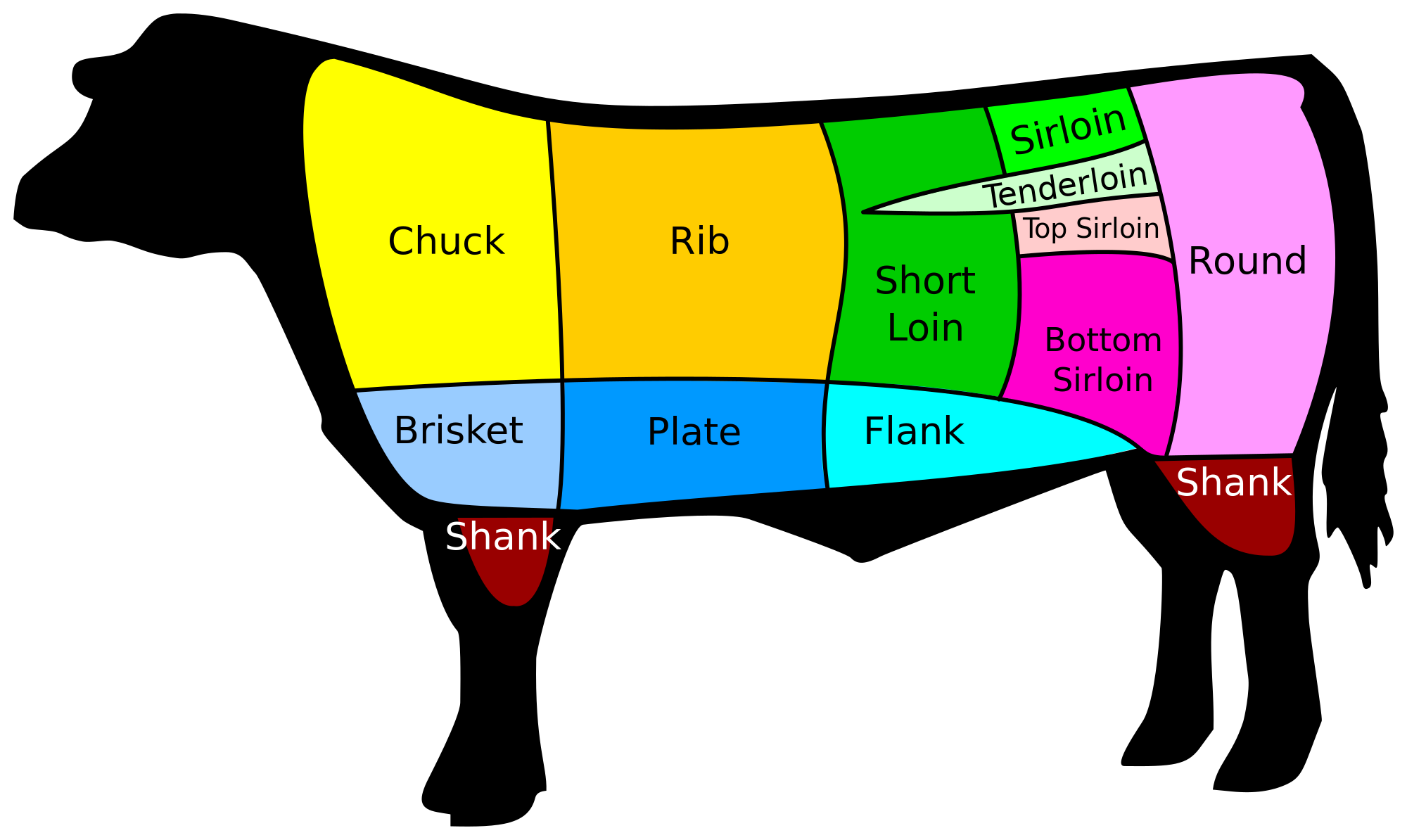
The beef clod or shoulder clod is one of the least expensive cuts of beef and is taken from the shoulder (chuck) region of the animal. Beef clod is a large muscle system, with some fat that covers the muscles.[1] The clod's composition is mainly three muscles: the shoulder tender, the top blade and the clod heart and is one of two chuck subprimal cuts. It is often divided into its three separate muscle cuts for retail sale.[2]

Beef clod, along with beef brisket, is historically the foundation of Central Texas-style barbecue, as epitomized by Kreuz Market in Lockhart, Texas, where the clod has been prepared since 1900 by long, slow smoking.[3] Beef clod may also be prepared with moist heat or braising.[4][5]

Shoulder tender

[edit]

A shoulder tender[6][7] also called beef shoulder petite tender,[8] beef shoulder tender petite roast,[9] bistro filet, rat or teres major steak[6][7] is a US cut of beef of the teres major muscle from the blade of the shoulder (chuck). It is one of the tenderest beef muscles and is said to be "white-tablecloth quality",[6][10] being a similar quality to filet mignon, but cheaper.[11] It is rarely used, as it requires skill to extract.[6][failed verification] It is known as petite tender medallion, petite tender[9] or tender medallions if sliced into medallions (after being roasted or grilled whole).[8][10] It is shaped like a pork tenderloin,[10] and weighs 8 to 10 ounces (230 to 280 g).[8]

The flat iron steak lies above it, and is distinct from this steak, as it is formed from different muscles: teres minor and infraspinatus.

See also

[edit]

References

[edit]
[edit]
Revisions and contributorsEdit on WikipediaRead on Wikipedia
from Grokipedia
The beef clod, also known as the shoulder clod, is a subprimal derived from the primal in the region of the carcass, consisting of the large muscle system positioned posterior to the and ventral to the medial ridge of the blade bone. This boneless cut, designated as Institutional Purchase Specification (IMPS) item 114, typically weighs between 13 and 21 pounds and includes key muscles such as the infraspinatus (used for flat iron steaks), the teres major (used for petite tender or shoulder tender), and the long head of the brachii (used for clod heart or shoulder center roasts), along with other portions like the lateral and medial heads of the triceps brachii. The beef clod is prized for its robust beefy flavor and relative affordability compared to premium cuts like ribeye or tenderloin, making it a staple in both commercial and home cooking. Its muscle composition results in varying tenderness levels, with the infraspinatus being the second-most tender muscle in the entire carcass after the psoas major (tenderloin), and the teres major also relatively tender, while other portions, such as parts of the brachii, benefit from low-and-slow cooking methods to achieve optimal texture. Commonly fabricated into roasts, steaks, or , the clod is especially popular in traditions, where it is often smoked whole to serve large groups, requiring extended cooking times of 10-18 hours at low temperatures around 225-250°F to break down connective tissues. In retail settings, portions like the (from the infraspinatus) have gained acclaim for their marbling and juiciness when grilled quickly over high heat, while the petite tender is ideal for pan-searing or broiling due to its tenderness similar to . Overall, the beef clod exemplifies the versatility of the chuck primal, contributing to its role in economical yet flavorful dishes across global cuisines.

Overview

Definition and Characteristics

The beef clod, also known as the shoulder clod, is an inexpensive subprimal cut from the primal of the beef carcass, consisting of a large, boneless muscle system suitable for further processing into roasts and steaks. In its whole form, it typically weighs 13 to 21 pounds (5.9 to 9.5 kg), depending on the animal's size and grade category. This cut is characterized by a moderate covering of fat over its substantial muscular structure, which contributes to its robust beefy flavor but also imparts overall toughness due to the rigorous activity of the underlying tissues during the animal's life. Unlike many other cuts, the clod is rarely sold at retail in its entirety, serving instead as a wholesale item primarily destined for fabrication by processors into smaller portions or ground products. Economically, it commands a low price per pound—often around $3.50 to $4.00 for select grades—providing high yield potential for processors who can derive multiple value-added products from its components, thereby maximizing carcass utilization. This affordability and versatility make it a staple in institutional and foodservice sectors, where cost efficiency is paramount. Historically, the beef clod remained underutilized in retail settings, often relegated to ground beef or generic roasts, until the early 2000s when research into tender sub-muscles sparked interest in premium derived cuts, enhancing its overall market value by an estimated $50 to $70 per head. This shift has positioned the clod as a key contributor to improved beef industry economics without altering its fundamental role as a budget-friendly subprimal. For instance, it encompasses contrasting elements like the tender shoulder tender muscle amid its tougher matrix.

Location in the Carcass

The beef clod, also known as the shoulder clod, constitutes the lateral (outer) portion of the primal within the beef carcass, positioned above the and below the while encompassing the blade area. This placement situates it in the forequarter, where it forms a significant part of the , which accounts for approximately 30% of the total carcass weight. As defined in institutional meat purchase specifications (IMPS 114), the clod is centered around the or blade bone, from which it is separated to yield a boneless subprimal. In relation to other beef primals, the clod is one of the two primary subprimals of the , alongside the chuck roll, and is isolated during butchering by following natural seams surrounding the bone. It lies ventral to the ridge of the bone, extending from the to the tip of the blade bone , and is separated from adjacent areas like the through parallel straight cuts along the ventral side of the blade ridge and over the . This structural arrangement highlights its role in the overall primal, a forequarter section derived after initial carcass splitting. The clod incorporates muscles from the forequarter that support and weight-bearing during the animal's life, resulting in its characteristic toughness due to and heavy usage. In standard butchering processes, it is removed intact following hide removal, evisceration, and splitting of the carcass into sides, as part of the initial breakdown into primals like the under USDA guidelines. This occurs prior to further subprimal fabrication, ensuring the clod is handled as a wholesale unit in grading and distribution systems.

Anatomy

Primary Muscles

The beef clod, a subprimal cut from the bovine , consists of five primary muscles that define its structure and utility: the infraspinatus (forming the bulk of the top blade), teres minor (a smaller portion integrated into the top blade), supraspinatus (comprising the ), teres major (known as the shoulder tender), and long head of the brachii (forming the clod heart). These muscles perform essential roles in the forelimb's locomotion and stability, reflecting their active use in supporting the animal's weight and movement, which imparts a characteristic toughness to the clod. The infraspinatus and teres minor enable external rotation of the while providing lateral stabilization to the . The supraspinatus facilitates initial abduction and elevation of the , further reinforcing integrity. The teres major draws the toward the body (adduction) and assists in internal rotation and extension. The long head of the brachii primarily extends the and contributes to shoulder adduction, making it a key extensor in the upper . Collectively, their locomotor demands result in higher content compared to less active muscles elsewhere in the carcass. Tenderness varies significantly among these muscles due to differences in fiber type, workload, and collagen levels, as measured by Warner-Bratzler shear force values (lower values indicate greater tenderness). The infraspinatus ranks among the most tender muscles in the carcass (shear ~3.20 kg, second only to the tenderloin), prized for its juiciness when aged or sliced against the grain. The teres major is also tender (shear 3.83 kg), suitable for quick cooking without extensive tenderization. In contrast, the supraspinatus and long head of the triceps brachii rank lower (shear 4.71 kg and 4.38 kg, respectively), with tougher profiles from greater connective tissue that benefits from moist, low-heat methods to achieve palatability. The teres minor, often processed with the infraspinatus, aligns closely with its high tenderness traits. Approximate weights of these muscles vary by animal size and breed but provide insight into their proportional contributions to the clod, which typically totals 10-20 pounds (4.5-9 kg). The long head of the triceps brachii (clod heart) is the largest, often comprising 12-15 pounds (5.4-6.8 kg) or more of the subprimal. The infraspinatus and teres minor combined (top blade) yield about 5-7 pounds (2.3-3.2 kg). The supraspinatus (shoulder center) is intermediate at roughly 2-3 pounds (0.9-1.4 kg). The teres major (shoulder tender) is the smallest, averaging 12-24 ounces (340-680 g) per side.

Supporting Tissues

The beef clod exhibits a thin layer of external covering its exterior surface, which is typically minimal due to the active nature of the region in . This cover is often trimmed during fabrication, reflecting the cut's lean profile. Intramuscular marbling is limited in the clod, as the constant use of muscles during the animal's life results in less deposition within the muscle fibers compared to less-exercised areas like the . Connective tissue in the beef clod is characterized by high content, particularly in the seams separating individual muscles such as the triceps brachii and infraspinatus. These seams consist of dense layers that contribute to the cut's toughness if not properly addressed, but the collagen breaks down into during moist-heat cooking methods, enhancing tenderness. Seam fat and silver skin provide natural divisions within the clod, facilitating the isolation of individual muscles during processing. The silver skin, a tough membranous layer of , is prominent on the and requires removal to improve tenderness in derived cuts. These supporting tissues influence the clod's overall , with low trim losses enabling yields of up to 80% usable meat after removing external fat and silver skin. Marbling levels, though minimal, contribute to USDA quality grading, where clod portions often fall into or Select categories based on intramuscular fat distribution. The structure also supports dry aging potential, as the lean composition and seam separations allow for controlled enzymatic breakdown without excessive moisture loss.

Processing and Subcuts

Fabrication Methods

The fabrication of beef clod, a subprimal cut from the chuck primal (IMPS/NAMP 114), follows Institutional Meat Purchase Specifications (IMPS) guidelines. Following carcass chilling post-slaughter, the chuck primal is broken down to obtain the whole clod, which is then maintained at an internal temperature of 40-45°F (4-7°C) in a controlled environment for 24-48 hours to ensure firmness and prevent microbial growth. Breakdown starts by removing external and silver skin using a to expose the underlying muscle structure. Muscles are then separated along natural seams, such as those between the primary muscles, with a flexible to follow the lines precisely. This seam-based separation minimizes unnecessary cuts and preserves muscle integrity during disassembly. Key tools include a straight-bone for initial large cuts and a trim for precision work, often employing techniques to shave away excess tissue without damaging lean meat. Yield optimization focuses on minimizing trim loss from and , targeting approximately 15-20% overall to maximize usable product from the primal. Variations in fabrication depend on market demands; whole primals are often sold intact for applications where slow cooking enhances flavor, while retail operations involve more detailed breakdown for portion control. Modern practices include vacuum packaging the fabricated pieces to extend chilled up to 30-40 days by reducing oxygen exposure and bacterial proliferation.

Key Derived Cuts

The beef clod, a subprimal cut from the chuck primal (IMPS/NAMP 114), yields several retail and foodservice cuts through standard fabrication methods that separate its primary muscles while minimizing trim loss. These derived cuts leverage the clod's rich beefy flavor and varying tenderness levels, with yields depending on animal size and processing efficiency; a typical clod weighs 13-21 pounds, producing about 70-80% usable meat after bone and fat removal. The shoulder tender, also known as the teres major or petite tender (IMPS 114F), is a compact, elongated muscle removed from the top of the , typically weighing 8-10 ounces per piece. This lean, tender cut resembles a smaller in shape and texture, offering a juicy profile suitable for whole or portioning into medallions, and it represents approximately 5% of the clod's yield. The derives from the within the top blade portion of the clod (IMPS 1114D), fabricated by removing the inelastic seam to enhance tenderness; each steak weighs 10-12 ounces and is cross-cut against the into boneless portions. Renowned as the second most tender steak after the tenderloin, it delivers robust marbling and flavor while yielding around 13% from the clod. The top blade steak, sourced from the and portions of the infraspinatus in the clod's top blade (IMPS 1114C), is a budget-friendly option often weighing 8-10 ounces per steak, though its central gristle seam typically leads to cubing for or kebabs rather than whole. This cut provides economical value with good iness but requires fabrication to address toughness, contributing about 30% to clod yields before further processing. The clod heart, comprising the deep pectoral and long head of the brachii (IMPS 114E), forms the largest derived cut from the clod, often left as a whole roast weighing 5-7 pounds or portioned into steaks. Lean and versatile with a pronounced flavor, it suits or stewing and accounts for roughly 30% of the clod's weight, serving as an affordable alternative to higher-priced roasts. Other notable yields include the Denver steak (IMPS 1112D3), a related but distinct cut from the underblade's serratus ventralis muscle adjacent to the clod, prized for its marbling and tenderness in 8-10 ounce portions. Additionally, trim from fabrication, comprising approximately 15-20% of the clod's weight, is commonly directed to production, enhancing overall utilization.

Culinary Uses

Cooking Techniques

The beef clod, known for its varying degrees of toughness across its muscles, benefits from cooking techniques that address connective tissues through appropriate heat applications. Moist heat methods are ideal for tougher sections like the clod heart, where in a flavorful liquid such as for 2.5-3.5 hours at 325°F (163°C) tenderizes the until it reaches an internal of about 195°F (90°C) and is fork-tender. Similarly, stewing cubed portions from the top blade muscle, a subprimal derived from the clod, involves simmering in liquid over low heat to break down fibers, typically for 2-3 hours until fork-tender. For more tender subcuts like the , dry heat grilling is recommended to preserve juiciness; cook over high direct heat for 4-5 minutes per side to achieve medium-rare at an internal temperature of 135°F (57°C). The shoulder tender, another relatively tender portion, suits at 425°F (218°C) for 20-25 minutes, aiming for an internal temperature of 145°F (63°C) for medium . Smoking the whole clod low-and-slow at 250°F (121°C) for 12-16 hours until reaching 195-200°F (90-93°C) internal temperature yields a tender, flavorful result, particularly in Texas-style using post wood for its mild smoke profile. General preparation tips enhance outcomes across methods: marinate tougher sections overnight in acidic mixtures to aid flavor penetration and tenderness; allow the to rest 5-10 minutes post-cooking to redistribute juices; and always slice against the grain to shorten muscle fibers for improved chewability. High-heat dry cooking should be avoided for non-tender muscles, as it contracts proteins and expels moisture, resulting in toughness.

Regional and Cultural Applications

In traditions, the beef clod has been a staple since the early , particularly at historic establishments like Kreuz Market in Lockhart, which began serving smoked whole clods as part of its meat market operations around 1900. These large cuts are typically smoked low and slow over post oak, then sliced thin against the grain for serving on butcher paper plates, embodying the region's beef-centric, sauce-minimalist style that prioritizes the meat's natural flavor. Beyond , in other parts of the , the beef clod is commonly used for institutional roasts, such as arm roasts prepared for large-scale foodservice operations, due to its lean profile and economical yield. It also contributes significantly to production, especially in burgers, as the region's muscles provide robust flavor when trimmed and blended. In recent years, subcuts like flat iron steaks from the shoulder clod have gained traction in dining, valued for their tenderness and marbling after the removal of a central sinew, appealing to consumers seeking affordable, flavorful alternatives to pricier cuts. Internationally, the beef clod features in as a base for , where it's braised slowly with spices like , , and to create tender, shredded meat for tacos and burritos. In Asian dishes, such as Chinese beef stews, clod portions from the are simmered with , ginger, and star for hours, yielding melt-in-the-mouth texture in hearty bowls served with rice or noodles. However, in , the shoulder clod remains relatively underutilized compared to the U.S., often relegated to stewing, , or rather than being marketed as distinct premium cuts. Since the , modern trends in the U.S. have driven value-added for the beef clod, transforming it from a low-value trim cut into a specialty item through innovations like the flat iron steak's commercialization around 2002, which boosted retail availability and consumer awareness. This cultural shift reflects broader industry efforts to enhance carcass utilization, with branded programs promoting clod-derived products for their beefy flavor and versatility, moving it from bulk processing to targeted sales in supermarkets and restaurants.

References

Add your contribution
Related Hubs
User Avatar
No comments yet.