


Wikipedia
Bell pepper
View on Wikipedia
 | This article needs additional citations for verification. (September 2024) |
| Bell pepper | |
|---|---|
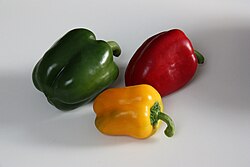
 Green, yellow, and red bell peppers | |
| Species | Capsicum annuum |
| Heat | None |
| Scoville scale | 0 SHU |
The bell pepper (also known as sweet pepper, paprika, pepper, capsicum /ˈkæpsɪkəm/[1] or, in some parts of the US midwest, mango[2]) is the fruit of plants in the Grossum Group of the species Capsicum annuum.[3][4] Cultivars of the plant produce fruits in different colors, including red, yellow, orange, green, white, chocolate, candy cane striped, and purple. Bell peppers are sometimes grouped with less pungent chili varieties as "sweet peppers". While they are botanically fruits—classified as berries—they are commonly used as a vegetable ingredient or side dish. Other varieties of the genus Capsicum are categorized as chili peppers when they are cultivated for their pungency, including some varieties of Capsicum annuum.
Peppers are native to Mexico, Central America, the Caribbean and northern South America. Pepper seeds were imported to Spain in 1493 and then spread through Europe and Asia. Preferred growing conditions for bell peppers include warm, moist soil in a temperature range of 21 to 29 °C (70 to 84 °F).[5]
Nomenclature
[edit]
.jpg)
The name pepper was given by Europeans when Christopher Columbus brought the plant back to Europe. At that time, black pepper (peppercorns), from the unrelated plant Piper nigrum originating from India, was a highly prized condiment. The name pepper was applied in Europe to all known spices with a hot and pungent taste and was therefore extended to genus Capsicum when it was introduced from the Americas. The most commonly used name of the plant family chile is of Mexican origin, from the Nahuatl word chilli.[citation needed]
The terms bell pepper (US, Canada, Philippines, UK), pepper or sweet pepper (UK, Ireland, Canada, South Africa, Zimbabwe), and capsicum (Australia, Bangladesh, India, Malaysia, New Zealand, Pakistan and Sri Lanka) are often used for any of the large bell-shaped peppers, regardless of their color. The fruit is simply referred to as a "pepper", or additionally by color ("green pepper" or red, yellow, orange, purple, brown, black).[6] In the Midland region of the U.S., bell peppers, either fresh or when stuffed and pickled, are sometimes called mangoes.[7][8]
In some languages, the term paprika, which has its roots in the word for pepper, is used for both the spice and the fruit – sometimes referred to by their color (for example groene paprika, gele paprika, in Dutch, which are green and yellow, respectively). The bell pepper is called "パプリカ" (papurika) or "ピーマン" (pīman, from French piment pronounced with a silent 't') in Japan.[9] In Switzerland, the fruit is mostly called peperone, which is the Italian name of the fruit. In France, it is called poivron, with the same root as poivre (meaning "pepper") or piment. In Spain it is called pimiento morrón, the masculine form of the traditional spice, pimienta and "morrón" (snouted) referring to its general shape. In South Korea, the word "피망" (pimang from the French piment) refers to green bell peppers, whereas "파프리카" (papeurika, from paprika) refers to bell peppers of other colors. In Sri Lanka, both the bell pepper and the banana pepper are referred to as a "capsicum" since the bell pepper has no Sinhalese translation. In Argentina and Chile, it is called "morrón".[citation needed]
| Nutritional value per 100 g (3.5 oz) | |||||||||||||||||||||||||||||||||||||||||||||||||
|---|---|---|---|---|---|---|---|---|---|---|---|---|---|---|---|---|---|---|---|---|---|---|---|---|---|---|---|---|---|---|---|---|---|---|---|---|---|---|---|---|---|---|---|---|---|---|---|---|---|
| Energy | 27 kcal (110 kJ) | ||||||||||||||||||||||||||||||||||||||||||||||||
4.64 g | |||||||||||||||||||||||||||||||||||||||||||||||||
| Sugars | 2.4 g | ||||||||||||||||||||||||||||||||||||||||||||||||
| Dietary fiber | 1.8 g | ||||||||||||||||||||||||||||||||||||||||||||||||
0.13 g | |||||||||||||||||||||||||||||||||||||||||||||||||
0.9 g | |||||||||||||||||||||||||||||||||||||||||||||||||
| |||||||||||||||||||||||||||||||||||||||||||||||||
| Other constituents | Quantity | ||||||||||||||||||||||||||||||||||||||||||||||||
| Water | 92 g | ||||||||||||||||||||||||||||||||||||||||||||||||
| †Percentages estimated using US recommendations for adults,[10] except for potassium, which is estimated based on expert recommendation from the National Academies.[11] | |||||||||||||||||||||||||||||||||||||||||||||||||
Colors
[edit]The most common colors of bell peppers are green, yellow, orange and red. Other colors include brown, white, lavender, and dark purple, depending on the variety. Most typically, unripe fruits are green or, less commonly, pale yellow or purple. Red bell peppers are simply ripened green peppers,[12] although the Permagreen variety maintains its green color even when fully ripe. Therefore, mixed colored peppers also exist during parts of the ripening process.[citation needed]
Uses
[edit]Culinary
[edit]Like the tomato, bell peppers are botanical fruits and culinary vegetables. Pieces of bell pepper are commonly used in garden salads and as toppings on pizza. There are many varieties of stuffed peppers prepared using hollowed or halved bell peppers. Bell peppers (and other cultivars of Capsicum annuum) may be used in the production of the spice paprika.
Nutrition
[edit]A raw red bell pepper is 94% water, 5% carbohydrates, 1% protein, and contains negligible fat. A 100 gram (3.5 ounce) reference amount supplies 26 calories, and is a rich source of vitamin C – containing 158% of the Daily Value (DV) – vitamin A (20%), and vitamin B6 (23% DV), with moderate contents of riboflavin (12%), folate (12% DV), and vitamin E (11% DV). A red bell pepper supplies twice the vitamin C and eight times the vitamin A content of a green bell pepper.[13]
The bell pepper is the only member of the genus Capsicum that does not produce capsaicin, a lipophilic chemical that can cause a strong burning sensation when it comes in contact with mucous membranes. Bell peppers are thus scored in the lowest level of the Scoville scale, meaning that they are not spicy. This absence of capsaicin is due to a recessive form of a gene that eliminates the compound and, consequently, the "hot" taste usually associated with the rest of the genus Capsicum. This recessive gene is overwritten in the Mexibelle pepper, a hybrid variety of bell pepper that produces small amounts of capsaicin (and is thus mildly pungent). Conversely, a mutant strain of habanero has been bred to create a heatless version called the 'Habanada'. Sweet pepper cultivars produce non-pungent capsaicinoids.[14]
Production
[edit]In 2020, global production of bell peppers was 36 million tonnes, led by China with 46% of the total, and secondary production by Mexico, Indonesia, and Turkey.[15]
See also
[edit]

References
[edit]- ^ Wells, John C. (2008), Longman Pronunciation Dictionary (3rd ed.), Longman, p. 123, ISBN 9781405881180
- ^ Rice, Briana. "Why do some people in Cincinnati call green peppers 'mangoes'?". The [Cincinnati] Enquirer. Retrieved 23 October 2025.
- ^ "Capsicum annuum (bell pepper)". CABI. 28 November 2017. Retrieved 15 March 2018.
- ^ "Capsicum annuum (Grossum Group) (Bell Pepper, Red pepper, Sweet Pepper) | North Carolina Extension Gardener Plant Toolbox". plants.ces.ncsu.edu. Retrieved 22 March 2020.
- ^ "Growing Peppers: The Important Facts". GardenersGardening.com. Archived from the original on 27 January 2013. Retrieved 10 January 2013.
- ^ "Bell and Chili Peppers". Agricultural Marketing Resource Center, US Department of Agriculture. October 2017. Retrieved 25 August 2018.
- ^ "Dictionary of American Regional English". Retrieved 15 March 2018.
- ^ Hollandbeck, Andy (6 June 2024). "In a Word: When Is a Mango Not a Mango". The Saturday Evening Post. Retrieved 5 February 2025.
- ^ Azhar Ali Farooqi; B. S. Sreeramu; K. N. Srinivasappa (2005). Cultivation of Spice Crops. Universities Press. p. 336. ISBN 978-81-7371-521-1.
- ^ United States Food and Drug Administration (2024). "Daily Value on the Nutrition and Supplement Facts Labels". FDA. Archived from the original on 27 March 2024. Retrieved 28 March 2024.
- ^ "TABLE 4-7 Comparison of Potassium Adequate Intakes Established in This Report to Potassium Adequate Intakes Established in the 2005 DRI Report". p. 120. In: Stallings, Virginia A.; Harrison, Meghan; Oria, Maria, eds. (2019). "Potassium: Dietary Reference Intakes for Adequacy". Dietary Reference Intakes for Sodium and Potassium. pp. 101–124. doi:10.17226/25353. ISBN 978-0-309-48834-1. PMID 30844154. NCBI NBK545428.
- ^ "Vegetable of the Month: Bell Pepper". CDC Fruit & Vegetable of the Month. Archived from the original on 3 January 2003. Retrieved 9 April 2012.
- ^ University of the District of Columbia. "Peppers" (PDF). Center for Nutrition, Diet and Health. Retrieved 13 March 2013.
- ^ Macho, Antonio; Lucena, Concepción; Sancho, Rocio; Daddario, Nives; Minassi, Alberto; Muñoz, Eduardo; Appendino, Giovanni (1 February 2003). "Non-pungent capsaicinoids from sweet pepper". European Journal of Nutrition. 42 (1): 2–9. doi:10.1007/s00394-003-0394-6. ISSN 1436-6207. PMID 12594536. S2CID 25276690.
- ^ "Bell pepper production". Tridge. 2020. Retrieved 5 August 2022.

Grokipedia
Bell pepper
View on GrokipediaOrigin and History
Domestication in the Americas
Bell peppers, classified as Capsicum annuum var. grossum, trace their origins to the domestication of the broader C. annuum species in Central America, particularly in what is now Mexico.[18][19] Recent genetic and archaeological studies (as of 2024) indicate that this domestication occurred near the Yucatán Peninsula and southern coastal Guerrero, with earlier evidence from sites like the Tehuacán Valley.[20] Archaeological and genetic studies indicate that this domestication process began around 6,000 years ago, as indigenous peoples transitioned from gathering wild varieties to cultivating plants with desirable traits like larger fruits and varied pungency levels.[21] Key archaeological findings from sites like the Tehuacán Valley in Mexico, including Coxcatlán Cave, provide direct evidence of early cultivation. Remains such as seeds, fruit residues, and starch microfossils dated to approximately 6,000–4,000 BCE demonstrate the presence of both wild and early domesticated forms, primarily small and pungent varieties.[22][23][24] Non-pungent varieties, including precursors to modern bell peppers, were later selected by indigenous groups for milder flavors, reduced capsaicin content, and increased fruit size, integrating them into broader culinary uses while retaining nutritional value. In pre-Columbian societies, including the Aztecs and Mayans, C. annuum peppers played a central role in agriculture and daily life, often grown alongside maize, beans, and squash in the milpa system. They served as a staple crop, providing essential vitamins and flavor to diets dominated by tortillas, stews, and atole, while also holding cultural significance in rituals—such as warding off evil spirits among Mayan descendants or symbolizing vitality in Aztec ceremonies. Modern genetic analyses confirm that the wild ancestor, C. annuum var. glabriusculum (chiltepin), underwent domestication in these regions, with reduced genetic diversity in cultivated non-pungent lines reflecting targeted selection by indigenous farmers.[25][26][27][28] This early domestication laid the foundation for the plant's eventual dissemination to Europe following Christopher Columbus's voyages in 1492.[18]Global Dissemination and Cultivation
Christopher Columbus introduced bell pepper seeds to Europe upon his return from the Americas in 1493, marking the beginning of their global spread as part of the Columbian Exchange.[3] These seeds first took root in Spain, where Franciscan monks began cultivating the plants in the 16th century, initially as ornamental garden specimens valued for their novelty and vibrant colors.[29] By the mid-16th century, cultivation had extended to Italy, where the warm Mediterranean climate proved ideal, and the peppers transitioned from decorative use to incorporation in local cuisines.[30] Portuguese and Spanish trade routes facilitated the rapid dissemination of bell peppers beyond Europe, reaching Africa and Asia by the early 16th century. Portuguese traders carried seeds along established maritime paths to India and Southeast Asia around 1510, where the plants adapted to tropical conditions, thriving in humid, warm environments similar to their American origins.[31] In Africa, dissemination occurred via coastal trade networks, with early cultivation noted in Portuguese colonies by the 1520s, allowing adaptation to diverse subtropical climates across the continent.[32] By the late 1500s, bell peppers had arrived in China through these routes, integrating into agricultural systems suited to its varied regional climates and becoming a staple in southern provinces.[33] The naming of bell peppers evolved alongside their spread, reflecting confusion with existing spices; in English, the term "sweet pepper" emerged by the late 17th century to distinguish the mild varieties from pungent types, as documented in early botanical texts.[34] As a key element of the Columbian Exchange, bell peppers transformed global agriculture and diets, introducing a new vegetable that enriched culinary traditions without the heat of black pepper, which had previously dominated European spice trade.[35] In Europe, early varietal selection focused on improving yield and flavor, with the first documented red bell peppers appearing in 18th-century botanical records from Dutch and Hungarian gardens, where breeders selected for sweeter, non-pungent fruits that ripened to deep red hues.[36] These developments laid the foundation for modern cultivars, emphasizing adaptation to temperate growing seasons while preserving the plant's core traits from its American domestication.[37]Taxonomy and Nomenclature
Botanical Classification
Bell peppers belong to the species Capsicum annuum L. within the genus Capsicum of the family Solanaceae, order Solanales, class Magnoliopsida, phylum Tracheophyta, and kingdom Plantae.[38] They are classified as non-pungent cultivars of C. annuum var. annuum, distinguished by the absence of capsaicin and related capsaicinoids in their fruits, a trait resulting from selective breeding that suppresses the biosynthetic pathway for these compounds.[39] Specifically, bell peppers fall under the Grossum Group, characterized by large, blocky, sweet fruits.[38] The plant is an herbaceous annual in temperate climates or a short-lived perennial herb in tropical regions, typically reaching heights of 0.5 to 1.2 meters with an upright, bushy growth habit.[38][1] It features alternate, simple leaves that are broad, ovate to lanceolate, and dark green, measuring up to 10 cm long.[40] Flowers are solitary, bisexual, and actinomorphic, with a white to pale purple corolla 9-15 mm in diameter, five petals, and blue-purple anthers; they are self-compatible and primarily self-pollinating, though facultative outcrossing can occur at rates of 2-90% depending on pollinator activity.[38] The fruits are indehiscent berries developing from the inferior ovary, initially green and maturing to colors such as red, yellow, or orange in non-pungent varieties.[1] The life cycle of C. annuum involves a vegetative phase followed by flowering and fruiting, with fruits typically setting 60-90 days after transplanting under optimal conditions, though maturity from anthesis to harvest ranges from 35-50 days for the green stage.[38] As diploids with 2n=24 chromosomes, these plants are photoperiod-insensitive but frost-sensitive, thriving in warm-season environments.[38] Bell peppers differ from wild relatives, such as C. annuum var. glabriusculum, which produce small, pungent fruits and exhibit greater genetic diversity, and from other Capsicum species like C. frutescens (e.g., tabasco peppers), which are strictly annuals with pendant, highly pungent fruits, distinct flower spot patterns, and lower cross-compatibility.[38]Common Names and Etymology
The primary English name for the plant, "bell pepper," derives from the fruit's distinctive bell-like shape.[41] This term dates back to at least the late 17th century, as recorded in accounts by English surgeon Lionel Wafer during his travels in the Americas.[34] An alternative common name, "sweet pepper," emerged in the early 20th century to differentiate the mild-flavored varieties from their pungent chili relatives within the same genus.[42] In Spanish-speaking regions, the fruit is known as "pimiento," a term borrowed into English as "pimento," originating from the Latin pigmentum meaning "pigment" or "coloring," in reference to the vibrant hues of the ripe pods.[43] The related word "pimentón" serves as an augmentative form of pimiento and commonly refers to the dried and ground form used as a spice, particularly the smoked variety from Spain.[44] In Portuguese, the name "pimentão" follows a similar pattern, acting as an augmentative of pimenta (pepper) to denote the larger, milder capsicums. Regional variations reflect linguistic adaptations and colonial influences. In Australia, New Zealand, and parts of India, the term "capsicum" predominates, directly adopting the botanical genus name Capsicum, which Linnaeus coined in the 18th century from the Greek kaptein ("to bite"), alluding to the biting quality of many species in the group.[1] In French, "poivron" is used, derived from poivre (pepper), itself from Latin piper, emphasizing the historical association with spice.[45] The word "paprika," while primarily denoting the ground spice made from dried sweet peppers (originating from Hungarian paprika meaning "pepper"), is occasionally applied to the fresh fruit in certain European contexts, though it remains distinct from the spice product.[46] The shared use of "pepper" in these names stems from a historical misconception during the Age of Exploration, when European explorers like Christopher Columbus encountered New World capsicums and likened their flavor and appearance to the valuable Asian black pepper (Piper nigrum), leading to the application of the term despite no botanical relation.[47] This naming convention arose from the spice trade's prominence, where black pepper was a prized commodity, causing ongoing confusion between the unrelated plants.[48]Varieties and Characteristics
Color Variants
Bell peppers typically start as green fruits in their immature stage, owing to high levels of chlorophyll in the skin that masks other pigments.[49] During maturation, chlorophyll degrades, allowing the accumulation of carotenoids and other compounds that produce a range of colors including red, yellow, orange, purple, and brown.[50][51] This process involves the biosynthesis of specific pigments: beta-carotene imparts orange and contributes to red hues, while lutein is responsible for yellow coloration.[50][52] Purple bell peppers arise from anthocyanins in select hybrid varieties, and brown results from genetic variations that alter carotenoid profiles in otherwise red fruits.[53][54] Red bell peppers require the longest maturation period, often 2-3 weeks on the plant after reaching full green size, leading to higher nutrient levels such as approximately 1.5 to 2 times more vitamin C per 100 grams compared to green peppers (around 128 mg versus 80 mg).[13][55] Yellow bell peppers, ripening to that color via lutein accumulation, also show elevated vitamin C at about 184 mg per 100 grams.[13] In commercial production, green bell peppers dominate availability as they are harvested early for quicker turnover, while colored variants command higher prices due to the extended on-vine time and lower yields.[56][57] Rare colors like white and black emerge from targeted breeding programs that select for unique pigment expressions or suppress common carotenoids.[58][54] Maturity influences flavor, with riper colored peppers tasting sweeter due to increased sugar accumulation during the extended ripening phase, in contrast to the more bitter, grassy notes of green ones.[56][59]Size, Shape, and Other Traits
Bell peppers typically exhibit a blocky shape, characterized by a square or rectangular form with three to four lobes, measuring approximately 7-10 cm in length and width.[60][1] This standard morphology provides a sturdy structure suitable for fresh market handling and culinary applications. Mini varieties are compact, often 3-5 cm in length with a more uniform, slightly tapered form.[61] Contrary to a common misconception, bell peppers do not have male or female forms. The idea that three-lobed peppers are "male" (with fewer seeds, supposedly better for certain cooking applications) and four-lobed peppers are "female" (with more seeds, better for stuffing) is a myth. Bell peppers develop from hermaphroditic flowers and lack gender differentiation in their fruits. The number of lobes, typically three or four, is influenced by factors such as cultivar, growing conditions, and fruit position on the plant, rather than sex. Seed count varies independently, with no consistent correlation to lobe number. For culinary purposes, peppers should be selected based on specific recipe needs (e.g., seed content, size, or shape) rather than lobe count or supposed gender.[62][63] Fruit size in bell peppers varies widely, with standard types ranging from 7-10 cm and hybrid varieties capable of reaching up to 15 cm or more in length, as seen in cultivars like Big Bertha.[64] These dimensions are influenced by factors such as pollination efficiency and nutrient availability; poor pollination due to temperature extremes can result in smaller or misshapen fruits, while adequate photosynthate from balanced nutrition supports larger growth.[65] Wall thickness also differs by variety and purpose, ranging from 6-8 mm in thick-walled types preferred for fresh consumption due to their firmness, to thinner skins in certain cultivars suited for drying processes.[66] Modern F1 hybrids incorporate traits like resistance to tobacco mosaic virus, enhanced heat tolerance for warmer climates, and uniform ripening to ensure consistent harvest quality.[67] Sensory characteristics include a crisp texture and mild flavor, registering 0 Scoville heat units, which contributes to their versatility in raw or cooked dishes.[68] Variations in seed cavity size further impact edible yield, as larger cavities reduce the proportion of fleshy pericarp relative to the core, lowering the amount of consumable tissue per fruit.[69]Culinary Uses
Preparation and Cooking Methods
Bell peppers are commonly prepared raw by slicing them into strips or rings for addition to salads, sandwiches, wraps, or as a dipper with hummus, where they provide a crisp texture and retain higher levels of vitamin C and other antioxidants compared to cooked forms.[70][71] Stuffing is another raw preparation method, involving removal of the core and seeds before filling the peppers with ingredients like cooked rice or meat mixtures, which can then be baked.[72] They can also be pickled whole or in slices using vinegar-based brines for extended shelf life while preserving their crunch.[73] Various cooking techniques highlight the versatility of bell peppers. Roasting involves charring the skin under a broiler, over an open flame, or on a grill until blistered and blackened, followed by steaming in a covered container to loosen the skin for easy peeling; this method enhances sweetness and is suitable for incorporation into dishes like vegetable stews.[74] Sautéing or stir-frying quickly cooks sliced peppers in a hot pan with oil, preserving much of their nutrient content while adding tenderness to mixed vegetable dishes.[70][71] Grilling whole or halved peppers imparts a smoky flavor and charred edges, ideal for slicing into strips for use in wraps or as a side.[8] Steaming, often achieved by microwaving whole or halved peppers for 4 to 6 minutes on high power, softens them to a crisp-tender stage without excessive moisture loss, making them suitable for stuffing or salads.[75] For preservation, bell peppers can be frozen whole, halved, or chopped after washing, coring, and seeding; water blanching halves for 3 minutes or strips for 2 minutes before packaging helps maintain quality for up to a year.[76] Canning involves slashing slits in the peppers, blanching or blistering them, then packing into jars with boiling water or vinegar for pressure or water-bath processing to ensure safety.[77] Drying slices or strips in a dehydrator or oven at low heat (around 135°F) until brittle allows them to be ground into flakes or powder for long-term seasoning storage in airtight containers.[73] Flavor enhancement often includes pairing bell peppers with onions and garlic during sautéing or grilling, as these aromatics complement the peppers' mild sweetness and add depth to the overall profile.[78] Charring through roasting or grilling introduces a smoky note that elevates the peppers' taste in various preparations.[74] To minimize any bitterness from the white pithy membranes, remove the seeds and inner ribs after coring the pepper, which also improves texture.[79]Cultural Significance in Dishes
Bell peppers hold a prominent place in Mediterranean cuisines, where they are often featured in stuffed preparations known as dolma in Turkish and Greek traditions. Originating from Ottoman culinary practices, dolma involves hollowing out bell peppers and filling them with a mixture of rice, herbs, and sometimes minced meat or vegetables, symbolizing hospitality and communal feasting across the region.[80] In Greek variations, such as dolmadakia, the peppers are typically simmered in olive oil and lemon juice, reflecting the shared heritage of the Ottoman Empire that influenced Southeastern European and Western Asian foodways.[81] Another iconic Mediterranean dish incorporating bell peppers is pipérade, a Basque specialty from the Pyrénées-Atlantiques region of France and Spain, dating back to the early 19th century. This stew combines sliced green and red bell peppers with tomatoes, onions, and Espelette peppers, embodying the vibrant red, white, and green colors of the Basque flag and serving as a comforting base for eggs or meat.[82] The dish highlights the cultural fusion in the Basque Country, where bell peppers arrived post-Columbian exchange and became integral to local identity through their use in slow-cooked, rustic preparations.[83] In Asian cuisines, bell peppers, known as shimla mirch in India, are a versatile staple, particularly in Punjabi and North Indian curries, where green varieties are favored for their affordability and crisp texture. Dishes like bharwa shimla mirch feature whole green bell peppers stuffed with spiced mashed potatoes and onions, then cooked in a tomato-based gravy, representing everyday home cooking and festive meals in Indian households.[84] This preparation underscores the vegetable's role in balancing flavors in spice-heavy gravies, a practice rooted in the post-16th-century introduction of capsicums to the subcontinent via Portuguese traders. In Chinese cuisine, bell peppers appear prominently in stir-fries like di san xian from Shandong province, where they are wok-tossed with eggplant and potatoes to create a harmonious mix of textures and mild sweetness that complements bolder savory elements.[85] Their inclusion in such quick-cooked dishes reflects the efficiency of stir-frying techniques that have defined Chinese regional cooking for centuries.[86] Across American culinary landscapes, bell peppers are essential to Tex-Mex traditions, particularly in fajitas and chili, where they add color, crunch, and subtle sweetness to grilled meats and stews. Fajitas, a Texan-Mexican fusion dish popularized in the 20th century, typically include strips of bell peppers alongside skirt steak, onions, and tortillas, evoking the border region's blend of ranching culture and Mexican influences.[87] In chili con carne, a staple of Southwestern American fare, diced bell peppers contribute to the hearty base, enhancing the dish's role as a communal comfort food during gatherings. Hungarian stuffed peppers, or töltött paprika, have also influenced American immigrant cuisines, especially in Midwestern communities, where bell peppers are filled with ground meat, rice, and seasoned with paprika—a spice central to Hungarian identity since the 16th century.[88] This dish, introduced to Hungary by Ottoman Turks, traveled with emigrants to the U.S., adapting to local ingredients while preserving its comforting, family-oriented essence.[89] Historically, bell peppers transitioned from ornamental plants in Europe—introduced in 1493 via Spain and initially grown for decorative purposes in gardens—to essential culinary ingredients by the 18th and 19th centuries, as their mild flavor encouraged widespread adoption in stews and salads.[90] In the Southern United States, this evolution culminated in their integration into soul food traditions, exemplified by pepper jelly, a sweet-spicy condiment made from chopped bell peppers, sugar, and vinegar that emerged in the late 20th century (1970s).[91] Pepper jelly embodies the South's multicultural roots, drawing from African, French, and Native American influences, and serves as a versatile accompaniment to fried foods and cheeses in communal meals.[92] Its popularity highlights bell peppers' shift to a staple status in African American Southern cuisine, where it adds a tangy contrast to rich, flavorful dishes.[93]Nutrition and Health
Nutritional Composition
Bell peppers are low-calorie vegetables primarily composed of water, with the remainder consisting mainly of carbohydrates and small amounts of protein and fat. Per 100 grams of raw bell pepper, the nutritional profile includes approximately 20-31 calories, 92-94% water, 4.6-6.3 grams of carbohydrates (including 2-4 grams of sugars and 1.7-2.1 grams of dietary fiber), 0.9-1 gram of protein, and negligible fat (0.2-0.3 grams).[94][9] In terms of vitamins, bell peppers are particularly rich in vitamin C, providing 80-183 milligrams per 100 grams depending on color, which exceeds the daily recommended intake for adults. One medium raw bell pepper (approximately 120–150 grams) yields 150–190 mg of vitamin C, with higher amounts in red and yellow varieties, often outperforming citrus fruits and strawberries per calorie.[12][11][10] They also contain vitamin A (primarily from beta-carotene, ranging from 157 micrograms retinol activity equivalents or about 370-3,131 IU), vitamin B6 (0.2-0.3 milligrams), and folate (10-46 micrograms). Minerals present include potassium (211-212 milligrams), with smaller amounts of iron (0.3-0.4 milligrams) and magnesium (10-12 milligrams).[94][55][9] Bell peppers contain antioxidants such as quercetin and luteolin, flavonoid compounds that contribute to their overall nutritional value; for example, red varieties may have up to 34 micrograms of quercetin per gram. Unlike hot peppers, bell peppers lack capsaicin, the compound responsible for spiciness. However, unripe green bell peppers contain trace amounts of solanine, a glycoalkaloid typical of nightshade plants, though at levels below 10 milligrams per kilogram, which is considered negligible.[95][96] Bell peppers contain low levels of oxalic acid (oxalate), typically around 10 mg per 100 g fresh weight, with commonly reported values of 9-10 mg/100 g and some variation from 2-20 mg/100 g depending on variety, color, and measurement method. They are generally classified as a low-oxalate food, relevant for individuals monitoring oxalate intake (e.g., to reduce risk of calcium oxalate kidney stones).[97] Nutritional content varies by color, with riper varieties (red, yellow, orange) generally higher in certain vitamins due to increased carotenoid and ascorbic acid accumulation during maturation. Green bell peppers, being unripe, have lower levels of vitamins A and C compared to red and yellow. The table below summarizes key nutrients per 100 grams of raw bell peppers by color, based on USDA data.| Nutrient | Green | Red | Yellow |
|---|---|---|---|
| Calories (kcal) | 20 | 31 | 27 |
| Water (%) | 93.9 | 92.2 | 92.0 |
| Carbohydrates (g) | 4.6 (sugars 2.4, fiber 1.7) | 6.0 (sugars 4.2, fiber 2.1) | 6.3 (sugars 3.9, fiber 0.9) |
| Protein (g) | 0.9 | 1.0 | 1.0 |
| Fat (g) | 0.2 | 0.3 | 0.2 |
| Vitamin C (mg) | 80.4 | 127.7 | 183.0 |
| Vitamin A (IU) | 370 | 3,131 | 200 |
| Potassium (mg) | 211 | 211 | 212 |
Health Benefits and Risks
Bell peppers provide significant health benefits primarily through their rich content of vitamins, antioxidants, and fiber. Vitamin C, abundant in bell peppers, plays a crucial role in immune function by supporting cellular functions of both innate and adaptive immune systems, while also serving as a potent antioxidant that protects cells from oxidative stress.[100][101] These properties help enhance immune defenses and reduce the risk of infections.[101] The carotenoids, such as beta-carotene and lycopene found especially in red bell peppers, promote eye health by protecting against age-related macular degeneration and cataracts through their antioxidant effects on retinal tissues.[102][103] Additionally, epidemiological studies and meta-analyses have linked higher dietary intake of carotenoids from sources like red peppers to a reduced risk of prostate cancer incidence, attributed to their ability to inhibit tumor growth and inflammation.[104][105] Bell peppers support skin health through their high content of vitamin C and carotenoids, which act as antioxidants to promote collagen production, protect against UV damage, and aid in wound healing.[106][107] Flavonoids in bell peppers, including luteolin and apigenin, exhibit anti-inflammatory properties by modulating pathways like NF-κB, which can lower chronic inflammation and support cardiovascular health through improved endothelial function and reduced risk of heart disease.[108][109] Purple bell peppers, rich in anthocyanins, offer specialized benefits including enhanced anti-inflammatory effects and potential anticancer properties, as anthocyanins can modulate inflammatory pathways and induce apoptosis in cancer cells. In comparison, red bell peppers provide broader antioxidant power due to higher carotenoid, vitamin C, and phenolic content, along with greater performance in antioxidant capacity assays.[15][110] The dietary fiber content further aids digestive health by promoting regular bowel movements, adding bulk to stool, and supporting gut microbiota balance.[111][112] Recent research, including studies from the 2020s, highlights bell peppers' low glycemic index (typically 40-45), which contributes to stable blood glucose levels and aids diabetes management by slowing carbohydrate absorption without spiking insulin response.[113][114] Unlike spicy peppers, the absence of capsaicin in bell peppers eliminates potential gastrointestinal irritation or toxicity risks associated with capsaicinoids, making them a safer option for regular consumption.[112][107] Despite these benefits, bell peppers pose some risks, particularly for sensitive individuals. Allergies to the nightshade family (Solanaceae), which includes bell peppers, are rare but can cause symptoms like hives, digestive discomfort, or respiratory issues due to cross-reactivity with alkaloids.[115][116] Non-organic bell peppers often contain pesticide residues, such as organophosphates, which have been detected in high levels and may pose chronic health risks like endocrine disruption upon repeated exposure.[117][118] Overconsumption of fiber-rich bell peppers can lead to digestive upset, including bloating, gas, or abdominal discomfort, especially if intake increases rapidly without adequate hydration.[119][120]Production and Cultivation
Major Producing Regions
Bell peppers, also known as sweet peppers, are a major global crop, with production concentrated in regions offering suitable climates for year-round cultivation. In 2023, worldwide production of fresh bell peppers reached 53.39 million metric tons, dominated by a handful of leading countries that account for the majority of output.[121] The top producing nations include China, which leads with 17.10 million metric tons annually, followed by Mexico at 3.68 million metric tons. Other significant producers are Turkey (3.08 million metric tons), Indonesia (3.06 million metric tons), and Spain (1.39 million metric tons), with the United States contributing 0.577 million metric tons, primarily from California and Florida. These figures reflect data from 2023, highlighting the crop's scale in subtropical and temperate zones ideal for open-field and protected cultivation. In 2024, global production was estimated at approximately 56 million metric tons.[121][122][123][124][125][126]| Rank | Country | Production (2023, million metric tons) |
|---|---|---|
| 1 | China | 17.10 |
| 2 | Mexico | 3.68 |
| 3 | Turkey | 3.08 |
| 4 | Indonesia | 3.06 |
| 5 | Spain | 1.39 |
| 6 | United States | 0.577 |