Hubbry Logo
Ben BernieBen BernieMain
Open search
Ben Bernie
Community hub
Ben Bernie
logo
8 pages, 0 posts
0 subscribers
Be the first to start a discussion here.
Ben Bernie
Ben Bernie
from Wikipedia

Key Information

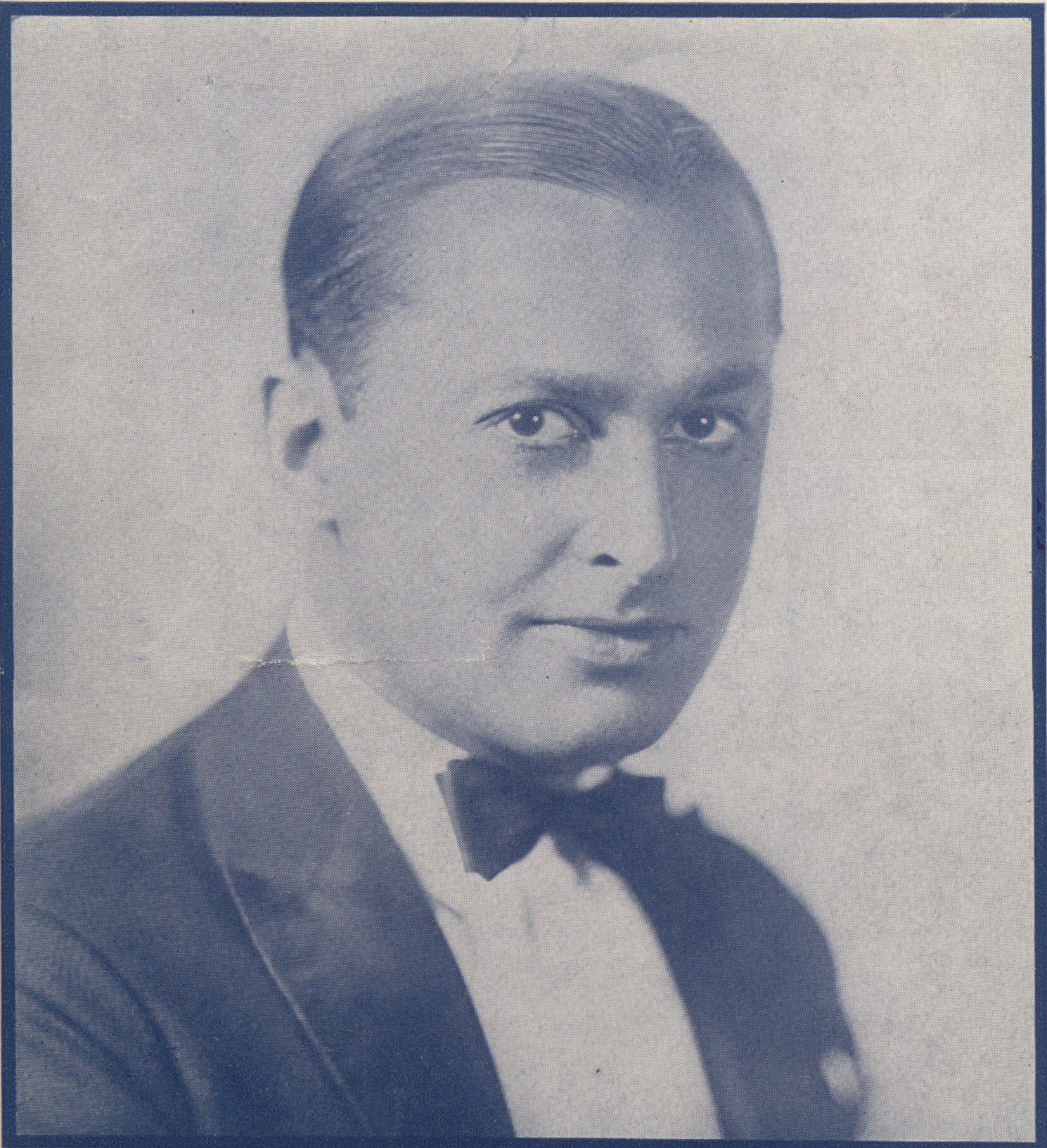
Benjamin Anzelevitz (May 30, 1891 – October 20, 1943),[1] known professionally as Ben Bernie, was an American jazz violinist, bandleader, and radio personality, often introduced as "The Old Maestro". He was noted for his showmanship and memorable bits of snappy dialogue, being part of the first generation of "stars" of American popular music, alongside other artists such as Paul Whiteman (a fellow violinist and bandleader), Ted Lewis, and Al Jolson.

Career

[edit]

Early years

[edit]

Bernie was born Benjamin Anzelevitz[2] in Bayonne, New Jersey. He attended Columbia University and the New York College of Music.[1] By the age of 15 he was teaching violin, but this experience apparently diminished his interest in the violin for a time.

Bernie performed in vaudeville, appearing with Charles Klass as The Fiddle Up Boys in 1912[3] and with Phil Baker as Baker and Bernie,[4] but he met with little success until 1922 when he joined his first orchestra. Later, he had his own band, The Lads, seen in the early DeForest Phonofilm sound short, Ben Bernie and All the Lads (1924–25), featuring pianist Oscar Levant. He toured with Maurice Chevalier in Europe.

Radio and other performances

[edit]
Ben Bernie pictured in an ad for his NBC radio series of 1932–35

Bernie and his orchestra were heard November 15, 1926, via a remote broadcast from the Hotel Roosevelt in New York City, on the first NBC broadcast.[1] In 1928, he starred in the Broadway musical, Here's Howe, as Dan Danny.

His musical variety radio shows through the 1930s, usually titled, Ben Bernie, The Old Maestro received ratings that placed him among radio's top ten programs. He was heard on radio as early as 1923, broadcasting on WJZ and the NBC Blue Network in 1930–31, sponsored by Mennen. After a 1931–32 run on CBS, sponsored by Blue Ribbon Malt, which was acquired by Pabst Beer (during Prohibition, they sold malt syrup, the primary ingredient in brewing "homemade beer"), he was heard Tuesdays on NBC from 1932 to 1935, also with Pabst. His announcer during this period was Jimmy Wallington.

On the Blue Network from 1935 to 1937, Bernie's sponsor was the American Can Company. He returned to CBS in 1938, sponsored by U.S. Rubber. With Half-&-Half Tobacco as a sponsor, he hosted a musical quiz program from 1938 to 1940. From 1940 to 1941, Bromo-Seltzer was his sponsor on the Blue Network. Wrigley's Gum sponsored The Ben Bernie War Workers' Program (1941–43). He also made guest appearances on other radio shows. He appeared in four feature films Shoot the Works (1934), Stolen Harmony (1935),Wake Up and Live (1937), and Love and Hisses (1937)

His theme was "It's a Lonesome Old Town" and his signature trademark, "yowsah, yowsah, yowsah" (also spelled "yowsa" or "yowza"), became a national catchphrase.[4] The term was memorably used by a character in the film They Shoot Horses, Don't They? (1969), Richie Cunningham in a 1976 episode of Happy Days, "They Shoot Fonzies, Don't They?" (1976), by the band Chic with their hit "Dance, Dance, Dance (Yowsah, Yowsah, Yowsah)" (1977),[5] Frank Zappa in his 1979 single "Dancin' Fool" and Ritch Brinkley as Cappy in 1994's comedy, Cabin Boy.[citation needed]

Announcers for Bernie's programs included Harlow Wilcox, Harry von Zell and Bob Brown. His radio shows featured comedy from Lew Lehr and Fuzzy Knight, and the line-up of vocalists included Buddy Clark, Little Jackie Heller, Scrappy Lambert, Pat Kennedy, Jane Pickens, Dinah Shore, and Mary Small.

To boost ratings, Walter Winchell and Bernie, who were good friends, staged a fake rivalry similar to the comedic conflict between Jack Benny and Fred Allen. This mutually beneficial "feud" was a running gag on their radio appearances and continued in two films in which they portrayed themselves: Wake Up and Live (1937) and Love and Hisses (1937). They are also caricatured in the Warner Bros. cartoons The Woods Are Full of Cuckoos (1937) as "Ben Birdie" and "Walter Finchell" and The Coo-Coo Nut Grove (1936) as "Ben Birdie" and "Walter Windpipe".

Recordings

[edit]

Bernie's orchestra recorded throughout the 1920s and 1930s on Vocalion (1922–25), Brunswick (1925–33), Columbia (1933), Decca (1936), and ARC (Vocalion and OKeh) (1939–40). In 1923 Bernie and the Hotel Roosevelt Orchestra recorded "Who's Sorry Now?".

In 1925 Ben Bernie and his orchestra recorded "Sweet Georgia Brown". Bernie was the co-composer of this jazz standard, which became the theme song of the Harlem Globetrotters.

Personal life

[edit]
Ben Bernie and his orchestra on the cover of the sheet music for the 1922 hit song Carolina in the Morning

On December 24, 1915, Bernie married Rose Harris (maiden; 1893–1965) in Manhattan, New York. They had a son, Jason H. Bernie (1918–1969). Ben and Rose Bernie separated in September 1931 and divorced September 1935. In October 1935, Ben Bernie remarried Dorothy P. Wesley (1908–1990) in Miami, Florida.[2]

Bernie died from a pulmonary embolism in October 1943, aged 52, and was buried in Mount Hebron Cemetery, in Queens, New York.[6]

Bernie has a star at 6280 Hollywood Boulevard in the Radio section of the Hollywood Walk of Fame. It was dedicated February 8, 1960.[7]

Selected discography

[edit]
  • "Swinging Down the Lane" (1923) (Vocalion) [8]
  • "Wildflower" (1923) (Vocalion)
  • "Sweet Georgia Brown" July 1925 (#1 hit for 5 weeks) (Vocalion)
  • "Sleepy Time Gal" (vocal Arthur Fields) March 1926 (#1 hit for 4 weeks) (Brunswick)
  • "Reaching for the Moon" (vocal Paul Hagan) (Benny Davis / Jesse Greer) (1926) (Brunswick)
  • "Ain't She Sweet" (vocal Scrappy Lambert & Billy Hillpot) May 1927 (#1 hit for 4 weeks) (Brunswick)
  • "I'm Looking Over a Four Leaf Clover" (vocal Scrappy Lambert) (1927) (Brunswick)
  • "To Whom It May Concern" (1931) (Brunswick)
  • "Just a Gigolo" (vocal Frank Sylvano) (1931) (Brunswick)
  • "Marching Along Together" (vocal by Manny Prager & Ben Bernie) August 21, 1933 (Columbia)
  • "We Won't Have to Sell the Farm" August 21, 1933 (Columbia)
  • "The Duke Is on a Bat Again" (vocal by Manny Prager & Ben Bernie) August 21, 1933 (Columbia)
  • "Ain't That Marvelous (My Baby Loves Me)" (vocal Manny Prager) August 21, 1933 (Columbia)
  • "This Is Romance" (vocal by Frank Prince)), Sept. 19, 1933 (Columbia)
  • "You Gotta Be a Football Hero", (vocal by Manny Prager & Ben Bernie) Sept. 19, 1933 (Columbia)
  • "Shanghai Lil", (vocal by Stu Johnson) Sept. 26, 1933 (Columbia)
  • "Who's Afraid of the Big Bad Wolf?", Sept. 26, 1933 (Columbia)

References

[edit]

Bibliography

[edit]
[edit]
Revisions and contributorsEdit on WikipediaRead on Wikipedia
from Grokipedia
Ben Bernie (May 30, 1891 – October 20, 1943) was an violinist, , , and , best known by his nickname "The Old Maestro" for his energetic showmanship and witty on-air banter. Born Benjamin Anzelwitz in , he rose to prominence in the entertainment industry during the early , blending musical talent with comedic flair to become one of the first major stars of . His career spanned , recording, , and , with his achieving widespread success through hit recordings and live performances in the and . Bernie began performing as a violinist in his teens, teaching the instrument by age 15 before transitioning to professional entertainment. He studied at the New York College of Music, , and , which honed his classical skills, though he soon gravitated toward popular and styles. In 1912, he entered as half of the comedy-musical duo "Bernie and Baker" with pianist Phil Baker, touring theaters and refining his stage presence through humorous patter and violin solos. By the early , he formed his first , "Ben Bernie and All the Lads," which recorded for labels including Vocalion, Brunswick, Columbia, Decca, and , capturing the era's dance band sound. A pivotal achievement came in 1925 when Bernie co-composed the enduring "" with and Maceo Pinkard, which became a number-one hit for his band and later the theme song for the . His radio career flourished in the 1930s with shows like The Ben Bernie Show, which ranked among the top ten programs and featured his orchestra alongside celebrity guests and his signature sign-off tune "Au Revoir, Pleasant Dreams." Bernie also appeared in films such as Stolen Harmony (1935) and earned a star on the in the radio category on February 8, 1960. He continued performing until his health declined, ultimately succumbing to a in , at age 52; he was buried in Mount Hebron Cemetery in , New York.

Early Life

Birth and Family

Ben Bernie was born Benjamin Anzelevitz on May 30, 1891, on Attorney Street in New York City's , to Jewish immigrant parents from , Julius Anzelevitz, a , and Anna "Annie" Melnick. The family moved to , when Bernie was six years old, before returning to when he was thirteen, where they endured significant amid a household of eleven children. Bernie later recalled these hardships vividly, noting that fruit remained a perceived luxury in his adulthood. Such economic struggles profoundly influenced his drive toward music as a pathway out of destitution and into professional success. Around the , as he entered the entertainment world, Anzelevitz adopted the stage name Ben Bernie to better suit and performance appeal.

Education and Initial Training

Ben Bernie attended , from which he graduated, before pursuing formal musical education in the early 1910s at , , and the New York College of Music, where he focused on studies. These institutions provided him with structured training in classical techniques and musical theory, laying the groundwork for his later career as a violinist. Amid these studies, Bernie supplemented his learning through practical experience, teaching lessons by the age of 15 to support himself and refine his skills, though this role briefly dampened his enthusiasm for the instrument. This early instructional work occurred in New York amid modest circumstances, helping him develop proficiency despite limited resources.

Career Beginnings

Vaudeville Performances

Ben Bernie made his entry into professional around , teaming up with accordionist Charles Klass to form the duo The Fiddle Up Boys, a violin-comedy act that featured novelty musical selections infused with humorous routines. The pair debuted on the big-time circuit that year at a New York theater, presenting instrumental pieces that highlighted their synchronized playing and lighthearted stage antics. This partnership marked Bernie's shift from local performances to broader audiences, leveraging his instrumental proficiency alongside comedic timing. In the late 1910s, Bernie partnered with Phil Baker, creating the act Baker and Bernie, which combined and music with rapid-fire jokes and sketches during tours on prominent circuits such as Keith-Albee. Active through the early , the duo appeared in venues like the Orpheum Theatre in 1918, where their blend of melody and humor drew crowds seeking entertaining variety shows. The collaboration emphasized Bernie's growing affinity for integrating wit into musical delivery, setting for his later solo endeavors. Throughout these vaudeville engagements, Bernie cultivated a signature comedic style, employing exaggerated motions, facial grimaces, and theatrical gestures to amplify the novelty and playfulness of his solos and duets. This approach transformed traditional performance into a vehicle for comedy, distinguishing him among instrumentalists of the era and endearing him to vaudeville patrons.

Orchestra Formation and Early Tours

In 1922, Ben Bernie formed his first orchestra in , transitioning from his background as a violinist to leading a -oriented ensemble. Drawing inspiration from contemporaries like , he recruited skilled musicians, including players from Don Juelle's band, to create a group known initially as Ben Bernie and His Orchestra. This formation marked Bernie's shift toward bandleading, emphasizing danceable arrangements that blended hot elements with popular tunes of the era. The orchestra quickly secured a prominent residency at the Hotel Roosevelt in New York, debuting in 1923 for what was intended as a short engagement but extending through much of the decade until 1929. This steady venue allowed the band to refine its sound, evolving from vaudeville-style novelty acts into a polished dance band format suitable for hotel ballrooms and early radio broadcasts. During this period, Bernie incorporated influences from emerging styles, featuring notable sidemen such as saxophonist Jack Pettis and, by 1925, pianist , who joined for the group's "All the Lads" configuration. The band's initial recordings, beginning in 1922 on the Vocalion label, captured this development, with tracks like "My Buddy" showcasing their rhythmic, violin-led interpretations. Bernie's early touring efforts expanded beyond New York, including national vaudeville circuits that built on his prior stage experience. A significant international venture came in the early 1930s when Bernie and his orchestra toured with , performing on vaudeville circuits and gaining exposure to diverse audiences across the continent.

Radio and Entertainment Career

Radio Debut and Programs

Ben Bernie entered the radio landscape with a significant milestone on November 15, 1926, when he and his orchestra performed a remote broadcast from the Hotel Roosevelt in as part of the inaugural network transmission. This appearance, originating from WEAF and linked to other stations, represented a pivotal shift from his and live touring roots to national electronic broadcasting, reaching audiences across 25 stations in 21 cities. The event highlighted Bernie's orchestra as one of several society ensembles featured, establishing his presence in the emerging medium of network radio. Throughout the 1930s, Bernie hosted highly rated musical variety programs, most notably under the title Ben Bernie, The Old Maestro, which consistently ranked among the top ten shows by audience metrics. These broadcasts were sponsored by prominent brands including for his first commercial series, starting in 1931 with frequent airings from the Exposition, and later Wrigley's Gum during wartime extensions into the early 1940s, though his core 1930s success centered on the former two. Aired weekly on major networks such as and , the programs drew large listenership through their blend of live orchestral —drawing on Bernie's established band experience—and engaging comedic elements. The format of Bernie's shows emphasized a lively mix of musical numbers performed by his orchestra, interspersed with ad-libbed comedy sketches and humorous banter that showcased his vaudeville-honed wit. Guest appearances, such as those by singers like Ethel Shutta and Gracie Barrie, added variety, often involving pun-filled interactions and vocal performances that encouraged audience rapport through relatable, lighthearted exchanges. This structure not only highlighted Bernie's playing and but also fostered a sense of communal entertainment, with broadcasts originating from studios or remote locations to simulate live venue energy.

Style, Catchphrases, and Rivalries

Ben Bernie's radio persona was defined by a distinctive comedic style that seamlessly integrated his solos with rapid-fire banter and wry, informal remarks directed at both the and dancers. This approach introduced a novel level of casual engagement to early broadcasts, making his shows feel intimate and lively despite the medium's limitations. His warm speaking voice and chatty introductions often featured playful exchanges, including humorous asides that appealed to Depression-era listeners craving escapist entertainment amid economic hardship. While his playing provided melodic anchors, it was the quick-witted —sometimes incorporating ethnic-inflected jokes common to the influences he carried into radio—that set him apart, fostering a sense of camaraderie and light-hearted fun. A hallmark of Bernie's broadcasts was his signature catchphrase, "yowsah, yowsah, yowsah," which originated in his radio appearances and evolved into a versatile tool for emphasis and humor. Derived from "yes, ," the phrase functioned as a scat-like , adding rhythmic pulse to his light and expressing surprise, enthusiasm, or agreement in his monologues and band interactions. By , it had permeated as a national catchphrase, emblematic of Bernie's showmanship and often punctuating his on-air sign-offs or comedic builds. Bernie's radio career gained further notoriety through his high-profile with , which ignited in the 1930s as a deliberate between the two longtime friends. Modeled after other comedic rivalries in , it featured mutual on-air jabs, satirical insults, and public spats that played out across their respective programs, turning personal barbs into cross-promotional . This orchestrated conflict delighted audiences with its theatrical energy and significantly boosted ratings for both Bernie and Winchell by drawing in curious listeners eager for the next installment.

Musical Output

Recordings and Chart Success

Ben Bernie's orchestra initiated its recording career in 1922 with , producing a series of popular dance-oriented tracks that blended with rhythmic swing until 1925. In 1925, the group transitioned to , where it maintained a prolific output through 1933, capturing the band's evolving sound during the peak of the . Subsequent sessions occurred with Columbia in 1933, Decca in 1936, and ARC from 1939 to 1940, reflecting Bernie's adaptability amid changing musical trends and economic challenges. The orchestra achieved significant commercial success in the 1920s, with several recordings topping the charts and establishing Bernie as a leading figure in . "Sweet Georgia Brown," released on Vocalion in 1925, reached number one for five weeks, showcasing the band's lively fox-trot style. This was followed by "Sleepy Time Gal" on Brunswick in 1926, which held the top position for four weeks and highlighted the ensemble's smooth, melodic interpretations of contemporary hits. In 1927, "Ain't She Sweet" also topped the charts for four weeks, further solidifying the orchestra's reputation for infectious, danceable arrangements that appealed to a broad audience. Additional 1920s and 1930s releases, such as "Me and My Shadow" (1927) and "Little White Lies" (1930), charted prominently, contributing to the band's nine top 100 hits and underscoring the band's consistent market impact. Bernie's recordings emphasized a fusion of jazz elements with dance rhythms, facilitated by key personnel who shaped the orchestra's distinctive sound. Arranger and pianist Al Armer provided sophisticated charts that integrated hot jazz solos within structured dance formats, while saxophonists Jack Pettis and added improvisational flair to tracks like the early hits. Vocalists such as Arthur Fields contributed to successes like "Sleepy Time Gal," delivering warm, engaging performances that enhanced the band's commercial appeal and bridged vaudeville traditions with phonograph popularity. Trumpeter Bill "Jazz" Moore and other sidemen, including violinist Max Rosen, supported this hybrid style, enabling the orchestra to thrive in both recording studios and live venues throughout the era.

Compositions and Collaborations

Ben Bernie made significant contributions to as a songwriter, particularly through co-compositions that blended , , and styles. His most enduring work is "Sweet Georgia Brown," co-written in 1925 with composer Maceo Pinkard and lyricist Kenneth Casey; the tune, inspired by a , features lively rhythms and playful lyrics that captured the exuberance of the . The original recording by Bernie and his Hotel Roosevelt Orchestra served as a commercial vehicle for the song, propelling it to widespread popularity and establishing it as an early with over 1,000 subsequent covers. Beyond this landmark, Bernie co-authored several other originals with contemporaries, adapting them for his band's energetic performances and influencing the burgeoning repertoire. Notable examples include "Craving" (1925), a syncopated fox-trot co-composed with Philip Charig, Kenneth Casey, and William Lewis, which showcased his knack for rhythmic innovation. In , he partnered with lyricists Al Goering and Walter Hirsch on "Holding My Honey's Hand" (), a lighthearted number that highlighted his collaborative approach to crafting accessible, band-friendly tunes. Bernie also worked with Clarence Gaskill on "Winnie the Wailer" (), further demonstrating his role in producing material that bridged humor with emerging swing elements. These partnerships with established figures like Pinkard and Casey not only expanded Bernie's catalog but also helped shape the melodic foundations of early standards.

Film Appearances

Roles in Motion Pictures

Ben Bernie made his screen debut in the 1934 musical comedy Shoot the Works, directed by , where he portrayed bandleader Joe Davis, infusing the role with comedic flair rooted in his background. In the film, Bernie led his through several musical numbers, blending humor with lively performances that highlighted his charismatic stage presence. He followed this with a supporting role in Stolen Harmony (1935), a semi-musical directed by Alfred L. Werker, playing bandleader Jack Conrad, who recruits an ex-convict musician into his ensemble. The picture incorporated Bernie's orchestra in key sequences, showcasing integrated musical interludes amid the narrative tension. Bernie's established radio fame provided crossover appeal to Hollywood, enabling him to reprise exaggerated versions of his broadcasting persona in subsequent films. In Wake Up and Live (1937), a satirical musical comedy directed by Sidney Lanfield, he appeared as himself, directing his band on stage in a trendy New York club setting. Similarly, in Love and Hisses (1937), another Lanfield-directed musical, Bernie played himself as a navigating lighthearted scenarios with his ensemble. Across these 1930s pictures, Bernie's roles emphasized the musical comedy genre through live band performances and spots, allowing him to demonstrate his instrumental prowess alongside comedic timing.

Feuds and On-Screen Persona

Ben Bernie's well-publicized mock with gossip columnist was prominently featured in the 1937 film Love and Hisses, where scripted confrontations between the two men provided comedic fodder central to the plot. In the movie, Bernie, playing a version of himself as a , dismisses a young singer's talent to provoke Winchell, who then promotes her in his column as part of their ongoing rivalry, heightening the humorous tension. This portrayal drew directly from their real-life radio banter, transforming the feud into a vehicle for on-screen that exaggerated their public spats for entertainment value. On screen, Bernie's "Old Maestro" persona was amplified through a blend of his violin expertise and vaudeville-style comedy, often incorporating his signature catchphrases like "Yow-sah" to create a folksy, authoritative yet self-deprecating character. Films such as Love and Hisses showcased him conducting his orchestra with theatrical flair, merging musical performances with comic interludes that highlighted his quick-witted banter and exaggerated conducting gestures, endearing him to audiences as a larger-than-life figure. This on-screen interpretation leaned into his vaudeville roots, portraying the Old Maestro as a blend of maestro and showman, distinct from his more straightforward radio broadcasts. These filmic depictions of Bernie's feuds and persona extended their influence into pop culture, notably inspiring parodies in animated shorts that captured the era's celebrity rivalries. like The Coo-Coo Nut Grove (1936) and The Woods Are Full of Cuckoos (1937) satirized the Winchell-Bernie dynamic through caricatured animal characters mimicking their banter, embedding the feud into broader comedic tropes of media personalities clashing for public amusement. Such adaptations underscored how Bernie's on-screen rivalries contributed to the cultural lexicon of humorous feuds in entertainment during the decade.

Personal Life and Death

Marriages and Family

Ben Bernie married Rose Harris on December 21, 1915, in a union that lasted nearly two decades until their divorce on September 19, 1935. The couple had one son, Jason Harris Bernie, born on October 19, 1918, who later served as an aviation cadet and passed away on July 6, 1969. Following his divorce, Bernie wed Dorothy P. Wesley, a former star, on November 7, 1935, in ; this marriage endured until his death and produced no additional children. Wesley, born May 13, 1908, outlived Bernie and died on January 26, 1990. Amid the relentless pace of his career in , , and , Bernie maintained a relatively private family life, with scant contemporary accounts detailing his home dynamics or interactions with his son and wives, reflecting the era's tendency to shield entertainers' personal affairs from public scrutiny. His professional success, however, afforded financial stability that supported his family's needs during these years.

Illness and Passing

In the early 1940s, Ben Bernie's health began to decline due to complications from a lifelong cigar-smoking habit and the physical strain of extensive touring. He was stricken with in February 1943 while performing in , leading to multiple relapses that confined him to an for 11 weeks. Despite medical advice, he left his sickbed to fulfill engagements at West Coast war plants, exacerbating his condition. Bernie died suddenly on October 20, 1943, in , at the age of 52, from a pulmonary with cardiac complications. His body was transported to New York for services, where more than 1,200 friends and admirers from the stage, screen, and radio industries attended the funeral rites on October 28, 1943. He was buried at Mount Hebron Cemetery in , New York.

Legacy

Cultural Impact

Ben Bernie's composition "Sweet Georgia Brown," co-written with Maceo Pinkard and Kenneth Casey in 1925, achieved lasting prominence when it was adopted as the official theme song of the basketball team in 1952. The song's upbeat rhythm, first popularized by Bernie's own recording that year, has been performed at Globetrotters games worldwide ever since, introducing generations of audiences to early standards and perpetuating Bernie's musical legacy in live entertainment settings. Bernie's innovative blend of music and comedy on and radio broadcasts influenced subsequent bandleaders and comedians, particularly through his signature "yowsah, yowsah, yowsah," which became a national sensation and was echoed in later acts across radio and television. His playful on-air feuds, such as the long-running mock rivalry with columnist , helped establish the format of staged celebrity conflicts as a staple of broadcast humor, paving the way for enduring rivalries in shows by figures like and . As a vaudeville performer who made early radio appearances by 1923 and later hosted his own radio shows in , Bernie played a pivotal role in bridging live stage to , adapting vaudeville's improvisational banter and musical interludes into structured radio formats that evolved into modern comedic programming. This evolution contributed to the development of feuds and musical in film and television, where his showmanship style informed hybrid performances combining with scripted wit.

Honors and Recognition

Ben Bernie received a star on the at 6280 in the radio category, dedicated on February 8, 1960, recognizing his pioneering contributions to broadcast entertainment. His work as a violinist-bandleader has been documented in jazz histories and discographies, such as the Discography of American Historical Recordings, which catalogs over 300 of his sessions from 1918 to 1943 and highlights his role in early . Similarly, biographical entries in jazz reference works, including JazzStandards.com, acknowledge Bernie as a key figure in 1920s-1930s ensembles, emphasizing his vaudeville-to-radio transition without adopting swing styles. In the , Bernie's recordings have seen reissues that preserve his legacy, including the 2018 compilation Best Recordings - Ben Bernie and His Orchestra featuring 40 tracks from the and , and digital collections on platforms like the from 2014 onward. These efforts often spotlight staples like "," co-composed by Bernie, underscoring his influence on enduring standards. Bernie is featured in biographical works on radio history, such as Erik Barnouw's A Pictorial History of Radio (1960), which details his orchestra's prominence in broadcasts, and Paul F. Lazarsfeld's Radio and the Printed Page (1940), analyzing his programs' audience impact. Media retrospectives, including a 2021 documentary on , revisit his "Old Maestro" persona and feuds that defined early entertainment radio.

References

Add your contribution
Related Hubs
User Avatar
No comments yet.